
Ink additives Market Demand, Share & Growth by 2034
Coverage: by Type (Dispersing and Wetting Agents, Foam Control Additives, Slip and Rub Materials, Rheology Modifiers); Technology (Solvent based, Water based, Others); Process (Lithographic, Gravure, Flexographic, Digital, Others); Application (Packaging, Publishing, Commercial Printing) , and Geography (North America, Europe, Asia Pacific, and South and Central America)
- Status : Data Released
- Report Code : TIPRE00004859
- Category : Chemicals and Materials
- No. of Pages : 150
- Available Report Formats :


- Last update date : September 02, 2026


2025 Market Size
US$ 2.58 Bn
Base year value
2034 Forecast
US$ 3.79 Bn
Projected by 2034
CAGR 2026-2034
4.37 %
Growth rate
Addressable Market
US$ 28.93 Bn
(2026-2034)
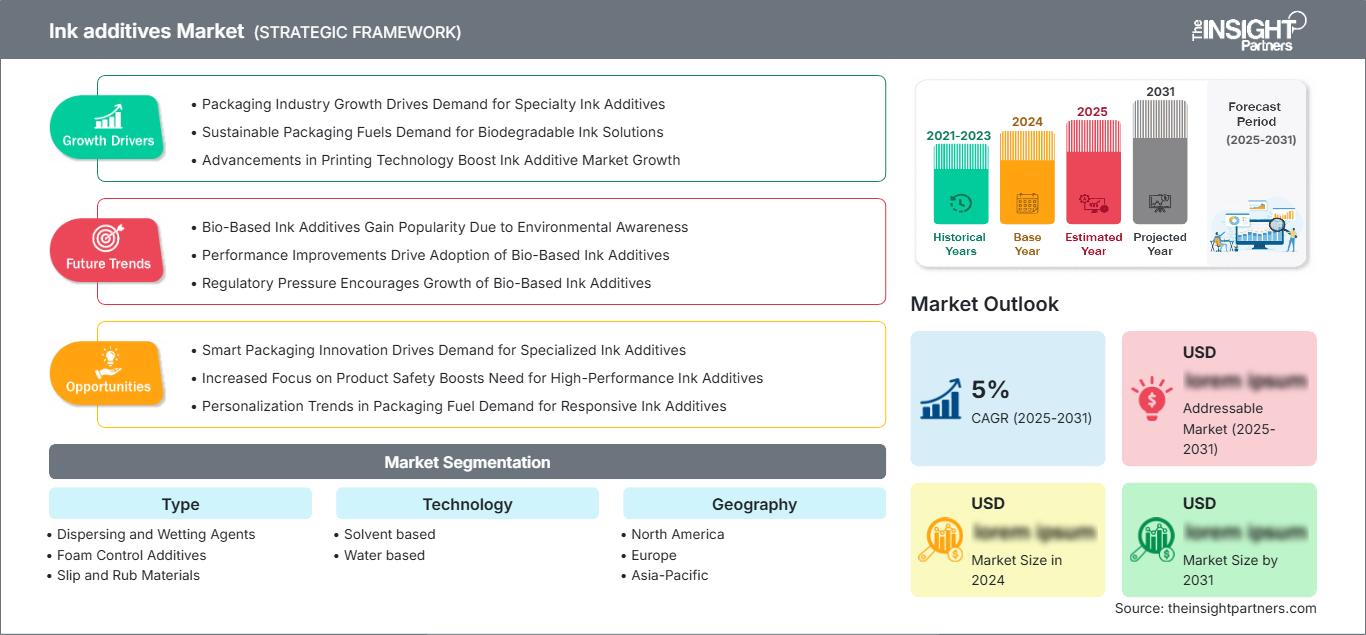
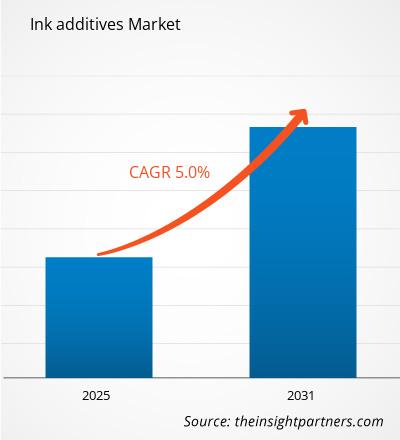
The global Ink additives market was valued at US$ 2.58 billion in 2025 and is expected to reach US$ 3.79 billion by 2034; it is estimated to record a CAGR of 4.37% during 2026-2034.
Ink additives Market Assessment and Insights
- North America: North America maintains a significant position, supported by advanced packaging converters and established specialty-chemical supply chains. Its 2025 share is estimated at 28–32%, with growth of 4.3–4.7% CAGR between 2026–2034.
- US: The US accounts for approximately 78–82% of North America's 2025 Ink Additives Market share, supported by packaging, labels, industrial printing, and digital-printing applications, expanding at 4.2–4.6% CAGR during 2026–2034.
- Europe: Europe represents an estimated 25–29% share in 2025, led by Germany, Italy, France, and the UK. Regulatory pressure on emissions and migration, together with specialty packaging demand, supports 4.5–4.9% CAGR during 2026–2034.
- Asia Pacific: Asia Pacific holds an estimated 30–34% share in 2025, led by China, Japan, India, South Korea, and Australia. Packaging production, manufacturing expansion, and water-based technology adoption support 5.3–5.7% CAGR during 2026–2034.
- Largest Segment: Dispersing and Wetting Agents represent the largest type segment, with an estimated 34–38% market share in 2025 and 5.2–5.6% CAGR during 2026–2034, reflecting their importance in pigment stabilization and color development.
- High Growth Segment: Water based technology is the high-growth segment, representing approximately 42–46% share in 2025 and expanding at 6.0–6.4% CAGR during 2026–2034, supported by low-VOC formulation requirements.
- Key companies analyzed in detail: ALTANA AG, BASF SE, Dow Inc., Elementis plc, Evonik Industries AG, Shamrock Technologies, Inc., MÜNZING CHEMIE GmbH, Solvay SA/NV, The Lubrizol Corporation, KEIM-ADDITEC Surface GmbH.
Source: The Insight Partners' analysis based on proprietary research, government publications, company annual reports, investor presentations, industry databases, and expert interviews.
The industry has moved beyond functional additives alone to multifunctional technologies that can control multiple formulation parameters at once. Dispersion and wetting technology is increasingly focused on pigment stabilization and color strength, while surface additives deal with slip, rub, leveling, and substrate interaction. Suppliers have also begun differentiating products based on solventborne, waterborne, UV cure, and digital printing needs, adding another layer of specialization to formulation.
The Ink Additives Market forecasts indicate that in the future, we expect suppliers to focus on low-VOC, low-migration, renewable feedstock, and regulation-ready technologies. Asia-Pacific will gain additional capacity and technology investment with increased packaging production, but North America and Europe will be centers for innovation. The need for low-VOC, food-contact, and substances of concern regulations will increasingly drive product decisions and the displacement of existing chemistries.
Ink additives Market Report Scope
| Report Attribute | Details |
|---|---|
| Market size in 2025 | US$ 2.58 Billion |
| Market Size by 2034 | US$ 3.79 Billion |
| Global CAGR (2026 - 2034) | 4.37% |
| Historical Data | 2021-2024 |
| Forecast period | 2026-2034 |
Ink additives Market Analysis
Demand is closely tied to the performance specifications associated with printing ink for flexible packaging, label, corrugated packaging, publication, industrial graphics, and specialties. Additives are the intermediaries in the value chain located between the producers of chemical raw materials and ink producers, offering components that affect pigment dispersion, viscosity, foam, surface properties, and durability. Therefore, chemical reliability and technical expertise in specific applications are essential.
The Ink Additives Market report indicates that supply conditions are driven by specialty chemicals production, raw material availability, production presence in certain regions, and formulation expertise. Since the usage of additives is usually quite low in terms of weight, customers focus on performance per weight, not the quantity alone. BASF, ALTANA, Dow, Elementis, Evonik, MÜNZING, and other companies offer various additive categories in their product lines, allowing customers to combine them in one portfolio.
The competitive environment involves global specialty-chemical suppliers together with additive companies. The ALTANA BYK business encompasses technologies of dispersing, wetting, defoaming, surface treatment, and rheology, while BASF offers formulation additives for printing and packaging processes. Dow contributes with silicone based technologies of dispersing, wetting, leveling, and foam control, while Elementis has been concentrating heavily on rheology control including organoclay technology for printing inks.
Competitive positioning becomes more and more dependent upon technical services, application laboratories, regulatory assistance, and formulating additives for particular printing systems. Evonik is concentrating on high purity siloxanes, MÜNZING concentrates on technologies of defoamers, dispersants, wetting agents, rheology modifiers, and waxes. Shamrock stands out with wax and PTFE based performance additives, while Lubrizol and KEIM ADDITEC focus on formulating technologies. Thus investments are made mainly in differentiated chemistry.
● REPORT CUSTOMIZATION
Tailor This Report To Align With Your Specific Business Requirements
This report can be customized to align precisely with your business objectives, scope, and target markets. Customization options include tailored segmentation, geography, competitive analysis, and strategic insights to support informed decision-making.
Customize This Report →WHAT YOU CAN ADJUST
- ● Segmentations
- ● Geography
- ● Competitive Analysis
- ● Language Preferences
Ink additives Market: Strategic Insights
Regional Insights
North America ink additives market
The North American region makes up an estimated share of 28-32% in 2025 and is projected to grow at a CAGR of 4.3-4.7% through 2034. The US market is leading in terms of regional consumption due to advanced flexible packaging, labeling, commercial printing, and industrial graphics. Presence of well-established converter networks leads to a growing need for additives that offer increased print efficiency, improved color stability, surface quality, and resistance.
The ink additives market trends indicate that regional adoption is also being driven by low-VOC content products and packaging functionality needs. Well-established technical-service networks of suppliers help in collaboration with ink formulators and converters. The Canadian market helps out with packaging and industrial applications, while Mexico provides additional demand from manufacturing and consumer goods packaging. North American consumers prefer multifunctional additives that make formulation easier without compromising performance.
U.S. ink additives Market
The US represents approximately 78–82% of North America's 2025 share and is projected to grow at 4.2–4.6% CAGR during 2026–2034. Demand is concentrated in flexible packaging, corrugated packaging, labels, commercial printing, and industrial graphics. Large chemical suppliers and specialist manufacturers maintain established customer relationships and application-support capabilities.
The use of aqueous and energy curing resins continues to offer advantages to the market, especially where the converters are looking for reductions in their emissions and better workplace environments. The development of digital printing has created new demands related to rheology control, jetting stability, wettability, and substrate interaction. Additives used in packaging converters need to provide properties of scuff-resistance, de-foaming and color.
Europe ink additives Market
Europe accounts for 25-29% of the share in 2025, growing at 4.5-4.9% CAGR. Germany emerges as the dominant country market owing to the presence of specialty chemicals, industrial printing, packaging manufacture, and formulation skills. UK, France, Italy, and Spain contribute to the demand by means of packaging, labels, commercial printing, and end use of consumer products.
In the UK market, flexible packaging and label printing become the focus with an increasing relevance of water-based and low-emission formulations. Germany draws advantage from its strong specialty chemicals industry as well as industrial printers base. France derives the benefit from the combination of food packaging and industrial applications, whereas Italy relies on its strong network in converting and packaging manufacturing. Spain derives benefit from food, beverages, and consumer goods packaging applications.
APAC ink additives Market
APAC holds approximately 30-34% market share in 2025 and is expected to grow at 5.3-5.7% CAGR to be the fastest-growing region. China dominates the market, followed by Japan, India, South Korea, and Australia. Additives' demand is driven by packaging production, consumer goods, electronics, and manufacturing industries.
China relies on strong printing and packaging industries, whereas India is developing flexible packaging and label printing industry. In Japan and South Korea, emphasis is placed on high-performance and precise uses, but Australia depends on packaging and specialty printing industries. Increasing environmental concerns, modern printing machinery, and growing waterborne systems should drive the demand for formulations additives in APAC.
Middle East & Africa ink additives Market
Middle East & Africa is expected to expand at approximately 4.0–4.4% CAGR during 2026–2034. Saudi Arabia and the UAE are important Middle Eastern markets because packaging investment accompanies industrial diversification and infrastructure development. South Africa leads regional African demand through established packaging, printing, and consumer-goods manufacturing capabilities.
Growth is supported by food and beverage packaging, construction-related printing, labels, and industrial applications. Saudi Arabia benefits from manufacturing diversification, while the UAE serves as a regional logistics and converting hub. South Africa remains comparatively mature. Rest of MEA contributes smaller but developing demand as local packaging capacity increases and import substitution initiatives encourage regional manufacturing.
Segmentation Analysis
Type
Type is expected to register a modelled 4.7–5.2% CAGR during 2026–2034. The Ink additives Market scope by type reflects the need to manage interactions among pigments, binders, carriers, substrates, and printing equipment. Formulators increasingly select multifunctional chemistry capable of delivering stable dispersion, controlled foam, surface durability, and predictable flow while satisfying environmental and food-packaging requirements.
- Dispersing and Wetting Agents: These additives are strategically important for pigment stabilization, viscosity control, color development, substrate wetting, and storage stability across aqueous, solventborne, UV-curable, and digital ink formulations.
- Foam Control Additives: Waterborne flexographic and overprint systems create significant defoaming requirements because persistent foam can interfere with production, ink transfer, surface quality, and high-speed printing consistency.
- Slip and Rub Materials: Wax and surface additives improve coefficient of friction, scratch resistance, anti-blocking, rub resistance, and handling performance, particularly across packaging, labels, and protective overprint applications.
- Rheology Modifiers: Rheological additives control viscosity, flow, leveling, suspension, and transfer characteristics, enabling formulators to adapt ink behavior to press architecture, printing speed, substrate characteristics, and application method.
Technology
Technology is projected to expand at a modelled 4.8–5.3% CAGR during 2026–2034. Additive requirements vary substantially by carrier chemistry. Environmental considerations favor aqueous and energy-curable technologies in suitable applications, although solvent systems retain important positions where drying performance, substrate adhesion, and process economics remain decisive.
- Solvent based: Solventborne systems remain important in flexible packaging and gravure applications where rapid drying, film formation, adhesion, and reliable performance on nonporous substrates are critical operational requirements.
- Water based: Waterborne formulations require sophisticated defoaming, wetting, dispersion, and rheology packages to overcome surface-tension and foam-management challenges while supporting lower-VOC printing strategies.
Process
Process is expected to register a modelled 4.9–5.4% CAGR during 2026–2034. Each printing technology imposes distinct viscosity, transfer, drying, surface, and dispersion requirements. Digital is gaining strategic importance, while flexographic and gravure processes continue to underpin high-volume packaging production.
- Lithographic: Lithographic printing sustains additive demand across publishing, cartons, commercial materials, and specialty applications requiring controlled ink-water balance, rub resistance, rheology, transfer, and surface characteristics.
- Gravure: Gravure remains relevant for long-run flexible packaging and decorative printing, creating requirements for dispersion stability, controlled viscosity, surface performance, adhesion, and reliable high-speed transfer.
- Flexographic: Flexography benefits from packaging and label applications, with waterborne systems increasing the importance of foam-control additives, pigment dispersants, wetting agents, and carefully engineered rheology.
- Digital: Digital printing is the high-growth process, benefiting from short runs, personalization and variable data while requiring tightly controlled dispersion, viscosity, surface tension, jetting reliability, and substrate interaction.
Application
Application is projected to expand at a modelled 4.8–5.3% CAGR during 2026–2034. Packaging provides the strongest structural demand because inks must withstand converting, transportation, filling, handling, and consumer use while satisfying increasingly complex food-contact, recycling, and sustainability requirements.
- Packaging: Flexible films, labels, folding cartons, corrugated boxes, and other printed packaging formats create broad demand for additives controlling dispersion, foam, friction, abrasion resistance, adhesion, and print quality.
- Publishing: Books, magazines, newspapers, and related printed media sustain specialized additive consumption, although digitization limits volume expansion compared with packaging and digitally enabled commercial applications.
- Commercial Printing: Marketing materials, transactional products, signage, brochures, and customized print applications support additive demand as printers pursue faster turnaround, shorter runs, consistent reproduction, and broader substrate compatibility.
Opportunity Snapshot
| Technology | Revenue Contribution | Trend Tag | Adoption Stage |
|---|---|---|---|
| Solvent based | High | Fast Drying | Mature |
| Water based | High | Low VOC | Scaling |
Ink additives Market Growth Drivers and Impact Analysis
Expansion of Flexible Packaging and High-Speed Printing
In the ink additives Market, Flexible packaging is increasing the technical burden placed on printing inks because converters must achieve consistent color, adhesion, rub resistance, gloss, and process stability on thin polymeric films. High-speed flexographic and gravure operations amplify the consequences of poor wetting, foam, viscosity drift, and pigment instability. Additives therefore provide a relatively efficient route for improving formulation performance without redesigning the entire ink system. Demand is particularly attractive for multifunctional products that combine wetting, leveling, slip, or defoaming properties. Suppliers capable of validating performance on polyethylene, polypropylene, polyester, paper, and coated substrates can address multiple packaging formats. The resulting value proposition is increasingly based on productivity, lower waste, reduced downtime, and consistent finished-print quality rather than additive consumption alone.
Regulatory Pressure for Lower-Emission and Safer Formulations
Environmental and packaging regulations in the ink additives Market are changing the technical specification of printing inks, especially where volatile organic compounds, migration, and substances of concern affect material selection. Formulators increasingly require additives compatible with waterborne, low-VOC, food-contact, and energy-curable systems while preserving print quality and processing speed. This transition creates opportunities for suppliers that can demonstrate regulatory status and formulation compatibility rather than merely offering conventional performance. The impact is strongest in Europe and North America but is increasingly relevant in Asia Pacific as export-oriented packaging manufacturers align products with international customer requirements. Regulatory pressure also encourages replacement of legacy additive chemistries and supports premium pricing for solutions that reduce reformulation risk. Product development is consequently shifting toward lower-emission technologies, cleaner raw materials, and improved compatibility with modern resin systems.
Growth of Digital and Functional Printing Applications
Digital printing introduces different formulation requirements from conventional flexographic, gravure, and offset systems because droplet formation, jetting behavior, viscosity, surface tension, drying, and substrate interaction must remain tightly controlled. Additives influence these variables while also supporting color density, adhesion, print durability, and nozzle reliability. Growth in digital packaging, industrial decoration, labels, and specialty graphics therefore expands demand for precisely engineered additive packages. Suppliers with strong formulation laboratories can capture value by tailoring chemistry to specific inkjet platforms and substrate combinations. The market impact extends beyond digital ink volumes because digital systems also require primers, overprint varnishes, and surface-treatment technologies. As printers pursue shorter runs, variable data, personalization, and reduced setup waste, additive suppliers can benefit from formulations designed around productivity and consistent digital-print quality.
Ink additives Market Future Trends
Shift Toward Multifunctional and Bio-Attributed Additives
Future product development is likely to favor multifunctional additives that address two or more formulation requirements while maintaining low dosage. This approach can reduce formulation complexity, simplify inventory management, and improve compatibility between additive packages. At the same time, bio-attributed and renewable-feedstock chemistry should gain attention as converters and brand owners pursue lower product carbon footprints. Suppliers will increasingly differentiate products through verified feedstock sourcing, mass-balance approaches, regulatory documentation, and lifecycle considerations. The most successful technologies will need to deliver environmental benefits without compromising pigment dispersion, foam control, surface performance, or print durability. This creates a technical challenge because renewable raw materials can alter molecular structure and compatibility. Consequently, future innovation will focus on maintaining predictable performance while progressively reducing the environmental burden of additive production and formulation.
Data-Driven Formulation and Application-Specific Additive Design
Digital formulation tools and laboratory automation are expected to change how additive systems are selected and optimized. Instead of relying exclusively on trial-and-error formulation, suppliers can increasingly correlate additive chemistry with substrate properties, resin architecture, pigment type, printing speed, drying conditions, and desired surface characteristics. This approach should accelerate customer trials and reduce the number of formulation iterations required before commercialization. Application-specific additive design will become particularly valuable for digital printing, flexible packaging, and specialty industrial inks, where narrow operating windows can create quality problems. Suppliers with application databases, predictive testing capabilities, and strong technical-service teams will gain an advantage. Over time, additive development should become more closely integrated with complete ink-system engineering, rather than treating additives as independent formulation components.
Ink additives Market Opportunities
Low-Migration Additives for Food and Pharmaceutical Packaging
Food and pharmaceutical packaging offers an attractive opportunity for suppliers capable of developing additive systems that combine performance with stringent migration and regulatory requirements. Customers increasingly need consistent print quality without compromising packaging safety or recyclability objectives. This creates room for specialty dispersants, defoamers, wetting agents, surface modifiers, and rheology technologies designed specifically for compliant formulations. Suppliers can strengthen their position by offering documentation packages, regional regulatory support, application testing, and compatibility guidance for different substrates and binders. Investment should prioritize chemistries that maintain low odor, low migration, and stable performance under demanding printing conditions. Partnerships with ink manufacturers and packaging converters can shorten qualification cycles and provide direct feedback on production requirements, creating defensible application-specific positions in higher-value additive niches.
Localized Technical Centers in High-Growth Asian Markets
Asia Pacific presents an opportunity to combine regional manufacturing with localized formulation support. China and India offer large packaging ecosystems, while Japan and South Korea provide technically demanding applications that can support premium additive development. Establishing application laboratories near major converting clusters can reduce customer qualification time and allow suppliers to tailor products to local substrates, pigments, binders, equipment, and regulatory requirements. Local technical centers can also improve supply resilience by supporting regional inventory decisions and faster troubleshooting. Investment priorities should include water-based formulation capabilities, digital-printing expertise, and testing for rub resistance, wetting, foam, viscosity, and substrate adhesion. Companies that combine local technical responsiveness with global quality standards can build stronger customer retention than suppliers competing primarily on price.
Recent Developments
- January 2026: Evonik Coating Additives introduced TEGOa Dispers 695, a novel hyperdispersant for radiation-curing inks and solventborne polyurethane inks.
- June 2026: Siegwerk, a global company in printing inks and coatings for packaging applications, announced the successful completion of its acquisition of Hi-Tech Inks, one of India’s leading manufacturers of flexographic and gravure printing inks.
Frequently Asked Questions

- Comprehensive Market Sizing and Forecast Analysis
- Detailed Segmentation Analysis
- In-Depth Market Dynamics Assessment
- Regional and Country-Level Insights
- Competitive Landscape and Company Benchmarking
- Strategic Business Intelligence
Recent Reports
Testimonials

The Insight Partners' SCADA System Market report is comprehensive, with valuable insights on current trends and future forecasts. The team was highly professional, responsive, and supportive throughout. We are very satisfied and highly recommend their services.
RAN KEDEM Partner, Reali Technologies LTDs
I requested a report on a very specific software market and the team produced the report in a few days. The information was very relevant and well presented. I then requested some changes and additions to the report. The team was again very responsive and I got the final report in less than a week.
JEAN-HERVE JENN Chairman, Future Analytica
We worked with The Insight Partners for an important market study and forecast. They gave us clear insights into opportunities and risks, which helped shape our plans. Their research was easy to use and based on solid data. It helped us make smart, confident decisions. We highly recommend them.
PIYUSH NAGPAL Sr. Vice President, High Beam Global
The Insight Partners delivered insightful, well-structured market research with strong domain expertise. Their team was professional and responsive throughout. The user-friendly website made accessing industry reports seamless. We highly recommend them for reliable, high-quality research services
YUKIHIKO ADACHI CEO, Deep Blue, LLC.
This is the first time I have purchased a market report from The Insight Partners.While I was unsure at first, I visited their web site and felt more comfortable to take the risk and purchase a market report.I am completely satisfied with the quality of the report and customer service. I had several questions and comments with the initial report, but after a couple of dialogs over email with their analyst I believe I have a report that I can use as input to our strategic planning process.Thank you so much for taking the extra time and making this a positive experience.I will definitely recommend your service to others and you will be my first call when we need further market data.
JOHN SUZUKI President and Chief Executive Officer, Board Director, BK Technologies
I wish to appreciate your support and the professionalism you displayed in the course of attending to my request for information regarding to infectious disease IVD market in Nigeria. I appreciate your patience, your guidance, and the fact that you were willing to offer a discount, which eventually made it possible for us to close a deal. I look forward to engaging The Insight Partners in the future, all thanks to the impression you have created in me as a result of this first encounter.
DR CHIJIOKE ONYIA MANAGING DIRECTOR, PineCrest Healthcare Ltd.Reason to Buy
- Informed Decision-Making
- Understanding Market Dynamics
- Competitive Analysis
- Identifying Emerging Markets
- Customer Insights
- Market Forecasts
- Risk Mitigation
- Boosting Operational Efficiency
- Strategic Planning
- Investment Justification
- Tracking Industry Innovations
- Aligning with Regulatory Trends





 Get Free Sample for