Intelligent Irrigation Systems Market Size & Overview
The Intelligent Irrigation Systems Market was valued at US$ 2.54 Billion in 2025 and is projected to reach US$ 7.69 Billion by 2034, expanding at a CAGR of 13.10% during 2026–2034. In adoption, the move is from timer-controlled water application to connected systems, automatic scheduling, and field-level sensors that enable measurable water productivity, visibility, and robustness of decisions regarding irrigation.
The Intelligent Irrigation Systems Market Size in North America will be driven by the market growth forecasted at a Compound Annual Growth Rate (CAGR) of 11.8-12.8% to reach 2034. Agriculture in western parts suffering water stress and urban municipalities' rules on efficient landscape water usage drive the need for replacement, coupled with certification for weather-based and soil moisture controllers, which instills greater confidence in buyers.
Growth in Intelligent Irrigation Systems Market relies on the economic factors related to water, energy, labor, and crop protection. Seventy-two percent of the fresh water use comes from the agriculture industry, whereas 1.2 billion people live in agricultural zones with severe water shortages. Such conditions stimulate farmers to implement precise scheduling, water management, and automatic fertilization irrigation. Outdoor water use and overwatering in the urban environment result in a similar replacement cycle. The ecosystem includes sensor suppliers, controllers' companies, meteorological data providers, hydraulic system suppliers, installers, agronomists, utilities, and end users. The hardware market relies on semiconductors, communications modules, protective cases, valves, and probes. The software layer provides the forecasting, alerts, dashboards, and portfolio management capabilities. Partnerships are still important as calibration, hydraulic engineering, communication abilities, and maintenance determine the success of algorithms in the field.
Intelligent Irrigation Systems Market Report shows that this market is quite competitive and segmented into irrigation system companies that offer their full-line products, commercial irrigation water management companies, and cloud-based residential irrigation systems vendors. Rain Bird Corporation, Hunter Industries Incorporated, The Toro Company, and Netafim Ltd capitalize on extensive distribution networks and diverse product portfolio. HydroPoint Data Systems, Inc., Calsense, Baseline, Inc., and Weathermatic concentrate on control at multiple sites, flow intelligence and water budget compliance. Positioning is highly dependent on recurring software revenues, retrofit capability, and unique sensors. Rachio, Inc. provides better consumer connection, while Jain Irrigation Systems Limited combines accurate control with micro-irrigation technologies. The top investments are cellular gateways, sensing of plant response, anomaly detection and open systems architecture. Providers that combine advanced hardware with substantial water savings and reponsive support proviort could maintain margins amid controller commodification and erratic farm procurement cycles.
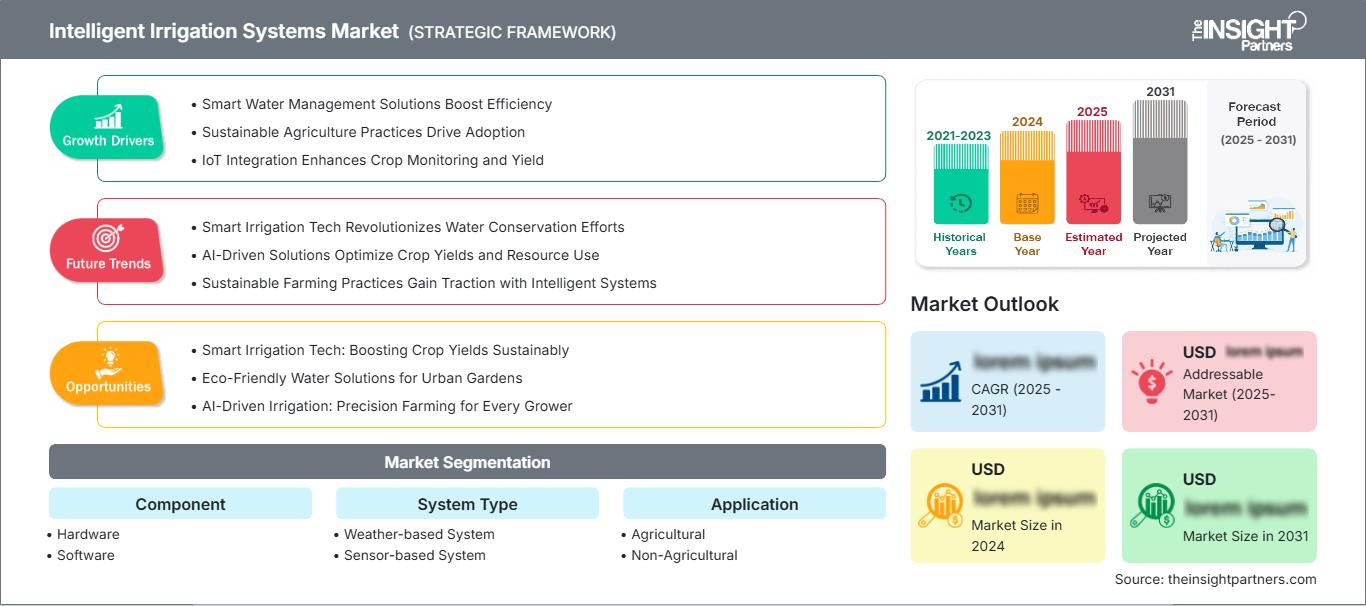
Intelligent Irrigation Systems Market Assessment and Insights
- North America: Accounted for 33–36% share in 2025 and is expected to grow at an 11.8–12.8% CAGR during 2026–2034, supported by drought exposure, retrofit economics, utility rebates, and mature professional irrigation channels.
- US: Represented 77–81% of North American revenue in 2025 and is projected to expand at an 11.5–12.5% CAGR during 2026–2034.
- Europe: Held 24–27% share in 2025 and is forecast to grow at a 12.0–13.0% CAGR during 2026–2034, led by Spain, Italy, France, Germany, and the UK.
- Asia Pacific: Captured 27–30% share in 2025 and is expected to record a 15.0–16.0% CAGR during 2026–2034, with China, India, Japan, South Korea, and Australia shaping demand.
- Largest Segment: Hardware held a 61–65% market share in 2025 and is projected to grow at an 11.8–12.8% CAGR during 2026–2034.
- High Growth Segment: Software represented 35–39% market share in 2025 and is expected to expand at a 15.0–16.0% CAGR during 2026–2034.
- Key companies analyzed in detail: Baseline, Inc.; Calsense; Jain Irrigation Systems Limited; Hunter Industries Incorporated; HydroPoint Data Systems, Inc.; Netafim Ltd.; Rachio, Inc.; Rain Bird Corporation; The Toro Company; Weathermatic.
Source: The Insight Partners' analysis based on proprietary research, government publications, company annual reports, investor presentations, industry databases, and expert interviews.
Intelligent Irrigation Systems Market Trends
Plant-Response Intelligence Moves Beyond Soil-Only Measurement
Intelligent Irrigation Systems Market trends will increasingly incorporate direct plant-response data alongside soil moisture and weather forecasts. Sensors that observe crop water status can reveal stress before generalized models detect it, particularly in orchards, vineyards, and protected cultivation. Platforms will fuse plant, soil, hydraulic, and forecast signals to recommend zone-specific irrigation and fertigation. This transition should improve confidence in automation because users can compare predicted need with biological response. Commercial success will depend on affordable sensors, crop-specific calibration, and decision interfaces that translate complex measurements into clear actions. Vendors will also need validation across varieties, growth stages, climates, and irrigation methods before autonomous closed-loop control becomes mainstream.
Edge Automation and Interoperable Irrigation Ecosystems
Future systems will distribute intelligence between cloud platforms and field gateways. Edge processing allows irrigation to continue during connectivity interruptions, evaluates sensor thresholds locally, and responds rapidly to leaks or pressure anomalies. Open interfaces will become more important as operators connect legacy controllers, pumps, valves, weather services, farm-management software, and utility reporting systems. Interoperability can reduce vendor lock-in and expand retrofit markets, but it also increases cybersecurity and data-governance requirements. Device authentication, encrypted communications, role-based access, and update management will become procurement criteria. Suppliers that publish reliable integration tools while protecting safety-critical commands should gain influence with large farms, municipalities, campuses, and contractors managing diverse equipment estates.
Intelligent Irrigation Systems Market Growth Factors
Escalating Water Scarcity and Irrigation Productivity Requirements
Agriculture accounts for 72% of global freshwater withdrawals, and 1.2 billion people live in agricultural areas facing severe water constraints. The operational implication is direct: farms must produce more output per unit of applied water while protecting yield from uneven rainfall. Intelligent controllers combine weather, soil, flow, and crop-stage signals to shorten unnecessary runtime and identify abnormal consumption. Impact is strongest in orchards, vineyards, greenhouses, and irrigated field crops, where missed watering can damage high-value output. Adoption also improves pumping-energy management and supports documented water allocations. However, technology must be paired with hydraulic maintenance, irrigation design, and operator training because scheduling intelligence cannot compensate for blocked emitters, pressure imbalance, or poorly zoned fields.
Regulation, Certification, and Utility Incentives for Efficient Landscapes
Public policy increasingly turns water efficiency into a procurement criterion rather than a voluntary feature. US EPA WaterSense states that residential outdoor use approaches eight billion gallons daily and that up to 50% may be wasted through inefficient irrigation. Its labeled controllers independently demonstrate performance, giving utilities a consistent basis for rebates and property owners a lower-risk retrofit choice. In Europe, reclaimed-water rules require quality monitoring, permitting, transparency, and risk management for agricultural irrigation. These frameworks favor platforms that record schedules, flow, alarms, and consumption. Market impact extends beyond equipment sales: contractors gain retrofit work, software providers gain reporting demand, and municipalities can compare water budgets across portfolios. Vendors lacking certification, audit trails, or secure data handling face longer qualification cycles.
Cloud Connectivity and Lifecycle Economics of Retrofit Platforms
Connected irrigation changes purchasing from a one-time controller decision into a lifecycle operating model. Mobile access, remote diagnostics, weather feeds, sensor histories, and automated alerts reduce site visits while improving response to leaks or failed zones. Retrofit modules are particularly influential because owners can preserve valves, wiring, pumps, and distribution networks while adding communications and analytics. That lowers capital barriers for homes, campuses, municipalities, and farms with mixed-age assets. Cloud platforms also support recurring service revenue, device-health monitoring, and multi-site benchmarking, strengthening supplier relationships after installation. Field reliability remains decisive: intermittent connectivity, weak power, sensor drift, and incompatible protocols can erode savings. Successful platforms therefore combine offline control, scalable gateways, technician tools, and clear ownership of operational data.
Intelligent Irrigation Systems Market Opportunities
Affordable Digital Irrigation for Small and Midsized Farms
Smallholders and midsized farms remain underserved because enterprise-grade automation can exceed their budgets, technical capacity, or connectivity. Vendors can address this gap with modular controllers, built-in cellular communications, simplified installation, and subscription tiers linked to farm size. Partnerships with micro-irrigation dealers, cooperatives, lenders, and agronomy advisers can lower acquisition costs and provide local support. Investment should prioritize reliable core functions such as scheduling, alerts, and fertigation before advanced analytics. Pay-as-you-grow configurations can help customers begin with a few zones and add sensors later. The opportunity is strongest in horticulture, coffee, cocoa, orchards, and greenhouses, where crop value supports measurable returns from reduced labor, controlled inputs, and fewer irrigation errors.
Reclaimed-Water and Municipal Portfolio Management
Reclaimed-water expansion in the Intelligent Irrigation Systems Market Forecast creates an investment opportunity for control platforms that combine irrigation scheduling with water-quality, allocation, and compliance data. European technical assessments indicate that reuse could cover 10% of agricultural water needs, while current treated municipal wastewater reuse is well below potential. Vendors can develop integrations for treatment operators, irrigation districts, farms, and municipal landscapes, enabling users to verify source, volume, timing, and system condition. Multi-site dashboards are equally relevant for schools, parks, road medians, hotels, and public campuses. Winning solutions should support permissions, audit logs, flow anomalies, and water budgets. Partnerships with engineering firms and utilities can embed intelligent control into infrastructure upgrades rather than selling it as isolated landscape equipment.
Segmentation Analysis
Component
The Intelligent Irrigation Systems Market scope by component covers hardware and software, with the main segment projected to expand at a 13.0–14.0% CAGR during 2026–2034. Hardware anchors field execution through controllers, sensors, meters, gateways, and valves, while software converts weather, soil, flow, and asset data into schedules and alerts. Purchasing is shifting toward integrated packages, but open interfaces remain important for retrofit projects and mixed-vendor estates.
- Hardware: Hardware remains the largest revenue contributor because every deployment requires durable field devices. Demand centers on upgradeable controllers, moisture sensors, weather stations, flow meters, communications modules, and remotely actuated valves.
- Software: Software is strategically important for recurring revenue and fleet management. Cloud dashboards, mobile control, anomaly detection, reporting, and application programming interfaces help operators manage dispersed sites and verify water outcomes.
System Type
System type is expected to grow at a 12.8–13.8% CAGR during 2026–2034 as users select between weather-based scheduling and direct soil-response control. Weather-based systems offer simpler, broad-area deployment using evapotranspiration and forecast inputs. Sensor-based systems provide localized evidence where soil, crop, slope, shade, or microclimate variability matters. Hybrid architectures are increasingly preferred because they cross-check forecast assumptions against measured field conditions and flow behavior.
- Weather-based System: Weather-based systems suit residential, commercial, and geographically distributed portfolios. They adjust runtimes using local climate inputs, reduce unnecessary watering, and simplify deployment where installing multiple in-ground probes is impractical.
- Sensor-based System: Sensor-based systems are important in high-value crops and variable soils. Direct moisture or plant-response measurements improve zone decisions, irrigation timing, and exception handling when generalized weather data cannot reflect local conditions.
Application
Application segmentation is projected to register a 13.2–14.2% CAGR during 2026–2034. Agricultural deployments prioritize yield stability, fertigation precision, pumping costs, and labor reduction across fields, orchards, vineyards, and greenhouses. Non-agricultural users emphasize water budgets, landscape quality, compliance, and centralized maintenance. Both applications increasingly require auditable consumption data, but purchasing cycles differ: farms align investment with crop economics, whereas institutions often procure through capital plans and service contracts.
- Agricultural: Agricultural demand is driven by water stress, high-value crop economics, and labor scarcity. Integrated irrigation and fertigation platforms gain importance where yield, nutrient delivery, and energy consumption must be managed together.
- Non-Agricultural: Non-agricultural demand spans homes, municipalities, campuses, hotels, sports facilities, and golf courses. Portfolio-level monitoring, leak detection, weather responsiveness, and utility rebate eligibility shape purchasing and replacement decisions.
Opportunity Snapshot
| Application | Revenue Contribution | Trend Tag | Adoption Stage |
| Agricultural | High | Precision Fertigation | Scaling |
| Non-Agricultural | Medium | Portfolio Control | Mature |
Regional Insights
North America Intelligent Irrigation Systems Market
North America held 33–36% Intelligent Irrigation Systems Market share in 2025 and is estimated to expand at an 11.8–12.8% CAGR during 2026–2034. The US Department of Agriculture reports 54.9 million irrigated acres in 2022, while irrigated farms generated more than half of crop sales from less than 17% of harvested cropland. This concentration supports spending on yield protection, pumping efficiency, and remote scheduling.
The urban and business landscape provides the second engine for demand. According to EPA WaterSense figures, swapping out regular timers for WaterSense controllers could save an American household 15,000 gallons per year on average. Utilities provide rebates, drought laws, and access to professional contractors, and Canada makes contributions by means of greenhouse horticulture, water conservation efforts in municipalities, and smart agriculture.
U.S. Intelligent Irrigation Systems Market
The United States is made up of 77%-81% of North American market in 2025 and grows by 11.5%-12.5% annually from 2026 to 2034. Irrigation accounts for 47% of fresh water used by the nation from 2010 to 2020. California and Nebraska each have around eight million acres under irrigation in 2022, which requires moisture, center pivot, and flow measurement.
The application also grows in residences, educational institutions, hotels, business premises, park facilities, and golf courses. Rain Bird Corporation, Hunter Industries Incorporated, The Toro Company, HydroPoint Data Systems, Inc., Calsense, Baseline, Inc., Rachio, Inc., and Weathermatic hold notable market positions through their products or distribution channels. Consumers are inclined toward WaterSense-certified weather and soil-moisture controllers, portfolio dashboards, leak alerts, and retrofit components due to lower installation cost and water conservation results.
Europe Intelligent Irrigation Systems Market
Share of Europe was 24–27% in 2025, and growth is estimated to occur at a CAGR of 12.0–13.0% through 2026–2034. Spain is at the forefront of the region’s use of precision agriculture technology, since irrigated horticulture, drought conditions, and accounting for water resources make precision scheduling essential. Italy and France utilize vineyards, orchards, greenhouse and nursery production, and urban landscaping that will benefit from soil moisture measurement, flow control, and local weather conditions.
Both Germany and the UK have focused on sports field maintenance, colleges, public parks, and green houses, and users favor compatibility, monitoring, and efficiency. Regulation (EU) 2020/741 provides specifications about water quality, monitoring, authorization, transparency, and risk management in the use of reclaimed water in agricultural irrigation. One billion cubic meters of sewage treatment facilities are being recycled each year in Europe, while technical calculations show that six times more can be recycled.
APAC Intelligent Irrigation Systems Market
The market share for the Asia Pacific region stood at 27-30% in 2025 and is expected to register a CAGR of 15.0-16.0% from 2026 to 2034. China dominates with agricultural mechanization, whereas India stands out with its dependency on irrigation combined with increasing adoption of micro-irrigation solutions and mobile-based farming services.
Japan and South Korea have the ability to automate and offer protected horticulture. In this area, fragmented farmers tend to like modular control systems and sensors that use cellular communications. The need for food security, water table pressure, and climate change will mean that the investment in projects combining pumps, valves, and weather will be guaranteed.
Middle East & Africa Intelligent Irrigation Systems Market
Middle East & Africa (MEA) will grow with a CAGR between 13.5% and 14.5% from 2026 to 2034. Saudi Arabia is leading by managing water scarcity, protecting agriculture, and undertaking huge urban landscape construction projects. UAE encourages indoor agriculture farming and smart public areas in which desalination prices make conservation economics.
Commercial fruit, wine, and agricultural produce will find a market in South Africa, while the Rest of MEA needs infrastructure development. Solar pumps, cellular gateways, and advanced sensors can address problems of bad connections and networks. This depends on financing, installation expertise, availability of spare parts, and suitability to drip irrigation systems alone.
Intelligent Irrigation Systems Market Report Scope
| Report Attribute | Details |
|---|---|
| Market size in 2025 | US$ 2.54 Billion |
| Market Size by 2034 | US$ 7.69 Billion |
| Global CAGR (2026 - 2034) | 13.10% |
| Historical Data | 2021-2024 |
| Forecast period | 2026-2034 |
| Segments Covered | Component, System Type, Application |
| Region scope | North America, Europe, Asia-Pacific, South and Central America, Middle East and Africa |
Recent Developments
- August 2026: Netafim Ltd launched GrowSphere FLEX, a connected irrigation and fertigation controller aimed at smallholders and midsized farmers. The system combines built-in cellular connectivity, remote management, sensor monitoring, reports, alerts, and crop-stage recommendations, extending digital automation toward farms that have historically faced cost, infrastructure, and complexity barriers.
- October 2025: Rain Bird Corporation acquired Rachio, Inc., adding a cloud-connected residential controller business, smart hose-end timer, and adjacent smart-home capabilities. Rachio continues as a wholly owned subsidiary, while the transaction broadens Rain Bird's consumer technology portfolio and creates product-development and channel opportunities across connected, water-efficient outdoor management.
- April 2025: Netafim Ltd partnered with Treetoscope to integrate direct plant-sensing technology into the GrowSphere digital farming platform. The collaboration gives orchard and tree-crop growers real-time plant water-status information and automated recommendations, complementing existing irrigation and fertigation management with biological measurements that can improve timing, resource efficiency, and crop performance.
Frequently Asked Questions

Recent Reports






