
Internet of Things (IoT) in Consumer Electronics Market Size, Share & Growth by 2034
Coverage: By Product (Smart TV, Smart Phones, Kitchen Appliances, Laptops, Wearable Devices, Others); Connectivity (NFC, Bluetooth, Wi-Fi, Zigbee, Z-Wave, Others) , and Geography (North America, Europe, Asia Pacific, and South and Central America)
- Status : Data Released
- Report Code : TIPRE00003025
- Category : Electronics and Semiconductor
- No. of Pages : 150
- Available Report Formats :


- Last update date : September 21, 2026


2025 Market Size
US$ 10.5 Bn
Base year value
2034 Forecast
US$ 64.53 Bn
Projected by 2034
CAGR 2026-2034
22.35 %
Growth rate
Addressable Market
US$ 295.66 Bn
(2026-2034)
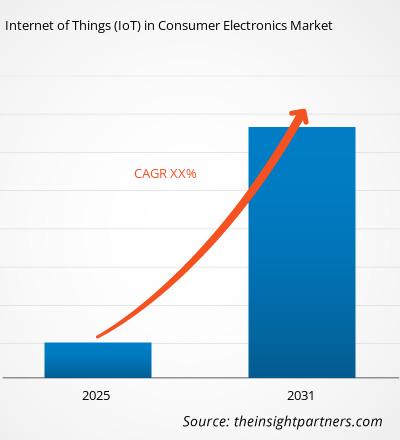
The Internet of Things in Consumer Electronics Market stood at US$ 10.5 Billion in 2025 and is projected to reach US$ 64.53 Billion by 2034, registering a CAGR of 22.35% during 2026–2034. The market reflects the convergence of connected consumer devices, wireless communication, cloud platforms, edge computing, and intelligent software. Increasing device interoperability and embedded intelligence are reshaping product development, while connected ecosystems increasingly influence purchasing, service, and lifecycle management decisions.
North America remains a strategically important market, supported by high household connectivity, established cloud infrastructure, and strong adoption of connected televisions, smartphones, appliances, and wearables. The regional market is expected to expand at approximately 19–22% CAGR between 2026 and 2034. Rising investments in edge AI, Matter-compatible ecosystems, and device security are strengthening the Internet of Things in Consumer Electronics Market size across the region.
Internet of Things (IoT) in Consumer Electronics Market Assessment and Insights
- North America: North America is estimated to represent a 27–31% share in 2025 and is projected to grow at a 19–22% CAGR between 2026–2034, supported by mature smart-home ecosystems, cloud infrastructure, and high connected-device penetration.
- US: The US is estimated to account for 82–86% of North America's 2025 market and is expected to expand at a 19–22% CAGR between 2026–2034, led by smart-home platforms and connected entertainment.
- Europe: Europe is estimated to hold a 22–26% share in 2025 and is expected to grow at a 18–21% CAGR between 2026–2034, with Germany, the UK, France, Italy, and Spain supporting adoption through smart-home integration and digitalization.
- Asia Pacific: Asia Pacific is estimated to account for a 31–35% share in 2025 and is projected to grow at a 24–27% CAGR between 2026–2034, led by China, Japan, South Korea, and India through electronics manufacturing and connected-device adoption.
- Largest Segment: Smart Phones are estimated to hold a 31–35% market share in 2025 and grow at a 21–24% CAGR between 2026–2034, reflecting their central role in connected ecosystems.
- High Growth Segment: Wearable Devices are estimated to hold a 14–18% market share in 2025 and grow at a 25–28% CAGR between 2026–2034, driven by health, fitness, and personalized digital services.
- Key companies analyzed in detail: Amazon Web Services, Inc., Apple Inc., Arm Holdings plc, Cisco Systems, Inc., Hewlett Packard Enterprise Company, International Business Machines Corporation, Intel Corporation, Qualcomm Technologies, Inc., STMicroelectronics N.V., Texas Instruments Incorporated.
Source: The Insight Partners' analysis based on proprietary research, government publications, company annual reports, investor presentations, industry databases, and expert interviews.
The Internet of Things in Consumer Electronics Market has progressed from internet-enabled devices to devices that are able to detect, communicate, process, and respond to context-based input. Devices such as smartphones are becoming more control interface-driven, whereas televisions, appliances, and wearable devices are incorporating voice, vision, location, and behavior technology. The advancement in semiconductor technology, lower-power wireless devices, embedded operating systems, and cloud computing has lowered the technical constraints on consumer devices manufacturers. Qualcomm’s 2025 Smart Home strategy provides an example of this shift towards edge AI and intelligent interactions.
Future growth is seen in the expansion from device connectivity to a continuous digital ecosystem covering homes, devices, and services. Money is being invested in interoperability, cybersecurity, edge inference, and device lifecycle management. Regulations on privacy and cybersecurity will affect architecture designs, especially in the case of connected devices that generate behavioral or household data. The new manufacturing centers of Asia are well-placed to capitalize on this development.
Internet of Things (IoT) in Consumer Electronics Market Report Scope
| Report Attribute | Details |
|---|---|
| Market size in 2025 | US$ 10.5 Billion |
| Market Size by 2034 | US$ 64.53 Billion |
| Global CAGR (2026 - 2034) | 22.35% |
| Historical Data | 2021-2024 |
| Forecast period | 2026-2034 |
Internet of Things (IoT) in Consumer Electronics Market Analysis
Consumer demand will be driven by consumer preferences for convenience, customization, control from distance, and integration. Internet of Things in Consumer Electronics Market growth will be thus tied to ecosystems based on smartphones, smart homes, wearables, and connected entertainment solutions. The supply chain will span semiconductor and sensors producers, connectivity providers, device manufacturers, operating systems developers, cloud platforms, resellers, and after sales support companies. The supply side trend will be toward producers capable of hardware-software-connectivity-security integration in ever shorter product development cycles.
Device producers are moving beyond the stand-alone products to build digital relationships. Connected TVs can provide content customization options, appliances can provide remote diagnostics, and wearables can provide continuous streams of data that can be used by various applications and services. Cloud infrastructures will help manage connected devices, and edge processing will ensure minimal latency and necessary data transfer. AWS will help with device onboarding, fleet management, monitoring, analytics, and secure device lifecycle management operations.
Positioning is increasingly becoming driven by ecosystem reach instead of merely the specifications of the hardware. In the Internet of Things in Consumer Electronics Market report, it is stated that Apple Inc. prioritizes hardware integration, software (OS), privacy, and compatibility with smart homes while Amazon Web Services, Inc. offers cloud services and device management services. Edge Computing & Connectivity are the priorities of Qualcomm Technologies, Inc. while processor, embedded solutions, and semiconductors come from Intel Corporation, Arm Holdings plc, STMicroelectronics N.V., and Texas Instruments Incorporated.
Strategic investments are targeting AI acceleration, wireless technologies, security, and developers' enablement. Infrastructure capabilities that will facilitate connected devices are offered by Cisco Systems, Inc. and Hewlett Packard Enterprise Company, while International Business Machines Corporation provides analytics and enterprise AI capabilities. Acquisition of Edge Impulse by Qualcomm Technologies, Inc. for 2025 shows the importance of the embedded AI development, as noted by the company that has more than 170,000 developers on its platform.
● REPORT CUSTOMIZATION
Tailor This Report To Align With Your Specific Business Requirements
This report can be customized to align precisely with your business objectives, scope, and target markets. Customization options include tailored segmentation, geography, competitive analysis, and strategic insights to support informed decision-making.
Customize This Report →WHAT YOU CAN ADJUST
- ● Segmentations
- ● Geography
- ● Competitive Analysis
- ● Language Preferences
Internet of Things (IoT) in Consumer Electronics Market: Strategic Insights

Regional Insights
North America Internet of Things in Consumer Electronics Market
The North America market is anticipated to have a 27–31% Internet of Things in Consumer Electronics Market share in 2025 and a CAGR of 19–22% up until 2034. The United States leads in terms of demand due to connected televisions, smartphones, appliances, speakers, security devices, and wearables being used in a highly developed digital environment. High availability of broadband services, usage of the cloud, and developed platforms enable fast commercialization. Customers increasingly desire products that can interact with each other, rather than standalone devices, thus increasing demand for connectivity.
Canada adds to the growth with deployments of connected homes, development of digital infrastructure, and rising use of smart appliances and home entertainment systems. Regional companies focus on such features as privacy, cybersecurity, and processing locally due to the increasing amount of personal information collected by connected products. Matter protocol compatibility within the Apple ecosystem ensures further interoperability across participating platforms. North America Internet of Things in Consumer Electronics Market share is driven by developer communities and innovation in semiconductors.
U.S. Internet of Things in Consumer Electronics Market
The US constitutes about 82-86% of North America's 2025 market and is expected to register a 19-22% CAGR up until 2034. This is thanks to the dominant presence of Apple Inc., Amazon Web Services, Inc., Cisco Systems, Inc., Intel Corporation, and Qualcomm Technologies, Inc., which has created an expansive ecosystem of devices, cloud platforms, processors, and connectivity solutions. Applications for smart TVs, smartphones, connected devices, and wearables continue to be critical, as more people are using smartphones as universal controls.
Consumers can benefit from advanced retail channels and quick adaptation of emerging consumer technologies. Smart home platforms are trending towards interoperable architecture, and edge AI is allowing for quicker local processing of voice-based, image-based, and contextual applications. The importance of AI-enabled televisions and appliances in building next-generation smart homes has been emphasized by Qualcomm Technologies, Inc. Thus, the Internet of Things in Consumer Electronics Market in the US is evolving from a connectivity-led market to an intelligence-led one.
Europe Internet of Things in Consumer Electronics Market
The estimated 2025 market share and growth CAGR through 2034 for Europe is 22-26% and 18-21%, respectively. Key countries driving the demand include the UK, Germany, France, Italy, and Spain, where Germany stands out as the largest market. Adoption in Europe is driven by the need for energy efficiency, expectations of privacy, cybersecurity standards, and consumer interest in digital services. Connected entertainment devices and smart appliances continue to be key areas of business opportunity.
The key drivers of the UK market include existing smart home usage, connected entertainment, and developed digital sales channels. Germany focuses on energy efficient appliances, good industrial design, and privacy-aware connected devices. The French market is fueled by smart home services and connected consumer platforms, while Italy and Spain benefit from adoption through smart appliances, connected entertainment, and hospitality technology spin-offs. Across Europe, data interoperability and management continues to play a critical purchasing role.
APAC Internet of Things in Consumer Electronics Market
The Asia Pacific region is expected to account for 31–35% of the market by 2025 and is anticipated to grow at a CAGR of 24–27% until 2034. Leading the regional demand are China, Japan, South Korea, India, and Australia. Presence of electronics manufacturing infrastructure, consumer base, investments in semiconductors, and smartphone usage helps in quick implementation of connected solutions.
China enjoys advantages of electronics manufacturing and adoption of smart homes, whereas Japan and South Korea have focuses on advanced appliances, television, and wearables. India offers long-term growth opportunities via digital infrastructure developments and electronics manufacturing. Australia contributes through connected home and energy management applications. Support from policies towards digitalization and electronics manufacturing aids the outlook of the regional Internet of Things in Consumer Electronics Market.
Middle East & Africa Internet of Things in Consumer Electronics Market
MEA and Africa markets will experience 17-20% growth CAGR through 2034. The leader within the region in terms of demand will be Saudi Arabia due to the implementation of the smart cities approach along with digital infrastructure and connected residential buildings. It will be followed by the UAE owing to technological approach of urban development and adoption of premium consumer electronics and South Africa acting as an important gate for the commercialization of connected devices in Africa.
Use cases such as energy management, security, entertainment, and smart home will play important role in the region. Digital transformation policy in Saudi Arabia and smart city programs in the UAE are driving factors of the demand of connected devices whereas telecommunications infrastructure in South Africa is allowing more devices usage. Rest of MEA will demonstrate fragmentation in terms of affordability, connectivity availability, and infrastructure issues.
Segmentation Analysis
Product
Product represents the core demand dimension because connectivity is increasingly embedded directly into consumer electronics. The segment is projected to expand at a 22–25% CAGR during 2026–2034. Device manufacturers are adding sensors, wireless interfaces, embedded processors, and software capabilities to differentiate products, while platform interoperability increases the strategic value of ecosystem-compatible hardware. The broad Internet of Things in Consumer Electronics Market scope is therefore expanding from individual connected products toward coordinated device portfolios.
- Smart TV: Smart TVs remain a major connected entertainment category, combining internet access, application ecosystems, voice interfaces, content personalization, and integration with other household devices.
- Smart Phones: Smartphones function as primary connectivity hubs, supporting device control, authentication, mobile applications, location services, and interaction with broader consumer IoT ecosystems.
- Kitchen Appliances: Connected refrigerators, ovens, washing machines, and other appliances use remote monitoring, diagnostics, automation, and voice interaction to improve convenience and operational efficiency.
- Laptops: Connected laptops increasingly integrate cloud services, wireless peripherals, AI processing, and cross-device synchronization, strengthening their role within personal digital ecosystems.
- Wearable Devices: Wearables connect continuously with smartphones and cloud platforms, enabling personalized applications across fitness, wellness, communications, payments, and contextual digital experiences.
Connectivity
Connectivity is projected to grow at a 23–26% CAGR during 2026–2034 as consumer products require reliable, low-power, interoperable communications. The segment's trajectory is supported by Wi-Fi evolution, Bluetooth improvements, and growing use of standardized smart-home protocols. Connectivity selection increasingly depends on power consumption, range, latency, security, interoperability, and deployment environment rather than bandwidth alone.
- NFC: NFC supports short-range interactions such as pairing, authentication, payments, and device configuration, providing a low-friction connectivity mechanism for smartphones and wearable products.
- Bluetooth: Bluetooth remains strategically important for personal devices, peripherals, wearables, audio products, and short-range smart-home applications requiring efficient wireless communication.
- Wi-Fi: Wi-Fi supports high-bandwidth consumer products including televisions, appliances, laptops, and home hubs, with newer generations improving throughput, latency, and multi-device performance.
- Zigbee: Zigbee remains relevant for low-power smart-home devices where mesh networking, interoperability, and efficient device-to-device communication are important.
- Z-Wave: Z-Wave serves smart-home applications requiring reliable low-power mesh communication, particularly for security, automation, sensors, and residential control systems.
Opportunity Snapshot
| End-user | Revenue Contribution (High/Medium/Low) | Trend Tag | Adoption Stage |
| Education | Medium | Smart Learning | Scaling |
| Retail | Medium | Connected Retail | Scaling |
| Hospitality | Medium | Guest Automation | Scaling |
| Enterprises | High | Workplace IoT | Mature |
| Transportation | Medium | Mobility Tech | Scaling |
Internet of Things (IoT) in Consumer Electronics Market Growth Drivers and Impact Analysis
Expansion of AI-enabled connected devices
Artificial intelligence is increasing the functional value of connected consumer electronics by enabling devices to interpret speech, images, behavioral patterns, and environmental conditions. Instead of serving primarily as remote-controlled products, televisions, appliances, smartphones, and wearables can increasingly make contextual decisions. Qualcomm Technologies, Inc. demonstrated AI chatbots for appliances and intelligent television concepts in 2025, illustrating how edge inference can become part of everyday consumer interfaces. This shift encourages manufacturers to invest in processors, neural processing units, sensors, and software frameworks. It also creates opportunities for higher-value product tiers because intelligence can support personalization, automation, diagnostics, and new digital services. Consequently, AI integration is becoming an important differentiator in connected-device product planning.
Growing demand for interoperable smart-home ecosystems
Consumer frustration with fragmented device ecosystems is increasing the strategic importance of interoperability. Standards such as Matter allow compatible products from different manufacturers to operate across supported platforms, reducing dependence on proprietary ecosystems. Apple provides Matter support within iOS, while AWS has developed managed integrations supporting Zigbee, Z-Wave, Wi-Fi, and Matter-based device models. This environment can reduce integration friction for consumers and developers while encouraging manufacturers to design products for broader ecosystem compatibility. The commercial impact extends across smart appliances, televisions, security devices, and home hubs. As interoperability improves, purchasing decisions may increasingly emphasize ecosystem compatibility, software support, privacy, and long-term device management alongside traditional hardware specifications.
Rising importance of device security and lifecycle management
Connected consumer electronics create persistent cybersecurity requirements because devices can remain networked throughout their operating lives. Security considerations increasingly cover identity, secure boot, encrypted communications, firmware updates, vulnerability management, and cloud access controls. AWS expanded IoT capabilities in 2025 with customer-managed encryption keys and additional private networking and IPv6 support, reflecting the growing importance of controlled data handling and secure infrastructure. Manufacturers therefore face pressure to design security into hardware and software rather than treating it as an aftermarket feature. This requirement benefits vendors with established security architectures and long-term software capabilities while raising development standards for smaller consumer-electronics manufacturers entering connected categories.
Internet of Things (IoT) in Consumer Electronics Market Future Trends
Connected products will evolve toward autonomous household agents
The next stage of connected consumer electronics is likely to involve coordinated AI agents that manage multiple devices rather than isolated voice commands. Smart televisions, appliances, home hubs, and smartphones could share contextual information to automate routines, recommend actions, and coordinate household activities. Edge processing will become increasingly important because it can reduce latency and keep sensitive information closer to the user. Qualcomm has already demonstrated concepts involving conversational appliances, multimodal televisions, and home hubs. As these capabilities mature, manufacturers may compete increasingly on software intelligence, interoperability, and service ecosystems. This transition could shift consumer value from individual hardware specifications toward the quality of coordinated digital experiences delivered across connected products.
Wi-Fi evolution and multi-protocol connectivity will reshape device architecture
Connectivity architectures in the Internet of Things in Consumer Electronics Market Trends are expected to become more flexible as consumer products support multiple wireless technologies simultaneously. Wi-Fi 7 can address high-throughput applications, while Bluetooth, Zigbee, Z-Wave, NFC, and emerging standardized protocols serve different range, power, and interaction requirements. Qualcomm's 2025 expansion of Wi-Fi 7 into broader consumer-electronics applications illustrates the movement toward faster and lower-latency wireless experiences. Device designers will increasingly select connectivity stacks based on workload and energy requirements rather than relying on a single protocol. Multi-protocol chips can also reduce hardware complexity and support broader ecosystem interoperability, creating opportunities for semiconductor vendors and module suppliers that can combine connectivity, security, and edge processing.
Internet of Things (IoT) in Consumer Electronics Market Opportunities
Expansion of subscription-based connected services
Connected consumer products provide manufacturers with opportunities to develop recurring revenue streams beyond initial hardware sales. Device owners can receive premium analytics, extended cloud storage, advanced automation, security monitoring, personalized recommendations, or remote diagnostic services through subscriptions. The Internet of Things in Consumer Electronics Market Forecasts therefore extend beyond unit shipments to include software-enabled monetization potential. Manufacturers should identify services that generate measurable consumer value rather than adding subscriptions solely for access to basic functionality. Cloud providers and platform vendors can support billing, authentication, analytics, and device management, while OEMs retain control over product-specific experiences. This model is particularly relevant to smart-home hubs, security products, premium appliances, and wearables where continuous data generation creates opportunities for recurring engagement.
Localization of edge AI for privacy-sensitive consumer applications
Edge AI offers an attractive investment opportunity where consumers demand faster responses and stronger control over personal information. Processing voice, video, sensor, and behavioral data locally can reduce dependence on continuous cloud transmission and support privacy-sensitive use cases. Manufacturers can differentiate products through secure local inference while retaining cloud connectivity for updates, synchronization, and optional advanced services. Investment priorities include low-power NPUs, secure memory, efficient model execution, and developer tools that simplify deployment across different hardware classes. Semiconductor suppliers and platform vendors are positioned to capture value by providing integrated compute, connectivity, and security stacks. As regulatory scrutiny around personal data continues, locally processed intelligence may become a meaningful design criterion for premium connected consumer products.
Recent Developments
- January 2026: Infineon Technologies AG (FSE: IFX / OTCQX: IFNNY) introduced the AIROC ACW741x, a new product family that integrates a tri-radio with Wi-Fi 7, Bluetooth LE 6.0 with Channel Sounding, and IEEE 802.15.4 Thread, with Matter ecosystem support in a single device. This product family introduces the industry’s first 20 MHz Wi-Fi 7 device for IoT, provides Wi-Fi 7 Multi-Link for IoT for enhanced robustness in congested environments and has the industry's lowest Wi-Fi connected standby power.
- December 2025: Semtech Corporation (Nasdaq: SMTC), a leading provider of high-performance semiconductor, Internet of Things (IoT) systems and cloud connectivity service solutions, will demonstrate its IoT connectivity, smart sensing and protection technology portfolio at the Consumer Electronics Show (“CES”) 2026 being held from January 6-9, 2026 at the Las Vegas Convention Center (LVCC). The company’s presence at both the Venetian Resort Hotel (Murano 3201A) and the LoRa Alliance® Pavilion (LVCC North Hall, stand #10349) will showcase solutions designed to help consumer electronics manufacturers address connectivity, protection and deployment challenges across smart cities, industrial automation and global IoT applications.
- January 2023: MicroEJ announced ground-breaking advancements in software-defined everything, turning fixed-function IoT products into a network of programmable devices with upgradable features and distributed intelligence.
Frequently Asked Questions

- Comprehensive Market Sizing and Forecast Analysis
- Detailed Segmentation Analysis
- In-Depth Market Dynamics Assessment
- Regional and Country-Level Insights
- Competitive Landscape and Company Benchmarking
- Strategic Business Intelligence
Recent Reports
Testimonials

The Insight Partners provided valuable market intelligence that supported our global go-to-market strategy. Their team was professional, responsive, and attentive to our feedback, providing thoughtful analysis and helpful methodological clarifications throughout the project.
Junmo Kim Chief Financial Officer (CFO), Enertech Co., Ltd.
The Insight Partners' SCADA System Market report is comprehensive, with valuable insights on current trends and future forecasts. The team was highly professional, responsive, and supportive throughout. We are very satisfied and highly recommend their services.
RAN KEDEM Partner, Reali Technologies LTDs
I requested a report on a very specific software market and the team produced the report in a few days. The information was very relevant and well presented. I then requested some changes and additions to the report. The team was again very responsive and I got the final report in less than a week.
JEAN-HERVE JENN Chairman, Future Analytica
We worked with The Insight Partners for an important market study and forecast. They gave us clear insights into opportunities and risks, which helped shape our plans. Their research was easy to use and based on solid data. It helped us make smart, confident decisions. We highly recommend them.
PIYUSH NAGPAL Sr. Vice President, High Beam Global
The Insight Partners delivered insightful, well-structured market research with strong domain expertise. Their team was professional and responsive throughout. The user-friendly website made accessing industry reports seamless. We highly recommend them for reliable, high-quality research services
YUKIHIKO ADACHI CEO, Deep Blue, LLC.
This is the first time I have purchased a market report from The Insight Partners.While I was unsure at first, I visited their web site and felt more comfortable to take the risk and purchase a market report.I am completely satisfied with the quality of the report and customer service. I had several questions and comments with the initial report, but after a couple of dialogs over email with their analyst I believe I have a report that I can use as input to our strategic planning process.Thank you so much for taking the extra time and making this a positive experience.I will definitely recommend your service to others and you will be my first call when we need further market data.
JOHN SUZUKI President and Chief Executive Officer, Board Director, BK Technologies
I wish to appreciate your support and the professionalism you displayed in the course of attending to my request for information regarding to infectious disease IVD market in Nigeria. I appreciate your patience, your guidance, and the fact that you were willing to offer a discount, which eventually made it possible for us to close a deal. I look forward to engaging The Insight Partners in the future, all thanks to the impression you have created in me as a result of this first encounter.
DR CHIJIOKE ONYIA MANAGING DIRECTOR, PineCrest Healthcare Ltd.Reason to Buy
- Informed Decision-Making
- Understanding Market Dynamics
- Competitive Analysis
- Identifying Emerging Markets
- Customer Insights
- Market Forecasts
- Risk Mitigation
- Boosting Operational Efficiency
- Strategic Planning
- Investment Justification
- Tracking Industry Innovations
- Aligning with Regulatory Trends





 Get Free Sample for