
IP Deskphones Market Size, Trends & Growth by 2034
Coverage: by Type (Video Desktop IP Phone, Common Desktop IP Phone); Application (Office, Hotel, Others), and Geography (North America, Europe, Asia Pacific, and South and Central America)
- Status : Data Released
- Report Code : TIPRE00013149
- Category : Electronics and Semiconductor
- No. of Pages : 150
- Available Report Formats :


- Last update date : September 21, 2026


2025 Market Size
US$ 1.23 Bn
Base year value
2034 Forecast
US$ 2.76 Bn
Projected by 2034
CAGR 2026-2034
9.40 %
Growth rate
Addressable Market
US$ 17.82 Bn
(2026-2034)
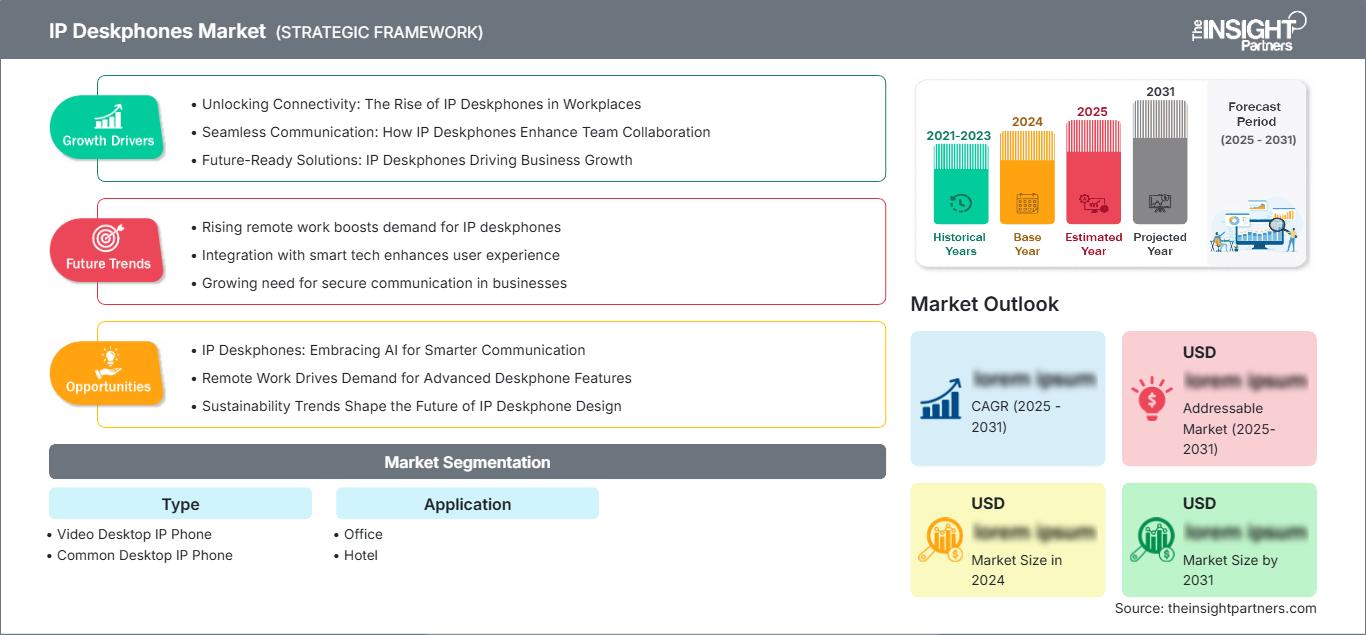
The IP Deskphones Market is positioned as a core enterprise communication endpoint category, with the market valued at US$ 1.23 Billion in 2025 and projected to reach US$ 2.76 Billion by 2034, registering a CAGR of 9.40% from 2026 to 2034. Expansion is supported by enterprise migration toward IP-based telephony, cloud communications, unified communications, and increasingly integrated workplace endpoints.
Across North America, the IP Deskphones Market size is supported by established enterprise telephony infrastructure, cloud PBX migration, and continued replacement of legacy endpoints. Demand is particularly resilient in healthcare, financial services, government, hospitality, and distributed corporate environments where dependable fixed-location voice communication remains operationally important.
IP Deskphones Market Assessment and Insights
- North America: North America is expected to retain a leading position, representing 33–37% share in 2025 and growing at a 7.8–8.8% CAGR between 2026–2034, supported by cloud telephony migration, enterprise replacement cycles, and established UC infrastructure.
- US: The US accounts for approximately 72–76% of North American demand in 2025, expanding at a 7.9–8.9% CAGR between 2026–2034, supported by enterprise communications modernization.
- Europe: Europe represents 25–29% share in 2025 and is expected to expand at a 8.4–9.4% CAGR between 2026–2034, with Germany, the UK, France, Italy, and Spain supporting replacement and digital workplace deployments.
- Asia Pacific: Asia Pacific is estimated at 22–26% share in 2025, growing at a 10.2–11.2% CAGR between 2026–2034, led by China, Japan, South Korea, and India as enterprises modernize communications infrastructure.
- Largest Segment: Common Desktop IP Phone is estimated at 58–63% market share in 2025, with a 8.2–9.2% CAGR between 2026–2034, reflecting broad enterprise and operational use.
- High Growth Segment: Video Desktop IP Phone represents approximately 37–42% market share in 2025, with a 10.2–11.2% CAGR between 2026–2034, driven by richer collaboration requirements.
- Key companies analyzed in detail: ALE International, Avaya Inc., Cisco Systems, Inc., D-Link Corporation, Escene Communication Co., Ltd., Grandstream Networks, Inc., Mitel Networks Corporation, NEC Corporation, Plantronics, Inc., and Yealink Network Technology Co., Ltd.
Source: The Insight Partners' analysis based on proprietary research, government publications, company annual reports, investor presentations, industry databases, and expert interviews.
The IP Deskphones Market has transitioned from plain VoIP terminals to managed phones with HD audio, video, Bluetooth, Wi-Fi, PoE, centralized provisioning, and cloud voice. Focus in product design continues to tilt toward seamless integration with UC platforms, efficient management, and reduced energy usage. There have also been changes in manufacturing approach in favor of hardware platform standardization and software-based differentiation to cover the needs of the enterprise, hospitality, branch office, and hybrid work environment through related device portfolios.
The IP Deskphones Market report shows that future growth would be increasingly decentralized towards emerging economies of Asia, selective markets in the Middle East, and digitally mature companies in Europe. Development focus will shift towards secure firmware, centralized device management, AI-based audio processing, and cloud deployment flexibility. The regulatory focus on security, energy efficiency, and data protection will aid demand for managed endpoints integrating well with enterprise communications infrastructure.
IP Deskphones Market Report Scope
| Report Attribute | Details |
|---|---|
| Market size in 2025 | US$ 1.23 Billion |
| Market Size by 2034 | US$ 2.76 Billion |
| Global CAGR (2026 - 2034) | 9.40% |
| Historical Data | 2021-2024 |
| Forecast period | 2026-2034 |
IP Deskphones Market Analysis
Enterprise demand is increasingly associated with cloud PBX, SIP trunking, unified communication, and hybrid office environment requirements. In turn, the growth of IP Deskphones Market depends not just on handset upgrades, but also on wider modernization of voice network infrastructure. The value chain consists of handset vendors, semiconductor providers, OS and firmware developers, UC applications, telecom providers, distributors, systems integrators, and managed service providers.
Lifecycle costs become more important procurement consideration than handsets cost alone. Handset features such as PoE compatibility, centralized management options, security updates, interoperability, warranty terms, and compatibility with current call-control systems are taken into account. Supply chain is still fairly scalable since handset architecture is built around proven semiconductor, display, audio, and networking components. Nevertheless, availability of components, logistics cost, local certifications, and software compatibility may impact supply schedules and cost.
Differences will be created based on integrated software and hardware solutions. Cisco Systems, Inc. integrates desk endpoints and collaboration infrastructure, but Avaya Inc. and Mitel Networks Corporation still retain relevance in areas where businesses favor proven telephony infrastructures. Yealink Network Technology Co., Ltd. and Grandstream Networks, Inc. offer tough competition through a wide range of SIP capabilities and deployability. At the same time, ALE International and NEC Corporation are relevant through enterprise communications.
Moreover, according to the analysis of the IP Deskphones Market, there is an increased focus on strategic portfolio segmentation. The differences of the products offered by vendors are now defined not only by the specifications of handsets but also by the roles of users, deployment situations, collaboration, and management. D-Link Corporation and Escene Communication Co., Ltd. are relevant to cost-sensitive deployments, but Plantronics, Inc. makes its contribution through the consideration of endpoints and headsets.
● REPORT CUSTOMIZATION
Tailor This Report To Align With Your Specific Business Requirements
This report can be customized to align precisely with your business objectives, scope, and target markets. Customization options include tailored segmentation, geography, competitive analysis, and strategic insights to support informed decision-making.
Customize This Report →WHAT YOU CAN ADJUST
- ● Segmentations
- ● Geography
- ● Competitive Analysis
- ● Language Preferences
IP Deskphones Market: Strategic Insights
Regional Insights
North America IP Deskphones Market
North America is estimated to represent 33–37% share in 2025, supported by mature enterprise telephony infrastructure and widespread cloud communication adoption. The regional market is expected to grow at a 7.8–8.8% CAGR through 2034. Large organizations continue replacing aging PBX-connected devices with SIP-compatible endpoints that integrate with cloud calling and unified communications.
The US accounts for 72–76% of North American demand, while Canada contributes through business services, government, healthcare, and hospitality deployments. Enterprise procurement increasingly emphasizes centralized management, secure firmware, PoE, and interoperability with UC platforms. Replacement demand remains important because fixed desk endpoints continue serving reception, executive, contact-center, operational, and shared-office roles even as mobile and software-based communications expand.
U.S. IP Deskphones Market
The US represents approximately 72–76% of North American demand in 2025 and is expected to expand at a 7.9–8.9% CAGR. Big businesses are upgrading their communication infrastructure but still use physical endpoints that need guaranteed and exclusive voice communications. The procurement landscape continues to include the healthcare sector, financial institutions, governmental agencies, educational institutions, and the hospitality industry.
Cisco Systems, Inc., Avaya Inc., and Mitel Networks Corporation stay relevant for enterprises, while Yealink Network Technology Co., Ltd. and Grandstream Networks, Inc. cater to the needs of users deploying SIP and cloud-based solutions. There is an increasing interest in devices that have the capabilities of PoE, Bluetooth, provisioning, and UC integration.
Europe IP Deskphones Market
Europe is estimated at 25–29% share in 2025 and is projected to grow at an 8.4–9.4% CAGR, with Germany expected to remain a leading national market. The IP Deskphones Market share is supported by enterprise digitization, legacy replacement, regulatory attention to cybersecurity, and demand for interoperable communications platforms across multinational organizations.
Reasons why the UK continues to be an attractive deployment market include that more businesses are now blending cloud calling with their endpoint solutions for the purposes of receptionists, call centers, and executives. The need will also be augmented by the trend of hybrid working and the shift towards managed communications. There is high industry and enterprise demand in Germany, where reliability and integration are still crucial factors in purchases, as well as equipment with long lifecycles.
APAC IP Deskphones Market
APAC represents approximately 22–26% share in 2025 and is expected to grow at a 10.2–11.2% CAGR. China still leads the markets, and Japan, South Korea, India, and Australia play their roles by digitizing enterprises, improving telecommunication infrastructure, IT services, and developing the hospitality industry.
Industrial investment and government-led digital infrastructure programs drive the adoption in office environments and service firms. India is very important because the growth in IT services and distributed corporations needs scalable voice infrastructure. China and South Korea can rely on their own technological ecosystems, whereas Japan focuses on reliability and longevity of the products.
Middle East & Africa IP Deskphones Market
Middle East and Africa demand is supported by infrastructure development, hospitality expansion, government digitization, and enterprise modernization. The region is expected to grow at a 8.0–9.0% CAGR, with Saudi Arabia and the UAE representing leading markets because of large-scale infrastructure and smart-city investments.
Digital transformation in Saudi Arabia is due to Vision 2030 initiatives, and UAE continues developing its business infrastructure with connectivity in mind. South Africa is still significant for enterprise business, due to advanced telecommunication infrastructure. The rest of MEA demand is fragmented, but could be further developed via hospitality, governmental facilities, telecommunication development, and business developments with IP-based communication needs.
Segmentation Analysis
Type
Type remains a central determinant of procurement strategy because organizations balance affordability, voice reliability, collaboration requirements, and user functionality. The segment is expected to expand at approximately 8.8–9.8% CAGR from 2026–2034. The IP Deskphones Market scope increasingly includes endpoints that combine conventional telephony with video, mobile integration, headset connectivity, and cloud administration.
- Video Desktop IP Phone: These devices address executives, managers, collaboration-intensive teams, and selected customer-facing roles requiring integrated visual communication. Demand is supported by hybrid work, larger displays, cameras, and closer integration between voice and video collaboration.
- Common Desktop IP Phone: Standard voice-focused devices retain broad adoption because they provide dependable communication at lower acquisition and management complexity. Reception areas, administrative desks, shared workspaces, and operational teams continue to favor straightforward SIP endpoints.
Application
Application is expected to expand at approximately 9.0–10.0% CAGR from 2026–2034, with offices representing the principal deployment environment. Organizations continue using dedicated endpoints where reliability, accessibility, shared access, and operational continuity are more important than replacing telephony entirely with software applications.
- Office: Offices represent the largest application environment because fixed endpoints remain useful for reception, executive workstations, customer service, administration, and shared desks. Centralized provisioning and UC integration improve manageability across distributed corporate locations.
- Hotel: Hotels use IP deskphones for guest rooms, reception, back-office communication, and service coordination. Integration with property-management systems, centralized administration, and dependable internal calling support continued deployment, particularly in newly constructed and renovated properties.
Opportunity Snapshot
| Application | Revenue Contribution (High/Medium/Low) | Trend Tag | Adoption Stage |
|---|---|---|---|
| Office | High | Cloud UC | Mature |
| Hotel | Medium | Smart Hospitality | Scaling |
IP Deskphones Market Growth Drivers and Impact Analysis
Cloud UC and SIP Migration Expanding Endpoint Demand
The cloud-based unified communications solution will create a continual need for IP-enabled endpoints despite businesses moving away from their legacy PBX systems. The SIP platform will enable companies to integrate their physical phones with cloud-based calling, centralized management, and software collaboration. This will generate demand for replacements for businesses that had been using proprietary or analog solutions. The effect is likely to be felt especially among distributed companies because endpoint standardization cuts down on management efforts in the various branches. The managed service providers are also in a position to bundle the phones with connectivity and UC services, thus taking the procurement process from purchasing hardware once to paying for communication services over time.
Hybrid Work Preserving Dedicated Voice Endpoints
The hybrid approach does not get rid of physical telephony because there are various business processes in the office that need reliable voice communication. For example, reception, call centers, health-care stations, executive areas, security and other departments may find that fixed endpoints add value. Contemporary desktop phones offer features such as Bluetooth, Wi-Fi, mobile phone pairing, programmable buttons, and collaborative applications. Thus, modern deskphones can coexist with laptops and cell phones and are not competing with them. It creates more diversified procurement when phones are chosen depending on the employee's role and his or her process of working. Therefore, companies can use advanced endpoints for executives and budget models for regular employees, which leads to higher demand for equipment as well as encourages manufacturers to create wider product ranges.
Hospitality and Commercial Infrastructure Modernization
The IP Deskphones Market forecast shows that hotel building, renovation, and commercial real estate upgrades offer another demand avenue. IP hotel communications allow for central provisioning, telephony via the network, and integration with property management systems. Newly built hotels can forgo legacy cabling investments in favor of integrating communications with more general Ethernet networks. Additionally, renovation periods can be utilized to upgrade old analog equipment to newer IP communications solutions. Communication needs in commercial buildings become increasingly flexible and extend beyond simple office installations to reception areas, security systems, facilities management systems, and tenant services. Companies that can provide solutions which can satisfy specific requirements of this market niche, such as workflow compatibility, multilingualism, and remote management capabilities, have the potential to tap into a specialized customer base.
IP Deskphones Market Future Trends
AI-Enabled Audio and Context-Aware Endpoints
Future devices are likely to incorporate increasingly sophisticated AI functions focused on practical communication improvements rather than standalone artificial intelligence features. Noise suppression, voice enhancement, acoustic echo cancellation, speaker identification, and context-aware call controls can improve usability in open offices and shared environments. Hardware manufacturers may increasingly use local processing to reduce latency and support privacy-sensitive functions. At the same time, cloud platforms can provide centralized analytics and firmware optimization. This combination could create differentiated product tiers based on processing capability, microphone architecture, and software integration. The resulting trend will shift purchasing criteria from conventional handset specifications toward measurable communication quality, manageability, and user experience. Vendors that can demonstrate practical productivity benefits may gain stronger positioning in premium enterprise deployments.
Sustainability and Lifecycle-Oriented Device Design
Environmental considerations are likely to become more influential in enterprise endpoint procurement. Buyers are increasingly evaluating energy consumption, recycled materials, packaging, repairability, software-support duration, and end-of-life management alongside technical specifications. Deskphones generally consume less power than many larger computing devices, but organizations operating thousands of endpoints can still achieve measurable savings through energy-efficient components and intelligent power management. Manufacturers may therefore emphasize recycled plastics, modular components, longer software support, and centralized configuration to extend useful life. Procurement teams could also assess total lifecycle impact rather than focusing solely on acquisition cost. These factors favor suppliers capable of documenting environmental attributes and maintaining reliable firmware support. Sustainability requirements may consequently become integrated into enterprise RFPs and technology refresh policies.
IP Deskphones Market Opportunities
Verticalized Solutions for Hospitality and Healthcare
Specialized endpoint portfolios represent an attractive investment opportunity because hospitality and healthcare require communication workflows that differ from conventional offices. Hotel devices can integrate room-service processes, property-management platforms, multilingual interfaces, and centralized administration. Healthcare environments require dependable communication, simplified controls, hygiene considerations, and compatibility with operational workflows. Vendors can create differentiated solutions by combining hardware with software interfaces and vertical-specific management tools. Partnerships with system integrators and property technology providers can improve market access while reducing dependence on direct hardware sales. Investors and manufacturers can also target renovation programs, where replacement decisions are tied to broader facility modernization. A vertical strategy can support higher customer retention because once devices are integrated into operational processes, replacement decisions consider workflow compatibility and service continuity.
Managed Endpoint Services and Lifecycle Contracts
The transition toward cloud communication creates an opportunity to commercialize deskphones through managed endpoint models rather than standalone hardware transactions. Enterprises can procure devices together with provisioning, monitoring, firmware management, analytics, replacement services, and support under recurring contracts. Such models reduce upfront complexity for customers and provide vendors with more predictable revenue streams. Service providers can standardize device families across multiple clients while using centralized management platforms to lower support costs. The opportunity is particularly relevant for distributed organizations with many branches or shared workspaces. Over time, lifecycle contracts can incorporate security updates, device refreshes, asset tracking, and recycling. These capabilities can strengthen customer relationships and make endpoint management a strategic component of broader unified communications services. The IP Deskphones Market Forecasts therefore increasingly depends on hardware-service convergence.
Recent Developments
- June 2026: Cisco Systems, Inc. updated its Desk Phone 9800 Series documentation and released updated product information, including a June 2026 data sheet for the series. The portfolio emphasizes modern desk communication, centralized device management, AI-powered audio capabilities, and sustainability features, reflecting continued investment in enterprise physical communication endpoints.
- May 2025: Yealink Network Technology Co., Ltd. launched its “AI Your Workspace” initiative, presenting AI-enabled solutions across SIP phones, collaboration devices, and business headsets. The launch emphasized AI, security, sustainability, and integrated workplace deployment, indicating a broader strategy to connect traditional communication endpoints with intelligent collaboration ecosystems.
- November 2024: Grandstream Networks, Inc. introduced new desktop and cordless IP phones, including the GRP2610(P) and GRP2611G carrier-grade models. The devices support multiple lines and SIP accounts, while the GRP series incorporates zero-touch provisioning and centralized management capabilities for higher-volume enterprise and service-provider deployments.
Frequently Asked Questions

- Comprehensive Market Sizing and Forecast Analysis
- Detailed Segmentation Analysis
- In-Depth Market Dynamics Assessment
- Regional and Country-Level Insights
- Competitive Landscape and Company Benchmarking
- Strategic Business Intelligence
Recent Reports
Testimonials

The Insight Partners provided valuable market intelligence that supported our global go-to-market strategy. Their team was professional, responsive, and attentive to our feedback, providing thoughtful analysis and helpful methodological clarifications throughout the project.
Junmo Kim Chief Financial Officer (CFO), Enertech Co., Ltd.
The Insight Partners' SCADA System Market report is comprehensive, with valuable insights on current trends and future forecasts. The team was highly professional, responsive, and supportive throughout. We are very satisfied and highly recommend their services.
RAN KEDEM Partner, Reali Technologies LTDs
I requested a report on a very specific software market and the team produced the report in a few days. The information was very relevant and well presented. I then requested some changes and additions to the report. The team was again very responsive and I got the final report in less than a week.
JEAN-HERVE JENN Chairman, Future Analytica
We worked with The Insight Partners for an important market study and forecast. They gave us clear insights into opportunities and risks, which helped shape our plans. Their research was easy to use and based on solid data. It helped us make smart, confident decisions. We highly recommend them.
PIYUSH NAGPAL Sr. Vice President, High Beam Global
The Insight Partners delivered insightful, well-structured market research with strong domain expertise. Their team was professional and responsive throughout. The user-friendly website made accessing industry reports seamless. We highly recommend them for reliable, high-quality research services
YUKIHIKO ADACHI CEO, Deep Blue, LLC.
This is the first time I have purchased a market report from The Insight Partners.While I was unsure at first, I visited their web site and felt more comfortable to take the risk and purchase a market report.I am completely satisfied with the quality of the report and customer service. I had several questions and comments with the initial report, but after a couple of dialogs over email with their analyst I believe I have a report that I can use as input to our strategic planning process.Thank you so much for taking the extra time and making this a positive experience.I will definitely recommend your service to others and you will be my first call when we need further market data.
JOHN SUZUKI President and Chief Executive Officer, Board Director, BK Technologies
I wish to appreciate your support and the professionalism you displayed in the course of attending to my request for information regarding to infectious disease IVD market in Nigeria. I appreciate your patience, your guidance, and the fact that you were willing to offer a discount, which eventually made it possible for us to close a deal. I look forward to engaging The Insight Partners in the future, all thanks to the impression you have created in me as a result of this first encounter.
DR CHIJIOKE ONYIA MANAGING DIRECTOR, PineCrest Healthcare Ltd.Reason to Buy
- Informed Decision-Making
- Understanding Market Dynamics
- Competitive Analysis
- Identifying Emerging Markets
- Customer Insights
- Market Forecasts
- Risk Mitigation
- Boosting Operational Efficiency
- Strategic Planning
- Investment Justification
- Tracking Industry Innovations
- Aligning with Regulatory Trends





 Get Free Sample for