
Iris Recognition Market Size, Share & Forecast by 2034
Coverage: by Component (Hardware, Software); Product Type (Smartphones, Wearable, Personal Computers/Laptops, Others); Industry (BFSI, Government, Military and Defense, Automotive, Others) , and Geography (North America, Europe, Asia Pacific, and South and Central America)
- Status : Data Released
- Report Code : TIPRE00007534
- Category : Electronics and Semiconductor
- No. of Pages : 150
- Available Report Formats :


- Last update date : October 22, 2026


2025 Market Size
US$ 12.47 Bn
Base year value
2034 Forecast
US$ 80.83 Bn
Projected by 2034
CAGR 2026-2034
23.08 %
Growth rate
Addressable Market
US$ 364.53 Bn
(2026-2034)
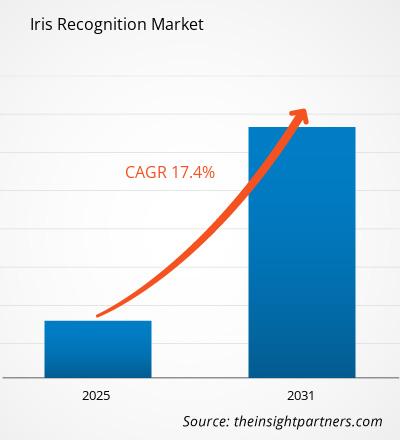
The Iris Recognition Market was valued at US$ 12.47 Billion in 2025 and is projected to reach US$ 80.83 Billion by 2034, expanding at a CAGR of 23.08% during 2026–2034. Expansion reflects wider deployment of non-contact identity verification across public security, financial services, defense, connected devices, and mobility. Higher matching accuracy, lifelong iris-pattern stability, and improving near-infrared imaging strengthen the technology’s role in high-assurance authentication workflows worldwide.
North America remains a pivotal commercialization hub, with an estimated CAGR of 21–23% through 2034 as federal identity modernization and enterprise zero-trust programs sustain procurement. The Iris Recognition Market size benefits from mature systems integration, established biometric testing practices, and demand for contactless access across airports, data centers, financial institutions, and critical infrastructure. Procurement increasingly favors interoperable software, presentation-attack defenses, and multimodal platforms rather than isolated scanners.
Iris Recognition Market Assessment and Insights
- North America represented 28–31% of 2025 revenue and is expected to record a 21–23% CAGR during 2026–2034, supported by border modernization, regulated access control, and a dense biometric vendor ecosystem.
- US accounted for 79–83% of North American revenue in 2025 and is projected to grow at a 21–23% CAGR through 2034.
- Europe held 23–26% in 2025 and is forecast to expand at 20–22% CAGR, with the UK and Germany leading deployments while France, Italy, and Spain broaden border and enterprise use.
- Asia Pacific captured 30–34% in 2025 and is projected to post a 25–27% CAGR, led by China, India, Japan, and South Korea through digital identity and electronics integration.
- Largest Segment Hardware held a 52–56% market share in 2025 and should grow at a 20–22% CAGR as cameras, illuminators, and embedded modules scale.
- High Growth Segment Software represented 44–48% of 2025 revenue and is projected to expand at a 25–27% CAGR through recurring licenses, analytics, and multimodal orchestration.
- Key companies analyzed in detail: BioEnable Technologies Pvt. Ltd., CMITech Company, Ltd., EyeLock LLC, HID Global Corporation, IDEMIA Group, IrisGuard UK Ltd., IriTech, Inc., NEC Corporation, Princeton Identity, Inc., and Thales Group.
Source: The Insight Partners' analysis based on proprietary research, government publications, company annual reports, investor presentations, industry databases, and expert interviews.
The development of commercial offerings has shifted from special purpose iris stations to compact cameras, edge computing, and multimodal ID solutions. While the importance of near-infrared optical technology persists, better image quality assurance and algorithms that account for movement, glasses wearing, different distance ranges, and poor lighting conditions make things better. The economics of the business model has changed as standard modules enter laptop computers, kiosks, and smartphones, and vendors have decoupled the camera hardware from matching engines. Such an approach reduces implementation costs and provides buyers the ability to integrate iris matching with face recognition, fingerprints, credentials, and risk assessment.
Up to 2034, investments will be concentrated in South and Southeast Asia, air travel hub countries in the Gulf area, and African nations with identity systems whose renewal and registration at the national level happen simultaneously. Privacy-by-design approaches, template security, consent management, and performance testing will be procurement gateways. Understanding of regulations concerning biometric technologies of high risk will be helpful for suppliers who can prove the accuracy of the system, bias, cyber security, and life cycle management.
Iris Recognition Market Report Scope
| Report Attribute | Details |
|---|---|
| Market size in 2025 | US$ 12.47 Billion |
| Market Size by 2034 | US$ 80.83 Billion |
| Global CAGR (2026 - 2034) | 23.08% |
| Historical Data | 2021-2024 |
| Forecast period | 2026-2034 |
Iris Recognition Market Analysis
Iris Recognition Market Growth is driven by passwordless authentication, digital public infrastructure, fraud detection, and hygiene. Capture device suppliers source sensors, near-infrared light sources, optical systems, and processing, whereas integrators implement recognition software, identity databases, and access control applications. The ongoing IREX program of NIST evaluates one-to-many recognition algorithms using operational data sets that were kept under embargo, thus increasing the buyers’ trust in performance criteria.
The availability of the component base is not an issue, but calibration, compliance, and integration skills are. The buyers demand that the system be able to recognize iris irrespective of eye color, age, movement, eyewear, and lighting conditions. Hence, the implementation services are essential. The openness of interfaces and the interoperability of templates will grow more important in the purchasing process because of the need to protect the customer’s investment in enrollment.
According to the analysis of the Iris Recognition Market Report, the competition is twofold between diversified identity companies and dedicated iris recognition providers. NEC Corporation, IDEMIA Group, Thales Group, and HID Global Corporation offer integrated solutions for civil identification, travel, and access control, while IriTech, Inc., EyeLock LLC, CMITech Company, Ltd., IrisGuard UK Ltd., Princeton Identity, Inc., and BioEnable Technologies Pvt. Ltd. are focusing on capture effectiveness, embedded modules, or specific applications.
Money is shifting to edge computing, liveness determination, cloud management, and tiny multimodal cameras. Effective positioning requires the proof of certification, dataset management, integration partners, and software licensing revenues. Companies who reduce enrollment friction and have scalable one-to-many matching capabilities will be able to defend their margins, while those providing hardware alone will experience commoditization.
● REPORT CUSTOMIZATION
Tailor This Report To Align With Your Specific Business Requirements
This report can be customized to align precisely with your business objectives, scope, and target markets. Customization options include tailored segmentation, geography, competitive analysis, and strategic insights to support informed decision-making.
Customize This Report →WHAT YOU CAN ADJUST
- ● Segmentations
- ● Geography
- ● Competitive Analysis
- ● Language Preferences
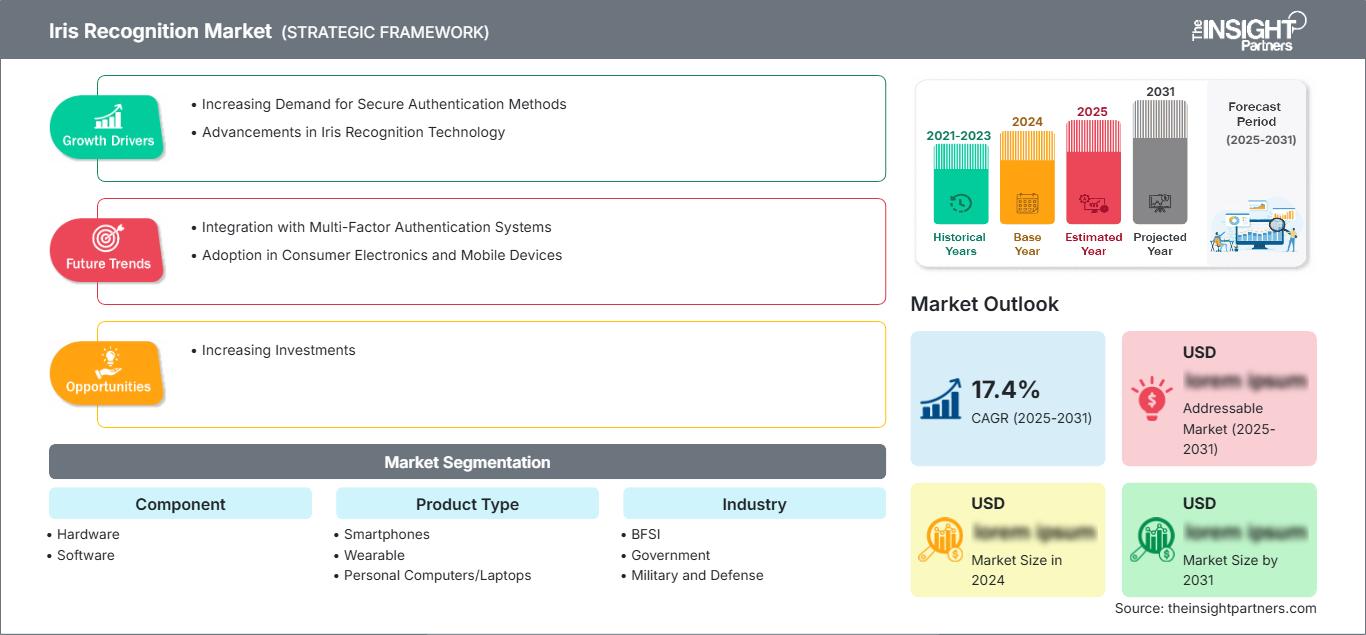
Iris Recognition Market: Strategic Insights
Regional Insights
North America Iris Recognition Market
The North America region had a Iris Recognition Market share of 28-31% in the total revenue in 2025 and is expected to register 21-23% CAGR till 2034. The market share for the North American market is due to the government's identity management systems, automation in airports, military facilities, and access control in finance systems.
The trend in corporate solutions has moved from standalone iris recognition readers to converged solutions for both physical and virtual environments. According to the survey conducted by HID Global, 35% of respondents have implemented biometrics, while 13% were planning to do so. The budget allocated by Canadians for border control and critical infrastructure along with the American budget adds to the overall budget.
U.S. Iris Recognition Market
In 2025, the US accounted for 79-83% of North American sales and will experience a 21-23% CAGR in 2026-2034. Federal government, defense industry, airports, data centers, financial institutions, and health care systems are sources of diverse demand. NIST's IREX tests ensure consistent assessment of one-to-many accuracy, image quality, and scalability for the procuring organizations.
NEC Corporation, IDEMIA Group, HID Global Corporation, EyeLock LLC, Princeton Identity, Inc., and IriTech, Inc. operate technology, integration, or business activities. Adoption is high in cases when iris recognition complements face recognition or credentials to raise the level of assurance, but not all types of identification are substituted. Speed of miniaturized capturing, edge computing, and zero-trust access architectures enable to implement solutions in enterprise check points and self-service kiosks.
Europe Iris Recognition Market
The region accounted for 23–26% of revenue in 2025 and was forecast to deliver 20–22% CAGR. The UK has a clear lead in border technology, financial identity, and research, while the existing airport infrastructure forms the basis for touchless passenger handling. Efficiency in procurement of biometrics in the context of digital governance in Europe involves minimizing the amount of data, establishing purpose limitations, and documenting human supervision.
Secure systems for gaining access in industry and government sectors in Germany are attributable to the availability of cybersecurity-conscious firms and transportation developments. In France, Italy, and Spain, automated border control, law enforcement identity, and airport development initiatives have been embraced despite stringent approval processes. In France, there are many identity solutions vendors nationally, while in Italy, there is a focus on migration management.
APAC Iris Recognition Market
The Asia-Pacific region is estimated to generate 30% to 34% of global revenue in 2025 and is anticipated to grow with a CAGR of 25% to 27%. The China market is dominated due to the production of electronics and public security system whereas the India market is dominated due to digital identities, banking, and benefits.
Australia is interested in border security and critical infrastructure assurance. Regulatory support for digital public services and high rates of mobile phones along with component availability facilitate the commercialization process. However, different privacy and procurement policies demand local data storage.
Middle East & Africa Iris Recognition Market
MEA and Africa is expected to grow at a CAGR of 22% to 24% up to 2034. UAE has strong capabilities in seamless airport security and travel, Saudi Arabia focuses on smart infrastructure and secure government services, whereas South Africa leverages biometrics for financial inclusion, border management, and controlled access.
Rest-of-MEA applications include identity registration, delivery of aid, and critical infrastructure. Critical energy and transport infrastructure projects enable high-level security access, low levels of connectivity in many locations drive edge computing solutions.
Segmentation Analysis
Component
The component category is projected to expand at a 22–24% CAGR during 2026–2034. The Iris Recognition Market scope spans capture optics, near-infrared illumination, processors, matching engines, liveness functions, and integration layers. Hardware retains the larger base because every endpoint requires imaging capability, while software grows faster as buyers centralize matching, analytics, policy, and lifecycle management across mixed device fleets.
- Hardware leads installed revenue through cameras, scanners, illuminators, and embedded modules. Demand is strongest in border, defense, and national identity projects requiring durable capture and controlled image quality.
- Software gains strategic importance through algorithm upgrades, template management, presentation-attack detection, and multimodal orchestration. Subscription licensing and cloud deployment create recurring revenue and easier fleet-wide performance improvements.
Product Type
The product type category should register a 23–25% CAGR through 2034 as authentication migrates from dedicated stations into personal and connected devices. Smartphones provide scale, laptops support workforce security, and wearables create emerging hands-free applications. Success depends on camera resolution, near-infrared support, battery efficiency, user positioning, and secure on-device template storage.
- Smartphones represent the broadest potential endpoint base, supporting device unlock, mobile banking, payments, and digital identity. Adoption depends on compact optics, low-power processing, and consistent performance across lighting conditions.
- Wearable devices remain an emerging category for augmented reality, industrial safety, and continuous authentication. Eye-tracking convergence can improve module economics, although comfort, power consumption, and privacy require careful design.
- Personal Computers/Laptops address passwordless workforce access and privileged-user authentication. Integration with enterprise identity platforms and secure processors supports regulated industries, remote work, and administrative access to sensitive systems.
Industry
The industry category is forecast to grow at a 22–24% CAGR during 2026–2034. Government and defense establish high-assurance reference deployments, BFSI converts fraud and account-access use cases, and automotive applications emerge with driver recognition and personalization. Adoption varies with risk tolerance, regulation, enrollment scale, and the cost of integrating iris with existing credentials and databases.
- BFSI applies iris verification to onboarding, branch transactions, ATMs, and privileged access. Banks prioritize fraud reduction, non-repudiation, and customer convenience while requiring strong consent, encryption, and fallback procedures.
- Government remains central to national identity, border control, law enforcement, and benefit delivery. Population-scale matching rewards interoperable templates, high throughput, auditability, and durable enrollment quality across decentralized locations.
- Military and Defense demand rigorous authentication for facilities, systems, and field operations. Contactless matching and resistance to credential sharing are valuable, but ruggedization, offline operation, and anti-spoofing are essential.
- Automotive adoption centers on driver identification, personalization, fleet authorization, and in-cabin security. Integration with driver-monitoring cameras creates efficiencies, though changing illumination and safety certification complicate implementation.
Opportunity Snapshot
| Industry Vertical | Revenue Contribution | Trend Tag | Adoption Stage |
| BFSI | High | Fraud Defense | Scaling |
| Government | High | Digital Identity | Mature |
| Military and Defense | Medium | Secure Access | Mature |
| Automotive | Medium | Driver Identity | Emerging |
| Others | Low | Vertical Pilots | Emerging |
Iris Recognition Market Growth Drivers and Impact Analysis
Passwordless Security and Identity-Fraud Reduction
The continuing prevalence of compromised credentials means that organizations look for authentication mechanisms that are not shareable, forgettable, and replayable. Iris recognition provides reliable physiological characteristics, contactless data capture, and good one-to-many discrimination, which makes it applicable to account recovery, privilege authentication, and identity deduplication purposes. The strongest market opportunity exists when the consequences of a false positive are more expensive than the hardware and implementation costs. Banks will tie up customers for the execution of high-value transactions, while governments may cut down on duplicate benefit claims. The adoption of iris recognition technology is now being done with iris recognition combined with face recognition, device possession, or behavior analysis, which enables risk-based policy application instead of mandatory high-friction authentication.
Expansion of Digital Identity and Automated Borders
The identity programs of the nation and the automated travel process require a fast and effective comparison of many people. The NIST evaluates the algorithm for one-to-many identification of irises for 500,000 enrollees as a part of IREX 10 operational testing. This example demonstrates how much useful technology is. IATA emphasizes that identity verification by means of digital identity allows for bag drop, security, immigration and boarding if the traveler decides to provide his biometrics. Besides, there is a commercial side of things. Not only the border kiosk brings revenue but there are also income sources related to enrollment process, matching, mobile credentials, integration, and maintenance.
Compact Sensors, Edge AI, and Multimodal Integration
Compact camera modules and enhanced edge processors minimize the obstacles related to conventional iris units in terms of size, delay, and bandwidth. NEC has introduced smaller face-and-iris systems that have the capability to work together with legacy PCs or tablets and match tens of millions of people. This trend expands the applications to include ATMs, POS units, enrollment stations, laptops, and industrial gateways. Processing at the edge will not only preserve sensitive images closer to the source but also allow intermittent connectivity as well as less compute at the center. The multimodal approach increases the usability by allowing face to help quickly position the person whereas iris provides high-assurance confirmation.
Iris Recognition Market Future Trends
On-the-Move Multimodal Authentication
Iris Recognition Market trends will increasingly favor authentication while users walk naturally through controlled spaces. Combining iris with face recognition can reduce positioning friction and improve confidence without requiring cards or passwords. NEC’s planned customer trials for compact walk-through multimodal technology signal movement toward critical facilities, airports, and high-throughput venues. Future systems will use a common camera, dynamic illumination, and real-time quality scoring to capture usable eye imagery at greater distances. Success will be measured by throughput, exception rates, and performance across changing weather and demographics, not laboratory accuracy alone. Integrators that coordinate doors, risk engines, and identity databases will capture disproportionate value.
Privacy-Preserving Template and Policy Architectures
Subsequent deployments will avoid movement of the raw image of the eye and keep the biometric template separate from the personally identifiable record. The techniques of edge extraction, encrypted storage of the template, revocable biometrics, and authorized data exchanges could mitigate risk without compromising match capability. Policy engines will log the consent, intent, retention, and access by operators of each exchange, providing an audit function appropriate for regulated settings. Future buyers will require independent validation of presentation attack detection as well as security, along with the more traditional measure of matching performance. This development makes software platforms that can handle multiple scanners and local regulations attractive.
Iris Recognition Market Opportunities
Modernize Identity Infrastructure in Emerging Economies
Population-scale identity programs in Asia, Africa, and the Middle East offer suppliers opportunities to package enrollment, deduplication, mobile kits, training, and lifecycle support. Investment should focus on modular systems that operate offline, synchronize securely, and support multiple languages and identity modalities. Partnerships with local integrators can improve field maintenance, regulatory alignment, and public-sector procurement access. Vendors can reduce project risk by offering phased pilots tied to measurable enrollment quality, duplicate detection, and service availability. Commercial models should combine equipment sales with recurring software, hosting, and support. Solutions built around open standards will be better positioned for donor-funded or multi-agency programs that require long asset lives.
Embed Iris Authentication in Personal and Industrial Devices
Laptops, mixed reality goggles, wearable devices for industries, and secure mobile terminals can all be distinguished through unobtrusive iris recognition. Priorities for investment are low-power near-infrared lighting, optics, eye tracking, secure storage of templates, and software development kits. Cooperation deals between biometric experts, sensor manufacturers, and equipment OEMs can help with qualification issues and fit the modules to thermal and mechanical requirements. The first applications should relate to regulated workforces, field services, maintenance in defense industry, and financial accounting where assurance would make an additional cost in bill of material acceptable. As soon as economies of scale kick in, the same modules can be used for more general consumer applications.
Recent Developments
- December 2025: NEC Corporation developed walk-through face-and-iris multimodal authentication using one compact camera. The system is designed to verify moving individuals against a database exceeding 100 million records indoors or outdoors. Customer proof-of-concept trials are planned for fiscal 2026, with implementation targeted for fiscal 2027 in critical facilities requiring strict identity assurance.
- March 2026: Smart Eye AB and Fingerprint Cards AB (FPC) have demonstrated a new multimodal biometric authentication solution that combines facial recognition with iris recognition. The technology is designed to provide stronger identity verification while maintaining a seamless user experience. The solution builds on the companies’ partnership established in January 2025, when Smart Eye licensed FPC’s iris-recognition technology. The companies have since integrated the iris technology with Smart Eye’s existing camera-based sensing capabilities, creating a system capable of verifying a person through two separate biometric characteristics captured by the same camera.
- September 2025: CMITech has introduced its EF-70 dual iris and face recognition system, featuring advanced iris-recognition technology from Fingerprint Cards (FPC). The companies say the collaboration combines high-quality biometric imaging with sophisticated iris algorithms to deliver fast and reliable identity authentication. The EF-70 is designed as a combined facial and iris recognition platform, allowing users to authenticate through either biometric modality. Its interface is built around a 5-inch high-resolution color display, which shows users how to position themselves correctly before biometric capture.
Frequently Asked Questions

- Comprehensive Market Sizing and Forecast Analysis
- Detailed Segmentation Analysis
- In-Depth Market Dynamics Assessment
- Regional and Country-Level Insights
- Competitive Landscape and Company Benchmarking
- Strategic Business Intelligence
Recent Reports
Testimonials

The Insight Partners provided valuable market intelligence that supported our global go-to-market strategy. Their team was professional, responsive, and attentive to our feedback, providing thoughtful analysis and helpful methodological clarifications throughout the project.
Junmo Kim Chief Financial Officer (CFO), Enertech Co., Ltd.
The Insight Partners' SCADA System Market report is comprehensive, with valuable insights on current trends and future forecasts. The team was highly professional, responsive, and supportive throughout. We are very satisfied and highly recommend their services.
RAN KEDEM Partner, Reali Technologies LTDs
I requested a report on a very specific software market and the team produced the report in a few days. The information was very relevant and well presented. I then requested some changes and additions to the report. The team was again very responsive and I got the final report in less than a week.
JEAN-HERVE JENN Chairman, Future Analytica
We worked with The Insight Partners for an important market study and forecast. They gave us clear insights into opportunities and risks, which helped shape our plans. Their research was easy to use and based on solid data. It helped us make smart, confident decisions. We highly recommend them.
PIYUSH NAGPAL Sr. Vice President, High Beam Global
The Insight Partners delivered insightful, well-structured market research with strong domain expertise. Their team was professional and responsive throughout. The user-friendly website made accessing industry reports seamless. We highly recommend them for reliable, high-quality research services
YUKIHIKO ADACHI CEO, Deep Blue, LLC.
This is the first time I have purchased a market report from The Insight Partners.While I was unsure at first, I visited their web site and felt more comfortable to take the risk and purchase a market report.I am completely satisfied with the quality of the report and customer service. I had several questions and comments with the initial report, but after a couple of dialogs over email with their analyst I believe I have a report that I can use as input to our strategic planning process.Thank you so much for taking the extra time and making this a positive experience.I will definitely recommend your service to others and you will be my first call when we need further market data.
JOHN SUZUKI President and Chief Executive Officer, Board Director, BK Technologies
I wish to appreciate your support and the professionalism you displayed in the course of attending to my request for information regarding to infectious disease IVD market in Nigeria. I appreciate your patience, your guidance, and the fact that you were willing to offer a discount, which eventually made it possible for us to close a deal. I look forward to engaging The Insight Partners in the future, all thanks to the impression you have created in me as a result of this first encounter.
DR CHIJIOKE ONYIA MANAGING DIRECTOR, PineCrest Healthcare Ltd.Reason to Buy
- Informed Decision-Making
- Understanding Market Dynamics
- Competitive Analysis
- Identifying Emerging Markets
- Customer Insights
- Market Forecasts
- Risk Mitigation
- Boosting Operational Efficiency
- Strategic Planning
- Investment Justification
- Tracking Industry Innovations
- Aligning with Regulatory Trends





 Get Free Sample for