
Large Format Inkjet Printers LFP Market Size, Trends & Growth by 2034
Large Format Inkjet Printers LFP Market Size and Forecasts (2021–2034), Global and Regional Share, Trends, and Growth Opportunity Analysis Report Coverage : By Application (Advertising, Textiles, Packaging, Signage, Architectural), Technology (UV Inkjet, Solvent Inkjet, Dye Sublimation Inkjet, Latex Inkjet), Print Width (Up to 24 inches, 24 to 44 inches, 44 to 64 inches, Over 64 inches), End Use (Retail, Manufacturing, Education, Entertainment)
- Status : Data Released
- Report Code : TIPRE00039499
- Category : Electronics and Semiconductor
- No. of Pages : 150
- Available Report Formats :


- Last update date : September 23, 2026


2025 Market Size
US$ 10.16 Bn
Base year value
2034 Forecast
US$ 15.82 Bn
Projected by 2034
CAGR 2026-2034
5.04 %
Growth rate
Addressable Market
US$ 117.87 Bn
(2026-2034)
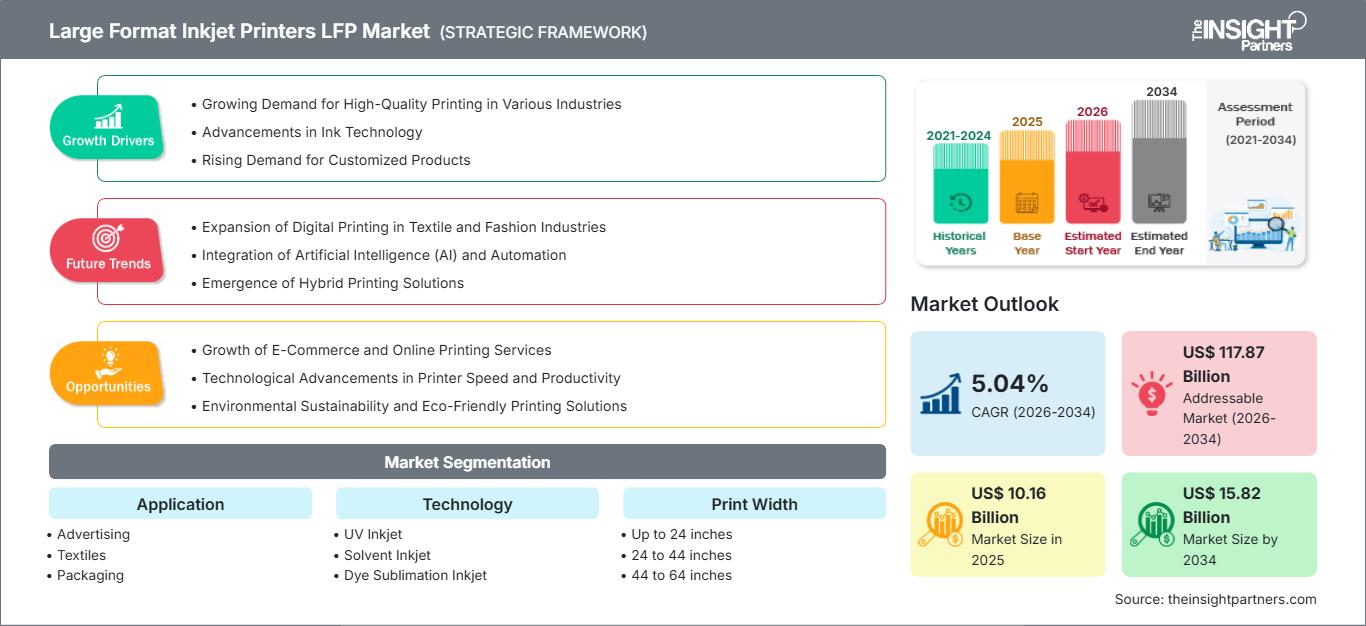
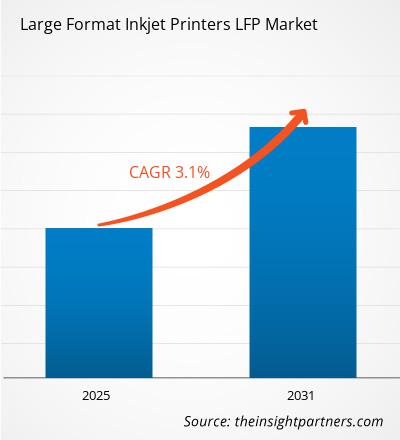
The Large Format Inkjet Printers LFP Market was valued at US$ 10.16 Billion in 2025 and is expected to reach US$ 15.82 Billion by 2034. The market is projected to register a CAGR of 5.04% during 2026–2034. Demand is being shaped by production flexibility, substrate diversity, consistent color management, and the migration of signage, textile, packaging, and technical drawing workflows toward digitally controlled inkjet equipment.
North America is estimated to expand at a 4.6–5.2% CAGR as print service providers modernize fleets and distributed businesses bring poster, CAD, and promotional production closer to demand. The Large Format Inkjet Printers LFP Market size in the region also benefits from mature software ecosystems, replacement of solvent-heavy platforms, and sustained investment by architecture, engineering, construction, retail, and education users seeking shorter turnaround times and reliable remote fleet management.
Large Format Inkjet Printers LFP Market Assessment and Insights
- North America: Share in 2025 is estimated at 31–34%, with a CAGR between 2026 – 2034 of 4.6–5.2%, supported by fleet renewal, technical printing, retail graphics, and workflow automation.
- US: The country represented 78–82% of North American revenue in 2025 and is projected to grow at a 4.7–5.3% CAGR during 2026–2034.
- Europe: Share in 2025 is estimated at 27–30%, with a 4.2–4.8% CAGR through 2034. Germany leads, while the UK, France, Italy, and Spain sustain signage and industrial demand.
- Asia Pacific: The Large Format Inkjet Printers LFP Market Share in 2025 is estimated at 30–33%, expanding at a 5.8–6.5% CAGR through 2034 as China, Japan, South Korea, India, and Australia deepen digital production capacity.
- Largest Segment: Advertising held an estimated 31–35% market share in 2025 and is projected to expand at a 4.6–5.2% CAGR during 2026–2034.
- High Growth Segment: Dye Sublimation Inkjet captured an estimated 17–20% market share in 2025 and is projected to grow at a 6.4–7.2% CAGR during 2026–2034.
- Key companies analyzed in detail: Brother Industries, Ltd.; Mimaki Engineering Co., Ltd.; Kolbus GmbH & Co. KG; HP Inc.; Wideformat Solutions; Roland DG Corporation; Xerox Holdings Corporation; Seiko Epson Corporation; Canon Inc.; and Konica Minolta, Inc.
Source: The Insight Partners' analysis based on proprietary research, government publications, company annual reports, investor presentations, industry databases, and expert interviews.
Equipment evolution has progressed from highly specialized poster and CAD machines to flexible devices capable of printing on both rigid and flexible materials with reduced operator interventions. The application of UV curing, latex technology, automated nozzles, embedded spectrophotometers, and cloud connected raster image processors decreases downtime and increases opportunities to sell a variety of applications. Economically it is more profitable to have short-run and variable graphics rather than focusing on maximum possible speeds of equipment. This change is seen in the Large Format Inkjet Printers LFP Market.
The investment will expand to the Asian manufacturing clusters, Gulf construction programs, and African retail centers through 2034. Most likely, buyers will opt for modular equipment with capability of field upgrade, low emission ink systems, and monitoring of operation data. Procurement criteria for indoor air quality, energy usage, and recyclable media will increase the demand for UV and latex technologies, as well as financing and managed-service business models which will provide equipment to small converters. Local technical assistance will be crucial due to direct impact on utilization and payback.
Large Format Inkjet Printers LFP Market Report Scope
| Report Attribute | Details |
|---|---|
| Market size in 2025 | US$ 10.16 Billion |
| Market Size by 2034 | US$ 15.82 Billion |
| Global CAGR (2026 - 2034) | 5.04% |
| Historical Data | 2021-2024 |
| Forecast period | 2026-2034 |
Large Format Inkjet Printers LFP Market Analysis
The Large Format Inkjet Printers LFP Market Report has been built upon the need for fast and personalized communication in retail campaigns, transportation branding, exhibitions, construction sites, and localized packaging. The need for shorter runs with frequent redesigns has led brand owners to demand print shops shift from analog setups to digital workflows. Media suppliers, ink suppliers, printhead suppliers, RIP suppliers, distributors, service companies, and finishing suppliers create a symbiotic relationship in which certified media profiles and consistent maintenance enable sellable output.
Supply chain economics favor those who are capable of getting hold of printheads, electronics, specialty pigments, curing systems, and regional consumables. The hardware business model is reinforced by selling inks, service agreements, software, and workflow subscriptions. Cost of operation is more relevant than purchase price, particularly when color correction, operator labor, ventilation, power consumption, and wasted substrate play a major role in profitability.
Large Format Inkjet Printers – LFP
Market analysis suggests that the competition space for this segment is split by wide technology groups and application specialists. HP Inc., Canon Inc., and Seiko Epson Corporation provide products for technical, graphics and production sectors respectively, while Mimaki Engineering Co., Ltd. and Roland DG Corporation focus more on multi-purpose signage, textile, UV and print and cut processes. In addition, Brother Industries, Ltd., Xerox Holdings Corporation, Konica Minolta, Inc., Kolbus GmbH & Co. KG, and Wideformat Solutions offer neighboring production solutions, distribution channels, or integrations.
The focus of investments is on miniaturized hybrid devices, automated maintenance features, connectivity to production dashboards and premium inks with properties like white, clear, fluorescent or gamut extensions. The strategic orientation is becoming more and more application-oriented as opposed to product-oriented one. Those vendors who are able to integrate media certification, color management, operator training, financing, and fast field service help to minimize the risks and secure recurrent revenue stream.
● REPORT CUSTOMIZATION
Tailor This Report To Align With Your Specific Business Requirements
This report can be customized to align precisely with your business objectives, scope, and target markets. Customization options include tailored segmentation, geography, competitive analysis, and strategic insights to support informed decision-making.
Customize This Report →WHAT YOU CAN ADJUST
- ● Segmentations
- ● Geography
- ● Competitive Analysis
- ● Language Preferences
Large Format Inkjet Printers LFP Market: Strategic Insights
Regional Insights
North America Large Format Inkjet Printers LFP Market
The North American market is expected to capture a 31-34% market share by 2025 and grow at a CAGR of 4.6-5.2% through 2034. Large Format Inkjet Printers LFP market share includes a substantial installed base with sign shops, commercial printers, architectural, engineering and construction companies, retail establishments, schools and corporate graphics units. There is a need for replacements for systems that facilitate fast calibration and maintenance and also secure job submission across distributed environments.
Latex and UV systems replacing solvent solutions or providing direct print capabilities onto rigid substrates represent the largest growth segments. Retail refresh, events, wraps, construction plans and personalized decor provide volumes, but digital screens limit poster production needs. Buyers look increasingly at customer support, ink compatibility, energy usage and remote diagnostics in addition to the speed of the printer. Local resellers play an important role because testing and operator education decrease the learning curve associated with substrates.
U.S. Large Format Inkjet Printers LFP Market
The US accounted for 78-82% of North American revenue in 2025 and will register a 4.7-5.3% CAGR through 2034. A high density of dealer networks and the availability of HP Inc., Canon U.S.A., Inc., Epson America, Inc., Roland DGA Corporation, and Mimaki USA will enable trials, installation, training, and after-sales services. The fleet replacement will be substantial in architecture, engineering, construction, education, retail, and commercial graphics.
The demand for applications has become diversified per print room. Compact 24-inch printers are used for technical drawings and educational posters while 44-64-inch units are for professional graphics, wraps, decorations, and soft signage. Rigid to flexible hybrid systems will make it possible for smaller suppliers to do jobs that were previously assigned to specialists in flatbeds. Increasingly, customers will demand cloud job monitoring, consistent color, minimum operator interference, and ink properties documentation.
Europe Large Format Inkjet Printers LFP Market
The Europe region is forecasted to contribute with 27-30% market share in 2025 and further grow at a CAGR of 4.2-4.8%. Germany is ahead in the region owing to industrial print, events, retail manufacturing, and excellent offerings of equipment and services. Converters in Germany prefer automated operations, consistency of colors, efficiency, and application in controlled indoor settings, with emphasis on replacing existing solvent systems with UV, latex, and water-based systems.
The United Kingdom is benefitting from retail, events, décor, and decentralized manufacturing. In France, strengths stem from luxury presentation, cultural graphics, and commercial signage. In Italy, wide format printing is associated with design, textiles, furnishings, and packaging prototypes. In Spain, strengths arise from tourism, retail environment, and promotional graphics. In these regions, buyers are leveraging multi-functional printers and validated media profiles in their fleets. Substrate selection is influenced by considerations of circularity, while equipment investment is justified when automation solves labor issues and reduces make-ready waste.
APAC Large Format Inkjet Printers LFP Market
The market share of the Asia Pacific region stood at 30-33% in 2025, and it will have a CAGR of 5.8-6.5%. The region is dominated by China due to its industrial clusters in the production volume, signage, packaging, and textile industry sectors. Japan and South Korea cater to high end graphics and electronics applications.
India supports the increasing demand from the retail, events, apparels, and infrastructure segments, while Australia provides the demand from the technical print and display applications. Local industry presence, digital manufacturing, construction, and retail branding support the adoption. The region is price sensitive; hence modular solution is more advantageous, but reliability and availability of ink matters.
Middle East & Africa Large Format Inkjet Printers LFP Market
Middle East & Africa is expected to grow at a CAGR of 4.9-5.7% to 2034. Saudi Arabia dominates investments on the back of projects involving tourism, construction, entertainment, and retail developments that create demand for graphics design, wayfinding solutions, décor, and event production services. The UAE provides the regional printing service center of excellence along with high-end display needs.
The South African market serves as the anchor for the regional commercial graphics and education needs. The remaining markets develop at a variable pace driven by availability of distribution and financing options.
Segmentation Analysis
Application
The application segment is projected to expand at a 4.8–5.5% CAGR during 2026–2034. The Large Format Inkjet Printers LFP Market scope spans high-volume visual communication and precise technical output, with equipment selection shaped by durability, color gamut, substrate compatibility, turnaround, and finishing requirements. Advertising remains largest, while textiles and packaging create attractive diversification paths for established print providers.
- Advertising: Advertising is the principal revenue pool, supported by campaign versioning, transit graphics, vehicle wraps, exhibitions, and point-of-purchase materials requiring rapid color-consistent output across numerous media.
- Textiles: Textile demand centers on soft signage, sportswear, décor, flags, and personalized apparel, where dye sublimation enables vivid color, durable transfer, and economical short-run production.
- Packaging: Packaging applications emphasize mock-ups, prototypes, corrugated displays, and localized promotional runs, allowing converters to accelerate approvals and serve fragmented brand campaigns without plates.
- Signage: Signage remains strategically important for indoor displays, wayfinding, backlit graphics, and outdoor communication, with UV and latex platforms balancing durability, odor requirements, and media breadth.
- Architectural: Architectural printing supports CAD drawings, plans, renderings, and site documentation, prioritizing fine-line accuracy, dependable media handling, secure workflows, and compact equipment footprints.
Technology
Technology revenue is expected to rise at a 5.3–6.0% CAGR during 2026–2034. Purchases increasingly balance color performance, curing speed, ventilation needs, media heat sensitivity, and lifecycle cost. UV inkjet gains from rigid-media versatility, latex supports indoor graphics, solvent retains outdoor relevance, and dye sublimation accelerates with textile personalization and soft-signage demand.
- UV Inkjet: UV inkjet supports immediate curing and printing on diverse rigid or flexible substrates, making it strategically important for displays, décor, packaging prototypes, and industrial graphics.
- Solvent Inkjet: Solvent inkjet retains a material installed base in durable outdoor signage and wraps, although ventilation requirements and sustainability goals encourage migration toward eco-solvent, latex, or UV alternatives.
- Dye Sublimation Inkjet: Dye sublimation is the high-growth technology for polyester textiles and soft signage, combining saturated color, wash durability, lightweight shipment, and scalable customization.
- Latex Inkjet: Latex inkjet serves odor-sensitive indoor and outdoor applications with broad media compatibility, supporting retailers and print providers seeking versatile output without traditional solvent handling constraints.
Print Width
Print width categories are forecast to expand at a 4.7–5.4% CAGR during 2026–2034. Width selection reflects available floor space, application mix, roll utilization, finishing capacity, and required throughput. Mid-width systems offer the broadest balance for signage and professional graphics, while compact devices serve distributed technical users and grand-format platforms address banners and high-volume display production.
- Up to 24 inches: Compact models serve schools, studios, small offices, and distributed AEC teams, emphasizing easy operation, low footprint, mixed sheet-roll handling, and affordable in-house production.
- 24 to 44 inches: This range supports CAD, photography, posters, and proofing, presenting a versatile entry point for professional users that require precision without industrial floor-space commitments.
- 44 to 64 inches: The category is central to commercial graphics, wraps, décor, and textiles, combining productive roll handling with broad media availability and compatibility with common finishing equipment.
- Over 64 inches: Grand-format platforms target banners, building graphics, industrial textiles, and high-volume displays, where automation, loading assistance, curing capacity, and finishing integration determine operating economics.
End Use
End-use demand is projected to advance at a 4.6–5.3% CAGR during 2026–2034. Retail generates frequent visual refreshes, manufacturing values process integration and industrial marking, education benefits from accessible poster and technical output, and entertainment requires fast event graphics. Adoption depends on utilization, operator capability, service coverage, and whether internal production lowers outsourcing time and cost.
- Retail: Retailers use wide-format output for seasonal promotions, window graphics, floor displays, wayfinding, and store personalization, favoring fast turnaround and consistent reproduction across locations.
- Manufacturing: Manufacturers apply systems to prototypes, labels, diagrams, décor components, process aids, and packaging mock-ups, valuing substrate flexibility, repeatability, uptime, and connection with design workflows.
- Education: Schools and universities produce posters, teaching aids, exhibitions, campus signage, and architectural drawings, prioritizing compact footprints, straightforward operation, security, and manageable consumable costs.
- Entertainment: Entertainment users require event branding, stage graphics, backdrops, promotional displays, and themed décor, creating project-based demand where speed, color impact, and installation deadlines are critical.
Opportunity Snapshot
| Application | Revenue Contribution | Trend Tag | Adoption Stage |
| Advertising | High | Versioned Campaigns | Mature |
| Textiles | High | Soft Signage | Scaling |
| Packaging | Medium | Digital Prototypes | Scaling |
| Signage | High | Retail Refresh | Mature |
| Architectural | Medium | Hybrid CAD | Mature |
Large Format Inkjet Printers LFP Market Growth Drivers and Impact Analysis
Short-Run Customization Reshapes Print Economics
Fragmentation of campaigns by location, language, event, and group of customers is taking place for brand holders, resulting in reduced run length and greater number of unique files. Without the need for plates and make-ready, inkjet makes it possible to undertake urgent work and print only the needed number of copies. It goes far beyond advertisements, as packaging departments speed up their prototype making, textile decorators conduct tests of a limited collection, and schools localize their documents. Using one device for printing on various substrates leads to increased equipment efficiency, although profit is gained by automation of pre-flight, color matching, and finishing processes. The competition is thus on the overall workflow efficiency rather than just the speed of printing.
Migration Toward Lower-Emission Ink Platforms
Technology choices are being dictated by indoor air needs, consumer sustainability policies, and operator safety expectations. Latex, aqueous, and UV-curing systems could decrease reliance on traditional solvent-based process, especially when odor and timing of application become important issues, in particular in the case of educational institutions, medical centers, hospitality facilities, and retail interiors. From the standpoint of business, the benefit would be more addressable substrates and locations. Consumers now expect the manufacturers to provide data on their ink certifications, energy needs, information about recyclability, and media compatibility. Manufacturers that manage to create lower-emission products together with durability and curing ability could attract consumers who need replacement.
Automation Addresses Labor and Uptime Constraints
The recruitment of skilled staff is still challenging for most print markets, hence the need for automatic calibration, nozzle detection, media loading, queuing, and diagnosis. This is because these tasks minimize the number of interventions required per task and ensure that a single operator can manage several printers. Efficiency is also needed to keep up with the delivery deadlines of marketing campaigns, building blueprints, and event graphics since late deliveries render the projects worthless. Cloud-based dashboard technology provides visibility of fleets from different locations, and the predictive maintenance technology allows distribution firms to make arrangements for the replacement of components and technicians before failure. Such efficiencies contribute to equipment upgrades in even saturated markets.
Large Format Inkjet Printers LFP Market Future Trends
AI-Assisted Preflight and Autonomous Color Control
Large Format Inkjet Printers LFP Market trends will increasingly center on software that detects low-resolution images, missing fonts, contour-cut errors, media mismatches, and color risks before production. AI-assisted vectorization and job preparation can shorten operator time while recovering legacy artwork for current workflows. Closed-loop sensing will adjust nozzles, feed accuracy, and color targets with less manual calibration. Over time, these functions will shift purchasing criteria toward measurable reductions in reprints and setup minutes. Vendors with interoperable APIs and transparent data controls will be better positioned to connect printers with order portals, design platforms, finishing equipment, and enterprise reporting systems securely.
Modular Hybrid Platforms Expand Application Portfolios
Future equipment architectures will allow print providers to add white ink, rigid-media capability, expanded curing, automation, or workflow modules as order profiles evolve. This reduces the risk of buying a highly specialized system before demand is established and extends useful equipment life through field upgrades. Hybrid roll-to-roll and flatbed configurations will be particularly relevant for firms entering packaging displays, décor, and short-run rigid graphics from a signage base. Suppliers will need robust qualification processes because every added substrate changes adhesion, curing, handling, and finishing requirements. Modular investments will favor vendors capable of supporting application development consistently across regional dealer networks.
Large Format Inkjet Printers LFP Market Opportunities
Build Textile Microfactories Near Demand Centers
Dye sublimation creates an investment route into soft signage, personalized apparel, sportswear, flags, and interior décor without the inventory exposure associated with long analog runs. The Large Format Inkjet Printers LFP Market Forecasts support phased deployment near retail or event demand centers, where rapid replenishment and localized designs command service value. Investors should pair printers with heat-transfer capacity, color-managed fabric profiles, cutting, sewing, and order automation rather than treating output as an isolated step. Partnerships with fabric suppliers and fulfillment operators can stabilize quality and lead times. Success depends on repeatable shrinkage control, wash performance, operator training, and a focused application portfolio.
Convert Packaging Prototyping into Short-Run Production
Converters and commercial printers can expand from mock-ups into corrugated displays, localized cartons, and promotional packaging by integrating wide-format inkjet with cutting tables, workflow software, and approved inks. The opportunity is strongest where brands need rapid testing, regional language versions, event packs, or influencer campaigns that are uneconomic for conventional setup. Investment decisions should begin with substrate and compliance requirements, followed by finishing throughput and order capture. Providers that quantify reduced approval cycles and inventory risk can sell business outcomes rather than square-meter capacity. Equipment vendors can accelerate adoption through validated application recipes, financing, and partnerships spanning boards, coatings, cutting, and inspection.
Recent Developments
- September 2025: Canon U.S.A., Inc. announced the Colorado XL-series, including roll-to-roll and hybrid 3.4-meter platforms based on UVgel technology. The modular systems support field upgrades, white ink, rigid and flexible media, and production modes designed for high-throughput graphics operations, extending Canon’s portfolio into the 3.2-meter production class.
- April 2025: Epson America, Inc. introduced the 24-inch SureColor P7370 and 44-inch SureColor P9370 for professional photography, fine art, and graphic design. The devices use a ten-channel PrecisionCore printhead, dedicated photo and matte black channels, violet ink for expanded gamut, broader media support, and print speeds stated at more than twice the preceding generation. [https://news.epson.com/news/surecolor-p7370-p9370-photographic-printers]
- August 2026: HP has launched the DesignJet XT870 24-inch large-format printer in India, targeting photographers, photo-printing businesses, and professionals looking for an in-house solution for large-format output. The printer was unveiled at Photo Video Asia 2026 and is positioned as an entry-level option within HP’s professional large-format printing portfolio.
Frequently Asked Questions

- Comprehensive Market Sizing and Forecast Analysis
- Detailed Segmentation Analysis
- In-Depth Market Dynamics Assessment
- Regional and Country-Level Insights
- Competitive Landscape and Company Benchmarking
- Strategic Business Intelligence
Recent Reports
Testimonials

The Insight Partners provided valuable market intelligence that supported our global go-to-market strategy. Their team was professional, responsive, and attentive to our feedback, providing thoughtful analysis and helpful methodological clarifications throughout the project.
Junmo Kim Chief Financial Officer (CFO), Enertech Co., Ltd.
The Insight Partners' SCADA System Market report is comprehensive, with valuable insights on current trends and future forecasts. The team was highly professional, responsive, and supportive throughout. We are very satisfied and highly recommend their services.
RAN KEDEM Partner, Reali Technologies LTDs
I requested a report on a very specific software market and the team produced the report in a few days. The information was very relevant and well presented. I then requested some changes and additions to the report. The team was again very responsive and I got the final report in less than a week.
JEAN-HERVE JENN Chairman, Future Analytica
We worked with The Insight Partners for an important market study and forecast. They gave us clear insights into opportunities and risks, which helped shape our plans. Their research was easy to use and based on solid data. It helped us make smart, confident decisions. We highly recommend them.
PIYUSH NAGPAL Sr. Vice President, High Beam Global
The Insight Partners delivered insightful, well-structured market research with strong domain expertise. Their team was professional and responsive throughout. The user-friendly website made accessing industry reports seamless. We highly recommend them for reliable, high-quality research services
YUKIHIKO ADACHI CEO, Deep Blue, LLC.
This is the first time I have purchased a market report from The Insight Partners.While I was unsure at first, I visited their web site and felt more comfortable to take the risk and purchase a market report.I am completely satisfied with the quality of the report and customer service. I had several questions and comments with the initial report, but after a couple of dialogs over email with their analyst I believe I have a report that I can use as input to our strategic planning process.Thank you so much for taking the extra time and making this a positive experience.I will definitely recommend your service to others and you will be my first call when we need further market data.
JOHN SUZUKI President and Chief Executive Officer, Board Director, BK Technologies
I wish to appreciate your support and the professionalism you displayed in the course of attending to my request for information regarding to infectious disease IVD market in Nigeria. I appreciate your patience, your guidance, and the fact that you were willing to offer a discount, which eventually made it possible for us to close a deal. I look forward to engaging The Insight Partners in the future, all thanks to the impression you have created in me as a result of this first encounter.
DR CHIJIOKE ONYIA MANAGING DIRECTOR, PineCrest Healthcare Ltd.Reason to Buy
- Informed Decision-Making
- Understanding Market Dynamics
- Competitive Analysis
- Identifying Emerging Markets
- Customer Insights
- Market Forecasts
- Risk Mitigation
- Boosting Operational Efficiency
- Strategic Planning
- Investment Justification
- Tracking Industry Innovations
- Aligning with Regulatory Trends





 Get Free Sample for