
Large Format Printer Market Size, Growth & Demand by 2034
Coverage: By Offerings (Printers, RIP Software, and After-sales services); Printing Technology (Ink-Based (Inkjet) Printers, Toner-Based (Laser) Printers); Ink Type (Aqueous ink, Solvent ink, UV-cured ink, Latex ink, and Dye sublimation ink); Application (Apparel and Textile, Advertising, Cad and Technical Printing, Signage, and Decor), and Geography (North America, Europe, Asia Pacific, and South and Central America)
- Status : Data Released
- Report Code : TIPRE00003452
- Category : Electronics and Semiconductor
- No. of Pages : 150
- Available Report Formats :


- Last update date : September 28, 2026


2025 Market Size
US$ 10.27 Bn
Base year value
2034 Forecast
US$ 13.02 Bn
Projected by 2034
CAGR 2026-2034
2.67 %
Growth rate
Addressable Market
US$ 105.69 Bn
(2026-2034)
The global Large Format Printer market was valued at US$ 10.27 billion in 2025 and is expected to reach US$ 13.02 billion by 2034; it is estimated to record a CAGR of 2.67% during 2026-2034.
Large Format Printer Market Assessment and Insights
- North America: North America remains a major regional market, with a 27–31% share in 2025 and a 3.2–3.9% CAGR during 2026–2034, supported by commercial graphics, signage, CAD output, and replacement demand.
- US: The US represents 82–87% of North American demand, with a 3.3–4.0% CAGR during 2026–2034, supported by mature print-service infrastructure and diversified applications.
- Europe: Europe accounts for a 24–28% share in 2025 and is expected to grow at 3.1–3.8% CAGR through 2034, led by Germany, the UK, France, Italy, and Spain, where signage, décor, and technical printing remain important.
- Asia Pacific: Asia Pacific holds a 29–33% share in 2025 and is projected to expand at 3.7–4.5% CAGR, led by China, Japan, South Korea, and India, with textile production and advertising supporting equipment demand.
- Largest Segment: Printing technology is led by ink-based printers, representing a 75–80% market share in 2025 and expanding at a 3.0–3.7% CAGR through 2034.
- High Growth Segment: Among applications, décor is the high-growth segment, representing a 13–17% market share in 2025 and advancing at a 4.3–5.1% CAGR through 2034.
- Key companies analyzed in detail: Agfa-Gevaert NV, Canon Inc., Durst Group AG, HP Inc., Konica Minolta, Inc., MIMAKI ENGINEERING CO., LTD., Roland DG Corporation, Seiko Epson Corporation, Ricoh Company, Ltd., and Xerox Holdings Corporation.
Source: The Insight Partners' analysis based on proprietary research, government publications, company annual reports, investor presentations, industry databases, and expert interviews.
The market has evolved from plotter-oriented technical production toward digitally integrated platforms combining high-resolution imaging, automated media handling, sophisticated color management, and cloud-connected workflows. Ink-based systems increasingly address mixed substrates and variable-volume jobs, while UV, latex, solvent, and dye sublimation formulations broaden commercial applications. Current product portfolios also emphasize compact footprints, energy management, automated maintenance, and software integration.
Future expansion should increasingly come from production environments seeking equipment utilization across several applications rather than single-purpose installations. Emerging Asian manufacturing centers, Gulf infrastructure programs, and digitally enabled print-service providers create opportunities for flexible systems. Regulatory pressure on volatile organic compounds and waste is also encouraging suppliers to improve water-based, latex, UV-curable, and energy-efficient solutions while preserving output durability and productivity.
Large Format Printer Market Report Scope
| Report Attribute | Details |
|---|---|
| Market size in 2025 | US$ 10.27 Billion |
| Market Size by 2034 | US$ 13.02 Billion |
| Global CAGR (2026 - 2034) | 2.67% |
| Historical Data | 2021-2024 |
| Forecast period | 2026-2034 |
Large Format Printer Market Analysis
The drivers of Large Format Printer Market include replacement cycles, personalization options, shorter run lengths, and the need for resolution in advertising, signage, textile printing, décor, and technical documentation. The value chain covers the manufacture of printheads and inks, printers, RIPs, media manufacturing, distribution, integration, and post sales. Digital workflows minimize setup needs and allow efficient short runs, while cloud-based management allows better use of the machines.
The evolving dynamics of supply are increasingly shifting in favor of those printer manufacturers who can offer an integrated package of hardware, consumables, software, and services. Printer manufacturers, thus, are competing in terms of nozzle technology, calibration, media support, security, remote diagnostics, and lifecycle support rather than just speed. Ink technology has strategic significance due to its effect on substrate compatibility, drying performance, air quality, and total costs of operation.
The Large Format Printer Market has a somewhat diversified competitive structure, as imaging companies compete along with wide-format specialists. Canon Inc. enhances its market presence by means of Colorado large format platforms, and HP Inc. integrates its DesignJet product line with workflow and construction-oriented digital solutions. Seiko Epson Corporation focuses on professional, technical, signage, and textile uses, while MIMAKI ENGINEERING CO., LTD. and Roland DG Corporation remain strong specialists in graphics and signage.
More investments are now made into automation, productivity, ink improvements environmentally and software-based production. Agfa-Gevaert NV, Durst Group AG, Konica Minolta, Inc., Ricoh Company, Ltd., and Xerox Holdings Corporation increase competitive dynamics in terms of workflow, imaging, industrial and service competencies. The sources of strategic differentiation have been moving from hardware characteristics to the ecosystem-based one which helps users avoid downtime, handle media variety and make better use of equipment.
● REPORT CUSTOMIZATION
Tailor This Report To Align With Your Specific Business Requirements
This report can be customized to align precisely with your business objectives, scope, and target markets. Customization options include tailored segmentation, geography, competitive analysis, and strategic insights to support informed decision-making.
Customize This Report →WHAT YOU CAN ADJUST
- ● Segmentations
- ● Geography
- ● Competitive Analysis
- ● Language Preferences
Large Format Printer Market: Strategic Insights
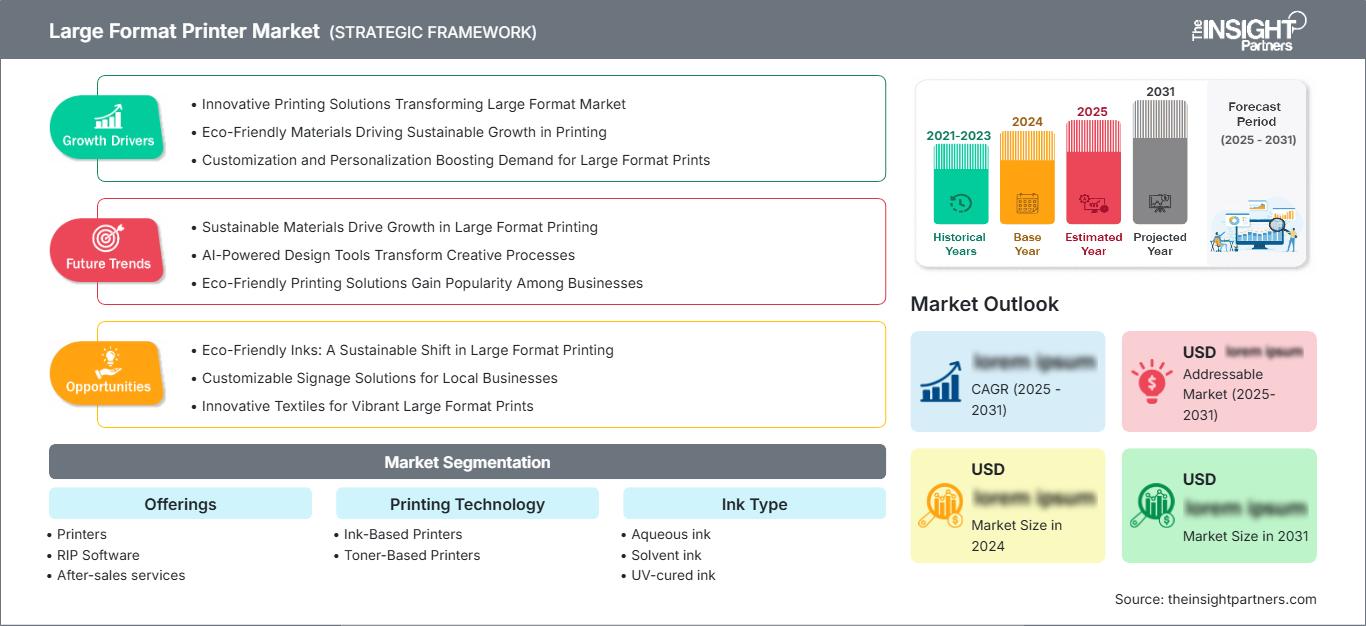
Regional Insights
North America Large Format Printer Market
North America is projected to have a 27-31% market share in 2025, and it is anticipated to grow at 3.2-3.9% CAGR up to 2034. It derives growth from well-established commercial printing facilities, replacement of aging fleet, and extensive usage in signage, advertising, CAD, and decorations. North America is also characterized by robust distribution channels and service providers.
The US makes up most of the regional demand, while Canada is driven by governmental applications, construction applications, retail applications, and institutional applications. In addition, Mexico will serve as another source for manufacturing and commercial-print demand in the region. Adoption of Large Format Printer Market is largely driven by factors such as productivity, security, remote monitoring, and low maintenance.
U.S. Large Format Printer Market
The US was responsible for 82–87% of North American consumption in 2025 and is expected to expand at a 3.3–4.0% CAGR until 2034. The industry receives support from the existence of well-established print service providers, advertising spends, construction, and the use of digital signage. Large Format Printer Market demand is diverse, encompassing retail graphics, vehicle wraps, technical illustrations, and décor.
Leading producers have an extensive US reach. HP Inc., Canon Inc., Seiko Epson Corporation, Ricoh Company, Ltd., and Xerox Holdings Corporation cater to both business and technical needs, whereas niche producers cater to signage and graphics. Applications trends include rapid delivery, customization, and the ability to switch between substrates without having to set up again.
Europe Large Format Printer Market
Europe’s share was forecast to be 24–28% in 2025 and to experience growth at a CAGR of 3.1–3.8% until 2034. Germany was the most important market due to industrial printing, technical documentation, manufacturing and advertisement. The importance of the UK market was due to commercial graphics, retail signs, events and specialized printing service providers. The Large Format Printer Market Share was additionally influenced by compliance with environmental requirements and replacement of solvent-based systems.
France, Italy and Spain provided additional demand for decor, textile, advertising and technical printing. France had advantages in commercial graphics and interior applications, Italy in textile and design, and Spain in retail signs and tourism graphics. European customers pay more attention not only to performance parameters but also to energy consumption, ink chemistry, waste and workflow automation.
APAC Large Format Printer Market
The APAC region had accounted for around 29–33% share of worldwide demand in 2025 and is projected to witness CAGR of 3.7–4.5% through 2034. China is the major country due to its manufacturing base, signage, textile production, and commercial printing. Japan and South Korea provide advanced adoption of equipment, whereas India provides increasing demand owing to advertising, infrastructure, textiles, and retail.
Australia offers technologically advanced but relatively smaller market. The industrialization, urbanization, digital advertisement, and textile manufacturing provide impetus to invest in equipment in this region. Growth in Large Format Printer Market is further spurred by government infrastructure development and adoption of digitally controlled printing.
Middle East & Africa Large Format Printer Market
Although demand for the Middle East and Africa segment is relatively low, it is driven by infrastructure, tourism, retail developments, and event graphics. In terms of regional usage, Saudi Arabia and the UAE dominate, whereas South Africa is the main market in sub-Saharan Africa. This region is forecast to grow at 3.8%-4.6% CAGR through 2034.
Infrastructure development in Saudi Arabia and commercial building in the UAE provide growth opportunities in signage and architecture, and there is well-developed print service infrastructure in South Africa. Demand in the rest of MEA is emerging via distributors and projects. Energy availability, cost of imported equipment, technical services, and infrastructure development are some of the key drivers in this region.
Segmentation Analysis
Offerings
Offerings are projected to expand at a 2.8–3.5% CAGR during 2026–2034. Printers remain the core revenue component, while RIP software and after-sales services increasingly influence equipment utilization, recurring revenue, maintenance quality, workflow integration, and customer retention.
- Printers: Printers remain the principal offering because throughput, substrate compatibility, resolution, and reliability directly determine production economics for commercial and industrial users.
- RIP Software: RIP software improves color management, nesting, queue control, automation, and device utilization, making workflow intelligence increasingly important in multi-printer production environments.
- After-sales services: After-sales services support uptime through preventive maintenance, technical assistance, consumables management, calibration, and repair, strengthening lifecycle economics for high-utilization customers.
Printing Technology
Printing Technology is forecast to grow at a 3.0–3.7% CAGR through 2034. Ink-based printers retain broad application flexibility, while toner-based platforms continue serving selected technical and production workflows requiring consistent output, controlled media handling, and dependable image reproduction.
- Ink-Based Printers: Ink-based printers dominate application flexibility because they accommodate diverse substrates and support signage, textile, décor, advertising, and technical requirements.
- Toner-Based Printers: Toner-based printers retain relevance where dry output, document consistency, and workflow familiarity provide advantages in selected technical and commercial printing environments.
Ink Type
Ink Type is expected to expand at a 3.2–4.0% CAGR during 2026–2034. Chemistry selection increasingly depends on substrate, drying speed, outdoor durability, indoor-air requirements, color performance, and finishing processes, encouraging customers to maintain differentiated equipment fleets.
- Aqueous ink: Aqueous ink remains important for photographic, technical, and indoor graphics where image quality, color accuracy, and relatively clean production environments are priorities.
- Solvent ink: Solvent ink supports durable outdoor graphics, banners, vehicle wraps, and signage because strong substrate adhesion and weather resistance remain valuable.
- UV-cured ink: UV-cured ink enables immediate curing and broad rigid-substrate compatibility, supporting high-mix production where rapid handling and minimal drying time improve throughput.
- Latex ink: Latex ink is increasingly relevant for indoor graphics and mixed applications because water-based formulations can combine productivity, durability, and reduced odor requirements.
- Dye sublimation ink: Dye sublimation ink supports textile and décor production by transferring color into polyester-based materials and enabling customized, short-run visual products.
Application
Application is projected to advance at a 3.4–4.2% CAGR through 2034. Signage remains a major demand center, while décor and apparel applications benefit from customization, shorter production cycles, digital design workflows, and growing preference for on-demand output.
- Apparel and Textile: Apparel and textile printing benefits from customization and shorter production runs, with digital workflows reducing dependence on long setup cycles and enabling localized production.
- Advertising: Advertising remains a substantial application because retailers, brands, venues, and agencies require banners, displays, promotional graphics, and campaign-specific visual materials.
- Cad and Technical Printing: CAD and technical printing provides stable demand from architecture, engineering, construction, manufacturing, and infrastructure workflows requiring precise drawings, plans, maps, and technical documentation.
- Signage: Signage remains strategically important across retail, transportation, events, commercial properties, and outdoor advertising, requiring durable output and rapid turnaround across diverse substrates.
- Decor: Décor is positioned as a comparatively high-growth application because digitally printed wallpaper, murals, flooring graphics, and interior surfaces enable customization and shorter production cycles.
Opportunity Snapshot
| Application | Revenue Contribution (High/Medium/Low) | Trend Tag | Adoption Stage |
|---|---|---|---|
| Apparel and Textile | Medium | On-Demand Textile | Scaling |
| Advertising | High | Campaign Graphics | Mature |
| Cad and Technical Printing | Medium | Digital Plans | Mature |
| Signage | High | Retail Graphics | Mature |
| Decor | Medium | Custom Interiors | Scaling |
Large Format Printer Market Growth Drivers and Impact Analysis
Expansion of Short-Run and Customized Production
Production economics in digital technology are evolving since customers are demanding custom graphics, localized campaigns, individualized fabrics, and small batch sizes. Traditional production methods may lose their attractiveness when there are frequent changes in graphics or production is fragmented. The use of large format digital printers makes the need for setup less significant, enabling print providers to switch quickly between digital files and final output. This enhances the potential for versatility of such systems in areas like signage, advertising, décor, and fabrics. Value may be derived by vendors through media, ink, workflow software, and service agreements. The implication is even greater for providers trying to diversify away from commoditized signage. Customers' demands are becoming diverse, with faster job changeover and automated color management becoming key factors in decision-making.
Integration of Printing With Digital Production Workflows
Integration in workflow management has become an important purchasing criterion, considering that print environments link design programs, RIP, production scheduling, cloud monitoring, and maintenance. The automation of pre-flight checks and job handling could minimize human interaction and increase uniformity in a decentralized fleet of devices. HP Inc., for instance, has added more digital links in design, print, and construction workflows, and other vendors are now adding remote monitoring and production-management features. Vendors therefore have more chance to distinguish themselves based on software-driven efficiency than mere hardware. In addition, integration can optimize asset management, consumables planning, and service responsiveness. If the customer operates several units, centralized management offers a convenient way of load-balancing.
Shift Toward More Efficient and Lower-Impact Printing
Environmentally based criteria are affecting ink choice, machine design, packaging, energy management, and waste minimization. Consumers are beginning to weigh odor, emissions, drying considerations, substrate recyclability, and energy usage along with print quality. Water-based latex and UV curable ink systems may be able to satisfy some of the criteria for indoor printing and mixed substrates while minimizing limitations of current processes. Automation of maintenance procedures and energy management capabilities are being incorporated by ink manufacturers as well. The latest DesignJet offerings from Hewlett-Packard, for instance, focus on recycling and energy savings, illustrating how environmentally based criteria are starting to play a role in product marketing rather than just product compliance.
Large Format Printer Market Future Trends
AI-Assisted Production and Predictive Workflow Management
Workflow solutions using AI technology are anticipated to evolve from offering help with design into making production decisions automatically. Future products could become capable of analyzing aspects such as job complexity, requirements for different types of media, usage of ink, available devices, and maintenance history in order to propose the best routes for production. In Large Format Printer Market Trends, production can be automatically distributed between printers, potential problems with quality of output can be predicted, and maintenance of the equipment can be scheduled depending on the load of the printers. Thus, companies that manufacture large format printers and have advanced software might benefit by offering more differentiated products despite their similar hardware features.
Greater Convergence Across Signage, Textile, and Décor Production
Expect the delineation between application-focused print environments to blur somewhat as flexible machinery offers greater flexibility in terms of substrates to print on. Providers of print services will be looking for a machinery platform which can cope with signage jobs during high times of advertising, textiles during seasonal campaigns, and decoration jobs during building or refurbishing seasons. This could help to enhance the efficiency of equipment and reduce the reliance on only one type of customer segment. The large format printer market manufacturers will be responding to this trend by creating modular machines, changing media systems, wider ink collections, and software to make changing applications simpler.
Large Format Printer Market Opportunities
Regionalized Textile and Apparel Production
The field of textile manufacturing continues to be a promising investment sector as companies try to reduce lead times and exposure while producing more tailored collections. Digital printing will allow for sampling, small batches, promotional products, and localized manufacturing without the setup costs associated with longer conventional runs. Investors can focus on integrated facilities with manufacturing, design, and ordering alongside the printing. Large Format Printer Market Forecasts need to consider the growing integration between printer usage and the economics of the entire textile production process. The most promising prospects will be where there is an overlap of garment manufacturing, e-commerce, and digital design abilities.
Digitally Enabled Décor and Architectural Graphics
Interior decoration presents a chance to expand digital printing from posters and banners into wallpaper, murals, window graphics, flooring and surface applications. The need for digital printing can be generated from hospitality, retail, residential customization and commercial interior projects. Investors should consider printers that can deliver decorative prints in different formats and still maintain the same color quality and substrate quality. The need to print becomes more enhanced where the printers are able to coordinate with designers, interior contractors, architects and installers of the printed material. A wider scope in the services offered will ensure the generation of project demands rather than single machine demand.
Recent Developments
- January 2025: Canon India launched seven new imagePROGRAF TZ and TX large-format printers, including the TZ-5320 and TX-5420/5320/5220 series, to address high-volume printing needs across graphic design, architecture, engineering, construction and corporate applications. The new models feature enhanced magenta ink and image-processing technology for more vivid colours, sharper lines and improved poster quality, while faster printing, automatic roll-paper detection, ink sensing and colour calibration are designed to reduce downtime and improve productivity.
- August 2026: HP unveiled the DesignJet XT870 24-inch large-format printer in India at Photo Video Asia 2026, introducing a more affordable entry-level solution for photographers and photo-printing businesses. The XT870 expands HP’s professional photo-printing portfolio alongside the DesignJet Z6 and Z9⁺ series, offering businesses greater flexibility across applications and price points while supporting high-quality, professional photo output.
- June 2026: Agfa expanded its presence in the UK and Nordic markets by appointing Friedheim International as a reseller for its advanced wide-format inkjet printing solutions. The partnership strengthens Agfa’s distribution network across these regions, providing customers with broader access to its wide-format printing technologies while leveraging Friedheim’s established market presence and industry expertise
Frequently Asked Questions

- Comprehensive Market Sizing and Forecast Analysis
- Detailed Segmentation Analysis
- In-Depth Market Dynamics Assessment
- Regional and Country-Level Insights
- Competitive Landscape and Company Benchmarking
- Strategic Business Intelligence
Recent Reports
Testimonials

The Insight Partners' SCADA System Market report is comprehensive, with valuable insights on current trends and future forecasts. The team was highly professional, responsive, and supportive throughout. We are very satisfied and highly recommend their services.
RAN KEDEM Partner, Reali Technologies LTDs
I requested a report on a very specific software market and the team produced the report in a few days. The information was very relevant and well presented. I then requested some changes and additions to the report. The team was again very responsive and I got the final report in less than a week.
JEAN-HERVE JENN Chairman, Future Analytica
We worked with The Insight Partners for an important market study and forecast. They gave us clear insights into opportunities and risks, which helped shape our plans. Their research was easy to use and based on solid data. It helped us make smart, confident decisions. We highly recommend them.
PIYUSH NAGPAL Sr. Vice President, High Beam Global
The Insight Partners delivered insightful, well-structured market research with strong domain expertise. Their team was professional and responsive throughout. The user-friendly website made accessing industry reports seamless. We highly recommend them for reliable, high-quality research services
YUKIHIKO ADACHI CEO, Deep Blue, LLC.
This is the first time I have purchased a market report from The Insight Partners.While I was unsure at first, I visited their web site and felt more comfortable to take the risk and purchase a market report.I am completely satisfied with the quality of the report and customer service. I had several questions and comments with the initial report, but after a couple of dialogs over email with their analyst I believe I have a report that I can use as input to our strategic planning process.Thank you so much for taking the extra time and making this a positive experience.I will definitely recommend your service to others and you will be my first call when we need further market data.
JOHN SUZUKI President and Chief Executive Officer, Board Director, BK Technologies
I wish to appreciate your support and the professionalism you displayed in the course of attending to my request for information regarding to infectious disease IVD market in Nigeria. I appreciate your patience, your guidance, and the fact that you were willing to offer a discount, which eventually made it possible for us to close a deal. I look forward to engaging The Insight Partners in the future, all thanks to the impression you have created in me as a result of this first encounter.
DR CHIJIOKE ONYIA MANAGING DIRECTOR, PineCrest Healthcare Ltd.Reason to Buy
- Informed Decision-Making
- Understanding Market Dynamics
- Competitive Analysis
- Identifying Emerging Markets
- Customer Insights
- Market Forecasts
- Risk Mitigation
- Boosting Operational Efficiency
- Strategic Planning
- Investment Justification
- Tracking Industry Innovations
- Aligning with Regulatory Trends





 Get Free Sample for