
Laser Markable Labels Market Size, Growth & Demand by 2034
Coverage: By Material (Plastic, Aluminium, Stainless steel, Others); Industry (Automotive, Food and Beverage, Logistics, Pharmaceutical, Consumer Goods, Others), and Geography (North America, Europe, Asia Pacific, and South and Central America)
- Status : Data Released
- Report Code : TIPRE00014087
- Category : Electronics and Semiconductor
- No. of Pages : 150
- Available Report Formats :


- Last update date : September 28, 2026


2025 Market Size
US$ 2.32 Bn
Base year value
2034 Forecast
US$ 5.04 Bn
Projected by 2034
CAGR 2026-2034
8.99 %
Growth rate
Addressable Market
US$ 32.91 Bn
(2026-2034)
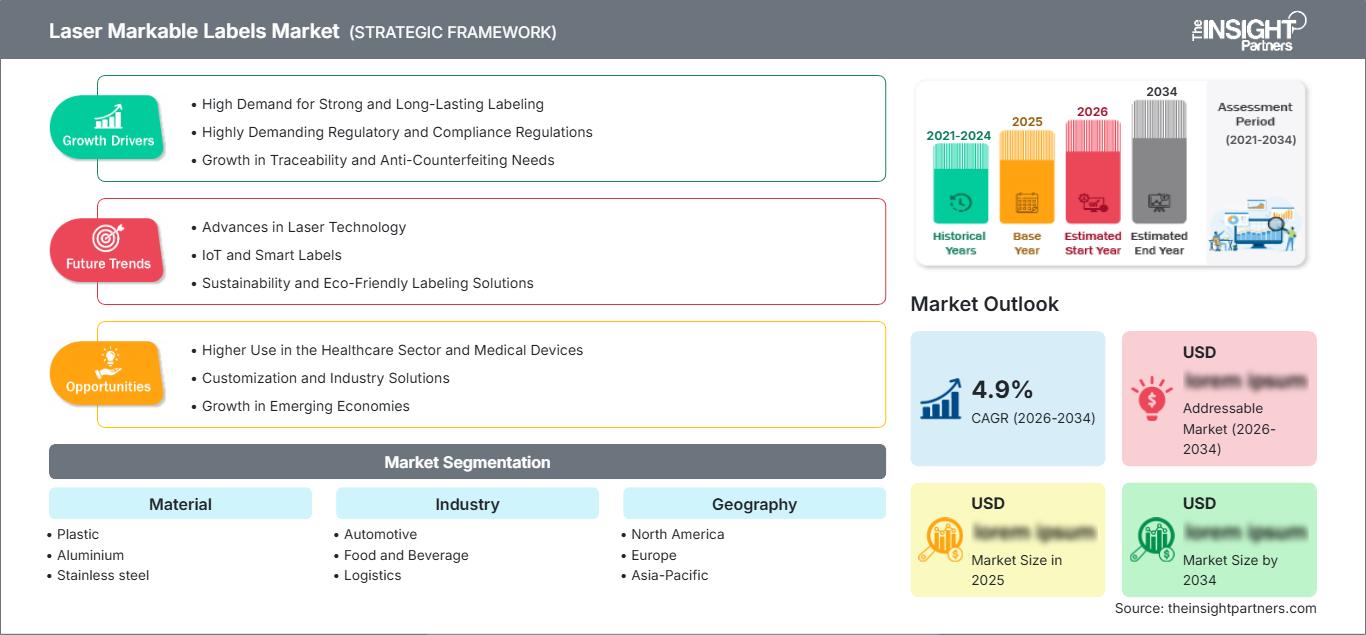
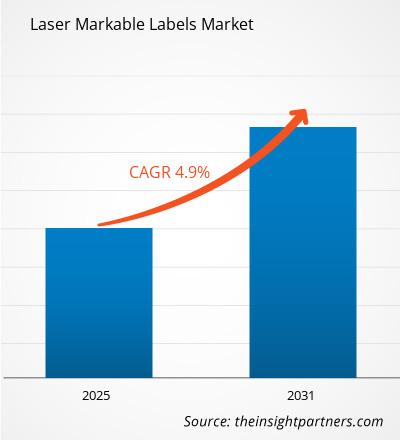
The Laser Markable Labels Market is positioned for sustained expansion as manufacturers increase adoption of permanent identification, traceability, anti-counterfeiting, and automated marking solutions. The market is valued at US$ 2.32 Billion in 2025 and is projected to reach US$ 5.04 Billion by 2034, registering a CAGR of 8.99% during 2026–2034. Growth reflects rising requirements for durable product identification across automotive, logistics, pharmaceutical, food and beverage, and industrial manufacturing applications.
North American demand is supported by automated manufacturing, stricter product identification practices, and expanding use of machine-readable codes across production environments. The Laser Markable Labels Market size is expected to advance at an estimated 7.2–7.8% CAGR through 2034, with demand strengthened by durable identification requirements, reshoring of selected manufacturing activities, and increasing integration of marking with inspection and production-control systems.
Laser Markable Labels Market Assessment and Insights
- North America: North America is expected to account for a 26–30% share in 2025 and expand at a 7.2–7.8% CAGR between 2026–2034, supported by automotive traceability, industrial automation, pharmaceutical identification, and demand for permanent labels capable of surviving demanding operating conditions.
- US: The US is estimated to represent 72–76% of North America's 2025 market, with a 7.0–7.6% CAGR between 2026–2034, driven by advanced manufacturing, logistics automation, and regulatory emphasis on durable product identification.
- Europe: Europe is projected to hold a 24–28% share in 2025 and grow at a 7.8–8.4% CAGR between 2026–2034, led by Germany, the UK, France, Italy, and Spain, where automotive manufacturing, industrial machinery, pharmaceuticals, and sustainability requirements support permanent labeling.
- Asia Pacific: Asia Pacific is estimated to command a 34–38% share in 2025 and expand at a 10.0–10.8% CAGR between 2026–2034. China, Japan, South Korea, India, and Australia are important markets, supported by electronics, automotive production, industrial automation, and export-oriented manufacturing.
- Largest Segment: Plastic is the largest material segment, with a 55–60% market share in 2025 and a 8.2–8.8% CAGR during 2026–2034, reflecting versatility, lightweight construction, and broad compatibility.
- High Growth Segment: Industry is the high-growth main segment, representing a 40–44% market share in 2025 and expanding at a 9.3–10.0% CAGR during 2026–2034 as traceability becomes embedded in production workflows.
- Key companies analyzed in detail: 3M Company, Brady Corporation, Camcode, Horizons Inc., KEYENCE Corporation, LINTEC Corporation, Nortec Group, Nippon Carbide Industries Co., Inc., tesa SE, Universal Laser Systems, Inc.
Source: The Insight Partners' analysis based on proprietary research, government publications, company annual reports, investor presentations, industry databases, and expert interviews.
The economics of label production are moving away from the traditional system of pre-printed label identity towards computer-controlled on-demand labeling. Dual layers, special coating, durable adhesives, and laser-friendly substrates are more commonly available for fine printing, serial numbers, bar codes, and 2D codes. The market for Laser Markable Labels thus depends more on material design, converting process, and optics, instead of merely supplying labels.
In the forecast period, the use of such labels will spread to manufacturing nations, where their factory production lines become more advanced in terms of tracking system, and labeling becomes a part of vision inspection systems. Investment in connectivity of production lines, anti-counterfeiting methods, and serialization will help drive the demand. Regulatory pressure over product origin and history may push the supplier companies to produce better labels.
Laser Markable Labels Market Report Scope
| Report Attribute | Details |
|---|---|
| Market size in 2025 | US$ 2.32 Billion |
| Market Size by 2034 | US$ 5.04 Billion |
| Global CAGR (2026 - 2034) | 8.99% |
| Historical Data | 2021-2024 |
| Forecast period | 2026-2034 |
Laser Markable Labels Market Analysis
The current demand trend is shifting from traditional labeling volumes towards traceability needs. The drivers for the growth of the Laser Markable Labels Market include automotive serialization, pharmaceutical identification, logistics tracking, electronics production, and industrial asset management. It comprises manufacturers of substrates, adhesive suppliers, label converters, laser equipment vendors, integrators, machine vision companies, and end-users. The supply side factors are driven by specialty films, metals, coatings, adhesives, converting capacities, and compatibility testing.
Substrate performance continues to matter since the labels need to withstand heat, wear and tear, chemicals, moisture, UV radiation, and frequent manipulation. Competitors battle over substrate performance and adhesive capabilities, while the converters fight for dimensional accuracy and dispensing efficiency. Production planning takes into account laser wavelength, marking rate, beam properties, and surface chemistry. Hence, the supply chain is technically integrated.
The competitive positioning of companies is now being achieved on the basis of offering comprehensive solutions for identification. As per Laser Markable Labels Market Report, 3M Company and Brady Corporation offer durable label material whereas tesa SE offers tamper evident and fast laser markable labels. KEYENCE Corporation integrates laser marking with automation and inspection, thus becoming relevant in cases where the quality of markings need to be validated at the same time.
Application specialists like Camcode, Horizons Inc., LINTEC Corporation, Nortec Group, Nippon Carbide Industries Co., Inc., and Universal Laser Systems, Inc. cater to niche applications including industrial identification, special materials, converting, and laser processing. Investments will be made in application engineering, material development, automatic dispensing, and fast marking. Those vendors who can integrate substrates, adhesives, marking processes, and inspection systems are likely to win in industrial programs.
● REPORT CUSTOMIZATION
Tailor This Report To Align With Your Specific Business Requirements
This report can be customized to align precisely with your business objectives, scope, and target markets. Customization options include tailored segmentation, geography, competitive analysis, and strategic insights to support informed decision-making.
Customize This Report →WHAT YOU CAN ADJUST
- ● Segmentations
- ● Geography
- ● Competitive Analysis
- ● Language Preferences
Laser Markable Labels Market: Strategic Insights
Regional Insights
North America Laser Markable Labels Market
North America accounts for an estimated 26–30% Laser Markable Labels Market share in 2025, and the region will experience a CAGR of 7.2–7.8% from 2025 to 2034. US is the major center of demand driven by automobile manufacturing, aerospace supply chain, pharmaceutical manufacturing, electronics and automation of warehouses. Permanent identification is becoming part of production control and not a labeling process. The market demand is also being influenced by investment in automated inspection and serialization of products.
Canada is making contributions with its demands from automobile, food processing, energy equipment and logistics industries, while Mexico is contributing by increasing the demand within the region by integrating its manufacturing with the US. There is increased demand for labels that are resistant to chemicals, abrasion, temperature changes and outdoor conditions. Label suppliers who have local converting capabilities and equipment compatibilities are able to shorten the qualification period.
U.S. Laser Markable Labels Market
The United States represents approximately 72–76% of North American market share of the 2025 total market, forecast to experience growth at CAGR of 7.0–7.6% up to 2034. Applications for labeling include automotive, pharmaceutical, electronics, logistics, and industrial equipment. Linking marking systems with machine vision, enterprise software, and automated material handling systems allows greater precision of serializations and less involvement of humans.
Competitors include: 3M Company, Brady Corporation, KEYENCE Corporation, tesa SE, and Universal Laser Systems, Inc. Trends in applications are: small label format, readability, security and durability, and identification. Reshoring and modernization are key drivers of demand due to on-demand printing of flexible ID systems which eliminate the need for pre-printed labels in inventories.
Europe Laser Markable Labels Market
In 2025, Europe is expected to hold a 24–28% market share and will continue to experience growth at a CAGR of 7.8–8.4% up to 2034, Germany being the largest country market in the region. Application drivers include automotive, machinery, pharmaceuticals, electronics, and industrial automation industries, while product traceability and circular-economy principles promote the use of durable identification systems. Established engineering tradition is another factor that drives the popularity of integrated marking and inspection systems in Europe.
The UK remains a market due to aerospace industry, pharmaceuticals, logistics, and advanced manufacturing, where serialization-based identification helps to manage the lifecycle of products. Germany enjoys high levels of adoption in automotive and machinery manufacturing owing to advanced automation ecosystem. Other contributing countries in Europe are France, Italy, and Spain with automotive industry, food processing, industrial machinery, and pharmaceuticals manufacturing. Buyers from the region tend to place importance on the long-life span, chemical resistance, security, and optimal materials utilization.
APAC Laser Markable Labels Market
The APAC region is predicted to have a share of 34-38% in 2025, growing at a CAGR of 10.0-10.8% until 2034 and accounting for the highest regional market. China dominates the region, whereas other countries like Japan, South Korea, India, and Australia help through industries such as electronics, automotive, machinery, pharmaceuticals, and logistics.
China has large-scale manufacturing, which helps in high-volume use of DPM technology, whereas Japan and South Korea focus on precision manufacturing and electronics. India has been increasing their industrial automation and localized manufacturing, thereby creating more scope for the industry. Australia is helping through industrial equipment and logistics.
Middle East & Africa Laser Markable Labels Market
MEA will witness a growth rate of 8.8%-9.6% CAGR until 2034. Saudi Arabia and the UAE are pioneers in their adoption on the back of diversification of industry, infrastructure, pharmaceuticals, and advanced manufacturing efforts. South Africa continues to be vital for the use of durable identification solutions in automotive, mining machinery, food processing, and general industrial applications.
MEA outside South Africa and Saudi Arabia's demand is growing with regards to infrastructure, energy equipment, consumer goods, and logistics. Harsh conditions of high temperatures, dust, chemicals, and outdoor applications have increased the need for abrasion and weather resistance of identification solutions. Increasing investments in industrial automation and localization of production can open more application possibilities; the UAE can become the region’s leader in logistics and manufacturing identification solutions.
Segmentation Analysis
Material
Material selection determines marking contrast, adhesion, environmental resistance, and expected service life. Plastic remains the leading material category, while aluminium and stainless steel serve applications requiring higher mechanical strength or metallic appearance. The material segment is projected to expand at an 8.2–8.8% CAGR during 2026–2034. The Laser Markable Labels Market scope increasingly favors substrates engineered for specific laser wavelengths, adhesive conditions, and operating environments.
- Plastic: Plastic labels maintain broad adoption because they combine lightweight construction, flexibility, chemical resistance, and compatibility with complex surfaces. They are widely suited to automotive components, electronics, logistics containers, and industrial equipment requiring variable identification.
- Aluminium: Aluminium supports applications requiring a metallic construction, dimensional stability, and resistance to demanding environments. Its positioning is strongest where identification must remain durable while maintaining a premium or industrial appearance.
- Stainless steel: Stainless steel serves severe-duty identification applications requiring strong resistance to corrosion, heat, abrasion, and mechanical exposure. Its strategic importance increases for industrial assets and equipment operating in demanding environments.
Industry
Industry applications in the Laser Markable Labels Market are expanding as identification becomes integrated into manufacturing execution, inspection, maintenance, and asset-tracking workflows. This segment is projected to grow at a 9.3–10.0% CAGR during 2026–2034. Demand varies by regulatory intensity, production complexity, product lifetime, and environmental exposure, making application engineering an important differentiator for suppliers serving multiple industrial verticals.
- Automotive: Automotive manufacturers require permanent identification for components, certification information, serial numbers, and traceability. Durable labels support high-volume production while maintaining readability through assembly, handling, service, and vehicle operation.
- Food and Beverage: Food and beverage operations increasingly use durable identification for equipment, containers, process assets, and logistics. Resistance to moisture, cleaning chemicals, temperature changes, and repeated washing supports adoption.
- Logistics: Logistics applications prioritize readable identification across handling, storage, transportation, and distribution. Laser-markable solutions can support serialized information where labels encounter abrasion, weather, repeated scanning, and variable operating conditions.
- Pharmaceutical: Pharmaceutical applications require reliable identification across packaging, equipment, laboratory assets, and production processes. Permanent marking supports traceability, quality control, and anti-counterfeiting requirements where information integrity is critical.
- Consumer Goods: Consumer goods manufacturers use durable identification for product authentication, component traceability, warranty management, and logistics. Flexible laser-markable constructions allow variable information while supporting shorter production runs and changing product configurations.
Opportunity Snapshot
| Industry | Revenue Contribution | Trend Tag | Adoption Stage |
|---|---|---|---|
| Automotive | High | Vehicle Traceability | Mature |
| Food and Beverage | Medium | Washdown Coding | Scaling |
| Logistics | Medium | Asset Tracking | Scaling |
| Pharmaceutical | Medium | Secure Identification | Scaling |
| Consumer Goods | Medium | Product Authentication | Scaling |
Laser Markable Labels Market Growth Drivers and Impact Analysis
Expansion of Automated Traceability Across Manufacturing
There is an increasing number of connections between ID procedures and production execution, machine vision, quality control, and warehouse management. This trend contributes to higher utility of labels that can be marked with lasers because ID procedures become integral parts of a continuous process of collecting data rather than a separate stage of packaging. Automotive and electronic products manufacturers will be able to correlate components with production lots, test results, and service histories using serial numbers. There are also benefits for logistics providers who need durable labels that keep readability despite multiple handling operations. There is also an additional factor that affects the demand for labels because buyers tend to assess vendors based on such criteria as marking accuracy, material compatibility, dispensing, and verification.
Rising Need for Durable Identification in Harsh Environments
Today’s equipment, vehicles, machinery, and production assets have an increased need for marking that stays legible in the presence of heat, chemicals, abrasion, moisture, ultraviolet light, and mechanical contact. Traditionally marked labels could be subjected to loss of contrast and adhesion due to such environmental factors, leading to risks. Specialized materials for laser marking allow solving this issue using special facestock, coatings, adhesives, and marking technologies. Car plants, food production, pharmaceuticals, and other industries will find the use of such materials beneficial for their identification purposes. This trend has more pronounced influence on the materials used for long-lasting assets. The development of better adhesion to low surface energy materials, resistance to aggressive cleaning, and high-speed laser systems is driving the improvement in the material segment.
Growth of Anti-Counterfeiting and Product Authentication Requirements
Pharmaceuticals, automotive components, electronic equipment, and consumer products are at risk from counterfeits and component substitution. Laser-markable labels may be designed to include serialized markings, tamper-resistant structure, high-contrast coding, and specific identification elements that deter reuse by unauthorized individuals. This is especially pertinent in situations where permanent identification is necessary during the life cycle of the product. The manufacturer may utilize laser marking technology in combination with database information, barcode checks, and verification systems to provide better identification of authentic products. The business implications include improved supply chain visibility since service providers and distributors will have means of checking the identity of the products and their history. With increasing demand for product authentication, suppliers offering material protection technologies and laser marking technologies will have an opportunity to participate in high-end identification applications.
Laser Markable Labels Market Future Trends
Integration of Intelligent Identification With Connected Production
The Laser Markable Labels Market trends are likely to shift toward identification systems that connect marking, verification, and production databases in real time. Future installations will increasingly generate unique identifiers automatically from manufacturing software, then verify readability through machine vision before products leave the production cell. This architecture can reduce manual data entry, strengthen genealogy records, and support rapid product changeovers. Suppliers are likely to develop label constructions optimized for faster marking, smaller codes, and improved contrast across diverse substrates. Another emerging direction is greater coordination between laser equipment, robotic handling, and automated dispensing. These developments should move laser-markable labels from passive identification components toward digitally orchestrated production assets that contribute directly to traceability, quality assurance, and lifecycle information management.
Higher-Speed, Lower-Impact Laser Marking Materials
Material development in the Laser Markable Labels Market is expected to focus on faster marking, cleaner ablation, reduced particulate generation, and improved compatibility with lower-energy processes. Advanced coatings can be engineered to respond efficiently to specific laser wavelengths, allowing manufacturers to increase throughput without compromising contrast or substrate integrity. This trend is especially relevant for high-volume automotive, electronics, and logistics operations where marking cycle time affects overall line productivity. Suppliers are also likely to improve adhesive formulations for recycled plastics, textured surfaces, painted metals, and low-energy substrates. Environmental considerations may encourage constructions that use less material while retaining required durability. Over time, customers could increasingly evaluate labels according to total process efficiency, including storage, dispensing, marking, inspection, waste, and replacement frequency, rather than acquisition price alone.
Laser Markable Labels Market Opportunities
Expansion of Specialized Solutions for Pharmaceutical Traceability
Pharmaceutical manufacturing provides an attractive opportunity because identification accuracy directly affects quality management, serialization, authentication, and lifecycle traceability. Suppliers can develop laser-markable constructions tailored to packaging equipment, production assets, laboratory tools, and temperature-sensitive environments. Investment opportunities extend beyond materials into automated application, verification, and software connectivity. Vendors capable of meeting strict cleanliness, chemical resistance, and readability requirements can build specialized product portfolios for pharmaceutical manufacturers and contract production organizations. Regional expansion in Asia Pacific and the Middle East can further broaden demand as pharmaceutical production becomes more geographically distributed. The Laser Markable Labels Forecasts therefore should consider application-specific material engineering as an important avenue for value creation, particularly where customers require long-term identification and documented traceability rather than conventional short-life labeling.
Development of Tamper-Evident and Authentication Label Platforms
Authentication in the Laser Markable Labels Market Forecast represents a strategic opportunity for suppliers seeking differentiation beyond conventional identification. Laser-markable films can be designed with destructive constructions, embedded security features, serialized information, or machine-readable codes that support product verification. Automotive components, pharmaceuticals, industrial equipment, and high-value consumer goods are potential targets because unauthorized substitution can create substantial commercial and safety consequences. Companies can invest in integrated platforms combining secure materials, laser processing, digital identifiers, and inspection software. Partnerships with equipment manufacturers and system integrators can accelerate qualification in production environments. Opportunity development should prioritize applications where security benefits justify specialized material costs. Such positioning can also create recurring demand for engineered label formats as customers expand serialization programs across product families and geographically distributed manufacturing networks.
Recent Developments
- August 2026: Mondi, a global leader in sustainable packaging and paper, has developed an award-winning packaging concept that combines a corrugated outer box with a recyclable, laser-marked flexible packaging. Designed for eCommerce and bag-in-box applications, the concept can be applied across a range of flexible packaging formats and demonstrates how innovative packaging design can support circularity and improve supply chain efficiency.
- June 2026: Americhem, a global leader in custom polymer solutions, announced the launch of its Laser Marking Solutions platform, a portfolio of masterbatches and engineered compounds designed to enhance laser marking performance across a wide range of polymer systems.
- September 2025: The MULTIVAC Group partnered with Videojet for Pack Expo Las Vegas 2025 (North Hall, Booth N-8222) to showcase a Videojet 7920 UV Laser Marking System Integrated inside a MULTIVAC Thermoforming Packaging Machine. The Videojett 7920 UV laser marking system delivers superior codes on a wide variety of paper and plastic packaging materials. The 7920 UV laser is seamlessly integrated into the MULTIVAC thermoforming packaging machine, creating a solution that delivers top-notch package quality, efficiency, and productivity. This solution showcases the capability of one laser to mark three tracks of packages, with washdown ratings up to IP65, and without the mess and costs associated with ink and printer ribbon.
Frequently Asked Questions

- Comprehensive Market Sizing and Forecast Analysis
- Detailed Segmentation Analysis
- In-Depth Market Dynamics Assessment
- Regional and Country-Level Insights
- Competitive Landscape and Company Benchmarking
- Strategic Business Intelligence
Recent Reports
Testimonials

The Insight Partners provided valuable market intelligence that supported our global go-to-market strategy. Their team was professional, responsive, and attentive to our feedback, providing thoughtful analysis and helpful methodological clarifications throughout the project.
Junmo Kim Chief Financial Officer (CFO), Enertech Co., Ltd.
The Insight Partners' SCADA System Market report is comprehensive, with valuable insights on current trends and future forecasts. The team was highly professional, responsive, and supportive throughout. We are very satisfied and highly recommend their services.
RAN KEDEM Partner, Reali Technologies LTDs
I requested a report on a very specific software market and the team produced the report in a few days. The information was very relevant and well presented. I then requested some changes and additions to the report. The team was again very responsive and I got the final report in less than a week.
JEAN-HERVE JENN Chairman, Future Analytica
We worked with The Insight Partners for an important market study and forecast. They gave us clear insights into opportunities and risks, which helped shape our plans. Their research was easy to use and based on solid data. It helped us make smart, confident decisions. We highly recommend them.
PIYUSH NAGPAL Sr. Vice President, High Beam Global
The Insight Partners delivered insightful, well-structured market research with strong domain expertise. Their team was professional and responsive throughout. The user-friendly website made accessing industry reports seamless. We highly recommend them for reliable, high-quality research services
YUKIHIKO ADACHI CEO, Deep Blue, LLC.
This is the first time I have purchased a market report from The Insight Partners.While I was unsure at first, I visited their web site and felt more comfortable to take the risk and purchase a market report.I am completely satisfied with the quality of the report and customer service. I had several questions and comments with the initial report, but after a couple of dialogs over email with their analyst I believe I have a report that I can use as input to our strategic planning process.Thank you so much for taking the extra time and making this a positive experience.I will definitely recommend your service to others and you will be my first call when we need further market data.
JOHN SUZUKI President and Chief Executive Officer, Board Director, BK Technologies
I wish to appreciate your support and the professionalism you displayed in the course of attending to my request for information regarding to infectious disease IVD market in Nigeria. I appreciate your patience, your guidance, and the fact that you were willing to offer a discount, which eventually made it possible for us to close a deal. I look forward to engaging The Insight Partners in the future, all thanks to the impression you have created in me as a result of this first encounter.
DR CHIJIOKE ONYIA MANAGING DIRECTOR, PineCrest Healthcare Ltd.Reason to Buy
- Informed Decision-Making
- Understanding Market Dynamics
- Competitive Analysis
- Identifying Emerging Markets
- Customer Insights
- Market Forecasts
- Risk Mitigation
- Boosting Operational Efficiency
- Strategic Planning
- Investment Justification
- Tracking Industry Innovations
- Aligning with Regulatory Trends





 Get Free Sample for