
Law Enforcement Biometrics Market Trends, Size & Growth by 2034
Coverage: By Type (Fingerprint Identification, Facial Recognition, Iris Recognition, DNA Analysis); Application (Defence and Homeland Security, Others) , and Geography (North America, Europe, Asia Pacific, and South and Central America)
- Status : Data Released
- Report Code : TIPRE00020275
- Category : Electronics and Semiconductor
- No. of Pages : 150
- Available Report Formats :


- Last update date : September 23, 2026


2025 Market Size
US$ 6.19 Bn
Base year value
2034 Forecast
US$ 13.66 Bn
Projected by 2034
CAGR 2026-2034
9.19 %
Growth rate
Addressable Market
US$ 88.71 Bn
(2026-2034)
The Law Enforcement Biometrics Market reached US$ 6.19 Billion in 2025 and is projected to attain US$ 13.66 Billion by 2034, registering a CAGR of 9.19% during 2026–2034. The expansion reflects stronger demand for accurate identity resolution across criminal investigations, border operations, booking, and intelligence workflows. Agencies are prioritizing interoperable platforms that combine capture quality, matching performance, auditability, cybersecurity, and evidence management within governed operational environments.
Across North America, the Law Enforcement Biometrics Market size is expected to expand at an estimated 8.6–9.2% CAGR through 2034. Modernization of federal, state, and local identification systems supports procurement, while wider access to interoperable fingerprint, face, and iris repositories increases operational utility. Cloud migration, mobile capture, and cybersecurity requirements are also shifting spending from isolated devices toward managed, multimodal identification platforms.
Law Enforcement Biometrics Market Assessment and Insights
- North America: Accounted for 36–39% Law Enforcement Biometrics Market share in 2025 and is forecast to grow at 8.6–9.2% CAGR between 2026–2034, supported by repository modernization, cross-agency interoperability, and mobile identity verification.
- US: Represented 80–84% of North American revenue in 2025, with 8.5–9.1% CAGR between 2026–2034 as federal and local agencies refresh biometric infrastructure.
- Europe: Held 24–27% share in 2025 and is projected to record 8.2–8.8% CAGR between 2026–2034, led by the UK, Germany, France, Italy, and Spain.
- Asia Pacific: Captured 22–25% share in 2025 and is expected to post 10.5–11.3% CAGR between 2026–2034, with China, Japan, South Korea, India, and Australia driving deployments.
- Largest Segment: Fingerprint Identification held 45–49% market share in 2025 and is anticipated to grow at 7.8–8.5% CAGR during 2026–2034.
- High Growth Segment: Facial Recognition represented 27–31% market share in 2025 and is forecast to expand at 11.4–12.2% CAGR during 2026–2034.
- Key companies analyzed in detail: 3M Cogent, Inc.; 4G Identity Solutions Pvt. Ltd.; Cross Match Technologies, Inc.; M2SYS Technology; NEC Corporation; IDEMIA Identity & Security France SAS; Aware, Inc.; Ayonix Corporation; Biometric Intelligence and Identification Technologies; and BioEnable Technologies Pvt. Ltd.
Source: The Insight Partners' analysis based on proprietary research, government publications, company annual reports, investor presentations, industry databases, and expert interviews.
Biometrics in Law Enforcement Market has grown from the era of Automated Fingerprint Identification System solutions into a modular multi-modal one involving fingerprinting, facial, iris scans, and DNA. Increasing importance of software is observed since there is a need to update algorithms, workflow management, quality control, and tools of examiners without replacing all endpoints. Production dynamics have shifted, since robust hardware, COTS cameras, cloud technology, and standard interfaces reduce integration complexity but certified hardware, cloud-based hosting, and professional integration are still important barriers.
During 2021 through 2034, adoption is likely to grow in the Asia Pacific and selected Middle Eastern countries where identity programs, border security, policing, and smart city initiatives use common infrastructure. Money will go to interoperable systems, sovereign cloud, liveness detection, and performance verification processes. Regulatory headwinds will be limited to those cases where procurement will be driven by purposeful data usage controls, retention policies, human reviews, and accuracy validation, otherwise, slower adoption and increased compliance cost can be expected.
Law Enforcement Biometrics Market Report Scope
| Report Attribute | Details |
|---|---|
| Market size in 2025 | US$ 6.19 Billion |
| Market Size by 2034 | US$ 13.66 Billion |
| Global CAGR (2026 - 2034) | 9.19% |
| Historical Data | 2021-2024 |
| Forecast period | 2026-2034 |
Law Enforcement Biometrics Market Analysis
Law Enforcement Biometrics Market growth is built on the requirement to identify identities fast through bookings, warrants, latent fingerprinting, border crossings, and background investigations. The demand increasingly revolves around multimodal matching owing to the fact that environmental conditions may compromise one mode of operation. Fingerprints continue to serve as a basis, and the other modalities include faces and irises.
The market consists of sensors, algorithms, system integration services, security cloud providers, forensic laboratories, and organizations that operate government repositories. The supply chain faces less constraints with respect to component availability and is more driven by certification, migration, data quality, and procurement issues. Open interfaces, standardized templates, and phased modernization will support faster adoption and capitalize on past investments.
In accordance with the Law Enforcement Biometrics Market report, there is a competitiveness difference between the full-stack public security companies and the software companies. While NEC Corporation and IDEMIA Identity & Security France SAS deal with holistic identification services, Aware, Inc., M2SYS Technology, Ayonix Corporation, and BioEnable Technologies Pvt. Ltd. take advantage of modules, orchestration, or geographic availability.
The funding in the Law Enforcement Biometrics Market is becoming subscription-oriented in software, sovereign computing, algorithmic improvement, and cyber resilience. 3M Cogent, Inc., 4G Identity Solutions Pvt. Ltd., Cross Match Technologies, Inc., and Biometric Intelligence and Identification Technologies remain competitive through the use of legacy systems and domain expertise. Strategic positioning involves tangible accuracy, user-friendly examiners, geographic availability, and effortless integration of fingerprint, face, iris recognition, and case management processes without any allegiance to any specific capturing technology.
● REPORT CUSTOMIZATION
Tailor This Report To Align With Your Specific Business Requirements
This report can be customized to align precisely with your business objectives, scope, and target markets. Customization options include tailored segmentation, geography, competitive analysis, and strategic insights to support informed decision-making.
Customize This Report →WHAT YOU CAN ADJUST
- ● Segmentations
- ● Geography
- ● Competitive Analysis
- ● Language Preferences
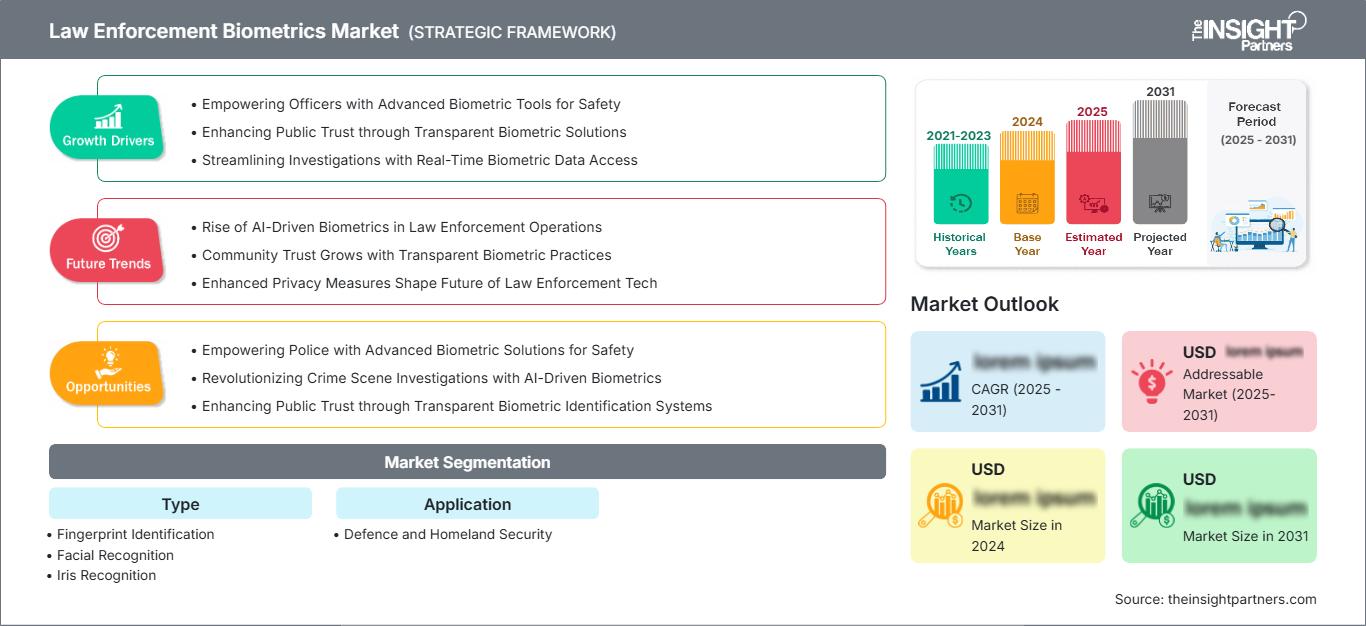
Law Enforcement Biometrics Market: Strategic Insights
Regional Insights
North America Law Enforcement Biometrics Market
North America held 36–39% of 2025 Law Enforcement Biometrics Market and is projected to expand at 8.6–9.2% CAGR through 2034. Market share of the Law Enforcement Biometrics segment includes developed fingerprint databases, large-scale public safety budgets, and frequent use of biometrics across federal, state, local, tribal and territorial organizations. According to DHS, IDENT is the biggest biometric repository of US government, featuring fingerprints, face images and irises.
Requirements for modernization are defined by cloud-native ABIS, mobile enrollment, latent workflow automation and interoperability with criminal history and border systems. CJIS-compliant cybersecurity measures, audit trail and human review become procurement requirements. Canada adds its contribution with border control, immigration and police modernization, but the US is still the main purchaser. Hence, the regional market forecast is more stable than the emerging one, since replacement cycle and software upgrades compensate the lack of growth of the whole database.
U.S. Law Enforcement Biometrics Market
The US accounted for 80–84% of North American revenue in 2025 and is expected to grow at 8.5–9.1% CAGR during 2026–2034. Demand includes booking stations, fingerprint identification, mugshot and latent face searches, border identity validation, background checking and applicant screening, and access defense capabilities. The FBI NGI-DHS IDENT interoperability initiative increases the population that can be accessed by authorized organizations from the federal level.
NEC Corporation, IDEMIA Identity & Security France SAS, Aware, Inc., M2SYS Technology, and legacy integrators have considerable operational presence through software and support solutions. There is increased preference for cloud-based systems among purchasers; however, agencies need CJIS compliance, connectivity, and forensic process workflow. The US market adoption also indicates an evolution in governance with use policy documentation, demographic performance testing, and verification of examiner results, especially for facial recognition systems.
Europe Law Enforcement Biometrics Market
Europe represented 24–27% of 2025 revenue and is forecast to advance at 8.2–8.8% CAGR. The UK is driven by legacy police fingerprinting, immigration control, and growing governance of facial recognition. Germany focuses on federal-state interoperability, data minimization, and certified implementations, driving the need for configurable solutions with advanced auditing capabilities.
France blends national policing, border protection, and identity document expertise. Meanwhile, Italy and Spain focus on migration management, forensic innovation, and cross-border information exchange. The EU AI Act sets stringent requirements regarding remote biometric identification, steering procurement to necessity assessments, authorization, logging, and human supervision. Therefore, regional development is assessed rather than unchecked. Suppliers have to prove their technology in terms of operational effectiveness, privacy-by-design approach, and integration into European data spaces. The UK is still the leader in national markets, while Germany provides sustainable upgrade needs and France maintains vibrant domestic biometrics industry.
APAC Law Enforcement Biometrics Market
Asia Pacific generated 22–25% of 2025 revenue and should record the fastest regional CAGR of 10.5–11.3%. China relies on massive infrastructure of public security, while India connects police modernization with national digital identity programs. Japan and South Korea emphasize accuracy and contactless technologies.
Australia offers border and law enforcement procurement with high assurance standards. In the region as a whole, urban surveillance, mobile policing, passport infrastructure expansion, and local technology capabilities underlie demand. Policy differences remain significant, leading to the importance of local hosting, language-specific matching, and governance for competition.
Middle East & Africa Law Enforcement Biometrics Market
Middle East & Africa is projected to expand at 9.6–10.4% CAGR through 2034. Saudi Arabia leads through border, defense, pilgrimage-management, and smart-infrastructure programs, while the UAE deploys advanced identity systems across airports and public services.
South Africa anchors demand in Sub-Saharan Africa through police, civil identity, and border modernization. Rest-of-MEA opportunities center on foundational registries, mobile enrollment, and secure checkpoints. Energy facilities and major transport investments create high-assurance access requirements, although procurement capacity, connectivity, and data-governance maturity vary widely.
Segmentation Analysis
Type
The Type segment is expected to grow at 8.8–9.5% CAGR during 2026–2034. Law Enforcement Biometrics Market scope increasingly covers interoperable modality portfolios rather than isolated engines. Agencies select technology according to evidentiary value, capture conditions, repository quality, response time, and legal authority. Fingerprints retain procedural maturity, facial recognition supports contactless search, iris strengthens high-assurance verification, and DNA analysis remains indispensable for forensic attribution despite longer workflows.
- Fingerprint Identification: Dominates established booking, background-check, and latent-evidence workflows because templates are standardized, repositories are extensive, and examiner practices are deeply embedded across criminal-justice systems.
- Facial Recognition: Gains demand for investigative leads, border processing, and mobile verification, while procurement increasingly requires liveness, demographic performance evidence, use-policy controls, and human confirmation.
- Iris Recognition: Serves high-assurance identity verification where contactless capture and low false-match risk are valued, especially at borders, detention facilities, and defense-controlled access points.
- DNA Analysis: Provides the strongest forensic differentiation for biological evidence and cold-case review, but laboratory capacity, chain-of-custody requirements, processing time, and privacy safeguards constrain routine field use.
Application
The Application segment is forecast to expand at 9.0–9.7% CAGR during 2026–2034. Demand is concentrated in defense and homeland security environments requiring rapid, defensible identity decisions across borders, bases, investigations, and watchlist operations. Spending favors platforms that connect enrollment, matching, intelligence, and case workflows while enforcing role-based access, retention policies, encryption, and complete audit histories.
- Defence: Represents mission-critical adoption across border control, counterterrorism, military access, disaster response, and interagency intelligence, where multimodal redundancy and secure repository exchange improve identification resilience.
- Homeland Security: Market is expanding through facial, fingerprint, iris, and DNA technologies, driven by border security, criminal identification, surveillance, digital policing, and advanced biometric integration
Opportunity Snapshot
| Application | Revenue Contribution | Trend Tag | Adoption Stage |
| Defence | High | Identity Fusion | Scaling |
| Homeland Security | High | Biometric Fusion | Scaling |
Law Enforcement Biometrics Market Growth Drivers and Impact Analysis
Modernization of Legacy AFIS and ABIS Infrastructure
There exist many agencies that maintain repositories based on obsolete equipment, legacy interfaces, and batch processing models. This time around, replacements have become focused on modular ABIS solutions that preserve enrollment files, maximize productivity, improve efficiency, and provide for interoperability across jurisdictions. The advantages of adopting cloud computing implementations are those of overcoming infrastructure refreshment difficulties, albeit at the cost of template translation, validation, cybersecurity certification, and continuity in the chain of evidence. Software providers able to provide upgrades on a modality-by-modality and workflow-by-workflow basis would lower risks. The consequence of modernization efforts will be increased software and services footprint in procurements that encompass data cleansing, integration, training, and support management. Modernization also provides an opportunity for specialized vendors that are interoperable with existing repositories and do not require complete replacement of those.
Expansion of Mobile and Multimodal Identification
The operational users of identity answers at traffic stops, border crossings, transfer sites, disaster areas, and spontaneous checkpoints have an increasing need for mobile solutions. Mobile fingerprinting, face recognition, and iris scanning speeds up the process between the encounter and the answer of the repository by combining multiple sensors which are robust against poor image quality, physical damage, lighting, or absence of information in one method alone. This has an effect on the business in the form of subscription licensing and fleet management, since agencies need to manage and support distributed devices. Those vendors with fast capture combined with role-based access, offline capability, and a defined path to qualified examiners will have the advantage.
Interagency Data Exchange and Border Security Mandates
Value is enhanced for police, immigration, border, and defense services where authorized biometric searches can be conducted on databases that exist outside their own jurisdiction. This is shown by the confirmation from the DHS that the IDENT database allows fingerprint matches to be shared with state, local, tribal, and territorial law enforcement organizations. Similar objectives apply to border transformation and international information sharing efforts. This creates a demand for procurement of solutions that support standardized template formats, identity deduplication, watchlist management, and auditable query routing. For vendors, there are two implications. Firstly, bigger business prospects open up in relation to gateway technologies and federated searches; secondly, compliance becomes important in areas such as encryption, purpose limitation, retention, and access. Vendors need to demonstrate that increased interoperability does not reduce governance.
Law Enforcement Biometrics Market Future Trends
Biometric Orchestration Becomes the Control Layer
Law Enforcement Biometrics Market trends will increasingly shift towards orchestration platforms which work to integrate multiple algorithms, sensors, repositories, and policy considerations through a single operational layer. It will not require the choice of a specific modality every single time; transactions can be routed on the basis of context, risk, image quality, and jurisdiction. Orchestration will make vendor comparison, fall back matching, centralization, and quick algorithm updating possible. Eventually, the purchase process may come to differentiate workflow management from matching engine procurement, thereby lowering lock-in and fostering healthy competition. This will also involve an increased emphasis on governance functionality since agencies require consistency with regard to the management of consent, retention, access, and audit.
Continuous Assurance Replaces One-Time Certification
Performance of biometrics in the future will be considered an operational responsibility as opposed to a deployment test. The authorities will analyze instances of false match, non-match, demographic discrepancies, live check results, examiner interventions, and system drift in a practical environment. Continuous assurance will be based on the combination of benchmarking data and local validation data, generating periodic need for testing, dashboards, model governance, and documentation of corrective measures. Algorithmic changes can be implemented via controlled release mechanisms and reversible deployments, especially in cloud computing environments. The above will benefit those suppliers who are able to demonstrate their performance metrics and allow for third-party evaluations.
Law Enforcement Biometrics Market Opportunities
Sovereign Cloud and Managed Modernization Services
Law Enforcement Biometrics Market Forecasts support investment in sovereign cloud environments that combine elastic computing with jurisdictional control over sensitive records. Suppliers can build recurring revenue by packaging migration assessment, template conversion, encryption, disaster recovery, continuous updates, and accredited operations as managed services. The opportunity is strongest among agencies that need modernization but lack specialist infrastructure teams. Successful offerings should permit hybrid deployment, preserve local evidence custody, and provide clear exit mechanisms to reduce lock-in concerns. Partnerships with government cloud providers and regional systems integrators can accelerate accreditation and support. Investors should prioritize platforms with reusable compliance controls, open interfaces, and documented migration tooling, because these capabilities lower delivery risk across multiple agencies while maintaining operational and legal separation.
Affordable Multimodal Platforms for Underserved Agencies
Smaller police forces and emerging-market agencies often face fragmented procurement, limited forensic staff, and restricted access to national repositories. Vendors can address this gap with configurable platforms that bundle certified capture, fingerprint and face matching, case workflow, and secure connectivity under predictable subscription pricing. Channel partnerships with local integrators can supply training, maintenance, language localization, and data-governance support. Investment should focus on modular products that begin with one workflow and scale without replacing the initial deployment. Shared service models can further improve economics while preserving tenant-level access controls. The opportunity is not simply lower-cost hardware; it is a complete operational package that reduces implementation complexity, supports audit readiness, and demonstrates measurable reductions in identification turnaround time.
Recent Developments
- July 2026: Integrated Biometrics is partnering with SIC Biometrics to bring its compact fingerprint-scanning technology to two new mobile biometric identification platforms designed for demanding field operations. The two systems—the Companion 50SiT Tomahawk and All-in-One G3—are built around Integrated Biometrics’ Five-0 fingerprint scanner. The company says the Five-0 is an FBI Appendix F-certified FAP 50 devices capable of complete 10-fingerprint enrollment in a compact, portable form factor.
- June 2026: IDEMIA Public Security has announced strong results in the latest National Institute of Standards and Technology (NIST) Evaluation of Latent Fingerprint Technologies (ELFT), highlighting the company’s advances in the speed and scalability of forensic fingerprint identification. The latest evaluation demonstrates IDEMIA’s ability to process latent fingerprint searches rapidly while maintaining the level of accuracy required for law enforcement and forensic investigations. The results position the company as a leading technology provider in the field of latent fingerprint identification.
- August 2026: FaceTec, Inc., has announced the release of its UR Codes August 2026 Update. The latest document highlights real-world applications of the UR Code model, including identity verification use cases designed to support critical and potentially life-saving situations. FaceTec’s UR Code is a full-stack digital identity credential protocol incorporated into a standard QR barcode. Unlike conventional passwords or physical identification cards, the technology uses cryptographic methods to link a person’s verified identity attributes directly to their 3D biometric facial data, providing a secure way to verify that an individual is genuinely associated with the claimed identity.
Frequently Asked Questions

- Comprehensive Market Sizing and Forecast Analysis
- Detailed Segmentation Analysis
- In-Depth Market Dynamics Assessment
- Regional and Country-Level Insights
- Competitive Landscape and Company Benchmarking
- Strategic Business Intelligence
Recent Reports
Testimonials

The Insight Partners' SCADA System Market report is comprehensive, with valuable insights on current trends and future forecasts. The team was highly professional, responsive, and supportive throughout. We are very satisfied and highly recommend their services.
RAN KEDEM Partner, Reali Technologies LTDs
I requested a report on a very specific software market and the team produced the report in a few days. The information was very relevant and well presented. I then requested some changes and additions to the report. The team was again very responsive and I got the final report in less than a week.
JEAN-HERVE JENN Chairman, Future Analytica
We worked with The Insight Partners for an important market study and forecast. They gave us clear insights into opportunities and risks, which helped shape our plans. Their research was easy to use and based on solid data. It helped us make smart, confident decisions. We highly recommend them.
PIYUSH NAGPAL Sr. Vice President, High Beam Global
The Insight Partners delivered insightful, well-structured market research with strong domain expertise. Their team was professional and responsive throughout. The user-friendly website made accessing industry reports seamless. We highly recommend them for reliable, high-quality research services
YUKIHIKO ADACHI CEO, Deep Blue, LLC.
This is the first time I have purchased a market report from The Insight Partners.While I was unsure at first, I visited their web site and felt more comfortable to take the risk and purchase a market report.I am completely satisfied with the quality of the report and customer service. I had several questions and comments with the initial report, but after a couple of dialogs over email with their analyst I believe I have a report that I can use as input to our strategic planning process.Thank you so much for taking the extra time and making this a positive experience.I will definitely recommend your service to others and you will be my first call when we need further market data.
JOHN SUZUKI President and Chief Executive Officer, Board Director, BK Technologies
I wish to appreciate your support and the professionalism you displayed in the course of attending to my request for information regarding to infectious disease IVD market in Nigeria. I appreciate your patience, your guidance, and the fact that you were willing to offer a discount, which eventually made it possible for us to close a deal. I look forward to engaging The Insight Partners in the future, all thanks to the impression you have created in me as a result of this first encounter.
DR CHIJIOKE ONYIA MANAGING DIRECTOR, PineCrest Healthcare Ltd.Reason to Buy
- Informed Decision-Making
- Understanding Market Dynamics
- Competitive Analysis
- Identifying Emerging Markets
- Customer Insights
- Market Forecasts
- Risk Mitigation
- Boosting Operational Efficiency
- Strategic Planning
- Investment Justification
- Tracking Industry Innovations
- Aligning with Regulatory Trends





 Get Free Sample for