
LED Tube Lights Market Trends, Size & Forecast by 2034
Coverage: By Size (Less Than 3 Feet, More Than 3 Feet); Application (Residential, Commercial, Industrial) , and Geography (North America, Europe, Asia Pacific, and South and Central America)
- Status : Data Released
- Report Code : TIPRE00022014
- Category : Electronics and Semiconductor
- No. of Pages : 150
- Available Report Formats :


- Last update date : September 23, 2026


2025 Market Size
US$ 9.42 Bn
Base year value
2034 Forecast
US$ 19.81 Bn
Projected by 2034
CAGR 2026-2034
8.61 %
Growth rate
Addressable Market
US$ 131.06 Bn
(2026-2034)
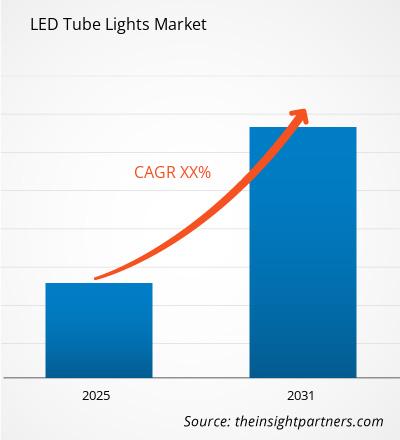
The LED Tube Lights market was valued at US$ 9.42 billion in 2025 and is expected to reach US$ 19.81 billion by 2034; it is estimated to record a CAGR of 8.61% during 2026-2034.
LED Tube Lights Market Assessment and Insights
- North America: North America accounted for a modelled 28–32% Led Tube Lights Market share in 2025 and is expected to grow at a CAGR of 8.9–9.6% between 2026–2034, supported by commercial retrofits, fluorescent replacement, and building-efficiency requirements.
- US: The US represented 83–87% of North America's 2025 value and is projected to grow at 8.8–9.5% CAGR, supported by warehouse, retail, education, healthcare, and office retrofits.
- Europe: Europe held an estimated 27–31% share in 2025 and is projected to expand at 9.3–10.0% CAGR, led by Germany, the UK, France, Italy, and Spain through fluorescent phaseouts and energy-efficiency policies.
- Asia Pacific: Asia Pacific represented 32–36% of 2025 demand and is expected to record 10.4–11.2% CAGR, with China, Japan, South Korea, India, and Australia supporting production, infrastructure, and replacement activity.
- Largest Segment: More Than 3 Feet held a modelled 61–65% market share in 2025 and is forecast to grow at 9.2–9.8% CAGR, reflecting commercial and industrial linear-lighting requirements.
- High Growth Segment: Industrial represented a modelled 28–32% share in 2025 and is projected to grow at 10.4–11.1% CAGR, supported by warehouses, factories, and high-hour operating environments.
- Key companies analyzed in detail: Acuity Brands, Inc., Eaton Corporation plc, Cree Lighting USA LLC, Current Lighting Solutions, LLC, Hubbell Incorporated, Signify N.V., LG Electronics Inc., Panasonic Corporation, Samsung Electronics Co., Ltd., LEDVANCE GmbH, and Zumtobel Group AG.
Source: The Insight Partners' analysis based on proprietary research, government publications, company annual reports, investor presentations, industry databases, and expert interviews.
In the Led Tube Lights Market, product development is shifting from basic fluorescent replacement towards higher efficacy tubes, universal ballast compatibility, main power connection, advanced optics, and material efficiency. Short tubes can accommodate compact fixtures, but long tubes will still play an important role in offices, warehouses, retail environments, and industry settings. The companies are also increasing their efforts on lumen maintenance, thermal management, switch robustness, and easier installation in order to cut the lifecycle cost and ease the transition of existing luminaire fittings.
The next step in the Led Tube Lights Market demand will be determined by the phase-out of fluorescent lights, replacement of the first generation of LED products, and deployment of connected lighting solutions. In Europe, demand is expected to be driven by regulations, but in the Asia Pacific region, both manufacturing volumes and infrastructure will influence the growth of demand. North America may be supported by commercial renovations and energy management initiatives.
LED Tube Lights Market Report Scope
| Report Attribute | Details |
|---|---|
| Market size in 2025 | US$ 9.42 Billion |
| Market Size by 2034 | US$ 19.81 Billion |
| Global CAGR (2026 - 2034) | 8.61% |
| Historical Data | 2021-2024 |
| Forecast period | 2026-2034 |
LED Tube Lights Market Analysis
Growth in the Led Tube Lights Market has been driven by the cost-efficiency benefits of replacing fluorescent lamps for applications that have prolonged usage periods. These lights can offer significantly reduced energy usage and operating life, while the capability for direct replacement means that many existing luminaire systems can continue to be used. As a result, office buildings, warehouses, schools, hospitals, retail stores, and industrial buildings will be recurrent sources of demand as fluorescent systems need to be replaced or updated to new standards.
The key players in the Led Tube Lights Market are LED chip manufacturers, driver and electronics for power suppliers, tube assembly manufacturers, optical component manufacturers, lighting OEMs, distributors, electrical contractors, and facility management companies. The supply factors consist of semiconductors, aluminum, polymers, drivers, phosphors, optics, and production capability in various geographical locations. Long tube lights require thermal and mechanical controls, while shorter ones require compactness. Signify N.V. and Acuity Brands, Inc. are some of the manufacturers which have tube lights integrated in their lighting solutions.
The Led Tube Lights Market report reveals that the key aspects considered during competitive analysis include efficiency, ease of installation, ballast compatibility, longevity, optics performance, safety, and overall costs. Signify N.V. is known for having a broad line of Philips LEDtube lights, whereas Acuity Brands, Inc. relies on its broad portfolio of commercial lighting solutions. Eaton Corporation plc and Hubbell Incorporated have already created an effective distribution system for electricity; Cree Lighting USA LLC and Current Lighting Solutions, LLC have professional LED applications. Contributions from Samsung Electronics Co., Ltd. and LG Electronics Inc. include their semiconductor technology.
Investments in the Led Tube Lights Market have been moving towards products which minimize hassle of conversion without changing the whole luminaire. LEDVANCE GmbH targets tube lights which can work with standard control gears and mains electricity supply, while the market is increasingly focusing on harsh industrial applications with high output and thermal resistance features. Hence, strategic positioning must strike a balance between minimizing hassle of installation, but still maintaining high efficacy and robust construction with lifetime guarantees.
● REPORT CUSTOMIZATION
Tailor This Report To Align With Your Specific Business Requirements
This report can be customized to align precisely with your business objectives, scope, and target markets. Customization options include tailored segmentation, geography, competitive analysis, and strategic insights to support informed decision-making.
Customize This Report →WHAT YOU CAN ADJUST
- ● Segmentations
- ● Geography
- ● Competitive Analysis
- ● Language Preferences
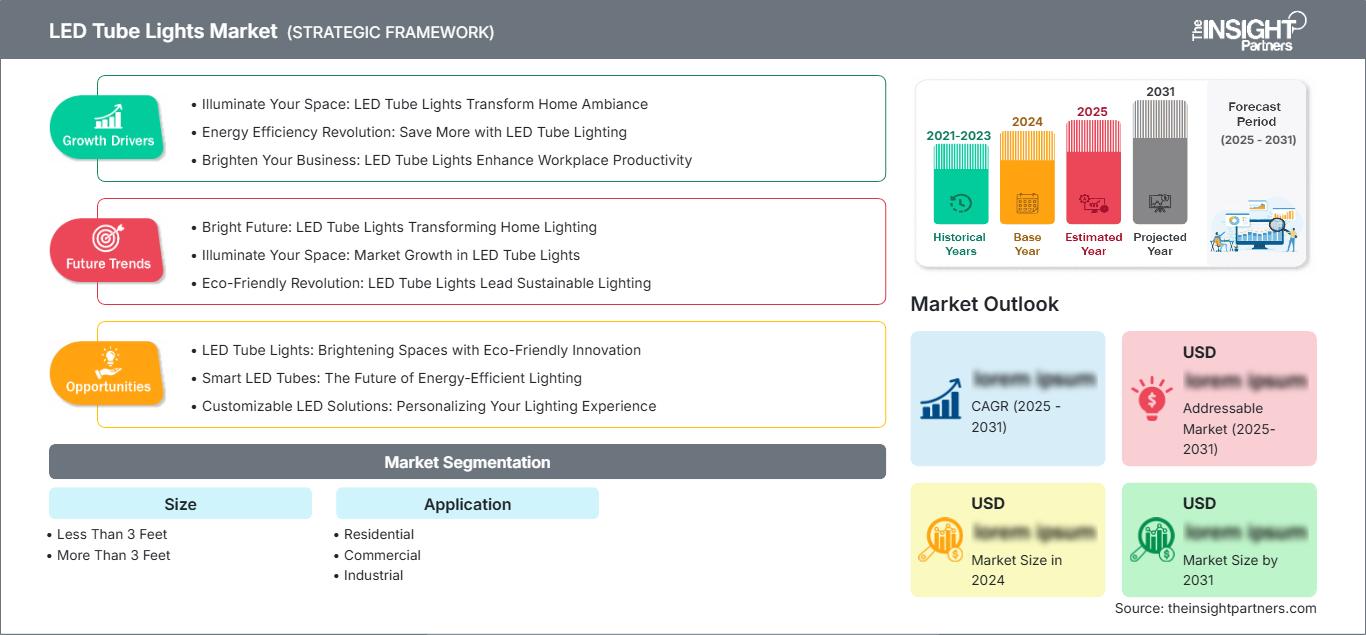
LED Tube Lights Market: Strategic Insights
Regional Insights
North America Led Tube Lights Market
North America accounted for 28–32% of global Led Tube Lights Market in 2025 and is projected to grow at 8.9–9.6% CAGR through 2034. The US is the main driver of the regional market due to commercial renovation, warehouse development, construction of educational institutions, health care buildings, and modernization of retail properties. LED tubes are still popular since it is possible to preserve existing fixtures for linear fluorescent light and save energy without performing luminaire replacement. The demand is stimulated in Canada by means of institutional retrofitting and energy efficiency campaigns.
Products that provide ease of installation, a long lifespan, appropriate electric systems, and efficient optics are preferred in the region now. Industrial establishments that have a long working schedule become a good target since the cost saving occurs faster. Acuity Brands, Inc., Eaton Corporation plc, Cree Lighting USA LLC, Current Lighting Solutions, LLC, and Hubbell Incorporated have already taken their places in professional lighting and electrical market sectors.
U.S. Led Tube Lights Market Market
The US represented 83–87% of North America's 2025 value and is expected to expand at 8.8–9.5% CAGR through 2034. The commercial building, warehouse, school, hospital, retail, and industrial sectors constitute the main consumer market segment. The cost structure of retrofit is favorable when the fixtures are used throughout many hours in a day and when the existing housings have the capacity to incorporate the tubes without requiring structural changes.
Some of the Led Tube Lights Market trends include energy efficient tubes, low flicker lights, consistency in colors, and being able to work with occupancy and daylight controls. Acuity Brands, Inc., Eaton Corporation plc, Cree Lighting USA LLC, Current Lighting Solutions, LLC, and Hubbell Incorporated serve many professional lighting markets. There is demand due to the upgrading of old fluorescent lamps. Consumers consider electrical compatibility, heat generation, warranties, installation time, and life-cycle costs besides lamp pricing.
Europe Led Tube Lights Market Market
Europe represented 27–31% of 2025 global value and is projected to grow at 9.3–10.0% CAGR, with Germany leading regional demand. The UK will continue to play a significant role in this market, with France, Italy, and Spain participating due to their industrial, commercial, and public building refurbishment activities. Regulations prohibiting inefficient lighting technologies will facilitate decisions in favor of the replacement and will strengthen the business case for LED tubes.
Led Tube Lights Market states that Germany combines manufacturing of industrial products, renovation of commercial properties, and strict requirements in terms of energy performance, which positively impacts tube quality demand. The UK will benefit from its commercial refurbishment activities and focus on efficient buildings. There will be growth in France, Italy, and Spain as offices, retail, hospitality, warehouse, and public properties become involved. Signify N.V. and LEDVANCE GmbH and others European vendors will focus on efficacy, mercury-free production, material efficiency, and installability.
APAC Led Tube Lights Market Market
APAC represented 32–36% of 2025 value and is expected to grow at 10.4–11.2% CAGR. China is at the forefront of the region due to the extent of their manufacturing capacity and domestic consumption, whereas Japan and South Korea focus on producing high-quality electronics and professional lighting products. India is growing due to commercial construction projects and infrastructural upgrades, and Australia facilitates growth through energy efficiency initiatives.
Industrial use, warehousing, office buildings, and infrastructure are key applications for LEDs. China integrates the breadth of their supply chain with high levels of domestic consumption, whereas India provides significant replacement opportunities due to the modernization of their lighting systems. Japan and South Korea facilitate premium product offerings, while Australia focuses on compliance and energy efficiency.
Middle East & Africa Led Tube Lights Market Market
Middle East and Africa is projected to expand at 8.7–9.5% CAGR through 2034. Demand comes from commercial construction, infrastructure development, hospitality development, and urban development from Saudi Arabia and the UAE. South Africa is still the most robust sub-Saharan market with support from both commercial and industrial construction. Rest of MEA is still fragmented but there are opportunities for replacement.
According to the Forecast of the Led Tube Lights Market Energy, efficiency is becoming an issue for large buildings and infrastructure in high-cost operations. Saudi Arabia and the UAE become significant players in modern offices, retail, hospitality, and public infrastructure, whereas South Africa becomes the main contributor in industrial and institutional application. Durable and thermally efficient tubes are strategic issues in hot climates, where overheating could have an impact on the durability and maintenance.
Segmentation Analysis
Size
The Size segment is projected to grow at a CAGR of 9.5–10.1% between 2026–2034. Longer tubes remain important because commercial and industrial luminaires frequently use linear formats requiring broad, uniform illumination. Shorter products retain relevance in compact fixtures, retrofit projects, and applications with limited installation space.
- Less Than 3 Feet: Less Than 3 Feet products serve compact fixtures and applications requiring shorter linear light sources. Their demand is concentrated in residential, specialty commercial, and space-constrained installations where fixture dimensions influence replacement selection.
- More Than 3 Feet: More Than 3 Feet products dominate professional linear applications because offices, warehouses, factories, retail stores, and institutional buildings commonly use longer luminaires requiring broad illumination and efficient coverage.
Application
According to the Led Tube Lights Market forecast, the Application segment is expected to expand at a CAGR of 9.9–10.5% through 2034. Commercial applications provide substantial demand because of large installed fluorescent populations, long operating hours, and energy-management objectives. Industrial facilities also provide attractive opportunities where extended operating schedules accelerate retrofit economics, while residential adoption remains linked to compact fixture replacement.
- Residential: Residential applications emphasize easy installation, familiar form factors, suitable color temperatures, and low operating costs. Demand is influenced by replacement of fluorescent fixtures and increasing consumer awareness of LED efficiency.
- Commercial: Commercial applications represent a major demand pool because offices, retail, schools, healthcare facilities, and hospitality properties use large numbers of linear luminaires. Retrofit projects increasingly prioritize efficiency, maintenance reduction, and consistent illumination.
- Industrial: Industrial applications require durable tubes capable of sustained operation in warehouses, factories, workshops, and production areas. Thermal reliability, switching durability, lumen maintenance, and suitability for demanding environments influence purchasing decisions.
Opportunity Snapshot
| Application | Revenue Contribution (High/Medium/Low) | Trend Tag (MAX 2 words) | Adoption Stage |
| Residential | Medium | Home Retrofit | Scaling |
| Commercial | High | Fluorescent Retrofit | Mature |
| Industrial | High | High-Hour Sites | Scaling |
LED Tube Lights Market Growth Drivers and Impact Analysis
Fluorescent Phaseout and Regulatory Efficiency Requirements
Government regulations targeting inefficiencies and mercury contamination in lighting have the effect of accelerating the replacement process for linear fluorescent lamps. More governments are using such regulations as energy performance standards, labeling, and hazardous material regulations to promote energy-efficient lighting. The IEA recognizes LED upgrade technology as a great opportunity for improving energy efficiency and states that LED tubes provide fast return on investment relative to fluorescent lights. These regulatory actions increase demand from discretionary replacement to mandatory replacement for tube suppliers. Buyers need to take into account product efficiency, safety, hazardous materials, and lifetime performance when purchasing products. This means a bigger replacement pool for LED tubes, especially in Europe, where there is a phaseout of fluorescent lamps.
Commercial Retrofit Economics and Reduced Maintenance Requirements
The commercial market is one where there is a lot of demand due to the fact that lighting equipment runs for long hours during the day and the savings in power and maintenance are very high. Offices, factories, schools, hospitals, and retail stores can make use of the LED tubes for modernizing their linear lighting fixtures without having to upgrade the whole luminaire assembly. Long-life may minimize the amount of labor required for changing lamps frequently, while the instant on performance and better optical control can help meet operational needs. Lighting is increasingly being looked at by facility managers on the basis of the total cost of ownership, not just the initial cost of the lamp. This helps the product that is more efficient and performs reliably electrically.
Improving LED Efficacy and Product Performance
Advancements in LED efficacies are not only giving it an increasingly greater performance edge over older fluorescent alternatives but also enabling the manufacturers to generate the required lighting effect with less energy input. Modern professional LED tube lights can offer good lumen output, long-life operation, better light color quality, and special optic effects. The developments make possible the use of LED tubes as replacements of traditional products for wider applications without any decrease in their lighting quality. There are product developments that have taken into consideration the ease of installation by introducing the use of universal tubes, mains-connected designs, and integration with existing control gear. For instance, Signify N.V. offers professional LEDtube products that cater to certain fluorescent replacements requirements. Greater performance levels will raise the worthiness of the product to industrial and commercial consumers.
LED Tube Lights Market Future Trends
Universal Compatibility and Simplified Retrofit Architectures
Futuristic tube designs may have more focus on universal compatibility, where products are compatible with several electrical set ups with minimum installation modifications. The strategy may lower the demand for man power and help procurement in facility management companies managing varied building portfolios. Products designed to function with mains, control gears or external driver systems may be used with different fixture types without the requirement for special stock keeping. The development may also promote manufacturers to improve installation safety, ballast detection, heat resistance and electrical insulation. With retrofits involving various building generations, compatibility may be a procurement factor just like efficacy.
Circular Materials and Longer-Life Tube Construction
Sustainability considerations are likely to influence tube construction, packaging, component selection, and end-of-life strategies. Manufacturers are beginning to incorporate recycled materials and reduce dependence on virgin plastics while maintaining mechanical strength and optical performance. Signify N.V. has already introduced an LED tube using post-consumer recycled plastic, demonstrating how material circularity can become a product-level differentiator. Future products may increasingly use recyclable housings, replaceable components, lower-material packaging, and designs supporting easier disassembly. Longer operating life will remain important because reducing replacement frequency lowers material consumption and maintenance requirements. Procurement teams may consequently assess environmental characteristics alongside efficacy, lifetime, electrical performance, and total cost.
LED Tube Lights Market Opportunities
Large-Scale Commercial Relighting Programs
Commercial relighting programs provide an attractive investment opportunity because large buildings often contain thousands of linear fixtures. Suppliers can target bundled solutions combining LED tubes, installation services, energy assessment, and controls compatibility. Such approaches can reduce decision complexity for building owners and accelerate deployment across multi-site portfolios. Opportunities are particularly strong in offices, schools, healthcare networks, retail chains, warehouses, and public buildings with standardized fixture inventories. Manufacturers can also develop application-specific product packages for high-ceiling warehouses, low-temperature storage areas, and high-hour industrial environments. Strategic partnerships with electrical distributors and contractors can improve project access, while digital audit tools can help identify replacement quantities and expected energy savings. The resulting opportunity extends beyond lamp sales into project-based retrofit services and recurring maintenance relationships.
Industrial and Infrastructure Replacement Platforms
Industrial and infrastructure applications offer opportunities for products engineered around demanding operating conditions rather than general-purpose replacement. Warehouses, factories, parking facilities, transport buildings, and public infrastructure require reliable illumination over extended operating schedules and may experience temperature variation, dust, vibration, or switching stress. Manufacturers can differentiate through reinforced construction, surge protection, high switching endurance, and application-specific optical distribution. Longer tubes are particularly relevant where broad illumination is required across large spaces. Infrastructure projects can also create demand for standardized procurement platforms covering multiple sites and fixture types. Suppliers that combine durable products with technical documentation, contractor support, and simplified replacement procedures can improve project adoption. Growth opportunities therefore exist in both new infrastructure and modernization of established industrial facilities.
Recent Developments
- May 2025: Signify N.V. — Signify introduced the Philips MASTER LEDtube T8 EM/mains using an average of 40% post-consumer recycled plastic in its tube construction. The company stated that the range would be upgraded across mainstream European markets and expanded to ASEAN, Indonesia, and Greater China, linking LED tube replacement with circular-material objectives.
- March 2025: Acuity Brands, Inc. — Acuity Brands Lighting showcased new lighting solutions at LEDucation 2025, including products from Gotham Lighting, Nightingale, nLight, and Peerless Lighting. The portfolio emphasized advanced LED lighting, controls, and application-specific performance, reflecting continued expansion of integrated LED solutions across professional commercial environments and supporting the broader transition from conventional linear systems.
- June 2025: LEDVANCE GmbH expanded its professional tube portfolio with products designed for fluorescent replacement applications, including T5 products compatible with electronic control gear. The company's 2025 product information also highlights universal T8 configurations and compatibility documentation, supporting simplified retrofit deployment across existing luminaires and different electrical configurations.
Frequently Asked Questions

- Comprehensive Market Sizing and Forecast Analysis
- Detailed Segmentation Analysis
- In-Depth Market Dynamics Assessment
- Regional and Country-Level Insights
- Competitive Landscape and Company Benchmarking
- Strategic Business Intelligence
Recent Reports
Testimonials

The Insight Partners provided valuable market intelligence that supported our global go-to-market strategy. Their team was professional, responsive, and attentive to our feedback, providing thoughtful analysis and helpful methodological clarifications throughout the project.
Junmo Kim Chief Financial Officer (CFO), Enertech Co., Ltd.
The Insight Partners' SCADA System Market report is comprehensive, with valuable insights on current trends and future forecasts. The team was highly professional, responsive, and supportive throughout. We are very satisfied and highly recommend their services.
RAN KEDEM Partner, Reali Technologies LTDs
I requested a report on a very specific software market and the team produced the report in a few days. The information was very relevant and well presented. I then requested some changes and additions to the report. The team was again very responsive and I got the final report in less than a week.
JEAN-HERVE JENN Chairman, Future Analytica
We worked with The Insight Partners for an important market study and forecast. They gave us clear insights into opportunities and risks, which helped shape our plans. Their research was easy to use and based on solid data. It helped us make smart, confident decisions. We highly recommend them.
PIYUSH NAGPAL Sr. Vice President, High Beam Global
The Insight Partners delivered insightful, well-structured market research with strong domain expertise. Their team was professional and responsive throughout. The user-friendly website made accessing industry reports seamless. We highly recommend them for reliable, high-quality research services
YUKIHIKO ADACHI CEO, Deep Blue, LLC.
This is the first time I have purchased a market report from The Insight Partners.While I was unsure at first, I visited their web site and felt more comfortable to take the risk and purchase a market report.I am completely satisfied with the quality of the report and customer service. I had several questions and comments with the initial report, but after a couple of dialogs over email with their analyst I believe I have a report that I can use as input to our strategic planning process.Thank you so much for taking the extra time and making this a positive experience.I will definitely recommend your service to others and you will be my first call when we need further market data.
JOHN SUZUKI President and Chief Executive Officer, Board Director, BK Technologies
I wish to appreciate your support and the professionalism you displayed in the course of attending to my request for information regarding to infectious disease IVD market in Nigeria. I appreciate your patience, your guidance, and the fact that you were willing to offer a discount, which eventually made it possible for us to close a deal. I look forward to engaging The Insight Partners in the future, all thanks to the impression you have created in me as a result of this first encounter.
DR CHIJIOKE ONYIA MANAGING DIRECTOR, PineCrest Healthcare Ltd.Reason to Buy
- Informed Decision-Making
- Understanding Market Dynamics
- Competitive Analysis
- Identifying Emerging Markets
- Customer Insights
- Market Forecasts
- Risk Mitigation
- Boosting Operational Efficiency
- Strategic Planning
- Investment Justification
- Tracking Industry Innovations
- Aligning with Regulatory Trends





 Get Free Sample for