
Dental Headlights Market Trends, Demand & Growth by 2034
Coverage: by Types ( Fiber Optic Light, Wireless LED, Micro LED ); Applications ( Hospitals, Dental Clnics ), and Geography (North America, Europe, Asia Pacific, and South and Central America)
- Status : Data Released
- Report Code : TIPRE00011779
- Category : Life Sciences
- No. of Pages : 150
- Available Report Formats :


- Last update date : August 24, 2026


2025 Market Size
US$ 2.49 Bn
Base year value
2034 Forecast
US$ 3.48 Bn
Projected by 2034
CAGR 2026-2034
4.28 %
Growth rate
Addressable Market
US$ 27.80 Bn
(2026-2034)
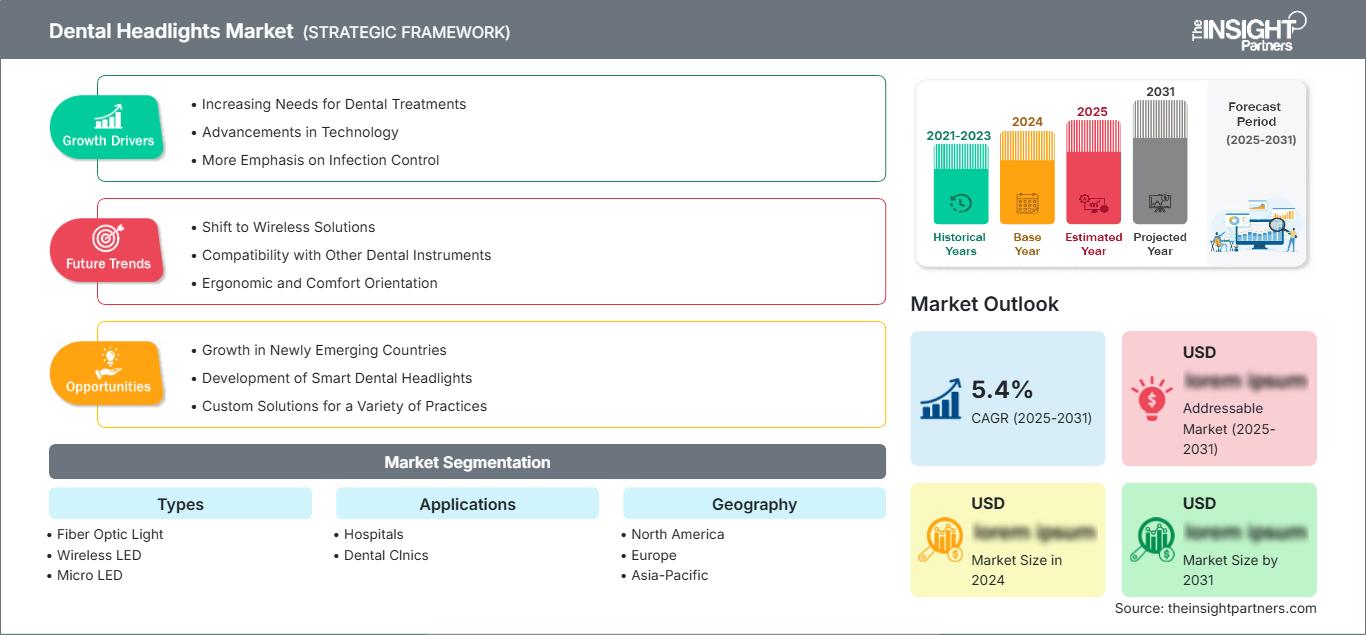
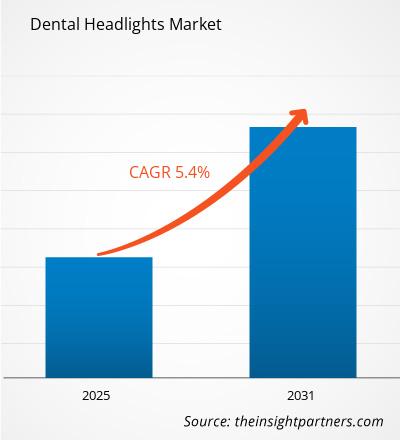
The Dental Headlights Market is valued at US$ 2.49 Billion in 2025 and is projected to reach US$ 3.48 Billion by 2034, registering a CAGR of 4.28% during 2026–2034. The market is witnessing an increase in the demand for lighting products owing to their use in precise dentistry procedures that require focused light, magnification, ergonomics, and visualization.
It is projected to grow at a CAGR of 4.70%–5.20% from 2026 to 2034. Growth drivers include high usage of magnification systems, developed dental practices, and upgrading old light instruments. Other factors impacting the Dental Headlights Market Size include preference for wireless lighting, good battery life, and integrated lighting solutions for long hours of clinical practice.
Dental Headlights Market Assessment and Insights
- North America: North America remains the leading regional market, with a 2025 share of 38–40% and CAGR of 4.70–5.20% between 2026–2034. Strong dental infrastructure and premium equipment adoption support sustained replacement demand.
- US: The US represents 66–70% of North American demand in 2025 and is projected to grow at a CAGR of 4.60–5.10% between 2026–2034, supported by advanced private practices.
- Europe: Europe accounts for 27–29% share in 2025 and is expected to grow at a CAGR of 4.00–4.70% during 2026–2034. Germany, the UK, France, Italy, and Spain remain important demand centers.
- Asia Pacific: Asia Pacific represents 20–22% share in 2025 and is projected to expand at a CAGR of 6.20–7.20% during 2026–2034. China, Japan, South Korea, India, and Australia support regional expansion.
- Largest Segment: Dental Clinics hold a 58–62% market share in 2025 and are projected to grow at a CAGR of 4.50–5.20% during 2026–2034, supported by private-practice utilization.
- High Growth Segment: Wireless LED represents a 30–34% market share in 2025 and is expected to register a CAGR of 6.80–7.60% during 2026–2034, driven by mobility and ergonomics.
- Key companies analyzed in detail: Carl Zeiss Meditec AG, LED Dental Inc., General Scientific Corporation, A-dec, Inc., MediLED, LumaDent, DENTALEZ, Practicon, Inc., KaVo Dental GmbH, and Trove.
Source: The Insight Partners' analysis based on proprietary research, government publications, company annual reports, investor presentations, industry databases, and expert interviews.
Development in technology has led to the evolution of the lighting system for dentistry from heavy and simple light sources to LED lights that are light and cordless and can be used with dental loupes. The distinguishing characteristics of these products now include light uniformity, color temperature, heat handling, battery life, and controls.
For future expansion, investment should go into emerging markets for dentistry where there are clinics growing along with specialist practices and dental education. Factors like regulation compliance, electrical safety, infection control, and quality of medical devices will play a major role in purchasing criteria. In future, focus of the investment should go into portability, energy management, compactness of the optics, and compatibility with current loupes rather than illumination hardware..
Dental Headlights Market Report Scope
| Report Attribute | Details |
|---|---|
| Market size in 2025 | US$ 2.49 Billion |
| Market Size by 2034 | US$ 3.48 Billion |
| Global CAGR (2026 - 2034) | 4.28% |
| Historical Data | 2021-2024 |
| Forecast period | 2026-2034 |
Dental Headlights Market Analysis
The demand pattern is driven by the requirements of clinicians who require constant illumination in the limited space of the oral cavity while performing various procedures, such as endodontics, implantology, restorations, and microsurgery in dentistry. Thus, the development of the Dental Headlights Market will depend on the cooperation between dental professionals, loupe manufacturers, optical component providers, LED providers, battery providers, distributors, and equipment dealers.
The supply network for Dental Headlights has quite modular design, enabling firms to purchase LEDs, optical components, battery packs, charging units, and head attachments from different companies. Although this makes it easier to configure a product, it also means that there is more attention paid to quality controls. The buyers look at total ownership cost and consider whether the device is compatible with their current magnification systems.
Positioning involves a change in scope from mere lighting to optics, ergonomics, and integrationin the Market Report. This is illustrated by the fact that Carl Zeiss Meditec AG focuses on visualization and ergonomic dentistry, while General Scientific Corporation, through SurgiTel, provides specialized lighting and loupes. A-dec, Inc. and DENTALEZ are interested in operatory ecosystems, while LumaDent concentrates on portability of clinical lighting.
The competition is widened by the specialist manufacturers like LED Dental Inc., MediLED, Practicon, Inc., KaVo Dental GmbH, and Trove. Cordless operation, beam control, battery systems, and hands-free controls become the future investments. According to the Dental Headlights Market Report, differentiation will rely heavily on clinical usability, interoperability, service, and lifecycle economics.
● REPORT CUSTOMIZATION
Tailor This Report To Align With Your Specific Business Requirements
This report can be customized to align precisely with your business objectives, scope, and target markets. Customization options include tailored segmentation, geography, competitive analysis, and strategic insights to support informed decision-making.
Customize This Report →WHAT YOU CAN ADJUST
- ● Segmentations
- ● Geography
- ● Competitive Analysis
- ● Language Preferences
Dental Headlights Market: Strategic Insights
Regional Insights
North America Dental Headlights Market
North America accounts for a 38-40% of the Dental Headlights Market share in 2025 and is forecasted to exhibit a CAGR of 4.70-5.20% till 2034. North America has a matured private dentistry scenario, the widespread usage of loupes, distribution of equipment, and robust replacement rates. High-end systems find favor owing to the need for lightweight design, constant illumination, and battery life.
The US will dominate the regional market, with support coming from advanced specialty facilities and dental service organizations. Canada will play its role through existing clinical infrastructure, whereas Mexico has long-term growth potential for private dental service provision. The region also has the advantage of manufacturers and distributors with existing clinical ties. Regulation status for dental operating lights in the US provides a framework for compliance.
U.S. Dental Headlights Market
The United States accounts for 66-70% of North America's demand in 2025 and is projected to witness growth at a CAGR of 4.60-5.10% from 2026 to 2034. The adoption of the technology is observed in private dental clinics, specialty clinics, dental colleges, and high volume clinics. Leading players such as Carl Zeiss Meditec AG, General Scientific Corporation, A-dec, Inc. and others hold presence in the market through visualization, operatory, and illumination solutions.
Cordless and loupes mounted systems are gaining popularity for procedures that require mobility. Endodontic, Implantology, cosmetic dentistry, and restorative surgeries drive the need for controlled lighting and proper color perception. Replacement purchases are also significant due to the fact that the importance of lighting as part of the ergonomic working station is increasing.
Europe Dental Headlights Market
In Europe, the market is estimated to be a 27-29% share in 2025 and expected to register a CAGR of 4.00-4.70% till 2034, where Germany emerges as the largest country. The UK and German markets serve as important demand bases, thanks to robust dental infrastructure and ergonomics.
The UK is a preferred location for advanced private and specialist practices whereas Germany gains benefit due to precise engineering and established medical device industry. France, Italy, and Spain contribute additional demand from private dental practices, education in dentistry, cosmetology services, and replacement of aging illumination systems. Procurement in Europe is becoming more conscious of longevity of products, infection control, and regulatory aspects.
APAC Dental Headlights Market
The APAC region has a share of 20-22% in 2025 and is expected to experience growth at a CAGR of 6.20-7.20%. China is the major country, and Japan, South Korea, India, and Australia represent individual demand pockets. Growth in clinics and improvement in availability of professional equipment aid market adoption.
The technical prowess in optical devices and electronic production is an advantage to the supply side in the market, while the development in the healthcare industry and initiatives in dentistry are on the demand side. The large markets for portable equipment are India and China; Japan and South Korea specialize in technical precision.
Middle East & Africa Dental Headlights Market
The Middle East and Africa region is projected to grow at a CAGR of 5.80-6.80% and the driving factor for this region will be Saudi Arabia. The region of UAE has an advantage of advanced private healthcare infrastructure and the medical tourism facility. South Africa offers an existing dental services market, while Rest of MEA continues to remain segmented.
Energy availability, infrastructure investments in healthcare, and urbanization play an important role in the buying trends of the region. In high income regions, cordless lights and those which are compatible with loupes are sought-after, while in emerging regions durability and cost play a key role.
Segmentation Analysis
Types
The Types segment is projected to grow at a CAGR of 4.60–5.40% during 2026–2034. Technology selection depends on illumination consistency, portability, beam quality, operating duration, and compatibility with magnification systems. Wireless formats increasingly address ergonomic requirements, while fiber-based systems retain relevance where dependable, established illumination architectures remain preferred. The Market scope consequently spans both replacement-driven demand and technology-led upgrades.
- Fiber Optic Light: Fiber Optic Light remains relevant where clinicians prioritize established illumination architectures, stable beam delivery, and integration with existing equipment. Demand is concentrated in practices valuing proven clinical workflows.
- Wireless LED: Wireless LED benefits from cordless mobility, lower cable interference, compact battery systems, and compatibility with loupe-mounted workflows. Its strategic importance increases as practitioners prioritize ergonomic freedom.
- Micro LED: Micro LED supports compact optical designs and precise illumination delivery. Its strategic role is linked to miniaturization, lower device weight, and opportunities to integrate advanced control functions.
Applications
The Applications segment is projected to grow at a CAGR of 4.10–5.00% during 2026–2034. Purchasing behavior differs between institutional and private settings, with clinics emphasizing clinician-level portability and hospitals prioritizing standardized equipment, reliability, and procedural compatibility. The segment determines how suppliers structure distribution, service, warranty, and procurement models across diverse dental environments.
- Hospitals: Hospitals require dependable illumination for oral surgery, specialist dentistry, trauma management, and complex procedures. Centralized procurement tends to emphasize durability, regulatory documentation, service support, and compatibility with broader clinical infrastructure.
- Dental Clnics: Dental Clnics generate broad recurring demand across general, cosmetic, restorative, orthodontic, and endodontic procedures. Private practices increasingly value portable systems that support individual clinicians and flexible operatory configurations.
Opportunity Snapshot
| Applications | Revenue Contribution (High/Medium/Low) | Trend Tag | Adoption Stage |
|---|---|---|---|
| Hospitals | Medium | Surgical Precision | Mature |
| Dental Clnics | High | Loupe Integration | Scaling |
Dental Headlights Market Growth Drivers and Impact Analysis
Rising Adoption of Magnification-Based Dentistry
With more frequent use of dental loupes and microscopic procedures, there will be a greater significance placed on light sources that are in alignment with the clinician’s viewing axis. With coaxial lighting and loupe lighting, shadows due to head positioning of the clinician are reduced and visibility in tight fields is maintained. These issues directly impact on the design process since light weight, balance, diameter of beam, location of batteries, and ability to mount have to be considered together. The result of the above is that demand moves away from standard lighting to lighting that takes into account the clinician’s visual flow. In this manner, manufacturers who are able to show ergonomic advantages will have a distinct advantage in specialist practices, while distributors can use the compatibility of the lumens with loupes as a purchasing criteria.
Expansion of Private Dental Practice Networks
With the ongoing evolution of organized dental clinics and multi-chair practices, more opportunities for structured equipment purchases arise. Contrary to individual practitioners, organized clinics can have standardized lighting requirements in several operatories, thus generating repeat purchases of matching headlight systems and replacement parts. Standardization adds more value to service agreements, battery exchange programs, education, and distribution channel support. For developing markets, new clinic creation triggers the first-time equipment purchases, whereas developed markets give rise to replacement demand due to upgrading of practice's clinical workstation. Manufacturers who offer flexible systems at various price points may be able to handle both situations without breaking up their distribution channels. From the business perspective, the point is especially important for wireless systems due to the ability of their cordless operation to facilitate transfers between operatories.
Improved LED Efficiency and Portable Power Architecture
Advances in LED efficiency, thermal control, optical miniaturization, and rechargeable battery technology are improving the practicality of portable clinical illumination. Better power management allows manufacturers to balance brightness with operating duration without substantially increasing device weight. This directly addresses a longstanding purchasing tension between illumination performance and practitioner comfort. Compact battery modules also allow suppliers to develop modular product families, using common power platforms across different light heads and mounting configurations. For buyers, this can reduce accessory complexity and simplify replacement cycles. The commercial effect is a gradual migration toward products that deliver consistent output while minimizing interruptions during procedures. Suppliers that combine efficient LEDs with robust charging systems and replaceable components can strengthen lifecycle economics. This driver also encourages innovation in controls, including tactile, proximity, and other hands-free interfaces that reduce unnecessary contact during clinical workflows.
Dental Headlights Market Future Trends
Smart Illumination and Context-Aware Controls
Future systems in the Dental Headlights Market Trends are likely to incorporate increasingly intelligent controls that adjust illumination according to procedure requirements, ambient conditions, or clinician preferences. Instead of relying solely on manual intensity changes, manufacturers can develop preset profiles for restorative, endodontic, surgical, and examination workflows. Proximity sensing and hands-free activation may become more common where contamination control and uninterrupted procedures are priorities. Integration with loupe systems could allow clinicians to control illumination without shifting posture or interrupting treatment. Another potential direction is synchronization with cameras and visualization platforms, enabling lighting and image capture to operate as a coordinated system. Such development would move the category beyond a standalone light source toward a connected clinical accessory. Suppliers that establish reliable software interfaces and intuitive controls may gain differentiation as dental practices increasingly evaluate equipment according to workflow efficiency rather than illumination output alone.
Higher-Precision Optical Performance for Specialty Dentistry
Specialty dentistry is expected to push product development toward tighter control of beam shape, color rendering, glare reduction, and illumination uniformity. Endodontic and microsurgical procedures require visibility in narrow fields where inconsistent light can obscure anatomical details. Restorative and cosmetic procedures similarly place greater emphasis on accurate visual assessment of materials and tissues. Future products may therefore combine compact LED arrays with refined lenses, filters, and adjustable beam profiles. Manufacturers are also likely to focus more closely on eye comfort, especially for clinicians who perform lengthy procedures under magnification. These requirements create opportunities for differentiated optical architectures rather than incremental brightness increases. Over time, product specifications may increasingly emphasize measurable visual performance, ergonomic integration, and procedure-specific configurations. This trend should favor suppliers with strong optical engineering capabilities and clinical-development partnerships.
Dental Headlights Market Opportunities
Localized Product Platforms for Emerging Dental Markets
Manufacturers can pursue localized product strategies in markets where dental clinic infrastructure is expanding but premium equipment remains sensitive to acquisition cost. Modular platforms can combine a common optical core with different battery configurations, mounting systems, charging accessories, and service packages, allowing suppliers to address varied purchasing conditions. Local assembly or regional distribution can shorten delivery cycles and improve availability of replacement batteries and components. Partnerships with dental schools, distributors, and organized clinic networks can also accelerate product familiarization without requiring extensive direct sales infrastructure. The Dental Headlights Market Forecasts point toward opportunities where portable systems can serve both established private clinics and mobile or community-oriented dental services. Investors should prioritize platforms with scalable manufacturing, replaceable components, and straightforward maintenance requirements. Such characteristics can support penetration without compromising the technical attributes expected from professional clinical illumination.
Integrated Illumination Packages for Dental Training and Clinics
Dental education represents a strategically attractive channel because equipment preferences formed during training can influence later professional purchasing behavior. Suppliers can develop bundled packages combining loupes, headlights, mounting accessories, batteries, and training support for students and early-career clinicians. Institutions can benefit from standardized equipment that simplifies teaching and maintenance across laboratories and simulation environments. Manufacturers can also use these settings to collect structured feedback on ergonomics, beam quality, battery endurance, and user interface design before broader commercial deployment. The opportunity is not limited to education because similar packages can be adapted for new dental practices and multi-chair clinics. A coordinated portfolio can increase recurring accessory sales while improving compatibility across product generations. Suppliers that establish institutional relationships early may create longer customer lifecycles and improve conversion from entry-level equipment to premium clinical systems.
Recent Developments
- June 2026: Carl Zeiss Meditec AG announced that Carl Zeiss AG intends to acquire additional shares in Carl Zeiss Meditec AG worth up to €200 million. The move reinforces long-term strategic support for the medical technology business, which includes dental visualization and illumination solutions.
- December 2025: General Scientific Corporation, through SurgiTel, introduced the Odyssey Digital LED Headlight, an upgraded portable illumination system for dental and surgical procedures. The product development emphasizes brighter illumination and digital functionality, extending the company's portfolio of clinician-focused LED lighting systems.
- July 2025: LumaDent introduced its upgraded Tactile Control Cable for its 360-series dental headlights. The redesigned control uses a low-profile tactile switch, supports multiple mounting configurations, and was developed to improve ergonomic operation and durability during clinical use.
Frequently Asked Questions

- Comprehensive Market Sizing and Forecast Analysis
- Detailed Segmentation Analysis
- In-Depth Market Dynamics Assessment
- Regional and Country-Level Insights
- Competitive Landscape and Company Benchmarking
- Strategic Business Intelligence
Recent Reports
Testimonials

The Insight Partners' SCADA System Market report is comprehensive, with valuable insights on current trends and future forecasts. The team was highly professional, responsive, and supportive throughout. We are very satisfied and highly recommend their services.
RAN KEDEM Partner, Reali Technologies LTDs
I requested a report on a very specific software market and the team produced the report in a few days. The information was very relevant and well presented. I then requested some changes and additions to the report. The team was again very responsive and I got the final report in less than a week.
JEAN-HERVE JENN Chairman, Future Analytica
We worked with The Insight Partners for an important market study and forecast. They gave us clear insights into opportunities and risks, which helped shape our plans. Their research was easy to use and based on solid data. It helped us make smart, confident decisions. We highly recommend them.
PIYUSH NAGPAL Sr. Vice President, High Beam Global
The Insight Partners delivered insightful, well-structured market research with strong domain expertise. Their team was professional and responsive throughout. The user-friendly website made accessing industry reports seamless. We highly recommend them for reliable, high-quality research services
YUKIHIKO ADACHI CEO, Deep Blue, LLC.
This is the first time I have purchased a market report from The Insight Partners.While I was unsure at first, I visited their web site and felt more comfortable to take the risk and purchase a market report.I am completely satisfied with the quality of the report and customer service. I had several questions and comments with the initial report, but after a couple of dialogs over email with their analyst I believe I have a report that I can use as input to our strategic planning process.Thank you so much for taking the extra time and making this a positive experience.I will definitely recommend your service to others and you will be my first call when we need further market data.
JOHN SUZUKI President and Chief Executive Officer, Board Director, BK Technologies
I wish to appreciate your support and the professionalism you displayed in the course of attending to my request for information regarding to infectious disease IVD market in Nigeria. I appreciate your patience, your guidance, and the fact that you were willing to offer a discount, which eventually made it possible for us to close a deal. I look forward to engaging The Insight Partners in the future, all thanks to the impression you have created in me as a result of this first encounter.
DR CHIJIOKE ONYIA MANAGING DIRECTOR, PineCrest Healthcare Ltd.Reason to Buy
- Informed Decision-Making
- Understanding Market Dynamics
- Competitive Analysis
- Identifying Emerging Markets
- Customer Insights
- Market Forecasts
- Risk Mitigation
- Boosting Operational Efficiency
- Strategic Planning
- Investment Justification
- Tracking Industry Innovations
- Aligning with Regulatory Trends





 Get Free Sample for