
Liquid Crystal Display Drivers Market Growth, Share & Trends by 2034
Liquid Crystal Display Drivers Market Size and Forecasts (2021–2034), Global and Regional Share, Trends, and Growth Opportunity Analysis by Type (LCD Character Drivers, LCD Graphic Drivers, LCD Segment Drivers); Application (Automotive, Industrial, Medical, Small Appliance, Others); and Geography
- Status : Data Released
- Report Code : TIPRE00023689
- Category : Electronics and Semiconductor
- No. of Pages : 150
- Available Report Formats :


- Last update date : October 07, 2026


2025 Market Size
US$ 11.55 Bn
Base year value
2034 Forecast
US$ 20.99 Bn
Projected by 2034
CAGR 2026-2034
7.75 %
Growth rate
Addressable Market
US$ 153.80 Bn
(2026-2034)
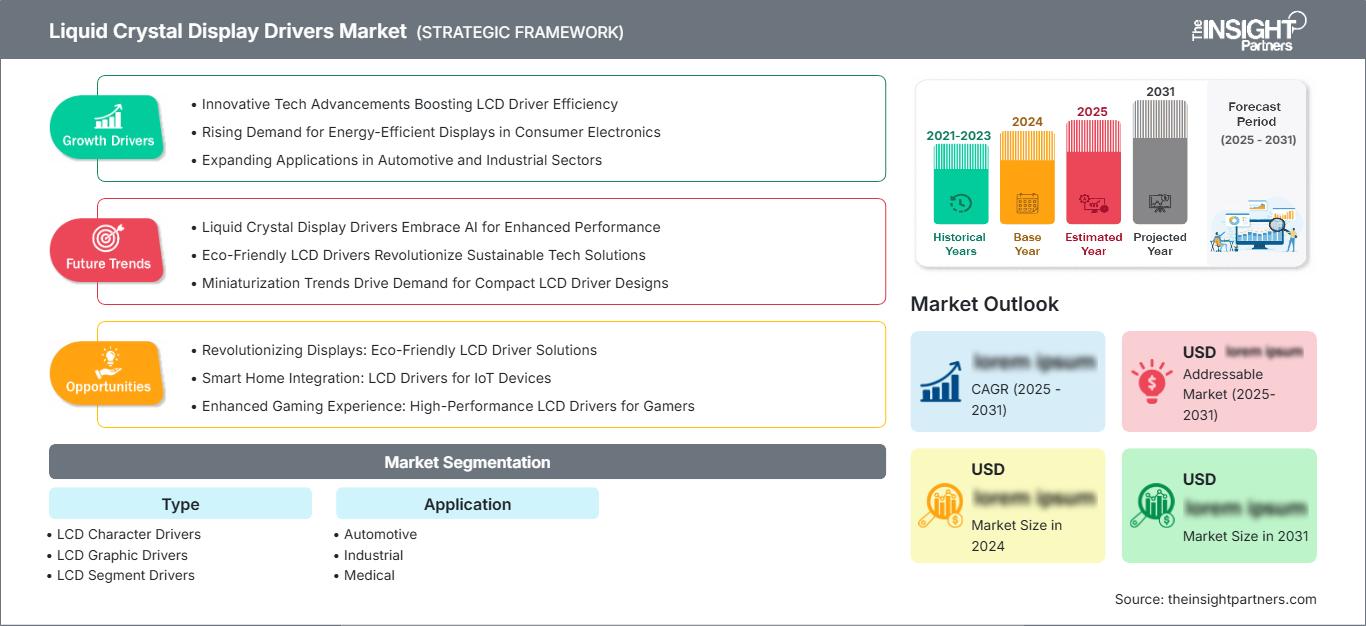
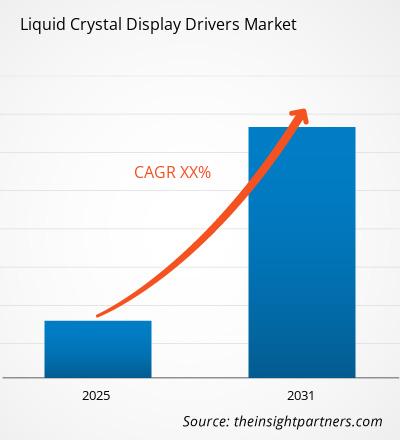
Global demand for embedded electronics and precision display control continues to reshape the liquid crystal display drivers market, valued at US$ 11.55 Billion in 2025 and projected to reach US$ 20.99 Billion by 2034, expanding at a CAGR of 7.75% between 2026 and 2034. This trajectory reflects sustained integration of display driver integrated circuits across automotive, industrial, medical, and consumer electronics platforms worldwide.
North America is estimated to expand at a CAGR of 7.0-7.6% through 2034, supported by the liquid crystal display drivers market size expansion tied to automotive digital cockpit adoption and industrial automation upgrades. Rising demand for ruggedized instrumentation displays across defense and medical equipment manufacturing further reinforces regional momentum, alongside semiconductor reshoring initiatives strengthening domestic driver IC supply chains.
Liquid Crystal Display Drivers Market Assessment and Insights
- North America: The region holds an estimated 22-25% share in 2025, growing at a CAGR of 7.0-7.6% between 2026-2034, driven by automotive electrification, industrial automation, and domestic semiconductor investment programs strengthening supply resilience.
- US: The United States accounts for the majority of regional revenue in 2025, advancing at a CAGR of 6.9-7.4% through 2034, backed by strong automotive and medical device manufacturing bases.
- Europe: Europe commands roughly 18-21% share in 2025 and is projected to grow at 7.1-7.7% CAGR through 2034, led by Germany, the UK, and France on the strength of automotive and industrial electronics production.
- Asia Pacific: Asia Pacific dominates with an estimated 42-46% share in 2025, expanding at a CAGR of 8.2-8.8% between 2026-2034, led by China, Japan, and South Korea through consumer electronics and display manufacturing scale.
- Largest Segment: LCD Segment Drivers hold the largest share at 34-38% in 2025, growing at a CAGR of 7.3-7.8% through 2034, owing to widespread use in appliances, meters, and industrial control panels.
- High Growth Segment: LCD Graphic Drivers register the fastest growth at a CAGR of 8.4-8.9% through 2034, propelled by automotive cluster displays and industrial HMI panels demanding higher resolution output.
- Key companies analyzed in detail: Samsung Electronics Co., Ltd., LG Display Co., Ltd., NXP Semiconductors N.V., RAIO Technology Inc., Toshiba Corporation, Texas Instruments Incorporated, Novatek Microelectronics Corp., Renesas Electronics Corporation, Seiko Epson Corporation, Fujitsu Limited.
Source: The Insight Partners' analysis based on proprietary research, government publications, company annual reports, investor presentations, industry databases, and expert interviews.
The display drivers industry has seen continuous evolution in terms of miniaturization, from basic segmented drivers used in digital instrumentation to advanced graphic drivers in the form of highly integrated ICs that enable high-resolution automotive and industrial displays. In terms of technology, manufacturers have opted for smaller geometries to enable reduced power consumption and increased pin density, while competition for fab capacity has grown from other segments in the semiconductor space, which has made many manufacturers go for capacity agreements at foundries.
In the coming years, manufacturers are anticipated to move away from the usual East Asia-based manufacturing facilities, as they seek to gain flexibility and resilience in their supply chains by investing in countries like Southeast Asia and India. The regulatory incentives offered in the form of financial and fiscal policies by the US and EU governments in favor of domestic semiconductor manufacturing will contribute to the growth of capacity additions.
Liquid Crystal Display Drivers Market Report Scope
| Report Attribute | Details |
|---|---|
| Market size in 2025 | US$ 11.55 Billion |
| Market Size by 2034 | US$ 20.99 Billion |
| Global CAGR (2026 - 2034) | 7.75% |
| Historical Data | 2021-2024 |
| Forecast period | 2026-2034 |
Liquid Crystal Display Drivers Market Analysis
Continuous LCD drivers industry growth is driven by increasing adoption of digital instrument clusters in passenger and commercial vehicles as well as by increasing applications of segment and character drivers in industrial meters and controls. Value chain includes wafer production, driver IC design, module integration, and OEM assembly, where foundry capacity and efficiency of design for manufacturing define cost advantage for suppliers.
Market supply remains affected by high concentration of fabrication capacity at the hand of selected number of foundries, causing recurring issues related to long lead times due to demand spikes. Increasing trend towards dual sourcing and vertical integration of manufacturers ensures access to driver ICs, especially those for automotive application that require prolonged qualification cycle and high reliability.
The competitive forces existing in the Liquid Crystal Display Drivers Market Report of liquid crystal display drivers suggest a scenario determined by the factors of size, level of integration, and specialization of applications. Samsung Electronics Co., Ltd. and LG Display Co., Ltd. benefit from vertical integration of their panel production processes, whereas NXP Semiconductors N.V., Texas Instruments Incorporated, and Renesas Electronics Corporation specialize on automotive-oriented product ranges to meet the needs for cockpit digitization.
On the other hand, Toshiba Corporation, Novatek Microelectronics Corp., and RAIO Technology Inc. keep developing low-power products and character drivers that will be used for industrial and household devices, and Seiko Epson Corporation and Fujitsu Limited are leading in providing precision display modules. Collaboration efforts between designers of driver ICs and producers of panels are growing stronger.
● REPORT CUSTOMIZATION
Tailor This Report To Align With Your Specific Business Requirements
This report can be customized to align precisely with your business objectives, scope, and target markets. Customization options include tailored segmentation, geography, competitive analysis, and strategic insights to support informed decision-making.
Customize This Report →WHAT YOU CAN ADJUST
- ● Segmentations
- ● Geography
- ● Competitive Analysis
- ● Language Preferences
Liquid Crystal Display Drivers Market: Strategic Insights
Regional Insights
North America Liquid Crystal Display Drivers Market
North America is estimated to hold a 22-25% of the global liquid crystal display drivers market share in 2025, expanding at a CAGR of 7.0-7.6% through 2034. Growth stems from rising adoption of digital instrument clusters in passenger vehicles and growing deployment of industrial HMI panels across manufacturing facilities modernizing production lines with real-time visual monitoring systems.
The structural factors include federal programs that provide incentives for driving IC production within the domestic setting. Other structural factors include the continued investment in the production of medical devices that will require display driver ICs to be more compact and reliable. Canada and Mexico add marginal demand due to their production of auto parts and electronics assembly.
U.S. Liquid Crystal Display Drivers Market
The United States represents the largest regional market for liquid crystal display drivers in North America, holding a 78-82% market share in 2025 and growing at a CAGR of 6.9-7.4% till 2034. The robust presence of domestic automobile production in conjunction with the growth of medical devices and industrial equipment manufacturing has sustained the demand for character, graphic and segment drivers across various applications.
Texas Instruments Incorporated, NXP Semiconductors N.V. and other companies have a substantial design and manufacturing operation in the country that is involved in qualification processes for automotive-grade products. The application trends reveal that there is a growing tendency towards use of graphic drivers in automobiles for infotainment purposes while characters and segment drivers are used in industrial and medical segments respectively.
Europe Liquid Crystal Display Drivers Market
Europe holds an estimated 18-21% share of the global liquid crystal display drivers market in 2025, growing at a CAGR of 7.1-7.7% through 2034, with Germany identified as the leading contributor given its dominant automotive and industrial machinery manufacturing base requiring advanced display driver integration.
Germany emerges as the biggest market in the region owing to its demand for digital cockpits from the automobile industry and graphic drivers for its industries' automated systems. The UK market is supported by the manufacture of medical devices and industrial electronics, while France, Italy, and Spain show consistent demand from their automotive components and appliance manufacturers utilizing character driver ICs in their products.
APAC Liquid Crystal Display Drivers Market
Asia Pacific dominates the global market with an estimated 42-46% share in 2025, expanding at the fastest regional CAGR of 8.2-8.8% through 2034. China leads given its extensive display panel manufacturing base, followed by Japan, South Korea, India, and Australia.
The continued expansion and innovation of graphic and segment driver ICs for both automotive and consumer electronics usage through industrial policy backing for semiconductor fabrication within China and India, along with the well-established display technology infrastructure of Japan and South Korea, keeps on going.
Middle East & Africa Liquid Crystal Display Drivers Market
According to reports, the market in the Middle East and Africa region is expected to exhibit a CAGR of 6.6% to 7.1% during the forecast period of 2034, led by Saudi Arabia owing to infrastructure development and industrial automation projects aligned with the diversification plans of the country.
In the UAE, smart infrastructure and automotive manufacturing contribute to market growth, whereas South Africa and the rest of MEA regions are growing slowly due to applications in the energy industry and industrial equipment with cost-effective drivers for character displays.
Segmentation Analysis
Type
The Type segment of the liquid crystal display drivers market scope encompasses LCD Character Drivers, LCD Graphic Drivers, and LCD Segment Drivers, collectively growing at a CAGR of 7.6-8.1% between 2026 and 2034. Demand distribution reflects varied resolution and complexity requirements across automotive, industrial, medical, and appliance applications, with graphic drivers gaining share as displays trend toward higher information density and richer visual interfaces.
- LCD Character Drivers: These drivers remain widely used in cost-sensitive industrial and appliance applications requiring simple alphanumeric output, valued for low power consumption and manufacturing simplicity across control panels.
- LCD Graphic Drivers: Increasingly preferred for automotive clusters and industrial HMI panels, these drivers support high-resolution imaging, enabling richer visual interfaces demanded by modern digital dashboard and control system designs.
- LCD Segment Drivers: Segment drivers dominate meter displays, appliance indicators, and basic instrumentation, offering reliable performance and cost efficiency for applications where numeric or icon-based output suffices adequately.
Application
The Application segment records a CAGR of 7.8-8.3% between 2026 and 2034, led by automotive and industrial adoption. Automotive applications benefit from digital cockpit proliferation, while industrial and medical equipment manufacturers increasingly integrate driver ICs into control interfaces, meters, and diagnostic devices, reflecting broadening cross-sector reliance on precision display technology for operational visibility.
- Automotive: Digital instrument clusters and infotainment systems drive strong demand for graphic and segment drivers, supported by rising vehicle electronics content across passenger and commercial vehicle platforms globally.
- Industrial: Industrial automation and control panel modernization sustain steady demand for character and segment drivers, valued for reliability in harsh operating environments requiring consistent visual monitoring capabilities.
- Medical: Medical device manufacturers increasingly integrate compact display drivers into diagnostic and monitoring equipment, prioritizing low power consumption and long-term component reliability for critical healthcare applications.
- Small Appliance: Small appliance manufacturers rely on cost-efficient segment and character drivers for basic display functions, supporting consumer electronics and household equipment requiring simple, dependable visual output.
Opportunity Snapshot
| Application | Revenue Contribution | Trend Tag | Adoption Stage |
|---|---|---|---|
| Automotive | High | Digital Cockpits | Scaling |
| Industrial | High | HMI Panels | Mature |
| Medical | Medium | Wearable Diagnostics | Scaling |
| Small Appliance | Medium | Smart Indicators | Mature |
Liquid Crystal Display Drivers Market Growth Drivers and Impact Analysis
Automotive Digital Cockpit Proliferation Driving Driver IC Demand
Rising integration of fully digital instrument clusters and center console displays across passenger and commercial vehicles is significantly boosting demand for graphic and segment display drivers. Automakers are replacing analog gauges with configurable digital panels to enhance driver information delivery and support advanced driver assistance system visualization. This shift requires higher-resolution, automotive-grade driver ICs capable of withstanding extended temperature ranges and vibration exposure. As electric vehicle production accelerates globally, demand for compact, energy-efficient display drivers supporting battery status and range indicators is intensifying further. Suppliers with established automotive qualification pipelines, including NXP Semiconductors N.V. and Renesas Electronics Corporation, are well positioned to capture this expanding demand base across multiple vehicle segments and regional markets worldwide.
Industrial Automation Expanding Demand for Reliable Display Interfaces
Manufacturing facilities worldwide are modernizing production lines with human-machine interface panels requiring dependable character and segment display drivers for real-time process monitoring. Industrial automation investment, driven by labor cost pressures and efficiency mandates, is expanding installation of control panels across manufacturing, energy, and logistics operations. These environments demand driver ICs engineered for extended operational lifespans and resistance to electromagnetic interference common in industrial settings. Growing adoption of predictive maintenance systems further increases reliance on visual display components for equipment status reporting. This sustained industrial modernization trend, particularly across manufacturing-intensive economies, continues reinforcing baseline demand for segment and character drivers within control system architectures globally.
Medical Device Miniaturization Supporting Compact Driver Integration
Expanding production of portable diagnostic and monitoring equipment is increasing demand for compact, low-power display drivers capable of supporting extended battery life in medical devices. Healthcare providers increasingly favor point-of-care diagnostic tools featuring integrated digital displays for immediate readout, replacing bulkier legacy equipment. This trend is prompting driver IC manufacturers to develop smaller footprint designs without compromising display clarity or power efficiency. Regulatory emphasis on device reliability further necessitates rigorous qualification processes, favoring established suppliers with proven track records in medical-grade component manufacturing. As home healthcare and remote patient monitoring adoption grows, sustained demand for character and graphic drivers within compact medical instrumentation is expected to strengthen considerably across developed and emerging healthcare markets.
Liquid Crystal Display Drivers Market Future Trends
Integration of Driver ICs with Touch and Sensor Functionality
Display driver manufacturers are increasingly pursuing integrated designs combining driver, touch controller, and sensor functions within single packages, reflecting broader liquid crystal display drivers market trends toward system-level consolidation. This approach reduces bill-of-materials complexity and board space requirements, appealing particularly to automotive and medical device manufacturers seeking compact, cost-efficient solutions. As display interfaces evolve toward multi-touch and gesture-based interaction, driver IC architectures are expected to incorporate greater processing capability, enabling faster response times and improved power management. This consolidation trend is likely to reshape competitive positioning among suppliers capable of delivering integrated silicon solutions.
Growing Adoption of Low-Power Driver Architectures for Battery-Operated Devices
Rising proliferation of battery-powered industrial sensors, wearable medical devices, and portable consumer equipment is driving development of ultra-low-power display driver architectures. Manufacturers are prioritizing energy-efficient designs that extend operational runtime without compromising display responsiveness or clarity. This trend is particularly pronounced in segment and character driver categories serving cost-sensitive appliance and industrial applications. Advances in semiconductor process technology are enabling reduced standby current consumption, supporting longer battery life cycles across diverse end-use scenarios. As sustainability considerations gain prominence among original equipment manufacturers, low-power driver adoption is expected to accelerate across multiple application categories through the forecast period.
Liquid Crystal Display Drivers Market Opportunities
Expansion into Emerging Southeast Asian Manufacturing Hubs
Growing semiconductor assembly and testing investment across Vietnam, Malaysia, and Thailand presents significant opportunity for display driver manufacturers seeking supply chain diversification beyond traditional East Asian hubs. These emerging manufacturing hubs offer competitive labor costs and expanding government incentives supporting electronics component production. Companies establishing regional packaging and testing facilities can better serve growing automotive and consumer electronics assembly operations relocating to Southeast Asia. This geographic diversification also reduces exposure to regional supply chain disruptions while enabling faster response to localized demand growth. Liquid crystal display drivers market forecasts suggest sustained investment interest in these emerging production corridors will continue strengthening through 2034 as manufacturers rebalance global capacity footprints strategically.
Strategic Investment in Automotive-Grade Qualification Capacity
Expanding automotive digitization presents substantial opportunity for driver IC suppliers investing in dedicated automotive-grade qualification and testing capacity. Vehicle manufacturers require components meeting stringent reliability standards, creating differentiated positioning for suppliers with established qualification track records. Companies expanding automotive-specific design centers and testing infrastructure can capture growing demand from electric vehicle platforms requiring specialized display driver solutions for battery management and range visualization. This investment opportunity extends to partnerships with tier-one automotive suppliers seeking integrated display module solutions. Suppliers prioritizing automotive qualification capacity expansion are positioned to benefit from sustained digital cockpit adoption across global vehicle production platforms through the coming decade.
Frequently Asked Questions

- Comprehensive Market Sizing and Forecast Analysis
- Detailed Segmentation Analysis
- In-Depth Market Dynamics Assessment
- Regional and Country-Level Insights
- Competitive Landscape and Company Benchmarking
- Strategic Business Intelligence
Recent Reports
Testimonials

The Insight Partners provided valuable market intelligence that supported our global go-to-market strategy. Their team was professional, responsive, and attentive to our feedback, providing thoughtful analysis and helpful methodological clarifications throughout the project.
Junmo Kim Chief Financial Officer (CFO), Enertech Co., Ltd.
The Insight Partners' SCADA System Market report is comprehensive, with valuable insights on current trends and future forecasts. The team was highly professional, responsive, and supportive throughout. We are very satisfied and highly recommend their services.
RAN KEDEM Partner, Reali Technologies LTDs
I requested a report on a very specific software market and the team produced the report in a few days. The information was very relevant and well presented. I then requested some changes and additions to the report. The team was again very responsive and I got the final report in less than a week.
JEAN-HERVE JENN Chairman, Future Analytica
We worked with The Insight Partners for an important market study and forecast. They gave us clear insights into opportunities and risks, which helped shape our plans. Their research was easy to use and based on solid data. It helped us make smart, confident decisions. We highly recommend them.
PIYUSH NAGPAL Sr. Vice President, High Beam Global
The Insight Partners delivered insightful, well-structured market research with strong domain expertise. Their team was professional and responsive throughout. The user-friendly website made accessing industry reports seamless. We highly recommend them for reliable, high-quality research services
YUKIHIKO ADACHI CEO, Deep Blue, LLC.
This is the first time I have purchased a market report from The Insight Partners.While I was unsure at first, I visited their web site and felt more comfortable to take the risk and purchase a market report.I am completely satisfied with the quality of the report and customer service. I had several questions and comments with the initial report, but after a couple of dialogs over email with their analyst I believe I have a report that I can use as input to our strategic planning process.Thank you so much for taking the extra time and making this a positive experience.I will definitely recommend your service to others and you will be my first call when we need further market data.
JOHN SUZUKI President and Chief Executive Officer, Board Director, BK Technologies
I wish to appreciate your support and the professionalism you displayed in the course of attending to my request for information regarding to infectious disease IVD market in Nigeria. I appreciate your patience, your guidance, and the fact that you were willing to offer a discount, which eventually made it possible for us to close a deal. I look forward to engaging The Insight Partners in the future, all thanks to the impression you have created in me as a result of this first encounter.
DR CHIJIOKE ONYIA MANAGING DIRECTOR, PineCrest Healthcare Ltd.Reason to Buy
- Informed Decision-Making
- Understanding Market Dynamics
- Competitive Analysis
- Identifying Emerging Markets
- Customer Insights
- Market Forecasts
- Risk Mitigation
- Boosting Operational Efficiency
- Strategic Planning
- Investment Justification
- Tracking Industry Innovations
- Aligning with Regulatory Trends





 Get Free Sample for