
Lithium-ion Battery Materials Market Size, Demand & Growth by 2034
Lithium-ion Battery Materials Market Size and Forecasts (2021 - 2034), Global and Regional Share, Trends, and Growth Opportunity Analysis Report Coverage : by Battery Chemistry (LFP, LCO, NMC, NCA, LMO); Material (Cathode, Anode, Electrolyte); Application (Portable Device, Electric Vehicle, Industrial, Power Tool, Medical Device); and Geography (North America, Europe, Asia Pacific, and South and Central America)
- Status : Data Released
- Report Code : TIPRE00040492
- Category : Chemicals and Materials
- No. of Pages : 150
- Available Report Formats :


- Last update date : July 20, 2026


2025 Market Size
US$ 40.84 Bn
Base year value
2034 Forecast
US$ 161.15 Bn
Projected by 2034
CAGR 2026-2034
16.48 %
Growth rate
Addressable Market
US$ 850.66 Bn
(2026-2034)
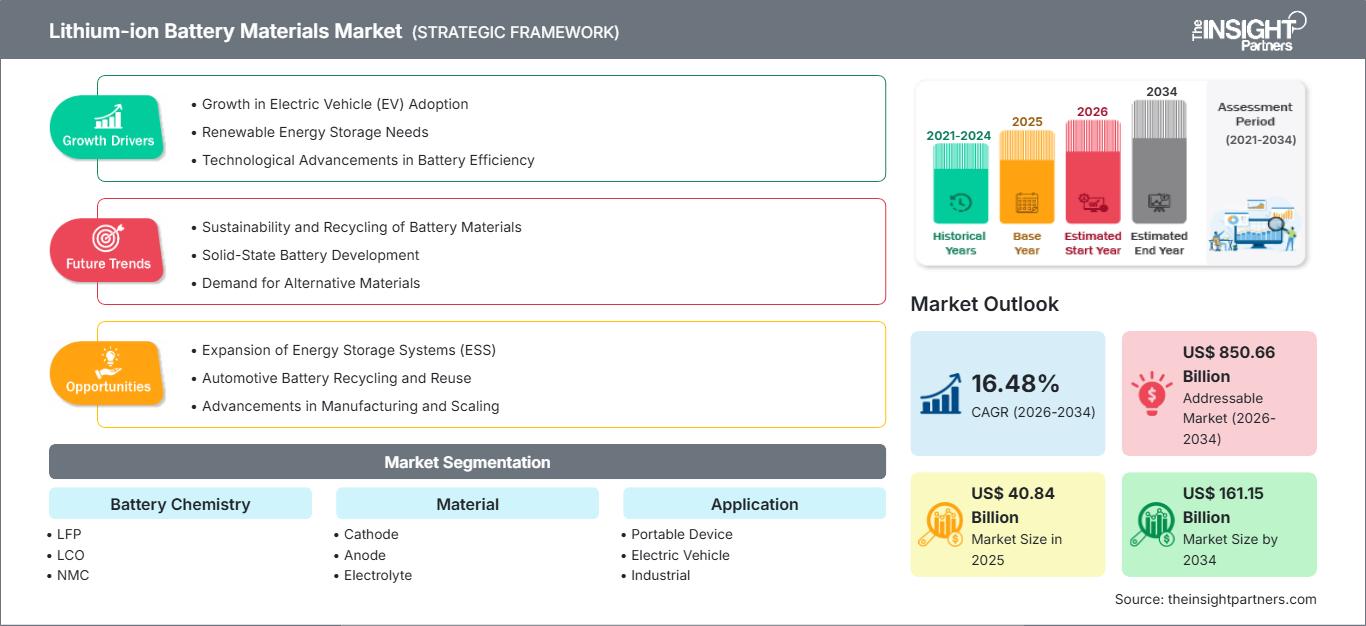
The lithium-ion battery materials market size stood at US$ 40.84 billion in 2025 and is anticipated to reach US$ 161.15 billion by 2034, with a CAGR of 16.48% in the 2026-2034 forecast period. The market will experience growth due to increasing production of electric vehicles, adoption of stationary energy storage systems, and demand for rechargeable batteries from consumer electronic products and industrial sectors. Increasing investment in battery manufacturing facilities and material development will drive the supply chain and demand for cathode, anode, and electrolyte materials.
In North America, huge investment in gigafactory, critical mineral extraction, and electric vehicle manufacturing will boost the demand for advanced battery materials in the region. The market value of lithium-ion battery materials in North America is driven by localization policies by governments, tax benefits in the battery supply chain, and increased adoption of energy storage systems. Growth in the region is anticipated to be strong with CAGR ranging between 14.5% and 16.0% by 2034.
Lithium-ion Battery Materials Market Assessment and Insights
- North America: Strong investments in localized battery supply chains, EV manufacturing, and energy storage projects position the region as a major consumption center. Lithium-ion battery materials market share in 2025: 22%–24%; CAGR between 2026–2034: 14.5%–16.0%.
- US: The country remains the leading contributor within North America due to battery manufacturing incentives and EV production expansion. Share of North America in 2025: 78%–82%; CAGR between 2026–2034: 15.0%–16.5%.
- Europe: Demand is supported by battery manufacturing investments across Germany, France, Hungary, Sweden, and Poland. Share in 2025: 24%–26%; CAGR between 2026–2034: 15.5%–17.0%.
- Asia Pacific: China, South Korea, Japan, and India continue to dominate global battery material production and consumption. Share in 2025: 46%–48%; CAGR between 2026–2034: 17.0%–18.5%.
- Largest Segment: Cathode materials maintain leadership due to their high value contribution within battery production. Market share in 2025: 44%–46%; CAGR between 2026–2034: 16.0%–17.0%.
- High Growth Segment: Electric Vehicle application benefits from accelerating electrification strategies globally. Market share in 2025: 52%–54%; CAGR between 2026–2034: 18.0%–19.5%.
- Key companies analyzed in detail: Umicore SA, Targray Technology International Inc., LG Chem Ltd., BTR New Material Group Co., Ltd., Shanghai Shanshan Technology Co., Ltd., Resonac Holdings Corporation, Kureha Corporation, Mitsubishi Chemical Group Corporation, Asahi Kasei Corporation, Sumitomo Corporation.
Source: The Insight Partners' analysis based on proprietary research, government publications, company annual reports, investor presentations, industry databases, and expert interviews.
The battery manufacturing ecosystem is fast evolving, with battery makers moving towards high-energy-density chemistries, localized supply chain models, and vertical integration in sourcing. The increasing demand for electric mobility and storage have increased investments in cathode active materials, synthetic graphite, conductive additives, and electrolytes. There is an increasing trend for manufacturers to invest in securing supply chains through strategic collaborations with mining companies and material processors and scaling up refineries across Asia, Europe, and North America in order to cut down on concentration within the supply chains.
It is anticipated that over the forecast period, growth will come from the growing presence of battery manufacturing plants in Southeast Asia, India, North America, and some European nations. Incentives for local battery manufacturing and processing of minerals and sustainability criteria have prompted investments across the chain. This is expected to increase the long-term trajectory of growth in the lithium-ion battery materials market.
Lithium-ion Battery Materials Market Report Scope
| Report Attribute | Details |
|---|---|
| Market size in 2025 | US$ 40.84 Billion |
| Market Size by 2034 | US$ 161.15 Billion |
| Global CAGR (2026 - 2034) | 16.48% |
| Historical Data | 2021-2024 |
| Forecast period | 2026-2034 |
Lithium-ion Battery Materials Market Analysis
Electrification in the sectors of transportation, industrial machinery, and energy storage devices is considered to be the most important factor driving the market growth. The development of materials that are used in cathodes and anodes, which should ensure high energy density, durability, and thermal stability, becomes increasingly important for battery makers. Renewable energy sources adoption is another factor contributing to the demand growth.
The value chain consists of mining, refining, precursor making, active materials production, cell manufacturing, and battery packs assembly. It depends on the supply of such materials as lithium, nickel, cobalt, manganese, graphite, and specialized electrolytes. Localization activities currently taking place in the US, Europe, and India stimulate investments in the entire value chain.
Competition is still focused on innovation, production scale, supply security, and sustainability. Umicore SA, LG Chem Ltd., Mitsubishi Chemical Group Corporation, and Asahi Kasei Corporation are continuing their work on developing innovative materials and technologies of recycling to consolidate their positions in the market. At the same time, BTR New Material Group Co., Ltd. and Shanghai Shanshan Technology Co., Ltd. retain considerable power in the market of graphite and anode materials supplies.
In general, investment flows will be focused on plants for precursors, cathodes, recycling systems, and local production of materials. The strategic cooperation between carmakers, battery manufacturers, and material suppliers is getting more frequent. Targray Technology International Inc., Kureha Corporation, Resonac Holdings Corporation, and Sumitomo Corporation are entering into such deals which provide supply chain robustness, technology development, and access to fast-developing centers of battery production all around the world.
● REPORT CUSTOMIZATION
Tailor This Report To Align With Your Specific Business Requirements
This report can be customized to align precisely with your business objectives, scope, and target markets. Customization options include tailored segmentation, geography, competitive analysis, and strategic insights to support informed decision-making.
Customize This Report →WHAT YOU CAN ADJUST
- ● Segmentations
- ● Geography
- ● Competitive Analysis
- ● Language Preferences
Lithium-ion Battery Materials Market: Strategic Insights
Regional Insights
North America Lithium-Ion Battery Materials Market
North America accounted for 22%–24% of global demand in 2025 and is projected to expand at a CAGR of 14.5%–16.0% through 2034. Growth is supported by large-scale investments in electric vehicle production, battery cell manufacturing, and domestic critical mineral processing. Government incentives targeting battery supply chain localization are encouraging construction of new material processing and manufacturing facilities throughout the region.
Battery manufacturers are becoming more interested in sourcing regionally because of the risks involved in importing. The increasing use of energy storage technology, increased investments in renewables, and growth in EV adoption will ensure continued consumption of the materials. The share of lithium-ion battery materials in North America is bound to be high.
U.S. Lithium-Ion Battery Materials Market
The United States represented 78%–82% of North American demand in 2025 and is expected to record a CAGR of 15.0%–16.5% through 2034. Federal incentives supporting battery manufacturing, EV adoption, and domestic mineral processing have accelerated investments across the battery value chain. Several new battery plants and material processing facilities are being established to meet rising domestic demand.
All key industry players have been increasing their collaborations with automobile makers and battery manufacturers. The need of the electric vehicle, energy storage system, industrial machinery, and high-tech electronic devices will ensure demand in the long run. More investment in recycling facilities and circular economy will increase recovery rate and strengthen supply security.
Europe Lithium-Ion Battery Materials Market
In 2025, Europe had the share of 24%–26% of total worldwide demand and was anticipated to grow at a CAGR of 15.5%–17.0% during the forecast period. Germany will remain the key market for this region owing to extensive involvement of its automotive industry and development of factories producing batteries. The region still focuses on development of the battery supply chain, aiming to cut import dependency and boost industrial competitiveness.
In the UK, innovation in batteries is being promoted through R&D activities and energy transitions. In Germany, a lot of advantages are provided by large production volumes of electric vehicles and the building of battery factories. France is getting investments into battery materials and cell production. Italy and Spain are joining the battery ecosystem of the region owing to automotive electrification and industrial upgrades.
APAC Lithium-Ion Battery Materials Market
The Asia-Pacific region held a share of 46%-48% of the global market in 2025 and is predicted to grow at a CAGR of 17.0%-18.5% till 2034. The major reason behind this growth in demand is because of the presence of abundant refining capacity, leading battery manufacturing, and the adoption of electric vehicles in China.
Other countries like Japan and South Korea continue to contribute to this market due to technological advancements and innovations in materials. India and Australia are working to enhance their positions in this market due to investment in battery manufacturing.
Middle East & Africa Lithium-Ion Battery Materials Market
The Middle East & Africa region is projected to expand at a CAGR of 13.0%–14.5% during the forecast period. Growing investments in renewable energy projects and energy storage infrastructure are creating opportunities for battery material suppliers. Saudi Arabia is emerging as a key investment destination due to industrial diversification initiatives.
The UAE still supports initiatives for clean energy production and advanced manufacturing. South Africa gains from its mineral resources and greater involvement in battery supply chain activities. Programs for infrastructure improvement and energy transitions should drive future demand.
Segmentation Analysis
Battery Chemistry
The battery chemistry segment is expected to grow at a CAGR of 16.5%–17.5% during 2026–2034. Technology selection is increasingly influenced by energy density requirements, cost optimization, safety considerations, and supply chain availability. The lithium-ion battery materials market scope continues expanding as manufacturers diversify chemistry portfolios to address evolving application requirements across transportation, industrial, and energy storage sectors.
- LFP – Widely adopted in electric vehicles and stationary storage systems due to strong safety performance, long cycle life, and lower dependence on nickel and cobalt supply chains.
- LCO – Maintains relevance in portable electronics where high energy density and compact battery design remain important purchasing considerations.
- NMC – Represents a balanced chemistry platform offering strong energy density, performance, and commercial scalability across multiple battery applications.
- NCA – Utilized primarily in high-performance electric vehicles requiring enhanced energy density and extended driving range capabilities.
- LMO – Supports applications requiring thermal stability, reliable performance, and favorable power characteristics in specialized battery systems.
Material
The material segment is projected to grow at a CAGR of 16.0%–17.0% through 2034. Material selection significantly influences battery performance, durability, safety, and manufacturing economics. Ongoing research efforts focus on improving conductivity, energy density, cycle life, and sustainability while supporting large-scale battery production requirements.
- Cathode – The largest material category, accounting for substantial battery cost contribution and directly influencing energy density, performance, and overall cell efficiency.
- Anode – Growing adoption of advanced graphite and silicon-enhanced materials supports improvements in charging performance and energy storage capacity.
- Electrolyte – Essential for ion transport within battery cells, with innovation focused on safety enhancement and improved operational stability.
Opportunity Snapshot
| Application | Revenue Contribution | Trend Tag | Adoption Stage |
|---|---|---|---|
| Portable Device | Medium | Miniaturized Cells | Mature |
| Electric Vehicle | High | Fast Charging | Scaling |
| Industrial | Medium | Grid Storage | Scaling |
| Power Tool | Medium | High Output | Mature |
| Medical Device | Low | Precision Power | Emerging |
Lithium-ion Battery Materials Market Growth Drivers and Impact Analysis
Accelerating Global Electric Vehicle Production and Battery Demand
Adoption of electric vehicles continues to be the most important driver of growth in the entire battery materials value chain. Vehicle emissions regulations and fuel efficiency requirements are being put in place by governments all over the world to drive manufacturers to increase their portfolio of battery vehicles. With the increase in the manufacture of battery packs, there will be corresponding increases in demand for materials used in battery manufacturing such as cathodes, anodes, electrolytes, conductive additives, and specialty chemicals. There is a trend towards the use of higher-capacity batteries which have increased material intensity per vehicle, especially nickel-rich and advanced lithium chemistry. Charging stations, battery cost reductions, and increasing acceptance of electric vehicles will further drive vehicle electrification. Material suppliers are reacting with capacity additions and strategic sourcing initiatives among other innovations.
Expansion of Grid-Scale Energy Storage Infrastructure
Fast development of renewable energy generation technologies is leading to high demand for battery energy storage technologies that will be able to balance out energy generated from time to time. Utilities and grid operators have started utilizing lithium-ion battery assets for improving stability of the grid, managing peaks in loads, and ensuring the reliability of energy supply. With increasing number of solar and wind facilities, the need for battery systems becomes more relevant for storing additional electric power and enabling flexible energy distribution. These factors drive increased demand for battery grade lithium compounds, graphite, electrolytes, and cathode active materials. Energy security goals pursued in large economies lead to investments into storage solutions on a large scale. Integration of distributed energy resources, microgrids, and commercial storage solutions contributes to the material demand as well.
Localization of Critical Mineral Processing and Battery Supply Chains
Governments and industry participants are increasingly prioritizing domestic battery supply chain development to reduce exposure to geopolitical risks and material shortages. Investments in refining, precursor manufacturing, cathode production, and recycling facilities are accelerating across North America, Europe, and parts of Asia. Public funding programs, tax incentives, and industrial strategies encourage regional production of battery materials while improving supply security. These initiatives are reshaping trade flows and supporting establishment of integrated battery ecosystems closer to end-use manufacturing centers. In addition, localized production can reduce transportation costs, improve traceability, and strengthen sustainability performance. Material suppliers capable of establishing diversified sourcing networks and regional production footprints are expected to benefit from increasing procurement requirements focused on resilience, transparency, and long-term availability of critical battery inputs.
Lithium-ion Battery Materials Market Future Trends
Commercialization of High-Silicon and Advanced Anode Technologies
The lithium-ion battery materials market trends indicate increasing commercialization of high-silicon and silicon-composite anode technologies designed to improve battery energy density and charging performance. Manufacturers are investing heavily in advanced material engineering to address limitations associated with conventional graphite anodes. As electric vehicle manufacturers seek longer driving ranges and faster charging capabilities, advanced anode solutions are expected to gain broader adoption. Material producers are also exploring novel coatings, binders, and nanostructured materials to enhance durability and cycle stability. Continued innovation is likely to support next-generation battery platforms that deliver improved performance while maintaining cost competitiveness and manufacturing scalability across multiple end-use industries.
Growth of Battery Recycling and Circular Material Supply Networks
Battery recycling is expected to become a strategic component of future supply chains as demand for critical minerals continues increasing. Recovering lithium, nickel, cobalt, manganese, and graphite from end-of-life batteries can reduce dependence on primary mining activities and improve supply resilience. Governments are implementing regulations encouraging recycling, traceability, and responsible resource utilization. Battery manufacturers and material suppliers are increasingly investing in closed-loop systems that recover valuable materials for reuse in new battery production. As recycling technologies mature and collection volumes increase, secondary raw materials are expected to contribute a growing share of future supply. This trend will support sustainability goals while helping mitigate long-term resource availability concerns.
Lithium-ion Battery Materials Market Opportunities
Investment Expansion Across Emerging Battery Manufacturing Hubs
Emerging manufacturing locations across Southeast Asia, India, Eastern Europe, and selected Middle Eastern economies present significant growth potential for battery material suppliers. Expanding automotive production, favorable industrial policies, and growing energy storage deployment are encouraging battery manufacturers to diversify production footprints beyond established markets. These developments create opportunities for suppliers of cathode materials, anode materials, electrolytes, and specialty chemicals to establish regional partnerships and production facilities. The availability of skilled labor, improving infrastructure, and supportive investment frameworks further enhance market attractiveness. Companies capable of securing early positions within emerging battery ecosystems are expected to benefit from long-term demand growth, localized procurement preferences, and stronger integration with future battery manufacturing networks. These developments support favorable lithium-ion battery materials market forecasts over the next decade.
Development of Sustainable and Low-Carbon Material Production
Growing emphasis on environmental performance is creating opportunities for producers capable of delivering low-carbon and responsibly sourced battery materials. Automotive manufacturers, battery producers, and policymakers increasingly evaluate supply chains based on carbon intensity, traceability, and sustainability metrics. Investments in renewable-powered refining operations, recycling infrastructure, and advanced processing technologies can strengthen competitive positioning. Demand for certified materials is expected to increase as environmental reporting requirements become more stringent across major markets. Companies that develop transparent sourcing frameworks and reduce production emissions may secure long-term supply agreements with battery manufacturers seeking to meet sustainability objectives. These initiatives can also improve operational efficiency while supporting evolving regulatory expectations and customer procurement requirements.
Recent Developments
- June 2026: Australian battery technology company Sicona Battery Technologies secured $45 million from the Australian Renewable Energy Agency (ARENA) to build and operate its first commercial-scale silicon-carbon battery anode material production facility in the Illawarra region.
- June 2026: Australian advanced-materials company AnteoTech stepped further into the global battery-technology conversation with the launch of a new primer additive aimed at improving how lithium-ion battery electrodes are made. The company, which trades on the ASX and is commonly cited under the ticker ASX: ADO, has introduced a product it calls “Anteo C”, positioning it as a performance-enhancing addition to its broader Anteo Battery Technology (ABT) portfolio.
- June 2026: NEO Battery Materials Ltd. ("NEO" or the "Company") (TSXV: NBM) (OTC: NBMFF), a low-cost, silicon-enhanced battery manufacturer enabling high-performance capabilities for drones, robotics, and physical AI, strategically acquired an additional 10% interest in its operating subsidiary, NEO Battery Korea Co., Ltd. ("NBM Korea"), through a Stock Purchase Agreement dated June 26, 2026, from Automobile & PCB Inc. ("A&P"), strengthening NEO's ownership of a key operating asset.
Frequently Asked Questions

- Comprehensive Market Sizing and Forecast Analysis
- Detailed Segmentation Analysis
- In-Depth Market Dynamics Assessment
- Regional and Country-Level Insights
- Competitive Landscape and Company Benchmarking
- Strategic Business Intelligence
Recent Reports
Testimonials

The Insight Partners provided valuable market intelligence that supported our global go-to-market strategy. Their team was professional, responsive, and attentive to our feedback, providing thoughtful analysis and helpful methodological clarifications throughout the project.
Junmo Kim Chief Financial Officer (CFO), Enertech Co., Ltd.
The Insight Partners' SCADA System Market report is comprehensive, with valuable insights on current trends and future forecasts. The team was highly professional, responsive, and supportive throughout. We are very satisfied and highly recommend their services.
RAN KEDEM Partner, Reali Technologies LTDs
I requested a report on a very specific software market and the team produced the report in a few days. The information was very relevant and well presented. I then requested some changes and additions to the report. The team was again very responsive and I got the final report in less than a week.
JEAN-HERVE JENN Chairman, Future Analytica
We worked with The Insight Partners for an important market study and forecast. They gave us clear insights into opportunities and risks, which helped shape our plans. Their research was easy to use and based on solid data. It helped us make smart, confident decisions. We highly recommend them.
PIYUSH NAGPAL Sr. Vice President, High Beam Global
The Insight Partners delivered insightful, well-structured market research with strong domain expertise. Their team was professional and responsive throughout. The user-friendly website made accessing industry reports seamless. We highly recommend them for reliable, high-quality research services
YUKIHIKO ADACHI CEO, Deep Blue, LLC.
This is the first time I have purchased a market report from The Insight Partners.While I was unsure at first, I visited their web site and felt more comfortable to take the risk and purchase a market report.I am completely satisfied with the quality of the report and customer service. I had several questions and comments with the initial report, but after a couple of dialogs over email with their analyst I believe I have a report that I can use as input to our strategic planning process.Thank you so much for taking the extra time and making this a positive experience.I will definitely recommend your service to others and you will be my first call when we need further market data.
JOHN SUZUKI President and Chief Executive Officer, Board Director, BK Technologies
I wish to appreciate your support and the professionalism you displayed in the course of attending to my request for information regarding to infectious disease IVD market in Nigeria. I appreciate your patience, your guidance, and the fact that you were willing to offer a discount, which eventually made it possible for us to close a deal. I look forward to engaging The Insight Partners in the future, all thanks to the impression you have created in me as a result of this first encounter.
DR CHIJIOKE ONYIA MANAGING DIRECTOR, PineCrest Healthcare Ltd.Reason to Buy
- Informed Decision-Making
- Understanding Market Dynamics
- Competitive Analysis
- Identifying Emerging Markets
- Customer Insights
- Market Forecasts
- Risk Mitigation
- Boosting Operational Efficiency
- Strategic Planning
- Investment Justification
- Tracking Industry Innovations
- Aligning with Regulatory Trends





 Get Free Sample for