
Metal Magnesium Market Growth, Trends & Forecast by 2034
Coverage: By Product Type (Pure Magnesium, Magnesium Compounds, Magnesium Alloys); End Use (Aerospace and Defense, Automotive, Medical and Healthcare, Electronics, Others); Application (Die Casting, Aluminum Alloys, Titanium Reduction, Iron And Steel Making, Others) , and Geography (North America, Europe, Asia Pacific, and South and Central America)
- Status : Data Released
- Report Code : TIPRE00014630
- Category : Chemicals and Materials
- No. of Pages : 150
- Available Report Formats :


- Last update date : July 30, 2026


2025 Market Size
US$ 5.8 Bn
Base year value
2034 Forecast
US$ 9.72 Bn
Projected by 2034
CAGR 2026-2034
5.90 %
Growth rate
Addressable Market
US$ 70.29 Bn
(2026-2034)
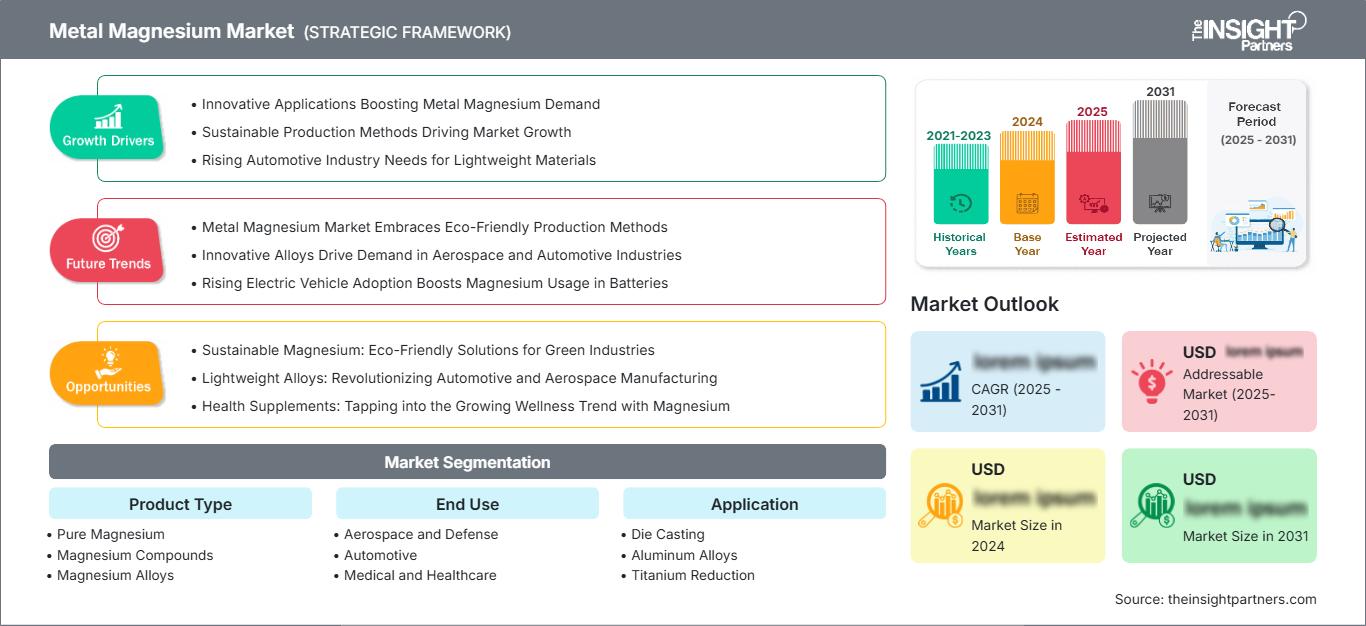
The global metal magnesium market value stood at US$ 5.8 billion in 2025 and is expected to hit US$ 9.72 billion by 2034, registering a CAGR of 5.90% from 2026-2034. The market keeps growing since lightweight materials become more important strategically for the automotive, aerospace, electronics, and metallurgy industries. The good strength-to-weight ratio, high machining ability, and recyclability of magnesium contribute to an increased application of magnesium in structural design, alloys production, and industrial manufacturing processes.
North America remains a technologically advanced region for production and consumption of metal magnesium due to the development of the aerospace industry, automotive lightweighting programs, and defense investments. It is projected that the value of the metal magnesium market size in North America will experience a CAGR of 5.2–5.7% over the forecast period due to higher requirements for magnesium alloys and the role of magnesium in the aluminum production process.
Metal Magnesium Market Assessment and Insights
- North America: Strong aerospace manufacturing, aluminum production, and automotive lightweighting enabled the region to account for 22–26% share in 2025, while the market is projected to expand at a CAGR of 5.2–5.7% during 2026–2034.
- US: The country represented 76–80% of North America's market in 2025, supported by defense, aerospace, and advanced manufacturing industries, and is expected to record a CAGR of 5.3–5.8%.
- Europe: Germany, France, Italy, and the UK continue leading regional demand through automotive manufacturing, aerospace engineering, and metallurgical industries. Europe captured 21–25% share in 2025 and is forecast to register a CAGR of 5.0–5.5%.
- Asia Pacific: China, Japan, South Korea, and India remain the largest production and consumption centers. Asia Pacific accounted for 44–48% share in 2025 and is projected to grow at a CAGR of 6.2–6.7%.
- Largest Segment: Magnesium Alloys dominated the product portfolio with 45–49% market share in 2025, supported by transportation and aerospace demand, while expanding at a CAGR of 6.0–6.5%.
- High Growth Segment: Automotive emerged as the fastest-growing end-use industry, accounting for 30–34% market share in 2025 and projected to expand at a CAGR of 6.5–7.0% due to vehicle lightweighting initiatives.
- Key companies analyzed in detail: Alliance Magnesium Inc., Dead Sea Magnesium Ltd., Latrobe Magnesium Limited, Mag Specialties Inc., NIPPON KINZOKU CO., LTD., RIMA Industrial S/A, Solikamsk Magnesium Works, U.S. Magnesium LLC, VSMPO-AVISMA Corporation, Wenxi YinGuang Magnesium Industry (Group) Co., Ltd.
Source: The Insight Partners' analysis based on proprietary research, government publications, company annual reports, investor presentations, industry databases, and expert interviews.
Constant innovations in extraction techniques, alloy design, and recycling operations are revolutionizing the dynamics of the metal magnesium industry. Manufacturers are working on developing sustainable production techniques, energy efficient reduction techniques, automated casting operations, and advanced alloys to ensure high-quality product output with reduced environmental pollution. In addition, recycling operations are becoming increasingly popular due to sustainability concerns and availability of magnesium.
The future growth will depend on rising demand for electric vehicles, upgrading the aerospace industry, growing need for renewable energy infrastructure, and defense manufacturing. The government programs aimed at securing critical minerals, magnesium production within domestic boundaries, and decarbonization of industries will help in driving investments in North America, Europe, and Asia Pacific.
Metal Magnesium Market Report Scope
| Report Attribute | Details |
|---|---|
| Market size in 2025 | US$ 5.8 Billion |
| Market Size by 2034 | US$ 9.72 Billion |
| Global CAGR (2026 - 2034) | 5.90% |
| Historical Data | 2021-2024 |
| Forecast period | 2026-2034 |
Metal Magnesium Market Analysis
The growth of the magnesium metal market has been mainly driven by increased demand for lightweight engineering materials that have the ability to increase fuel efficiency, reduce emissions, and improve structural performance. Car manufacturers are gradually substituting magnesium alloys in place of heavy metals in components such as steering wheels, transmission housing, seats, instrument panels, and structural parts. Companies within the aerospace industry are also increasing the use of magnesium in the interior and specific structural parts in their aircraft, while metallurgical companies keep using magnesium in producing aluminum alloys, reduction of titanium and desulfurization of iron.
The magnesium metal value chain includes mining companies, magnesium producers, alloy manufacturers, component fabricators, die-casting companies, recyclers and OEMs in transportation, electronics and industrial markets. Magnesium alloys have continued to be the biggest commercial application due to their favorable strength to weight ratio and processing capabilities. Investments in recycling and more sustainable extraction methods have continued to increase.
The metal magnesium market report reveals that competitive advantage is determined by technology capability, reliability of supply, innovation in alloy manufacturing and sustainability performance. Firms such as U.S. Magnesium LLC, Alliance Magnesium Inc., Latrobe Magnesium Limited, RIMA Industrial S/A, Dead Sea Magnesium Ltd., and VSMPO-AVISMA Corporation have been making investments in advanced manufacturing technology, recycling technology, and alloys development to improve market position. Joint ventures with automobile and aerospace firms are rapidly pushing commercial use of magnesium metals.
Production capacity expansion beyond usual areas of supply will help in securing critical minerals and reducing geopolitical risks. Investments in production technology using low carbon emissions, material recycling, automated inspection for quality assurance, and high purity magnesium will increase competitiveness and allow firms to comply with increasing environmental standards.
● REPORT CUSTOMIZATION
Tailor This Report To Align With Your Specific Business Requirements
This report can be customized to align precisely with your business objectives, scope, and target markets. Customization options include tailored segmentation, geography, competitive analysis, and strategic insights to support informed decision-making.
Customize This Report →WHAT YOU CAN ADJUST
- ● Segmentations
- ● Geography
- ● Competitive Analysis
- ● Language Preferences
Metal Magnesium Market: Strategic Insights
Regional Insights
North America Metal Magnesium Market
North America is set to be responsible for 22%-26% of the magnesium market share in 2025 and is estimated to grow at a CAGR of 5.2%-5.7% between 2026-2034. The growth in demand is being driven by increased adoption of lightweight materials for manufacturing of automobiles, aircraft, and military equipment. Initiatives taken by governments in favor of indigenous mining and production of critical metals and resilient supply chains have spurred investments in magnesium mining, recycling, and alloy manufacturing. Increased use of magnesium in aluminum alloy manufacturing and titanium reduction is another factor boosting the growth of the market in the region.
Manufacturing capabilities, well-established research organizations, and adoption of sustainable magnesium manufacturing technology are among the strengths of the region. Continued investment in magnesium recycling, cleaner magnesium reduction, and alloy manufacturing will help reduce the environmental impact while securing supply chains. Investment in manufacturing of electric vehicles, commercial aircraft, and automation will generate a consistent demand for magnesium through the forecast period.
U.S. Metal Magnesium Market
The US accounted for 76% to 80% of the North American magnesium market in 2025 and will report a CAGR of 5.3% to 5.8% during the period until 2034. High aerospace manufacturing, defense modernization projects, and automobile lightweighting programs will continue to bolster domestic magnesium consumption. In addition, the nation continues to be a prominent consumer of magnesium that finds use in aluminum alloy manufacturing and titanium manufacturing.
Some of the key players operating in the region include U.S. Magnesium LLC and Alliance Magnesium Inc., among others. Downstream magnesium consumers continue to make investments in advanced die casting and lightweight magnesium parts manufacturing. Increasing government funding towards domestic production of critical minerals and diversification of the supply chain is driving investment into technology and innovation.
Europe Metal Magnesium Market
Europe has managed to capture 21–25% share of the global market in 2025 and will experience a CAGR of 5.0-5.5% during the forecast period. Germany is the major consumer in the region due to its strong presence in the automotive and engineering sectors while the UK, France, Italy, and Spain have continued expanding magnesium applications in the aerospace, manufacturing, and specialty metallurgy sectors. Sustainable goals and regulations on lightweight vehicles will drive the use of magnesium alloys in the region.
Germany will remain the major regional consumer due to its strong presence in the automotive industry and engineering industry. The UK will enjoy a strong presence due to the existence of the aerospace and defense industries that require advanced lightweight materials. France, Italy, and Spain will continue expanding their use of magnesium in the automotive, electronics, and industrial casting industries.
APAC Metal Magnesium Market
Asia Pacific was responsible for the largest share of 44–48% in the global market in 2025 and will witness the highest regional CAGR of 6.2–6.7%. China dominates as the world's top manufacturer and consumer, whereas Japan, South Korea, and India are increasing their consumption due to the growing demand from automotive and electronics manufacturing industries.
Initiatives taken by governments in favor of producing electric vehicles and advanced manufacturing will aid in increasing consumption in the region. Magnesium alloys production and die-casting will drive exports in Asia Pacific.
Middle East & Africa Metal Magnesium Market
Growth of the Middle East and Africa market is estimated to reach CAGR of 5.4–5.9% during 2026-2034. Leadership among regional trends belongs to Saudi Arabia due to industrial diversification and downstream magnesium processing investments, whereas the UAE is constantly improving advanced manufacturing and aerospace industry support that utilizes lightweight metal materials.
South Africa will be an important consumer in the area due to mining equipment, industrial manufacturing, and metallurgy activities, while the Rest of MEA can benefit from infrastructure development and industrial expansion. Investment into value-added magnesium processing and diversification of manufacturing activities will provide growth in regional magnesium consumption gradually.
Segmentation Analysis
Product Type
The Product Type segment in the metal magnesium market is expected to register a CAGR of 5.9–6.4% during 2026–2034. Product demand varies according to purity requirements, alloy composition, and industrial application. Magnesium alloys continue dominating commercial demand because of their excellent mechanical properties and lightweight characteristics, while pure magnesium and magnesium compounds remain essential for metallurgical, chemical, and specialty manufacturing processes. The metal magnesium market scope continues expanding as producers develop application-specific materials supporting transportation, electronics, healthcare, and industrial manufacturing.
- Pure Magnesium – Widely utilized in metallurgical processing, titanium production, desulfurization, and specialty chemical applications where high-purity magnesium delivers consistent process efficiency and reliable material performance.
- Magnesium Compounds – Used across pharmaceuticals, agriculture, chemicals, flame retardants, and environmental treatment applications because of their versatile chemical properties and broad industrial utility.
- Magnesium Alloys – The largest product category, driven by extensive use in automotive structures, aerospace components, consumer electronics, and lightweight engineering applications requiring high strength-to-weight performance.
End Use
The End Use segment is projected to grow at a CAGR of 6.1–6.6% throughout the forecast period. Rising demand for lightweight, recyclable, and high-performance materials continues supporting magnesium adoption across transportation, healthcare, electronics, and defense industries. Continuous innovation in alloy engineering and manufacturing technologies further expands commercial opportunities for downstream applications.
- Aerospace and Defense – Magnesium alloys improve aircraft weight reduction and operational efficiency while supporting selected structural, interior, and defense applications requiring high-performance lightweight materials.
- Automotive – Represents the fastest-growing end-use segment owing to increasing use of magnesium components in electric vehicles, conventional automobiles, steering systems, seat structures, and transmission housings.
- Medical and Healthcare – Magnesium materials are increasingly evaluated for biodegradable implants, medical devices, and specialized healthcare applications requiring biocompatibility and lightweight performance.
- Electronics – Consumer electronics manufacturers utilize magnesium alloys for lightweight housings, structural frames, laptops, cameras, and communication equipment requiring high dimensional stability.
Application
The Application segment is forecast to register a CAGR of 5.7–6.2% during 2026–2034. Demand remains diversified across metal processing, casting operations, and industrial manufacturing. Magnesium continues serving as a critical raw material supporting lightweight component production, alloy development, and metallurgical processing across multiple end-use industries.
- Die Casting – Represents the largest application owing to widespread production of lightweight automotive, aerospace, and electronics components with complex geometries and high dimensional precision.
- Aluminum Alloys – Magnesium improves mechanical strength, corrosion resistance, and overall performance of aluminum alloys utilized across transportation, packaging, and industrial manufacturing sectors.
- Titanium Reduction – High-purity magnesium plays a vital role in the Kroll process for producing titanium sponge used extensively in aerospace, defense, and industrial applications.
- Iron And Steel Making – Magnesium serves as an effective desulfurizing agent, improving steel quality and supporting efficient metallurgical processing in integrated steel production facilities.
Opportunity Snapshot
| Application | Revenue Contribution | Trend Tag | Adoption Stage |
| Die Casting | High | Lightweight Parts | Mature |
| Aluminum Alloys | High | Alloy Strength | Mature |
| Titanium Reduction | Medium | Aerospace Metals | Scaling |
| Iron And Steel Making | Medium | Clean Steel | Mature |
Metal Magnesium Market Growth Drivers and Impact Analysis
Growing Lightweight Material Adoption Across Automotive Manufacturing
The transition toward fuel-efficient and electric vehicles continues to increase magnesium consumption because it is approximately one-third lighter than aluminum and nearly 75% lighter than steel while maintaining favorable mechanical properties. Automotive manufacturers are expanding the use of magnesium die-cast components in steering wheels, seat frames, transmission cases, and instrument panel supports to reduce vehicle weight and improve battery efficiency. Regulatory standards related to vehicle emissions across North America, Europe, and Asia Pacific are accelerating this shift toward lightweight materials. Continuous advancements in alloy formulations and casting technologies are improving corrosion resistance, strength, and manufacturability, enabling broader commercial adoption. As electric vehicle production continues expanding globally, demand for high-performance magnesium materials is expected to strengthen significantly throughout the forecast period.
Increasing Aerospace Production and Defense Modernization Programs
Commercial aircraft deliveries, military fleet modernization, and expanding space exploration activities are creating sustained demand for magnesium alloys. Aerospace manufacturers increasingly utilize magnesium components in gearbox housings, transmission systems, interior structures, and specialized equipment where weight reduction directly improves operational efficiency and fuel economy. Governments across the United States, Europe, India, and several Asia Pacific countries continue increasing defense investments while supporting domestic aerospace manufacturing capabilities. These developments encourage greater consumption of lightweight structural metals with superior performance characteristics. Continuous research into fire-resistant magnesium alloys and advanced surface treatment technologies is expanding potential aerospace applications while addressing historical performance limitations, creating long-term opportunities for producers operating within high-value manufacturing sectors.
Expansion of Aluminum Alloy and Metallurgical Industries
The aluminum industry remains one of the largest consumers of magnesium, using it extensively to improve alloy strength, corrosion resistance, and mechanical performance. Rising global production of aluminum for transportation, packaging, renewable energy infrastructure, and construction applications continues supporting magnesium demand. Simultaneously, magnesium maintains an essential role in titanium reduction and steel desulfurization processes, ensuring stable industrial consumption beyond transportation markets. Investments in primary metal production across Asia Pacific and the Middle East are strengthening downstream demand for metallurgical-grade magnesium products. Growing industrialization, infrastructure development, and advanced manufacturing activities across emerging economies are expected to sustain healthy consumption levels while encouraging producers to expand production capacity and improve process efficiency.
Metal Magnesium Market Future Trends
Development of Low-Carbon and Recycled Magnesium Production
Growing sustainability requirements are encouraging producers to commercialize low-emission magnesium production technologies using recycled feedstock, renewable energy, and alternative extraction processes. These metal magnesium market trends are gaining momentum as governments and manufacturers seek to reduce carbon intensity throughout metal supply chains. Companies are investing in electrolytic technologies, waste recycling, and circular economy initiatives that improve environmental performance while reducing dependence on conventional production routes. Customers in automotive and aerospace industries increasingly prioritize sustainably produced magnesium materials, creating competitive differentiation for manufacturers capable of supplying certified low-carbon products.
Advanced Magnesium Alloys for High-Performance Engineering Applications
Continuous material innovation is expanding the commercial potential of magnesium through the development of stronger, corrosion-resistant, and heat-tolerant alloy systems. Research organizations and industrial manufacturers are collaborating to improve alloy chemistry for electric vehicles, aerospace structures, defense equipment, and medical applications. Additive manufacturing, precision die casting, and digital process optimization are further supporting production efficiency and product consistency. These innovations are expected to broaden the range of applications previously limited by mechanical or environmental performance constraints, supporting higher-value product development throughout the industry.
Metal Magnesium Market Opportunities
Expansion of Domestic Critical Mineral Supply Chains
Many governments have identified magnesium as a strategically important material supporting transportation, aerospace, defense, and clean energy industries. Consequently, incentives for domestic mining, refining, recycling, and downstream alloy production continue increasing across North America and Europe. Metal magnesium market Forecasts indicate that companies investing in localized production facilities, recycling technologies, and secure raw material sourcing will benefit from improving supply resilience and favorable industrial policies. Strategic partnerships between mining companies, alloy producers, and manufacturing industries are expected to strengthen regional competitiveness while reducing dependence on concentrated international supply sources.
Growing Opportunities in Medical and Advanced Electronics Applications
Emerging applications involving biodegradable medical implants, portable electronics, precision instruments, and advanced communication devices present attractive long-term investment opportunities. Continued research into biocompatible magnesium materials and miniature lightweight components is expanding commercialization potential beyond traditional industrial sectors. Manufacturers capable of producing high-purity specialty magnesium products with consistent quality standards are well positioned to capture premium market segments. Increasing research funding, healthcare innovation, and miniaturization of electronic products are expected to accelerate demand for specialized magnesium materials over the coming decade.
Recent Developments
- July 2026: Latrobe Magnesium (LMG) secured a strategic funding agreement worth up to $16 million with Singapore-based Long State Investment Limited, providing the company with the capital to complete commissioning of its demonstration plant and support future expansion.
- December 2025: Magmec, a company building facilities for the production of clean magnesium, signed an MOU with Metix, a South African subsidiary of SMS group, to develop a magnesium metal production plant in the United Arab Emirates that utilizes advanced reduction furnace technology. The facility will be designed to process magnesium oxide originating from feed sources including dolomite and brine, among others.
Frequently Asked Questions

- Comprehensive Market Sizing and Forecast Analysis
- Detailed Segmentation Analysis
- In-Depth Market Dynamics Assessment
- Regional and Country-Level Insights
- Competitive Landscape and Company Benchmarking
- Strategic Business Intelligence
Recent Reports
Testimonials

The Insight Partners' SCADA System Market report is comprehensive, with valuable insights on current trends and future forecasts. The team was highly professional, responsive, and supportive throughout. We are very satisfied and highly recommend their services.
RAN KEDEM Partner, Reali Technologies LTDs
I requested a report on a very specific software market and the team produced the report in a few days. The information was very relevant and well presented. I then requested some changes and additions to the report. The team was again very responsive and I got the final report in less than a week.
JEAN-HERVE JENN Chairman, Future Analytica
We worked with The Insight Partners for an important market study and forecast. They gave us clear insights into opportunities and risks, which helped shape our plans. Their research was easy to use and based on solid data. It helped us make smart, confident decisions. We highly recommend them.
PIYUSH NAGPAL Sr. Vice President, High Beam Global
The Insight Partners delivered insightful, well-structured market research with strong domain expertise. Their team was professional and responsive throughout. The user-friendly website made accessing industry reports seamless. We highly recommend them for reliable, high-quality research services
YUKIHIKO ADACHI CEO, Deep Blue, LLC.
This is the first time I have purchased a market report from The Insight Partners.While I was unsure at first, I visited their web site and felt more comfortable to take the risk and purchase a market report.I am completely satisfied with the quality of the report and customer service. I had several questions and comments with the initial report, but after a couple of dialogs over email with their analyst I believe I have a report that I can use as input to our strategic planning process.Thank you so much for taking the extra time and making this a positive experience.I will definitely recommend your service to others and you will be my first call when we need further market data.
JOHN SUZUKI President and Chief Executive Officer, Board Director, BK Technologies
I wish to appreciate your support and the professionalism you displayed in the course of attending to my request for information regarding to infectious disease IVD market in Nigeria. I appreciate your patience, your guidance, and the fact that you were willing to offer a discount, which eventually made it possible for us to close a deal. I look forward to engaging The Insight Partners in the future, all thanks to the impression you have created in me as a result of this first encounter.
DR CHIJIOKE ONYIA MANAGING DIRECTOR, PineCrest Healthcare Ltd.Reason to Buy
- Informed Decision-Making
- Understanding Market Dynamics
- Competitive Analysis
- Identifying Emerging Markets
- Customer Insights
- Market Forecasts
- Risk Mitigation
- Boosting Operational Efficiency
- Strategic Planning
- Investment Justification
- Tracking Industry Innovations
- Aligning with Regulatory Trends





 Get Free Sample for