
Mono Bluetooth Headsets Market Trends, Size & Forecast by 2034
Coverage: by Product Type (HSP (Handset Profile), HFP (Hands Free Profile), A2DP (Advanced Audio Distribution Profile)); Application (Sports, Communication, Others); Distribution Channel (Hypermarket/Supermarket, Multi Branded Stores, Exclusive Stores, Online) , and Geography (North America, Europe, Asia Pacific, and South and Central America)
- Status : Data Released
- Report Code : TIPRE00004647
- Category : Electronics and Semiconductor
- No. of Pages : 150
- Available Report Formats :


- Last update date : September 30, 2026


2025 Market Size
US$ 4.15 Bn
Base year value
2034 Forecast
US$ 9.9 Bn
Projected by 2034
CAGR 2026-2034
10.14 %
Growth rate
Addressable Market
US$ 62.44 Bn
(2026-2034)
The mono bluetooth headsets market size is valued at US$ 4.15 Billion in 2025 and is projected to reach US$ 9.9 Billion by 2034, registering a CAGR of 10.14% from 2026 to 2034. Expansion is supported by hands-free communication requirements, workplace mobility, connected devices, and demand for lightweight audio equipment across professional and consumer environments.
North America is positioned for sustained expansion, supported by high smartphone and enterprise communication penetration, replacement demand, and adoption of wireless workplace accessories. The region is estimated to record a CAGR of 9.4–10.2% during 2026–2034, with enterprise communications, logistics, retail, and mobile professionals providing durable demand.
Mono Bluetooth Headsets Market Assessment and Insights
- North America: Holds an estimated 31–35% mono bluetooth headsets market share in 2025 and is expected to grow at a 9.4–10.2% CAGR between 2026–2034, supported by enterprise mobility, retail communications, and established wireless accessory ecosystems.
- US: Accounts for approximately 24–27% of global revenue in 2025 and is projected to expand at a 9.5–10.3% CAGR between 2026–2034, led by business communication and mobile professional applications.
- Europe: Represents approximately 24–28% share in 2025 and is expected to register a 9.1–10.0% CAGR between 2026–2034. Germany, the UK, France, Italy, and Spain support demand through enterprise mobility and connected workplace adoption.
- Asia Pacific: Represents approximately 29–33% share in 2025 and is forecast to grow at a 10.8–11.7% CAGR between 2026–2034, with China, Japan, South Korea, and India strengthening production and consumer adoption.
- Largest Segment: Communication is estimated at a 45–49% market share in 2025, expanding at a 9.6–10.4% CAGR during 2026–2034, supported by professional calling and mobile workforce requirements.
- High Growth Segment: Online distribution is estimated at a 25–29% market share in 2025, with a 11.2–12.0% CAGR during 2026–2034, driven by product comparison and broad digital reach.
- Key companies analyzed in detail: GN Store Nord A/S, Koninklijke Philips N.V., Logitech International S.A., Motorola Trademark Holdings, LLC, Panasonic Holdings Corporation, Plantronics, Inc., Samsung Electronics Co., Ltd., Sennheiser electronic SE & Co. KG, Sony Corporation, and Xiaomi Corporation.
Source: The Insight Partners' analysis based on proprietary research, government publications, company annual reports, investor presentations, industry databases, and expert interviews.
The product category has grown from simple one-ear wireless phones into dedicated communication devices that include superior microphones, increased battery life, multi-point connections, noise suppression technology, and better compatibility with smartphones. The evolution of Bluetooth technology has expanded the application possibilities. Current Bluetooth projections suggest the shipment of more than 5.3 billion Bluetooth devices by 2025, providing a robust environment for wireless audio peripherals.
In the future, manufacturers in the mono bluetooth headsets market will focus on miniaturization of their industrial design, implementation of artificial intelligence in voice communication, audio adaptation, and interoperability. Increasing demand in India, Southeast Asian countries, Latin America, and chosen Middle Eastern countries will enlarge the consumer base; and business purchasing needs will encourage producers to make their products software-oriented, secure, and easy-to-manage in fleets.
Mono Bluetooth Headsets Market Report Scope
| Report Attribute | Details |
|---|---|
| Market size in 2025 | US$ 4.15 Billion |
| Market Size by 2034 | US$ 9.9 Billion |
| Global CAGR (2026 - 2034) | 10.14% |
| Historical Data | 2021-2024 |
| Forecast period | 2026-2034 |
Mono Bluetooth Headsets Market Analysis
Demand in the mono bluetooth headsets market arises because of the requirement of continuous hands-free communication in various sectors such as offices, transportation, shopping, logistics, field services, and personal transportation. The eco-system comprises of suppliers of bluetooth chipset, makers of acoustic parts, microphone makers, headset assemblers, software makers, distributors, retailers, and service providers after-sales. The production process is now dependent on integrated modules that integrate wireless communication, batteries, microphones, speakers, and control electronics into a small package.
The supply situation in the mono bluetooth headsets market is still affected by factors such as components availability, chip price, battery availability, concentration of manufacturing, and regional assembling. Vendors offer different products depending on the quality of the microphone, comfort, durability, connectivity performance, battery life, and compatibility of the product and not only the connectivity.
The competition in the mono bluetooth headsets market consists of specialty audio companies, consumer electronics companies, enterprise peripherals companies, and technology companies. GN Store Nord A/S specializes in professional communication solutions, while Logitech International S.A. combines workplace peripherals and software strengths. The competitors include Samsung Electronics Co., Ltd., Sony Corporation, Xiaomi Corporation, Koninklijke Philips N.V., Panasonic Holdings Corporation, Motorola Trademark Holdings, LLC, Sennheiser electronic SE & Co. KG, and Plantronics, Inc.
The investments will be directed more and more at microphone array solutions, digital signal processing, adaptive noise cancellation, software-controlled devices, and voice functionality powered by AI. It seems that recent product offerings indicate that positioning strategies begin to evolve towards the soft specifications and the value of productivity and ecosystems. This will benefit companies with capabilities in industrial design, connectivity, distribution, and software/services relationship building.
● REPORT CUSTOMIZATION
Tailor This Report To Align With Your Specific Business Requirements
This report can be customized to align precisely with your business objectives, scope, and target markets. Customization options include tailored segmentation, geography, competitive analysis, and strategic insights to support informed decision-making.
Customize This Report →WHAT YOU CAN ADJUST
- ● Segmentations
- ● Geography
- ● Competitive Analysis
- ● Language Preferences
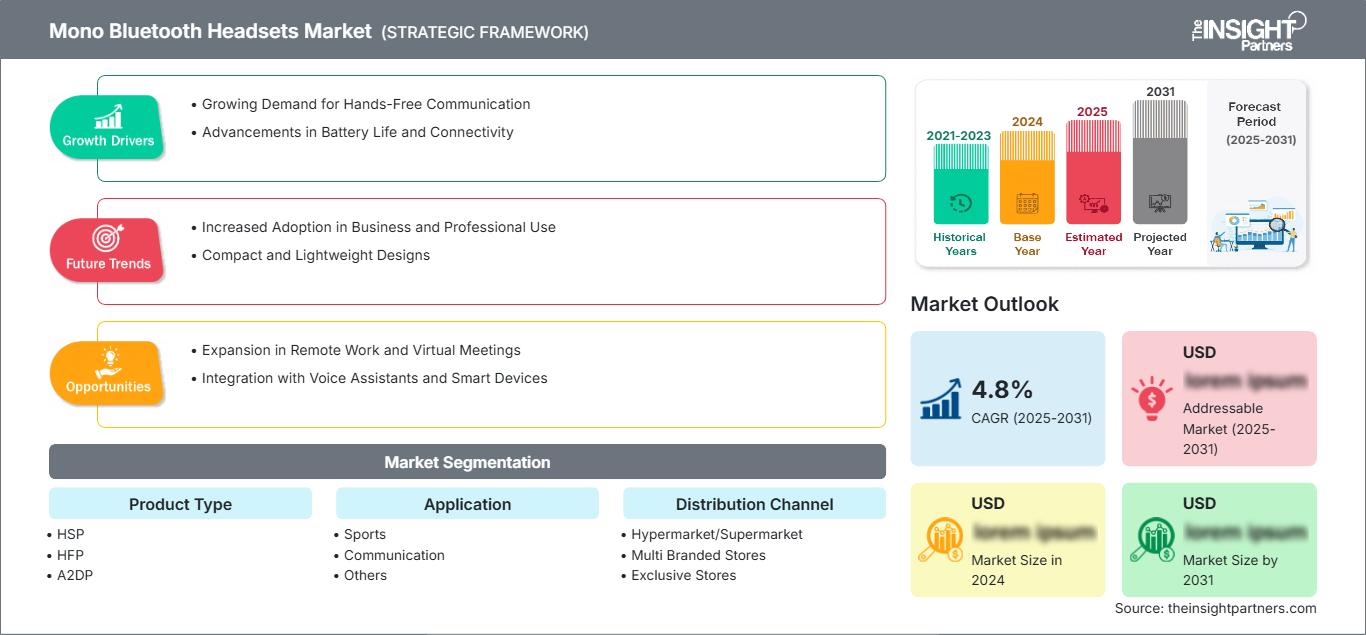
Mono Bluetooth Headsets Market: Strategic Insights
Regional Insights
North America mono bluetooth headsets market
North America is estimated to account for 31–35% share in 2025, with growth of 9.4–10.2% CAGR through 2034. It also has high maturity of smartphone ownership, collaboration capabilities of enterprises, and high usage of wireless peripherals in both business and personal settings.
The United States is the key demand area with backing from corporate communications, contact centers, logistics, health administration, and mobile users. Canada helps out in terms of enterprise IT purchases and consumer electronics adoption. The demand is shifting towards reliable microphones, all-day wear comfort, multipoint capabilities, and device management. Companies with existing enterprise connections have a strong advantage here.
U.S. mono bluetooth headsets market
The US represents approximately 76–79% of North American revenue in 2025 and is projected to expand at a 9.5–10.3% CAGR through 2034. Field communications, field operations, retail, transportation, and professional mobile usage continue to be key market segments.
Jabra, Logitech, Plantronics, Motorola, and many other consumer electronics providers continue to enjoy good brand awareness in both professional and consumer segments. Current application trends point toward devices that are light-weight, provide high-quality voice capture, are immune to background noise, have solid pairing capabilities, and provide extended battery life. In addition, acquisition strategies are also paying increasing attention to device compatibility, device management, warranty considerations, and total cost of ownership.
Europe mono bluetooth headsets market
The mono bluetooth headsets market report shows that Europe holds approximately 24–28% share in 2025 and is expected to register a 9.1–10.0% CAGR through 2034. In terms of ranking, Germany is number one, followed by the UK, France, Italy, and Spain. The driving factors for the need in the country include workplace digitization, logistics modernization, and consumer electronics distribution.
The United Kingdom is an important market for business communications, where the use is driven by hybrid work arrangements and contact center modernization. Germany has an advantage of its ecosystem of industry and automotive, where there is a need for reliable hands-free communication. In France, the need comes from enterprise mobility and consumer electronics, and in Italy and Spain from retail, transport, hospitality, and mobile workforce.
APAC mono bluetooth headsets market
The mono bluetooth headsets market forecast shows that APAC represents approximately 29–33% share in 2025 and is forecast to grow at a 10.8–11.7% CAGR through 2034. China leads the region, supported by electronics manufacturing, domestic brands, and large consumer demand.
The contributions from Japan and South Korea come from their excellent electronics and ecosystems of devices, whereas India brings excellent opportunities for growth through penetration of smartphones and ecommerce. Demand is mature in Australia. Regional growth comes through manufacturing scale, competitiveness of components, ecommerce penetration and digital policies, whereas local brands compete based on value for money and ecosystem integration.
Middle East & Africa mono bluetooth headsets market
Middle East and Africa is projected to grow at a 8.6–9.5% CAGR through 2034, with Saudi Arabia and the UAE representing leading regional demand centers. Modernization of infrastructure and digitization in workplaces facilitate the adoption within the commercial sectors.
South Africa helps by means of business communications, retail, and services, while the Rest of MEA is less integrated. Saudi Arabia is helped by digitization and infrastructure projects on a big scale, while the UAE offers demand from business services, aviation, hospitality, and logistics. Growth in smartphones and better online retailing infrastructure will enable gradual penetration in the region.
Segmentation Analysis
Product Type
Product Type segmentation covers HSP, HFP, and A2DP. The segment is expected to expand at a 9.7–10.5% CAGR during 2026–2034 as users prioritize reliable voice connectivity, compatibility, and increasingly capable audio profiles. Product differentiation is shifting toward integrated wireless performance, microphone quality, battery optimization, and support for newer Bluetooth functionality.
- HSP: Serves basic headset communication requirements and remains relevant where straightforward voice connectivity, low complexity, and economical procurement are priorities across professional and personal applications.
- HFP: Holds strong strategic relevance for hands-free calling, particularly in mobile work, transportation, and enterprise communication scenarios requiring dependable two-way voice functionality and broad device compatibility.
- A2DP: Supports higher-quality audio streaming and strengthens the product proposition where users combine calling with music, multimedia, training, and other content consumption requirements.
Application
Application includes Sports, Communication, and Others. This segment is projected to grow at a 9.6–10.4% CAGR during 2026–2034, with communication remaining central while sports-oriented use expands through mobility, fitness routines, and hands-free convenience. Application-specific design requirements increasingly influence acoustic configuration, durability, comfort, and battery selection.
- Sports: Demand is associated with secure fit, lightweight construction, sweat resistance, simple controls, and hands-free operation, making product reliability important for runners, gym users, and active consumers.
- Communication: Represents the principal application because professional and mobile users require consistent voice clarity, dependable connectivity, comfort during extended calls, and efficient interaction with smartphones and workplace platforms.
- Others: Covers secondary applications where mono operation provides practical advantages, including selected accessibility, service, monitoring, and task-oriented scenarios requiring users to maintain environmental awareness.
Distribution Channel
Distribution Channel comprises Hypermarket/Supermarket, Multi Branded Stores, Exclusive Stores, and Online. The segment is expected to grow at a 10.6–11.4% CAGR during 2026–2034, supported by broader digital retail and omnichannel purchasing behavior. Distribution strategy increasingly combines product visibility with fast fulfillment and after-sales support.
- Hypermarket/Supermarket: Provides physical product access and impulse-oriented purchasing, particularly where consumers compare entry and mid-tier wireless accessories alongside smartphones and other electronics.
- Multi Branded Stores: Enable direct comparison across competing audio products and remain important for customers seeking demonstrations, staff guidance, warranty assurance, and immediate product availability.
- Exclusive Stores: Strengthen brand-led purchasing by enabling manufacturers to present complete portfolios, accessories, ecosystem compatibility, and premium service experiences within controlled retail environments.
- Online: Benefits from extensive assortment, transparent specifications, customer reviews, promotional flexibility, and delivery convenience, making digital channels increasingly important for both established brands and emerging manufacturers.
Opportunity Snapshot
| Application | Revenue Contribution | Trend Tag | Adoption Stage |
| Sports | Medium | Active Mobility | Scaling |
| Communication | High | Voice Productivity | Mature |
| Others | Low | Task Mobility | Emerging |
Mono Bluetooth Headsets Market Growth Drivers and Impact Analysis
Expansion of mobile and hybrid communication workflows
The ongoing trend towards mobile collaboration, distributed teams, field service applications, and flexible working models makes hands-free communication more important than ever. Firms are increasingly demanding employees who are able to communicate while looking at screens, managing inventory, traveling between locations, or engaging with customers. There is thus a need for light-weight headsets that will stay connected for long time without causing much strain to the user. Enterprises also consider microphone performance, platform compatibility, warranty, and centralized deployment capabilities when choosing the headset technology. The more these considerations make it into procurement policies, the more opportunities there are for vendors with well-established enterprise distribution channel to get recurring purchases and replacements. The mono bluetooth headsets market thus gains from the transition from accessory headsets purchase to productivity-focused workplace headsets.
Improving Bluetooth audio capabilities and device interoperability
Bluetooth technology is progressing beyond conventional wireless audio through LE Audio, Auracast, improved power efficiency, and enhanced interoperability. The Bluetooth SIG reported that global Bluetooth device shipments are projected to exceed 5.3 billion units in 2025, demonstrating the scale of the underlying ecosystem. For headset manufacturers, broader Bluetooth deployment lowers connectivity barriers and supports compatibility across smartphones, tablets, computers, vehicles, and specialized devices. Improved wireless efficiency can also support longer operating periods and more flexible product designs. These advances encourage manufacturers to refresh existing portfolios and introduce products capable of supporting evolving standards. The resulting technology cycle creates opportunities for premium differentiation while maintaining demand for practical mono communication products where low complexity, voice clarity, and reliable pairing remain more important than immersive stereo experiences.
Growth of specialized hands-free use across operational sectors
Mono headsets provide an operational advantage when users need continuous environmental awareness while communicating. Retail employees, warehouse personnel, drivers, technicians, customer-service teams, and frontline workers can use one-ear devices while retaining awareness of surrounding activity. This use case expands the addressable customer base beyond conventional office communication. Product requirements in these environments often include rugged construction, replaceable batteries, easy controls, dependable wireless connections, and strong microphone performance. Vendors are responding with application-specific designs rather than relying solely on consumer-oriented form factors. Sector-specific procurement can also generate higher repeat demand because organizations equip multiple employees with standardized devices. This dynamic supports predictable replacement cycles and encourages suppliers to develop durable portfolios tailored to operational workflows, environmental conditions, and shift-based usage.
Mono Bluetooth Headsets Market Future Trends
AI-enabled voice interaction and adaptive audio processing
AI is expected to become increasingly embedded in headset functionality, particularly through improved voice isolation, transcription, contextual commands, and adaptive sound processing. Future mono devices are likely to use microphones and onboard or connected software to distinguish speech from operational noise more effectively. Instead of treating noise cancellation as a standalone feature, manufacturers may integrate environmental classification with communication software to optimize call quality dynamically. Enterprise applications could extend this capability through automated meeting assistance, voice-led workflows, and real-time information retrieval. The strongest opportunities will emerge where AI improves measurable productivity rather than simply adding novelty features. This transition could also encourage closer integration between hardware vendors, operating-system providers, collaboration platforms, and enterprise software developers.
Transition toward low-power and broadcast-enabled Bluetooth architectures
The mono bluetooth headsets market trends show that the continued development of Bluetooth LE Audio and Auracast is expected to influence future product architectures, particularly where power efficiency, accessibility, and shared audio experiences matter. Auracast can support broadcast audio from compatible transmitters to multiple receiving devices, creating potential applications in public venues, transportation, education, healthcare, and enterprise environments. For mono headset suppliers, the technology can expand use cases beyond one-to-one device connections. Future product development is therefore likely to consider compatibility with broadcast environments alongside traditional calling and streaming. As Bluetooth specifications evolve more frequently, manufacturers that maintain upgradeable software and flexible hardware architectures should be better positioned to incorporate new capabilities without completely redesigning product platforms.
Mono Bluetooth Headsets Market Opportunities
Enterprise fleet management and vertical-specific headset programs
Enterprise customers represent an attractive opportunity because standardized headset deployment can create repeat purchases across large employee populations. Suppliers can develop vertical-specific portfolios for retail, logistics, transportation, healthcare administration, hospitality, and field service. Opportunity extends beyond hardware through centralized configuration, firmware management, asset tracking, warranty programs, and replacement services. Vendors can also create tiered portfolios based on duty cycle, environmental exposure, battery requirements, and collaboration-platform compatibility. Such solutions allow buyers to evaluate total ownership cost instead of unit price alone. Strategic investment in enterprise software integration and channel partnerships could therefore increase customer retention while reducing dependence on highly competitive consumer retail cycles. The strongest propositions will combine durable hardware with measurable productivity benefits and simplified device administration.
Expansion through digital commerce and localized product portfolios
Online distribution provides manufacturers with a scalable route into countries where physical specialty retail remains fragmented. Digital channels allow brands to present multiple configurations, compare specifications, collect customer feedback, and adjust promotional strategies quickly. Localization can further improve conversion through regional language support, compatible accessories, warranty infrastructure, and pricing suited to local purchasing power. India, Southeast Asia, Latin America, and selected Middle Eastern economies offer opportunities for suppliers that combine affordable products with dependable after-sales service. Manufacturers can also use online channels to test new form factors before expanding through physical retailers. Strategic investment in regional fulfillment, marketplace partnerships, localized marketing, and service networks could broaden reach while maintaining tighter control over product positioning and customer data.
Recent Developments
- January 2026: GN Store Nord A/S: Jabra introduced the Evolve3 Series, combining professional voice clarity, adaptive ANC, deep-learning-based ClearVoice technology, extended battery capability, fast charging, AI interaction, and centralized device management through Jabra Plus. The launch reflects the increasing convergence of professional communication hardware, AI-enabled workflows, and enterprise device administration.
- September 2025: Logitech International S.A.: Logitech launched Zone Wireless 2 ES for Business, incorporating hybrid active noise cancellation and AI-powered microphones for noisy offices. The Bluetooth version was positioned for enterprise use with Microsoft Teams, Zoom, and Google Meet certifications, highlighting continued investment in communication quality, workplace compatibility, and software-supported productivity.
- February 2026: Samsung Electronics Co., Ltd.: Samsung introduced the Galaxy Buds4 series with enhanced ANC, adaptive equalization, Bluetooth 6.1, Auracast support, hands-free controls, and deeper AI integration. The launch demonstrates how wireless audio products are increasingly being positioned as intelligent extensions of broader device ecosystems rather than standalone accessories.
Frequently Asked Questions

- Comprehensive Market Sizing and Forecast Analysis
- Detailed Segmentation Analysis
- In-Depth Market Dynamics Assessment
- Regional and Country-Level Insights
- Competitive Landscape and Company Benchmarking
- Strategic Business Intelligence
Recent Reports
Testimonials

The Insight Partners provided valuable market intelligence that supported our global go-to-market strategy. Their team was professional, responsive, and attentive to our feedback, providing thoughtful analysis and helpful methodological clarifications throughout the project.
Junmo Kim Chief Financial Officer (CFO), Enertech Co., Ltd.
The Insight Partners' SCADA System Market report is comprehensive, with valuable insights on current trends and future forecasts. The team was highly professional, responsive, and supportive throughout. We are very satisfied and highly recommend their services.
RAN KEDEM Partner, Reali Technologies LTDs
I requested a report on a very specific software market and the team produced the report in a few days. The information was very relevant and well presented. I then requested some changes and additions to the report. The team was again very responsive and I got the final report in less than a week.
JEAN-HERVE JENN Chairman, Future Analytica
We worked with The Insight Partners for an important market study and forecast. They gave us clear insights into opportunities and risks, which helped shape our plans. Their research was easy to use and based on solid data. It helped us make smart, confident decisions. We highly recommend them.
PIYUSH NAGPAL Sr. Vice President, High Beam Global
The Insight Partners delivered insightful, well-structured market research with strong domain expertise. Their team was professional and responsive throughout. The user-friendly website made accessing industry reports seamless. We highly recommend them for reliable, high-quality research services
YUKIHIKO ADACHI CEO, Deep Blue, LLC.
This is the first time I have purchased a market report from The Insight Partners.While I was unsure at first, I visited their web site and felt more comfortable to take the risk and purchase a market report.I am completely satisfied with the quality of the report and customer service. I had several questions and comments with the initial report, but after a couple of dialogs over email with their analyst I believe I have a report that I can use as input to our strategic planning process.Thank you so much for taking the extra time and making this a positive experience.I will definitely recommend your service to others and you will be my first call when we need further market data.
JOHN SUZUKI President and Chief Executive Officer, Board Director, BK Technologies
I wish to appreciate your support and the professionalism you displayed in the course of attending to my request for information regarding to infectious disease IVD market in Nigeria. I appreciate your patience, your guidance, and the fact that you were willing to offer a discount, which eventually made it possible for us to close a deal. I look forward to engaging The Insight Partners in the future, all thanks to the impression you have created in me as a result of this first encounter.
DR CHIJIOKE ONYIA MANAGING DIRECTOR, PineCrest Healthcare Ltd.Reason to Buy
- Informed Decision-Making
- Understanding Market Dynamics
- Competitive Analysis
- Identifying Emerging Markets
- Customer Insights
- Market Forecasts
- Risk Mitigation
- Boosting Operational Efficiency
- Strategic Planning
- Investment Justification
- Tracking Industry Innovations
- Aligning with Regulatory Trends





 Get Free Sample for