
Movie Projectors Market Size, Trends & Growth by 2034
Coverage: by Product Type (Laser Projector, Pico Projector, Others); Technology Type (DLP, LCD, Others) , and Geography (North America, Europe, Asia Pacific, and South and Central America)
- Status : Data Released
- Report Code : TIPRE00005435
- Category : Electronics and Semiconductor
- No. of Pages : 150
- Available Report Formats :


- Last update date : October 13, 2026


2025 Market Size
US$ 6.53 Bn
Base year value
2034 Forecast
US$ 10.96 Bn
Projected by 2034
CAGR 2026-2034
6.68 %
Growth rate
Addressable Market
US$ 82.34 Bn
(2026-2034)
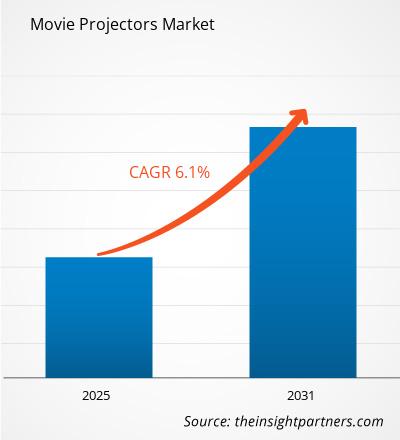
The Movie Projectors Market expansion is supported by growing home entertainment adoption and sustained cinema infrastructure modernization, with the market valued at US$ 6.53 Billion in 2025 and projected to reach US$ 10.96 Billion by 2034, expanding at a CAGR of 6.68% between 2026 and 2034. Rising demand for laser and pico projector technologies across residential, commercial, and cinema applications reinforces sustained global adoption momentum.
North America is estimated to grow at a CAGR of 6.2-6.7% through 2034, reflecting the movie projectors market size expansion driven by continued digital cinema screen upgrades and rising residential home theater installation demand. Growing corporate and educational sector adoption of portable projection technology further reinforces sustained regional consumption patterns.
Movie Projectors Market Assessment and Insights
- North America: The region holds an estimated 26-29% share in 2025, growing at a CAGR of 6.2-6.7% between 2026-2034, supported by cinema digital upgrades, home theater adoption, and corporate presentation equipment refresh cycles.
- US: The United States represents the majority of regional demand in 2025, expanding at a CAGR of 6.1-6.6% through 2034, driven by residential and commercial cinema projection equipment upgrades.
- Europe: Europe accounts for roughly 20-23% share in 2025 and is projected to grow at a CAGR of 6.3-6.8% through 2034, led by Germany, the UK, and France through cinema and corporate adoption.
- Asia Pacific: Asia Pacific dominates with an estimated 36-40% share in 2025, expanding at a CAGR of 7.2-7.7% between 2026-2034, led by China, India, and Japan through cinema infrastructure expansion and consumer electronics manufacturing.
- Largest Segment: The Laser Projector segment holds the largest share at 52-56% in 2025, growing at a CAGR of 7.1-7.6% through 2034, favored for superior brightness and extended operational lifespan.
- High Growth Segment: The Pico Projector segment registers the fastest growth at a CAGR of 8.3-8.8% through 2034, propelled by rising portable device demand across residential and mobile presentation applications.
- Key companies analyzed in detail: Aiptek International GmbH, Barco NV, Casio Computer Co., Ltd., Christie Digital Systems USA, Inc., GDC Technology Limited, NEC Display Solutions, Ltd., Panasonic Corporation, Qisda Corporation, Samsung Electronics Co., Ltd., Sony Corporation, Epson America, Inc.
Source: The Insight Partners' analysis based on proprietary research, government publications, company annual reports, investor presentations, industry databases, and expert interviews.
The market has evolved through successive technology transitions, moving from conventional lamp-based projection systems toward laser light source architectures offering extended operational lifespan and superior brightness consistency. Manufacturers have progressively enhanced digital light processing and liquid crystal display imaging technologies, enabling sharper resolution and improved color accuracy across commercial and residential applications. Production processes have shifted toward compact, energy-efficient designs, supporting broader adoption across portable pico projector categories serving mobile presentation and personal entertainment use cases.
Looking ahead, manufacturers are expected to expand distribution across emerging Southeast Asian and South Asian markets, undergoing cinema infrastructure development. Regulatory support for digital cinema conversion, alongside energy efficiency standards favoring laser light sources, is likely to accelerate replacement demand. Growing investment in short-throw and ultra-short-throw projection technology presents sustained opportunities across home theater and corporate presentation segments through the forecast period.
Movie Projectors Market Report Scope
| Report Attribute | Details |
|---|---|
| Market size in 2025 | US$ 6.53 Billion |
| Market Size by 2034 | US$ 10.96 Billion |
| Global CAGR (2026 - 2034) | 6.68% |
| Historical Data | 2021-2024 |
| Forecast period | 2026-2034 |
Movie Projectors Market Analysis
Market growth is attributed to the increasing digitization of movie screens in the developing world, coupled with increasing usage of residential home theaters due to a reduction in the prices of laser projectors and increased content access through streaming. The value chain involves the manufacture of optical components, light sources, projection and distribution channels. Cost competitiveness is determined by the procurement of components and light engine technologies.
There are limited optical components and semiconductor light sources manufacturers, which means that the supply is still affected by the scarcity of components, which is experienced occasionally when there are periods of increased demand. Vertical integration is common among manufacturers who seek to incorporate light engines into their products as a way of product differentiation.
Market Analysis indicates that the competition in the market is dominated by the well-established brands in terms of imaging technologies as well as cinema equipment companies. Sony Corporation and Panasonic Corporation have wide portfolios consisting of laser and digital light processing products, whereas Christie Digital Systems USA, Inc. and Barco NV dominate the commercial cinema installation sector through high-end digital projection systems.
NEC Display Solutions, Ltd. and Epson America, Inc. are continuously enhancing their presentation portfolio in the corporate and education sectors, whereas Casio Computer Co., Ltd. and Aiptek International GmbH are concentrating on developing pico projectors for consumers. GDC Technology Limited and Qisda Corporation offer cinema server solutions and residential projector sales.
● REPORT CUSTOMIZATION
Tailor This Report To Align With Your Specific Business Requirements
This report can be customized to align precisely with your business objectives, scope, and target markets. Customization options include tailored segmentation, geography, competitive analysis, and strategic insights to support informed decision-making.
Customize This Report →WHAT YOU CAN ADJUST
- ● Segmentations
- ● Geography
- ● Competitive Analysis
- ● Language Preferences
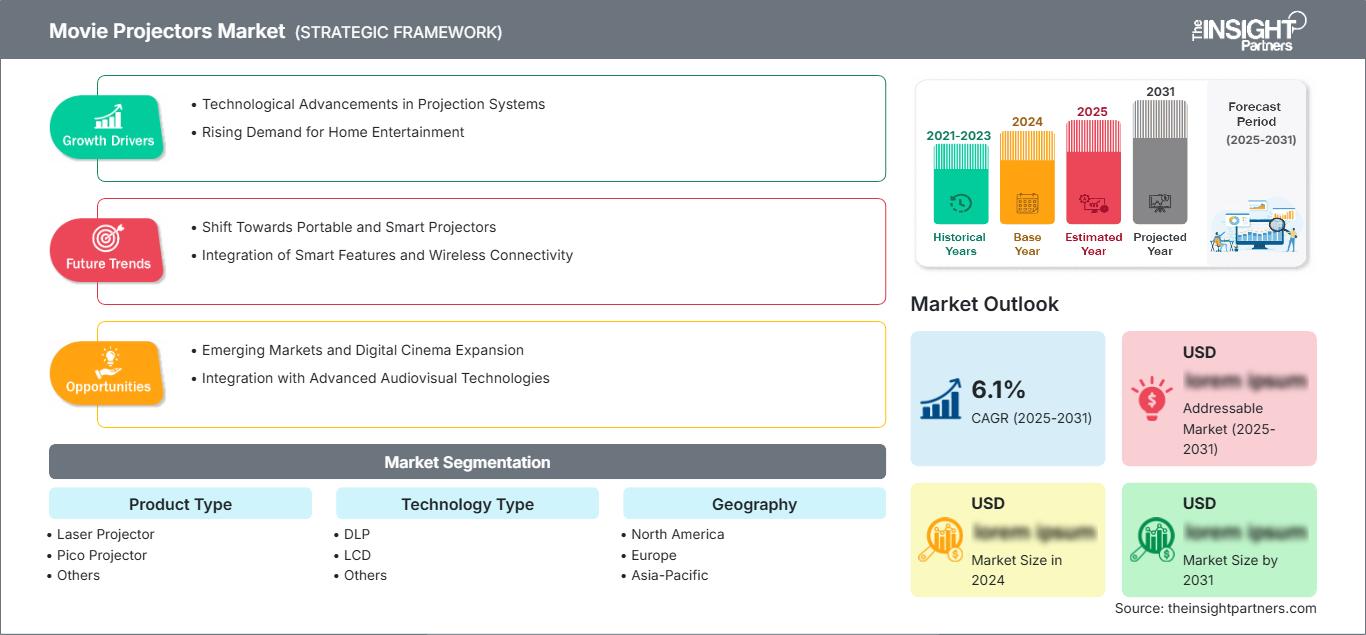
Movie Projectors Market: Strategic Insights
Regional Insights
North America Movie Projectors Market
North America holds an estimated 26-29% share of the global market in 2025, expanding at a CAGR of 6.2-6.7% through 2034. Growth will be driven by ongoing conversions to digital cinema screens from the remaining analog facilities, along with growth in residential home theatre installation facilitated by decreasing costs of laser projectors.
Some of the underlying factors include increasing requirements for presentation devices in corporations and education sectors, along with increased availability of streaming content, driving investments in home entertainment systems. The demand in Canada will come from upgrades in commercial cinema chains, while that of Mexico will come from its growing retail and entertainment infrastructure.
U.S. Movie Projectors Market
The United States Movie Projectors Market share is estimated at 81–85% of the North American market in 2025, growing at a CAGR of 6.1–6.6% through 2034. The strong culture of using laser and digital light processing projectors within residential home theaters, along with the continued modernization of commercial cinemas, contributes significantly towards the demand for such projectors.
The two key brands, Sony Corporation and Epson America, Inc., enjoy significant presence within their respective channels owing to robust domestic distribution. The use trend of such projectors reveals that the premium home theater installation prefers laser projectors, whereas the corporate and education markets prefer portable pico and standard projectors.
Europe Movie Projectors Market
Europe commands an estimated 20-23% share of the global market in 2025, growing at a CAGR of 6.3-6.8% through 2034, with Germany identified as the leading contributor given its extensive corporate and cinema infrastructure requiring advanced projection technology integration.
Germany represents the region's largest market, driven by corporate presentation equipment demand and cinema chain digital upgrades. The UK contributes through residential home theater and educational sector adoption, while France, Italy, and Spain register steady demand from cinema modernization projects and corporate event technology integration across expanding regional commercial infrastructure investments.
APAC Movie Projectors Market
Asia Pacific dominates the global movie projectors market with an estimated 36-40% share in 2025, expanding at the fastest regional CAGR of 7.2-7.7% through 2034. China leads, given its extensive cinema infrastructure expansion, followed by India, Japan, South Korea, and Australia.
Industrial policy support for domestic entertainment infrastructure, particularly across China and India, alongside Japan's established consumer electronics manufacturing ecosystem, continues driving cinema screen expansion and residential projector adoption across rapidly growing middle-class consumer segments region-wide.
Middle East & Africa Movie Projectors Market
The Middle East & Africa market is projected to grow at a CAGR of 5.9-6.4% through 2034, with Saudi Arabia leading regional demand through cinema infrastructure development and entertainment sector expansion tied to national diversification strategies.
The UAE contributes through commercial cinema and corporate technology adoption projects, while South Africa and the Rest of MEA register gradual uptake driven by expanding entertainment infrastructure and retail sector investment supporting residential and commercial projector demand.
Segmentation Analysis
Product Type
The Product Type segment of the market scope encompasses Laser Projector, Pico Projector, and Others categories, collectively growing at a CAGR of 7.4-7.9% between 2026 and 2034. Demand distribution reflects diverging application requirements, with laser and pico technologies gaining share as cinema and residential customers prioritize brightness consistency and portability over conventional lamp-based projector designs.
- Laser Projector: Laser projectors dominate cinema and premium home theater applications, valued for extended operational lifespan and consistent brightness performance compared to conventional lamp-based projection alternatives.
- Pico Projector: Pico projectors gain rapid traction in portable and mobile presentation applications, offering compact form factors suited to personal entertainment and on-the-go business presentation requirements.
- Others: This category includes conventional lamp-based and hybrid light source projectors, maintaining relevance across cost-sensitive educational and small commercial applications requiring budget-friendly projection solutions.
Technology Type
The Technology Type segment records a combined CAGR of 6.9-7.4% between 2026 and 2034, led by digital light processing adoption across cinema and commercial applications. Liquid crystal display technology maintains steady demand within budget-conscious residential and educational segments, reflecting continued diversification across imaging technology preferences.
- DLP: Digital light processing technology dominates cinema and commercial applications, valued for its superior contrast ratio and color accuracy suited to professional presentation and theatrical projection requirements.
- LCD: Liquid crystal display technology maintains steady demand across budget residential and educational applications, offering cost-effective image quality suited to classroom and home entertainment use cases.
- Others: This category includes emerging imaging technologies and hybrid systems, serving specialized applications requiring alternative optical engine configurations beyond conventional projection architectures.
Opportunity Snapshot
| Product Type | Revenue Contribution | Trend Tag | Adoption Stage |
| Laser Projector | High | Cinema Digitization | Mature |
| Pico Projector | Medium | Portable Entertainment | Scaling |
| Others | Low | Budget Projection | Mature |
Movie Projectors Market Growth Drivers and Impact Analysis
Expanding Home Theater Adoption Driven by Declining Laser Pricing
The declining costs associated with laser projector components are dramatically increasing the usage of home theater systems in residential houses, thus making premium quality projectors available to the average user, which were previously reserved only for use in commercial movie theaters. This is made possible due to the cost savings associated with improvements in the manufacturing process of laser diodes, and simpler designs in the optical engines. This is especially evident in the case of consumers who require a larger screen viewing experience than what a regular TV can provide. The rising number of content available on streaming services also plays a significant role in justifying home theater system investments by consumers.
Cinema Digital Conversion Sustaining Commercial Projector Replacement
Digital conversion to laser cinema screens in emerging markets, especially those experiencing rapid urbanization, has continued creating significant replacement demand for cutting-edge laser and digital light processing projection solutions. Increasingly, cinemas have come to prefer laser technology because of reduced maintenance expenses and higher image uniformity than traditional lamp-driven systems, which need periodic bulb changes. Such a trend has been supported by the desire for premium big format and immersive screen experiences that help distinguish movie presentations in theaters from movies streamed at home. Christie Digital Systems USA, Inc. and Barco NV have continued developing laser-based projection technologies for multiplexes and premium movie screenings. As investments in emerging market cinema facilities increase, there has been an increasing demand for projection technology that can facilitate the delivery of digital movie content.
Corporate and Educational Sector Demand for Portable Presentation Technology
Increasing needs for portable and pico projectors arising from corporate training mandates and educational technology upgrades are fueling steady demand for projection systems that enable flexibility in the presentation environment. Portable projectors that can be easily moved around and are capable of projecting from mobile devices and web content delivery systems are increasingly being prioritized by organizations today. Such a development is especially beneficial to educational establishments that adopt hybrid learning approaches and thus need versatile display technology for both traditional and virtual learning environments. Rising corporate interest in collaborative meeting rooms is adding to the overall addressable market demand for short-throw and portable projector systems.
Movie Projectors Market Future Trends
Advancement of Ultra-Short-Throw Technology for Space-Constrained Installations
Manufacturers are increasingly developing ultra-short-throw projection technology suited to space-constrained residential and commercial installations, reflecting evolving movie projectors market trends toward flexible placement solutions, eliminating traditional ceiling-mounted or distant projector positioning requirements. This innovation allows the enjoyment of big picture sizes despite having a small area for installation, and is suitable for use by urban residents who have rooms with smaller dimensions. With the reduced cost of production of ultra-short-throw due to advancements in optical technology, more widespread adoption is expected in the future. Such an expectation will affect the installation trends of home theaters, offering growth opportunities for manufacturers with optical technology innovations.
Integration of Smart Connectivity Features within Projector Platforms
Increasingly, the manufacturers of projectors have been equipping their machines with intelligent operating systems and capabilities for wireless content streaming, thereby removing the need for any kind of external streaming device to access the content. Such convergence makes the entertainment set-up at home much easier and also improves the user experience through built-in applications that provide support for popular streaming services. Even corporate and education sector projector manufacturers have realized the importance of smart connectivity and are working on developing models that allow wireless content streaming from mobile devices without requiring any kind of cable connection.
Movie Projectors Market Opportunities
Expansion of Cinema Infrastructure Investment Across Emerging Asian Markets
Growing middle-class consumer spending and urbanization across emerging Asian markets present a significant opportunity for projector manufacturers to expand commercial cinema equipment supply chains serving new multiplex construction projects. Companies establishing regional distribution and technical support networks can better serve growing theatrical exhibition demand while benefiting from favorable government entertainment infrastructure policies. This geographic expansion also reduces dependency on saturated developed cinema markets, facing slower screen count growth. Movie projectors market forecasts indicate sustained investment interest in emerging Asian cinema infrastructure will continue strengthening through 2034 as global manufacturers prioritize regional partnerships to capture expanding theatrical exhibition demand across rapidly developing consumer entertainment markets.
Strategic Investment in Compact Laser Engine Manufacturing Capacity
Expanding residential and portable projector demand presents a substantial opportunity for manufacturers investing in compact laser light engine manufacturing capacity to address anticipated component supply constraints. Companies establishing dedicated production lines for miniaturized laser diode assemblies can capture growing demand from pico projectors and home theater segments requiring reliable, cost-competitive component supply. This investment opportunity extends to partnerships between optical component specialists and established projector manufacturers seeking to accelerate product miniaturization timelines. Suppliers prioritizing compact laser engine capacity expansion are positioned to benefit from sustained residential and portable projector adoption across global consumer electronics markets through the coming decade.
Frequently Asked Questions

- Comprehensive Market Sizing and Forecast Analysis
- Detailed Segmentation Analysis
- In-Depth Market Dynamics Assessment
- Regional and Country-Level Insights
- Competitive Landscape and Company Benchmarking
- Strategic Business Intelligence
Recent Reports
Testimonials

The Insight Partners provided valuable market intelligence that supported our global go-to-market strategy. Their team was professional, responsive, and attentive to our feedback, providing thoughtful analysis and helpful methodological clarifications throughout the project.
Junmo Kim Chief Financial Officer (CFO), Enertech Co., Ltd.
The Insight Partners' SCADA System Market report is comprehensive, with valuable insights on current trends and future forecasts. The team was highly professional, responsive, and supportive throughout. We are very satisfied and highly recommend their services.
RAN KEDEM Partner, Reali Technologies LTDs
I requested a report on a very specific software market and the team produced the report in a few days. The information was very relevant and well presented. I then requested some changes and additions to the report. The team was again very responsive and I got the final report in less than a week.
JEAN-HERVE JENN Chairman, Future Analytica
We worked with The Insight Partners for an important market study and forecast. They gave us clear insights into opportunities and risks, which helped shape our plans. Their research was easy to use and based on solid data. It helped us make smart, confident decisions. We highly recommend them.
PIYUSH NAGPAL Sr. Vice President, High Beam Global
The Insight Partners delivered insightful, well-structured market research with strong domain expertise. Their team was professional and responsive throughout. The user-friendly website made accessing industry reports seamless. We highly recommend them for reliable, high-quality research services
YUKIHIKO ADACHI CEO, Deep Blue, LLC.
This is the first time I have purchased a market report from The Insight Partners.While I was unsure at first, I visited their web site and felt more comfortable to take the risk and purchase a market report.I am completely satisfied with the quality of the report and customer service. I had several questions and comments with the initial report, but after a couple of dialogs over email with their analyst I believe I have a report that I can use as input to our strategic planning process.Thank you so much for taking the extra time and making this a positive experience.I will definitely recommend your service to others and you will be my first call when we need further market data.
JOHN SUZUKI President and Chief Executive Officer, Board Director, BK Technologies
I wish to appreciate your support and the professionalism you displayed in the course of attending to my request for information regarding to infectious disease IVD market in Nigeria. I appreciate your patience, your guidance, and the fact that you were willing to offer a discount, which eventually made it possible for us to close a deal. I look forward to engaging The Insight Partners in the future, all thanks to the impression you have created in me as a result of this first encounter.
DR CHIJIOKE ONYIA MANAGING DIRECTOR, PineCrest Healthcare Ltd.Reason to Buy
- Informed Decision-Making
- Understanding Market Dynamics
- Competitive Analysis
- Identifying Emerging Markets
- Customer Insights
- Market Forecasts
- Risk Mitigation
- Boosting Operational Efficiency
- Strategic Planning
- Investment Justification
- Tracking Industry Innovations
- Aligning with Regulatory Trends





 Get Free Sample for