
Multi-Cloud Networking Market Share, Growth & Demand by 2034
Multi-Cloud Networking Market Size and Forecasts (2021 - 2034), Global and Regional Share, Trends, and Growth Opportunity Analysis Report Coverage : By Component (Solution, Services), Deployment Mode (Public Cloud, Private Cloud), Enterprise Size (Large Enterprise, Small and Medium Enterprise), Industry Verticals (BFSI, IT and Telecom, Retail and E-Commerce, Healthcare, Manufacturing, Energy and Utilities, Media and Entertainment, Others)
- Status : Data Released
- Report Code : TIPRE00039545
- Category : Technology, Media and Telecommunications
- No. of Pages : 150
- Available Report Formats :


- Last update date : July 30, 2026


2025 Market Size
US$ 2.46 Bn
Base year value
2034 Forecast
US$ 16.57 Bn
Projected by 2034
CAGR 2026-2034
23.61 %
Growth rate
Addressable Market
US$ 73.89 Bn
(2026-2034)
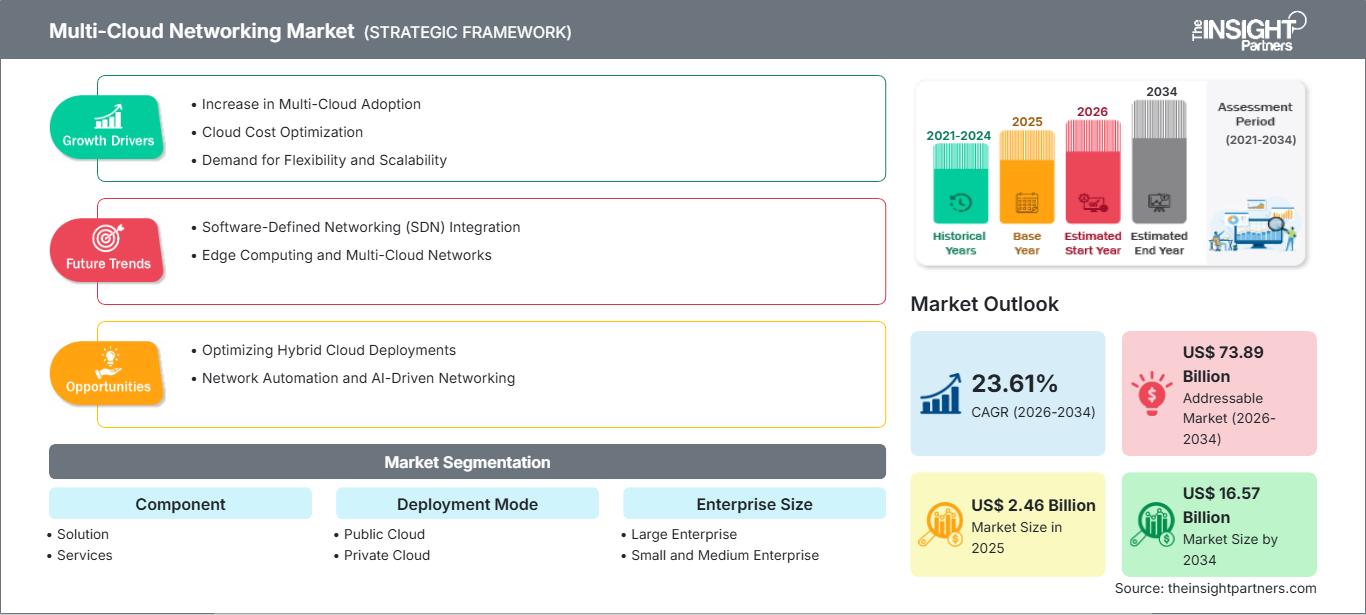
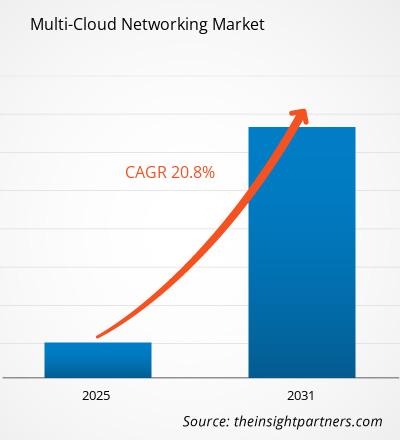
The global multi-cloud networking market is undergoing a decisive expansion phase, with a valuation estimated at US$ 2.46 Billion in 2025 and projected to reach US$ 16.57 Billion by 2034, advancing at a CAGR of 23.61% between 2026 and 2034. This trajectory reflects enterprises' accelerating shift toward distributed cloud architectures, unified connectivity fabrics, and workload portability across hyperscale environments, positioning multi-cloud networking as a foundational layer for modern digital infrastructure strategies worldwide.
Enterprises across North America are emerging as early adopters of unified cloud connectivity frameworks, with regional deployment expanding at an estimated CAGR of 22-24% through 2034. Rising hybrid workforce demands, stringent data sovereignty requirements, and aggressive hyperscale investment are reshaping the multi-cloud networking market size across the region, as large enterprises prioritize consistent security policy enforcement and low-latency application delivery spanning multiple public cloud providers simultaneously.
Multi-Cloud Networking Market Assessment and Insights
- North America: North America commands the largest revenue pool, holding an estimated 36-40% share in 2025 and advancing at a CAGR of 22-24% through 2034, driven by hyperscale density, enterprise cloud maturity, and stringent compliance mandates.
- US: The United States accounts for roughly 84-88% of North America's 2025 revenue, expanding at a CAGR of 22-23% through 2034 on sustained hyperscaler capital expenditure.
- Europe: Europe holds an estimated 24-27% share in 2025, growing at a CAGR of 23-25% through 2034, with the United Kingdom, Germany, and France leading adoption amid GDPR-driven data residency and sovereign cloud initiatives.
- Asia Pacific: Asia Pacific represents an estimated 20-23% share in 2025 and is set to expand at a CAGR of 25-27% through 2034, led by China, Japan, and India amid rapid digital infrastructure buildout.
- Largest Segment: The Solution component held the largest share, estimated at 62-66% in 2025, growing at a CAGR of 22-24% between 2026 and 2034 on rising fabric and orchestration platform deployment.
- High Growth Segment: The Public Cloud deployment mode is the fastest-growing category, projected to expand at a CAGR of 25-27% through 2034 as enterprises diversify hyperscaler dependency.
- Key companies analyzed in detail: Cisco Systems, Inc., Hewlett Packard Enterprise Company, F5, Inc., Juniper Networks, Inc., Nutanix, Inc., VMware, Inc., Oracle Corporation, Citrix Systems, Inc., Akamai Technologies, Inc., and Cloudflare, Inc.
Source: The Insight Partners' analysis based on proprietary research, government publications, company annual reports, investor presentations, industry databases, and expert interviews.
Enterprise networks' designs have seen a gradual move from the reliance on a single cloud as businesses spread their workload across AWS, Microsoft Azure, Google Cloud, and Oracle Cloud Infrastructure to avoid vendor lock-in and enhance cost efficiency. SD-WAN technologies evolved into cloud-native networking fabrics that could orchestrate interconnectivity, security, and traffic engineering in heterogeneous networks. Providers such as Cisco Systems, Inc. and VMware, Inc. implemented automation and policy control in their platforms, turning multi-cloud networking into an enterprise infrastructure platform for the purposes of application modernization.
Moving forward, we expect adoption to grow from North America and Western Europe to Southeast Asia, the Middle East, and Latin America as more data centers appear and hyper-scaled footprints expand further. Capital inflows into AI-ready infrastructure, sovereign cloud policies, and zero-trust regulation would further fuel platform adoption, whereas interoperability standards, orchestration APIs, and networking vendor consolidation would change competitive strategies during the coming decade.
Multi-Cloud Networking Market Report Scope
| Report Attribute | Details |
|---|---|
| Market size in 2025 | US$ 2.46 Billion |
| Market Size by 2034 | US$ 16.57 Billion |
| Global CAGR (2026 - 2034) | 23.61% |
| Historical Data | 2021-2024 |
| Forecast period | 2026-2034 |
Multi-Cloud Networking Market Analysis
Enterprise multi-cloud networking market growth is primarily driven by the proliferation of distributed application architectures, rising east-west traffic between cloud environments, and enterprise mandates for a consistent security posture across heterogeneous infrastructure. Firms tend to distribute workloads across many hyperscalers in order to manage their risks of dependency, optimize their latencies for regional users, and fulfill their legal data residency requirements.
The ecosystem is made up of fabric network providers, cloud service providers, systems integration companies, and managed service providers that provide the connectivity, security, and observability layers. The supply-side dynamics are biased toward vendors that have the ability to incorporate automation powered by artificial intelligence into orchestration platforms as businesses try to unify their fragmented point solutions through a consolidated control plane.
A detailed multi-cloud networking market analysis reveals intensifying competition among established networking incumbents and cloud-native challengers. Cisco Systems, Inc. and Juniper Networks, Inc. leverage deep enterprise install bases, while F5, Inc. and Citrix Systems, Inc. extend application delivery expertise into cloud-native fabrics. Cloudflare, Inc. and Akamai Technologies, Inc. are expanding edge-to-cloud connectivity portfolios, intensifying rivalry across security-centric and performance-centric positioning strategies.
Nutanix, Inc., VMware, Inc., and Oracle Corporation continue investing in hybrid infrastructure integration within the Multi-Cloud Networking Market, while Hewlett Packard Enterprise Company strengthens its portfolio through combined networking and AI infrastructure capabilities. Sustained venture funding into cloud networking startups, coupled with strategic acquisitions by incumbents, signals continued consolidation as vendors race to offer unified, policy-driven connectivity platforms spanning public, private, and hybrid cloud deployments.
● REPORT CUSTOMIZATION
Tailor This Report To Align With Your Specific Business Requirements
This report can be customized to align precisely with your business objectives, scope, and target markets. Customization options include tailored segmentation, geography, competitive analysis, and strategic insights to support informed decision-making.
Customize This Report →WHAT YOU CAN ADJUST
- ● Segmentations
- ● Geography
- ● Competitive Analysis
- ● Language Preferences
Multi-Cloud Networking Market: Strategic Insights
Regional Insights
North America Multi-Cloud Networking Market
North America anchored the largest multi-cloud networking market share in 2025, at an estimated 36-40%, supported by dense hyperscaler infrastructure, early enterprise cloud maturity, and aggressive AI workload deployment across financial services, technology, and healthcare sectors. Enterprises across the United States and Canada are prioritizing unified connectivity fabrics to manage distributed workloads spanning AWS, Microsoft Azure, Google Cloud, and Oracle Cloud Infrastructure, while regulatory emphasis on data residency and zero-trust security continues to reinforce platform investment.
The region is projected to expand at a CAGR of 22-24% between 2026 and 2034, propelled by continued hyperscaler capital expenditure, rising adoption of software-defined networking among large enterprises, and expanding managed service partnerships. Canada's growing data center footprint and sovereign cloud initiatives further support regional demand, while service providers increasingly bundle multi-cloud connectivity with observability and security offerings to differentiate portfolios amid intensifying competitive pressure from both incumbents and cloud-native entrants.
U.S. Multi-Cloud Networking Market
The United States represents an estimated 84-88% share of North America's multi-cloud networking market revenue in 2025, underpinned by concentrated hyperscaler data center investment, mature enterprise IT budgets, and dense presence of leading vendors including Cisco Systems, Inc., F5, Inc., VMware, Inc., and Cloudflare, Inc. Financial services, technology, and media enterprises are the earliest large-scale adopters, deploying unified fabrics to manage workload mobility, disaster recovery, and latency-sensitive application delivery across distributed cloud regions.
The projected CAGR of growth will remain in the range of 22-23% until 2034, aided by increasing AI infrastructure deployment, government cloud modernization programs, and higher demands for zero-trust network access that combines cloud connectivity platforms. More applications are being developed with containerized workloads and APIs, thereby necessitating the consolidation of isolated networking components into control planes.
Europe Multi-Cloud Networking Market
Europe accounted for an estimated 24–27% share of the Multi-Cloud Networking Market in 2025, with the United Kingdom leading regional adoption on the strength of financial services digitalization, sovereign cloud policy, and dense fintech innovation hubs across London and Manchester. Germany follows closely, driven by manufacturing digitalization, Industry 4.0 initiatives, and strict data protection enforcement under GDPR, prompting enterprises to deploy hybrid connectivity fabrics that balance on-premises control with public cloud scalability across automotive and industrial sectors.
France, Italy, and Spain are expanding steadily as enterprises modernize legacy telecom infrastructure and adopt cloud-first strategies across banking, retail, and public sector applications. The region is projected to grow at a CAGR of 23-25% through 2034, with the United Kingdom retaining its position as the leading country, supported by continued investment from vendors including F5, Inc., Citrix Systems, Inc., and Oracle Corporation, strengthening European data center partnerships.
APAC Multi-Cloud Networking Market
Asia Pacific held an estimated 20–23% share of the Multi-Cloud Networking Market in 2025, led by China's large-scale hyperscaler expansion, followed by Japan, South Korea, India, and Australia, where enterprises are accelerating cloud diversification amid rising digital economy investment and manufacturing automation.
The region is forecast to grow at a CAGR of 25-27% through 2034, the fastest globally, driven by government-backed digital infrastructure policies, data localization mandates, and expanding enterprise cloud budgets, with China retaining leadership on the scale of domestic cloud and telecom investment.
Middle East & Africa Multi-Cloud Networking Market
The Middle East and Africa Multi-Cloud Networking Market remains nascent but is expanding steadily, with the United Arab Emirates leading adoption through Dubai and Abu Dhabi's positioning as regional cloud and data center hubs, followed by Saudi Arabia's Vision 2030-linked digital infrastructure investment. Growing enterprise cloud adoption, increasing demand for data sovereignty, and ongoing investments in hyperscale facilities are encouraging organizations across the region to deploy multi-cloud networking solutions that improve connectivity, security, and operational flexibility.
South Africa and the Rest of MEA are gradually adopting cloud connectivity platforms to support energy, banking, and telecom modernization. The region is projected to expand at a CAGR of 24-26% through 2034, with the United Arab Emirates retaining leadership on sovereign cloud and smart-infrastructure investment momentum.
Segmentation Analysis
Component
The Component segment is projected to grow at a CAGR of 22-24% between 2026 and 2034, as enterprises increasingly prioritize integrated networking software over standalone hardware appliances. Rising demand for centralized orchestration platforms and consulting-led deployment support continues to expand the multi-cloud networking market scope, particularly among large enterprises modernizing legacy connectivity architectures across distributed cloud environments.
- Solution: Represents the dominant revenue contributor as enterprises adopt unified software platforms for orchestration, security policy enforcement, and traffic engineering across distributed multi-cloud environments.
- Services: Includes consulting, integration, and managed support offerings that help enterprises design, deploy, and operate complex cloud connectivity architectures across hybrid and multi-vendor environments.
Deployment Mode
The Deployment Mode segment is expected to expand at a CAGR of 23-25% through 2034, reflecting enterprises' accelerating migration toward public cloud infrastructure alongside continued reliance on private environments for regulated workloads. Hybrid architecture adoption is reinforcing demand for interoperable connectivity fabrics capable of bridging public and private cloud boundaries seamlessly.
- Public Cloud: Leads deployment demand as enterprises diversify workloads across hyperscalers such as AWS and Azure to optimize cost, performance, and resilience while minimizing vendor dependency risk.
- Private Cloud: Retains strong relevance among regulated industries requiring strict data control, supporting hybrid connectivity strategies that balance compliance obligations with cloud scalability benefits.
Enterprise Size
The Enterprise Size segment is forecast to grow at a CAGR of 23-25% between 2026 and 2034, with large organizations continuing to lead deployment given complex multi-region infrastructure needs, while smaller enterprises increasingly adopt cloud-native connectivity as managed service offerings lower implementation barriers and total cost of ownership.
- Large Enterprise: Dominates adoption given expansive multi-region infrastructure footprints, complex regulatory compliance requirements, and dedicated IT budgets supporting sophisticated multi-vendor cloud connectivity architecture deployment.
- Small and Medium Enterprise: Increasingly adopts subscription-based connectivity platforms as managed service offerings and simplified orchestration tools lower cost barriers and technical deployment complexity.
Industry Verticals
The Industry Verticals segment of the Multi-Cloud Networking Market is projected to expand at a CAGR of 24–26% through 2034, led by BFSI and IT & Telecom due to stringent compliance mandates, complex data management requirements, and highly data-intensive operations. Healthcare and retail sectors are also accelerating adoption to support digital customer engagement, real-time application performance, and regulatory data residency requirements across increasingly distributed cloud environments.
- BFSI: Leads vertical adoption given stringent regulatory compliance, fraud prevention requirements, and demand for resilient, low-latency connectivity supporting core banking and payment processing systems.
- IT and Telecom: Drives early adoption as providers manage distributed data center and edge infrastructure, requiring consistent orchestration and policy enforcement across public and private cloud environments.
- Retail and E-Commerce: Expands rapidly to support omnichannel customer experiences, seasonal traffic scaling, real-time inventory synchronization, and personalized engagement across geographically distributed multi-cloud commerce platform deployments.
- Healthcare: Adopts multi-cloud connectivity to support telehealth expansion, electronic health record interoperability, and compliance with stringent patient data protection and residency regulations globally.
- Manufacturing: Leverages multi-cloud connectivity to support Industry 4.0 initiatives, real-time production analytics, and seamless integration between edge devices and centralized cloud-based operational platforms.
- Energy and Utilities: Adopts multi-cloud connectivity platforms to manage distributed grid infrastructure, smart metering data streams, and regulatory reporting requirements across increasingly digitalized utility operations nationwide.
- Media and Entertainment: Relies on multi-cloud architectures to support high-bandwidth content delivery, global streaming distribution, and scalable rendering workloads across geographically dispersed cloud regions.
Opportunity Snapshot
| Industry Vertical | Revenue Contribution | Trend Tag | Adoption Stage |
| BFSI | High | Fraud Prevention | Mature |
| IT and Telecom | High | Edge Orchestration | Scaling |
| Retail and E-Commerce | Medium | Omnichannel Scaling | Scaling |
| Healthcare | Medium | Telehealth Interoperability | Emerging |
| Manufacturing | Medium | Industry 4.0 | Scaling |
| Energy and Utilities | Low | Grid Digitalization | Emerging |
| Media and Entertainment | Medium | Streaming Delivery | Scaling |
Multi-Cloud Networking Market Growth Drivers and Impact Analysis
Enterprise Cloud Diversification and Vendor Risk Mitigation
Organizations are now spreading their load out among more than one hyperscale provider in order to minimize dependencies on one provider, minimize risks of any potential downtime, and secure better commercial deals. Such diversification drives the current demand for enterprise connectivity, since it is now required that there be some unified connectivity fabrics that could deal with the traffic, security policies, and observability across all AWS, Microsoft Azure, Google Cloud, and Oracle Cloud Infrastructure at once. Firms from the financial services and technology sectors take the lead in using software-defined approaches that provide abstraction from cloud environments while retaining centralized governance.
Rising AI Workload Distribution Across Hyperscale Environments
Scalability issues in artificial intelligence workloads are pushing organizations to move their training, inference, and data pipelines to different cloud providers so as to utilize specialized GPU capacity, address variable costs, and prevent compute congestion. The result is an increasing need for fabric networks with high throughput and low latency capabilities for synchronizing data across geographical locations within different cloud regions. Cloud providers have started incorporating intelligent traffic engineering and automation in policies within their platforms so that east-west traffic management across clouds becomes more efficient. As there is an increase in neocloud providers along with traditional hyperscale providers, organizations are increasingly looking for connectivity services that are agnostic to vendors.
Regulatory Pressure for Data Sovereignty and Zero-Trust Security
North American, European, and Asia-Pacific governments are tightening their data residency, sovereignty, and zero-trust security regulations, thus demanding that companies design their cloud connectivity architecture to meet the requirements of detailed, region-specific policies. There is increased compliance pressure for financial services, healthcare, and government organizations to enforce security policies consistently in all environments where workloads reside within the cloud. In light of these regulations, there has been increased demand for control plane technologies that integrate access identity, encryption, and continuous monitoring into cloud connectivity infrastructure. The tightening of cross-border data transfer regulations has seen companies opt for solutions that automate compliance processes.
Multi-Cloud Networking Market Future Trends
Convergence of Networking, Security, and Observability into Unified Control Planes
Emerging multi-cloud networking market trends point toward the consolidation of previously siloed networking, security, and observability tools into single, AI-augmented control planes. Vendors are also embedding more natural language interfaces as well as self-healing features that allow network operators to control policies, traffic flow, and threat detection using consolidated dashboards for all connected clouds. It makes sense because this kind of consolidation simplifies operations for businesses working with tens of cloud services at one time, and as agents take care of common troubleshooting and scaling needs, infrastructure teams can focus on designing architectures, not configuring cloud after cloud.
Expansion of Agentic AI-Native Connectivity Fabrics
As more autonomous AI agents work in collaboration with enterprise apps, data lakes, and third-party services, the connectivity fabrics are changing in order to authenticate, direct, and secure machine-to-machine communication in large volumes, which are greater than those generated by human-based usage. Vendors have developed dedicated fabrics, which allow private connections to be extended to laptops, branch offices, and even several public clouds through one secure mesh. This change necessitates a greater volume of transactions with smaller payloads from the networking platform.
Multi-Cloud Networking Market Opportunities
Expansion into Small and Medium Enterprise Segments via Managed Services
The managed service providers with their simpler multi-cloud connectivity solution that comes at the price of a subscription have immense scope for growth since many small businesses are now trying to use cloud in diverse ways but lack expertise in network management. The vendors who provide orchestration, security and monitoring as an out-of-the-box solution will benefit immensely in capturing market share from these smaller enterprises that cannot afford the more complex enterprise-class solution. Efforts to build simpler low-code configuration and automated onboarding will help penetrate this market faster.
Sovereign and Regional Cloud Fabric Development in Emerging Markets
Current multi-cloud networking market forecasts indicate substantial opportunity in emerging economies building sovereign cloud infrastructure to satisfy data localization mandates and reduce reliance on foreign hyperscalers. For vendors who collaborate with regional telecom providers and cloud-related programs funded by the respective governments in the Middle East, Southeast Asia, and Latin America regions, early positioning is possible before enterprises widely adopt such technology. It provides a sustainable competitive edge for vendors as governments are mandating in-country data processing and regulations for cross-border data transfer become stringent in many industries worldwide.
Frequently Asked Questions

- Comprehensive Market Sizing and Forecast Analysis
- Detailed Segmentation Analysis
- In-Depth Market Dynamics Assessment
- Regional and Country-Level Insights
- Competitive Landscape and Company Benchmarking
- Strategic Business Intelligence
Recent Reports
Testimonials

The Insight Partners' SCADA System Market report is comprehensive, with valuable insights on current trends and future forecasts. The team was highly professional, responsive, and supportive throughout. We are very satisfied and highly recommend their services.
RAN KEDEM Partner, Reali Technologies LTDs
I requested a report on a very specific software market and the team produced the report in a few days. The information was very relevant and well presented. I then requested some changes and additions to the report. The team was again very responsive and I got the final report in less than a week.
JEAN-HERVE JENN Chairman, Future Analytica
We worked with The Insight Partners for an important market study and forecast. They gave us clear insights into opportunities and risks, which helped shape our plans. Their research was easy to use and based on solid data. It helped us make smart, confident decisions. We highly recommend them.
PIYUSH NAGPAL Sr. Vice President, High Beam Global
The Insight Partners delivered insightful, well-structured market research with strong domain expertise. Their team was professional and responsive throughout. The user-friendly website made accessing industry reports seamless. We highly recommend them for reliable, high-quality research services
YUKIHIKO ADACHI CEO, Deep Blue, LLC.
This is the first time I have purchased a market report from The Insight Partners.While I was unsure at first, I visited their web site and felt more comfortable to take the risk and purchase a market report.I am completely satisfied with the quality of the report and customer service. I had several questions and comments with the initial report, but after a couple of dialogs over email with their analyst I believe I have a report that I can use as input to our strategic planning process.Thank you so much for taking the extra time and making this a positive experience.I will definitely recommend your service to others and you will be my first call when we need further market data.
JOHN SUZUKI President and Chief Executive Officer, Board Director, BK Technologies
I wish to appreciate your support and the professionalism you displayed in the course of attending to my request for information regarding to infectious disease IVD market in Nigeria. I appreciate your patience, your guidance, and the fact that you were willing to offer a discount, which eventually made it possible for us to close a deal. I look forward to engaging The Insight Partners in the future, all thanks to the impression you have created in me as a result of this first encounter.
DR CHIJIOKE ONYIA MANAGING DIRECTOR, PineCrest Healthcare Ltd.Reason to Buy
- Informed Decision-Making
- Understanding Market Dynamics
- Competitive Analysis
- Identifying Emerging Markets
- Customer Insights
- Market Forecasts
- Risk Mitigation
- Boosting Operational Efficiency
- Strategic Planning
- Investment Justification
- Tracking Industry Innovations
- Aligning with Regulatory Trends





 Get Free Sample for