
Non-dispersive Infrared (NDIR) Market Trends, Share & Demand by 2034
Coverage: By Gas Type (Carbon Dioxide, Hydrocarbons, Refrigerant Gases, Sulphur Hexafluoride, Others); Application (HVAC, Monitoring, Detection and Analysis, Others); Industry (Automotive and Transportation, Chemicals, Oil and Gas, Medical, Food Processing, Others) , and Geography (North America, Europe, Asia Pacific, and South and Central America)
- Status : Data Released
- Report Code : TIPRE00017526
- Category : Electronics and Semiconductor
- No. of Pages : 150
- Available Report Formats :


- Last update date : September 30, 2026


2025 Market Size
US$ 738.06 Mn
Base year value
2034 Forecast
US$ 1,370.6 Mn
Projected by 2034
CAGR 2026-2034
7.12 %
Growth rate
Addressable Market
US$ 9,517.29 Mn
(2026-2034)
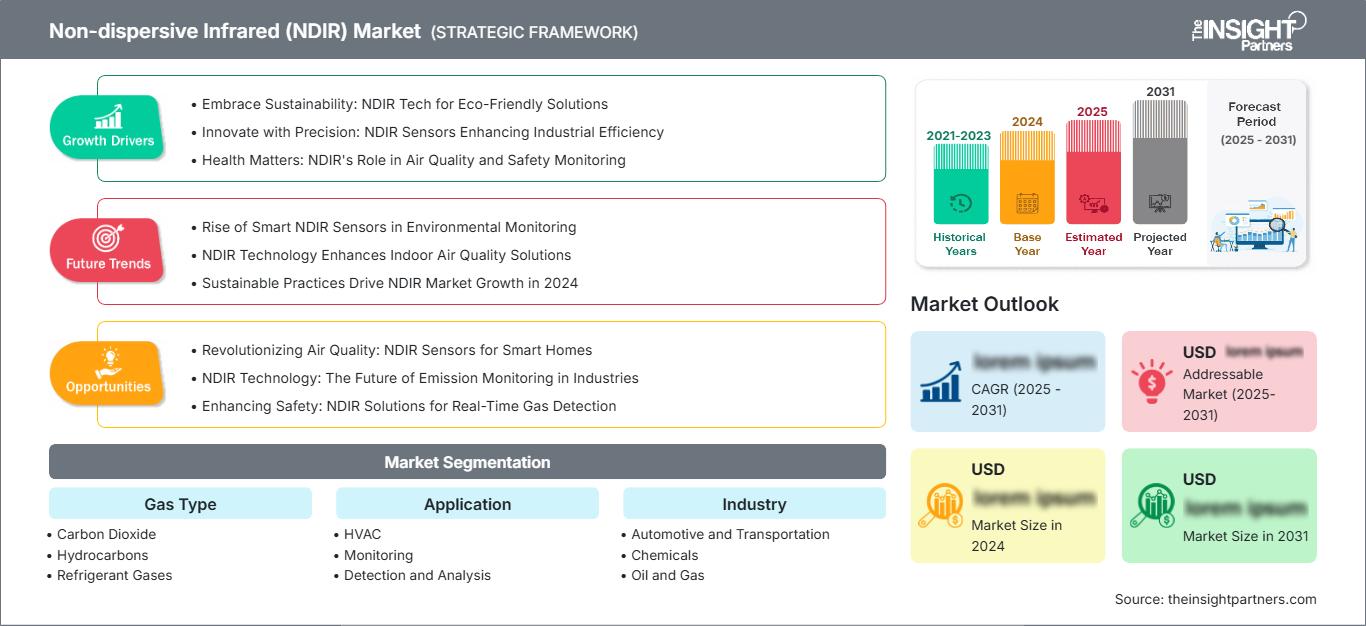
The Non-dispersive infrared market size is valued at US$ 738.06 Million in 2025 and is projected to reach US$ 1,370.6 Million by 2034, expanding at a CAGR of 7.12% during 2026–2034. The technology supports selective gas measurement through infrared absorption and is increasingly deployed for carbon dioxide, hydrocarbons, refrigerant gases, and sulphur hexafluoride across industrial, environmental, building, transportation, and medical applications.
North America is expected to maintain a strong position, supported by demand for indoor air-quality monitoring, industrial gas detection, energy-efficient HVAC control, and emissions management. The regional outlook indicates a CAGR of 6.6–7.0% during 2026–2034. Integration of compact sensors into connected building systems and increased monitoring requirements for industrial facilities are strengthening deployment across established and emerging applications.
Non-dispersive Infrared (NDIR) Market Assessment and Insights
- North America: North America is expected to represent a 27–31% Non-dispersive infrared market share in 2025, with adoption supported by HVAC automation, industrial safety, and emissions monitoring, while expanding at a CAGR of 6.6–7.0% between 2026–2034.
- US: The US is estimated to account for 78–82% of North America's 2025 share, supported by building automation, oil and gas monitoring, and advanced gas detection, with a 6.5–6.9% CAGR.
- Europe: Europe is projected to hold a 22–26% share in 2025 and grow at 6.7–7.1% CAGR, led by Germany, the UK, France, Italy, and Spain through industrial emissions control and refrigerant monitoring.
- Asia Pacific: Asia Pacific is estimated at 36–40% share in 2025 and is expected to expand at 7.5–7.9% CAGR, led by China, Japan, South Korea, India, and Australia through manufacturing and HVAC adoption.
- Largest Segment: HVAC is the largest application segment, representing a 45–49% share in 2025 and expanding at a 7.2–7.6% CAGR through 2034.
- High Growth Segment: Oil and Gas is the high-growth industry segment, holding an 18–22% share in 2025 and advancing at an 8.0–8.4% CAGR through 2034.
- Key companies analyzed in detail: Amphenol Advanced Sensors; Cambustion Limited; Dynament; Fuji Electric Co., Ltd.; Honeywell International Inc.; HORIBA, Ltd.; N.E.T. S.r.l.; TechStar; Yokogawa Electric Corporation; Zhengzhou Winsen Electronics Technology Co., Ltd.
Source: The Insight Partners' analysis based on proprietary research, government publications, company annual reports, investor presentations, industry databases, and expert interviews.
This development has moved on from laboratory-based infrared technology towards miniaturized modules suitable for embedded sensing. Innovations in IR sources, optical filters, detectors, signal processing, temperature correction, and calibration have minimized size while maximizing stability. Manufacturing is more driven by modular approaches that will enable sensor makers to cater to HVAC controllers, portable detectors, industrial analyzers, and automotive applications using common platforms. The move is widening the scope of applications and lowering integration issues.
Future demand in the Non-dispersive infrared market will be more oriented towards manufacturing clusters in Asia-Pacific region, infrastructure works in the Middle East, and retrofits in developed buildings. Areas of investment focus are shifting to low-power electronics, connected sensing, refrigerant sensing, and multiple gas sensing. Focus on air quality, methane emission, refrigerant leak detection, and exposure in workplaces will boost the need for continuous measurement. These developments will fuel adoption of this technology through distributed monitoring architectures.
Non-dispersive Infrared (NDIR) Market Report Scope
| Report Attribute | Details |
|---|---|
| Market size in 2025 | US$ 738.06 Million |
| Market Size by 2034 | US$ 1,370.6 Million |
| Global CAGR (2026 - 2034) | 7.12% |
| Historical Data | 2021-2024 |
| Forecast period | 2026-2034 |
Non-dispersive Infrared (NDIR) Market Analysis
The demand in the Non-dispersive infrared market is driven by the necessity for selective, reliable, and easy-to-manage gas sensing. HVAC companies incorporate CO2 sensing into ventilation control systems, and industrial users have the need for constant monitoring of hydrocarbons and combustion gases. The value chain includes infrared sources, detectors, optical chambers, electronics, firmware, calibration services, sensor modules, analyzers, system integration companies, and original equipment manufacturers. Therefore, supply competitiveness is driven by components' reliability, calibration capacity, and production scalability.
Supply dynamics in the Non-dispersive infrared market depend on the application. High volume CO2 modules need to be small, consume low power, and be cost-effective, while industrial analyzers should be reliable and insensitive to interferences. Refrigerants and hydrocarbon sensing imply additional specifications regarding wavelength range and environmental conditions. Companies possessing both component technology and application development knowledge can cover multiple positions within the value chain and develop sensing platforms specifically for industrial applications.
There are diversified automation firms, specialized sensor suppliers, suppliers of analytical instruments and regional suppliers in the competition. Amphenol Advanced Sensors and Honeywell International Inc. are companies that have sensor technology coupled with extensive customers in industries, while Dynament is specialized in infrared gas sensing. Fuji Electric Co., Ltd., HORIBA, Ltd., and Yokogawa Electric Corporation focus more on analytical instruments and process measurements, thus increasing their strength in challenging industrial settings.
The strategic positioning of Non-dispersive infrared market has become more focused on miniaturization, multi-gas, connectivity, and immunity to interference from the environment. Cambustion Limited stands out with its high-speed measuring of advanced engines and combustion, while N.E.T. S.r.l. caters for OEM gas detection. TechStar participates through analytical and gas detection equipment, while Zhengzhou Winsen Electronics Technology Co., Ltd. competes with miniature sensing modules. Hence, investments are now shifting towards product integration and multi-gas coverage.
● REPORT CUSTOMIZATION
Tailor This Report To Align With Your Specific Business Requirements
This report can be customized to align precisely with your business objectives, scope, and target markets. Customization options include tailored segmentation, geography, competitive analysis, and strategic insights to support informed decision-making.
Customize This Report →WHAT YOU CAN ADJUST
- ● Segmentations
- ● Geography
- ● Competitive Analysis
- ● Language Preferences
Non-dispersive Infrared (NDIR) Market: Strategic Insights
Regional Insights
North America Non-dispersive Infrared Market
North America is estimated to hold a 27–31% Non-dispersive infrared market share in 2025 and is projected to grow at a 6.6–7.0% CAGR through 2034. The United States still holds its place as the key market owing to the increasing demand for continuous gas measurement from commercial buildings, industrial facilities, energy companies, and the transport sector. Modern HVAC systems and indoor air quality initiatives are fostering the use of CO2 sensors, and the oil & gas industry needs hydrocarbon sensors.
Canada will supply the demand through its energy and mining sectors, as well as industrial processes and buildings, while Mexico adds further demand by means of automotive and industrial sectors. In North America, there is a growing preference for sensors that consume less power, have digital output, environmental compensation, and a longer operational life. The availability of technology manufacturers and distribution channels also helps meet replacement and OEM demand.
U.S. Non-dispersive Infrared Market Market
The US represents approximately 78–82% of North America's 2025 share and is expected to expand at a 6.5–6.9% CAGR. There is demand from the use of HVAC controls, workplace safety, emissions testing, automotive testing, and process monitoring. Buildings have increasingly resorted to using CO2 sensors for decision making in terms of ventilation without adhering strictly to fixed time schedules.
Industries include refineries, chemical processing plants, manufacturing plants, laboratories, and healthcare facilities. Honeywell International Inc. and Amphenol Advanced Sensors offer suitable sensing technologies, whereas Cambustion Limited addresses the needs in specialized automotive and combustion measurement. Adoption will also be driven by connected building systems, portable gas detectors, and technology upgrades. The mix of applications in the US will thus be diverse, leading to less dependence on any particular gas or application type.
Europe Non-dispersive Infrared Market
According to the Non-dispersive infrared market report, Europe is estimated at a 22–26% share in 2025 and is projected to expand at a 6.7–7.1% CAGR. Germany is the leading country, supported by industrial automation, automotive manufacturing, process industries, and environmental measurement. The UK also represents a significant technology and instrumentation base.
Gas analysis know-how and research-focused use cases in automotive applications is an advantage for the UK, whereas Germany enjoys its unique combination of process control, manufacturing, and building automation applications. Industrial facilities, HVAC upgrades, food production, and energy systems are key for France, Italy, and Spain. There is a growing focus on European procurements on low emissions, refrigerants, energy efficiency, and monitoring dependability. The European regulatory framework and the well-developed engineering system provide the potential to implement high-end sensors and analyzers.
APAC Non-dispersive Infrared Market
APAC is expected to account for 36–40% of 2025 demand and expand at a 7.5–7.9% CAGR. Top countries include China, followed by Japan, South Korea, India, and Australia. The presence of a large base of manufacturing industries and the installation of HVAC systems is driving sensor adoption.
There is ample scope for volume sales in China and India in buildings, automotive manufacturing, chemicals, and industrial machinery. Whereas Japan and South Korea emphasize instrumentations and manufacturing, the field of energy and resources management falls under the purview of Australia. There is increasing need for industrial modernization, improvement in air quality, energy efficiency, and emissions management.
Middle East & Africa Non-dispersive Infrared Market
Non-dispersive infrared market forecast shows that Middle East and Africa demand is projected to advance at a 7.1–7.5% CAGR, with Saudi Arabia leading regional adoption. Investment in commercial infrastructure and smart buildings in the UAE will drive HVAC applications and indoor air quality solutions, whereas South Africa can contribute to the segment through mining and industrial processing.
Energy infrastructure in Saudi Arabia can help the hydrocarbon detection and process monitoring applications to prosper, whereas the UAE will focus on building efficiency and infrastructure connectivity, and South Africa will need robust gas measurement solutions for mining, chemicals, and industries. The remaining MEA will slowly get into the habit of using monitoring systems along with energy, water, manufacturing, and infrastructure projects. Harsh working conditions give rise to the demand for rugged sensors and calibration solutions.
Segmentation Analysis
Gas Type
Gas Type is projected to expand at a 7.0–7.4% CAGR during 2026–2034. Carbon dioxide remains central to building ventilation and environmental monitoring, while hydrocarbons and refrigerant gases gain importance through safety and leakage-control requirements. Sulphur hexafluoride applications remain specialized but technically significant, particularly where sensitive leak detection is required.
- Carbon Dioxide: CO2 represents the broadest demand base because HVAC, indoor-air-quality, medical, and controlled-environment applications require continuous concentration measurement. Its established sensor architecture supports widespread integration into connected equipment.
- Hydrocarbons: Hydrocarbon sensing is strategically important for oil and gas, automotive, mining, and industrial safety. Methane and related gases require selective detection and durable operation under variable environmental conditions.
- Refrigerant Gases: Refrigerant detection is gaining relevance as cooling equipment shifts toward lower-global-warming-potential refrigerants and leakage monitoring becomes more important across commercial and industrial HVAC installations.
- Sulphur Hexafluoride: SF6 sensing serves specialized electrical and industrial applications where leakage identification is important for equipment integrity, environmental management, and maintenance planning.
Application
Application is forecast to register a 7.1–7.5% CAGR. HVAC remains the largest application because demand-controlled ventilation increasingly relies on gas concentration data. Monitoring and detection and analysis broaden usage into industrial safety, emissions measurement, process control, and specialized analytical systems.
- HVAC: HVAC applications have a mature installed base but continue to expand through smart-building upgrades, energy optimization, and indoor-air-quality initiatives. Embedded sensing supports automated ventilation decisions.
- Monitoring: Monitoring applications span environmental, industrial, medical, and building settings. Continuous measurement improves visibility into changing gas concentrations and supports preventive operational decisions.
- Detection and Analysis: Detection and analysis applications require higher precision and application-specific calibration. They are strategically important in process industries, automotive testing, emissions control, and specialized laboratory environments.
Industry
Industry is expected to advance at a 7.3–7.7% CAGR, reflecting increasing gas-monitoring requirements across manufacturing, energy, transportation, healthcare, and food production. Oil and gas is positioned as the fastest-growing industry segment because methane and hydrocarbon monitoring increasingly influence operational safety and emissions management.
- Automotive and Transportation: Vehicle testing, cabin-air monitoring, alternative-fuel development, and emissions analysis create demand for compact and fast-response gas sensing technologies.
- Chemicals: Chemical facilities require dependable measurement for process control, safety, emissions management, and leak identification, favoring sensors with strong selectivity and environmental stability.
- Oil and Gas: Oil and gas applications emphasize hydrocarbon detection, methane monitoring, process analysis, and worker protection. Continuous sensing can support faster identification of abnormal gas conditions.
- Medical: Medical applications use gas measurement in respiratory systems, anesthesia-related equipment, laboratory instruments, and controlled environments where reliable concentration measurement supports equipment performance.
- Food Processing: Food processing uses gas sensing for controlled atmospheres, storage monitoring, combustion systems, and process optimization, creating demand for compact sensors suited to automated equipment.
Opportunity Snapshot
| Industry | Revenue Contribution (High/Medium/Low) | Trend Tag (MAX 2 words) | Adoption Stage (Emerging/Scaling/Mature) |
| Automotive and Transportation | Medium | Emissions Testing | Scaling |
| Chemicals | Medium | Process Safety | Mature |
| Oil and Gas | High | Methane Monitoring | Scaling |
| Medical | Medium | Gas Control | Mature |
| Food Processing | Low | Atmosphere Control | Scaling |
Non-dispersive Infrared (NDIR) Market Growth Drivers and Impact Analysis
Expansion of Demand-Controlled Ventilation
The rising concern over the indoor air quality raises the need for continuous CO2 measurements in commercial buildings, education facilities, health care premises, and transport. Demand-controlled ventilation systems can be used to adapt to changes in the number of occupants and control the supply of outside air based on actual data, not pre-set schedules. This will create an opportunity for integration of small infrared CO2 sensors into thermostats, air handlers, building management systems, and room controllers. There are opportunities for commercialization not only in new construction but also through retrofit programs. Manufacturers of sensors which provide stable measurements, consume little power, have small size, and digital communication capability are well-placed to benefit from this. The trend provides a positive recurring revenue dynamic since the sensors will need to be replaced, recalibrated, or upgraded.
Increasing Industrial Emphasis on Continuous Gas Safety
Industrial plants are adopting gas measurement techniques continuously due to the possibility that there could be periods between measurements when a problem occurs. Monitoring of combustible gases and emissions in industries such as oil and gas, chemical, mining, and manufacturing is growing in demand. The infrared technique can provide an ideal solution in this case where poison resistance and optical measurement can make the difference in reliability compared with techniques that are prone to poisoning by the catalyst. The commercial aspect is especially important for harsh conditions where accessibility for maintenance and unwanted alarms can disrupt production. Demand is also evolving from single instruments to comprehensive safety systems that include sensing, alarm, connectivity, and analysis functions. Providers who have the ability to manufacture robust components with application-calibrated sensors will thus be able to supply equipment vendors and end-users alike.
Refrigerant Management and Lower-GWP Cooling Systems
The shift towards lower global warming potential refrigerants will drive a greater need for accurate detection technologies in commercial refrigeration, air conditioning, heat pump, and industrial cooling applications. With the increasing variety of refrigerants, sensing systems will have to be able to detect different absorption wavelengths while being able to avoid interference from humidity and other environmental factors. This would mean the adoption of infrared technologies, which can be designed to fit particular refrigerant signatures and incorporated into the equipment. The trend is particularly important for original equipment manufacturers since the choice of the sensors will become an integral part of the design of a safe and maintainable system rather than an additional option. Companies can benefit from designing portable sensors capable of detecting a variety of refrigerants and providing digital diagnostics.
Non-dispersive Infrared (NDIR) Market Future Trends
Edge Intelligence and Self-Diagnostic Sensing
The Non-dispersive Infrared Market trends show that future sensor architectures are likely to incorporate more processing directly within the sensing module, enabling baseline management, drift compensation, fault identification, and adaptive calibration. Rather than transmitting only a concentration value, intelligent modules can provide diagnostic information about temperature effects, optical degradation, condensation, and abnormal operating conditions. This can reduce dependence on external controllers and simplify integration into connected HVAC, industrial, and portable systems. Edge processing may also enable manufacturers to differentiate products through software rather than optics alone. Over time, sensor platforms with built-in diagnostics could support predictive maintenance by identifying performance deterioration before measurement quality becomes unacceptable. The trend is particularly relevant for distributed installations where physical access to every sensor is costly. It could therefore shift purchasing decisions toward total lifecycle performance rather than initial component price.
Multi-Gas Platforms and Modular Optical Architectures
Multi-gas sensing is expected to gain strategic importance in the Non-dispersive Infrared Market as equipment manufacturers seek to reduce component count and expand functionality within compact platforms. Advances in optical paths, detectors, filters, and signal processing can allow related sensor architectures to address carbon dioxide, methane, refrigerants, and other gases with application-specific configurations. Modular platforms may shorten product development cycles because common electronics and mechanical structures can be adapted across gas types. This approach is attractive to HVAC, industrial safety, automotive, and analytical equipment manufacturers serving multiple applications. The trend also encourages suppliers to develop configurable calibration libraries and digital interfaces that simplify equipment integration. As customers increasingly request flexible sensing portfolios, companies able to combine optical expertise with scalable manufacturing are likely to improve their competitive positioning and reduce engineering duplication.
Non-dispersive Infrared (NDIR) Market Opportunities
Embedded Sensing in Smart Building Equipment
Smart-building equipment represents an attractive investment opportunity because gas sensing can become a standard component of connected ventilation, thermostats, air-quality monitors, and building-management systems. Suppliers can target equipment manufacturers rather than relying solely on standalone sensor sales, creating opportunities for higher-volume embedded deployments. Product strategies should prioritize compact dimensions, low power consumption, digital interfaces, long calibration intervals, and reliable performance across temperature and humidity changes. The strongest opportunities are likely to arise where sensing data directly influences ventilation or energy-management decisions. Partnerships with HVAC manufacturers, controls companies, and system integrators can accelerate specification and reduce customer acquisition costs. A modular platform capable of supporting different concentration ranges and communication protocols can further broaden addressable applications while reducing development requirements for each equipment family.
Specialized Monitoring for Energy and Industrial Facilities
Energy and industrial facilities offer opportunities for application-specific sensing systems that combine gas measurement with alarms, communications, and analytics. Methane, hydrocarbon, refrigerant, and process-gas monitoring can support operational safety, maintenance, and emissions-management objectives. Suppliers can create value by tailoring optical configurations, environmental protection, calibration routines, and connectivity to specific operating conditions rather than selling generic modules. Demand is particularly relevant for facilities where inspection is difficult or where unplanned shutdowns carry significant financial consequences. Strategic investment in ruggedized sensors, portable instruments, and networked fixed detectors can address different points in the customer lifecycle. Companies can also expand through partnerships with industrial automation providers and engineering contractors, allowing sensor technology to become part of broader plant modernization programs rather than remaining a standalone component.
Recent Developments
- June 2026: Honeywell International Inc. updated its 4R NDIR Gas Sensor resources, including an evaluation-kit software package and product documentation for hydrocarbon sensing. The update supports integration and evaluation activities around Honeywell's NDIR platform for gas detection applications. The product documentation was published through Honeywell's sensing solutions channels during 2026.
- March 2026: Honeywell International Inc. introduced its 4-Series NDIR Hydrocarbon Gas Sensor for methane, propane, and butane detection in mining, oil and gas, petrochemical, plastics, and manufacturing environments. The sensor is designed for fixed and portable detectors and incorporates features intended to improve performance in humid and harsh conditions.
- January 2026: Cambustion Limited was awarded a Loughborough University gas-analyser contract involving equipment using FID, NDIR, and CLD technologies. The system supports high-speed measurement of hydrocarbons, CO, CO2, NO, and NO2 for combustion and gas-turbine research, demonstrating continued use of NDIR within advanced automotive and energy research applications.
Frequently Asked Questions

- Comprehensive Market Sizing and Forecast Analysis
- Detailed Segmentation Analysis
- In-Depth Market Dynamics Assessment
- Regional and Country-Level Insights
- Competitive Landscape and Company Benchmarking
- Strategic Business Intelligence
Recent Reports
Testimonials

The Insight Partners provided valuable market intelligence that supported our global go-to-market strategy. Their team was professional, responsive, and attentive to our feedback, providing thoughtful analysis and helpful methodological clarifications throughout the project.
Junmo Kim Chief Financial Officer (CFO), Enertech Co., Ltd.
The Insight Partners' SCADA System Market report is comprehensive, with valuable insights on current trends and future forecasts. The team was highly professional, responsive, and supportive throughout. We are very satisfied and highly recommend their services.
RAN KEDEM Partner, Reali Technologies LTDs
I requested a report on a very specific software market and the team produced the report in a few days. The information was very relevant and well presented. I then requested some changes and additions to the report. The team was again very responsive and I got the final report in less than a week.
JEAN-HERVE JENN Chairman, Future Analytica
We worked with The Insight Partners for an important market study and forecast. They gave us clear insights into opportunities and risks, which helped shape our plans. Their research was easy to use and based on solid data. It helped us make smart, confident decisions. We highly recommend them.
PIYUSH NAGPAL Sr. Vice President, High Beam Global
The Insight Partners delivered insightful, well-structured market research with strong domain expertise. Their team was professional and responsive throughout. The user-friendly website made accessing industry reports seamless. We highly recommend them for reliable, high-quality research services
YUKIHIKO ADACHI CEO, Deep Blue, LLC.
This is the first time I have purchased a market report from The Insight Partners.While I was unsure at first, I visited their web site and felt more comfortable to take the risk and purchase a market report.I am completely satisfied with the quality of the report and customer service. I had several questions and comments with the initial report, but after a couple of dialogs over email with their analyst I believe I have a report that I can use as input to our strategic planning process.Thank you so much for taking the extra time and making this a positive experience.I will definitely recommend your service to others and you will be my first call when we need further market data.
JOHN SUZUKI President and Chief Executive Officer, Board Director, BK Technologies
I wish to appreciate your support and the professionalism you displayed in the course of attending to my request for information regarding to infectious disease IVD market in Nigeria. I appreciate your patience, your guidance, and the fact that you were willing to offer a discount, which eventually made it possible for us to close a deal. I look forward to engaging The Insight Partners in the future, all thanks to the impression you have created in me as a result of this first encounter.
DR CHIJIOKE ONYIA MANAGING DIRECTOR, PineCrest Healthcare Ltd.Reason to Buy
- Informed Decision-Making
- Understanding Market Dynamics
- Competitive Analysis
- Identifying Emerging Markets
- Customer Insights
- Market Forecasts
- Risk Mitigation
- Boosting Operational Efficiency
- Strategic Planning
- Investment Justification
- Tracking Industry Innovations
- Aligning with Regulatory Trends





 Get Free Sample for