
Non-Ferrous Metals Market Size, Share & Forecast to 2034
Coverage: By Product (Aluminum, Copper, Zinc, Lead, Nickel, Tin, Titanium, Manganese, Others), Type (Primary and Secondary), End Use (Electrical and Electronics, Automotive and Transportation, Construction, Industrial Machinery and Equipment, Packaging, Energy and Power, Aerospace and Defense, Consumer Goods, Others), and Geography (North America, Europe, Asia Pacific, the Middle East and Africa, South and Central America)
- Status : Published
- Report Code : TIPRE00044133
- Category : Chemicals and Materials
- No. of Pages : 487
- Available Report Formats :


- Last update date : November 23, 2026


2025 Market Size
US$ 766.65 Bn
Base year value
2034 Forecast
US$ 1,226.06 Bn
Projected by 2034
CAGR 2026-2034
5.4 %
Growth rate
Addressable Market
US$ 9,058.15 Bn
(2026-2034)
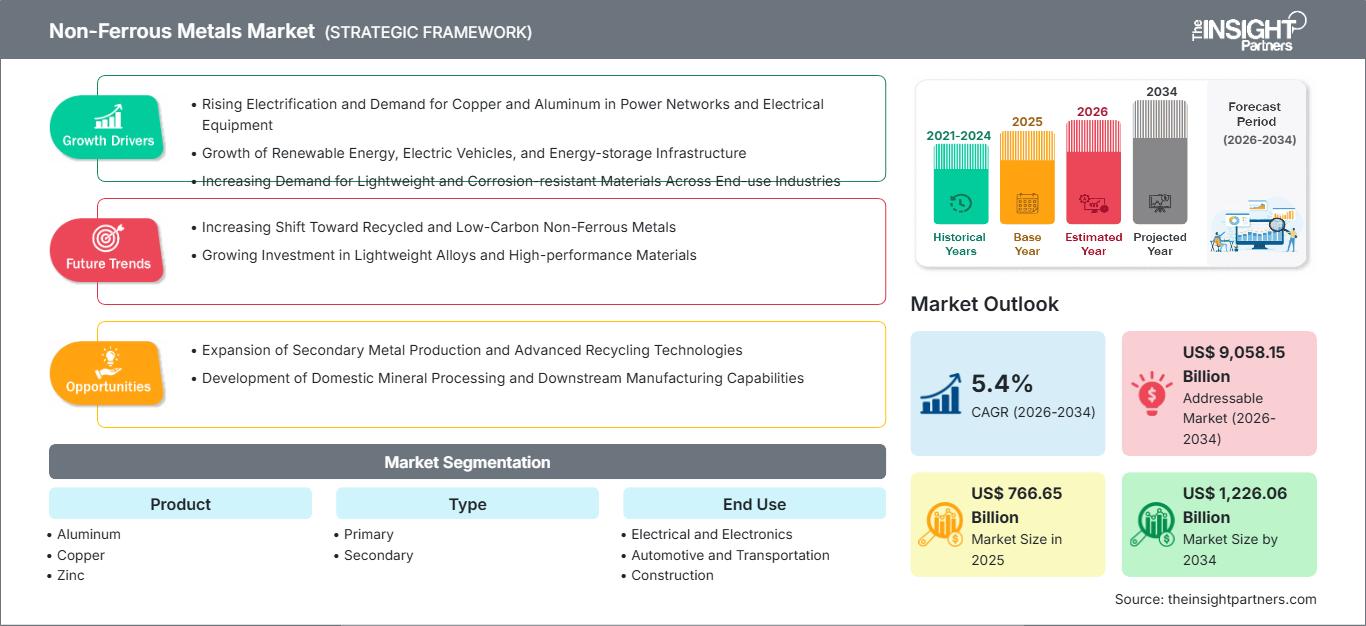
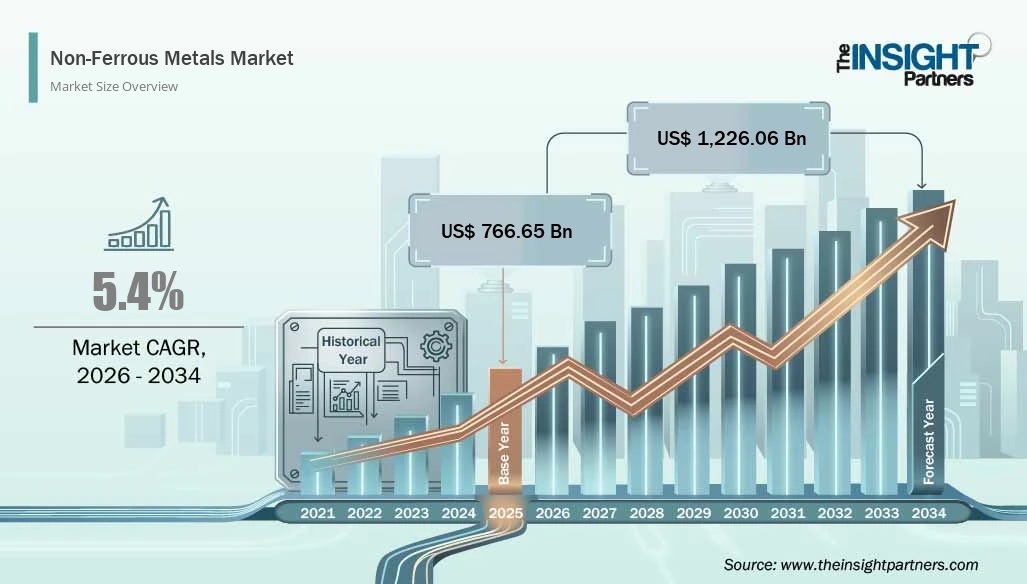
The Global Non-Ferrous Metals Market was valued at US$ 766.65 billion in 2025 and is projected to reach US$ 1,226.06 billion by 2034, registering a CAGR of 5.4% during 2026–2034. Market development is driven by rising demand for metals such as aluminum, copper, zinc, nickel, and other metals from the construction, electrical & electronics, automotive, transport, industrial equipment, and energy infrastructure sectors. The non-ferrous metals are important industrial materials due to the properties they possess, such as light weight, corrosion resistance, conductivity, thermal properties, and recyclability.
Asia Pacific leads the market share because of its extensive manufacturing processes, construction, infrastructure development, and metal usage. China is one of the leading countries that form Asia Pacific, and India, Japan, and South Korea provide their share of demand for stainless steel in the region from their automotive manufacturing and electronics industries. North America is expected to witness the highest regional CAGR of 6.1% till 2034 due to infrastructure improvements, electrification, renewable energy investments, and advanced manufacturing.
Non-Ferrous Metals Market Assessment and Insights
Regional Outlook
- North America: ~12.45% of the global market in 2025 | ~6.1% CAGR through 2034. Market position: North America is projected to record the fastest regional growth, supported by infrastructure modernization, electric vehicle manufacturing, renewable energy investments, and industrial expansion. The United States anchors regional consumption, while Canada and Mexico contribute through mining and manufacturing.
- Europe: ~20.61% of the global market in 2025. Market position: Europe represents an established industrial market supported by automotive manufacturing, construction, electrical equipment, and industrial machinery. Germany, France, Italy, and other manufacturing economies contribute to regional demand. Recycling and energy-efficient production remain important industry considerations.
- Asia Pacific: ~56.28% of the global market in 2025. Market position: Asia Pacific is the largest regional market because of its extensive manufacturing base, construction activities, and industrial metal consumption. China leads regional demand, while India, Japan, and South Korea contribute through automotive, electronics, infrastructure, and energy investments.
- Middle East & Africa: ~4.36% of the global market in 2025. Market position: The region benefits from infrastructure development, construction, industrial diversification, mining, and aluminum production. Gulf economies support metal consumption through industrial investments, while African markets contribute through mineral resources and mining activities.
- South & Central America: ~6.30% of the global market in 2025. Market position: Regional demand is supported by mining, metal production, infrastructure, and construction. Brazil, Chile, and Peru contribute through mineral resources and established copper and other metal industries.
Segment Outlook
- Aluminum: ~44.65% share in 2025. Market position: Aluminum is the largest product segment because of its lightweight properties, corrosion resistance, and recyclability. It is widely used in construction, transportation, packaging, electrical equipment, and industrial manufacturing.
- Primary: ~76.73% share in 2025. Market position: Primary non-ferrous metals dominate the market because of their importance in large-scale industrial manufacturing and infrastructure applications. Demand depends on mining output, refining capacity, energy costs, and raw material availability.
- Construction: ~27.85% share in 2025. Market position: Construction is the largest end-use segment because aluminum, copper, and zinc are widely used in building structures, electrical installations, plumbing, roofing, and infrastructure components.
Competitive Coverage
Glencore plc, CMOC Group Ltd, Zijin Mining Group Co. Ltd, Emirates Global Aluminium PJSC, South32 Ltd, First Quantum Minerals Ltd., Rio Tinto, BHP Group Limited, The Chilean National Copper Corporation (Codelco), Chalco, Freeport-McMoRan, RUSAL, Alcoa Corporation, Norsk Hydro ASA, and Hindalco Industries Ltd.
Methodology
The Insight Partners follows Data Collection & Secondary Research, Primary Research, Data Analysis, and Data Triangulation & Final Review to validate market estimates and insights. The methodology considers industry developments, company information, production and consumption trends, end-use demand, regional dynamics, and competitive positioning.
Source: The Insight Partners' analysis based on proprietary research, government publications, company annual reports, investor presentations, industry databases, and expert interviews.
The non-ferrous metals industry has developed through the process of industrialization, infrastructure construction, production of transport means, and the development of electrical and electronic installations. Non-ferrous metals encompass aluminum, copper, zinc, lead, nickel, tin, titanium, manganese, and other metals which do not have iron as their primary ingredient. This is due to their distinct physical and chemical characteristics. Aluminum is chosen for lightness, copper for its conductive abilities, zinc for anti-corrosion purposes, and titanium and nickel for engineering and industrial use.
Value chain of the industry involves activities like mineral exploration, mineral extraction, mineral processing, smelting, refining, alloy making, marketing, and recycling. Primary production is influenced by the availability of minerals, mining costs, power usage, and process efficiencies. Secondary production is associated with metals recovery from waste materials and scrap.
The market perspective is underpinned by the rising demand for raw materials for electrification, renewable energy, electric vehicles, digital technology, and advanced manufacturing. Copper is enjoying gains due to growing electricity networks, electrical machinery, and electric vehicles, whereas the rising demand for aluminum comes from construction, transport light weighting, packaging, and various industrial uses. Increasing focus on efficient resource management is also driving interest in recycling operations.
The competitive landscape comprises diversified miners, integrated metals companies, and aluminum and copper focused manufacturers. Glencore plc, Rio Tinto, BHP Group Limited, and South32 Ltd operate within diversified metals value chains. Emirates Global Aluminium PJSC, Alcoa Corporation, Norsk Hydro ASA, RUSAL, and Hindalco Industries Ltd are notable for their involvement in the aluminum industry, whereas Codelco and Freeport-McMoRan are major players in the copper industry. Competitiveness is built through resource availability, size of production, efficiency, processing, and customer base.
Non-Ferrous Metals Market Report Scope
| Report Attribute | Details |
|---|---|
| Market size in 2025 | US$ 766.65 Billion |
| Market Size by 2034 | US$ 1,226.06 Billion |
| Global CAGR (2026 - 2034) | 5.4% |
| Historical Data | 2021-2024 |
| Forecast period | 2026-2034 |
Non-Ferrous Metals Market Analysis
Non-Ferrous Metals Market growth is primarily connected to increasing consumption of aluminum, copper, zinc, and other metals across construction, electrical and electronics, automotive, transportation, and industrial manufacturing. These materials serve well in modern industries due to the characteristics of conductivity, durability, lightness, and resistance to corrosion. The uses of aluminum are widespread in the sectors of construction and transportation, whereas the use of copper is essential in electricity, power transmission, and electronics.
Construction accounted for approximately 27.85% of the global market in 2025, making it the largest end-use segment. The use of aluminum can be seen in facade work, roofing, window and door frames, and structural works, whereas copper is needed for wiring and plumbing. Zinc helps in providing protection from corrosion and galvanization. The process of urbanization, infrastructure development, and building construction helps in material consumption.
The conditions of supply are influenced by investments in mining, availability of resources, refining capabilities, energy prices, and transportation infrastructure. Primary production still plays a significant role in fulfilling industrial needs, while recycling is an additional source of materials. Enterprises start paying attention to diversification of supply, vertical integration, and secondary metal production.
Competitive positioning is influenced by access to mineral resources, production costs, processing efficiency, and geographic reach. Diversified mining companies operate across multiple metal categories, while specialized producers focus on aluminum, copper, and other industrial metals. The market's long-term development will depend on industrial investment, commodity economics, electrification, and the availability of primary and recycled materials.
● REPORT CUSTOMIZATION
Tailor This Report To Align With Your Specific Business Requirements
This report can be customized to align precisely with your business objectives, scope, and target markets. Customization options include tailored segmentation, geography, competitive analysis, and strategic insights to support informed decision-making.
Customize This Report →WHAT YOU CAN ADJUST
- ● Segmentations
- ● Geography
- ● Competitive Analysis
- ● Language Preferences
Non-Ferrous Metals Market: Strategic Insights
Regional Insights
North America Non-Ferrous Metals Market
North America accounted for approximately 12.45% of the global market in 2025 and is projected to register the fastest regional CAGR of 6.1% through 2034. Regional demand is supported by infrastructure modernization, automotive manufacturing, electrical equipment production, construction, and energy investments. The United States is the principal regional consumption market, while Canada contributes through mining and aluminum production. Mexico supports demand through automotive manufacturing and industrial supply chains.
Copper and aluminum are vital metals used in the transmission of electricity, production of renewable energy, electric cars, and manufacturing of industrial machinery. The investments in grid infrastructure, data centers, and advanced manufacturing are likely to boost local demand. Recycling and domestic processing could increase the availability of the metal. Nevertheless, the cost of energy, metal prices, and investment affect production economics.
U.S. Non-Ferrous Metals Market
The US is among the largest consumers of non-ferrous metals on the continent owing to various industries such as construction, electronics, automotive and industrial production. Aluminum is mainly used in transport, packaging, building and industry, and copper plays an important role in wiring, transformers, motors and power industry.
Investments in infrastructure construction, renewable energy, and electric vehicle manufacturing would help increase demand. Companies like Alcoa Corporation, Freeport-McMoRan, Rio Tinto, among others, belong to the total metal industry chain. Production from both domestic and international sources, including recycling, influences the supply of aluminum in the market. Long-term competitiveness would depend on the availability of raw materials, production efficiency, and industry investments..
Europe Non-Ferrous Metals Market
Europe accounted for approximately 20.61% of the global market in 2025. The region's established industrial base supports demand across automotive manufacturing, construction, electronics, industrial machinery, and aerospace. Germany is an important market, while France, Italy, and Spain contribute through manufacturing and infrastructure activities.
There are many uses of metals such as aluminum and copper in various fields such as transport, electronics, building system, and manufacture industries. The demand for metals in a particular area is also influenced by renewable energy initiatives, electricity used in cars, and modernizing of manufacturing industries. Energy and environmental costs influence the economics of metal production.
Companies such as Norsk Hydro ASA and other integrated metal producers support regional supply chains. Europe's market outlook will depend on industrial production, infrastructure investments, automotive manufacturing, and the competitiveness of primary and secondary metal operations.
APAC Non-Ferrous Metals Market
Asia Pacific accounted for approximately 56.28% of the global market in 2025, making it the largest regional market. Its leadership reflects extensive manufacturing capabilities, construction activities, metal production, and demand from automotive, electrical and electronics, and infrastructure industries. China is the leading contributor, while India, Japan, and South Korea support consumption through industrial development and manufacturing.
Demand from China’s construction, automobiles, electrical equipment and industries is high for aluminum, copper, zinc and other metals. India provides opportunities due to its infrastructure developments and urbanization and manufacturing sector. Japan and South Korea provide contribution in the form of their electronics, automobile and industries.
The region benefits from established mining, smelting, refining, and downstream manufacturing capabilities. Companies such as Chalco, Hindalco Industries Ltd, CMOC Group Ltd, and Zijin Mining Group Co. Ltd participate in the regional metal value chain. Market growth will depend on infrastructure spending, electrification, industrial production, raw material availability, and environmental requirements.
Middle East & Africa Non-Ferrous Metals Market
The Middle East and Africa accounted for approximately 4.36% of the global market in 2025. Regional demand is supported by infrastructure development, construction, industrial diversification, mining, and metal production. The UAE and Saudi Arabia contribute through aluminum production, industrial development, and large-scale infrastructure projects.
Emirates Global Aluminium PJSC is a major player in the regional aluminum market. The African market plays its part in providing raw materials through mining activities and some of the manufacturing processes. South Africa, through its industrial activity, construction and mining, adds to demand. Growth in the future will be based on mining, metal processing, energy, transport facilities, and industrialization. Local processing and manufacturing may provide more opportunities for regional producers.
South & Central America Non-Ferrous Metals Market
South and Central America accounted for approximately 6.30% of the global market in 2025. The region benefits from substantial mineral resources, established mining operations, metal production, and demand from construction and infrastructure development. Brazil, Chile, and Peru are important contributors.
Chile is one of the major copper producing nations in the region, with Codelco being one of its key players. Peru participates through copper mining and extraction of other minerals, whereas Brazil provides support through aluminum production and manufacturing.
Copper continues to be crucial for the regional metal industry. Development of the market will depend on various factors like mining investment, price of commodity, cost of production, and others.
Segmentation Analysis
Product
The product segment includes aluminum, copper, zinc, lead, nickel, tin, titanium, manganese, and others. Aluminum dominated the market with a share of approximately 44.65% in 2025, supported by its use in construction, transportation, packaging, and industrial manufacturing. Copper accounted for approximately 31.90% and is projected to register the fastest product-level CAGR of 5.8% through 2034 because of electrification and energy infrastructure investments.
- Aluminum: Accounted for approximately 44.65% of the market in 2025. Its lightweight properties, corrosion resistance, and recyclability support applications in construction, automotive, aerospace, packaging, and electrical equipment.
- Copper: Represented approximately 31.90% of the market and is projected to grow at 5.8% CAGR through 2034. Its conductivity makes it essential for electrical wiring, power transmission, renewable energy, electric vehicles, and electronics.
- Zinc: Accounted for approximately 4.93%. It is primarily used in galvanizing, corrosion protection, die-casting, and alloys. Construction and automotive manufacturing influence demand.
- Lead: Represented approximately 3.86%. It is used in lead-acid batteries, industrial equipment, and selected specialized applications.
- Nickel: Accounted for approximately 1.45%. It is used in stainless steel, specialized alloys, plating, and battery-related applications.
- Tin: Represented approximately 0.77%. Its applications include soldering, electronics, tin plating, and specialized alloys.
- Titanium: Accounted for approximately 0.22%. It is valued for strength, lightweight characteristics, and corrosion resistance, particularly in aerospace, defense, and specialized manufacturing.
- Manganese: Represented approximately 5.82%. It is used in steelmaking, alloys, and selected battery and industrial applications.
- Others: Accounted for approximately 6.39%. This category includes specialty and industrial metals used across engineering, manufacturing, and electronics.
Type
The type segment comprises primary and secondary non-ferrous metals. Primary metals dominated the market with approximately 76.73% share in 2025, while secondary metals accounted for 23.27%. Secondary metals are projected to register the fastest CAGR of 5.9% through 2034, supported by recycling, resource efficiency, and circular economy initiatives.
- Primary: Primary non-ferrous metals are produced through mining, ore processing, smelting, and refining. They supply large-scale industrial manufacturing, construction, transportation, and electrical infrastructure. Demand depends on mining capacity, ore availability, energy costs, and refining investments.
- Secondary: Secondary metals are recovered from manufacturing scrap, industrial waste, and end-of-life products. Their growth is supported by recycling infrastructure, resource conservation, and demand for recycled materials. Aluminum and copper are particularly important in secondary production.
End Use
The end-use segment includes electrical and electronics, automotive and transportation, construction, industrial machinery and equipment, packaging, energy and power, aerospace and defense, consumer goods, and others. Construction dominated the market with approximately 27.85% share in 2025. Aerospace and defense is projected to record the fastest CAGR of 6.7% through 2034.
- Electrical and Electronics: Accounted for approximately 21.76%. Copper and aluminum are used in cables, wiring, transformers, motors, connectors, and electronic equipment. Grid modernization and digital infrastructure support demand.
- Automotive and Transportation: Represented approximately 10.80%. Aluminum supports vehicle lightweighting, while copper is used in wiring, batteries, motors, and electrical systems. Electric vehicle adoption creates additional opportunities.
- Construction: Accounted for approximately 27.85%, making it the largest end-use segment. Aluminum, copper, and zinc are used in building facades, roofing, electrical systems, plumbing, and infrastructure components.
- Industrial Machinery and Equipment: Represented approximately 12.70%. Non-ferrous metals are used in motors, machinery components, heat exchangers, and industrial equipment. Manufacturing expansion supports demand.
- Packaging: Accounted for approximately 7.21%. Aluminum is widely used in beverage cans, food containers, and protective packaging because of its lightweight properties and recyclability.
- Energy and Power: Represented approximately 9.20%. Copper and aluminum are essential for transmission networks, renewable energy systems, cables, and electrical equipment.
- Aerospace and Defense: Accounted for approximately 2.70% and is projected to grow at 6.7% CAGR through 2034. Aluminum, titanium, and specialized alloys support aircraft structures, aerospace components, and defense equipment.
- Consumer Goods: Represented approximately 3.94%. Non-ferrous metals are used in household appliances, electronics, furniture, and other manufactured products.
- Others: Accounted for approximately 3.85%. Applications include specialized industrial processing, medical equipment, and other manufacturing activities.
Opportunity Snapshot
| Application | Revenue Contribution | Trend Tag | Adoption Stage |
|---|---|---|---|
| Construction | High | Infrastructure Materials | Mature |
| Electrical and Electronics | High | Electrification and Conductivity | Scaling |
| Automotive and Transportation | Medium | Lightweighting and Electrification | Scaling |
| Industrial Machinery and Equipment | Medium | Industrial Modernization | Mature |
| Packaging | Medium | Recyclable Metal Packaging | Mature |
| Energy and Power | Medium | Grid and Renewable Infrastructure | Scaling |
| Aerospace and Defense | Low | High-Performance Alloys | Scaling |
| Consumer Goods | Low | Metal-Based Components | Mature |
| Others | Low | Specialty Metal Applications | Emerging |
Non-Ferrous Metals Market Growth Drivers and Impact Analysis
Increasing infrastructure development and construction activities
Infrastructure development and construction are major growth drivers for non-ferrous metals. Aluminum, copper, and zinc are widely used in buildings, transportation infrastructure, utility networks, and industrial facilities. Aluminum supports facades, roofing, windows, and structural components, while copper is essential for electrical wiring and plumbing. Zinc contributes through galvanizing and corrosion protection.
Urbanization, population growth, industrialization, and investment in public infrastructures are contributing to the rising demand for metal intensive material. Construction and residential building activities are supporting the consumption of aluminum products and power supplies. Further growth will be contingent upon the expenditures on construction, development of infrastructure projects, and competitively priced metals.
Rising electrification and demand for copper and aluminum
The trend towards electrification is making copper and aluminum more important in the production, transmission, distribution, and utilization of electricity. Copper is utilized extensively in cabling, transformers, motors, and electrical equipment, while aluminum is useful in overhead transmission and other electrical equipment applications. Additional needs arise from renewable energy generation, electric vehicles, EV charging stations, grid upgrades, etc. Data centers are another source of demand for conductive metals. Copper is expected to benefit particularly from these developments, with a projected CAGR of 5.8% through 2034.
Expanding automotive production and lightweight material adoption
Non-ferrous metals have gained significant importance in the automobile industry because they help make automobiles efficient and effective. Aluminium helps reduce the weight of vehicles and supports the structure, whereas copper is used for wiring, electric motors, batteries, and electronics. Manufacture of electric vehicles will offer more chances of utilization in electric powertrains, batteries, and charging facilities. Demand will be influenced by automobile manufacture and vehicle electrification.
Non-Ferrous Metals Market Future Trends
Increasing adoption of recycled and secondary non-ferrous metals
Recycling is gaining importance as manufacturing companies try to optimize the use of resources and diversify their sources of raw materials. Secondary metals such as aluminum and copper can be obtained from industrial waste and EOL products. Infrastructure development to enhance recycling processes is being carried out. The CAGR for secondary metals between 2023 and 2034 is estimated to be at 5.9%. Recycling will depend on the availability of waste, quality of the materials, contamination levels, and cost of processing.
Growing demand for copper from electrification and energy infrastructure
Copper demand is expected to increase with investments in renewable energy, electricity grids, electric vehicles, and digital infrastructure. Its conductivity makes it essential for electrical systems, power transmission, motors, transformers, and electronic equipment.
Copper's projected 5.8% CAGR through 2034 reflects its importance across energy and industrial applications. Mining investments, resource availability, production efficiency, and refining capacity will influence the industry's ability to meet demand.
Increasing focus on lightweight and high-performance metal materials
Light weight and high-performance materials are being used extensively by automotive, aerospace, and defense industries. Aluminum and titanium are significant due to their strength-to-weight ratio and corrosion resistance. Aerospace and defense is projected to register the fastest end-use CAGR of 6.7% through 2034. Aircraft production, fleet modernization, defense investments, and advanced engineering applications are expected to support demand for specialized alloys and metal products.
Non-Ferrous Metals Market Opportunities
Expanding secondary metal production and recycling infrastructure
The increased focus on circular economy strategies presents chances for companies looking to put money into recycling of non-ferrous metals. Metals such as aluminum, copper, zinc, among others, can be recycled from waste from manufacturing processes and end-of-life products. Companies can invest in collecting scrap, scrap sorting and recovery methods, and recycling plants. Collaboration with industrial manufacturers and metal distributors may increase scrap availability. Considerations when making investment decisions should include scrap quality and cost of collection and processing.
Developing copper production capabilities to support electrification
Growing investment in electricity infrastructure, renewable energy, and electric vehicles provides opportunities to the copper producers. The mining companies as well as refiners can make gains from their resource development, production efficiencies, processing investments, and downstream integration. Long-term opportunities will depend upon the mineral resource quality, cost of mining, energy, capital investment, and price of the commodities. Producers with existing mines and dependable supply chain may be in position to cater to growing needs.
Recent Developments
- November 2026: Rio Tinto approved a $144 million investment by Resolution Copper (Rio Tinto share: $79 million) to advance the next phase of development at the project in Arizona, one of the world’s largest untapped copper deposits and a potential major new source of domestically produced copper for the United States.
- September 2026: Emirates Global Aluminium, the largest industrial company in the United Arab Emirates outside oil and gas and the world’s biggest ‘premium aluminium’ producer, announced the completion of its acquisition of an 80 per cent stake in Italian aluminium recycling company Eco Green.
Frequently Asked Questions

- Comprehensive Market Sizing and Forecast Analysis
- Detailed Segmentation Analysis
- In-Depth Market Dynamics Assessment
- Regional and Country-Level Insights
- Competitive Landscape and Company Benchmarking
- Strategic Business Intelligence
Recent Reports
Testimonials

The Insight Partners provided valuable market intelligence that supported our global go-to-market strategy. Their team was professional, responsive, and attentive to our feedback, providing thoughtful analysis and helpful methodological clarifications throughout the project.
Junmo Kim Chief Financial Officer (CFO), Enertech Co., Ltd.
The Insight Partners' SCADA System Market report is comprehensive, with valuable insights on current trends and future forecasts. The team was highly professional, responsive, and supportive throughout. We are very satisfied and highly recommend their services.
RAN KEDEM Partner, Reali Technologies LTDs
I requested a report on a very specific software market and the team produced the report in a few days. The information was very relevant and well presented. I then requested some changes and additions to the report. The team was again very responsive and I got the final report in less than a week.
JEAN-HERVE JENN Chairman, Future Analytica
We worked with The Insight Partners for an important market study and forecast. They gave us clear insights into opportunities and risks, which helped shape our plans. Their research was easy to use and based on solid data. It helped us make smart, confident decisions. We highly recommend them.
PIYUSH NAGPAL Sr. Vice President, High Beam Global
The Insight Partners delivered insightful, well-structured market research with strong domain expertise. Their team was professional and responsive throughout. The user-friendly website made accessing industry reports seamless. We highly recommend them for reliable, high-quality research services
YUKIHIKO ADACHI CEO, Deep Blue, LLC.
This is the first time I have purchased a market report from The Insight Partners.While I was unsure at first, I visited their web site and felt more comfortable to take the risk and purchase a market report.I am completely satisfied with the quality of the report and customer service. I had several questions and comments with the initial report, but after a couple of dialogs over email with their analyst I believe I have a report that I can use as input to our strategic planning process.Thank you so much for taking the extra time and making this a positive experience.I will definitely recommend your service to others and you will be my first call when we need further market data.
JOHN SUZUKI President and Chief Executive Officer, Board Director, BK Technologies
I wish to appreciate your support and the professionalism you displayed in the course of attending to my request for information regarding to infectious disease IVD market in Nigeria. I appreciate your patience, your guidance, and the fact that you were willing to offer a discount, which eventually made it possible for us to close a deal. I look forward to engaging The Insight Partners in the future, all thanks to the impression you have created in me as a result of this first encounter.
DR CHIJIOKE ONYIA MANAGING DIRECTOR, PineCrest Healthcare Ltd.Reason to Buy
- Informed Decision-Making
- Understanding Market Dynamics
- Competitive Analysis
- Identifying Emerging Markets
- Customer Insights
- Market Forecasts
- Risk Mitigation
- Boosting Operational Efficiency
- Strategic Planning
- Investment Justification
- Tracking Industry Innovations
- Aligning with Regulatory Trends





 Get Free Sample for