
Non-Ferrous Scrap Recycling Market Demand, Size & Forecast by 2034
Coverage: By Scrap Type (Aluminum, Copper, Lead, Others); Application (Construction, Automotive, Consumer Goods, Industrial Goods) , and Geography (North America, Europe, Asia Pacific, and South and Central America)
- Status : Data Released
- Report Code : TIPRE00014632
- Category : Chemicals and Materials
- No. of Pages : 150
- Available Report Formats :


- Last update date : November 11, 2026


2025 Market Size
US$ 690.03 Bn
Base year value
2034 Forecast
US$ 939.13 Bn
Projected by 2034
CAGR 2026-2034
3.48 %
Growth rate
Addressable Market
US$ 7,397.50 Bn
(2026-2034)
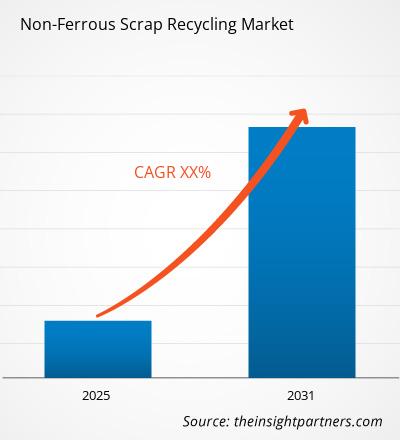
The Non-Ferrous Scrap Recycling Market was valued at US$ 690.03 Billion in 2025 and is projected to reach US$ 939.13 Billion by 2034, registering a CAGR of 3.48% from 2026 to 2034. Growth is supported by rising metal demand, resource conservation, decarbonization, urbanization, and increasing pressure to recover valuable materials from end-of-life products. Expanding recycling infrastructure and improved sorting, separation, and processing technologies are also strengthening the commercial value of secondary metals.
North America represents a mature recycling ecosystem supported by established collection networks, metal-consuming industries, infrastructure investment, and comparatively developed scrap trading channels. The Non-Ferrous Scrap Recycling Market size is supported by strong demand from automotive, construction, manufacturing, and packaging value chains. The region is expected to expand at approximately ~3% CAGR through 2034 as higher metal recovery rates, domestic sourcing strategies, and investment in advanced processing improve material availability.
Non-Ferrous Scrap Recycling Market Assessment and Insights
Regional Outlook
- North America: ~25% of the global market in 2025 | ~3% CAGR through 2034. Market position: North America remains a major regional recycling hub supported by established collection infrastructure, strong secondary-metal demand, mature scrap trading networks, and substantial industrial consumption. The US anchors regional activity across aluminum, copper, and lead recovery.
- US: ~85% of North American market revenue in 2025 | ~3% CAGR through 2034. Market position: The US dominates North American demand through extensive scrap collection, automotive dismantling, construction recovery, industrial recycling, and established secondary-metal processing. Advanced sorting and metal recovery investments are improving material quality and processing economics.
- Europe: ~28% of the global market in 2025 | ~3% CAGR through 2034. Market position: Europe has a mature circular-metals ecosystem supported by stringent resource-efficiency policies, established collection systems, and sophisticated smelting and refining infrastructure. Germany, Italy, France, and Spain remain important markets for secondary non-ferrous metals.
- Asia Pacific: ~35% of the global market in 2025 | ~5% CAGR through 2034. Market position: Asia Pacific is the largest and fastest-growing regional market, led by China and supported by India, Japan, South Korea, and Australia. Industrialization, urban development, manufacturing growth, and rising secondary-metal demand reinforce regional expansion.
Segment Outlook
- Aluminum: ~45% Share in 2025 | ~4% CAGR through 2034. Market position: Aluminum leads the scrap-type structure because it combines extensive downstream use with strong economic incentives for recovery. Automotive, packaging, construction, and transportation applications support recurring scrap generation, while secondary aluminum reduces energy requirements compared with primary production.
- Automotive: ~35% Share in 2025 | ~5% CAGR through 2034. Market position: Automotive represents a high-growth application because vehicle production, end-of-life vehicles, lightweighting, and increasing use of aluminum and copper create substantial recoverable material streams. Organized dismantling and improved recovery technologies strengthen the addressable supply.
Competitive Coverage
Aurubis AG, Haibao Machinery Technology Co., Ltd., Hindalco Industries Limited, Kuusakoski Oy, Matalco Inc., OmniSource, LLC, REMONDIS SE & Co. KG, SA Recycling LLC, Sims Limited, Wiscon Environmental Technology Inc.
Methodology
The Insight Partners follows Data Collection & Secondary Research, Primary Research, Data Analysis, and Data Triangulation & Final Review to validate market estimates and insights.
Source: The Insight Partners' analysis based on proprietary research, government publications, company annual reports, investor presentations, industry databases, and expert interviews.
The Non-Ferrous Scrap Recycling Market has progressed from conventional collection and material trading toward integrated recovery systems that combine automated sorting, shredding, separation, refining, and digital material tracking. Advances in sensor-based sorting, eddy-current separation, optical identification, and process controls are improving recovery yields and the consistency of secondary metals. Scrap processors increasingly connect collection networks with downstream smelters, refiners, foundries, and metal manufacturers. This integration allows higher-value material streams to be recovered while reducing contamination and improving the commercial attractiveness of complex scrap.
The forward outlook for Non-Ferrous Scrap Recycling Market share is increasingly shaped by resource-security policies, domestic critical-material strategies, and corporate decarbonization commitments. Asia Pacific is gaining importance as manufacturing capacity and metal consumption expand, while North America and Europe are investing in domestic recycling capacity to strengthen supply resilience. New projects increasingly emphasize higher recovery rates and processing of complex feedstocks rather than simple volume expansion. Regulatory incentives for circular material use and recycled content are expected to further encourage investment in collection, processing, traceability, and secondary-metal production.
Non-Ferrous Scrap Recycling Market Report Scope
| Report Attribute | Details |
|---|---|
| Market size in 2025 | US$ 690.03 Billion |
| Market Size by 2034 | US$ 939.13 Billion |
| Global CAGR (2026 - 2034) | 3.48% |
| Historical Data | 2021-2024 |
| Forecast period | 2026-2034 |
Non-Ferrous Scrap Recycling Market Analysis
Rising consumption of aluminum, copper, and lead creates a structural requirement for additional secondary material, particularly where primary production faces energy, environmental, or raw-material constraints. The Non-Ferrous Scrap Recycling Market growth is supported by automotive manufacturing, construction activity, electrical infrastructure, packaging, electronics, and industrial equipment. The ecosystem begins with scrap generation from manufacturing and end-of-life products and extends through collection, sorting, processing, trading, refining, and delivery of secondary metals to downstream users. Efficient material flows depend on collection density, scrap quality, metal prices, processing economics, and proximity to consumers.
Supply conditions in the Non-Ferrous Scrap Recycling Market vary substantially by metal and geography. Aluminum benefits from high recyclability and established collection channels, while copper scrap supply is closely linked to construction, electrical equipment, machinery, and electronics. Lead recovery remains closely associated with batteries and regulated collection systems. Processors, therefore, compete for consistent feedstock and increasingly invest in separation technologies capable of handling mixed or contaminated materials. Export and import flows remain important where local processing capacity differs from scrap availability. Higher-value recovery from complex streams is consequently becoming an increasingly important source of margin improvement.
Competitive positioning in the Non-Ferrous Scrap Recycling Market depends on collection scale, geographic density, processing technology, downstream relationships, and the ability to manage volatile metal prices. Aurubis AG combines recycling with multimetal smelting and refining, while Hindalco Industries Limited benefits from an integrated aluminum value chain through its Novelis operations. Sims Limited and SA Recycling LLC maintain extensive collection and processing networks, particularly in North America. Kuusakoski Oy and REMONDIS SE & Co. KG add strong European recycling capabilities across industrial and end-of-life material streams.
Investment in the Non-Ferrous Scrap Recycling Market is increasingly directed toward advanced sorting, recovery facilities, logistics infrastructure, and integrated processing. Matalco Inc. focuses on secondary aluminum production, while OmniSource, LLC operates within a broad US metal recycling network. Haibao Machinery Technology Co., Ltd. participates in equipment and processing solutions that support scrap handling and recovery. Wiscon Environmental Technology Inc. provides recycling equipment capabilities relevant to material processing. Strategic positioning is therefore shifting toward higher recovery yields, better feedstock quality, broader collection coverage, and closer integration with downstream metal consumers.
● REPORT CUSTOMIZATION
Tailor This Report To Align With Your Specific Business Requirements
This report can be customized to align precisely with your business objectives, scope, and target markets. Customization options include tailored segmentation, geography, competitive analysis, and strategic insights to support informed decision-making.
Customize This Report →WHAT YOU CAN ADJUST
- ● Segmentations
- ● Geography
- ● Competitive Analysis
- ● Language Preferences
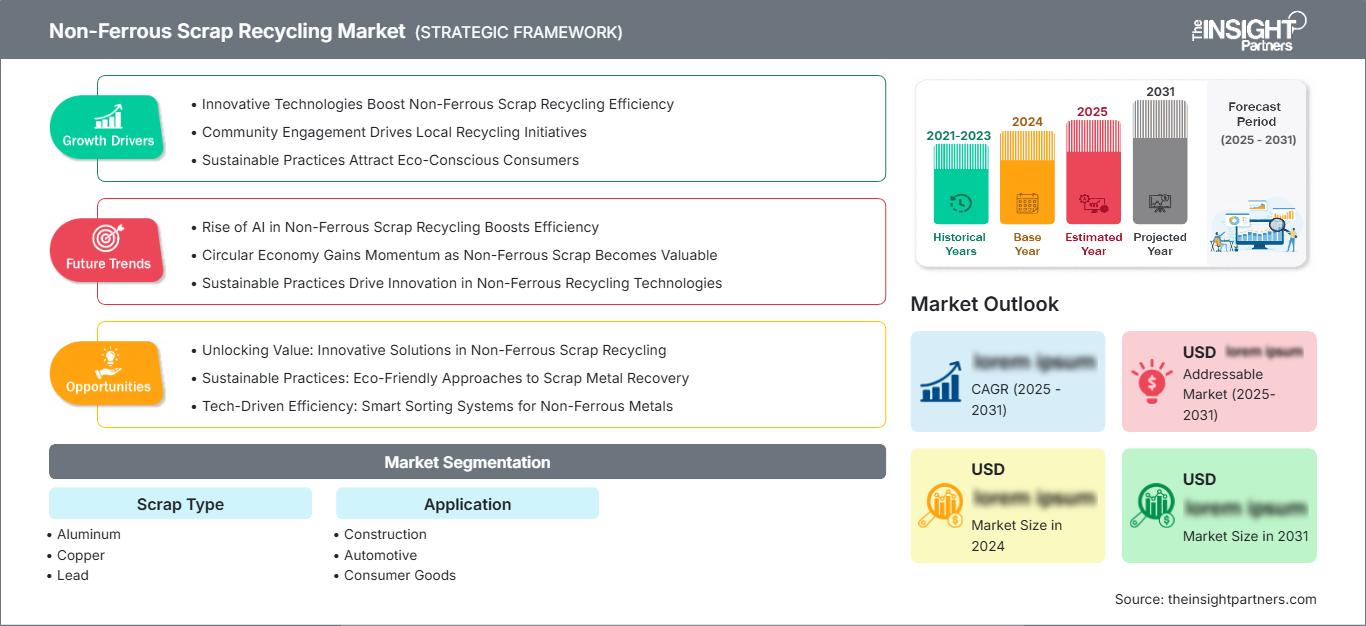
Non-Ferrous Scrap Recycling Market: Strategic Insights
Regional Insights
North America Non-Ferrous Scrap Recycling Market
North America represented approximately ~25% of the global Non-Ferrous Scrap Recycling Market in 2025 and is expected to grow at ~3% CAGR through 2034. There is a proven recycling system within the region, covering municipal collection, industrial scraps, automobile dismantling, construction, metals processing, trading, and secondary smelting. The US is the largest provider of the region’s business, whereas Canada is involved in processing connected with mining, industrial recycling, automobile recovery, and construction scrap. Mexico brings industrial scraps of automobiles, electronics, household appliances, and industrial production.
The regional market is experiencing high demand for secondary aluminum and copper among the manufacturing and infrastructure sectors. Automobile dismantling continues to be a significant source of aluminum, copper, and other reusable materials, whereas construction continues to generate metal scraps during demolitions and renovations. Processors are making investments in separation and downstream recovery technologies to enhance material quality. The strategies of domestic sourcing and supply chain reliability make scrap more valuable.
U.S. Non-Ferrous Scrap Recycling Market
The US accounts for approximately ~85% of North American Non-Ferrous Scrap Recycling Market revenue in 2025 and is projected to expand at ~3% CAGR through 2034. It owes its dominance to having a large industrial economy, a vast array of vehicles, considerable construction activities, an efficient scrap collecting network, and processors and metal users. There is also a lot of demand for secondary metals in the domestic markets of this country, which favors the recycling industry in that country.
Sims Limited, SA Recycling LLC, OmniSource, LLC, and Matalco Inc. play a part in the US recycling industry through the processes of collecting, processing, trading, and secondary aluminum production. The demand for aluminum scrap is strengthened by the need for beverage containers, auto parts, construction materials, and transportation. The recycling of copper becomes possible due to the use of electric infrastructure, construction work, machinery, and electronics.
Europe Non-Ferrous Scrap Recycling Market
Europe accounted for approximately ~28% of the global Non-Ferrous Scrap Recycling Market in 2025 and is expected to register ~3% CAGR through 2034. Germany is the most dominant country within Europe due to its industry, car manufacturing sector, efficient recycling facilities, and capacity to process metal. Italy and Spain are major recyclers of metal and have metal manufacturing industries, whereas France benefits from its construction and automotive waste streams as well as its industrial and packaging industries. The UK also continues to have an efficient metal collection system as well as recycling facilities.
One of the strategic recyclers within Europe is Aurubis AG, which deals in copper as well as various recovered metal types, whereas REMONDIS SE & Co. KG specializes in recycling and collection facilities. The industrial activities in Germany result in large amounts of manufacturing and end-of-life metal, which serves as source material for recycled metal production. Italy and Spain have efficient metal-processing industries and construction, as well as automotive demands.
The European Union is showing a growing preference for the circular economy, resource efficiency within the country, and decreased use of imported raw materials. This trend implies the need to invest in technologies that can help recover metals from complicated residues, e-waste, industrial waste, and end-of-life goods. Processors are getting better at material traceability and quality since downstream manufacturers are demanding consistent properties of recycled metals. The advanced infrastructure of the region suggests that future growth will be achieved through higher recovery and processing levels as well as increased recycled content.
APAC Non-Ferrous Scrap Recycling Market
Asia Pacific represented approximately ~35% of the global Non-Ferrous Scrap Recycling Market in 2025 and is expected to expand at ~5% CAGR through 2034. Asia Pacific represents the most developed region in this market, due to its strong manufacturing sector, metal-consuming industries, secondary-metal infrastructure, and focus on efficient use of resources. India is becoming an increasingly important producer, due to increasing industrialization, automobile ownership, building activity, and better waste collection services. Japan and South Korea possess developed recycling processes associated with the advanced manufacturing industry.
Australia provides its contribution through existing scrap collection and metal-processing operations in connection with construction, automobiles, infrastructure, and industrial equipment. Regional policies promote more effective use of resources and local recovery, while manufacturers look for increased availability of recovered material. Urban development and production activities generate more recoverable metals. All these factors, together with better sorting and processing capabilities, allow Asia Pacific to become the fastest-growing region, as well as one of the centers for secondary aluminum and copper supply.
Middle East & Africa Non-Ferrous Scrap Recycling Market
The Middle East & Africa Non-Ferrous Scrap Recycling Market is projected to expand at approximately ~4% CAGR through 2034. Saudi Arabia is one of the major players in the MEA region, thanks to the diversification of industry, infrastructure development, construction works, and a growing focus on resource efficiency. The UAE serves as a key trading and logistics center in the region, facilitating the scrap flows between suppliers, processors, and metal markets abroad. Infrastructure and construction works result in a significant production of aluminum and copper scrap.
South Africa features the most developed system for recycling in sub-Saharan Africa due to automotive, industrial, construction, and electronic applications. Markets in the rest of MEA are less developed, but still present potential as urbanization and infrastructure investments lead to growing amounts of recyclables collected. Processors operating in the region struggle with poorly organized scrap flows, creating an opportunity for established networks of scrap processing. Energy intensity of secondary-metal processing becomes a crucial factor when making investment decisions.
Segmentation Analysis
Scrap Type
Scrap Type determines the economic value, processing route, recovery technology, and downstream application of recycled material. Buyer priorities vary according to metal purity, contamination, form, and availability, making efficient collection and separation central to market performance. Increasing demand for secondary metals is encouraging processors to improve recovery from both manufacturing residues and end-of-life products. Within the category, Aluminum is expected to register approximately ~4% CAGR through 2034 because of its extensive use across transportation, packaging, construction, and consumer products and its strong suitability for repeated recycling.
- Aluminum: Aluminum scrap has strong strategic value because remelting requires substantially less energy than primary aluminum production. Beverage cans, automotive components, construction products, and industrial fabrications provide recurring feedstock, supporting closed-loop recycling relationships.
- Copper: Copper scrap is highly valued because recovered metal can re-enter demanding electrical and industrial applications after appropriate processing. Construction, power infrastructure, machinery, electronics, and manufacturing generate diverse copper-bearing scrap streams.
- Lead: Lead recycling is strongly connected with battery recovery and regulated collection systems. Established processing routes enable recovered lead to return to battery manufacturing, making collection efficiency, environmental controls, and closed-loop supply relationships particularly important.
Application
Application determines the volume and quality of scrap generated, the timing of material recovery, and the specifications required by downstream consumers. Industrial activity and product replacement cycles influence the availability of recoverable metals, while manufacturers increasingly seek recycled inputs to improve resource efficiency. Application demand also affects the geographic concentration of scrap because manufacturing and construction generate large localized material streams. Within this category, Automotive is projected to achieve approximately ~5% CAGR through 2034 as vehicle production, lightweighting, electrification, and end-of-life recovery increase the quantity and value of recoverable non-ferrous metals.
- Construction: Construction generates aluminum, copper, and lead-bearing scrap through building installation, renovation, demolition, and infrastructure replacement. Recovery efficiency depends heavily on project dismantling practices, collection systems, and the ability to separate metals from mixed construction materials.
- Automotive: Automotive scrap contains multiple recoverable metals from vehicles, components, wiring, radiators, and structural parts. Increasing vehicle complexity and lightweighting create opportunities for sophisticated dismantling and separation processes that can capture higher-value material streams.
- Consumer Goods: Consumer goods generate scrap through discarded appliances, packaging, electronics, household products, and other durable goods. Organized collection and improved sorting can increase recovery rates and return valuable aluminum and copper to manufacturing supply chains.
- Industrial Goods: Industrial goods create concentrated scrap streams from machinery, equipment, electrical systems, fabrication, and manufacturing processes. High material value and predictable industrial generation patterns make these streams attractive to specialized recyclers with established collection and processing relationships.
Opportunity Snapshot
| Application | Revenue Contribution | Trend Tag | Adoption Stage |
|---|---|---|---|
| Construction | High | Urban Redevelopment | Mature |
| Automotive | High | Vehicle Recovery | Scaling |
| Consumer Goods | Medium | Product Recovery | Scaling |
| Industrial Goods | Medium | Closed Loop | Mature |
Non-Ferrous Scrap Recycling Market Growth Drivers and Impact Analysis
Growing Demand for Secondary Aluminum and Copper
The demand for secondary metals is rising as companies try to source dependable materials while controlling their energy use, carbon emissions, and supply chain risks. This is especially true of aluminum and copper, since there are ways to recover considerable amounts of metal without mining corresponding amounts of virgin metal. In other words, cars, electrical installations, packaging, construction, and industries become the sources of the downstream pressure on secondary materials recovery. Higher metal prices could stimulate this trend by making the processing of metals more profitable for companies and thus encouraging them to process the materials that were not commercially viable before. The consequences will be felt by all links of the collection and processing chain as well, since higher downstream demand would justify the investments into sorting, shredding, refining, transportation, and quality control.
Expansion of Automotive and Infrastructure Scrap Streams
Vehicle production, vehicle scrapping, infrastructure expansion, and building renovations provide periodic opportunities for the recovery of non-ferrous metals. Modern cars include large amounts of aluminum and copper, whereas infrastructure, electricity, and building systems contribute extra copper. Aging of the infrastructure will lead to scrapping and renovation, which will provide secondary flows alongside new constructions. Organized scrapping and better collection efforts can make use of these flows prior to disposal and informal recycling. For the recycler, a frequent supply of scrap provides a chance to build specific collection contacts with manufacturers, scrappers, construction companies, demolition companies, and industry users. Higher recycling efficiency can enhance the security of the feedstock for secondary smelters and refiners. Higher material circulation is likely to bring about a higher link between manufacturing demand and scrap supply.
Resource Security and Circular Economy Policies
Recycled metals are becoming recognized not only as a waste management product but also as a resource security component by government agencies and industrial procurers. Policies promoting circularity, domestic processing, high levels of recycled content, and less reliance on imported virgin resources may enhance the business case for collection and secondary manufacturing. Europe is especially relevant because resource efficiency policies lead to higher recovery rates and increased transparency throughout supply chains. North America and Asia are also expanding domestic capacity for metal recycling in response to the need for a more secure source of metal. These trends in public policy and purchasing practices result in recyclers establishing formal collection systems, tracing material flows, and processing more difficult materials. This trend is most pronounced when regulations coincide with strong downstream demand and secondary metal can compete with primary metal on price and environmental metrics.
Non-Ferrous Scrap Recycling Market Future Trends
Advanced Sorting and Higher Recovery from Complex Scrap
The Non-Ferrous Scrap Recycling Market trends are moving toward more automated and data-driven recovery systems capable of separating mixed materials with greater precision. Sensor-based sorting, advanced shredding, eddy-current separation, artificial intelligence-supported identification, and improved metal recovery systems can increase yields from complex scrap. These technologies are particularly relevant as products become more sophisticated and contain multiple materials that are difficult to separate manually. Processors are also using digital monitoring to track feedstock composition, throughput, recovery rates, and equipment performance. The resulting shift is likely to favor operators with sufficient scale and technical expertise to justify automation investments. Higher recovery rates can increase the economic value of each tonne of collected material while reducing contamination and improving consistency for downstream smelters, refiners, and manufacturers.
Traceable Recycled-Metal Supply Chains
Recycled-metal buyers are increasingly interested in knowing where scrap originates, how it was processed, and what quality controls were applied before the material entered manufacturing. Digital documentation and traceability systems can strengthen supplier relationships by providing greater visibility over material flows. This trend is particularly relevant for automotive, electronics, packaging, and industrial manufacturers that are pursuing measurable circularity targets. Recycling companies may increasingly differentiate through verified sourcing, consistent specifications, transparent processing, and digital transaction records rather than relying only on physical collection scale. Greater traceability can also improve compliance with environmental requirements and customer procurement standards. Over time, data-enabled material tracking may help formalize fragmented collection channels and improve the ability of downstream buyers to incorporate secondary metals into higher-value applications.
Non-Ferrous Scrap Recycling Market Opportunities
Integrated Closed-Loop Recycling Partnerships
The Non-Ferrous Scrap Recycling Market Forecasts point to stronger opportunities for closed-loop arrangements connecting manufacturers directly with recyclers and secondary-metal producers. Automotive, beverage packaging, electronics, and industrial manufacturers generate relatively predictable scrap streams that can be collected, processed, and returned to production. Such arrangements can reduce material losses, improve supply visibility, and provide greater control over recycled-metal quality. Recyclers can capture additional value by offering collection, sorting, processing, certification, and logistics as an integrated service rather than selling undifferentiated scrap. Manufacturers can benefit from a more predictable source of secondary feedstock while improving circularity performance. Strategic partnerships are especially attractive where production facilities and recycling operations are geographically close, reducing transportation costs and supporting faster material turnaround.
Regional Processing Capacity for Strategic Metals
Investment opportunities are expanding around regional processing facilities that can convert locally generated scrap into specification-grade secondary metals. Building capacity closer to major manufacturing and consumption centers can reduce export dependence, improve material security, and retain more value within domestic or regional supply chains. Copper and aluminum are particularly relevant because both support electrification, transportation, construction, and industrial applications. New facilities can combine advanced sorting with refining and alloy preparation to increase the value recovered from each material stream. Companies with established collection networks have an advantage because they can secure feedstock while new entrants may need to develop supplier relationships before achieving scale. Regional processing also supports governments and manufacturers seeking greater resilience against international disruptions in primary raw-material supply.
Recent Developments
- June 6, 2026: TRIMET Aluminium SE announced expanded aluminum recycling capabilities at its Gelsenkirchen facility, including new melting units that increase recycled aluminum production capacity to as much as 70,000 metric tons annually. The company linked the investment to closed material loops, a broader alloy portfolio, and stronger long-term security of secondary raw-material supply.
- August 19, 2026: Gravita India Limited announced its entry into copper recycling through an agreement to acquire up to 100% of Rashtriya Metal Industries Limited. The transaction is intended to broaden Gravita's existing recycling portfolio into copper and copper-alloy products and strengthen its position in value-added secondary-metal manufacturing.
Frequently Asked Questions

- Comprehensive Market Sizing and Forecast Analysis
- Detailed Segmentation Analysis
- In-Depth Market Dynamics Assessment
- Regional and Country-Level Insights
- Competitive Landscape and Company Benchmarking
- Strategic Business Intelligence
Recent Reports
Testimonials

The Insight Partners provided valuable market intelligence that supported our global go-to-market strategy. Their team was professional, responsive, and attentive to our feedback, providing thoughtful analysis and helpful methodological clarifications throughout the project.
Junmo Kim Chief Financial Officer (CFO), Enertech Co., Ltd.
The Insight Partners' SCADA System Market report is comprehensive, with valuable insights on current trends and future forecasts. The team was highly professional, responsive, and supportive throughout. We are very satisfied and highly recommend their services.
RAN KEDEM Partner, Reali Technologies LTDs
I requested a report on a very specific software market and the team produced the report in a few days. The information was very relevant and well presented. I then requested some changes and additions to the report. The team was again very responsive and I got the final report in less than a week.
JEAN-HERVE JENN Chairman, Future Analytica
We worked with The Insight Partners for an important market study and forecast. They gave us clear insights into opportunities and risks, which helped shape our plans. Their research was easy to use and based on solid data. It helped us make smart, confident decisions. We highly recommend them.
PIYUSH NAGPAL Sr. Vice President, High Beam Global
The Insight Partners delivered insightful, well-structured market research with strong domain expertise. Their team was professional and responsive throughout. The user-friendly website made accessing industry reports seamless. We highly recommend them for reliable, high-quality research services
YUKIHIKO ADACHI CEO, Deep Blue, LLC.
This is the first time I have purchased a market report from The Insight Partners.While I was unsure at first, I visited their web site and felt more comfortable to take the risk and purchase a market report.I am completely satisfied with the quality of the report and customer service. I had several questions and comments with the initial report, but after a couple of dialogs over email with their analyst I believe I have a report that I can use as input to our strategic planning process.Thank you so much for taking the extra time and making this a positive experience.I will definitely recommend your service to others and you will be my first call when we need further market data.
JOHN SUZUKI President and Chief Executive Officer, Board Director, BK Technologies
I wish to appreciate your support and the professionalism you displayed in the course of attending to my request for information regarding to infectious disease IVD market in Nigeria. I appreciate your patience, your guidance, and the fact that you were willing to offer a discount, which eventually made it possible for us to close a deal. I look forward to engaging The Insight Partners in the future, all thanks to the impression you have created in me as a result of this first encounter.
DR CHIJIOKE ONYIA MANAGING DIRECTOR, PineCrest Healthcare Ltd.Reason to Buy
- Informed Decision-Making
- Understanding Market Dynamics
- Competitive Analysis
- Identifying Emerging Markets
- Customer Insights
- Market Forecasts
- Risk Mitigation
- Boosting Operational Efficiency
- Strategic Planning
- Investment Justification
- Tracking Industry Innovations
- Aligning with Regulatory Trends





 Get Free Sample for