
Oilfield Scale Inhibitor Market Trends, Share & Demand by 2034
Coverage: By Type (Phosphonates, Carboxylate/Acrylate, Sulfonates, Others); Application (Power and Construction Industry, Mining Industry, Oil and Gas Industry, Water and Wastewater Treatment, Food and Beverage Industry), and Geography (North America, Europe, Asia Pacific, and South and Central America)
- Status : Data Released
- Report Code : TIPRE00015098
- Category : Chemicals and Materials
- No. of Pages : 150
- Available Report Formats :


- Last update date : September 23, 2026


2025 Market Size
US$ 2.72 Bn
Base year value
2034 Forecast
US$ 4.29 Bn
Projected by 2034
CAGR 2026-2034
5.21 %
Growth rate
Addressable Market
US$ 31.83 Bn
(2026-2034)
The oilfield scale inhibitor market is valued at US$ 2.72 Billion in 2025 and is projected to reach US$ 4.29 Billion by 2034, expanding at a CAGR of 5.21% during 2026–2034. Demand is supported by increasing produced-water volumes, aging reservoirs, complex water chemistries, and the need to maintain production efficiency while controlling mineral deposition across wells, flowlines, pipelines, and processing equipment.
Across North America, oilfield scale inhibitor market demand is expected to expand at an estimated 5.4–5.9% CAGR between 2026–2034. Mature unconventional assets, rising water handling requirements, offshore development, and tighter operating-cost discipline are encouraging producers to adopt longer-lasting, lower-dosage, and application-specific scale-control chemistries.
Oilfield Scale Inhibitor Market Assessment and Insights
- North America: North America is estimated to hold a 34–38% share in 2025 and expand at a 5.4–5.9% CAGR between 2026–2034. Mature shale assets, produced-water management, and offshore production support recurring chemical demand.
- US: The US represents approximately 78–82% of North American demand in 2025 and is projected to grow at a 5.3–5.8% CAGR through 2034, supported by unconventional production and water-intensive operations.
- Europe: Europe is estimated to account for 21–25% of global demand in 2025, growing at 4.8–5.3% CAGR. Norway and the UK lead offshore requirements, while Germany, Italy, France, and Spain contribute industrial chemical demand.
- Asia Pacific: Asia Pacific is estimated at 24–28% share in 2025 and is expected to grow at 5.8–6.4% CAGR. China, India, Australia, Indonesia, and Malaysia provide opportunities through offshore production and mature-field management.
- Largest Segment: Phosphonates represent an estimated 42–46% share in 2025, with a 5.0–5.5% CAGR through 2034, reflecting established performance in carbonate and sulfate scale control.
- High Growth Segment: Carboxylate/Acrylate is estimated at 27–31% share in 2025 and is projected to grow at 5.9–6.5% CAGR, supported by formulation flexibility and environmental considerations.
- Key companies analyzed in detail: Akzo Nobel N.V., BASF SE, Clariant AG, Dow Inc., Evonik Industries AG, Halliburton Company, Innospec Inc., Kemira Oyj, SLB, Solvay SA.
Source: The Insight Partners' analysis based on proprietary research, government publications, company annual reports, investor presentations, industry databases, and expert interviews.
Chemical diversification, better application technologies, and awareness of scale formation risks specific to particular reservoirs become the key drivers for oilfield scale inhibitors market growth. Standardized applications are being substituted with phosphonate-based blends, polycarboxylates, tagged polymers, solid delivery systems, as well as high temperature, high salinity, and deep water chemicals.
In the future, market demand is expected to increase owing to increased activity from offshore projects, field reoptimization programs, and heavy water systems in the Middle East, Asia Pacific, and North America. Restrictions on the use of phosphorus-containing compounds and expectations for decreased environmental effects should promote sales of polymeric and biodegradable products. Producers with local blending facilities, technical services, and digital dosing technology will be more successful in retaining customers.
Oilfield Scale Inhibitor Market Report Scope
| Report Attribute | Details |
|---|---|
| Market size in 2025 | US$ 2.72 Billion |
| Market Size by 2034 | US$ 4.29 Billion |
| Global CAGR (2026 - 2034) | 5.21% |
| Historical Data | 2021-2024 |
| Forecast period | 2026-2034 |
Oilfield Scale Inhibitor Market Analysis
Oilfield scale inhibitor Market trends are highly dependent on the growing water production and complex reservoir conditions. With aging of the fields, higher amounts of water production can lead to changes in pressure, temperature, ionic concentration, and compatibility of formation water and injection water. Such changes cause the deposition of calcium carbonate, barium sulfate, strontium sulfate, iron sulfide, and other mineral formations. Accordingly, the value chain includes specialty chemicals, scale inhibitor preparation, lab testing, field operations, monitoring, and optimization of the treatments.
The supply situation is highly dependent on availability and pricing of phosphorous compounds, acrylic monomers, specialty polymers, solvents, and additives to the formulations. Suppliers that provide the ability for qualification of their chemistry for specific brine systems become more sought after in the industry rather than those who only sell standard products.
Positioning in the marketplace is becoming more dependent on production chemistry than just inhibitor chemistry. Halliburton and Schlumberger Limited integrate scale control chemicals with well intervention, stimulation, modeling, and production solutions, while Clariant focuses on bespoke oilfield chemical packages. BASF, Dow Inc., Evonik Industries AG, Innospec Inc., and Solvay SA provide their expertise in specialty chemicals, while Akzo Nobel N.V. and other players leverage formulations and applications.
There is a growing investment trend in formulations that can perform under lower doses, less frequent treatments, and more difficult formation conditions. The purchase of ChampionX by Schlumberger Limited has improved Schlumberger Limited’s production chemicals offerings and has enabled the company to integrate chemical treatments with digital production technology solutions. This integration will probably lead to differentiation among competitors due to reduced need for suppliers and reduction of operating expenses.
● REPORT CUSTOMIZATION
Tailor This Report To Align With Your Specific Business Requirements
This report can be customized to align precisely with your business objectives, scope, and target markets. Customization options include tailored segmentation, geography, competitive analysis, and strategic insights to support informed decision-making.
Customize This Report →WHAT YOU CAN ADJUST
- ● Segmentations
- ● Geography
- ● Competitive Analysis
- ● Language Preferences
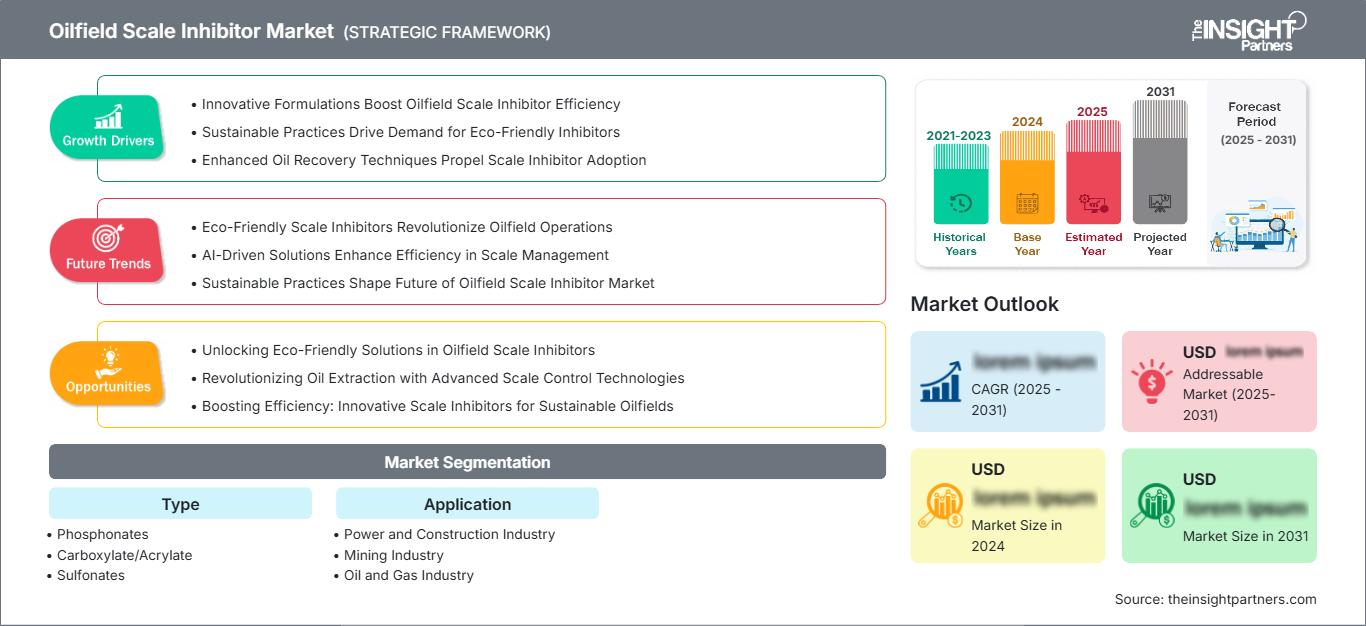
Oilfield Scale Inhibitor Market: Strategic Insights
Regional Insights
North America Oilfield scale inhibitor market
North America is estimated to represent 34–38% of global demand in 2025 and is projected to expand at a 5.4–5.9% CAGR through 2034. There is an abundance of consumption by the US due to the production of large quantities of produced water in unconventional wells as well as the necessity of managing mineral deposits. Canada supplies oil sand, conventional production and water handling services; whereas, Mexico adds to its consumption by providing additional offshore demand.
The regional market enjoys good chemical service networks, laboratory test facilities and continuous injection and squeeze treatments. Operators are more concerned about residual control, longer treatment life and compatibility with fracturing and stimulation fluids. Chemicals which work effectively under saline and subsea conditions are required for offshore Gulf of Mexico operations. Environmental issues are making suppliers consider lower phosphorous and polymer-based chemicals.
U.S. Oilfield scale inhibitor Market
The US accounts for an estimated 78–82% of North American demand in 2025 and is projected to grow at a 5.3–5.8% CAGR through 2034. Scale inhibition in Permian, Eagle Ford, Bakken, and other producing basins will ensure repeated need for scaling operations when dealing with an increasingly complicated produced-water flow.
Halliburton, Schlumberger Limited (SLB), Innospec Inc., and Dow Inc. have pertinent expertise in US oilfield chemicals and production services market segments. Increasingly, scale inhibitors are being combined with water analysis, residual analysis, and production optimization. Certain solid release technologies and long-lasting scale inhibitors will decrease the number of intervention operations in selected wells; meanwhile, custom chemistry solutions will help in dealing with different brine composition. All of this ensures that the US remains a leading regional market.
Europe Oilfield scale inhibitor Market
Europe is estimated to hold 21–25% of global demand in 2025 and is expected to grow at 4.8–5.3% CAGR. Both the UK and Norway have significant influence on oilfield chemicals in the region owing to their existing offshore operations. In addition, there is an influence from other countries such as Germany, France, Italy, and Spain, due to the smaller scale of industrial or specialty-chemical usage.
The importance of the UK comes from its role in North Sea production and the subsea infrastructure where size control needs to be done despite the changing characteristics of the water chemistry and the old infrastructure. Norway has demanding requirements with respect to offshore production that requires high performance inhibitors for saline produced water and difficult reservoir conditions.
APAC Oilfield scale inhibitor Market
APAC is estimated to account for 24–28% of global demand in 2025 and is projected to grow at 5.8–6.4% CAGR. Demand centers include China, India, Australia, Japan, South Korea, Indonesia, and Malaysia. Offshore facilities, mature oil fields, water injection, and expanding oil production infrastructure present ongoing scale management challenges.
China is the dominant demand center within the region, whereas India and Southeast Asia present strong growth potential. Australia provides support for offshore and mature oil field operations. Rising amounts of produced water and complex composition of the injection water require accurate chemicals selection. In addition, regional oil producers are exploring the benefits of using low-dose and long-lasting chemical solutions to cut down on chemical costs and intervention activities.
Middle East & Africa Oilfield scale inhibitor Market
Middle East and Africa demand is expected to expand at a 5.6–6.2% CAGR through 2034. The highest need for these chemicals comes from Saudi Arabia, followed by the UAE and the rest of the Gulf countries. Large-scale oil production, seawater injection, enhanced oil recovery programs, and surface facilities result in constant carbonate and sulfate scaling problems.
Both Saudi Arabia and the UAE are building up their production capacity and their water management infrastructure; however, South Africa also makes a significant contribution in terms of chemical need for industry and mining operations. In general, in the entire region, more and more customers need inhibitors able to cope with high salinity, high temperatures, and different water chemistries.
Segmentation Analysis
Type
The Type segment is projected to expand at a 5.3–5.8% CAGR during 2026–2034. Product selection depends on scale composition, reservoir temperature, brine chemistry, treatment method, environmental requirements, and desired treatment lifetime. Phosphonates remain established, while polymeric carboxylate technologies gain attention for specialized conditions.
- Phosphonates: Phosphonates maintain a strong position because of proven carbonate and sulfate scale-control performance, thermal stability, and compatibility across diverse oilfield brines. Their established field history supports continued use.
- Carboxylate/Acrylate: Carboxylate and acrylate chemistries provide formulation flexibility and strong dispersion characteristics. Their ability to support phosphorus-reduction strategies makes them increasingly relevant in environmentally sensitive applications.
- Sulfonates: Sulfonated polymers are important where operators require specific adsorption characteristics and performance against challenging scale systems. They can complement other chemistries in customized squeeze-treatment programs.
Application
The Application segment is expected to grow at a 5.0–5.6% CAGR between 2026–2034. Demand is influenced by the scale risk associated with each operating environment, with oil and gas remaining central while industrial water systems create additional opportunities for compatible chemistries.
- Power and Construction Industry: Cooling and process-water systems require scale prevention to preserve heat-transfer efficiency and equipment reliability. Chemical treatment demand is linked to water quality, operating cycles, and maintenance requirements.
- Mining Industry: Mineral-rich process waters create significant scaling risks in mining operations. Scale-control chemicals can protect pipelines, filtration equipment, and processing systems where suspended solids and dissolved minerals coexist.
- Oil and Gas Industry: Oil and gas remains a core application because scale can restrict production, damage equipment, increase intervention frequency, and disrupt flow assurance. Treatments span downhole, topside, pipeline, and water-injection systems.
- Water and Wastewater Treatment: Water treatment applications use scale-control chemistries to protect membranes, heat exchangers, pipelines, and process equipment. Demand rises with water reuse, desalination, and higher mineral loading.
- Food and Beverage Industry: Food and beverage processing requires controlled water chemistry to minimize deposits in heating and processing equipment. Formulation requirements emphasize regulatory compliance, compatibility, and controlled treatment levels.
Opportunity Snapshot
| Application | Revenue Contribution | Trend Tag | Adoption Stage |
| Power and Construction Industry | Medium | Cooling Systems | Scaling |
| Mining Industry | Medium | Mineral Control | Scaling |
| Oil and Gas Industry | High | Flow Assurance | Mature |
| Water and Wastewater Treatment | High | Water Reuse | Scaling |
| Food and Beverage Industry | Low | Process Hygiene | Emerging |
Oilfield Scale Inhibitor Market Growth Drivers and Impact Analysis
Rising Produced-Water Volumes Increase Scale Exposure
An increase in water production from mature and unconventional wells increases the risk of mineral deposition. Pressure, temperature, salinity, and ionic composition can make the produced fluid go past its saturation point, leading to carbonates and sulfates deposits in tubing, pumps, flow lines, and surface facilities. This means that there is a need for proactive treatment of the well rather than just cleaning up the deposits. The commercial aspect is also relevant because scaling may have an effect on flow efficiency and decrease the lifespan of equipment while triggering unnecessary operations. Increased water injection and reuse of produced water may change the chemical composition of the fluid.
Expansion of Offshore and Mature-Field Production Supports Chemical Demand
The need for robust scale-control chemistry is structurally driven by the continued life cycle of mature fields and development of offshore production facilities. Mature oil fields typically have a tendency to produce more water, while offshore oil fields pose the challenge of tight space restrictions and limitations in terms of logistical activities. Under such circumstances, it becomes highly valuable to have chemicals that are effective in the treatment process for a prolonged period even at lower dosages. There is a need for chemicals which are compatible with subsea operations and stimulation fluids. It is cost effective to sustain the production from the existing well fields rather than developing an entirely new set of fields to compensate for declining production capacity.
Environmental Requirements Encourage Advanced Polymer Formulations
Expectations regarding the environment are having an impact on the selection of oilfield production chemicals in situations where there are restrictions regarding discharges and also chemical substitutions. Phosphonates are still very relevant but, at the same time, there has been increased interest in considering other products that have reduced phosphorus burden, biodegradability or effectiveness at low dosage levels. This trend is providing an opening for carboxylate, acrylate, sulfonated polymer, tagged polymer and also hybrid formulations. The change does not mean that traditional formulations will not be used as reservoir performance is the major criterion in this respect. It only means that there is wider scope for other formulations and also that the suppliers will need to demonstrate both effectiveness and environmental compatibility.
Oilfield Scale Inhibitor Market Future Trends
Predictive Scale Management Using Digital Reservoir Models
Oilfield scale inhibitor market trends are moving toward predictive treatment programs that combine fluid analysis, reservoir modeling, production data, and chemical-response monitoring. Instead of selecting treatment frequency solely from historical field experience, operators can increasingly estimate scale risk from changing pressure, temperature, water chemistry, and production conditions. Digital workflows can support dynamic dosage adjustment and identify wells approaching critical inhibitor concentrations. Machine-learning models may further improve prediction of squeeze-treatment lifetime by correlating residual concentrations with produced-water volumes and reservoir characteristics. The commercial effect will be greater chemical efficiency rather than simply higher chemical consumption. Suppliers capable of connecting formulation databases with field monitoring platforms can differentiate through measurable treatment performance. This trend should also support remote optimization for offshore and geographically dispersed assets.
Longer-Life Solid and Low-Dosage Inhibitor Technologies
Another emerging direction is the development of delivery technologies that extend inhibitor residence time and reduce intervention requirements. Solid-release systems, inhibitor-impregnated materials, and highly adsorptive polymer formulations can provide gradual chemical release after placement near the wellbore or within stimulated formations. Such approaches are particularly relevant for offshore and remote wells where intervention costs are high. Future formulations are likely to target multiple scale types while maintaining compatibility with stimulation fluids, elastomers, metals, and reservoir rock. Greater emphasis will also be placed on reducing freshwater requirements, chemical transport, storage volumes, and treatment frequency. As operators evaluate production chemicals through total cost of ownership, longer treatment life can become a more important purchasing criterion than the lowest unit price.
Oilfield Scale Inhibitor Market Opportunities
Integrated Chemical and Digital Service Contracts
The oilfield scale inhibitor market Forecasts indicate opportunities for suppliers that combine chemistry with digital monitoring, water analysis, and performance assurance. Operators increasingly want measurable outcomes such as reduced intervention frequency, longer treatment intervals, stable production, and lower chemical consumption. Integrated contracts can connect laboratory qualification, product supply, dosing recommendations, residual monitoring, and periodic optimization under one service model. This structure can create recurring revenue while reducing the administrative burden associated with multiple specialist suppliers. It also gives chemical companies access to operational data that can improve future formulations. The opportunity is particularly relevant for offshore operators, mature fields, and geographically dispersed assets where specialist field support is expensive. Suppliers with established digital platforms and production-chemistry expertise are positioned to develop differentiated outcome-based agreements.
Regional Blending and Application Centers
Another opportunity is the development of regional formulation and technical-service centers close to major producing basins. Local manufacturing and blending can shorten lead times, reduce inventory requirements, improve responsiveness to changing reservoir conditions, and lower transportation exposure. Regional laboratories can also conduct brine compatibility, thermal stability, scale-screening, and coreflood testing using locally relevant fluids. This capability is valuable in markets such as the Middle East, North America, Southeast Asia, and Australia, where operating conditions vary considerably. Establishing local technical centers can additionally strengthen relationships with national oil companies and large independent producers. Suppliers can use these facilities to customize formulations, support field trials, and accelerate deployment. The approach therefore offers a practical route to improve service differentiation without relying solely on new chemical discoveries.
Recent Developments
- June 24, 2026: Clariant AG announced successful offshore deployment of HYTREAT ECO, an OSPAR-compliant low-dosage hydrate inhibitor technology in Norway and the UK. Field trials demonstrated hydrate control at substantially lower dosage than conventional treatment programs, supporting reduced chemical logistics and stronger environmental performance for demanding North Sea production conditions.
- June 18, 2025: Nouryon Chemicals Holding B.V. opened its first Houston Innovation Center directly dedicated to oilfield applications, focusing on sustainable drilling, completion, production, and stimulation chemistry. The facility includes testing capabilities for demulsification, corrosion and scale inhibition, and stimulation, strengthening localized technical collaboration with customers and service partners.
Frequently Asked Questions

- Comprehensive Market Sizing and Forecast Analysis
- Detailed Segmentation Analysis
- In-Depth Market Dynamics Assessment
- Regional and Country-Level Insights
- Competitive Landscape and Company Benchmarking
- Strategic Business Intelligence
Recent Reports
Testimonials

The Insight Partners provided valuable market intelligence that supported our global go-to-market strategy. Their team was professional, responsive, and attentive to our feedback, providing thoughtful analysis and helpful methodological clarifications throughout the project.
Junmo Kim Chief Financial Officer (CFO), Enertech Co., Ltd.
The Insight Partners' SCADA System Market report is comprehensive, with valuable insights on current trends and future forecasts. The team was highly professional, responsive, and supportive throughout. We are very satisfied and highly recommend their services.
RAN KEDEM Partner, Reali Technologies LTDs
I requested a report on a very specific software market and the team produced the report in a few days. The information was very relevant and well presented. I then requested some changes and additions to the report. The team was again very responsive and I got the final report in less than a week.
JEAN-HERVE JENN Chairman, Future Analytica
We worked with The Insight Partners for an important market study and forecast. They gave us clear insights into opportunities and risks, which helped shape our plans. Their research was easy to use and based on solid data. It helped us make smart, confident decisions. We highly recommend them.
PIYUSH NAGPAL Sr. Vice President, High Beam Global
The Insight Partners delivered insightful, well-structured market research with strong domain expertise. Their team was professional and responsive throughout. The user-friendly website made accessing industry reports seamless. We highly recommend them for reliable, high-quality research services
YUKIHIKO ADACHI CEO, Deep Blue, LLC.
This is the first time I have purchased a market report from The Insight Partners.While I was unsure at first, I visited their web site and felt more comfortable to take the risk and purchase a market report.I am completely satisfied with the quality of the report and customer service. I had several questions and comments with the initial report, but after a couple of dialogs over email with their analyst I believe I have a report that I can use as input to our strategic planning process.Thank you so much for taking the extra time and making this a positive experience.I will definitely recommend your service to others and you will be my first call when we need further market data.
JOHN SUZUKI President and Chief Executive Officer, Board Director, BK Technologies
I wish to appreciate your support and the professionalism you displayed in the course of attending to my request for information regarding to infectious disease IVD market in Nigeria. I appreciate your patience, your guidance, and the fact that you were willing to offer a discount, which eventually made it possible for us to close a deal. I look forward to engaging The Insight Partners in the future, all thanks to the impression you have created in me as a result of this first encounter.
DR CHIJIOKE ONYIA MANAGING DIRECTOR, PineCrest Healthcare Ltd.Reason to Buy
- Informed Decision-Making
- Understanding Market Dynamics
- Competitive Analysis
- Identifying Emerging Markets
- Customer Insights
- Market Forecasts
- Risk Mitigation
- Boosting Operational Efficiency
- Strategic Planning
- Investment Justification
- Tracking Industry Innovations
- Aligning with Regulatory Trends





 Get Free Sample for