
Open Radio Access Network (Open RAN) Market Demand, Trends & Forecast by 2034
Open Radio Access Network (Open RAN) Market Size and Forecasts (2021–2034), Global and Regional Share, Trends, and Growth Opportunity Analysis Report Coverage : By Component (Hardware, Software, Services); Unit (Radio Unit, Distributed Unit, Centralized Unit); Deployment (Private, Hybrid Cloud, Public Cloud)
- Status : Data Released
- Report Code : TIPRE00039567
- Category : Technology, Media and Telecommunications
- No. of Pages : 150
- Available Report Formats :


- Last update date : July 31, 2026


2025 Market Size
US$ 3.95 Bn
Base year value
2034 Forecast
US$ 80.89 Bn
Projected by 2034
CAGR 2026-2034
39.86 %
Growth rate
Addressable Market
US$ 269.93 Bn
(2026-2034)
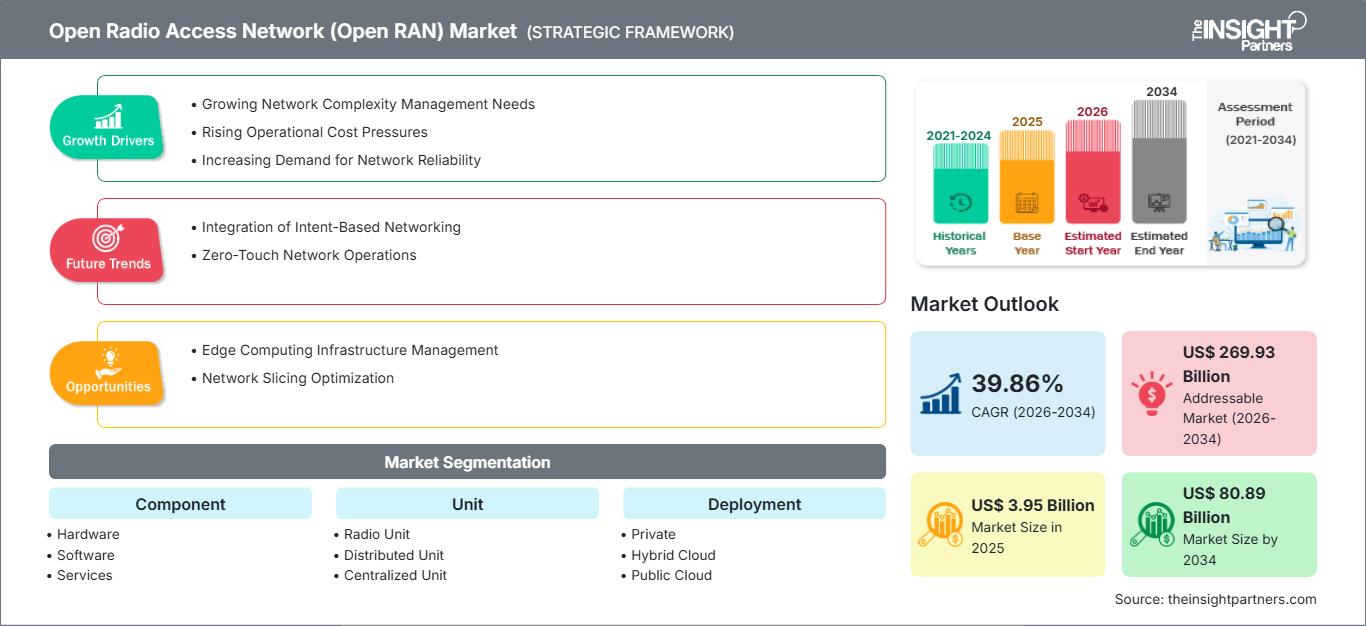
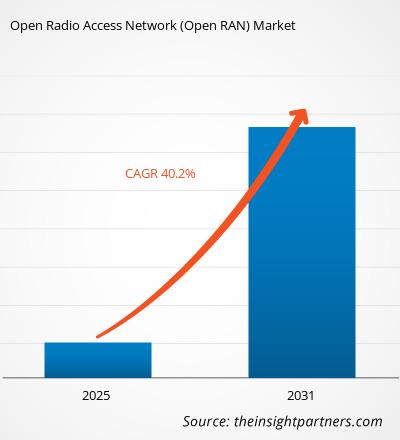
The Open Radio Access Network Market has emerged as one of the most closely watched segments within global telecommunications infrastructure, valued at US$ 3.95 Billion in 2025 and projected to reach US$ 80.89 Billion by 2034, expanding at a CAGR of 39.86% between 2026 and 2034. This trajectory reflects accelerating operator interest in disaggregated, software-defined radio architectures that reduce vendor lock-in while enabling flexible, multi-vendor deployment across greenfield and brownfield network sites worldwide.
Within North America, the Open Radio Access Network Market size is advancing at an estimated CAGR of 37-41% through 2034, propelled by aggressive 5G densification programs and federal broadband initiatives. Major carriers are prioritizing interoperable radio infrastructure to lower the total cost of ownership, while defense and rural connectivity mandates continue accelerating multi-vendor modernization efforts, reinforcing sustained regional investment momentum across both metropolitan and underserved coverage corridors.
Open Radio Access Network (Open RAN) Market Assessment and Insights
- North America: North America commands a leading position, holding an estimated 34-38% share in 2025 and advancing at a CAGR of 37-41% between 2026 and 2034, supported by early operator trials and dense fiber backhaul availability across metropolitan markets.
- US: The U.S. anchors regional demand with roughly 78-82% of North America's share in 2025, growing at a CAGR of 38-42% through 2034 amid strong carrier-led open interface adoption.
- Europe: Europe holds an estimated 24-28% share in 2025 and is projected to grow at a CAGR of 39-43% between 2026 and 2034, with the United Kingdom and Germany leading deployment through spectrum-sharing pilots and public funding programs.
- Asia Pacific: Asia Pacific accounts for an estimated 26-30% share in 2025, expanding at a CAGR of 41-45% through 2034, led by China, Japan, and South Korea as national operators pursue vendor diversification and domestic manufacturing incentives.
- Largest Segment: Hardware remains the largest segment, holding an estimated 46-50% share in 2025 and growing at a CAGR of 37-41% between 2026 and 2034, driven by radio unit deployment volumes.
- High Growth Segment: Software represents the fastest-growing segment, capturing an estimated 19-23% share in 2025 while advancing at a CAGR of 44-48% through 2034 as RAN intelligent controller platforms scale.
- Key companies analyzed in detail: NEC Corporation, Fujitsu Limited, Nokia Corporation, Samsung Electronics Co., Ltd., Radisys Corporation (Reliance Industries), Parallel Wireless, Inc., ZTE Corporation, AT&T Inc., Casa Systems, Inc., Mavenir Systems, Inc., and Rakuten Symphony, Inc.
Source: The Insight Partners' analysis based on proprietary research, government publications, company annual reports, investor presentations, industry databases, and expert interviews.
The development of the radio access network has been through clear stages in which proprietary, one-vendor base stations have changed into disaggregated hardware and software components following open interface specifications. The first experiments conducted by tier-one players confirmed the viability of interoperating between radio equipment and baseband software developed by various vendors, and consequently, the purchasing approach evolved away from one-vendor contracts. The development of chipsets, virtualization capabilities, and open source controllers has contributed towards the reduction of integration challenges in such a way that operators are able to conduct large-scale experiments using different vendors' equipment.
Moving forward, developing nations within Latin America, Southeast Asia, and Africa will deploy open radio interfaces as spectrum auctions increase and there is an increase in demand for rural network expansion. Funding programs backed by governments, such as telecommunications security programs, are motivating operators to source equipment from multiple vendors. Continued investment in cloud-native network functions and standardized testing frameworks is expected to de-risk deployment, positioning open architectures as a mainstream procurement standard rather than a pilot-stage alternative, according to the Open Radio Access Network Market report.
Open Radio Access Network (Open RAN) Market Report Scope
| Report Attribute | Details |
|---|---|
| Market size in 2025 | US$ 3.95 Billion |
| Market Size by 2034 | US$ 80.89 Billion |
| Global CAGR (2026 - 2034) | 39.86% |
| Historical Data | 2021-2024 |
| Forecast period | 2026-2034 |
Open Radio Access Network (Open RAN) Market Analysis
Open Radio Access Network Market growth is primarily driven by operator demand for flexible, interoperable infrastructure that reduces dependency on single equipment suppliers while lowering long-term capital expenditure. There is an increasing preference among telecom service providers for modular rollouts that will permit separate upgrades of radio, distributed, and central components, leading to shorter refresh intervals and better spectrum utilization in both densely populated urban regions and sparsely populated rural areas.
The value chain includes players like component makers, system integrators, cloud solution providers, and network operators, each of whom offers unique skillsets in what is a dispersed yet increasingly consolidated industry. Availability of semiconductors and radio-frequency components is crucial to the supply chain, which is why many players have moved to localize their production processes.
A comprehensive Open Radio Access Network Market analysis indicates intensifying competitive rivalry as established telecom equipment vendors and specialized software providers pursue overlapping strategies. Companies such as Nokia Corporation and Samsung Electronics Co., Ltd. continue expanding multi-vendor interoperability testing, while Fujitsu Limited and NEC Corporation strengthen radio unit portfolios through regional manufacturing partnerships aimed at reducing deployment costs for carriers.
Investment activity is concentrated around software-defined RAN intelligent controllers, with ZTE Corporation and AT&T Inc. advancing field trials alongside specialists including Parallel Wireless, Inc., Casa Systems, Inc., Radisys Corporation, Mavenir Systems, Inc., and Rakuten Symphony, Inc. Strategic partnerships between chipset makers and integrators are reshaping procurement, positioning agile vendors to capture share from traditional single-vendor incumbents.
● REPORT CUSTOMIZATION
Tailor This Report To Align With Your Specific Business Requirements
This report can be customized to align precisely with your business objectives, scope, and target markets. Customization options include tailored segmentation, geography, competitive analysis, and strategic insights to support informed decision-making.
Customize This Report →WHAT YOU CAN ADJUST
- ● Segmentations
- ● Geography
- ● Competitive Analysis
- ● Language Preferences
Open Radio Access Network (Open RAN) Market: Strategic Insights
Regional Insights
North America Open Radio Access Network Market
North America's Open Radio Access Network Market share reflects mature operator engagement, with carriers accelerating multi-vendor trials across metropolitan and suburban coverage areas. The structural drivers comprise federal programs for rural broadband in the U.S., mandatory network security measures for military purposes, and abundant fiber backhaul facilities that make it easier to deploy distributed units. An open interface is also a priority for regional operators due to the need to increase supplier diversity amid the current global shortage of semiconductors.
Canada is adding small momentum with spectrum-sharing pilots and public-private rural connectivity investments, but still deploys on a smaller scale compared to the United States. Regional carriers continue prioritizing vendor diversification clauses within procurement contracts, reflecting national security considerations tied to equipment sourcing. Combined with sustained hyperscaler cloud partnerships supporting centralized unit virtualization, North America is expected to maintain a CAGR of 37–41% between 2026 and 2034, sustaining its position as an early-adopter region for open interface radio infrastructure, according to the Open Radio Access Network Market report.
U.S. Open Radio Access Network Market
The United States represents the largest contributor to North America's Open Radio Access Network Market, holding an estimated 78-82% share of regional revenue in 2025. The adoption of carrier-led open interface is gaining traction owing to extensive field tests being conducted by national carriers aiming at diversifying their radio equipment suppliers, reducing the total cost of ownership, and speeding up the rollout of rural 5G coverage in federal broadband efforts for network upgrades across the country.
Company presence is limited to software companies and systems integrators providing support for deploying radio intelligent controllers and equipment vendors, increasing regional production capabilities. The applications are trending toward private network implementations where secure, low-latency is needed. The U.S. market is projected to expand at a CAGR of 38-42% between 2026 and 2034, reflecting continued carrier investment and favorable federal supply chain security policy.
Europe Open Radio Access Network Market
Europe held an estimated 24–28% share of the global Open Radio Access Network Market in 2025 and is projected to expand at a CAGR of 39–43% between 2026 and 2034. Regional expansion is enabled through pilot projects for spectrum sharing, funding programs, and commitments by operators to adopt multi-vendor strategies, encouraged by regulation promoting diversification in the telecom value chain among member nations, ensuring continued progress throughout the forecast period.
The UK leads regional adoption via open network trials from the government, along with operator commitments to adopting interoperable radio infrastructure, bolstered by innovation funding. This is followed by Germany due to industrial requirements for private networks and large-scale deployments by operators for radio and distributed unit production. The region also sees steady advancement via national digital infrastructure initiatives in France, Italy, and Spain, along with trials by operators of hybrid cloud architecture for modernizing radio access network infrastructure despite capital expenditure limitations.
APAC Open Radio Access Network Market
Asia Pacific accounted for an estimated 26–30% share of the global Open Radio Access Network Market in 2025 and is projected to expand at a CAGR of 41–45% between 2026 and 2034, representing the fastest growth rate among major regions. China leads regional deployment through domestic equipment manufacturing incentives and large-scale carrier trials, while Japan and South Korea are advancing adoption through public-private innovation programs focused on open interface standardization.
India and Australia are contributing to rising momentum through spectrum policy reform and rural connectivity mandates, encouraging operators to adopt cost-efficient, vendor-diversified radio infrastructure. Industrial policy support across the region, including domestic manufacturing subsidies, continues to reinforce China's leading position within the open interface ecosystem.
Middle East & Africa Open Radio Access Network Market
The Middle East and Africa region is advancing at a CAGR of 35-39% between 2026 and 2034, led by Saudi Arabia, as national digital transformation programs prioritize open interface radio deployment alongside broader smart infrastructure investment initiatives tied to economic diversification strategies across the region.
The UAE is expanding through enterprise private network pilots supporting logistics and energy sector connectivity, while South Africa and the Rest of MEA advance gradually through rural coverage expansion tied to national broadband policy, reflecting steady infrastructure modernization amid constrained capital availability.
Segmentation Analysis
Component
The Component segment defines much of the Open Radio Access Network Market scope, encompassing hardware, software, and services required for interoperable deployment. This segment is projected to expand at a CAGR of 39-43% between 2026 and 2034, driven by growing radio unit shipments and rising demand for orchestration software supporting multi-vendor network management across carrier and enterprise deployments.
- Hardware: Hardware remains foundational to physical radio and baseband infrastructure, supporting large-scale carrier deployment volumes and representing the primary capital expenditure category across greenfield 5G rollout programs.
- Software: Software encompasses RAN intelligent controllers and orchestration platforms, enabling automated network optimization, positioning this category as strategically critical for multi-vendor interoperability and operational efficiency gains.
- Services: Services cover integration, testing, and managed deployment support, remaining essential as operators navigate complex multi-vendor interoperability validation across greenfield and brownfield modernization projects.
Unit
The Unit segment, spanning radio, distributed, and centralized units, is projected to grow at a CAGR of 40-44% between 2026 and 2034. Demand is concentrated around radio unit deployment given direct correlation with cell site rollout volumes, while distributed and centralized units gain traction as network virtualization matures across operator infrastructure globally.
- Radio Unit: Radio Unit deployment scales directly with physical cell site rollout, representing the highest-volume hardware category and remaining central to coverage expansion across dense and rural network zones.
- Distributed Unit: Distributed Unit adoption is accelerating as operators decentralize baseband processing closer to cell sites, improving latency performance for time-sensitive applications, including industrial automation and private networks.
- Centralized Unit: Centralized Unit deployment supports pooled baseband resource management, enabling operators to improve spectral efficiency and reduce operational costs across large-scale, multi-site coordination.
Deployment
The Deployment segment, comprising private, hybrid cloud, and public cloud models, is projected to expand at a CAGR of 42-46% between 2026 and 2034, the fastest among all segmentation categories. Hybrid cloud adoption is accelerating as operators balance data sovereignty requirements with scalability, while private deployment gains traction among enterprise and industrial users.
- Private: Private deployment remains preferred among enterprise, defense, and industrial users requiring dedicated, secure network control with minimal reliance on shared public cloud infrastructure resources.
- Hybrid Cloud: Hybrid Cloud deployment balances centralized management efficiency with localized data processing, appealing to operators seeking scalability without fully relinquishing infrastructure control to public providers.
- Public Cloud: Public Cloud deployment appeals to operators prioritizing rapid scalability and reduced upfront infrastructure investment, particularly across greenfield markets pursuing accelerated open network rollout timelines.
Opportunity Snapshot
| End User | Revenue Contribution | Trend Tag | Adoption Stage |
| Telecom Operators | High | Multi-Vendor Trials | Scaling |
| Enterprises | Medium | Private Networks | Emerging |
| Government & Defense | Medium | Secure Connectivity | Emerging |
| Neutral Host Providers | Low | Shared Infrastructure | Emerging |
Open Radio Access Network (Open RAN) Market Growth Drivers and Impact Analysis
Vendor Diversification Reducing Single-Supplier Dependency
As telecom operators become more conscious about the dangers of single-supplier dependence in traditional radio access networks due to political tensions and disruptions in the supply chain, vendor diversification has emerged as one of their key concerns. The open standards for interfaces give telecom providers the freedom to combine units of radio equipment, baseband software, and orchestration from various suppliers, which minimizes the bargaining power of any particular supplier. This trend has motivated various regulators at the national level to positively reinforce multi-vendor sourcing with financial and security-oriented incentives. Consequently, telecom operators in North America, Europe, and certain parts of the Asia Pacific region have intensified their trials of ensuring interoperability of software and hardware solutions from various vendors.
5G Network Densification Accelerating Infrastructure Investment
The growing demand for mobile data usage and business connections is pushing operators into a wave of 5G densification efforts globally, thus creating an additional demand for highly efficient and cost-effective radio access networks. Deploying dense small cells along urban areas calls for modular devices that can be upgraded gradually without having to rebuild the entire network, which is one of the major advantages of disaggregated networks. Densification also increases the complexities associated with backhaul and fronthaul, making distributed and centralized units more preferable in terms of optimal use of spectrum in busy areas. Publicly backed broadband network rollout projects are another driving factor behind this trend, especially in rural and underserved areas, where cost-efficient network rollouts are critical.
Cloud-Native Network Function Adoption Supporting Scalability
The overall trend towards cloud-native network functions is bolstering the operators’ faith in the concept of virtualized software-defined radio access infrastructure. Unit functionalities are being executed through standardized commercial hardware that is orchestrated using cloud systems, thus minimizing reliance on proprietary baseband systems. This allows for flexible scaling of capacity depending on the traffic demands, making the approach more efficient in terms of capital utilization than rigid fixed capacity solutions. Cloud hyperscalers are also entering partnerships with the telecommunication companies for the deployment of hybrid and public clouds, enabling virtualization not just of core network functionalities but even at the radio access layer level.
Open Radio Access Network (Open RAN) Market Future Trends
Artificial Intelligence Integration Within RAN Intelligent Controllers
Artificial intelligence integration is expected to define near-term Open Radio Access Network Market trends, as operators deploy machine learning models within near-real-time and non-real-time RAN intelligent controllers to automate spectrum allocation, interference mitigation, and energy optimization. This capability allows networks to dynamically adjust configuration parameters based on live traffic conditions rather than static provisioning rules, improving both performance and operational cost efficiency. Vendors are increasingly embedding AI-driven analytics directly into orchestration platforms, positioning intelligent automation as a key differentiator among software providers as deployments mature beyond initial trials toward standard operational requirements.
Convergence of Private Networks and Neutral Host Infrastructure
Private network rollout is becoming more aligned with the concept of neutral hosts, providing the opportunity for many operators and enterprise end-users to utilize their disaggregated radio networks within one deployment. This way, there will be fewer duplications of capital expenditure at venues like stadiums, industrial parks, or transportation hubs, while maintaining the customizability of the networks for each tenant via software. In particular, neutral hosts are especially relevant in dense urban areas where access to physical sites is limited, hence motivating operators to establish infrastructure-sharing partnerships with independent infrastructure providers.
Open Radio Access Network (Open RAN) Market Opportunities
Expansion Into Underserved Rural and Emerging Market Geographies
Rural and emerging market geographies represent a substantial opportunity within current Open Radio Access Network Market Forecasts, as governments prioritize cost-efficient connectivity solutions to close persistent digital divides. Disaggregated infrastructure allows operators to deploy coverage incrementally without committing to full proprietary network build-outs, lowering upfront capital barriers in lower-revenue geographies. Multilateral development funding and national broadband programs across Latin America, Southeast Asia, and Sub-Saharan Africa are increasingly directing capital toward open interface deployment models specifically because of their scalability advantages, positioning vendors offering modular, low-cost hardware configurations to capture early-mover advantage as these markets transition from pilot programs toward commercial-scale expansion.
Enterprise Private Network Investment Across Industrial Sectors
Enterprise adoption of private radio access networks presents a significant investment opportunity, particularly across manufacturing, logistics, mining, and energy sectors requiring dedicated, low-latency connectivity for automation and industrial IoT applications. Open interface architecture allows enterprises to select best-fit hardware and software combinations tailored to specific operational requirements rather than committing to single-vendor proprietary systems. System integrators and software specialists are increasingly packaging turnkey private network solutions designed for rapid deployment within industrial environments, reducing technical barriers for enterprises lacking in-house telecom expertise, positioning vendors capable of delivering flexible, interoperable solutions to capture expanding enterprise demand.
Frequently Asked Questions

- Comprehensive Market Sizing and Forecast Analysis
- Detailed Segmentation Analysis
- In-Depth Market Dynamics Assessment
- Regional and Country-Level Insights
- Competitive Landscape and Company Benchmarking
- Strategic Business Intelligence
Recent Reports
Testimonials

The Insight Partners provided valuable market intelligence that supported our global go-to-market strategy. Their team was professional, responsive, and attentive to our feedback, providing thoughtful analysis and helpful methodological clarifications throughout the project.
Junmo Kim Chief Financial Officer (CFO), Enertech Co., Ltd.
The Insight Partners' SCADA System Market report is comprehensive, with valuable insights on current trends and future forecasts. The team was highly professional, responsive, and supportive throughout. We are very satisfied and highly recommend their services.
RAN KEDEM Partner, Reali Technologies LTDs
I requested a report on a very specific software market and the team produced the report in a few days. The information was very relevant and well presented. I then requested some changes and additions to the report. The team was again very responsive and I got the final report in less than a week.
JEAN-HERVE JENN Chairman, Future Analytica
We worked with The Insight Partners for an important market study and forecast. They gave us clear insights into opportunities and risks, which helped shape our plans. Their research was easy to use and based on solid data. It helped us make smart, confident decisions. We highly recommend them.
PIYUSH NAGPAL Sr. Vice President, High Beam Global
The Insight Partners delivered insightful, well-structured market research with strong domain expertise. Their team was professional and responsive throughout. The user-friendly website made accessing industry reports seamless. We highly recommend them for reliable, high-quality research services
YUKIHIKO ADACHI CEO, Deep Blue, LLC.
This is the first time I have purchased a market report from The Insight Partners.While I was unsure at first, I visited their web site and felt more comfortable to take the risk and purchase a market report.I am completely satisfied with the quality of the report and customer service. I had several questions and comments with the initial report, but after a couple of dialogs over email with their analyst I believe I have a report that I can use as input to our strategic planning process.Thank you so much for taking the extra time and making this a positive experience.I will definitely recommend your service to others and you will be my first call when we need further market data.
JOHN SUZUKI President and Chief Executive Officer, Board Director, BK Technologies
I wish to appreciate your support and the professionalism you displayed in the course of attending to my request for information regarding to infectious disease IVD market in Nigeria. I appreciate your patience, your guidance, and the fact that you were willing to offer a discount, which eventually made it possible for us to close a deal. I look forward to engaging The Insight Partners in the future, all thanks to the impression you have created in me as a result of this first encounter.
DR CHIJIOKE ONYIA MANAGING DIRECTOR, PineCrest Healthcare Ltd.Reason to Buy
- Informed Decision-Making
- Understanding Market Dynamics
- Competitive Analysis
- Identifying Emerging Markets
- Customer Insights
- Market Forecasts
- Risk Mitigation
- Boosting Operational Efficiency
- Strategic Planning
- Investment Justification
- Tracking Industry Innovations
- Aligning with Regulatory Trends





 Get Free Sample for