
Palm Vein Scanner Market Demand, Size & Forecast by 2034
Coverage: By Offering (Hardware, Software and Services); Product (Finger Vein Biometrics, Palm Vein Biometrics); Application (Access Control, User Authentication); End-user (Commercial, Industrial) , and Geography (North America, Europe, Asia Pacific, and South and Central America)
- Status : Data Released
- Report Code : TIPRE00017555
- Category : Electronics and Semiconductor
- No. of Pages : 150
- Available Report Formats :


- Last update date : October 13, 2026


2025 Market Size
US$ 837.91 Mn
Base year value
2034 Forecast
US$ 2,259.03 Mn
Projected by 2034
CAGR 2026-2034
11.65 %
Growth rate
Addressable Market
US$ 13,619.77 Mn
(2026-2034)
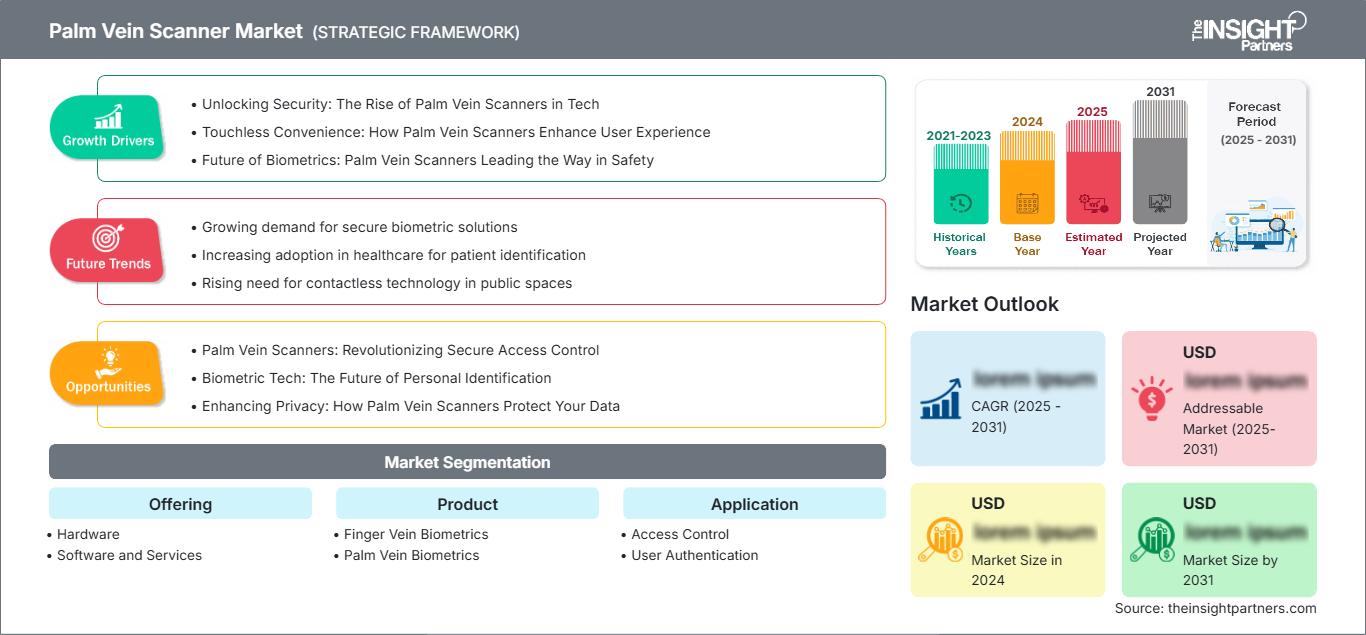
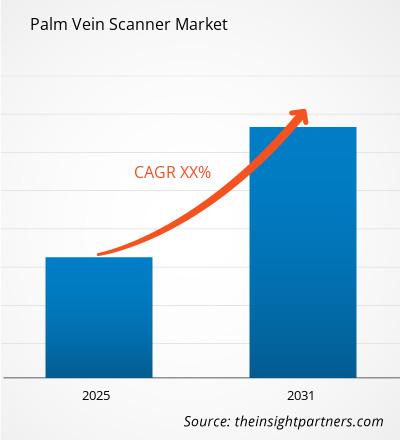
The palm vein scanner market is valued at US$ 837.91 Million in 2025 and is projected to reach US$ 2,259.03 Million by 2034, expanding at a CAGR of 11.65% during 2026–2034. The expansion reflects rising demand for contactless, secure identity verification across access control, user authentication, financial services, healthcare, and industrial environments where conventional credentials can create security and operational weaknesses.
The palm vein scanner market size outlook in North America remains structurally attractive, supported by enterprise cybersecurity spending, mature identity-management infrastructure, and demand for frictionless authentication. Its growth is reinforced by healthcare identity initiatives and high-security facilities seeking contactless verification, while integration with existing access platforms improves the commercial case for advanced vascular biometrics.
Palm Vein Scanner Market Assessment and Insights
- North America: North America is estimated to hold a 35–38% palm vein scanner market share in 2025 and expand at a 9.8–10.8% CAGR between 2026–2034, supported by enterprise security upgrades and contactless authentication.
- US: The US is estimated to represent 70–74% of North America in 2025 and grow at a 9.5–10.5% CAGR between 2026–2034 as healthcare, government, and enterprise deployments broaden.
- Europe: Europe is estimated at a 20–23% share in 2025, with a 10.2–11.2% CAGR through 2034. Germany, the UK, France, Italy, and Spain support adoption through regulated identity and access applications.
- Asia Pacific: Asia Pacific is estimated at a 30–33% share in 2025 and a 13.5–15.0% CAGR between 2026–2034, led by Japan, China, South Korea, and India through banking, transport, retail, and industrial use.
- Largest Segment: Hardware is estimated at a 50–55% share in 2025 and a 10.5–11.5% CAGR between 2026–2034, reflecting scanner-led deployment requirements.
- High Growth Segment: Software and Services is estimated at a 14–16% CAGR between 2026–2034, with a 22–26% combined share in 2025 as integration and lifecycle management expand.
- Key companies analyzed in detail: Fujitsu Limited, Hitachi, Ltd., iDLink Systems Pte Ltd., Imprivata, Inc., M2SYS Technology, Mantra Softech (India) Private Limited, Mofiria Corporation, NEC Corporation, Neurotechnology, Recogtech B.V., BioSec Group Ltd., and Matrix Comsec Private Limited.
Source: The Insight Partners' analysis based on proprietary research, government publications, company annual reports, investor presentations, industry databases, and expert interviews.
The market’s progress has shifted from bank-specific services and physical-access solutions to identity-based systems interoperating with scanners, biometric engines, encryption technologies, and enterprise applications. Near-infrared photography continues to be important due to its ability to provide images of subsurface vasculature without physical touch. As far as vendors’ focus at the manufacturing stage is concerned, they are becoming more concerned about sensor size, capturing ergonomics, embedded processing, software development kits, and flexible integration.
The industry has entered the next growth phase, where multimodal authentication, identity services delivered by cloud, and increased enrolment database size are important. The relevance of the market is evident in Asia Pacific and selected Middle Eastern regions where there is an increased interest in digital identities and smart infrastructures. The legislative interest in privacy related to biometrics is stimulating the development of template protection, consent management, auditability, and data minimization.
Palm Vein Scanner Market Report Scope
| Report Attribute | Details |
|---|---|
| Market size in 2025 | US$ 837.91 Million |
| Market Size by 2034 | US$ 2,259.03 Million |
| Global CAGR (2026 - 2034) | 11.65% |
| Historical Data | 2021-2024 |
| Forecast period | 2026-2034 |
Palm Vein Scanner Market Analysis
Market growth in the palm vein scanner space is driven by the necessity to substitute passwords, cards, and shared identities with authentication elements that are hard to clone or transfer. Value chain of the palm vein scanner market includes infrared illumination, imaging modules, scanners, algorithms, middleware, identity repositories, integration, and services. Highest demand is expected in cases where authentication fails generate significant costs in terms of security or operations.
The supply side is biased in favor of those suppliers who are able to provide technology stacks and not just reading devices. On the one hand, hardware still represents a tangible starting point; on the other hand, it is the software that manages matching, enrollment, policy management, logging and integration. Services provide installation, integration, monitoring, maintenance and compliance.
Market analysis of palm vein scanners reveals that competitive positioning rests largely on accuracy, capture speed, size of the device, interoperability, privacy features, and scalability for large number of users. Fujitsu Limited holds an impressive vascular biometric position through PalmSecure, whereas Hitachi, Ltd. integrates vein verification technology with other digital identity programs. NEC Corporation focuses on multimodal biometrics, and M2SYS Technology and Mantra Softech (India) Private Limited cater to the enterprise/industrial markets.
According to the palm vein scanner market report, other key players include iDLink Systems Pte Ltd., Imprivata, Inc., Mofiria Corporation, Neurotechnology, Recogtech B.V., BioSec Group Ltd., and Matrix Comsec Private Limited by virtue of their offering in the areas of software, sensors, and security products. Increasing investment is being made in miniature sensors, better algorithms, privacy enhancing architectures, application programming interfaces (APIs), and vertical applications in health care, banking, government, transportation, and industrial sectors.
● REPORT CUSTOMIZATION
Tailor This Report To Align With Your Specific Business Requirements
This report can be customized to align precisely with your business objectives, scope, and target markets. Customization options include tailored segmentation, geography, competitive analysis, and strategic insights to support informed decision-making.
Customize This Report →WHAT YOU CAN ADJUST
- ● Segmentations
- ● Geography
- ● Competitive Analysis
- ● Language Preferences
Palm Vein Scanner Market: Strategic Insights
Regional Insights
North America Palm Vein Scanner Market
North America is estimated to account for 35–38% of the palm vein scanner market share in 2025 and is projected to expand at a 9.8–10.8% CAGR through 2034. Mature identity systems, cyber budgets, and biometrics procurement processes exist in this geographic area. The USA continues to be the demand hub while Canada adds its part through its authentication needs related to government, health care, and institutions.
The palm vein scanner market forecast shows that factors influencing demand include contactless entry, workforce identification, health care validation, and protection of facilities. Biometrics companies with powerful APIs and integration skills will have an advantage due to the fact that buyers often connect biometric devices to access control, single sign on, visitor management, or workforce solutions.
U.S. Palm Vein Scanner Market
The U.S. is estimated to represent 70–74% of North American revenue in 2025 and is expected to grow at a 9.5–10.5% CAGR through 2034. The demand involves healthcare, governmental, data center, corporate campus, financial, and industrial sectors where verification of the individual's identity is essential.
Some of the major companies in this market include Fujitsu Limited, Imprivata, Inc., M2SYS Technology, NEC Corporation, along with other solution integrators. The applications are not limited to fixed-access applications but have extended to patient identification, workforce verification, terminal access, and transactions. The purchasing decision is now based on overall costs, integration capability, enrollment process, and privacy system architecture.
Europe Palm Vein Scanner Market
Europe is estimated to hold a 20–23% share in 2025 and is projected to grow at a 10.2–11.2% CAGR through 2034. Germany emerges as a key market driven by automation of industry and security needs of enterprises, whereas the United Kingdom, France, Italy, and Spain provide other avenues for adoption via regulated businesses and public services.
United Kingdom can be considered as a promising region for authentication solutions in enterprise and institutions where identity verification and access management are needed. Germany provides an interesting combination of digitization of industry and needs of secure workforce access. France has potential for deployments in regulated businesses and transport-related segments, whereas Italy and Spain offer potential in banking, healthcare, commercial and public sectors.
APAC Palm Vein Scanner Market
Asia Pacific is estimated at a 30–33% share in 2025 and is forecast to grow at a 13.5–15.0% CAGR through 2034, making it the leading growth region. Japan ranks highest in the current maturity level of deployment, whereas China, South Korea, India, and Australia make contributions via their digital identity, banking, retail, and industrial applications.
Japan leverages its long-term application of vascular biometric technology, while China and South Korea are focusing on increasing usage of contactless identity technology. There is potential in India through enterprise security and high-volume authentication.
Middle East & Africa Palm Vein Scanner Market
Middle East and Africa is projected to expand at an 11.0–12.5% CAGR through 2034, with Saudi Arabia leading regional demand, followed by the UAE and South Africa. Investment in smart infrastructure, secure facilities, and digital government supports adoption across high-value sites.
Saudi Arabia and the UAE are developing digitally enabled public and commercial environments, creating demand for frictionless identity verification. South Africa contributes through banking, enterprise, and institutional applications, while the rest of MEA offers opportunities in airports, energy facilities, and secure industrial sites. Infrastructure modernization and energy-sector security requirements strengthen the case for robust authentication technologies.
Segmentation Analysis
Offering
Offering in the palm vein scanner market scope is expected to grow at a 10.5–13.5% CAGR from 2026–2034 as buyers procure complete authentication environments. Hardware establishes sensing, software enables matching and policy management, and services reduce integration barriers. The mix is shifting toward recurring service value.
- Hardware: Hardware remains the physical foundation, with demand concentrated in scanners, sensing modules, and integrated terminals. Its importance reflects replacement cycles, installation scale, and performance requirements.
- Software and Services: Software and services are gaining importance as enterprises require enrollment management, orchestration, monitoring, integration, updates, and compliance support.
Product
Product is expected to expand at a 11.0–13.0% CAGR during 2026–2034 as organizations compare vascular modalities. Product selection depends on security level, user throughput, deployment environment, ergonomics, and system compatibility.
- Finger Vein Biometrics: Finger vein biometrics remains relevant where compact capture and established workflows are preferred. Demand is strongest in workstation access, banking, and secure enterprise environments.
- Palm Vein Biometrics: Palm vein biometrics benefits from contactless capture and a larger vascular imaging area, supporting access control, authentication, healthcare identification, and high-throughput environments.
Application
Application is expected to advance at a 11.5–13.5% CAGR from 2026–2034 as organizations expand biometric identity into broader authentication workflows. Adoption depends on risk exposure, user volume, integration requirements, and unauthorized-access consequences.
- Access Control: Access control remains a core application because vascular traits can strengthen entry authorization for offices, industrial sites, data centers, laboratories, and restricted facilities.
- User Authentication: User authentication is expanding across workstations, enterprise applications, healthcare systems, and transaction environments, reducing dependence on passwords, cards, or shared credentials.
End-user
End-user adoption is expected to rise at a 10.8–13.8% CAGR through 2034 as commercial and industrial organizations modernize identity controls. Deployment decisions reflect workforce scale, asset sensitivity, hygiene, integration complexity, and operating costs.
- Commercial: Commercial organizations use biometric authentication for workforce access, customer verification, transaction security, and controlled-area entry. Adoption is strongest where convenience and identity assurance must coexist.
- Industrial: Industrial users prioritize robust authentication for plants, warehouses, laboratories, utilities, and restricted zones. Contactless capture can support hygiene, throughput, and accountability where shared credentials create risk.
Opportunity Snapshot
| End Users | Revenue Contribution (High/Medium/Low) | Trend Tag (MAX 2 words) | Adoption Stage (Emerging/Scaling/Mature) |
| Commercial | High | Contactless Access | Scaling |
| Industrial | Medium | Workforce Security | Scaling |
Palm Vein Scanner Market Growth Drivers and Impact Analysis
Rising demand for high-assurance contactless identity verification
Companies are making efforts to use authentication technologies that can limit reliance on passwords, badges, and common authentication techniques. Palmscan vascular recognition becomes an effective solution where touch-free authentication must coexist with strong identity validation. Such applications include healthcare facilities, industrial sites, laboratories, and restricted corporate areas. However, the effect goes beyond purchase of scanners since deployment implies using enrollment solutions, integration with identities, management of policies, maintenance, and monitoring activities. Thus, the scope of the value chain increases. As companies integrate identity management systems, solution providers that can integrate biometric identification with access control and identity systems will receive bigger orders and longer-term service agreements.
Expansion of biometric identity across enterprise and public infrastructure
More and more often, biometric verification technology is being analyzed as part of overall digital identity ecosystems rather than as a stand-alone security solution. It brings possibilities into transport, health care, financial services, education, government agencies, and commercial complexes. The effect is most felt when one identity is sufficient for many applications, saving effort on re-enrollment. As a result, vendors are forced to supply an interoperable API, a scalable matching engine, safe storage of templates, and a workflow. Such an environment works best for those suppliers who can be a part of multi-application implementations and cooperate with systems integrators. In the long term, expanding identity networks make the marginal cost of using additional applications smaller, prompting enterprises to implement vascular biometric authentication not only at one checkpoint but as a whole identity program.
Advances in imaging, algorithms, and biometric integration
Improvements in near-infrared sensing, image processing, algorithm efficiency, and device miniaturization are increasing the practical flexibility of vascular authentication. Better capture ergonomics can reduce enrollment friction, while stronger algorithms can improve performance across different operating conditions. Integration with multimodal biometrics can also provide layered authentication for environments where a single factor is insufficient. These advances affect supplier competition because differentiation is moving from the scanner alone toward the combined performance of sensing, algorithms, software, and integration. Investment in compact modules and software development kits can broaden deployment into kiosks, terminals, workstations, and mobile-adjacent environments. Easier implementation lets organizations test smaller use cases before scaling, reducing adoption barriers.
Palm Vein Scanner Market Future Trends
Multimodal authentication will become a stronger enterprise architecture
Future palm vein scanner market trends combine vascular recognition with face, fingerprint, cards, or contextual risk signals. This approach can support adaptive authentication, allowing organizations to apply stronger verification when transaction value, location, user role, or system sensitivity increases. Multimodal architecture also helps address situations where a single biometric modality is temporarily unsuitable. Vendors will increasingly compete on orchestration software, common enrollment frameworks, and unified policy engines rather than isolated biometric readers. This shifts procurement toward platforms where palm vein capability becomes one component of a wider identity stack. Suppliers that provide modular interfaces and secure data exchange can participate in larger enterprise transformation programs while reducing the need for customers to maintain disconnected authentication environments.
Privacy-preserving biometric infrastructure will shape procurement decisions
As biometric identifiers receive greater regulatory scrutiny, organizations will place more emphasis on template protection, local processing, encryption, retention controls, consent mechanisms, and auditable access to biometric data. Future solutions are therefore likely to use architectures that minimize unnecessary movement of sensitive biometric information while preserving authentication speed. This trend can favor edge processing and controlled repositories in regulated sectors. Buyers may increasingly assess governance features alongside false-accept and false-reject performance, making privacy engineering a competitive differentiator. Suppliers will also need to document data flows, integration controls, and lifecycle policies clearly. The resulting procurement environment should reward vendors that treat biometric security, privacy, and operational resilience as interconnected design requirements rather than separate compliance activities.
Palm Vein Scanner Market Opportunities
Healthcare identity and medication-access ecosystems
The palm vein scanner market offers a strategic healthcare opportunity because identity errors can affect patient records, medication access, billing, and workforce authorization. Contactless vascular authentication can be positioned at registration desks, clinical workstations, controlled medication areas, and staff-only zones where reliable identity verification is valuable. Suppliers can pursue modular deployments that connect scanners with electronic health record workflows, workforce identity systems, and access-control platforms. The strongest investment opportunities are targeted applications where identity failure costs are high. Vendors should prioritize privacy-preserving enrollment, intuitive interfaces, interoperability, and service support. Partnerships with healthcare technology integrators can accelerate adoption because hospitals require authentication systems to fit established clinical and security workflows.
Industrial workforce and critical-facility authentication
Industrial sites represent an opportunity for biometric solutions that combine secure access with workforce accountability. Manufacturing plants, energy facilities, logistics hubs, laboratories, and restricted maintenance areas often require identity controls that remain usable across shift changes and high-throughput entry points. Palm vein scanner market solutions can support contactless verification while reducing reliance on physical credentials that may be lost, shared, or damaged. Suppliers can create value by integrating biometric events with workforce management, visitor systems, safety procedures, and operational access policies. Investment should focus on ruggedized hardware, environmental tolerance, rapid enrollment, centralized administration, and resilient operation during network interruptions. Such capabilities can differentiate solutions in critical facilities where authentication must remain dependable without adding excessive friction to routine workforce movement.
Frequently Asked Questions

- Comprehensive Market Sizing and Forecast Analysis
- Detailed Segmentation Analysis
- In-Depth Market Dynamics Assessment
- Regional and Country-Level Insights
- Competitive Landscape and Company Benchmarking
- Strategic Business Intelligence
Recent Reports
Testimonials

The Insight Partners provided valuable market intelligence that supported our global go-to-market strategy. Their team was professional, responsive, and attentive to our feedback, providing thoughtful analysis and helpful methodological clarifications throughout the project.
Junmo Kim Chief Financial Officer (CFO), Enertech Co., Ltd.
The Insight Partners' SCADA System Market report is comprehensive, with valuable insights on current trends and future forecasts. The team was highly professional, responsive, and supportive throughout. We are very satisfied and highly recommend their services.
RAN KEDEM Partner, Reali Technologies LTDs
I requested a report on a very specific software market and the team produced the report in a few days. The information was very relevant and well presented. I then requested some changes and additions to the report. The team was again very responsive and I got the final report in less than a week.
JEAN-HERVE JENN Chairman, Future Analytica
We worked with The Insight Partners for an important market study and forecast. They gave us clear insights into opportunities and risks, which helped shape our plans. Their research was easy to use and based on solid data. It helped us make smart, confident decisions. We highly recommend them.
PIYUSH NAGPAL Sr. Vice President, High Beam Global
The Insight Partners delivered insightful, well-structured market research with strong domain expertise. Their team was professional and responsive throughout. The user-friendly website made accessing industry reports seamless. We highly recommend them for reliable, high-quality research services
YUKIHIKO ADACHI CEO, Deep Blue, LLC.
This is the first time I have purchased a market report from The Insight Partners.While I was unsure at first, I visited their web site and felt more comfortable to take the risk and purchase a market report.I am completely satisfied with the quality of the report and customer service. I had several questions and comments with the initial report, but after a couple of dialogs over email with their analyst I believe I have a report that I can use as input to our strategic planning process.Thank you so much for taking the extra time and making this a positive experience.I will definitely recommend your service to others and you will be my first call when we need further market data.
JOHN SUZUKI President and Chief Executive Officer, Board Director, BK Technologies
I wish to appreciate your support and the professionalism you displayed in the course of attending to my request for information regarding to infectious disease IVD market in Nigeria. I appreciate your patience, your guidance, and the fact that you were willing to offer a discount, which eventually made it possible for us to close a deal. I look forward to engaging The Insight Partners in the future, all thanks to the impression you have created in me as a result of this first encounter.
DR CHIJIOKE ONYIA MANAGING DIRECTOR, PineCrest Healthcare Ltd.Reason to Buy
- Informed Decision-Making
- Understanding Market Dynamics
- Competitive Analysis
- Identifying Emerging Markets
- Customer Insights
- Market Forecasts
- Risk Mitigation
- Boosting Operational Efficiency
- Strategic Planning
- Investment Justification
- Tracking Industry Innovations
- Aligning with Regulatory Trends





 Get Free Sample for