
Paper Processing Resins Market Size, Share & Demand by 2034
Coverage: By Type (Acrylic, Melamine Formaldehyde, Butadiene Resin Latex, Polyamide, Others); Application (Kraft Paper Decorative Paper, Duplex Boards, Others) , and Geography (North America, Europe, Asia Pacific, and South and Central America)
- Status : Data Released
- Report Code : TIPRE00026032
- Category : Chemicals and Materials
- No. of Pages : 150
- Available Report Formats :


- Last update date : September 15, 2026


2025 Market Size
US$ 3.76 Bn
Base year value
2034 Forecast
US$ 5.92 Bn
Projected by 2034
CAGR 2026-2034
5.17 %
Growth rate
Addressable Market
US$ 43.91 Bn
(2026-2034)
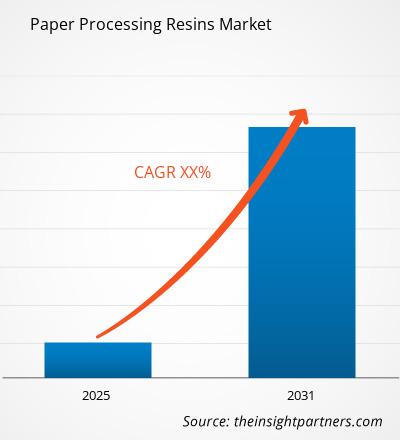
The Paper Processing Resins market was valued at US$ 3.76 billion in 2025 and is expected to reach US$ 5.92 billion by 2034; it is estimated to record a CAGR of 5.17% during 2026-2034.
Paper Processing Resins Market Assessment and Insights
- North America: North America is estimated to represent a 24–28% share in 2025 and expand at a 4.8–5.4% CAGR between 2026 and 2034. Packaging conversion, decorative laminates, and functional paper coatings underpin regional demand.
- U.S.: The U.S. accounts for approximately 78–82% of North American demand in 2025 and is projected to grow at a 4.7–5.3% CAGR between 2026–2034, supported by packaging and specialty-paper applications.
- Europe: Europe holds approximately 22–26% share in 2025 and is expected to grow at 4.5–5.1% CAGR between 2026 and 2034, with Germany, Italy, France, the UK, and Spain supporting resin consumption.
- Asia Pacific: Asia Pacific represents approximately a 31–35% share in 2025 and is projected to record a 6.0–6.7% CAGR between 2026 and 2034, led by China, Japan, India, South Korea, and Southeast Asian packaging production.
- Largest Segment: Acrylic represents an estimated 32–36% market share in 2025 and is expected to expand at 5.8–6.4% CAGR from 2026–2034, supported by versatile coating performance.
- High Growth Segment: Kraft Paper represents approximately 28–32% market share in 2025 and is projected to grow at 6.1–6.8% CAGR from 2026–2034, driven by packaging conversion.
- Key companies analyzed in detail: Mitsubishi Chemical Group Corporation, Vertex Chem Private Limited, DIC Corporation, Wacker Chemie AG, DSM-Firmenich AG, DuPont de Nemours, Inc., BASF SE, Arkema S.A., Nissin Chemical Co., Ltd., and Sumitomo Corporation.
Source: The Insight Partners' analysis based on proprietary research, government publications, company annual reports, investor presentations, industry databases, and expert interviews.
Technologies have seen developments toward aqueous dispersion, high solid contents, improved crosslinking controls, and resins for coatings at lower coating weights. The paper makers would increasingly seek stable viscosity, adhesion, surface strength, moisture resistance, and printability without affecting repulpability. Thus, the Paper Processing Resins Market ecosystem is formed by monomers, resin producers, formulation, paper makers, coating equipment, converters, and brand owners. Such integration makes it more advantageous for suppliers which could offer formulation and application services.
During the forecast period, the investments are expected to be directed towards Asia-Pacific capacities, specialty barrier technologies, and resins with low carbon footprints. The regulations regarding safety of food-contact materials, fluorinated substances, volatile organic compounds, and recyclability of packaging would drive the formulation development. New developments are especially significant for applications, where the paper substitutes the multilayer plastic films. Suppliers which integrate technical services and local production would be able to reduce the qualification time and adapt to regional specifications.
Paper Processing Resins Market Report Scope
| Report Attribute | Details |
|---|---|
| Market size in 2025 | US$ 3.76 Billion |
| Market Size by 2034 | US$ 5.92 Billion |
| Global CAGR (2026 - 2034) | 5.17% |
| Historical Data | 2021-2024 |
| Forecast period | 2026-2034 |
Paper Processing Resins Market Analysis
Paper Processing Resins Market prospects are directly related to packaging alternatives, surface functionalities, and demand for improved paper products. The companies offer acrylic resins, melamine-formaldehyde, latex resins based on butadiene, polyamides, and other chemicals that provide better adhesion, barrier protection, rigidity, wet strength, surface appearance, and resistance. The process starts with obtaining of raw materials like petrochemicals or biomass, production of resins, dispersion or solution making, formulation, quality control, and delivery of paper mills or converters. Dynamics of supplies depend on prices of monomers, energy, transportation tariffs, and local production.
The packaging industry remains one of the most significant drivers of demand since the paper substrates need more protection from water, grease, heat, and oil. Decorative papers need precise impregnation with the resins to provide necessary surface hardness, stability, and appearance. It is not just the competition in terms of lower weight application but also in terms of performance. Technical support is an important issue due to specific formulations according to fiber, machinery, and conditions of drying process.
Formulation depth, geographical coverage, laboratory services, and sustainability become more critical in competitive differentiation. BASF SE has strong capabilities for the paper coating formulations including acrylics and styrene dispersions, and DIC Corporation provides functional coatings solutions for the paper packaging industry. The Mitsubishi Chemical Group Corporation is developing barrier resin technologies for paper substrates. Wacker Chemie AG, Arkema S.A., and DuPont de Nemours, Inc. have the capability for providing polymers and specialty materials solutions that might be relevant to paper processing.
The Paper Processing Resins Market report reveals that the competitive environment is characterized by the coexistence of major chemical companies and regional players. Investments are directed at water-based resins, specialty barriers, low VOC, and recyclable formulations. Large companies with wide range of formulations are capable to sell adjacent resins to the packaging, decorative paper, and boards markets. Small regional specialists are capable to compete based on customization and fast development cycle as well as specific technical support of applications.
● REPORT CUSTOMIZATION
Tailor This Report To Align With Your Specific Business Requirements
This report can be customized to align precisely with your business objectives, scope, and target markets. Customization options include tailored segmentation, geography, competitive analysis, and strategic insights to support informed decision-making.
Customize This Report →WHAT YOU CAN ADJUST
- ● Segmentations
- ● Geography
- ● Competitive Analysis
- ● Language Preferences
Paper Processing Resins Market: Strategic Insights

Regional Insights
North America Paper Processing Resins Market
North America accounts for a 24-28% Paper Processing Resins Market share in 2025 with a projected 4.8-5.4% CAGR up to 2034. The largest region in terms of consumption is the USA due to well-developed technology of packaging conversion, specialty paper manufacture, decorative laminates, and need for high performance coated boards. Canada contributes via packaging, pulp and paper industry, and industrial papers. Water-based resins are more and more in the spotlight among resin producers.
Demand in the region is also driven by the shift towards the usage of fiber packaging. Paper converters need resins with properties such as grease barrier, moisture resistance, heat-sealing, adhesion and printing, recyclable materials. Food contact regulations stimulate qualification of well-controlled formulations. BASF SE, DuPont de Nemours, Inc., Arkema S.A. and other multinational suppliers have technological competence appropriate to the North American market. Expansion will be slow due to mature paper consumption offsetting growth in specialty packaging.
U.S. Paper Processing Resins Market
North America consists of around 78% - 82% of total US demand in 2025, which is expected to experience 4.7% - 5.3% CAGR up to 2034. Major segments include coated packaging, kraft-containing products, decorative paper, labels, special board grades, and industrial paper. The supply chain includes multinational companies like BASF SE that provide converters with coatings based on resins that include acrylic, latex, barrier, and functional grades.
Current trends include increasing usage of water-based products and paper substrates for better recyclability. Coating performance is still crucial due to converters’ need to balance barrier properties, repulpability, coating weight, drying time, and print quality. An important application in the region is food packaging since there are increasing efforts by paper-based substrates to replace plastics. Domestic production is predicted to focus more on special rather than commodity products.
Europe Paper Processing Resins Market
In Europe, the market size constitutes about 22-26% of the total share in 2025, with growth estimated at a CAGR of 4.5-5.1% from 2025 to 2034. The German market dominates the region, thanks to its advanced paper production, packaging conversion, specialty boards, and industrial coatings. The UK, France, Italy, and Spain are also adding demand from the packaging, printing, decorative paper, and converting sectors.
The UK markets focus on recyclable packaging and premium coated papers, whereas Germany remains strong in the demand for technically advanced papers and boards. Food packaging, specialty papers, and decoration make the French and Italian markets prosper, with Spain contributing through packaging conversion and board manufacturing. Increased pressure due to regulations regarding packaging recyclability, emission, and safety chemicals leads to re-formulations of resins. Some of the key suppliers include BASF SE, Arkema S.A., Wacker Chemie AG, among others.
APAC Paper Processing Resins Market
Asia Pacific contributes 31–35% share in 2025 and expected to grow at 6.0–6.7% CAGR till 2034. The region consumes high amount of resins, in that order; China, Japan, India, South Korea, and Australia. Packaging production, increasing paperboard converting, and industrialization drive resin requirement for various applications.
China possesses huge papermaking capacity along with packaging production, whereas India gains advantage due to increasing converting and consumer packaging demand. Japan and South Korea focus on premium specialty papers and coatings. Australia participates through packaging and specialty papers demand. Initiatives taken in the region to promote resource efficiency and local production drive investments in waterborne and recyclable coatings.
Middle East & Africa Paper Processing Resins Market
Demand in the Middle East and Africa is smaller but growing at a rate of 4.1–4.8% CAGR through 2034 as per model estimates. Saudi Arabia and the UAE gain on their packaging infrastructure investments, while South Africa continues to rely on diversified paper converting facilities. Rest of MEA participates through food packaging, board converting, printing, and specialty paper imports.
Infrastructure development and consumer goods manufacturing are key factors for resin demand throughout the region. Increasing importance of local manufacturing, logistics and packaging in Gulf regions and sensitivity to resin import prices and currency fluctuation in African markets make suppliers with reliable technical support and product availability able to cater to fragmented demand. Barrier coating, decorative papers and kraft packaging represent the most obvious medium term applications.
Segmentation Analysis
Type
The Type segment is expected to expand at a modeled 5.5–6.1% CAGR from 2026 to 2034. Resin chemistry determines adhesion, flexibility, water resistance, hardness, surface appearance, and compatibility with paper-processing conditions. Buyers increasingly select chemistries according to end-use performance rather than resin cost alone, encouraging specialty formulations and application-specific development.
- Acrylic: Acrylic resins provide strong adhesion, weatherability, film formation, and surface performance, making them important for coated papers, packaging barriers, printing substrates, and applications requiring consistent appearance.
- Melamine Formaldehyde: Melamine formaldehyde resins support impregnation and surface hardening, particularly in decorative papers where scratch resistance, dimensional stability, and durable finishes influence product performance.
- Butadiene Resin Latex: Butadiene resin latexes provide binding strength, flexibility, and printability for coated paper and board, supporting high-speed coating operations and demanding surface-finish requirements.
- Polyamide: Polyamide resins offer adhesion, toughness, chemical resistance, and functional performance, making them relevant to specialty coatings and paper structures requiring stronger resistance properties.
Application
The Application segment is projected to grow at a 6.0–6.6% CAGR from 2026 to 2034. Packaging-oriented applications are gaining importance as paper products require enhanced barrier and surface properties. Decorative and kraft papers remain significant because resin treatment improves durability, appearance, and processing performance across demanding downstream uses.
- Kraft Paper: Kraft paper benefits from resin technologies that improve moisture resistance, surface strength, printability, and functional performance, supporting sacks, wraps, bags, and flexible fiber-based packaging.
- Decorative Paper: Decorative paper requires controlled resin impregnation to deliver hardness, dimensional stability, abrasion resistance, and visual consistency for furniture, flooring, laminates, and interior applications.
- Duplex Boards: Duplex boards use processing resins to improve surface characteristics, coating adhesion, stiffness, and printability, supporting cartons, consumer packaging, labels, and other converted board products.
Opportunity Snapshot
| Application | Revenue Contribution | Trend Tag | Adoption Stage |
|---|---|---|---|
| Kraft Paper | High | Barrier Coating | Scaling |
| Decorative Paper | Medium | Surface Hardening | Mature |
| Duplex Boards | High | Carton Performance | Scaling |
Paper Processing Resins Market Growth Drivers and Impact Analysis
Expansion of Fiber-Based Packaging Applications
The shift toward fiber-based packaging is increasing the requirements for resins that can provide barrier properties without undermining paper recyclability. Foodservice containers, cartons, wraps, bags, and specialty boards increasingly need resistance to water, grease, oil, and heat. Resin suppliers, therefore, gain opportunities by developing coating systems that replace selected plastic layers while preserving converting efficiency. This shift also changes purchasing criteria, with paper mills evaluating total formulation performance rather than resin price alone. Companies that are able to demonstrate food-contact suitability, stable processing, and compatibility with established coating equipment can accelerate customer qualification. The commercial impact extends across acrylic, latex, polyamide, and specialty resin systems, creating demand for customized formulations and technical support. As converters increase fiber-based product offerings, resin consumption can expand even where conventional paper volumes remain comparatively stable.
Demand for Higher-Performance Decorative Papers
Decorative papers used in furniture, flooring, countertops, and interior surfaces require resins that deliver hardness, adhesion, dimensional stability, abrasion resistance, and consistent appearance. Rising expectations for durable interior finishes increase the importance of resin impregnation and curing performance. Manufacturers must control resin penetration, curing behavior, surface smoothness, and compatibility with decorative printing systems. This creates opportunities for suppliers with formulation expertise and process-development capabilities. Demand is also influenced by the replacement cycle for furniture and interior products, renovation activity, and investment in residential and commercial construction. Melamine-formaldehyde systems remain important for durable laminate applications, while alternative chemistries can address specific performance or sustainability requirements. The market impact is therefore concentrated in higher-value specialty formulations where performance differentiation supports customer retention and reduces sensitivity to commodity pricing.
Modernization of Paper Coating Operations
Paper mills are increasingly optimizing coating lines to improve productivity, reduce drying requirements, and maintain product quality at lower material usage. Resin suppliers can benefit when mills adopt high-solids binders, improved dispersions, and formulations designed for faster processing. Modern equipment increases the importance of rheology control, coating stability, surface uniformity, and predictable curing. These requirements encourage closer collaboration between resin producers, paper manufacturers, and coating-equipment suppliers. Investments in pilot facilities and application laboratories can shorten formulation-development cycles and help customers validate new grades before commercial production. The resulting market effect favors suppliers with broad technical portfolios and local service capabilities. It also encourages migration from standard resin grades toward application-specific products that improve coating efficiency, printability, barrier performance, and finished-paper quality while supporting increasingly stringent environmental and operational requirements.
Paper Processing Resins Market Future Trends
Water-Based and Repulpable Resin Systems
The Paper Processing Resins Market trends landscape is likely to move toward water-based, low-emission, and repulpable resin systems as paper packaging seeks improved environmental compatibility. Future formulations will increasingly combine barrier performance with easier recycling, lower odor, and reduced dependence on solvent-intensive technologies. Acrylic dispersions and specialty aqueous polymers are well-positioned for development because they can be engineered around specific coating methods and performance targets. Suppliers are also expected to improve bio-based content and optimize polymer architecture rather than relying solely on higher coating weights. Digital process monitoring could further improve consistency by linking coating parameters with resin performance. These changes will encourage customers to evaluate resin systems through lifecycle and process metrics, including drying energy, coating efficiency, recyclability, and material consumption. Competitive advantage should increasingly depend on demonstrated performance across the complete paper-processing workflow.
PFAS-Free Barrier Performance and Functional Paper
Future development will increasingly focus on paper coatings that provide grease, oil, moisture, and gas resistance without relying on substances facing regulatory scrutiny. Resin suppliers are positioned to develop multilayer or hybrid coating structures that combine barrier performance with food-contact requirements and repulpability. Innovation will extend beyond conventional surface coatings toward engineered polymer layers, primer systems, and multifunctional formulations that can replace selected plastic components. Customer qualification will become more rigorous because converters must demonstrate shelf-life performance, sealing behavior, printability, and recycling compatibility simultaneously. Asia Pacific is likely to become an important development center as packaging manufacturers scale new paper structures. Producers with proprietary polymer chemistry, application laboratories, and regulatory expertise can secure stronger positions by reducing qualification risk for converters and brand owners.
Paper Processing Resins Market Opportunities
Localized Production for Asia Pacific Packaging Converters
Asia Pacific offers an attractive investment opportunity because expanding packaging conversion requires reliable supplies of specialty resins, dispersions, and functional coating materials. Producers can establish regional manufacturing or blending operations near major paper and board clusters to reduce logistics costs and shorten customer qualification cycles. India, China, Indonesia, and Southeast Asia provide potential locations where packaging demand is expanding, and local technical capabilities are developing. Investment should prioritize flexible production assets capable of manufacturing multiple resin chemistries rather than single-product commodity facilities. Local laboratories can support rapid formulation adjustment for different paper grades and coating equipment. The Paper Processing Resins Market Forecasts, therefore, point toward greater regionalization of supply chains. Partnerships with paper mills and converters can further reduce commercialization timelines while creating recurring demand for application-specific formulations.
Specialty Resins for Recyclable Food Packaging
A significant opportunity lies in developing specialty resin systems that enable paper packaging to deliver performance traditionally associated with plastic structures. Suppliers can target grease-resistant food wrappers, liquid-resistant cartons, cups, trays, and flexible paper packaging where barrier properties remain critical. Investment priorities should include water-based polymers, heat-sealable coatings, low-migration formulations, and structures that preserve repulpability. Collaboration with converters can help validate coating weight, drying behavior, sealing strength, and recycling outcomes before broad commercialization. Regulatory expertise will also become a differentiator because food-contact requirements vary by jurisdiction. Producers that integrate resin chemistry with application engineering can move beyond commodity supply toward higher-value solutions. This opportunity also provides scope for licensing, joint development, and strategic partnerships with paper manufacturers seeking differentiated packaging grades.
Recent Developments
- December 2025: Mitsubishi Chemical Group Corporation developed a technology using its SoarnoL gas-barrier resin solution to coat paper substrates, providing gas-barrier and oil-resistance properties. The company stated that the technology can deliver oil resistance exceeding PFAS-based packaging under specified conditions and was targeting customer assessment for fiscal 2026 adoption, strengthening the role of resin-based functional barriers in food packaging.
- March 2026: BASF SE expanded dispersion production capacity at its Durban, South Africa, facility, strengthening its ability to supply resin and dispersion solutions for paper, packaging, coatings, and construction applications. The investment improves regional supply reliability and supports BASF’s strategy of increasing local production capabilities for customers requiring performance-enhancing polymer materials.
Frequently Asked Questions

- Comprehensive Market Sizing and Forecast Analysis
- Detailed Segmentation Analysis
- In-Depth Market Dynamics Assessment
- Regional and Country-Level Insights
- Competitive Landscape and Company Benchmarking
- Strategic Business Intelligence
Recent Reports
Testimonials

The Insight Partners' SCADA System Market report is comprehensive, with valuable insights on current trends and future forecasts. The team was highly professional, responsive, and supportive throughout. We are very satisfied and highly recommend their services.
RAN KEDEM Partner, Reali Technologies LTDs
I requested a report on a very specific software market and the team produced the report in a few days. The information was very relevant and well presented. I then requested some changes and additions to the report. The team was again very responsive and I got the final report in less than a week.
JEAN-HERVE JENN Chairman, Future Analytica
We worked with The Insight Partners for an important market study and forecast. They gave us clear insights into opportunities and risks, which helped shape our plans. Their research was easy to use and based on solid data. It helped us make smart, confident decisions. We highly recommend them.
PIYUSH NAGPAL Sr. Vice President, High Beam Global
The Insight Partners delivered insightful, well-structured market research with strong domain expertise. Their team was professional and responsive throughout. The user-friendly website made accessing industry reports seamless. We highly recommend them for reliable, high-quality research services
YUKIHIKO ADACHI CEO, Deep Blue, LLC.
This is the first time I have purchased a market report from The Insight Partners.While I was unsure at first, I visited their web site and felt more comfortable to take the risk and purchase a market report.I am completely satisfied with the quality of the report and customer service. I had several questions and comments with the initial report, but after a couple of dialogs over email with their analyst I believe I have a report that I can use as input to our strategic planning process.Thank you so much for taking the extra time and making this a positive experience.I will definitely recommend your service to others and you will be my first call when we need further market data.
JOHN SUZUKI President and Chief Executive Officer, Board Director, BK Technologies
I wish to appreciate your support and the professionalism you displayed in the course of attending to my request for information regarding to infectious disease IVD market in Nigeria. I appreciate your patience, your guidance, and the fact that you were willing to offer a discount, which eventually made it possible for us to close a deal. I look forward to engaging The Insight Partners in the future, all thanks to the impression you have created in me as a result of this first encounter.
DR CHIJIOKE ONYIA MANAGING DIRECTOR, PineCrest Healthcare Ltd.Reason to Buy
- Informed Decision-Making
- Understanding Market Dynamics
- Competitive Analysis
- Identifying Emerging Markets
- Customer Insights
- Market Forecasts
- Risk Mitigation
- Boosting Operational Efficiency
- Strategic Planning
- Investment Justification
- Tracking Industry Innovations
- Aligning with Regulatory Trends





 Get Free Sample for