
Pico Projector Market Size, Growth & Demand by 2034
Coverage: by Type ( Embedded and Non-embedded); Component ( Projection Lens, Light Source, and Illumination System); and Application (Consumer Electronics, Business and Education, Healthcare, and Others), and Geography (North America, Europe, Asia Pacific, and South and Central America)
- Status : Data Released
- Report Code : TIPRE00003282
- Category : Electronics and Semiconductor
- No. of Pages : 150
- Available Report Formats :


- Last update date : October 16, 2026


2025 Market Size
US$ 7.79 Bn
Base year value
2034 Forecast
US$ 39.68 Bn
Projected by 2034
CAGR 2026-2034
19.82 %
Growth rate
Addressable Market
US$ 192.64 Bn
(2026-2034)
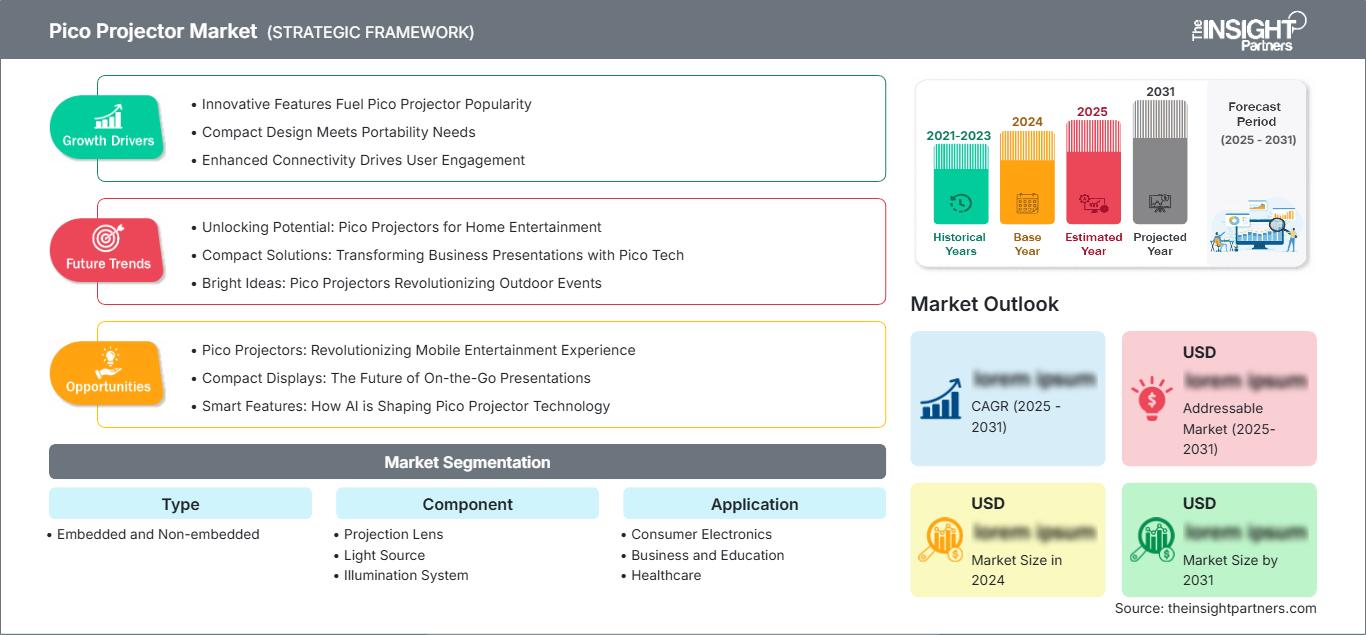
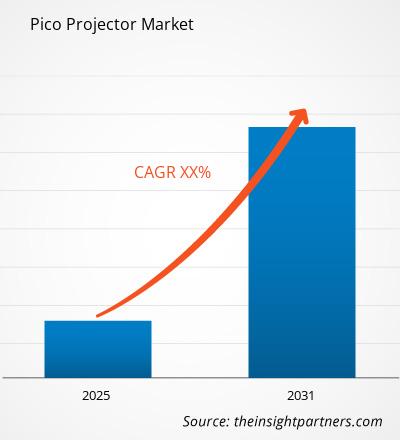
The Pico projector market is valued at US$ 7.79 Billion in 2025 and is projected to reach US$ 39.68 Billion by 2034, expanding at a CAGR of 19.82% during 2026–2034. These capabilities are extending projection beyond traditional presentation equipment toward mobile entertainment, education, healthcare visualization, and embedded display applications. Compact optical architectures, efficient illumination, wireless connectivity, and battery operation are supporting broader adoption across increasingly mobile visual communication environments.
North America remains a major adoption center, supported by mature consumer electronics channels, enterprise digitization, and demand for flexible visual communication. The pico projector market size is influenced by portable home entertainment, hybrid workplace presentations, classroom technology, and specialized visualization requirements. Regional suppliers are emphasizing autofocus, automatic keystone correction, streaming compatibility, compact industrial design, and energy-efficient light sources to improve usability in mobile environments.
Pico Projector Market Assessment and Insights
- North America: North America is estimated to hold a 32–35% share in 2025 and grow at 18–21% CAGR between 2026–2034. The pico projector market share reflects strong connected-device penetration, portable entertainment demand, enterprise mobility, and established distribution infrastructure.
- US: The US represents approximately 72–76% of North America's 2025 regional market and is expected to expand at 18–21% CAGR between 2026–2034, supported by consumer electronics, business presentation, education, and specialized applications.
- Europe: Europe is estimated at 23–25% share in 2025 and 17–20% CAGR between 2026–2034, with Germany, the UK, France, Italy, and Spain supporting demand through education, enterprise collaboration, hospitality, and home entertainment.
- Asia Pacific: Asia Pacific is estimated to account for 30–32% share in 2025 and expand at 21–24% CAGR between 2026–2034. China, Japan, South Korea, and India provide strong electronics manufacturing, component availability, and consumer adoption foundations.
- Largest Segment: Non-embedded products are estimated at 68–72% market share in 2025, growing at 18–21% CAGR between 2026–2034, reflecting portable entertainment and presentation demand.
- High Growth Segment: Healthcare applications are estimated at 7–10% share in 2025, advancing at 22–26% CAGR between 2026–2034 as compact visualization gains specialized use.
- Key companies analyzed in detail: AAXA Technologies Limited, Celluon Inc., Koninklijke Philips N.V., LG Electronics Inc., Optoma Technology Inc., Sony Corporation, Syndiant, Texas Instruments Incorporated, ZTE Corporation, and ViewSonic Corporation.
Source: The Insight Partners' analysis based on proprietary research, government publications, company annual reports, investor presentations, industry databases, and expert interviews.
Market for pico projectors has developed from simple miniature projection systems to compact digital display devices using advanced resolution, illumination, wireless connections, battery-powered operation and automatic image correction technology. Miniaturization of semiconductors resulted in decreasing size of the optical engine along with better performance in terms of power consumption. LED and laser illumination ensure increased durability and design freedom while electronics integration simplifies the architecture. Accordingly, production of compact modules, which can be integrated in an ever-widening variety of devices, has become possible.
As for the future perspectives, the emphasis will probably be put on image adjustment technologies, visualization, low-power operation and application-specific optics. The emerging market in Asia and in other developing countries may take advantage of cheaper components and growing electronics distribution. Meanwhile, funding is being attracted to software-based projection and connectivity. Energy efficiency and sustainability of electronic products will likely make an impact on regulation and hence promote efficient light engines and longer service life.
Pico Projector Market Report Scope
| Report Attribute | Details |
|---|---|
| Market size in 2025 | US$ 7.79 Billion |
| Market Size by 2034 | US$ 39.68 Billion |
| Global CAGR (2026 - 2034) | 19.82% |
| Historical Data | 2021-2024 |
| Forecast period | 2026-2034 |
Pico Projector Market Analysis
Market expansion for pico projectors results from convergent development in areas of miniature optics, semiconductor display technology, efficient light sources, batteries, connectivity, and mobile computing. Users that require large image projections without permanent installation are driving market growth, such as temporary presentations, entertainment, classes, and visualization needs. Products include display units, projection lenses, illumination systems, controllers, power management parts, software, optical engines, final assembly, distribution, and post-sales services.
Increasing supply-side tendencies support modular optical engines and standard electronic components, which could accelerate product development time. Providers of components have to achieve an optimal combination between brightness, contrast, resolution, thermal properties, sound generation, and energy consumption in limited space. Manufacturers of products distinguish themselves with industrial design, operating systems, connectivity, automatic focusing, keystoning adjustment, battery life, and compatibility with different kinds of content. The market moves from standalone hardware to connected visual platforms, enabling product providers to serve several applications by similar optical and electronic technologies.
Competitors include projector makers, consumer electronics players, semiconductor makers, and specialized pico projector developers. AAXA Technologies Limited and Celluon Inc. stand for compact projector specialization, while Koninklijke Philips N.V., LG Electronics Inc., Optoma Technology Inc., and Sony Corporation have more imaging and consumer electronics capabilities. Texas Instruments Incorporated is an important competitor at the components level thanks to its DLP technology. Additionally, Syndiant, ZTE Corporation, and ViewSonic Corporation provide relevant technologies and products in specialized or adjacent projection.
Analysis of pico projectors market shows that a key competitive factor is integration of optics with software and connectivity and not just miniaturization of a projector. The companies look into development of laser and LED illumination, higher resolution optics, smart operating systems, wireless projection, USB-C connection, and auto setup. Investments are made in embedded projects where a projector becomes a part of another product. Such strategy increases addressable demand in consumer electronics, business machines, education, health care systems, signs, and specialized industrial visualization.
● REPORT CUSTOMIZATION
Tailor This Report To Align With Your Specific Business Requirements
This report can be customized to align precisely with your business objectives, scope, and target markets. Customization options include tailored segmentation, geography, competitive analysis, and strategic insights to support informed decision-making.
Customize This Report →WHAT YOU CAN ADJUST
- ● Segmentations
- ● Geography
- ● Competitive Analysis
- ● Language Preferences
Pico Projector Market: Strategic Insights
Regional Insights
North America Pico projector market
North America is projected to be the 32-35% of the global share in 2025 with the CAGR of 18-21% for the period 2026-2034. US is the leading market due to good household connectivity, adoption of enterprise tech procurement, and widespread acceptance of portable consumer electronics. Contributions from Canada include education, small business presentation and home entertainment uses.
Streaming, working remotely, and mobile presentation play their roles in driving regional demand as well. In order to create traction for suppliers, it is necessary to merge projection with wireless casting, USB-C, built-in sound, and image auto-correction. The retail distribution channel prefers easy installation and ecosystem compatibility, while the corporate segment values reliability and connectivity. Technology growth will be driven in North America, with new opportunities appearing thanks to specialized solutions and embedded software.”
U.S. Pico projector Market
The United States is expected to hold a share of 72-76% in 2025 and grow at 18-21% CAGR up to 2034. The applications include home entertainment, presentation in businesses, learning and visualizing, while purchasers pay attention to portability, wirelessness, brightness, and simplicity of installation. Among major competitors in the segment of projection and display, there are LG Electronics Inc., Sony Corporation, Optoma Technology Inc., and ViewSonic Corporation.
Mobile solutions in enterprises and hybrid learning can support demand for portable equipment that can be used in different rooms. Consumer preference is defined by ability to work with streamed content, intelligent interface, automatic focus and compact speakers. The segment of healthcare and professional visualization is still niche one, but strategic for projections, as projection allows flexible visualization, where it is hard to use fixed panels.
Europe Pico projector Market
In 2025, Europe accounts for 23-25% market share and has a CAGR of 17-20% up to 2034. The region is an important regional market with Germany being the largest regional market, followed by the UK and France and Italy and Spain as secondary markets with applications in education, hospitality, home entertainment, and small business uses.
The UK has applications in flexible workspace technology, education, and home theater. In Germany, there are applications in industrial technology and business presentations. France is characterized by applications in education, culture, and consumer use cases. Italy and Spain provide applications in hospitality, retail, household entertainment, and mobile business applications. In Europe, environmental issues may determine product choice and components design due to their importance.
APAC Pico projector Market
The share for APAC is forecast to be 30-32% by 2025 and increase at 21-24% CAGR until 2034, thus being the leader among regions in terms of growth. China is likely to take the leading position owing to electronics production, component availability, and internal consumption demand. Advanced imaging and electronics production capabilities in Japan and South Korea complement India's contribution through opportunities in education, business mobility, and family entertainment segments.
Advanced manufacturing allows for the access to the supply chain of optical, semiconductor, battery, and connectivity components. Government-sponsored digital education and increased electronics penetration can boost demand in India and other developing countries. APAC should continue to play an important role in product development and manufacturing.
Middle East & Africa Pico projector Market
Middle East and Africa is estimated to account for 10–13% of global share in 2025 and expand at 16–20% CAGR through 2034. Saudi Arabia and the UAE provide leading demand through hospitality, entertainment, education, and infrastructure development, while South Africa represents an important market for business and educational applications. Rest of MEA demand remains more fragmented and price sensitive.
Infrastructure projects on a large scale, tourism, and learning through technology form examples of applications that call for a need for visual communication systems that have flexibility. The use of portable projectors is an example of devices that can be used in locations where fixed display screens are hard to install. Issues such as energy efficiency, connectivity, and after-sales support are important when making purchases.
Segmentation Analysis
Type
The pico projector market scope spans Type segmentation comprising Embedded and Non-embedded products. The type segment is expected to expand at 19–22% CAGR during 2026–2034. Non-embedded products maintain the larger position because they address portable entertainment, presentations, education, and temporary visualization. Embedded systems are gaining importance as manufacturers explore projection within smart appliances, mobile equipment, wearables, and specialized displays.
- Embedded: Embedded projection supports products requiring large visual output from compact hardware. Integration can reduce dependence on conventional panels and create differentiated interfaces, although optical alignment, thermal management, power consumption, and mechanical integration remain important engineering considerations.
- Non-embedded: Non-embedded systems remain widely applicable because users can transport, install, and reposition them independently. Demand is supported by home entertainment, business presentations, classrooms, travel, and temporary display requirements where flexibility is more important than permanent installation.
Component
Component segmentation covers Projection Lens, Light Source, and Illumination System. The component segment is projected to grow at 18–22% CAGR during 2026–2034 as manufacturers seek better optical efficiency, brightness, resolution, thermal performance, and operating life. Component selection increasingly influences image quality, battery endurance, enclosure size, and reliability.
- Projection Lens: Projection lenses determine optical efficiency, throw characteristics, focus performance, and image uniformity. Compact lens designs are strategically important because manufacturers must achieve usable image sizes while keeping projector dimensions small and maintaining consistent sharpness.
- Light Source: Light sources influence brightness, power consumption, operating life, color performance, and thermal requirements. LED solutions remain important for compact systems, while laser-based architectures provide opportunities for higher brightness, efficiency, and longer operating life.
- Illumination System: Illumination systems coordinate light delivery, color management, thermal control, and optical efficiency. Advanced architectures can improve brightness consistency and color output while reducing energy losses, supporting longer operation in battery-powered and embedded products.
Application
Application segmentation includes Consumer Electronics, Business and Education, and Healthcare. The application segment is expected to grow at 20–24% CAGR during 2026–2034. Consumer electronics provides the broadest opportunity, while business and education benefit from mobile presentation requirements. Healthcare is expected to expand faster from a smaller base as specialized visualization systems seek compact projection capabilities.
- Consumer Electronics: Consumer applications include portable entertainment, home viewing, gaming, mobile content sharing, and smart-device integration. Buyers prioritize simple setup, streaming compatibility, image quality, compact dimensions, battery operation, and attractive industrial design.
- Business and Education: Business and education users value mobility, quick deployment, wireless presentation, collaboration, and adaptable room configurations. Portable projection can support classrooms, meeting rooms, training environments, field presentations, and temporary facilities where fixed displays are inconvenient.
- Healthcare: Healthcare applications can use compact projection for visualization, education, training, patient communication, and specialized equipment interfaces. Adoption depends strongly on image clarity, reliability, cleanable surfaces, system integration, and application-specific validation requirements.
Opportunity Snapshot
| Application | Revenue Contribution | Trend Tag | Adoption Stage |
| Consumer Electronics | High | Smart Entertainment | Scaling |
| Business and Education | Medium | Mobile Presentation | Scaling |
| Healthcare | Low | Clinical Visualization | Emerging |
Pico Projector Market Growth Drivers and Impact Analysis
Expansion of portable and screen-flexible visual communication
Portable computing and flexible work environments are increasing the value of displays that can be moved between locations without fixed mounting. Compact projection systems can transform walls, tables, screens, or other surfaces into temporary visual interfaces, supporting meetings, classrooms, entertainment, and field activities. This flexibility can reduce installation constraints and make projection attractive where room layouts change frequently. Manufacturers that solve these constraints can differentiate products through ease of deployment rather than specifications alone. As users become more comfortable with wireless casting and automated image correction, setup friction should decline, strengthening adoption in environments where traditional displays are less convenient.
Advances in miniature optical and semiconductor architectures
Improvements in display chips, controllers, optical modules, and power-management components are expanding what can be achieved within compact projector enclosures. Semiconductor suppliers increasingly provide integrated solutions that address display control, illumination, power conversion, and software interfaces, reducing the engineering burden for system developers. Higher-resolution architectures also allow manufacturers to position compact projectors as credible alternatives for selected large-image applications. Better optical efficiency can reduce thermal load, improved power management can extend battery operation, and smarter control algorithms can simplify calibration. These improvements encourage thinner, lighter, quieter, and more connected products while widening applications suitable for miniature projection.
Growth of embedded visualization across connected devices
Embedding projection into larger products can create new demand that is not dependent on conventional projector replacement cycles. Smart appliances, portable equipment, interactive devices, specialized instruments, and other connected systems can use projection to provide temporary or large-format visual information without requiring a permanent panel. For manufacturers, embedded designs can create differentiation and potentially increase the value of compact projection technology within broader systems. However, success depends on managing power, heat, mechanical alignment, user safety, and long-term component availability during product development.
Pico Projector Market Future Trends
Intelligent projection with automated setup and adaptive imaging
Future products are expected to increasingly incorporate intelligent functions that automate focus, keystone correction, screen alignment, brightness adjustment, and image optimization. These capabilities can make compact projectors easier to use in bedrooms, classrooms, meeting rooms, and temporary locations where surfaces and viewing angles vary. Software will become a more important differentiator, reflecting pico projector market trends in intelligent setup, as manufacturers combine sensors, processors, wireless interfaces, and optical control. Adaptive algorithms can also help balance image quality with power consumption, particularly in battery-operated systems. Such functionality can reduce the perception that projection requires more setup than conventional displays.
Projection engines integrated into smart and mobile ecosystems
A second trend is the integration of projection engines into connected products rather than treating the projector as an isolated device. Manufacturers can use compact optical modules alongside mobile operating systems, voice interfaces, wireless connectivity, cameras, sensors, and cloud services to create interactive visual experiences. Smart-home devices could provide temporary information displays, while portable computers and specialized equipment could use projection for collaboration or contextual information. This direction creates opportunities for component suppliers because demand may arise from multiple product categories. It also increases requirements for software compatibility, cybersecurity, power management, thermal control, and long-term component support.
Pico Projector Market Opportunities
Application-specific optical modules for healthcare and professional equipment
Healthcare and professional equipment manufacturers represent an opportunity for suppliers capable of developing application-specific projection modules. These customers may prioritize reliability, controlled brightness, compact integration, cleanable surfaces, stable color output, and predictable component availability over consumer-oriented styling. Vendors can create differentiated value through customized optical engines, rugged housings, thermal solutions, and software interfaces designed around particular equipment requirements. The opportunity is attractive because specialized products can command stronger engineering value than standardized consumer devices, although validation cycles may be longer. Partnerships with equipment manufacturers can help projection specialists understand workflow requirements and design modules that fit existing architectures. Investment should focus on modular platforms that can be adapted across several professional applications while maintaining consistent component interfaces and production economics.
Embedded projection platforms for consumer electronics manufacturers
The pico projector market Forecasts point to embedded projection as consumer electronics companies use it to add large-format visualization to products where conventional screens are constrained by size, shape, or power requirements. Suppliers can pursue partnerships with manufacturers of smart-home equipment, portable devices, appliances, gaming products, and connected accessories. Pico projector market Forecasts indicate that a modular projection platform can shorten development time by combining an optical engine, display controller, illumination system, and power-management architecture into a configurable package. Vendors should prioritize scalable architectures supporting different resolutions and illumination configurations without redesigning the complete system.
Frequently Asked Questions

- Comprehensive Market Sizing and Forecast Analysis
- Detailed Segmentation Analysis
- In-Depth Market Dynamics Assessment
- Regional and Country-Level Insights
- Competitive Landscape and Company Benchmarking
- Strategic Business Intelligence
Recent Reports
Testimonials

The Insight Partners provided valuable market intelligence that supported our global go-to-market strategy. Their team was professional, responsive, and attentive to our feedback, providing thoughtful analysis and helpful methodological clarifications throughout the project.
Junmo Kim Chief Financial Officer (CFO), Enertech Co., Ltd.
The Insight Partners' SCADA System Market report is comprehensive, with valuable insights on current trends and future forecasts. The team was highly professional, responsive, and supportive throughout. We are very satisfied and highly recommend their services.
RAN KEDEM Partner, Reali Technologies LTDs
I requested a report on a very specific software market and the team produced the report in a few days. The information was very relevant and well presented. I then requested some changes and additions to the report. The team was again very responsive and I got the final report in less than a week.
JEAN-HERVE JENN Chairman, Future Analytica
We worked with The Insight Partners for an important market study and forecast. They gave us clear insights into opportunities and risks, which helped shape our plans. Their research was easy to use and based on solid data. It helped us make smart, confident decisions. We highly recommend them.
PIYUSH NAGPAL Sr. Vice President, High Beam Global
The Insight Partners delivered insightful, well-structured market research with strong domain expertise. Their team was professional and responsive throughout. The user-friendly website made accessing industry reports seamless. We highly recommend them for reliable, high-quality research services
YUKIHIKO ADACHI CEO, Deep Blue, LLC.
This is the first time I have purchased a market report from The Insight Partners.While I was unsure at first, I visited their web site and felt more comfortable to take the risk and purchase a market report.I am completely satisfied with the quality of the report and customer service. I had several questions and comments with the initial report, but after a couple of dialogs over email with their analyst I believe I have a report that I can use as input to our strategic planning process.Thank you so much for taking the extra time and making this a positive experience.I will definitely recommend your service to others and you will be my first call when we need further market data.
JOHN SUZUKI President and Chief Executive Officer, Board Director, BK Technologies
I wish to appreciate your support and the professionalism you displayed in the course of attending to my request for information regarding to infectious disease IVD market in Nigeria. I appreciate your patience, your guidance, and the fact that you were willing to offer a discount, which eventually made it possible for us to close a deal. I look forward to engaging The Insight Partners in the future, all thanks to the impression you have created in me as a result of this first encounter.
DR CHIJIOKE ONYIA MANAGING DIRECTOR, PineCrest Healthcare Ltd.Reason to Buy
- Informed Decision-Making
- Understanding Market Dynamics
- Competitive Analysis
- Identifying Emerging Markets
- Customer Insights
- Market Forecasts
- Risk Mitigation
- Boosting Operational Efficiency
- Strategic Planning
- Investment Justification
- Tracking Industry Innovations
- Aligning with Regulatory Trends





 Get Free Sample for