
Polymers In Medical Devices Market Trends, Demand & Growth by 2034
Coverage: By Product (PS, PP, PVC); End users/Applications (Implants, Medical Bags and Pouches, Medical Tubing), and Geography (North America, Europe, Asia Pacific, and South and Central America)
- Status : Data Released
- Report Code : TIPRE00014639
- Category : Chemicals and Materials
- No. of Pages : 150
- Available Report Formats :


- Last update date : July 08, 2026


2025 Market Size
US$ 2.54 Bn
Base year value
2034 Forecast
US$ 4.28 Bn
Projected by 2034
CAGR 2026-2034
5.99 %
Growth rate
Addressable Market
US$ 30.92 Bn
(2026-2034)
The polymers in medical devices market size was valued at US$ 2.54 billion in 2025 and is projected to reach US$ 4.28 billion by 2034, expanding at a CAGR of 5.99% during 2026–2034. Market expansion is supported by the increasing integration of advanced polymer materials into medical devices requiring durability, lightweight construction, chemical resistance, and biocompatibility. Continuous product innovation and expanding healthcare infrastructure are further encouraging the adoption of high-performance polymers across a broad range of medical applications.
North America is expected to maintain its leadership throughout the forecast period, registering an estimated CAGR of 5.4–5.8%. Growth is supported by strong investments in medical technology innovation, favorable regulatory pathways for advanced medical devices, and increasing demand for minimally invasive procedures. The region also benefits from a mature polymer manufacturing ecosystem, robust research collaborations, and continuous replacement of conventional materials with specialized medical-grade polymers, reflecting polymers in medical devices market trends.
Polymers In Medical Devices Market Assessment and Insights
- North America: North America accounted for 34–38% of the polymers in medical devices market share in 2025 and is anticipated to expand at a CAGR of 5.4–5.8% during 2026–2034. A strong medical manufacturing ecosystem, increasing demand for advanced implantable and disposable healthcare products, and continued innovation in medical-grade polymers are expected to support sustained regional market growth.
- U.S.: The U.S. represented 82–86% of the North American market in 2025 and is projected to register a CAGR of 5.5–5.9% during 2026–2034, driven by expanding medical device manufacturing, growing healthcare investments, and rising adoption of high-performance polymer materials.
- Europe: Europe held 26–30% polymers in medical devices market share in 2025 and is expected to grow at a CAGR of 5.2–5.6% during 2026–2034. Germany, the United Kingdom, and France remain leading markets, supported by advanced healthcare manufacturing, strong polymer innovation capabilities, and increasing production of medical devices.
- Asia Pacific: Asia Pacific accounted for 24–28% market share in 2025 and is forecast to expand at a CAGR of 6.8–7.2% during 2026–2034. China, Japan, and India continue to lead regional demand, driven by expanding healthcare investments, growing domestic production, and increasing medical device manufacturing.
- Largest Segment: Medical Tubing represented the largest market segment and is expected to record a CAGR of 5.8–6.2% during 2026–2034, reflecting rising utilization across infusion systems, catheters, respiratory devices, and minimally invasive treatment procedures.
- High Growth Segment: Implants is projected to grow at a CAGR of 6.6–7.0% during 2026–2034, driven by increasing preference for biocompatible, lightweight, and durable polymer-based implant materials across a broad range of medical applications.
- Key companies analyzed in detail: BASF SE; Bayer AG; Dow Inc.; DSM-Firmenich AG; DuPont de Nemours, Inc.; Eastman Chemical Company; Evonik Industries AG; Kraton Corporation; Shanghai New Shanghua Polymer Materials Co., Ltd.; Solvay SA.
Source: The Insight Partners' analysis based on proprietary research, government publications, company annual reports, investor presentations, industry databases, and expert interviews.
Innovations in polymer chemistry have led to revolutionary changes in the manufacturing of medical devices, making them lightweight, more resilient, and more biocompatible. Modern companies are actively using specialized thermoplastics and other polymer materials to replace conventional materials across various areas of healthcare.
The polymers in medical devices market forecast indicates that the future looks promising due to increasing investment in advanced diagnostics, minimally invasive surgery, and customized solutions. Manufacturing facilities in Asia and the Middle East are becoming attractive due to improvements in healthcare infrastructure and local manufacturing capabilities. The focus on patient safety, sustainable manufacturing processes, and biomaterial innovation can drive product development and create business opportunities in developed and developing healthcare markets.
Polymers In Medical Devices Market Report Scope
| Report Attribute | Details |
|---|---|
| Market size in 2025 | US$ 2.54 Billion |
| Market Size by 2034 | US$ 4.28 Billion |
| Global CAGR (2026 - 2034) | 5.99% |
| Historical Data | 2021-2024 |
| Forecast period | 2026-2034 |
Polymers In Medical Devices Market Analysis
The increasing use of medical devices based on polymer materials is mainly facilitated by the growing need for light-weight, durable, and biocompatible materials that help in improving patient care and at the same time, promote cost-efficient manufacturing. Polymers used in medicine such as polystyrene (PS), polypropylene (PP), and polyvinyl chloride (PVC) remain important in disposable and reusable healthcare applications due to their sterilization capability, chemical resistance, and design flexibility. The rising costs of healthcare services, hospital capacity, and infection control efforts are other factors driving demand in developed and emerging economies.
The business environment includes resin makers, compounding companies, medical device manufacturers, contract manufacturers, hospitals, and regulating bodies collaborating to provide quality assurance and compliance of products. The presence of stable supplies of raw materials, investments into polymer processing techniques, and the local production of medical devices contribute to supply chain robustness. Meanwhile, more stringent quality requirements motivate innovations in polymer materials to satisfy ever-evolving clinical and sustainability needs.
Competition within the polymers in medical devices market is characterized by continuous material innovation, strategic partnerships, and investments in specialized medical-grade product portfolios. BASF SE, Dow Inc., DuPont de Nemours, Inc., Evonik Industries AG, and Eastman Chemical Company continue to strengthen their positions through advanced polymer technologies that address demanding medical applications. Companies increasingly differentiate themselves by developing high-performance materials with enhanced durability, biocompatibility, sterilization resistance, and regulatory compliance.
According to the polymers in medical devices market report, key players are expanding regional manufacturing capacity while collaborating with medical device manufacturers to accelerate product development. DSM-Firmenich AG, Bayer AG, Solvay SA, Kraton Corporation, and Shanghai New Shanghua Polymer Materials Co., Ltd. are pursuing investments in specialty materials, technical support capabilities, and application-specific innovations. These strategic initiatives improve customer engagement, shorten product development cycles, and strengthen long-term competitiveness as healthcare providers seek increasingly sophisticated polymer solutions.
● REPORT CUSTOMIZATION
Tailor This Report To Align With Your Specific Business Requirements
This report can be customized to align precisely with your business objectives, scope, and target markets. Customization options include tailored segmentation, geography, competitive analysis, and strategic insights to support informed decision-making.
Customize This Report →WHAT YOU CAN ADJUST
- ● Segmentations
- ● Geography
- ● Competitive Analysis
- ● Language Preferences
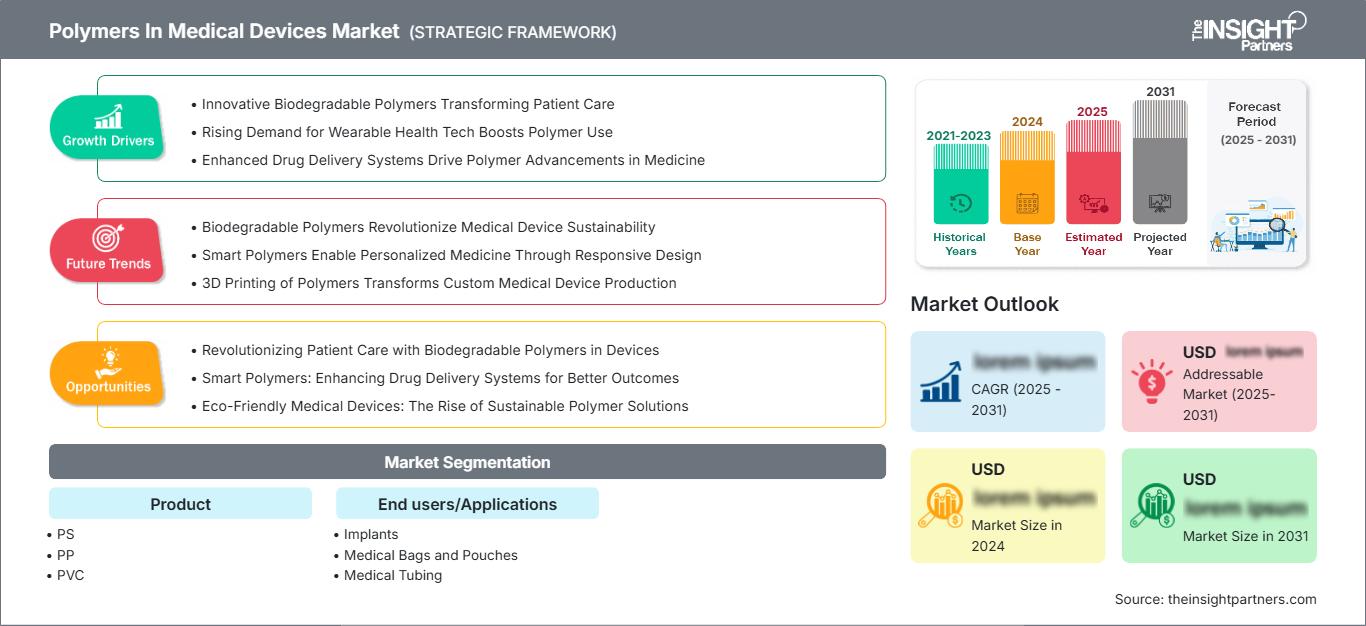
Polymers In Medical Devices Market: Strategic Insights
Regional Insights
North America Polymers in Medical Devices Market
North America accounted for 34–38% of the global polymers in medical devices market in 2025 and is projected to expand at a CAGR of 5.4–5.8% through 2034. Strong healthcare spending, advanced medical manufacturing capabilities, and continuous innovation in polymer materials support sustained regional demand across numerous healthcare applications.
The region also benefits from a well-established regulatory framework, significant research investments, and close collaboration between polymer suppliers and medical device manufacturers. Increasing adoption of minimally invasive procedures and single-use medical products continues to reinforce long-term market expansion.
U.S. Polymers in Medical Devices Market
The United States represented 82–86% of the North American market in 2025 and is anticipated to record a CAGR of 5.5–5.9% during the forecast period. Extensive manufacturing capacity and a strong concentration of global polymer suppliers contribute to market leadership.
Growing demand for implantable devices, medical tubing, diagnostic equipment, and disposable healthcare products continues to encourage innovation. The presence of major industry participants, advanced research institutions, and favorable commercialization capabilities further strengthens the country's competitive position within the regional market.
Europe Polymers in Medical Devices Market
Europe held 26–30% of the global market in 2025 and is expected to grow at a CAGR of 5.2–5.6% through 2034. The region benefits from established healthcare systems, sophisticated polymer processing capabilities, and strong regulatory standards promoting high-quality medical products.
Investments in technological innovations in medicine, digital healthcare, and advanced polymer technologies continue growing in the UK. Increasing cooperation among academic institutions, healthcare institutions, and producers contributes to the development and commercialization of new polymer products for innovative medical devices.
Germany remains the leading European market due to its well-developed medical device production industry, engineering capabilities, and industrial facilities. Investments in precise production, automation, and high-performance polymers ensure Germany's dominance in the market.
France, Italy, and Spain collectively contribute to regional expansion by modernizing healthcare facilities, increasing the manufacturing of disposable medical items, and driving higher demand for more advanced polymer products. Investments in medical technology continue to drive market development in Southern Europe.
APAC Polymers in Medical Devices Market
Asia Pacific represented 24–28% of the global market in 2025 and is forecast to register the fastest regional growth with a CAGR of 6.8–7.2%. Expanding healthcare infrastructure, rising domestic medical device production, and increasing investments in advanced polymer processing drive regional momentum.
China leads regional demand through its extensive manufacturing ecosystem and expanding healthcare sector. Japan maintains strong adoption of high-performance medical materials supported by technological innovation, while South Korea continues strengthening medical manufacturing capabilities through advanced production technologies.
India is emerging as a significant growth market owing to expanding healthcare access, increasing domestic manufacturing, and supportive industrial initiatives. Australia contributes through high healthcare standards, research-driven innovation, and growing demand for advanced polymer-based medical products across specialized clinical applications.
Middle East & Africa Polymers in Medical Devices Market
The Middle East & Africa polymers in medical devices market is projected to expand at a CAGR of 5.9–6.3% during the forecast period. Healthcare modernization initiatives, increasing investments in domestic medical manufacturing, and expanding hospital infrastructure are supporting gradual adoption of advanced polymer materials across the region.
Saudi Arabia is capitalizing on regional growth by diversifying into healthcare programs and investing in medical manufacturing. The United Arab Emirates is continually advancing its innovations in the healthcare industry, while South Africa is an essential market for medical devices due to its established healthcare infrastructure and industries. In the Rest of the Middle East & Africa, there is growing adoption of polymer-based medical products, driven by investments in healthcare accessibility and manufacturing.
Segmentation Analysis
Product
The Product segment forms the material foundation of the polymers in medical devices market, with demand driven by the need for reliable, sterilization-compatible, and biocompatible materials. Continuous innovation in medical-grade polymer formulations supports improved device performance while addressing increasingly stringent regulatory and clinical requirements. The product segment is projected to grow at a CAGR of 5.9–6.3% during 2026–2034, supported by expanding applications across disposable and implantable medical devices.
- PS (Polystyrene): Widely utilized in diagnostic components, laboratory consumables, specimen containers, and disposable medical equipment due to its excellent dimensional stability, optical clarity, ease of processing, and cost-effective manufacturing for high-volume healthcare applications.
- PP (Polypropylene): Increasingly adopted for syringes, medical containers, instrument components, and reusable healthcare products because of its outstanding chemical resistance, lightweight characteristics, sterilization compatibility, and mechanical durability across diverse clinical environments.
- PVC (Polyvinyl Chloride): Maintains strong demand in medical tubing, blood bags, fluid delivery systems, and oxygen masks owing to its flexibility, transparency, processability, and ability to meet stringent performance requirements for critical healthcare applications.
End Users/Applications
Demand across medical applications continues to increase as healthcare providers prioritize safer, lightweight, and high-performance polymer-based devices that improve patient care while reducing manufacturing complexity and lifecycle costs.
- Implants: Rapid adoption of advanced polymer materials in orthopedic, cardiovascular, spinal, and dental implants is supported by excellent biocompatibility, mechanical strength, reduced weight, and long-term performance in demanding clinical environments.
- Medical Bags and Pouches: Medical-grade polymers are extensively used in blood storage bags, intravenous solution bags, pharmaceutical packaging, and sterile medical pouches because they provide flexibility, durability, contamination resistance, and efficient sterilization compatibility.
- Medical Tubing: Representing the largest application segment, medical tubing benefits from widespread use in catheters, infusion systems, respiratory devices, dialysis equipment, and fluid management systems requiring flexibility, chemical resistance, and consistent clinical performance.
Opportunity Snapshot
| Segment Name | Revenue Contribution | Trend Tag | Adoption Stage |
| Implants | Medium | Bioengineered Materials | Scaling |
| Medical Bags and Pouches | Medium | Sterile Packaging | Mature |
| Medical Tubing | High | Minimally Invasive | Mature |
Polymers In Medical Devices Market Growth Drivers and Impact Analysis
Growing Demand for Minimally Invasive Medical Procedures
The increasing inclination toward minimally invasive procedures is driving demand for advanced polymer materials used in the manufacture of catheters, guidewires, delivery devices, and medical tubing. There is a need for polymers with superior strength and durability, along with good biocompatibility, to ensure consistent mechanical properties and patient comfort. The manufacturers of such polymers are continually working on new grades with improved features such as flexibility and sterilization. With the growing use of minimally invasive technology by hospitals and ambulatory care centers, demand for high-end medical polymers is expected to rise, thereby contributing to polymers in medical devices market growth in the coming years.
Expansion of Global Healthcare Infrastructure and Medical Manufacturing
Rapid healthcare infrastructure development in emerging economies is increasing demand for polymer-based medical devices. There are ongoing efforts by governments and private establishments to develop facilities and medical manufacturing facilities to enhance their healthcare delivery capacity. All these developments are leading to increased demand for medical polymers used in manufacturing tubes, packaging materials, implants, and disposable healthcare products. Regional manufacturing plants are being developed to make them more resilient and less dependent on imports of these materials.
Continuous Innovation in High-Performance Medical-Grade Polymers
Polymer companies are focused on developing materials with increased strength, chemical resistance, sterilization suitability, and biocompatibility. Technological advancements in polymer production enable companies to replace traditional materials with lighter, stronger ones that support the development of complex medical devices. Research in this area aims to develop more sustainable, efficient, and reliable products in accordance with new regulations that will be set worldwide.
Polymers In Medical Devices Market Future Trends
Growing Adoption of Sustainable and Recyclable Medical Polymers
Sustainability is gaining ground as a significant consideration in material selection within the medical devices industry. Companies are developing materials that are either recyclable, bio-derived, or less carbon-intensive polymers, which not only align with the environmental vision but also do not compromise the effectiveness and safety of medical equipment. Because of advances in materials engineering, the healthcare sector can minimize waste from single-use medical devices without sacrificing equipment performance. As hospitals implement sustainable policies and governments encourage manufacturers to adopt better production practices, demand for sustainable medical polymers will increase.
Expansion of Customized Polymer Solutions for Advanced Medical Devices
Developers of medical devices are increasingly seeking customized polymer compositions that meet their specific clinical, mechanical, and manufacturing needs. In response, polymer producers are developing customized polymers that are flexible, strong, transparent, radiopaque, and chemically resistant. Digital design technology, precise molding processes, and collaborative product development are contributing to shorter timelines for customized polymer components. The effect of this is likely to be an even stronger partnership between polymer manufacturers and medical device manufacturers.
Polymers In Medical Devices Market Opportunities
Increasing Localization of Medical Device Manufacturing in Emerging Economies
Healthcare manufacturing is expanding rapidly across Asia, the Middle East, and selected Latin American countries as governments promote domestic production of critical medical equipment. This trend presents significant potential for polymer companies to set up production bases, technical centers, and regional supply chains. Polymer companies that can provide medical-grade polymer materials with assurance will be well-positioned, given the increasing procurement needs of local medical device manufacturers.
Development of Advanced Biomaterials for Implantable Medical Devices
The demand for implants that deliver better clinical performance will continue to generate business opportunities for companies focusing on advanced polymer materials. Novel biomaterials capable of controlled degradation, improved tissue compatibility, and better mechanical properties will draw the attention of researchers and commercial investors. Manufacturers that focus on developing new polymer materials for applications in orthopedics, cardiology, neurology, and dentistry will gain a competitive edge through their unique products. The continued cooperation among materials scientists, medical practitioners, and medical device manufacturers is likely to accelerate the development of high-tech implants.
Recent Developments
- July 2025: Evonik Industries AG announced a strategic distribution agreement with IMCD for its RESOMER® bioresorbable medical device polymers across Europe. The partnership expands customer access to implantable medical-device polymers and strengthens technical support for orthopedic, dental, tissue reconstruction, and 3D-printed medical applications.
- June 2025: DuPont de Nemours, Inc. expanded its healthcare manufacturing facility in Heredia, Costa Rica, adding sterile healthcare packaging production and increasing existing medical tubing manufacturing capacity. The expansion strengthens the company's global healthcare supply chain while supporting growing demand from the medical device industry across the Americas.
- April 2025: DuPont de Nemours, Inc. introduced Liveo™ Pharma TPE Ultra-Low Temp Tubing, a sterilizable thermoplastic elastomer tubing designed for low-temperature biopharmaceutical processing. The product expands the company's healthcare materials portfolio by offering improved durability, flexibility, and performance for demanding bioprocessing applications.
Frequently Asked Questions

- Comprehensive Market Sizing and Forecast Analysis
- Detailed Segmentation Analysis
- In-Depth Market Dynamics Assessment
- Regional and Country-Level Insights
- Competitive Landscape and Company Benchmarking
- Strategic Business Intelligence
Recent Reports
Testimonials

The Insight Partners' SCADA System Market report is comprehensive, with valuable insights on current trends and future forecasts. The team was highly professional, responsive, and supportive throughout. We are very satisfied and highly recommend their services.
RAN KEDEM Partner, Reali Technologies LTDs
I requested a report on a very specific software market and the team produced the report in a few days. The information was very relevant and well presented. I then requested some changes and additions to the report. The team was again very responsive and I got the final report in less than a week.
JEAN-HERVE JENN Chairman, Future Analytica
We worked with The Insight Partners for an important market study and forecast. They gave us clear insights into opportunities and risks, which helped shape our plans. Their research was easy to use and based on solid data. It helped us make smart, confident decisions. We highly recommend them.
PIYUSH NAGPAL Sr. Vice President, High Beam Global
The Insight Partners delivered insightful, well-structured market research with strong domain expertise. Their team was professional and responsive throughout. The user-friendly website made accessing industry reports seamless. We highly recommend them for reliable, high-quality research services
YUKIHIKO ADACHI CEO, Deep Blue, LLC.
This is the first time I have purchased a market report from The Insight Partners.While I was unsure at first, I visited their web site and felt more comfortable to take the risk and purchase a market report.I am completely satisfied with the quality of the report and customer service. I had several questions and comments with the initial report, but after a couple of dialogs over email with their analyst I believe I have a report that I can use as input to our strategic planning process.Thank you so much for taking the extra time and making this a positive experience.I will definitely recommend your service to others and you will be my first call when we need further market data.
JOHN SUZUKI President and Chief Executive Officer, Board Director, BK Technologies
I wish to appreciate your support and the professionalism you displayed in the course of attending to my request for information regarding to infectious disease IVD market in Nigeria. I appreciate your patience, your guidance, and the fact that you were willing to offer a discount, which eventually made it possible for us to close a deal. I look forward to engaging The Insight Partners in the future, all thanks to the impression you have created in me as a result of this first encounter.
DR CHIJIOKE ONYIA MANAGING DIRECTOR, PineCrest Healthcare Ltd.Reason to Buy
- Informed Decision-Making
- Understanding Market Dynamics
- Competitive Analysis
- Identifying Emerging Markets
- Customer Insights
- Market Forecasts
- Risk Mitigation
- Boosting Operational Efficiency
- Strategic Planning
- Investment Justification
- Tracking Industry Innovations
- Aligning with Regulatory Trends





 Get Free Sample for