
Postal Automation System Market Share, Demand & Growth by 2034
Coverage: By Technology (Culler Facer Cancellers, Letter Sorters, Flat Sorters, Mixed Mail Sorters, Parcel Sorters, Others); Application (Government Postal, Courier, Express and Parcel); Component (Software, Hardware, Services) , and Geography (North America, Europe, Asia Pacific, and South and Central America)
- Status : Data Released
- Report Code : TIPRE00004367
- Category : Electronics and Semiconductor
- No. of Pages : 150
- Available Report Formats :


- Last update date : October 15, 2026


2025 Market Size
US$ 957.2 Mn
Base year value
2034 Forecast
US$ 1,598.9 Mn
Projected by 2034
CAGR 2026-2034
5.87 %
Growth rate
Addressable Market
US$ 11,582.70 Mn
(2026-2034)
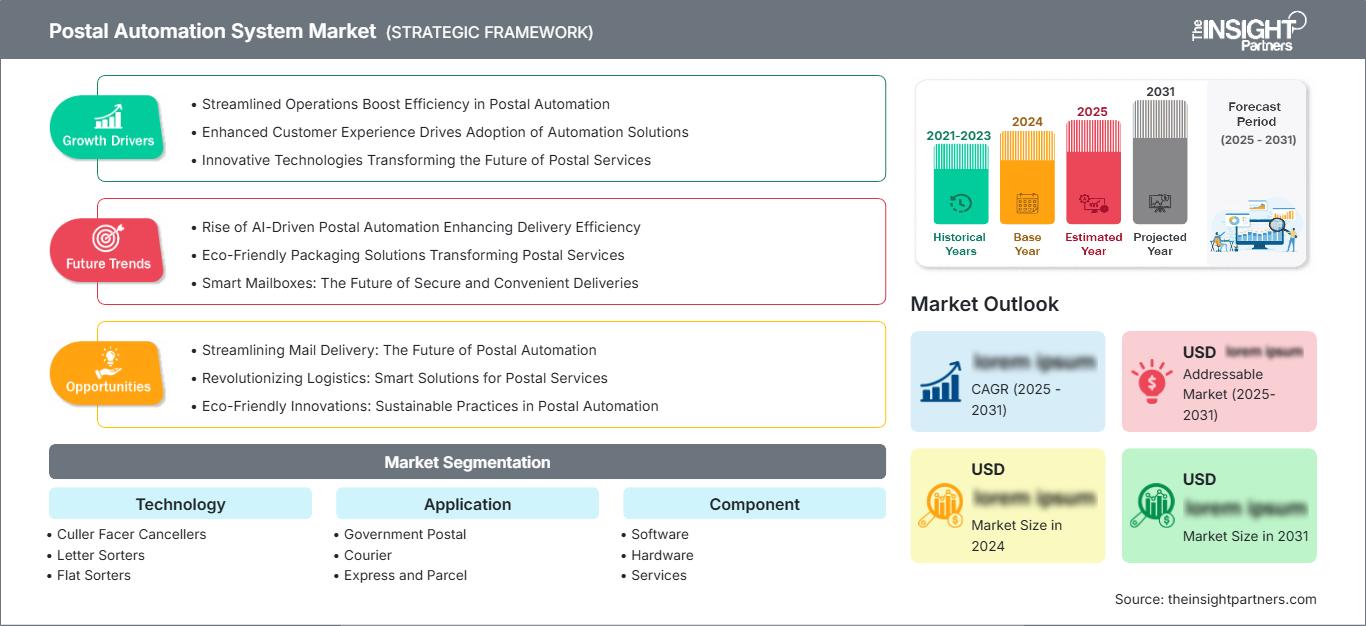
The postal automation system market is advancing steadily as postal operators and parcel logistics providers modernize processing infrastructure to manage rising shipment volumes and improve operational efficiency. The market was valued at US$ 957.2 Million in 2025 and is projected to reach US$ 1,598.9 Million by 2034, expanding at a CAGR of 5.87% during 2026–2034. Continued investments in intelligent sorting technologies, automated parcel handling, and digital mail processing are strengthening deployment across government postal networks and courier organizations worldwide.
North America continues to represent the leading regional ecosystem due to extensive automation investments by national postal agencies, mature courier networks, and sustained e-commerce activity. The postal automation system market size in the region is supported by advanced logistics infrastructure, increasing adoption of AI-enabled sorting technologies, and modernization initiatives by postal operators. The regional market is expected to expand at an estimated CAGR of 5.6–6.2% through 2034, supported by continued replacement of legacy sorting equipment and growing parcel throughput.
Postal Automation System Market Assessment and Insights
- North America: Maintained the leading position with an estimated 40–42% postal automation system market share in 2025 and is projected to grow at a CAGR of 5.6–6.2% during 2026–2034. Strong investments by postal agencies, high parcel volumes, and rapid deployment of AI-enabled sorting systems continue to support regional leadership.
- U.S.: Accounted for approximately 78–82% of the North American market in 2025 and is anticipated to register a CAGR of 5.7–6.3% through 2034, supported by USPS modernization and expanding private parcel delivery networks.
- Europe: Represented an estimated 27–30% market share in 2025 and is forecast to expand at a CAGR of 5.2–5.8%. Germany, France, the United Kingdom, and Italy continue investing in automated mail and parcel processing to improve delivery efficiency.
- Asia Pacific: Held approximately 22–25% of global revenue in 2025 and is expected to record the fastest regional expansion at a CAGR of 6.8–7.5%, led by China, Japan, India, and South Korea as parcel logistics infrastructure expands.
- Largest Segment: Parcel Sorters accounted for an estimated 34–38% market share in 2025 and are projected to grow at a CAGR of 6.3–6.9%, reflecting increasing parcel volumes generated by e-commerce and express delivery services.
- High Growth Segment: Courier, Express and Parcel applications represented approximately 45–49% market share in 2025 and are anticipated to expand at a CAGR of 6.5–7.2%, supported by cross-border commerce and same-day delivery expectations.
- Key companies analyzed in detail: BEUMER Group GmbH & Co. KG, Fives Group, Leonardo S.p.A., Lockheed Martin Corporation, NEC Corporation, Pitney Bowes Inc., SOLYSTIC SAS, Siemens AG, Toshiba Corporation, Vanderlande Industries B.V.
Source: The Insight Partners' analysis based on proprietary research, government publications, company annual reports, investor presentations, industry databases, and expert interviews.
The trend towards automation in the networks for postal services and parcels has shifted from basic mechanical devices to smart software-based platforms that can effectively process different mail flows. The innovations such as advanced optical character recognition (OCR), machine vision, artificial intelligence, robots, and predictive maintenance have increased efficiency while minimizing manual operations. At the same time, the operators use parcel sorters, letter sorters, and mixed mail sorting equipment in their logistics centers to handle increasing volumes of e-commerce parcels and delivery deadlines. The equipment providers are promoting system modularity, cloud monitoring, and energy-saving technologies which allow modernizing existing logistics centers by changing equipment only.
Future investments in postal modernization programs and digitalization will result in stable demand for advanced automated systems in the next decade. There are emerging markets in Asia Pacific, Middle East, and some Latin American states, where the capacities of parcel processing centers increase due to investments of both public and private sectors. Moreover, the regulatory emphasis on the efficiency and quality of operations will foster further automation. The integration of AI-based analytical tools, autonomous material handling systems, and digital twin technologies will provide enhanced resilience.
Postal Automation System Market Report Scope
| Report Attribute | Details |
|---|---|
| Market size in 2025 | US$ 957.2 Million |
| Market Size by 2034 | US$ 1,598.9 Million |
| Global CAGR (2026 - 2034) | 5.87% |
| Historical Data | 2021-2024 |
| Forecast period | 2026-2034 |
Postal Automation System Market Analysis
Parcel traffic growth due to e-commerce development, omnichannel retail operations, and cross-border shipping contributes to the ongoing intensification of demand for postal automation systems worldwide. The expansion of the market of postal automation systems is driven by investments in high-speed sorter, intelligent mail processing, and integrated logistics solutions, which increase productivity and reduce operational expenses at the same time. Labor shortage, the need for higher delivery accuracy, and the ability to handle shipment volume peaks during seasons are among the major priorities of postal services and courier companies, and technology providers are addressing them with innovative automation platforms that incorporate robotics, recognition technologies, and monitoring solutions.
The postal automation system market ecosystem consists of vendors of hardware, software, system integration, postal services, couriers, and maintenance services. Among hardware devices that form the core of implementation there are sorters of parcels, sorters of letters, and culler facer cancellers, while software solutions are used more often for process optimization and predictive maintenance. Increased demand for flexible automation architecture results in partnerships between technology providers and logistics services, thus providing regular opportunities for upgrade and maintenance services throughout the lifespan of the equipment.
The level of competition in the market is currently moderate to intense, as already existing automation experts have been continuously making investment in innovation, collaboration and expansion geographically. According to the postal automation system market analysis, the companies such as BEUMER Group GmbH & Co. KG, Fives Group, NEC Corporation, Pitney Bowes Inc., SOLYSTIC SAS, Siemens AG, Toshiba Corporation, and Vanderlande Industries B.V. are enhancing their presence in the market by providing intelligent sorting systems, digital automation and material handling solutions. Their emphasis on efficient operations, scalability and life cycle service makes them better equipped to meet the changing needs of government postal authorities and commercial postal service providers.
In the postal automation system market, there has been an increasing trend in investment in automation with the use of AI technology, cloud based fleet management and robotics. The manufacturers are continuously improving their research and development processes to provide flexible solutions, which can sort out various types of mails including letters, flats, mixed and parcels in one single operational area. Strategic acquisitions, technology partnerships and modernization agreements with national postal service operators would further enhance their competitive advantage as well as help generate revenues.
● REPORT CUSTOMIZATION
Tailor This Report To Align With Your Specific Business Requirements
This report can be customized to align precisely with your business objectives, scope, and target markets. Customization options include tailored segmentation, geography, competitive analysis, and strategic insights to support informed decision-making.
Customize This Report →WHAT YOU CAN ADJUST
- ● Segmentations
- ● Geography
- ● Competitive Analysis
- ● Language Preferences
Postal Automation System Market: Strategic Insights
Regional Insights
North America Postal Automation System Market
North America accounted for an estimated 40–42% share of the global market in 2025 and is expected to register a CAGR of 5.6–6.2% during 2026–2034. The area has a good postal network, high e-commerce adoption rates, and constant upgrades to postal modernization technology. The postal organizations and courier firms are switching out their older sorting mechanisms with new AI-powered automation technologies that increase efficiency, avoid mistakes, and lower the number of people needed.
Both the United States and Canada have invested in parcel processing centers that include robots to do sortation, OCR, and predictive maintenance capabilities. Private logistics firms are also building automation processes for same-day and next-day deliveries. Increasing parcel volume, rising labor costs, and optimization of the network will keep the process going.
U.S. Postal Automation System Market
The United States represented approximately 78–82% of the North American market in 2025 and is projected to expand at a CAGR of 5.7–6.3% through 2034. The nation’s government enjoys backing from significant postal modernization campaigns, wide adoption of automation technology by couriers, and consistent rise in domestic and international e-commerce activities. Market share of the automated postal system continues to be high in the US thanks to substantial investment in parcel handling solutions and sophisticated sorting mechanisms.
Leading suppliers of technology such as Pitney Bowes Inc., Siemens AG, BEUMER Group GmbH & Co. KG, and Vanderlande Industries B.V. enjoy a strong position in the industry via provision of equipment, software updates, and maintenance contracts. Growing demand is focused on parcel sorting machines that can sort different package sizes while increasing efficiency and accuracy of service delivery.
Europe Postal Automation System Market
Europe accounted for an estimated 27–30% of global revenue in 2025 and is forecast to expand at a CAGR of 5.2–5.8% during 2026–2034. Germany still dominates the regional market with its significant logistics automation investment, efficient manufacturing abilities, and constant upgrades of the postal system. Strict environmental laws have also promoted the use of energy-efficient sorting systems in the regional distribution centers.
In the UK, there is a higher use of automated parcel processing due to the persistent online shopping and delivery requirements of consumers. Germany still dominates with its efficient engineering skills and high automation of logistics systems. France, Italy, and Spain are still developing their automated mail processing ability through upgrading their postal facilities and enhancing their digital transformation processes.
APAC Postal Automation System Market
The postal automation system market report shows that Asia Pacific represented approximately 22–25% of global revenue in 2025 and is anticipated to record the fastest regional expansion with a CAGR of 6.8–7.5%. China leads regional demand owing to its large parcel processing network, followed by Japan, India, South Korea, and Australia, where logistics automation investments continue accelerating.
Government-backed digital infrastructure programs, expanding e-commerce ecosystems, and rising parcel volumes are encouraging postal operators to deploy intelligent sorting systems. Rapid warehouse automation, growing urbanization, and increasing adoption of AI-enabled logistics technologies are expected to strengthen long-term market development across the region.
Middle East & Africa Postal Automation System Market
The postal automation system market forecast shows that Middle East & Africa is projected to expand at a CAGR of 5.1–5.7% during 2026–2034. Saudi Arabia and the United Arab Emirates continue investing in logistics infrastructure as part of broader economic diversification initiatives, while South Africa remains an important regional postal and distribution hub.
Infrastructure modernization, expanding free-trade zones, and increasing parcel delivery demand are encouraging investments in automated sorting equipment across postal facilities. Although the regional market remains comparatively smaller than North America and Europe, improving digital commerce adoption and transportation connectivity are expected to create sustained opportunities for automation providers.
Segmentation Analysis
Technology
The Technology segment is projected to grow at a CAGR of 5.9–6.5% during 2026–2034. Technological innovation remains the foundation of postal automation, with operators adopting intelligent sorting platforms that combine robotics, OCR, machine vision, and AI-based decision support. Investments are increasingly directed toward modular, scalable systems capable of processing multiple mail formats while improving operational efficiency, reducing manual intervention, and lowering long-term maintenance costs. The postal automation system market scope continues to expand as digital technologies improve sorting precision and network visibility.
- Culler Facer Cancellers: These systems automate mail orientation, stamp cancellation, and preparation for downstream sorting operations, improving processing consistency while reducing manual handling requirements in high-volume postal facilities.
- Letter Sorters: Letter sorting equipment remains essential for processing conventional mail efficiently through barcode recognition, address reading, and automated routing, supporting postal organizations with high daily document volumes.
- Flat Sorters: Flat sorters are widely deployed for magazines, catalogs, and large envelopes requiring specialized handling, improving sorting speed and reducing product damage across distribution centers.
- Mixed Mail Sorters: Mixed mail sorting solutions enable simultaneous processing of diverse mail formats within a unified workflow, enhancing operational flexibility while optimizing facility utilization and labor productivity.
- Parcel Sorters: Parcel sorters represent the largest technology category, supporting high-speed processing of e-commerce shipments through advanced scanning, automated routing, and intelligent conveyor systems.
Application
The Application segment is expected to register a CAGR of 6.2–6.8% during 2026–2034. Rising parcel volumes and growing consumer expectations for rapid delivery continue driving investments across both public postal organizations and commercial logistics providers. Automation enables higher throughput, improved shipment visibility, lower operating costs, and greater service reliability across increasingly complex delivery networks.
- Government Postal: National postal organizations continue modernizing legacy facilities through investments in automated sorting equipment that improves operational efficiency, service quality, and long-term network sustainability.
- Courier, Express and Parcel: This sub-segment continues benefiting from expanding e-commerce activity, cross-border trade, and premium delivery services, driving sustained investments in intelligent parcel processing technologies.
Component
The Component segment is anticipated to grow at a CAGR of 5.8–6.4% during 2026–2034. Balanced demand for integrated hardware, software, and lifecycle services is supporting market expansion as operators prioritize end-to-end automation solutions. Vendors increasingly differentiate through predictive maintenance capabilities, cloud connectivity, cybersecurity features, and comprehensive support services.
- Software: Software platforms enable real-time monitoring, workflow optimization, predictive maintenance, analytics, and centralized operational control, improving overall system performance and decision-making.
- Hardware: Hardware includes sorting machines, conveyors, scanners, robotics, and material handling equipment forming the operational backbone of automated postal facilities.
- Services: Services encompass installation, system integration, maintenance, operator training, and lifecycle support, ensuring optimal performance while maximizing long-term return on automation investments.
Opportunity Snapshot
| Application | Revenue Contribution | Trend Tag | Adoption Stage |
|---|---|---|---|
| Government Postal | High | Network Modernization | Mature |
| Courier, Express and Parcel | High | E-commerce Parcels | Scaling |
Postal Automation System Market Growth Drivers and Impact Analysis
Expansion of E-commerce and Cross-Border Parcel Deliveries
The sustained increase in online retail transactions has fundamentally transformed postal and parcel logistics, creating strong demand for automated processing infrastructure. Consumers increasingly expect next-day and same-day deliveries, compelling postal organizations and courier providers to expand sorting capacity while maintaining service quality. Intelligent parcel sorters, robotic handling systems, and AI-enabled routing software are helping operators process growing shipment volumes with greater accuracy and lower operating costs. Cross-border trade has further intensified the need for scalable automation capable of handling customs documentation, diverse package dimensions, and fluctuating seasonal demand. As digital commerce continues expanding across developed and emerging economies, investment in automated postal facilities is expected to remain a strategic priority for both public and private logistics organizations.
Modernization of National Postal Infrastructure
Many national postal agencies are replacing aging mechanical equipment with intelligent automation platforms that integrate machine vision, optical character recognition, robotics, and cloud-based monitoring technologies. Modernization initiatives are designed to improve operational resilience, reduce processing errors, shorten delivery timelines, and enhance workforce productivity. Governments are allocating capital toward logistics infrastructure upgrades to support digital economies and improve public service efficiency. Integration of predictive maintenance capabilities also enables operators to reduce equipment downtime and optimize maintenance schedules. These modernization programs are creating long-term procurement opportunities for automation vendors while strengthening operational competitiveness across domestic and international postal networks.
Growing Adoption of Artificial Intelligence and Smart Logistics
Artificial intelligence is becoming an essential component of advanced postal automation by improving sorting accuracy, dynamic routing, and operational decision-making. AI-powered image recognition, real-time analytics, and digital twin technologies allow postal operators to optimize workflows based on changing shipment patterns. Machine learning algorithms continuously improve address recognition and parcel classification while minimizing manual intervention. Smart logistics platforms also facilitate predictive maintenance and capacity planning, helping organizations maximize equipment utilization and reduce lifecycle costs. As enterprises accelerate digital transformation strategies, demand for integrated automation ecosystems combining hardware, software, and intelligent analytics is expected to strengthen market competitiveness and encourage continued technology innovation.
Postal Automation System Market Future Trends
Increasing Integration of AI-Powered Intelligent Sorting Platforms
Artificial intelligence is expected to become a standard capability across future postal automation deployments. The postal automation system market trends indicate growing adoption of machine vision, deep learning algorithms, and predictive analytics that enhance address recognition, optimize parcel routing, and improve equipment utilization. Intelligent systems will increasingly support autonomous operational adjustments, reducing manual intervention while improving throughput during peak demand periods. Vendors are also embedding cloud connectivity and digital twin technologies into sorting equipment to enable remote diagnostics, predictive maintenance, and continuous performance optimization across distributed logistics networks. These developments will significantly improve processing efficiency and service reliability.
Expansion of Modular and Energy-Efficient Automation Solutions
Postal operators are increasingly seeking flexible automation architectures capable of supporting gradual infrastructure expansion without major facility redesign. Equipment manufacturers are responding with modular conveyor systems, scalable robotic sorters, and energy-efficient drive technologies that reduce operating costs while supporting sustainability objectives. Future installations are expected to emphasize reduced power consumption, recyclable components, and intelligent energy management systems. Combined with software-driven optimization and cloud-based operational visibility, modular automation will enable organizations to respond rapidly to changing parcel volumes while maintaining long-term investment flexibility and operational resilience.
Postal Automation System Market Opportunities
Automation Expansion Across Emerging Logistics Networks
Emerging economies continue investing in transportation infrastructure, digital commerce ecosystems, and national postal modernization programs, creating substantial opportunities for automation suppliers. The postal automation system market Forecasts indicate increasing procurement of scalable sorting technologies by governments and private logistics providers seeking to improve processing efficiency and service quality. Vendors offering modular platforms, localized technical support, and flexible financing models are well positioned to capture long-term contracts. Partnerships with regional system integrators, technology providers, and postal authorities will further strengthen market penetration while supporting sustainable growth across developing logistics ecosystems.
Cloud-Based Lifecycle Services and Predictive Maintenance
Automation vendors have significant opportunities to expand recurring revenue through cloud-enabled software subscriptions, remote monitoring services, predictive maintenance platforms, and performance analytics. Postal operators increasingly prioritize lifecycle optimization rather than standalone equipment purchases, creating demand for integrated digital service offerings. Advanced analytics can identify maintenance requirements before failures occur, improving equipment availability and reducing operational disruptions. Vendors capable of combining hardware innovation with long-term software support, cybersecurity, and operational consulting will strengthen customer retention while establishing differentiated value propositions within increasingly competitive global postal automation markets.
Frequently Asked Questions

- Comprehensive Market Sizing and Forecast Analysis
- Detailed Segmentation Analysis
- In-Depth Market Dynamics Assessment
- Regional and Country-Level Insights
- Competitive Landscape and Company Benchmarking
- Strategic Business Intelligence
Recent Reports
Testimonials

The Insight Partners provided valuable market intelligence that supported our global go-to-market strategy. Their team was professional, responsive, and attentive to our feedback, providing thoughtful analysis and helpful methodological clarifications throughout the project.
Junmo Kim Chief Financial Officer (CFO), Enertech Co., Ltd.
The Insight Partners' SCADA System Market report is comprehensive, with valuable insights on current trends and future forecasts. The team was highly professional, responsive, and supportive throughout. We are very satisfied and highly recommend their services.
RAN KEDEM Partner, Reali Technologies LTDs
I requested a report on a very specific software market and the team produced the report in a few days. The information was very relevant and well presented. I then requested some changes and additions to the report. The team was again very responsive and I got the final report in less than a week.
JEAN-HERVE JENN Chairman, Future Analytica
We worked with The Insight Partners for an important market study and forecast. They gave us clear insights into opportunities and risks, which helped shape our plans. Their research was easy to use and based on solid data. It helped us make smart, confident decisions. We highly recommend them.
PIYUSH NAGPAL Sr. Vice President, High Beam Global
The Insight Partners delivered insightful, well-structured market research with strong domain expertise. Their team was professional and responsive throughout. The user-friendly website made accessing industry reports seamless. We highly recommend them for reliable, high-quality research services
YUKIHIKO ADACHI CEO, Deep Blue, LLC.
This is the first time I have purchased a market report from The Insight Partners.While I was unsure at first, I visited their web site and felt more comfortable to take the risk and purchase a market report.I am completely satisfied with the quality of the report and customer service. I had several questions and comments with the initial report, but after a couple of dialogs over email with their analyst I believe I have a report that I can use as input to our strategic planning process.Thank you so much for taking the extra time and making this a positive experience.I will definitely recommend your service to others and you will be my first call when we need further market data.
JOHN SUZUKI President and Chief Executive Officer, Board Director, BK Technologies
I wish to appreciate your support and the professionalism you displayed in the course of attending to my request for information regarding to infectious disease IVD market in Nigeria. I appreciate your patience, your guidance, and the fact that you were willing to offer a discount, which eventually made it possible for us to close a deal. I look forward to engaging The Insight Partners in the future, all thanks to the impression you have created in me as a result of this first encounter.
DR CHIJIOKE ONYIA MANAGING DIRECTOR, PineCrest Healthcare Ltd.Reason to Buy
- Informed Decision-Making
- Understanding Market Dynamics
- Competitive Analysis
- Identifying Emerging Markets
- Customer Insights
- Market Forecasts
- Risk Mitigation
- Boosting Operational Efficiency
- Strategic Planning
- Investment Justification
- Tracking Industry Innovations
- Aligning with Regulatory Trends





 Get Free Sample for