
Preparative and Process Chromatography Market Demand, Share & Growth by 2034
Coverage: by Product Type (Process Chromatography, Preparative Chromatography); End-user (Biotechnology and Pharmaceutical Industries, Food and Nutraceutical Industries , Academic Research Laboratories, Others) , and Geography (North America, Europe, Asia Pacific, and South and Central America)
- Status : Data Released
- Report Code : TIPRE00005339
- Category : Manufacturing and Construction
- No. of Pages : 150
- Available Report Formats :


- Last update date : September 07, 2026


2025 Market Size
US$ 12.91 Bn
Base year value
2034 Forecast
US$ 23.58 Bn
Projected by 2034
CAGR 2026-2034
6.92 %
Growth rate
Addressable Market
US$ 164.79 Bn
(2026-2034)
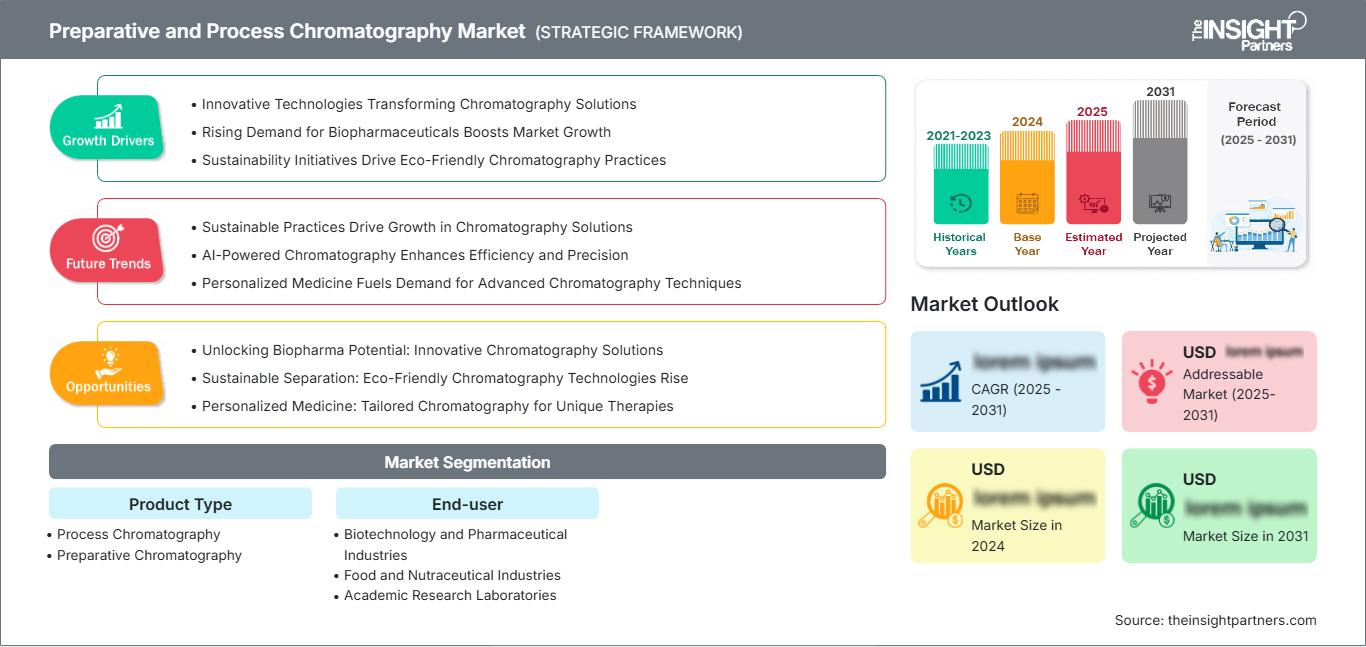
The global Preparative and Process Chromatography market was valued at US$ 12.91 billion in 2025 and is expected to reach US$ 23.58 billion by 2034; it is estimated to record a CAGR of 6.92% during 2026-2034.
Preparative and Process Chromatography Market Assessment and Insights
- North America: North America is estimated to represent a 31–35% share in 2025 and is growing at a CAGR of 7.8–8.5% between 2026–2034, supported by biopharmaceutical capacity, CDMO activity, and sophisticated downstream processing infrastructure.
- US: The US accounts for an estimated 72–76% share of North American revenues in 2025 and is growing at a CAGR of 7.7–8.3%, led by biologics manufacturing and purification investment.
- Europe: Europe holds an estimated 26–30% share in 2025 and is projected to grow at a CAGR of 7.3–7.9%, with Germany, the UK, Switzerland, and France supporting pharmaceutical manufacturing, process development, and technology adoption.
- Asia Pacific: Asia Pacific represents approximately 22–26% share in 2025 and is expected to expand at a CAGR of 8.2–8.8%, with China, Japan, South Korea, and India benefiting from expanding biomanufacturing and research capacity.
- Largest Segment: Process Chromatography commands an estimated 58–62% market share in 2025 and is projected to grow at a CAGR of 7.8–8.4%, reflecting its role in commercial-scale purification.
- High Growth Segment: Preparative Chromatography represents approximately 38–42% market share in 2025 and is expected to record a CAGR of 8.0–8.6%, supported by complex molecule isolation.
- Key companies analyzed in detail: Agilent Technologies Inc.; Bio-Rad Laboratories, Inc.; Chiral Technologies, Inc.; General Electric Company; Thermo Fisher Scientific Inc.; Novasep Holding S.A.S.; Pall Corporation; Shimadzu Corporation; Merck KGaA; Waters Corporation.
Source: The Insight Partners' analysis based on proprietary research, government publications, company annual reports, investor presentations, industry databases, and expert interviews.
From stand-alone separation devices to an integration of columns, resins, detectors, fraction collectors, and even software and automation for processing, the industry is undergoing development. More product development will be aimed at resolving challenges with biomolecules, oligonucleotides, peptides, and impurities related to antibodies. There will also be improvements in pressure tolerance, binding capacity, selectivity, solvent efficiency, and scale transfer to facilitate transfer from analytical development to purification and manufacturing.
Going forward, capital expenditure will expand outside the usual pharmaceutical hotbeds into other manufacturing sites in Asia and specific CDMOs. Process consistency and quality traceability under the regulatory focus will encourage the uptake of automated purification technologies. Other factors that will drive capital expenditure in the market will include sustainability, which means lower solvent use, better resin efficiency, faster processing, and higher recovery.
Preparative and Process Chromatography Market Report Scope
| Report Attribute | Details |
|---|---|
| Market size in 2025 | US$ 12.91 Billion |
| Market Size by 2034 | US$ 23.58 Billion |
| Global CAGR (2026 - 2034) | 6.92% |
| Historical Data | 2021-2024 |
| Forecast period | 2026-2034 |
Preparative and Process Chromatography Market Analysis
Demand growth is increasingly linked to the expanding number and complexity of biological products requiring downstream purification. The preparative and process chromatography market growth is supported by workflows where purity, recovery, scalability, and batch consistency must be balanced simultaneously. Pharmaceutical manufacturers, biotechnology companies, and CDMOs therefore evaluate chromatography as a process-critical technology rather than simply an analytical laboratory requirement.
Ecosystem includes resin and stationary-phase manufacturers, column makers, system makers, automation suppliers, pharmaceutical companies, contract development & manufacturing organizations (CDMOs), laboratories and distributors. Market forces arise from specific chemistries of resins and columns, detectors and services needed. More capacity in materials and pre-packed versions can shorten development periods, whereas modularity allows flexibility for manufacturers to adapt purification trains to changing volumes of products.
Market forces are more likely to be driven by application expertise as well as the availability of instrumentation. Agilent Technologies Inc., Waters Corporation, Shimadzu Corporation, Bio-Rad Laboratories, Inc., and Thermo Fisher Scientific Inc. manufacture chromatography instruments, columns, software and/or analytical and bioprocessing systems. Merck KGaA and Pall Corporation offer very strong process scale purification solutions, whereas Chiral Technologies, Inc. specializes in chiral separations.
Strategic investment is moving toward automation, workflow integration, and application-specific solutions. Novasep Holding S.A.S. contributes process chromatography expertise, while General Electric Company remains relevant through its historical chromatography and life sciences technology footprint. Differentiation increasingly depends on scale-up reliability, consumables compatibility, service networks, method-development support, and the ability to address increasingly heterogeneous molecules without compromising throughput.
● REPORT CUSTOMIZATION
Tailor This Report To Align With Your Specific Business Requirements
This report can be customized to align precisely with your business objectives, scope, and target markets. Customization options include tailored segmentation, geography, competitive analysis, and strategic insights to support informed decision-making.
Customize This Report →WHAT YOU CAN ADJUST
- ● Segmentations
- ● Geography
- ● Competitive Analysis
- ● Language Preferences
Preparative and Process Chromatography Market: Strategic Insights
Regional Insights
North America preparative and process chromatography market
North America is estimated at 31–35% share in 2025, with a regional CAGR of 7.8–8.5%. The US dominates regional demand because pharmaceutical companies, biotechnology developers, and CDMOs operate extensive development and commercial manufacturing networks. Canada adds demand through biotechnology research and specialized pharmaceutical production.
The regional ecosystem favors high-throughput purification, process analytical integration, and scalable chromatography platforms. Investments in domestic biomanufacturing capacity reinforce demand for reliable downstream technologies, while stringent quality requirements encourage reproducible methods. Process intensification and automated control should sustain adoption across commercial biologics facilities and advanced therapy manufacturing.
U.S. preparative and process chromatography Market
The US represents approximately 72–76% of North preparative and process chromatography market revenues in 2025 and is expected to grow at 7.7–8.3%. Its leadership reflects the concentration of pharmaceutical manufacturers, biotechnology companies, CDMOs, and research organizations requiring sophisticated purification infrastructure.
Agilent Technologies Inc., Bio-Rad Laboratories, Inc., Thermo Fisher Scientific Inc., Pall Corporation, and Waters Corporation have strong commercial or technical presence across relevant applications. Demand spans biologics purification, peptide processing, small-molecule isolation, and laboratory-scale method development. Increasing outsourcing to CDMOs also encourages standardized chromatography platforms that can transfer methods efficiently between development and production sites.
Europe preparative and process chromatography market
Europe is estimated to account for 26–30% share of the preparative and process chromatography market in 2025 and is projected to expand at 7.3–7.9%. Germany leads regional activity, supported by pharmaceutical manufacturing, biotechnology infrastructure, and major technology suppliers. The UK and France contribute through research-intensive pharmaceutical ecosystems and specialized development organizations.
Germany combines big pharmaceutical plants with experience in chromatography techniques and state-of-the-art manufacturing facilities. Merck KGaA offers an essential process technology capability for the region, whereas other European companies and institutes contribute to the development of purification techniques. The rising demand is associated with biologics, biosimilars, and valuable active pharmaceutical ingredients that need downstream processing.
The UK, France, Italy, and Spain conduct research and produce pharmaceutical products. However, the characteristics of demand differ from one manufacturer to another based on the scale of production and the degree of biotechnology application. The UK focuses on research and biologics development, whereas France has pharmaceutical production advantages. Italy and Spain also make contributions by active pharmaceutical production and research. Germany is the most successful country in terms of Europe.
APAC preparative and process chromatography market
APAC represents approximately 22–26% of the preparative and process chromatography market share in 2025 and is expected to grow at 8.2–8.8%, making it the fastest-growing major region. China leads, followed by Japan, South Korea, India, and Australia. Expansion of pharmaceutical manufacturing and biotechnology capacity supports equipment and consumables procurement.
China and India are strengthening manufacturing and outsourcing capabilities, while Japan and South Korea maintain sophisticated pharmaceutical and research ecosystems. Government support for biotechnology, local manufacturing, and advanced drug development reinforces regional investment. Australia contributes through research institutions and specialized biotechnology activity, creating demand for both preparative systems and scalable purification technologies.
Middle East & Africa preparative and process chromatography Market
The Middle East and Africa preparative and process chromatography market demand is expected to expand at 6.3–7.0%, with Saudi Arabia leading regional development, followed by the UAE and South Africa. Pharmaceutical localization, healthcare investment, and laboratory modernization are gradually broadening demand for advanced separation technologies.
Saudi Arabia and the UAE are investing in healthcare and life sciences infrastructure, while South Africa provides a comparatively established research and pharmaceutical base. The rest of MEA remains smaller but benefits from laboratory modernization and pharmaceutical localization. Energy-intensive manufacturing considerations also encourage interest in efficient systems that reduce solvent use, processing time, and operating requirements.
Segmentation Analysis
Product Type
Product Type segmentation reflects different operating objectives across analytical development, compound isolation, and commercial purification. Process Chromatography is expected to grow at a CAGR of 7.8–8.4%, supported by commercial biomanufacturing, while Preparative Chromatography is projected at 8.0–8.6%, reflecting increasing requirements for high-purity molecule isolation. The preparative and process chromatography market scope therefore, spans both development-stage purification and production-scale workflows.
- Process Chromatography: Process Chromatography remains the largest product category because it supports scalable downstream purification of biological products. Demand centers on reproducibility, resin performance, process capacity, and efficient impurity removal across commercial manufacturing operations.
- Preparative Chromatography: Preparative Chromatography serves compound isolation and purification, where high recovery and purity are essential. Demand is strengthened by pharmaceutical discovery, synthetic chemistry, peptide research, and the increasing complexity of molecules entering development pipelines.
End-user
End-user dynamics are shaped by the scale, regulatory requirements, and molecular complexity of each application environment. Biotechnology and Pharmaceutical Industries are expected to grow at a CAGR of 8.0–8.6%, supported by biologics and advanced therapeutics. Food and Nutraceutical Industries and Academic Research Laboratories remain important users, with demand tied to purification, characterization, and research throughput.
- Biotechnology and Pharmaceutical Industries: These users represent the core commercial demand base, requiring scalable purification, validated workflows, and consistent separation performance. Procurement decisions increasingly consider lifetime consumables, method transfer, automation, and regulatory documentation.
- Food and Nutraceutical Industries: Food and nutraceutical laboratories use preparative techniques for purification, fractionation, and compound characterization. Demand is linked to functional ingredients, natural products, quality control, and increasing analytical scrutiny of complex formulations.
- Academic Research Laboratories: Academic laboratories require flexible systems for method development, compound isolation, and structural research. Adoption is influenced by instrument versatility, shared-facility economics, software usability, and the ability to support diverse sample types.
Opportunity Snapshot
| End-user | Revenue Contribution | Trend Tag | Adoption Stage |
| Biotechnology and Pharmaceutical Industries | High | Biologic Purification | Mature |
| Food and Nutraceutical Industries | Medium | Natural Products | Scaling |
| Academic Research Laboratories | Medium | Method Automation | Scaling |
Preparative and Process Chromatography Market Growth Drivers and Impact Analysis
Increasing Biopharmaceutical Manufacturing Complexity
Greater diversification of therapeutic proteins, peptides, nucleic acid-based products, and other complex molecules places greater technical demands on their downstream purification. Different charges, sizes, hydrophobicity, and impurity profiles of such molecules may require a series of chromatographic processes in order to obtain sufficient purity and recovery. It is clear that such technical requirements place greater demand on resins with higher capacity, appropriate stationary phases, stronger columns, and a purification system in general. Processes that can be scaled up easily and without any yield losses are needed. With diversification of pipelines, suppliers able to offer multiple modes of purification and different scales of operations become increasingly relevant. Such an approach will allow greater investments in platforms, which can improve process efficiency and consistency.
Expansion of CDMO and Outsourced Manufacturing Capacity
The emergence of contract development and manufacturing organizations is reshaping how the equipment for chromatography is bought and used. In CDMO applications, there is a need to accommodate different customers, molecule types, batch sizes, and process requirements within the same facility. There is thus a need for the equipment to be modular, the columns to be versatile, the methods transferable, and the consumables to be consistent. The outsourced manufacturing business model also increases the importance of uptime and technical support due to the direct relationship between the process schedule and customer delivery commitments. Vendors who offer application, method development, and scalable solutions will be able to realize recurrent demand following equipment purchases. The effect is seen in places where the pharmaceutical companies are outsourcing process development and manufacturing.
Higher Emphasis on Purification Efficiency and Resource Utilization
There is a growing focus on enhancing recovery rates, lowering solvent usage, decreasing cycle times, and maximizing resin yields. In cases where several purification steps have to be carried out, the chromatographic step itself may contribute significantly to the overall downstream process burden, making efficiency gains economically worthwhile. High binding capacity, good selectivity, effective flow properties, and fraction management through automation would help decrease processing limitations without affecting product yield. Efficient use of resources is now considered an increasingly relevant factor in terms of process evaluation, as manufacturers are considering operating costs and environmental impact at the same time.
Preparative and Process Chromatography Market Future Trends
Intelligent Analytical-to-Preparative Method Transfer
The next phase of laboratory automation will increasingly connect analytical screening with preparative purification through software-guided method transfer. Instead of relying entirely on specialist interpretation, systems can evaluate separation difficulty, recommend operating conditions, and generate scaled purification methods from screening data. This approach can shorten development cycles and make sophisticated purification accessible to a broader user base. Automated fraction handling, sample tracking, and integrated detection will further reduce manual intervention. As laboratories process larger compound libraries and more diverse molecules, intelligent workflows are likely to become a competitive differentiator. The preparative and process chromatography market trends therefore, point toward systems that combine instrument control, method development, data interpretation, and purification execution within a coordinated digital environment.
Lower-Solvent and Higher-Productivity Separation Platforms
Future platforms are likely to emphasize separation performance while reducing solvent intensity and improving throughput. Preparative SFC can offer lower organic-solvent consumption for suitable applications, while improved stationary phases can enable stronger retention, better selectivity, and shorter purification cycles. Suppliers are also likely to refine column hardware and flow-path materials to reduce unwanted interactions that affect recovery and peak quality. These changes can support sustainability goals without treating environmental performance separately from productivity. Digital monitoring may allow operating conditions to be adjusted according to sample characteristics, reducing unnecessary processing. Over time, procurement decisions will increasingly evaluate solvent efficiency, column lifetime, recovery, throughput, and maintenance requirements together rather than selecting systems solely on initial capital cost.
Preparative and Process Chromatography Market Opportunities
Expansion of Advanced Purification Capacity in Asia
Investment opportunities are emerging across China, India, South Korea, and other Asian manufacturing hubs where pharmaceutical production and biotechnology capabilities are expanding. Suppliers can target these markets through localized technical support, scalable equipment configurations, application laboratories, and partnerships with CDMOs. The preparative and process chromatography market Forecasts indicate that faster regional manufacturing expansion can create demand not only for systems but also for columns, resins, replacement parts, validation services, and training. Localized supply chains can reduce procurement delays and strengthen customer confidence. Companies that align product specifications with regional manufacturing practices and regulatory expectations may establish durable positions before capacity expansion reaches maturity. Opportunities are particularly relevant for suppliers capable of supporting both laboratory-scale process development and subsequent commercial scale-up.
Integrated Purification Solutions for Complex Modalities
Complex therapeutic modalities create opportunities for suppliers to combine chromatography systems, resins, columns, detectors, software, and process-development services into integrated solutions. Rather than selling isolated equipment, vendors can address specific purification challenges involving peptides, oligonucleotides, proteins, and other difficult molecules. This approach can create stronger customer relationships because process performance depends on compatibility across multiple components. Suppliers can also use application data to develop specialized workflows for particular molecule classes, reducing method-development burden for customers. Investment should prioritize platforms with modular architecture, scalable consumables, strong data connectivity, and application-specific expertise. The resulting opportunity is less dependent on instrument replacement cycles and more closely tied to recurring purification activity across research, clinical development, and commercial manufacturing.
Frequently Asked Questions

- Comprehensive Market Sizing and Forecast Analysis
- Detailed Segmentation Analysis
- In-Depth Market Dynamics Assessment
- Regional and Country-Level Insights
- Competitive Landscape and Company Benchmarking
- Strategic Business Intelligence
Recent Reports
Testimonials

The Insight Partners' SCADA System Market report is comprehensive, with valuable insights on current trends and future forecasts. The team was highly professional, responsive, and supportive throughout. We are very satisfied and highly recommend their services.
RAN KEDEM Partner, Reali Technologies LTDs
I requested a report on a very specific software market and the team produced the report in a few days. The information was very relevant and well presented. I then requested some changes and additions to the report. The team was again very responsive and I got the final report in less than a week.
JEAN-HERVE JENN Chairman, Future Analytica
We worked with The Insight Partners for an important market study and forecast. They gave us clear insights into opportunities and risks, which helped shape our plans. Their research was easy to use and based on solid data. It helped us make smart, confident decisions. We highly recommend them.
PIYUSH NAGPAL Sr. Vice President, High Beam Global
The Insight Partners delivered insightful, well-structured market research with strong domain expertise. Their team was professional and responsive throughout. The user-friendly website made accessing industry reports seamless. We highly recommend them for reliable, high-quality research services
YUKIHIKO ADACHI CEO, Deep Blue, LLC.
This is the first time I have purchased a market report from The Insight Partners.While I was unsure at first, I visited their web site and felt more comfortable to take the risk and purchase a market report.I am completely satisfied with the quality of the report and customer service. I had several questions and comments with the initial report, but after a couple of dialogs over email with their analyst I believe I have a report that I can use as input to our strategic planning process.Thank you so much for taking the extra time and making this a positive experience.I will definitely recommend your service to others and you will be my first call when we need further market data.
JOHN SUZUKI President and Chief Executive Officer, Board Director, BK Technologies
I wish to appreciate your support and the professionalism you displayed in the course of attending to my request for information regarding to infectious disease IVD market in Nigeria. I appreciate your patience, your guidance, and the fact that you were willing to offer a discount, which eventually made it possible for us to close a deal. I look forward to engaging The Insight Partners in the future, all thanks to the impression you have created in me as a result of this first encounter.
DR CHIJIOKE ONYIA MANAGING DIRECTOR, PineCrest Healthcare Ltd.Reason to Buy
- Informed Decision-Making
- Understanding Market Dynamics
- Competitive Analysis
- Identifying Emerging Markets
- Customer Insights
- Market Forecasts
- Risk Mitigation
- Boosting Operational Efficiency
- Strategic Planning
- Investment Justification
- Tracking Industry Innovations
- Aligning with Regulatory Trends





 Get Free Sample for