
Pressure Vessel Market Size, Demand & Growth by 2034
Coverage: by Material (Steel Alloys, Other Alloys, Composites); Type (Boilers, Nuclear Reactors, Separators, Others); End user Industry (Oil and Gas, Chemicals, Power Generation, Others) , and Geography (North America, Europe, Asia Pacific, and South and Central America)
- Status : Data Released
- Report Code : TIPRE00005648
- Category : Manufacturing and Construction
- No. of Pages : 150
- Available Report Formats :


- Last update date : September 07, 2026


2025 Market Size
US$ 64.16 Bn
Base year value
2034 Forecast
US$ 77.71 Bn
Projected by 2034
CAGR 2026-2034
2.42 %
Growth rate
Addressable Market
US$ 652.02 Bn
(2026-2034)
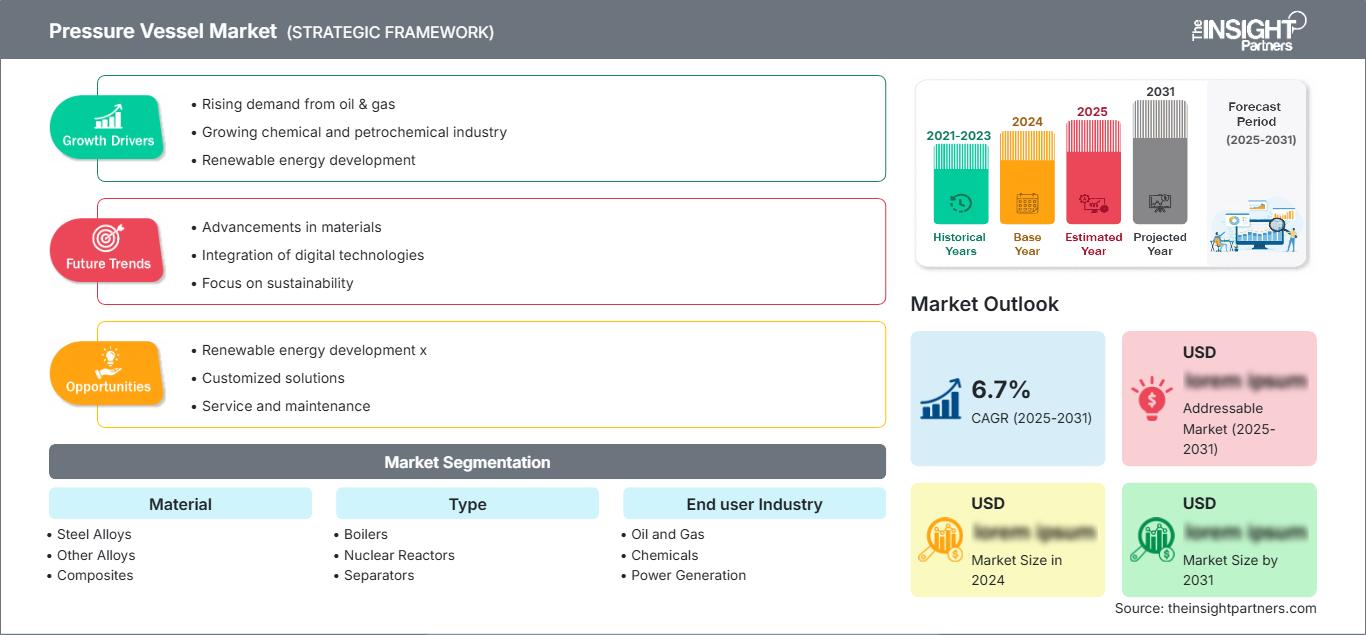
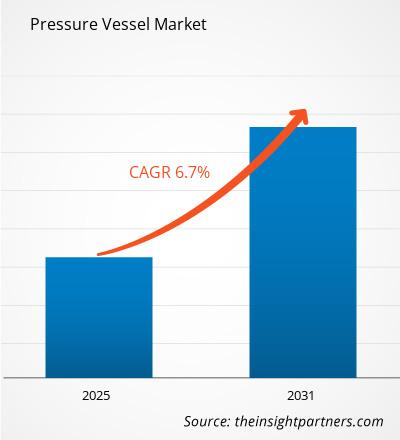
The pressure vessel market covers engineered equipment used to contain gases or liquids under pressures materially different from ambient conditions across energy, process industries, and specialized applications. The market is valued at US$ 64.16 Billion in 2025 and is projected to reach US$ 77.71 Billion by 2034, expanding at a CAGR of 2.42% during 2026–2034. Demand remains anchored in power generation, oil and gas processing, chemical production, nuclear infrastructure, and industrial gas handling.
North American demand is expected to expand at a 2.8–3.4% CAGR between 2026 and 2034, supported by replacement of aging process equipment and investment in gas infrastructure. The pressure vessel market size is also influenced by new nuclear generation, hydrogen handling, carbon management, and data-center-related power infrastructure, where reliability, material qualification, inspection requirements, and long service life remain important procurement criteria.
Pressure Vessel Market Assessment and Insights
- North America: North America is expected to represent a 24–28% share in 2025 and grow at a 2.8–3.4% CAGR between 2026–2034, supported by industrial modernization, gas infrastructure, nuclear investment, and replacement demand.
- US: The US is estimated to account for 78–82% of North America's 2025 value, with a 2.6–3.2% CAGR between 2026–2034, led by power, chemicals, gas processing, and nuclear applications.
- Europe: Europe is projected to hold a 20–24% share in 2025 and expand at a 2.0–2.7% CAGR between 2026–2034, with Germany, France, Italy, and the UK supporting specialized engineering, chemical processing, and nuclear applications.
- Asia Pacific: Asia Pacific is estimated at a 34–38% share in 2025 and is expected to grow at a 3.8–4.8% CAGR between 2026–2034, led by China, India, Japan, and South Korea through power and industrial infrastructure investment.
- Largest Segment: Steel Alloys is estimated at a 58–62% market share in 2025 and is projected to grow at a 2.3–2.9% CAGR between 2026–2034 because of strength, weldability, availability, and established code qualification.
- High Growth Segment: Composites are estimated at a 6–8% market share in 2025 and are projected to grow at a 5.5–6.5% CAGR between 2026–2034 as lightweight, corrosion-resistant construction gains traction.
- Key companies analyzed in detail: Babcock and Wilcox Enterprises, Inc.; Bharat Heavy Electricals Limited; Doosan Enerbility Co., Ltd.; GE Vernova Inc.; The Halvorsen Company; IHI Corporation; Larsen & Toubro Limited; Mitsubishi Heavy Industries, Ltd.; Pressure Vessels (India); Westinghouse Electric Company LLC.
Source: The Insight Partners' analysis based on proprietary research, government publications, company annual reports, investor presentations, industry databases, and expert interviews.
The pressure vessel market has evolved from conventional carbon-steel fabrication toward higher-strength alloys, engineered weldments, improved nondestructive examination, and increasingly specialized designs. Process plants need equipment that can withstand high temperatures, corrosion, cycle stress, and other tough operating conditions. Digital engineering, computational modeling, automated welding, and advanced inspection techniques are helping to improve the consistency of fabrication processes, while modular manufacturing is assisting equipment suppliers to cope with complicated scheduling and logistics challenges.
Moving forward, investments are focused on nuclear power generation, gas processing, hydrogen-related systems, petrochemicals, and decarbonization of industry. The growing economies of Asia are expanding their heavy industrial capacities, whereas projects in North America and Europe focus on replacements, safety enhancements, and low-carbon applications. Regulatory requirements continue to be a significant factor in purchasing decisions since pressure equipment should meet design codes, material tracing, welding qualifications, inspection methods, and lifetime performance expectations.
Pressure Vessel Market Report Scope
| Report Attribute | Details |
|---|---|
| Market size in 2025 | US$ 64.16 Billion |
| Market Size by 2034 | US$ 77.71 Billion |
| Global CAGR (2026 - 2034) | 2.42% |
| Historical Data | 2021-2024 |
| Forecast period | 2026-2034 |
Pressure Vessel Market Analysis
The pressure vessel market growth is supported by sustained equipment requirements across oil and gas processing, chemicals, power generation, refining, fertilizers, and industrial gases. The value chain begins with specialty steel, alloy, and composite material suppliers, followed by plate forming, forging, welding, heat treatment, machining, inspection, coating, and final assembly. EPC contractors and plant operators strongly influence specifications because vessels are generally engineered around project-specific pressure, temperature, corrosion, and capacity parameters. Supply dynamics therefore depend on qualified fabrication capacity and availability of certified materials.As highlighted in the pressure vessel market report, procurement is increasingly emphasizing total lifecycle performance rather than fabrication cost alone. Buyers assess fatigue resistance, corrosion allowance, inspection accessibility, maintenance intervals, and compliance with applicable standards. Large vessels also face transportation and installation constraints, encouraging regional fabrication and modular production. Expansion of refining and chemical capacity in Asia, together with gas infrastructure and nuclear investment, is sustaining demand for heavy fabricated equipment even where mature markets experience slower greenfield activity.
Competitive positioning is increasingly based on engineering depth, manufacturing scale, certification, and the ability to deliver complex equipment under stringent quality systems. The pressure vessel market analysis indicates that Babcock and Wilcox Enterprises, Inc., Bharat Heavy Electricals Limited, Doosan Enerbility Co., Ltd., GE Vernova Inc., IHI Corporation, Larsen & Toubro Limited, and Mitsubishi Heavy Industries, Ltd. compete through combinations of power equipment, process engineering, nuclear capabilities, and heavy fabrication.
The strategic investments will be made in capacity utilization, manufacturing capabilities, nuclear-grade quality system, and international EPC partnerships. The companies involved in meeting the requirements of specialized fabrication are Halvorsen Company and Pressure Vessels (India), whereas Westinghouse Electric Company LLC is more inclined towards nuclear technologies and lifecycle services. Competitive differentiators are moving away from vessel fabrication to qualifications for high-consequence applications, reliable performance, testing abilities, and EPC scheduling.
● REPORT CUSTOMIZATION
Tailor This Report To Align With Your Specific Business Requirements
This report can be customized to align precisely with your business objectives, scope, and target markets. Customization options include tailored segmentation, geography, competitive analysis, and strategic insights to support informed decision-making.
Customize This Report →WHAT YOU CAN ADJUST
- ● Segmentations
- ● Geography
- ● Competitive Analysis
- ● Language Preferences
Pressure Vessel Market: Strategic Insights
Regional Insights
North America pressure vessel market
North America is estimated to account for 24–28% of the global 2025 pressure vessel market value and is projected to expand at a 2.8–3.4% CAGR through 2034. The United States is the largest demand center, with the support of refineries, petrochemicals, natural gas processing, industrial gases, and power generation facilities. Canada contributes to demand from its oil sands, LNG, chemicals, mining, and utility projects. Replacing old process equipment continues to be important in addition to capacity expansions.
Nuclear energy investments create an extra specialized market for the demand since reactor vessels, steam generators, containment-related components and auxiliary systems have strict material qualification requirements. The region will also see growth in the gas infrastructure as well as industrial reshoring. Material selection for procurement is increasingly focusing on ASME compliance, traceability, weld quality, non-destructive testing and lifecycle integrity. Such demands tend to work for engineering and fabrication companies with ASME-certified manufacturing facilities.
U.S. pressure vessel Market
The U.S. represents approximately 78–82% of the North American pressure vessel market value in 2025 and is projected to expand at a 2.6–3.2% CAGR through 2034. Demand is diversified among chemicals, refining, natural gas treatment, power generation, industrial gases, and nuclear energy. GE Vernova Inc., Westinghouse Electric Company LLC, Babcock & Wilcox Enterprises, Inc., and The Halvorsen Company contribute specialized machinery and applications related to energy.
The specifications of the application are becoming increasingly distinct in dealing with aging plants and new infrastructure. Refurbishment and new construction in nuclear focus on high-integrity equipment, while petrochemical and natural gas applications rely on huge reactors, separators, drums, and storage tanks. Increased demand for electricity from data centers is reinforcing the rationale behind building more generation capacity, which is an indirect demand for boilers and pressurized equipment.
Europe pressure vessel Market
Europe is estimated to represent a 20–24% of the pressure vessel market share in 2025 and is expected to grow at a 2.0–2.7% CAGR through 2034. Germany remains a leading industrial market, supported by chemicals, machinery, hydrogen infrastructure, and process engineering. The UK and France contribute through energy, refining, aerospace-related industrial systems, and nuclear programs, while Italy and Spain provide additional chemical, energy, and process-equipment demand.
Germany and France remain particularly relevant because of their engineering capabilities and installed industrial base. Germany's chemical industry supports demand for reactors, separators, and heat-intensive process equipment, while France's nuclear fleet creates specialized requirements for nuclear-grade components and lifecycle replacement. The UK continues investing in energy security and nuclear capacity, while Italy and Spain support process industries, gas infrastructure, and industrial modernization. European buyers place strong emphasis on PED compliance, material certification, weld procedures, inspection, and environmental performance, favoring technologically capable suppliers.
APAC pressure vessel Market
APAC is estimated at 34–38% of the global pressure vessel market value in 2025 and is expected to expand at a 3.8–4.8% CAGR through 2034, making it the leading regional market. China leads, followed by India, Japan, and South Korea. Expanding chemical, refining, LNG, power, and nuclear infrastructure supports fabrication demand.
China's industrial scale, India's power and manufacturing expansion, Japan's nuclear restart activity, South Korea's energy investments, and Australia's gas and mining projects create diversified demand. Industrial policy and localization programs are increasing domestic manufacturing capabilities, while nuclear development adds requirements for specialized materials and high-integrity components. The region's large project pipeline also supports economies of scale in heavy fabrication and encourages suppliers to develop larger, higher-efficiency production facilities.
Middle East & Africa pressure vessel Market
The Middle East and Africa pressure vessel market is expected to represent a smaller global share, with growth estimated at 3.4–4.1% CAGR through 2034. Saudi Arabia leads regional demand, followed by the UAE and South Africa. Refining, petrochemicals, gas processing, desalination, and power infrastructure provide recurring applications for large process vessels.
Saudi Arabia's downstream investment and UAE industrial diversification support new equipment procurement, while South Africa contributes through chemicals, mining, and power applications. Other Middle Eastern markets benefit from LNG, hydrogen, ammonia, and industrial-gas projects. Energy-intensive projects require robust materials and long service intervals, creating opportunities for qualified suppliers. Local fabrication requirements and EPC partnerships are increasingly important because large equipment transportation, site logistics, and project execution can materially affect delivered cost and schedule.
Segmentation Analysis
Material
Material selection is primarily governed by pressure, temperature, corrosion exposure, fatigue, fabrication requirements, and applicable codes. Steel alloys remain dominant because they provide a practical combination of mechanical strength, weldability, supply availability, and established qualification routes. The segment is projected to expand at a 2.3–2.9% CAGR between 2026–2034. Advanced alloys and composites will gain importance where corrosion resistance or weight reduction provides sufficient lifecycle value.
- Steel Alloys: Steel alloys remain the principal material choice for large industrial vessels because of established fabrication processes, broad plate availability, strong mechanical properties, and extensive qualification under pressure-equipment codes.
- Other Alloys: Other alloys serve corrosive, high-temperature, or specialized process environments where conventional steels cannot provide adequate lifecycle performance, particularly in chemicals, refining, power, and selected nuclear applications.
- Composites: Composites address applications where lightweight construction and corrosion resistance are priorities, creating opportunities in specialized storage, hydrogen-related infrastructure, and systems where reduced mass offsets higher material and manufacturing complexity.
Type
Type influences vessel design according to the operating process, pressure conditions, thermal duty, and containment requirements. The segment is projected to grow at a 2.2–2.8% CAGR during 2026–2034. Boilers remain commercially significant because of their role in power and industrial steam generation, while reactors and separators benefit from chemical, refining, and gas-processing investment.
- Boilers: Boilers represent the largest type category because steam generation remains central to thermal power, industrial processing, cogeneration, and utility applications requiring controlled heat transfer under pressure.
- Nuclear Reactors: Nuclear reactors require highly engineered pressure-containing systems subject to demanding materials, inspection, quality-assurance, and regulatory requirements, creating high-value opportunities despite comparatively long project cycles.
- Separators: Separators are widely required in oil and gas, refining, petrochemical, and gas-processing facilities, where reliable phase separation directly supports process efficiency, safety, and downstream equipment protection.
- Others: Other equipment includes specialized pressure-containing systems serving industrial gases, water treatment, refrigeration, storage, and customized process applications with project-specific operating conditions.
End user Industry
End-user industry demand is tied closely to capital expenditure across process industries and energy systems. The segment is projected to expand at a 2.4–3.0% CAGR between 2026–2034. Oil and gas and chemicals remain major buyers, while power generation provides stable demand through boilers, nuclear systems, and plant modernization.
- Oil and Gas: Oil and gas operators require pressure vessels throughout separation, gas processing, refining, storage, and petrochemical conversion, with replacement and capacity expansion sustaining long-term procurement requirements.
- Chemicals: Chemical producers require reactors, separators, storage vessels, and specialized corrosion-resistant equipment, making material selection and process compatibility central to equipment specification and lifecycle economics.
- Power Generation: Power generation uses boilers, steam systems, nuclear components, and auxiliary pressure equipment, with new capacity and plant modernization supporting demand across both conventional and low-carbon generation.
- Others: Other industries include fertilizers, industrial gases, food processing, pharmaceuticals, water treatment, mining, refrigeration, and specialized manufacturing, where pressure containment is integral to process operation.
Opportunity Snapshot
| End User Industry | Revenue Contribution Trend | Tag Adoption Stage |
| Oil and Gas | High Gas Processing | Mature |
| Chemicals | High Process Reactors | Mature |
| Power Generation | High Nuclear Buildout | Scaling |
Pressure Vessel Market Growth Drivers and Impact Analysis
Expansion of nuclear and high-reliability power infrastructure
There will be an emerging specialized demand chain because the metallurgy, fabrication, and inspection of nuclear pressure vessels and the pressure-containing components have to meet strict criteria. As far as nuclear capacity and construction go, the center of gravity moves increasingly towards Asia, but the USA and Europe also pay much attention to extending their fleets and new generation. This affects not only reactor vessels, but also nuclear plants need steam generators, pressurizers, auxiliary systems, and replacement equipment. Thus, companies having nuclear-grade quality systems have access to longer-term project pipelines compared to those that are interested exclusively in industrial fabrication. Standardization of reactors may help in improving repeatability, while qualification is still a major barrier to entering the market.
Industrial process capacity and downstream energy integration
Any increase in refining, petrochemicals, gas processing, fertilizer, and chemical manufacturing capacity results in a higher demand for separation vessels, reactors, drums, boilers, and storage vessels. New installations often need a variety of vessel designs, based on the type of feedstocks used and pressure, temperature, and corrosion issues; hence, the need for vessel engineering fabrication. The importance of Asia in particular is due to the fact that China and India are growing their industrial capacity, while the Middle East keeps investing in downstream conversion plants and integrated energy facilities. The effect can also be observed in replacement markets, whereby customers replace old equipment to increase efficiency, handle new feedstocks, or meet environmental standards. In this regard, manufacturers who offer design, fabrication, and testing of vessels are likely to get more out of the business.
Rising electricity requirements from industrial electrification and data centers
Electrical demand is generating pressure vessel potential in an indirect fashion due to new generation capabilities as well as new thermal capabilities. More data centers, industrial electrification, cooling needs, and industrial activity are generating the need for electrical capacity that can be provided. The need for gas-fired generation capacity, nuclear generation capacity, industrial boilers, and process systems that go along with each of those could all require pressure vessels. This has particular relevance to the United States, where data center electrical use is increasingly being seen as one of the causes of electricity demand growth, as well as Asia where industrial development is still quite significant. From a manufacturer's standpoint, this means more opportunity in providing repeatable power plant equipment, while still having the capability to customize the higher-pressure vessels.
Pressure Vessel Market Future Trends
Advanced materials and hybrid vessel architectures
The pressure vessel market trends are expected to increasingly reflect material optimization rather than simple substitution of conventional steel. Low-alloy high-strength steels, corrosion-resistant materials, cladding techniques, and composites have the potential to increase the lifespan while decreasing weight or maintenance needs. Composite designs might consist of metallic pressure containment coupled with composite material reinforcements or special surfaces for difficult operating conditions. Selection will be aided by digital material design and lifecycle assessment based on fatigue, corrosion, thermal cycling, and inspection considerations. The hydrogen, ammonia, carbon, and other next-generation applications will drive such change due to differences in pressure, permeability, embrittlement, and corrosion behavior compared to established process conditions. The suppliers that can qualify materials according to existing codes have an opportunity here.
Digital engineering and condition-based integrity management
Future vessel procurement is likely to incorporate more digital engineering, traceability, and lifecycle monitoring. Three-dimensional design environments can connect calculations, fabrication drawings, welding procedures, inspection records, and material certificates, reducing information gaps during complex projects. During operation, inspection data can increasingly support risk-based maintenance by identifying changes in wall thickness, weld condition, fatigue exposure, or corrosion progression. This approach can reduce unnecessary shutdowns while improving confidence in remaining service life. Artificial intelligence may assist in inspection image interpretation and anomaly prioritization, although final engineering decisions will continue to depend on qualified procedures and regulatory requirements. The resulting model shifts competition from equipment delivery alone toward integrated asset integrity capabilities, particularly for nuclear, petrochemical, chemical, and other high-consequence installations.
Pressure Vessel Market Opportunities
Localized manufacturing for Asian industrial projects
The pressure vessel market scope is expanding through localization of heavy fabrication in India, Southeast Asia, and other Asian manufacturing centers. Investors can target facilities capable of producing large coded vessels, reactors, separators, boilers, and heat-integrated equipment while maintaining internationally recognized certification. Local manufacturing can reduce transportation constraints, improve project responsiveness, and support government objectives around domestic industrial capability. The strongest opportunities are likely to involve suppliers that combine local fabrication with engineering partnerships and export-quality inspection systems. India is particularly relevant because expanding power, refining, chemicals, fertilizers, and nuclear programs can support both domestic and international orders. Partnerships with EPC contractors can provide a route into large projects, while investment in welding automation, heavy rolling, nondestructive examination, and digital quality records can improve throughput and consistency.
Specialized equipment for hydrogen, ammonia, and carbon management
The pressure vessel market forecasts indicate that emerging low-carbon process systems can create higher-value opportunities even when aggregate market expansion remains moderate. Hydrogen, ammonia, carbon capture, utilization and storage, and related industrial-gas systems require carefully engineered containment and process equipment. Investment should focus on materials compatibility, pressure cycling, corrosion management, sealing, inspection, and applicable certification rather than capacity alone. Ammonia infrastructure can also leverage existing power and industrial assets, creating retrofit opportunities alongside greenfield projects. Suppliers with experience in high-pressure gas handling can extend their capabilities into new applications by adapting established fabrication and inspection platforms. Strategic positioning around specialized engineering, qualified materials, modular process skids, and lifecycle services can provide better margins than competing primarily for standardized vessel fabrication.
Frequently Asked Questions

- Comprehensive Market Sizing and Forecast Analysis
- Detailed Segmentation Analysis
- In-Depth Market Dynamics Assessment
- Regional and Country-Level Insights
- Competitive Landscape and Company Benchmarking
- Strategic Business Intelligence
Recent Reports
Testimonials

The Insight Partners' SCADA System Market report is comprehensive, with valuable insights on current trends and future forecasts. The team was highly professional, responsive, and supportive throughout. We are very satisfied and highly recommend their services.
RAN KEDEM Partner, Reali Technologies LTDs
I requested a report on a very specific software market and the team produced the report in a few days. The information was very relevant and well presented. I then requested some changes and additions to the report. The team was again very responsive and I got the final report in less than a week.
JEAN-HERVE JENN Chairman, Future Analytica
We worked with The Insight Partners for an important market study and forecast. They gave us clear insights into opportunities and risks, which helped shape our plans. Their research was easy to use and based on solid data. It helped us make smart, confident decisions. We highly recommend them.
PIYUSH NAGPAL Sr. Vice President, High Beam Global
The Insight Partners delivered insightful, well-structured market research with strong domain expertise. Their team was professional and responsive throughout. The user-friendly website made accessing industry reports seamless. We highly recommend them for reliable, high-quality research services
YUKIHIKO ADACHI CEO, Deep Blue, LLC.
This is the first time I have purchased a market report from The Insight Partners.While I was unsure at first, I visited their web site and felt more comfortable to take the risk and purchase a market report.I am completely satisfied with the quality of the report and customer service. I had several questions and comments with the initial report, but after a couple of dialogs over email with their analyst I believe I have a report that I can use as input to our strategic planning process.Thank you so much for taking the extra time and making this a positive experience.I will definitely recommend your service to others and you will be my first call when we need further market data.
JOHN SUZUKI President and Chief Executive Officer, Board Director, BK Technologies
I wish to appreciate your support and the professionalism you displayed in the course of attending to my request for information regarding to infectious disease IVD market in Nigeria. I appreciate your patience, your guidance, and the fact that you were willing to offer a discount, which eventually made it possible for us to close a deal. I look forward to engaging The Insight Partners in the future, all thanks to the impression you have created in me as a result of this first encounter.
DR CHIJIOKE ONYIA MANAGING DIRECTOR, PineCrest Healthcare Ltd.Reason to Buy
- Informed Decision-Making
- Understanding Market Dynamics
- Competitive Analysis
- Identifying Emerging Markets
- Customer Insights
- Market Forecasts
- Risk Mitigation
- Boosting Operational Efficiency
- Strategic Planning
- Investment Justification
- Tracking Industry Innovations
- Aligning with Regulatory Trends





 Get Free Sample for