
Real-time Flood Monitoring and Warning System Market Growth, Demand & Size by 2034
Coverage: by Component (Hardware, Software, Services); Access (Web Browser (Internet), Mobile Devices (WAP)); End User (Government, Media, Agriculture and Inland Fisheries, Transport and logistics, Energy, Construction, Tourism and Outdoor Entertainment) , and Geography (North America, Europe, Asia Pacific, and South and Central America)
- Status : Data Released
- Report Code : TIPRE00008326
- Category : Electronics and Semiconductor
- No. of Pages : 150
- Available Report Formats :


- Last update date : September 01, 2026


2025 Market Size
US$ 253.13 Mn
Base year value
2034 Forecast
US$ 415.57 Mn
Projected by 2034
CAGR 2026-2034
5.66 %
Growth rate
Addressable Market
US$ 3,030.53 Mn
(2026-2034)
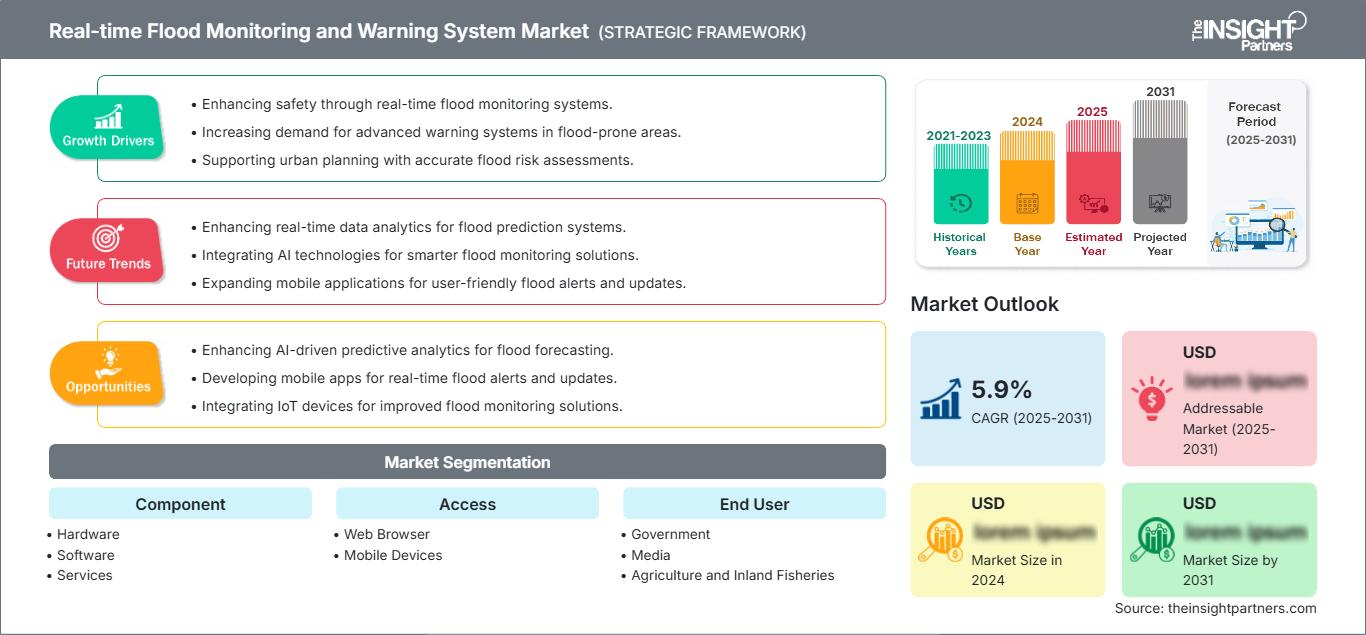
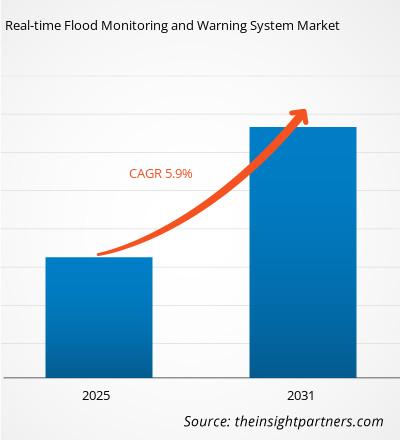
The real-time flood monitoring and warning system market is projected to grow from US$ 253.13 Million in 2025 to US$ 415.57 Million by 2034, registering a CAGR of 5.66% during 2026–2034. Adoption is rising as governments, utilities, transport authorities, and infrastructure operators use connected sensors, hydrological models, cloud platforms, and alerting tools to reduce flood exposure and improve emergency readiness.
North America remains a major demand center as the real-time flood monitoring and warning system market size is supported by municipal flood resilience programs, extreme rainfall exposure, aging drainage assets, and investment in public safety communications. The region is estimated to grow at a CAGR of 5.2–5.8% during 2026–2034 as city agencies integrate sensor networks, dashboards, and mobile alerts into disaster response workflows.
Real-time Flood Monitoring and Warning System Market Assessment and Insights
- North America: North America is estimated to hold 31–35% share in 2025 and grow at a CAGR of 5.2–5.8% between 2026–2034, led by municipal early warning networks, hydromet modernization, and transportation safety programs.
- US: The US is estimated to contribute 76–82% of North American demand in 2025 and grow at a CAGR of 5.3–5.9% through 2034.
- Europe: Europe is estimated to hold 24–28% share in 2025 and grow at a CAGR of 4.9–5.5%, led by the UK, Germany, France, Italy, and Spain.
- Asia Pacific: Asia Pacific is estimated to hold 26–30% share in 2025 and grow at a CAGR of 6.2–6.9%, driven by China, India, Japan, South Korea, and Australia.
- Largest Segment: Hardware is estimated to hold 44–48% share in 2025 and grow at a CAGR of 5.1–5.7% as agencies prioritize gauges, dataloggers, telemetry devices, solar power units, and rugged field stations.
- High Growth Segment: Services are estimated to hold 20–24% share in 2025 and grow at a CAGR of 6.4–7.1% as operators require installation, maintenance, calibration, analytics support, and system lifecycle management.
- Key companies analyzed in detail: ALS Limited, Arteria Technologies Private Limited, Campbell Scientific, Inc., Envira IOT, Fondriest Environmental, Inc., Hanwell Solutions Ltd., High Sierra Electronics, Inc., Sutron Corporation, Telegrafia a.s., and Valarm LLC.
Source: The Insight Partners' analysis based on proprietary research, government publications, company annual reports, investor presentations, industry databases, and expert interviews.
Technology evolution in the real-time flood monitoring and warning system market has moved from isolated gauges toward integrated networks combining rainfall sensors, water-level instruments, telemetry, mapping software, sirens, and automated public notification. Current production trends focus on robust hardware, communication interoperability, cloud computing, and deployment flexibility that may be used in large river valleys, coastlines, urban drainage basins, and remote catchments.
Future spending will go towards scalable platforms that integrate local hydrometeorological information with regional forecasts, transportation coordination, and emergency centers. Authorities will likely increase procurements for vulnerable urban flood plains, while other stakeholders such as utilities, ports, agriculture departments, and tourism services will purchase customized solutions. Disaster readiness and climate change regulations will further drive replacement and upgrade cycles.
Real-time Flood Monitoring and Warning System Market Report Scope
| Report Attribute | Details |
|---|---|
| Market size in 2025 | US$ 253.13 Million |
| Market Size by 2034 | US$ 415.57 Million |
| Global CAGR (2026 - 2034) | 5.66% |
| Historical Data | 2021-2024 |
| Forecast period | 2026-2034 |
Real-time Flood Monitoring and Warning System Market Analysis
Real-time flood monitoring and warning system market growth is shaped by the rising need for faster situational awareness during extreme rainfall, river overflow, flash floods, and coastal surge events. Sensor networks provide field data on rainfall, flow, and water levels, while software converts those readings into alerts and operating decisions. This makes the real-time flood monitoring and warning system market critical for communities that need earlier evacuation triggers, road closures, and asset protection during fast-moving events.
The ecosystem comprises makers of sensors, dataloggers, telemetry providers, software companies, installers, weather services, municipal agencies, and emergency teams. Hardware is essential, but the focus is now more on analysis, communication and service. Considerations for procurement usually include robustness of devices, ease of maintenance, delay in alarms, compatibility with the existing system, and the ability to provide warning to the public without causing any alarm fatigue.
Real-time flood monitoring and warning system market analysis shows a competitive field led by specialized hydromet and environmental monitoring providers. Campbell Scientific, Inc., High Sierra Electronics, Inc., Sutron Corporation, Valarm LLC, Arteria Technologies Private Limited, Telegrafia a.s., Hanwell Solutions Ltd., Fondriest Environmental, Inc., Envira IOT, and ALS Limited compete through sensor reliability, software usability, installation expertise, and system customization.
Investment trends are shifting toward turnkey programs that combine field instrumentation, web dashboards, mobile access, maintenance, and training, as highlighted in the Real-Time Flood Monitoring and Warning System Market Report. Vendors with multi-hazard warning capability are well-positioned because emergency managers increasingly prefer unified platforms. Strategic positioning depends on interoperability with agency databases, strong after-sales support, communication redundancy, and the ability to operate in remote, low-power, or harsh hydrological environments.
● REPORT CUSTOMIZATION
Tailor This Report To Align With Your Specific Business Requirements
This report can be customized to align precisely with your business objectives, scope, and target markets. Customization options include tailored segmentation, geography, competitive analysis, and strategic insights to support informed decision-making.
Customize This Report →WHAT YOU CAN ADJUST
- ● Segmentations
- ● Geography
- ● Competitive Analysis
- ● Language Preferences
Real-time Flood Monitoring and Warning System Market: Strategic Insights
Regional Insights
North America real-time flood monitoring and warning system market
North America is estimated to account for 31–35% real-time flood monitoring and warning system market share in 2025 and grow at a CAGR of 5.2–5.8% during 2026–2034. Demand is supported by federal, state, municipal, and watershed-level programs that deploy rainfall gauges, river sensors, weather stations, and public warning channels. Flood-prone highways, stormwater networks, and river basins are key application areas.
Growing urban exposure strengthens replacement demand as agencies seek modern telemetry, faster dashboards, and mobile warning capability. Public works departments, emergency managers, and transport agencies use real-time readings to support gate closures, detours, evacuation planning, and infrastructure protection. North American adoption also benefits from established hydromet suppliers and strong technical standards for environmental monitoring.
U.S. real-time flood monitoring and warning system market
The U.S. is estimated to represent 76–82% of North American Real-Time Flood Monitoring and Warning System demand in 2025 and grow at a CAGR of 5.3–5.9% through 2034. The need for frequent flooding of inland areas, rainfall caused by hurricanes, vulnerability to storm surge, and roadway safety concerns have led to increasing local investments. County, city, water district, and transportation departments have been increasingly using automated warning stations and remote monitoring via web-based systems.
There is a company presence in the region owing to Campbell Scientific, Inc., High Sierra Electronics, Inc., Sutron Corporation, Fondriest Environmental, Inc., and Valarm LLC, offering equipment and technical assistance to local buyers. The applications include ALERT and ALERT2 improvements, solar-powered stations, low-power data communication, bridge/roadway monitoring, and multiple rainfall/water level/weather measurement systems.
Europe real-time flood monitoring and warning system market
Europe is estimated to hold 24–28% share of the Real-Time Flood Monitoring and Warning System in 2025 and grow at a CAGR of 4.9–5.5% during 2026–2034, according to the Real-Time Flood Monitoring and Warning System Market Forecast. The UK leads demand through river-basin monitoring, smart drainage upgrades, and public alert modernization. Germany remains important because industrial corridors, inland waterways, and municipal utilities require reliable hydrological information.
France, Italy, and Spain add demand through coastal flood exposure, tourism risk management, agricultural water monitoring, and civil protection systems. European buyers generally emphasize compliance, data quality, and lifecycle reliability. Investments are also supported by climate adaptation planning, insurance pressure, and the need to connect local sensors with national forecasting and emergency communication frameworks.
APAC real-time flood monitoring and warning system market
Asia Pacific is estimated to hold 26–30% share of the in 2025 and grow at a CAGR of 6.2–6.9% from 2026–2034. China leads regional demand because of large river systems, urban flood control, and connected infrastructure programs. India, Japan, South Korea, and Australia add demand through monsoon management, typhoon preparedness, dam safety, and transport corridor protection.
Policy support for disaster risk reduction and smart city development is accelerating deployments across the region. Agencies are adopting mobile alerts, telemetry-linked gauges, satellite data integration, and predictive analytics. High population exposure in floodplains and coastal cities makes early warning capacity a practical infrastructure priority rather than a discretionary technology investment.
Middle East & Africa real-time flood monitoring and warning system market
The Middle East and Africa market is estimated to grow at a CAGR of 5.0–5.7% during 2026–2034, reflecting key Real-Time Flood Monitoring and Warning System Market Trends. Saudi Arabia and UAE drive adoption through urban drainage upgrades, transport safety, and flash-flood warnings. South Africa creates new demand for local warning solutions through municipal water supplies, mining areas, and river basin monitoring.
MEA region demand growth is driven by climate variability, creating the need for localized warning systems. New applications in energy corridors, construction sites, tourist locations, and other vulnerable communities need practical warning technologies. Growth is helped by infrastructure investment, aid-backed resilience projects, and deployment of low-power sensors in remote catchments.
Segmentation Analysis
Component
Component demand is expected to grow at a CAGR of 5.5–6.1% during 2026–2034. The real-time flood monitoring and warning system market scope spans field hardware, analytics software, and lifecycle services. Buyers increasingly procure integrated packages because reliable flood warning depends on accurate sensing, resilient communications, validated thresholds, trained operators, and maintenance programs that preserve performance during severe weather.
- Hardware: Hardware includes water-level sensors, rainfall gauges, dataloggers, telemetry units, solar power systems, sirens, and field enclosures that support continuous monitoring in rivers, drains, reservoirs, and road crossings.
- Software: Software converts incoming hydrological readings into dashboards, alarm rules, maps, reports, and mobile notifications, helping agencies interpret conditions quickly and coordinate response across departments.
- Services: Services cover site selection, installation, calibration, maintenance, training, data validation, and technical support, making them essential for long-term system reliability and public safety continuity.
Access
Access is expected to grow at a CAGR of 5.7–6.3% through 2026–2034 as agencies require both command-center visibility and mobile field access. Browser-based platforms remain important for analysts and emergency operations centers, while mobile devices improve operational response for field crews, public works teams, transport managers, and decision-makers during rapidly changing flood conditions.
- Web Browser: Web browser access supports centralized monitoring, map visualization, historical review, reporting, and interagency coordination through dashboards that can be used from emergency operation centers and municipal offices.
- Mobile Devices: Mobile access enables field teams, supervisors, and emergency personnel to receive alerts, review gauges, validate incidents, and make faster response decisions away from fixed control rooms.
End User
End-user demand is expected to grow at a CAGR of 5.8–6.5% during 2026–2034. The government still plays a major role; however, transportation, logistics, energy, agriculture, construction, media, tourism, and outdoor entertainment industries are also showing more interest in using early warning systems. For each industry, there is a different value for early warning systems, from evacuation to asset protection, crop management, and communication with visitors.
- Government: Government agencies use these systems for disaster preparedness, public alerts, evacuation decisions, drainage monitoring, and coordination between meteorological, hydrological, municipal, and emergency response departments.
- Media: Media organizations use verified flood data, maps, and alerts to improve public communication, support live reporting, and reduce misinformation during severe weather and community emergencies.
- Agriculture and Inland Fisheries: Farms and fisheries use flood intelligence to protect equipment, manage pond and river risks, plan field operations, and reduce losses during seasonal rainfall and river overflow events.
- Transport and logistics: Transport and logistics operators rely on roadway water detection, bridge monitoring, route alerts, and drainage intelligence to reduce closures, protect drivers, and reroute assets during storms.
- Energy: Energy operators apply flood monitoring to protect substations, pipelines, hydropower assets, access roads, and distributed infrastructure located near rivers, reservoirs, and low-lying industrial sites.
- Construction: Construction users deploy temporary and permanent monitoring to manage excavation safety, site drainage, equipment exposure, and project continuity during intense rainfall or upstream water-level changes.
- Tourism and Outdoor Entertainment: Tourism and outdoor entertainment operators use localized alerts to manage visitor safety at parks, campsites, resorts, waterfront venues, trails, and event sites exposed to sudden flooding.
Opportunity Snapshot
| End User | Revenue Contribution | Trend Tag | Adoption Stage |
| Government | High | Civic Alerts | Mature |
| Media | Low | Verified Feeds | Emerging |
| Agriculture and Inland Fisheries | Medium | Watershed Risk | Scaling |
| Transport and logistics | High | Road Alerts | Scaling |
| Energy | Medium | Asset Protection | Scaling |
| Construction | Medium | Site Safety | Emerging |
| Tourism and Outdoor Entertainment | Low | Visitor Safety | Emerging |
Real-time Flood Monitoring and Warning System Market Growth Drivers and Impact Analysis
Expansion of Public Flood Resilience Programs
Flood resilience investments by the public sector will be a key demand driver since floods have started to affect urban areas, transport routes, infrastructure, and other vulnerable communities. The government has started investing in better observation systems, early warning systems, and emergency communication system in order to mitigate human and economic losses. The real-time systems will help in providing intelligence for making decisions such as evacuation planning, temporary road closures, emergency work force allocation, and evaluation after the event.
Integration of IoT Sensors and Cloud-Based Alerting
IoT connectivity, solar-powered nodes, edge dataloggers, and cloud-based systems have been enabling flood monitoring to be more scalable and accessible. The agencies will be able to install sensors distributedly within the river basin, underpasses, bridges, reservoirs, and drainage network, with the ability to bring all the measurements on one dashboard and mobile alerts. This will minimize the reliance on site visitation and enable faster decision-making when the duration of time is short. The market implications can be seen through increased demand for an integrated system.
Rising Demand from Transport and Critical Infrastructure Operators
Transportation organizations, logistics companies, utility providers, and construction companies are increasingly adopting flood monitoring because there is an impact in terms of safety and finances when service delivery is disrupted. There could be pooling of water in roads, flooding of underpasses, overflow of bridges, or flooding of substations and other infrastructure components that need an immediate reaction. Warning systems assist operators to close down facilities before there is any danger to people and document the process.
Real-time Flood Monitoring and Warning System Market Future Trends
Predictive Analytics Linked to Local Sensor Networks
Real-time flood monitoring and warning system market trends point toward predictive analytics that combine gauge readings, rainfall forecasts, terrain data, drainage capacity, and historical flood behavior. For future platforms, it would be important to reduce the amount of time spent on showing the actual water level readings and instead recommend operational thresholds, probable overflow zones, and prioritization of responses. This change would create a need for software enhancements and model calibration services.
Mobile-First Warning and Community Communication
Message distribution is likely to evolve towards becoming more mobile first as the agencies try to make the process of dissemination more rapid to field personnel, citizens, drivers, and facility managers. The future warning systems will include the use of SMS, mobile application messages, public dashboard messages, variable message signs, and social media messaging platforms. The emerging trend facilitates adoption among small cities and private facilities because of the simplicity of using mobile interfaces.
Real-time Flood Monitoring and Warning System Market Opportunities
Retrofitting Urban Drainage and Roadway Networks
Real-Time Flood Monitoring & Alert System Forecasting shows promise in retrofitting existing drainage and road systems with level and rain gauges and real-time alert systems. Cities do not have time to change their entire stormwater systems, thus making monitoring an effective method of providing resiliency in operations immediately. Providers can offer products for underpasses, culverts, bridges, pumping stations, and low-lying streets.
Managed Services for Rural and Remote Catchments
Managed services provide the chance when local bodies do not have the technical skills to manage flood warning systems. Managed services can offer an entire package consisting of site visits, equipment, telemetry, dashboard, calibration, maintenance, and emergencies under a contract on a regular basis. This concept is suitable for rural basins, tourist locations, agricultural basins, and small towns that require early warnings without having their own hydromet department.
Frequently Asked Questions

- Comprehensive Market Sizing and Forecast Analysis
- Detailed Segmentation Analysis
- In-Depth Market Dynamics Assessment
- Regional and Country-Level Insights
- Competitive Landscape and Company Benchmarking
- Strategic Business Intelligence
Recent Reports
Testimonials

The Insight Partners' SCADA System Market report is comprehensive, with valuable insights on current trends and future forecasts. The team was highly professional, responsive, and supportive throughout. We are very satisfied and highly recommend their services.
RAN KEDEM Partner, Reali Technologies LTDs
I requested a report on a very specific software market and the team produced the report in a few days. The information was very relevant and well presented. I then requested some changes and additions to the report. The team was again very responsive and I got the final report in less than a week.
JEAN-HERVE JENN Chairman, Future Analytica
We worked with The Insight Partners for an important market study and forecast. They gave us clear insights into opportunities and risks, which helped shape our plans. Their research was easy to use and based on solid data. It helped us make smart, confident decisions. We highly recommend them.
PIYUSH NAGPAL Sr. Vice President, High Beam Global
The Insight Partners delivered insightful, well-structured market research with strong domain expertise. Their team was professional and responsive throughout. The user-friendly website made accessing industry reports seamless. We highly recommend them for reliable, high-quality research services
YUKIHIKO ADACHI CEO, Deep Blue, LLC.
This is the first time I have purchased a market report from The Insight Partners.While I was unsure at first, I visited their web site and felt more comfortable to take the risk and purchase a market report.I am completely satisfied with the quality of the report and customer service. I had several questions and comments with the initial report, but after a couple of dialogs over email with their analyst I believe I have a report that I can use as input to our strategic planning process.Thank you so much for taking the extra time and making this a positive experience.I will definitely recommend your service to others and you will be my first call when we need further market data.
JOHN SUZUKI President and Chief Executive Officer, Board Director, BK Technologies
I wish to appreciate your support and the professionalism you displayed in the course of attending to my request for information regarding to infectious disease IVD market in Nigeria. I appreciate your patience, your guidance, and the fact that you were willing to offer a discount, which eventually made it possible for us to close a deal. I look forward to engaging The Insight Partners in the future, all thanks to the impression you have created in me as a result of this first encounter.
DR CHIJIOKE ONYIA MANAGING DIRECTOR, PineCrest Healthcare Ltd.Reason to Buy
- Informed Decision-Making
- Understanding Market Dynamics
- Competitive Analysis
- Identifying Emerging Markets
- Customer Insights
- Market Forecasts
- Risk Mitigation
- Boosting Operational Efficiency
- Strategic Planning
- Investment Justification
- Tracking Industry Innovations
- Aligning with Regulatory Trends





 Get Free Sample for