
Real-Time Tracking Management System Market Size, Demand & Growth by 2034
Coverage: by Offering (Hardware, Software, Services); Application (Security, Analytics, Warehouse Management, Supply Chain Management, Others); End-User (Retail, Transportation and Logistics, Manufacturing, Oil and Gas, Aerospace and Defense, Others) , and Geography (North America, Europe, Asia Pacific, and South and Central America)
- Status : Data Released
- Report Code : TIPRE00010354
- Category : Electronics and Semiconductor
- No. of Pages : 150
- Available Report Formats :


- Last update date : September 01, 2026


2025 Market Size
US$ 2.74 Bn
Base year value
2034 Forecast
US$ 7.8 Bn
Projected by 2034
CAGR 2026-2034
12.32 %
Growth rate
Addressable Market
US$ 46.09 Bn
(2026-2034)
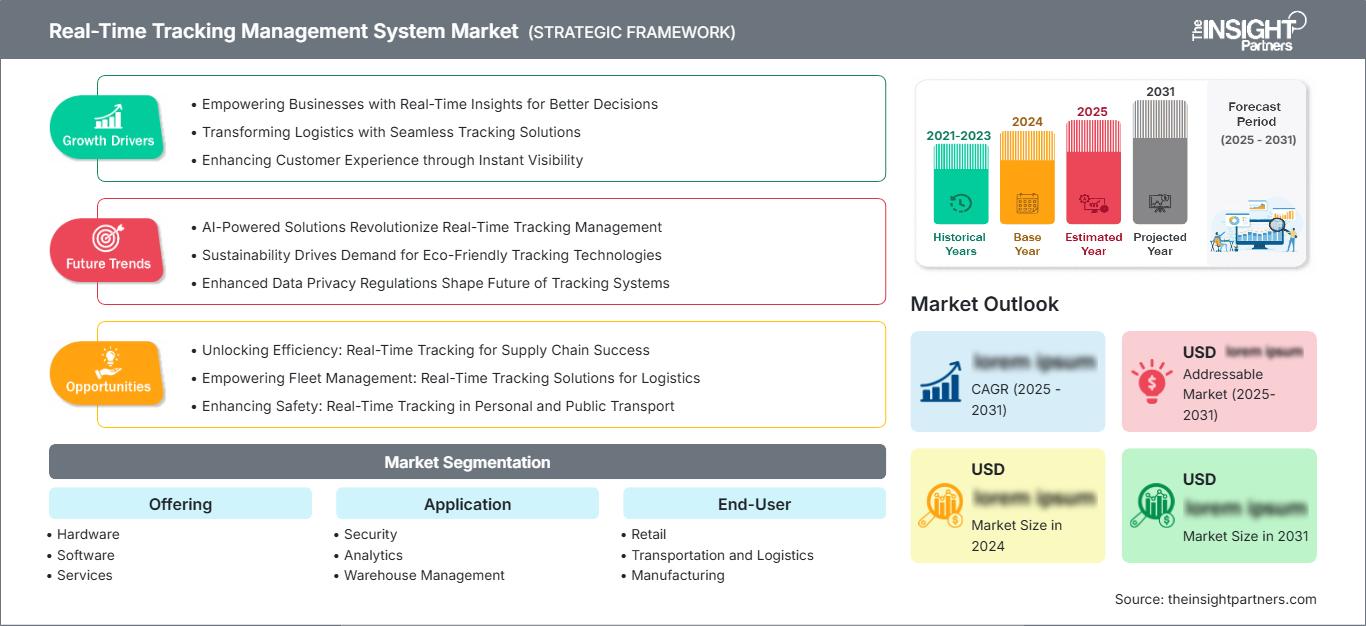
The real-time tracking management system market is projected to grow from US$ 2.74 Billion in 2025 to US$ 7.8 Billion by 2034, registering a CAGR of 12.32% during 2026–2034. Adoption is accelerating as enterprises use GPS, cellular IoT, RFID, Bluetooth, cloud analytics, and AI-enabled telematics to monitor vehicles, assets, inventory, field equipment, and high-value shipments with greater operational control.
North America is a strategic hub for real-time tracking management system market size expansion as fleets, retailers, defense contractors, oilfield operators, and manufacturers prioritize asset visibility and compliance-driven monitoring. The region is estimated to grow at a CAGR of 11.4–12.1% between 2026–2034, supported by connected fleet programs, warehouse digitization, cold-chain monitoring, and demand for low-latency decision-making across logistics networks.
Real-Time Tracking Management System Market Assessment and Insights
- North America: North America is estimated to hold 32–36% share in 2025 and grow at a CAGR of 11.4–12.1% between 2026–2034, supported by fleet compliance, retail fulfillment, and telematics modernization.
- US: The US is estimated to contribute 78–84% of North American demand in 2025 and grow at a CAGR of 11.6–12.3% during 2026–2034.
- Europe: Europe is estimated to hold 23–27% share in 2025 and grow at a CAGR of 10.5–11.2%, led by the UK, Germany, France, Italy, and Spain.
- Asia Pacific: Asia Pacific is estimated to hold 28–32% share in 2025 and grow at a CAGR of 13.1–13.8%, driven by China, India, Japan, South Korea, and Australia.
- Largest Segment: Software is estimated to hold 41–45% share in 2025 and grow at a CAGR of 12.8–13.5% as dashboards, analytics, integrations, and workflow automation capture a larger share of solution value.
- High Growth Segment: Services are estimated to hold 18–22% share in 2025 and grow at a CAGR of 13.6–14.4% due to implementation, integration, managed analytics, and lifecycle support requirements.
- Key companies analyzed in detail: ATrack Technology Inc., CalAmp Corp., Concox Information Technology Co., Ltd., Geotab Inc., Laird Connectivity, Meitrack Group, Sierra Wireless Inc., Teltonika Telematics, TomTom International BV, and Trackimo Inc.
Source: The Insight Partners' analysis based on proprietary research, government publications, company annual reports, investor presentations, industry databases, and expert interviews.
Technological innovation has transformed the market from simple location beacons into tracking ecosystems, which include tough hardware, embedded sensing, connectivity management, edge computing, and cloud applications. The production trends are towards multi-net devices, increased battery life, firmware configuration ability, and hardware platforms that help monitor fleet health, cargo conditions, driver performance, and asset utilization through a single dashboard.
Future demand will be highest in regions where there is a convergence of e-commerce activity, policies for connected transport systems, and industry digitalization. The investments will be in AI-based anomaly detection, open application programming interfaces, cybersecurity, and configurable hardware platforms that make integration easier. The regulatory focus on safety, emissions, cargo visibility, and security of high-value assets will increase business spending.
Real-Time Tracking Management System Market Report Scope
| Report Attribute | Details |
|---|---|
| Market size in 2025 | US$ 2.74 Billion |
| Market Size by 2034 | US$ 7.8 Billion |
| Global CAGR (2026 - 2034) | 12.32% |
| Historical Data | 2021-2024 |
| Forecast period | 2026-2034 |
Real-Time Tracking Management System Market Analysis
Real-time tracking management system market growth is driven by enterprises seeking live visibility over moving assets, distributed inventory, and mobile workers. Logistics providers employ tracking technology to shorten dwell time, prevent unapproved movement, and ensure deliveries are delivered reliably. The technology is used by manufacturers and retailers to associate warehouse activities with the status of shipments, while service organizations track tool usage and routes of technicians.
The ecosystem comprises device vendors, network providers, platform vendors, map providers, systems integrators, and internal user operations teams. Hardware captures location and condition information, but the software and service elements increasingly leverage the data into information that can be used for alerts, analysis, compliance, and automated work processes. Supply factors include components availability, cellular technology changeover, regional certification, and device management security.
Real-time tracking management system market analysis shows competition across specialist hardware firms, fleet platforms, and location intelligence providers. CalAmp Corp., Geotab Inc., Teltonika Telematics, TomTom International BV, ATrack Technology Inc., Concox Information Technology Co., Ltd., Meitrack Group, Sierra Wireless Inc., Trackimo Inc., and Laird Connectivity compete through device reliability, software depth, geographic support, and integration flexibility.
Investment trends favor scalable cloud platforms, AI-driven alerts, route optimization, and multi-asset visibility. Strategic positioning differs by customer base: fleet-centric vendors emphasize safety and maintenance, hardware companies prioritize ruggedized devices and global connectivity, and mapping providers support routing intelligence. Buyers increasingly prefer suppliers that can support implementation, analytics, and long-term device lifecycle management.
● REPORT CUSTOMIZATION
Tailor This Report To Align With Your Specific Business Requirements
This report can be customized to align precisely with your business objectives, scope, and target markets. Customization options include tailored segmentation, geography, competitive analysis, and strategic insights to support informed decision-making.
Customize This Report →WHAT YOU CAN ADJUST
- ● Segmentations
- ● Geography
- ● Competitive Analysis
- ● Language Preferences
Real-Time Tracking Management System Market: Strategic Insights
Regional Insights
North America real-time tracking management system market
North America is estimated to account for 32–36% real-time tracking management system market share in 2025 and grow at a CAGR of 11.4–12.1% during 2026–2034. Demand is led by transportation, retail, utilities, oilfield services, and field operations that need asset location, exception alerts, fleet safety data, and warehouse-to-delivery visibility.
Mature telematics adoption supports faster upgrades from basic tracking toward analytics-rich platforms. Enterprises are replacing disconnected GPS tools with systems that integrate vehicle diagnostics, proof of delivery, inventory movements, driver risk, and customer updates. Growth is also reinforced by large parcel networks, connected commercial fleets, and higher expectations for real-time service transparency.
U.S. real-time tracking management system Market
The U.S. is estimated to represent 78–84% of North American Real-time tracking management system market demand in 2025 and grow at a CAGR of 11.6–12.3% through 2034. Fleet operators, retailers, manufacturers, aerospace contractors, and energy companies use tracking systems to manage productivity, compliance, cargo security, and maintenance planning.
Company presence is strong because Geotab Inc., CalAmp Corp., TomTom International BV, Trackimo Inc., and Sierra Wireless Inc. support U.S. customers through device, platform, mapping, and connectivity ecosystems. Application trends include AI-assisted driver safety, cloud data streaming, high-value asset monitoring, yard visibility, and integration with transport management and warehouse systems.
Europe real-time tracking management system Market
Europe is estimated to hold 23–27% share in 2025 and grow at a CAGR of 10.5–11.2% during 2026–2034. The UK leads adoption through retail distribution, parcel logistics, and fleet safety programs, while Germany adds scale through manufacturing logistics, automotive supply chains, and industrial equipment tracking.
France, Italy, and Spain contribute demand through cold-chain distribution, construction fleets, public service vehicles, and cross-border road freight. European buyers prioritize data protection, emissions reporting, and interoperability with route planning and workforce tools. Vendors with secure cloud architecture and strong integration support are positioned well in regulated logistics environments.
APAC real-time tracking management system Market
Asia Pacific is estimated to hold 28–32% share in 2025 and grow at a CAGR of 13.1–13.8% from 2026–2034. China leads regional demand because of manufacturing scale, e-commerce logistics, and connected vehicle deployments.
India, Japan, South Korea, and Australia add growth through fleet digitization, warehouse automation, mining, cold chains, and last-mile delivery. Policy support for digital logistics, smart transport, and industrial IoT is increasing demand for cost-effective devices, mobile dashboards, and scalable cloud platforms across mixed vehicle and asset fleets.
Middle East & Africa real-time tracking management system Market
The Middle East and Africa Real-time tracking management system market is estimated to grow at a CAGR of 9.7–10.6% during 2026–2034. Saudi Arabia and the UAE lead adoption through logistics hubs, energy assets, construction fleets, and smart infrastructure programs.
South Africa adds demand from mining, retail distribution, and vehicle security, while Rest of MEA adoption is emerging in fleet compliance and cargo protection. Growth depends on cellular coverage, device durability, local integration support, and the ability to control theft, downtime, and remote asset utilization.
Segmentation Analysis
Offering
Offering demand is expected to grow at a CAGR of 12.2–12.9% during 2026–2034. The real-time tracking management system market scope includes hardware, software, and services that must work together across field devices, cloud platforms, mapping layers, analytics, and enterprise systems. Buyers increasingly choose integrated offerings to reduce deployment complexity and improve return on visibility investments.
- Hardware: Hardware includes GPS trackers, gateways, RFID devices, BLE tags, sensors, and vehicle interfaces that capture location, movement, diagnostics, environmental conditions, and asset status in real time.
- Software: Software provides dashboards, geofencing, route intelligence, reporting, alerts, analytics, and integration layers that turn tracking data into operational decisions across logistics, warehouses, and fleets.
- Services: Services cover installation, device configuration, platform integration, training, managed monitoring, maintenance, and analytics support, helping enterprises sustain system performance across multi-site operations.
Application
Application demand is expected to grow at a CAGR of 12.4–13.1% from 2026–2034. Security remains important, but analytics, warehouse management, and supply chain management are expanding because tracking data is now used for optimization rather than only location awareness. Enterprises are connecting real-time tracking with inventory accuracy, route planning, exception management, and customer service commitments.
- Security: Security applications use geofencing, tamper alerts, movement detection, and recovery workflows to protect vehicles, cargo, equipment, and high-value assets from theft or unauthorized use.
- Analytics: Analytics applications convert location, usage, route, and condition data into performance insights, predictive maintenance signals, utilization benchmarks, and operational improvement opportunities.
- Warehouse Management: Warehouse management applications track pallets, containers, forklifts, tools, and inventory movements to reduce search time, improve accuracy, and connect facility workflows with outbound logistics.
- Supply Chain Management: Supply chain management applications provide end-to-end visibility across suppliers, carriers, distribution centers, and customers, supporting exception handling, delivery reliability, and service-level performance.
End-User
End-User demand is expected to grow at a CAGR of 12.1–12.8% between 2026–2034. Retail, transportation and logistics, manufacturing, oil and gas, and aerospace and defense are the main buyers because each segment manages high-value mobile assets, complex workflows, and time-sensitive operations. Adoption varies by compliance pressure, asset intensity, and tolerance for delivery or production disruption.
- Retail: Retailers use tracking to monitor store replenishment, returns, cold-chain goods, delivery fleets, and high-value merchandise as omnichannel fulfillment raises expectations for accurate visibility.
- Transportation and Logistics: Transportation and logistics users depend on tracking for route performance, vehicle utilization, driver safety, shipment visibility, cargo security, and delivery exception management.
- Manufacturing: Manufacturers deploy systems to track components, finished goods, returnable containers, tools, and work-in-progress across plants, suppliers, warehouses, and outbound transport networks.
- Oil and Gas: Oil and gas operators monitor equipment, vehicles, containers, field personnel, and remote assets to improve safety, utilization, theft prevention, and service coordination.
- Aerospace and Defense: Aerospace and defense users require accurate tracking of parts, ground support equipment, secure shipments, and mission-critical assets subject to strict accountability standards.
Opportunity Snapshot
| End-User | Revenue Contribution | Trend Tag | Adoption Stage |
| Retail | High | Store Visibility | Scaling |
| Transportation and Logistics | High | Fleet Visibility | Mature |
| Manufacturing | Medium | Factory Flow | Scaling |
| Oil and Gas | Medium | Remote Assets | Scaling |
| Aerospace and Defense | Medium | Secure Chain | Emerging |
Real-Time Tracking Management System Market Growth Drivers and Impact Analysis
Rising Demand for End-to-End Supply Chain Visibility
Logistics providers employ tracking technology to shorten dwell time, prevent unapproved movement, and ensure deliveries are delivered reliably. The technology is used by manufacturers and retailers to associate warehouse activities with the status of shipments, while service organizations track tool usage and routes of technicians.
The ecosystem comprises device vendors, network providers, platform vendors, map providers, systems integrators, and internal user operations teams. Hardware captures location and condition information, but the software and service elements increasingly leverage the data into information that can be used for alerts, analysis, compliance, and automated work processes. Supply factors include component availability, cellular technology changeover, regional certification, and device management security.
Expansion of IoT-Enabled Fleet and Asset Telematics
Asset and fleet telematics are gaining capabilities as technology enables integration of GNSS, LTE, Bluetooth, CAN bus information, sensors, and onboard logic. Such a combination provides the ability to track locations as well as the health of the vehicle, cargo, driver, fuel consumption, and utilization of equipment. The consequence is that it transforms the process from being passive to active operational control. Businesses will be able to automate notifications, maintenance management, misuse detection, and enhance safety. Furthermore, IoT adoption makes it possible to deploy it in a scalable way for heterogeneous assets.
Warehouse Automation and Omnichannel Fulfillment Pressure
With the increasing omnichannel retailing and delivery time reduction, visibility of the warehouse and yard becomes crucial. There is a requirement for companies to have visibility of their pallets, roll cages, forklifts, trailers, high-value items, and returnable assets without having to physically look for them. The use of tracking technology will enhance inventory accuracy, minimize wasted labor, and integrate warehouse operations with transport execution. This trend boosts the adoption of software and services since integration with the warehouse management system, transport management system, and ERP is required.
Real-Time Tracking Management System Market Future Trends
AI-Based Exception Prediction Across Moving Assets
Real-time tracking management system market trends point toward predictive exception management that uses route history, dwell patterns, weather, traffic, driver behavior, asset condition, and service-level commitments. Future platforms will do more than show location; they will estimate risk, recommend interventions, and prioritize alerts based on business impact. This will reduce alarm fatigue and help teams focus on shipments, vehicles, or assets most likely to miss performance targets. Vendors with clean data models, APIs, and AI governance will be best positioned.
Convergence of Indoor, Outdoor, and Condition Monitoring
Tracing systems are anticipated to be more integrated among the different areas, including yards, warehousing, transportation, and long-distance transport. Companies would like to use solutions that combine GPS, RFID, BLE, ultra-wideband, barcode, and cellular IoT in a single system. Condition monitoring of temperature, humidity, shock, door state, and battery condition is anticipated to be used on sensitive shipments and expensive equipment. This would generate a need for interoperability software and services that assist the clients in integrating their tracing solutions in different environments.
Real-Time Tracking Management System Market Opportunities
Managed Tracking Services for Mid-Market Fleets
Real-time tracking management system market Forecasts indicate a strong opportunity in managed services for mid-market fleets that need visibility but lack internal telematics specialists. Vendors can bundle devices, connectivity, installation, dashboards, compliance reports, maintenance, and analytics support under subscription models. This lowers buyer complexity and creates recurring supplier revenue. The opportunity is attractive in logistics, construction, retail delivery, and field services, where operators need measurable savings from route optimization, theft reduction, utilization improvement, and driver safety programs.
High-Value Asset Tracking in Industrial Operations
Industrial organizations are extending their reach into tracking not only their vehicles but also their tools, mobile equipment, containers, spare parts, and critical components. Customers in oil & gas, aerospace & defense, utilities, and manufacturing sectors incur huge losses due to asset inactivity, misplacement, and unavailability at the time of planned operations. Vendors can tap into this demand with durable devices, long-lasting batteries, private network capability, and maintenance and inventory system integration.
Frequently Asked Questions

- Comprehensive Market Sizing and Forecast Analysis
- Detailed Segmentation Analysis
- In-Depth Market Dynamics Assessment
- Regional and Country-Level Insights
- Competitive Landscape and Company Benchmarking
- Strategic Business Intelligence
Recent Reports
Testimonials

The Insight Partners' SCADA System Market report is comprehensive, with valuable insights on current trends and future forecasts. The team was highly professional, responsive, and supportive throughout. We are very satisfied and highly recommend their services.
RAN KEDEM Partner, Reali Technologies LTDs
I requested a report on a very specific software market and the team produced the report in a few days. The information was very relevant and well presented. I then requested some changes and additions to the report. The team was again very responsive and I got the final report in less than a week.
JEAN-HERVE JENN Chairman, Future Analytica
We worked with The Insight Partners for an important market study and forecast. They gave us clear insights into opportunities and risks, which helped shape our plans. Their research was easy to use and based on solid data. It helped us make smart, confident decisions. We highly recommend them.
PIYUSH NAGPAL Sr. Vice President, High Beam Global
The Insight Partners delivered insightful, well-structured market research with strong domain expertise. Their team was professional and responsive throughout. The user-friendly website made accessing industry reports seamless. We highly recommend them for reliable, high-quality research services
YUKIHIKO ADACHI CEO, Deep Blue, LLC.
This is the first time I have purchased a market report from The Insight Partners.While I was unsure at first, I visited their web site and felt more comfortable to take the risk and purchase a market report.I am completely satisfied with the quality of the report and customer service. I had several questions and comments with the initial report, but after a couple of dialogs over email with their analyst I believe I have a report that I can use as input to our strategic planning process.Thank you so much for taking the extra time and making this a positive experience.I will definitely recommend your service to others and you will be my first call when we need further market data.
JOHN SUZUKI President and Chief Executive Officer, Board Director, BK Technologies
I wish to appreciate your support and the professionalism you displayed in the course of attending to my request for information regarding to infectious disease IVD market in Nigeria. I appreciate your patience, your guidance, and the fact that you were willing to offer a discount, which eventually made it possible for us to close a deal. I look forward to engaging The Insight Partners in the future, all thanks to the impression you have created in me as a result of this first encounter.
DR CHIJIOKE ONYIA MANAGING DIRECTOR, PineCrest Healthcare Ltd.Reason to Buy
- Informed Decision-Making
- Understanding Market Dynamics
- Competitive Analysis
- Identifying Emerging Markets
- Customer Insights
- Market Forecasts
- Risk Mitigation
- Boosting Operational Efficiency
- Strategic Planning
- Investment Justification
- Tracking Industry Innovations
- Aligning with Regulatory Trends





 Get Free Sample for