
Recycled Ocean Plastics Market Trends, Size & Growth by 2034
Coverage: By Resin Type [Polyethylene Terephthalate (PET), Polyethylene (PE), Polypropylene (PP), Polystyrene (PS), and Others] and Application (Footwear, Bags & Luggage, Apparel, Construction Materials, and Others)
- Status : Upcoming
- Report Code : TIPRE00029755
- Category : Chemicals and Materials
- No. of Pages : 150
- Available Report Formats :


- Last update date : March 04, 2026


2025 Market Size
US$ 18.53 Bn
Base year value
2034 Forecast
US$ 39.27 Bn
Projected by 2034
CAGR 2026-2034
8.7 %
Growth rate
Addressable Market
US$ 259.00 Bn
(2026-2034)
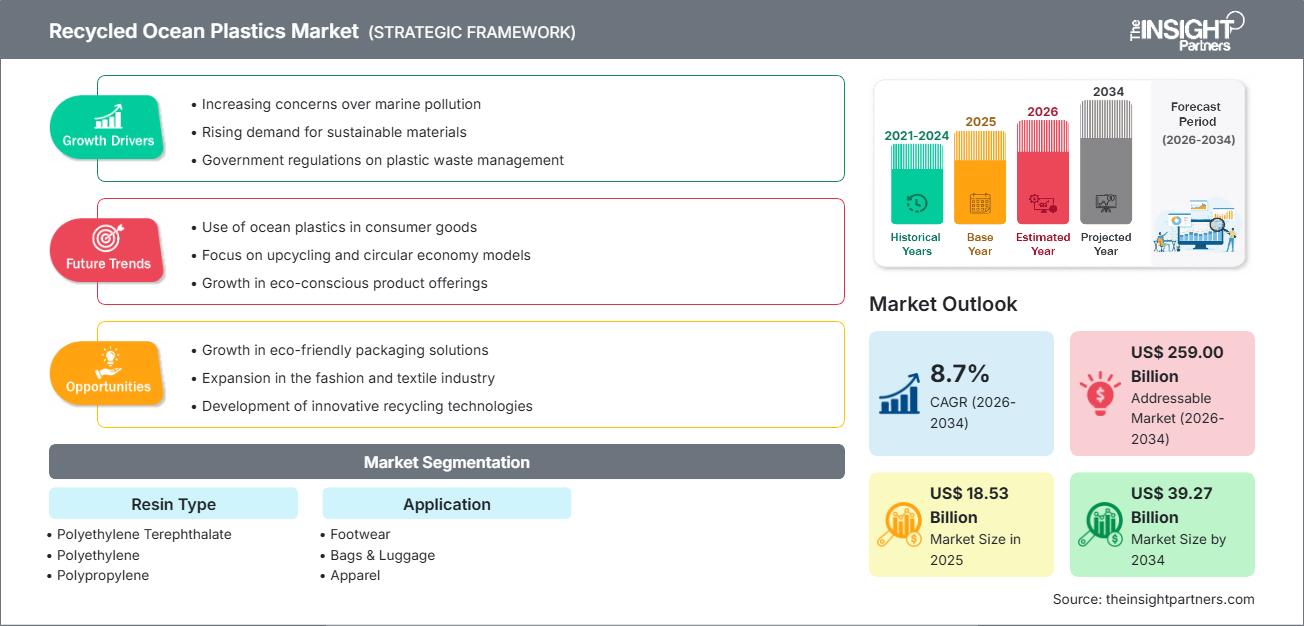
The global recycled ocean plastics market size is projected to reach US$ 39.27 billion by 2034 from US$ 18.53 billion in 2025. The market is anticipated to register a CAGR of 8.7% during the forecast period 2026–2034.
Key market dynamics include a heightening global focus on marine biodiversity conservation, rising corporate commitments to circular economy frameworks, and a significant shift toward traceable, eco-friendly materials in consumer goods. Additionally, the market is expected to benefit from the growing implementation of Extended Producer Responsibility (EPR) mandates, expansion in advanced chemical recycling infrastructure, and the increasing inclusion of ocean-bound resins in high-value segments like sustainable footwear and green construction materials.
Recycled Ocean Plastics Market Analysis
The recycled ocean plastics market analysis shows a shift toward high-performance circular materials as brands prioritize supply chain transparency and carbon footprint reduction. Procurement trends indicate the market is splitting into large-scale ocean-bound plastic recovery within shorelines and specialized initiatives targeting ghost gear and abandoned fishing nets. Strategic opportunities are emerging in high-durability polymers for the construction and apparel sectors, where recycled ocean resins offer a clear marketing advantage through environmental storytelling. The analysis also notes that market expansion depends on the scaling of mechanical purification technologies and the efficiency of sorting mixed marine waste. Competitive differentiation now stands out based on blockchain-verified traceability and social impact certifications that ensure ethical wages for waste collectors in coastal regions.
Recycled Ocean Plastics Market Overview
Marine-recycled materials have evolved from niche experimental textiles to mainstream industrial inputs. Recycled Ocean Plastics includes high-performance fibers for high-end sneakers, durable resins for eco-friendly luggage, and structural additives for sustainable building materials. Both global polymer manufacturers and circular-economy startups compete in this market, using plastic types such as Polyethylene Terephthalate and Polypropylene. Growing demand for sustainable alternatives to virgin plastics among environmentally conscious consumers in Europe and North America has increased the popularity of ocean plastics as a premium material choice. The US market is expanding rapidly, driven by corporate sustainability pledges and the high availability of functional outdoor apparel brands. Europe leads in revenue due to its mature regulatory landscape, while Asia-Pacific is advancing in large-scale collection networks and industrial manufacturing.
Market Assessment and Insights
- Global market for Recycled Ocean Plastics was valued at US$ 18.53 Billion in 2025
- Annual market size is expected to reach US$ 39.27 Billion by 2034
- Total addressable market (TAM) during 2026-2034 is projected to reach approximately US$ 259.00 Billion
- Market is anticipated to register a CAGR of 8.7% during the forecast period
- The United States represents a key market, supported by Increasing concerns over marine pollution, Rising demand for sustainable materials, Government regulations on plastic waste management, as well as evolving industry dynamics
- Market analysis covers North America, Europe, Asia-Pacific, South and Central America, Middle East and Africa, with growth evaluated across the forecast period
- Market opportunities such as Growth in eco-friendly packaging solutions, Expansion in the fashion and textile industry, Development of innovative recycling technologies are expected to influence market dynamics and addressable market
- Report profiles industry participants, including Aquafil S.p.A., BIONIC, Tide Ocean SA, Oceanworks, Textil Santanderina, Envision Plastics, OceanYarn, Waste2Wear, Unifi, Inc., SABIC, while analyzing competitive strategies and innovation developments
-
Source: The Insight Partners' analysis based on proprietary research, government publications, company annual reports, investor presentations, industry databases, and expert interviews.
● REPORT CUSTOMIZATION
Tailor This Report To Align With Your Specific Business Requirements
This report can be customized to align precisely with your business objectives, scope, and target markets. Customization options include tailored segmentation, geography, competitive analysis, and strategic insights to support informed decision-making.
Customize This Report →WHAT YOU CAN ADJUST
- ● Segmentations
- ● Geography
- ● Competitive Analysis
- ● Language Preferences
Recycled Ocean Plastics Market: Strategic Insights
-
Get Top Key Market Trends of this report.This FREE sample will include data analysis, ranging from market trends to estimates and forecasts.
Recycled Ocean Plastics Market Drivers and Opportunities
Market Drivers:
- Global Regulatory Mandates on Plastic Waste: Stringent policies such as the UN Global Plastic Treaty and various national bans on single-use plastics are forcing manufacturers to integrate recycled marine content into their product lines.
- Corporate Sustainability and ESG Goals: Major global brands in the footwear and apparel industries have committed to replacing virgin polyester with recycled ocean-bound materials to achieve net-zero targets.
- Technological Advancements in Polymer Recovery: Improvements in chemical and mechanical recycling allow for the processing of weathered and salt-degraded plastics into high-quality resins suitable for premium consumer goods.
Market Opportunities:
- Innovation in Sustainable Construction: Incorporating recycled ocean plastics into high-volume infrastructure products like plastic lumber, roofing tiles, and insulation offers massive scalability.
- Strategic Partnerships in the Fashion Sector: Collaborations between ocean cleanup organizations and luxury fashion houses provide high-margin opportunities for limited-edition footwear and luggage collections.
- Expansion of Traceability Solutions: Developing proprietary tracking technologies to prove the origin of recovered marine waste provides a significant competitive edge in the high-end sustainable market.
Recycled Ocean Plastics Market Report Segmentation Analysis
The Recycled Ocean Plastics Market share is analyzed across various segments to provide a clearer understanding of its structure, growth potential, and emerging trends. Below is the standard segmentation approach used in industry reports:
By Resin Type:
- Polyethylene Terephthalate: The most widely recycled polymer, primarily used in the textile and footwear industries to create high-tenacity fibers.
- Polyethylene: High-volume material used for durable goods, including heavy-duty bags and specialized construction components.
- Polypropylene: Preferred for its versatility in rigid applications such as luggage shells and automotive interior parts.
- Polystyrene: A growing segment used in protective packaging and insulation materials within the green building industry.
By Application:
- Footwear: A leading application segment where recycled ocean polyester and rubber alternatives are used in midsoles and uppers.
- Bags & Luggage: Rapidly expanding segment as travelers prioritize durable, eco-friendly gear made from recovered ocean-bound resins.
- Apparel: Driven by the outdoor and performance wear industries, utilizing recycled ocean nylon and polyester for high-performance gear.
- Construction Materials: An emerging high-volume segment using recycled marine plastics for sustainable decking, fencing, and structural additives.
By Geography:
- North America
- Europe
- Asia Pacific
- South & Central America
- Middle East & Africa
Recycled Ocean Plastics Market Report Scope
| Report Attribute | Details |
|---|---|
| Market size in 2025 | US$ 18.53 Billion |
| Market Size by 2034 | US$ 39.27 Billion |
| Global CAGR (2026 - 2034) | 8.7% |
| Historical Data | 2021-2024 |
| Forecast period | 2026-2034 |
| Segments Covered |
By Resin Type
|
| Regions and Countries Covered |
North America
|
| Market leaders and key company profiles |
|
Recycled Ocean Plastics Market Players Density: Understanding Its Impact on Business Dynamics
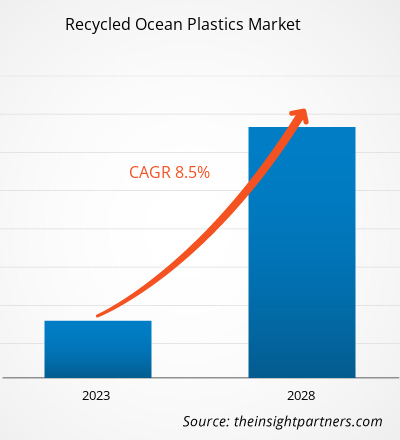
The Recycled Ocean Plastics Market is growing rapidly, driven by increasing end-user demand due to factors such as evolving consumer preferences, technological advancements, and greater awareness of the product's benefits. As demand rises, businesses are expanding their offerings, innovating to meet consumer needs, and capitalizing on emerging trends, which further fuels market growth.
Recycled Ocean Plastics Market Share Analysis by Geography
Asia-Pacific is expected to grow fastest in the coming years. Emerging markets in South & Central America, the Middle East, and Africa also have many untapped opportunities for premium resin producers and sustainable material manufacturers to expand.
The recycled ocean plastics market is undergoing a significant transformation, moving from environmental cleanup projects to a global high-value material supply chain. Growth is driven by the rising prevalence of plastic-free consumer movements and the expansion of the luxury sustainable goods. Below is a summary of market share and trends by region:
North America
- Market Share: A niche but rapidly expanding segment driven by gourmet retail packaging and the growth of high-end sustainable apparel brands.
- Key Drivers:
- Rising consumer preference for traceable and ethical materials
- Mainstreaming of recycled ocean plastic in consumer electronics like laptop housings and speakers.
- Trends: Scaling of modular recycling centers to reduce transport costs and the successful adoption of blockchain-backed certifications to verify environmental impact.
Europe
- Market Share: Holds the largest share globally, anchored by mature recycling ecosystems and the European Green Deal’s strict regulatory frameworks.
- Key Drivers:
- High domestic adoption of recycled resins in the automotive and luxury packaging industries
- Implementation of the EU plastic tax and single-use plastic directives.
- Trends: A strategic shift toward prioritizing high-purity mechanical recycling over lower-grade applications. There is also an increasing focus on Mixed Waste Sorting (MWS) to capture ocean-bound plastics from municipal streams.
Asia-Pacific
- Market Share: The fastest-growing region, with Southeast Asia and India acting as primary collection hubs and manufacturing engines for the textile industry.
- Key Drivers:
- Massive consumer base seeking eco-friendly alternatives
- Government-supported initiatives focused on river waste interception and smart waste management.
- Trends: Heavy reliance on digital mapping and AI-based sorting systems to improve the purity of recovered marine polymers for export to Western markets.
South and Central America
- Market Share: Emerging market with a growing artisanal sector in countries like Brazil, Argentina, and Chile.
- Key Drivers:
- Increasing awareness of the impact of plastic pollution on coastal tourism
- Modernization of small-scale recovery operations into commercial-grade material suppliers.
- Trends: Growth of boutique brands and the introduction of recycled plastic building materials for sustainable urban infrastructure.
Middle East and Africa
- Market Share: Developing market focusing on the formalization of waste collection and the protection of marine ecosystems through commercial recycling.
- Key Drivers:
- High demand for shelf-stable, sustainable packaging in arid climates
- Strategic investments in chemical recycling to process complex marine waste.
- Trends: Implementation of plastic credit schemes to fund coastal cleanup efforts, coupled wth a focus on high-strength polymers for the regional construction segment.
High Market Density and Competition
Competition is intensifying due to the presence of established leaders such as Oceanworks, Tide Ocean SA, and Biffa PLC. Regional specialists and niche players like Aquafil S.p.A. (Italy) and Plastix (Denmark), alongside innovators such as Ocean Plastic Technologies (South Africa), also contribute to a diverse and rapidly expanding market landscape.
This competitive environment pushes vendors to differentiate through:
- Functional Branding: Positioning ocean plastics as a superior environmental choice by highlighting the direct impact on marine life conservation.
- Product Diversification: Expanding beyond simple flakes to include high-end textiles, structural composites, and food-grade resins.
- Supply Chain Control: Managing the entire recovery process to ensure high purity and meet ethical clean-label standards.
Opportunities and Strategic Moves
- Incorporate Blockchain for Traceability: Partner with high-end retail channels and tech providers to deploy blockchain systems that offer secure, transparent tracking of ocean plastics. This builds consumer trust by validating sustainability claims directly from the point of collection to the final product.
- Expansion into Sustainable Construction: Beyond apparel, there is a significant opportunity to use recycled ocean-bound Polyethylene and Polystyrene for high-volume products like eco-friendly lumber, roofing tiles, and modular housing components to achieve industrial scale.
Major Companies operating in the Recycled Ocean Plastics Market are:
- Aquafil S.p.A.
- BIONIC
- Tide Ocean SA
- Oceanworks
- Textil Santanderina
- Envision Plastics
- OceanYarn
- Waste2Wear
- Unifi, Inc.
- SABIC
Disclaimer: The companies listed above are not ranked in any particular order.
Recycled Ocean Plastics Market News and Recent Developments
- In April 2025, UNIFI, Inc., the makers of REPREVE® and one of the world’s leading innovators in recycled and synthetic yarns, launched REPREVE with CiCLO® technology, recycled polyester and nylon embedded with a biodegradable technology that enables synthetics to break down naturally. REPREVE with CiCLO technology was created in collaboration with Intrinsic Advanced Materials, LLC, a joint venture between Parkdale Advanced Materials, Inc. and Intrinsic Textiles Group, LLC.
- In March 2024, Roberts Beauty, in collaboration with Oceanworks®, announced a significant environmental milestone: the removal of 100,000 pounds of plastic waste that was destined for our ocean and their borders through the IMPAC+ program. This collaborative effort reflects the shared commitment of both organizations to sustainability, increasing access to post-consumer recycled ocean-bound plastics, and ocean clean-up. The partnership between Roberts Beauty and Oceanworks® reinforces their pledge to make a difference by helping to curb additions to the global plastic crisis.
Recycled Ocean Plastics Market Report Coverage and Deliverables
The Recycled Ocean Plastics Market Size and Forecast (2021–2034) report provides a detailed analysis of the market covering below areas:
- Recycled Ocean Plastics Market size and forecast at global, regional, and country levels for all the key market segments covered under the scope
- Recycled Ocean Plastics Market trends, as well as market dynamics such as drivers, restraints, and key opportunities
- Detailed PEST and SWOT analysis
- Recycled Ocean Plastics Market analysis covering key market trends, global and regional framework, major players, regulations, and recent market developments
- Industry landscape and competition analysis covering market concentration, heat map analysis, prominent players, and recent developments in the Recycled Ocean Plastics Market.
- Detailed company profiles
Frequently Asked Questions

- Comprehensive Market Sizing and Forecast Analysis
- Detailed Segmentation Analysis
- In-Depth Market Dynamics Assessment
- Regional and Country-Level Insights
- Competitive Landscape and Company Benchmarking
- Strategic Business Intelligence
Recent Reports
Testimonials

The Insight Partners' SCADA System Market report is comprehensive, with valuable insights on current trends and future forecasts. The team was highly professional, responsive, and supportive throughout. We are very satisfied and highly recommend their services.
RAN KEDEM Partner, Reali Technologies LTDs
I requested a report on a very specific software market and the team produced the report in a few days. The information was very relevant and well presented. I then requested some changes and additions to the report. The team was again very responsive and I got the final report in less than a week.
JEAN-HERVE JENN Chairman, Future Analytica
We worked with The Insight Partners for an important market study and forecast. They gave us clear insights into opportunities and risks, which helped shape our plans. Their research was easy to use and based on solid data. It helped us make smart, confident decisions. We highly recommend them.
PIYUSH NAGPAL Sr. Vice President, High Beam Global
The Insight Partners delivered insightful, well-structured market research with strong domain expertise. Their team was professional and responsive throughout. The user-friendly website made accessing industry reports seamless. We highly recommend them for reliable, high-quality research services
YUKIHIKO ADACHI CEO, Deep Blue, LLC.
This is the first time I have purchased a market report from The Insight Partners.While I was unsure at first, I visited their web site and felt more comfortable to take the risk and purchase a market report.I am completely satisfied with the quality of the report and customer service. I had several questions and comments with the initial report, but after a couple of dialogs over email with their analyst I believe I have a report that I can use as input to our strategic planning process.Thank you so much for taking the extra time and making this a positive experience.I will definitely recommend your service to others and you will be my first call when we need further market data.
JOHN SUZUKI President and Chief Executive Officer, Board Director, BK Technologies
I wish to appreciate your support and the professionalism you displayed in the course of attending to my request for information regarding to infectious disease IVD market in Nigeria. I appreciate your patience, your guidance, and the fact that you were willing to offer a discount, which eventually made it possible for us to close a deal. I look forward to engaging The Insight Partners in the future, all thanks to the impression you have created in me as a result of this first encounter.
DR CHIJIOKE ONYIA MANAGING DIRECTOR, PineCrest Healthcare Ltd.Reason to Buy
- Informed Decision-Making
- Understanding Market Dynamics
- Competitive Analysis
- Identifying Emerging Markets
- Customer Insights
- Market Forecasts
- Risk Mitigation
- Boosting Operational Efficiency
- Strategic Planning
- Investment Justification
- Tracking Industry Innovations
- Aligning with Regulatory Trends





 Get Free Sample for