
RF Components Market Trends, Demand & Growth by 2034
Coverage: by Components (RF Filter, Duplexers, Power Amplifiers, Antenna Switches, Demodulators); Application (Consumer Electronics, Automotive, Military, Wireless Communication) , and Geography (North America, Europe, Asia Pacific, and South and Central America)
- Status : Data Released
- Report Code : TIPRE00011326
- Category : Electronics and Semiconductor
- No. of Pages : 150
- Available Report Formats :


- Last update date : September 15, 2026


2025 Market Size
US$ 47.36 Bn
Base year value
2034 Forecast
US$ 89.28 Bn
Projected by 2034
CAGR 2026-2034
7.3 %
Growth rate
Addressable Market
US$ 616.33 Bn
(2026-2034)
The global RF Components market was valued at US$ 47.36 billion in 2025 and is expected to reach US$ 89.28 billion by 2034; it is estimated to record a CAGR of 7.3% during 2026-2034.
RF Components Market Assessment and Insights
- North America: North America is estimated to hold a 28–32% share in 2025 and expand at a 7.6–8.4% CAGR between 2026–2034, supported by defense electronics, wireless infrastructure, satellite systems, and advanced automotive platforms.
- US: The US represents approximately 72–76% of North America's 2025 share and is projected to grow at a 7.7–8.5% CAGR between 2026–2034, led by defense, telecommunications, and semiconductor investment.
- Europe: Europe accounts for a modeled 20–24% share in 2025 and is expected to grow at a 7.3–8.1% CAGR between 2026–2034, with Germany, the UK, France, and Italy supporting automotive, industrial, and defense applications.
- Asia Pacific: Asia Pacific holds an estimated 36–40% share in 2025 and is projected to record a 9.0–9.8% CAGR between 2026–2034, led by China, Japan, South Korea, Taiwan, and India.
- Largest Segment: RF Filter is modeled at a 28–32% market share in 2025, with a 7.9–8.7% CAGR during 2026–2034, reflecting its central role in frequency selectivity and interference control.
- High Growth Segment: Automotive is modeled at a 10–14% share in 2025 and a 10.2–11.2% CAGR during 2026–2034, driven by connected vehicles, ADAS, telematics, and vehicle-to-everything architectures.
- Key companies analyzed in detail: Analog Devices, Inc.; API Technologies Limited; ETL Systems; FUJITSU LIMITED; HUBER+SUHNER; Murata Manufacturing Co., Ltd.; NXP Semiconductors; Qorvo, Inc.; Renesas Electronics Corporation; TDK Corporation.
Source: The Insight Partners' analysis based on proprietary research, government publications, company annual reports, investor presentations, industry databases, and expert interviews.
Wireless electronics technology now tends towards greater channelization, increased bandwidth, stringent filtering, and higher integration levels. RF technologies tend to merge the functions that had earlier been carried out by separate devices, saving space and improving signal quality. This trend will lead to production in more specialized semiconductor technologies, advanced packaging, multilayer substrates, and tightly controlled manufacturing facilities. Supplier differentiation will be based upon frequency range, insertion loss, thermal performance, reliability, and qualification ability.
During the forecast period, investments will not only be made into the well-known smartphone applications but also to emerging applications such as automotive radar, satellite communications, private networks, military equipment, and industrial wireless electronics. Some emerging economies are also trying to enhance their electronics manufacturing capabilities and hence create further manufacturing opportunities. The regulatory requirements in terms of spectrum use and EMC issues are likely to stimulate demand for filters, switches, amplifiers, and signal processing circuits.
RF Components Market Report Scope
| Report Attribute | Details |
|---|---|
| Market size in 2025 | US$ 47.36 Billion |
| Market Size by 2034 | US$ 89.28 Billion |
| Global CAGR (2026 - 2034) | 7.3% |
| Historical Data | 2021-2024 |
| Forecast period | 2026-2034 |
RF Components Market Analysis
Demand for rf components market products is increasingly linked to the number and complexity of wireless subsystems embedded in modern equipment. The rf components growth trajectory is shaped by 5G infrastructure, Wi-Fi evolution, connected vehicles, satellite links, radar, and defense communications. The value chain spans semiconductor materials, wafer fabrication, packaging, passive components, RF modules, system integrators, and original equipment manufacturers, with performance requirements cascading from system specifications to individual components.
Supply dynamics remain influenced by fabrication capacity, specialty materials, packaging availability, and qualification cycles. RF filters, power amplifiers, switches, and demodulators require different process capabilities, making supplier substitution more difficult than in standardized electronic categories. Manufacturers, therefore, balance high-volume consumer orders with longer-cycle automotive and defense programs. Supply-chain resilience, dual sourcing, regional manufacturing, and lifecycle management have become important purchasing criteria for system designers.
The competitive landscape combines diversified semiconductor manufacturers with specialists focused on RF connectivity and high-frequency components. Analog Devices, Inc. and NXP Semiconductors emphasize broad signal-chain and automotive capabilities, while Qorvo, Inc. maintains a strong position in RF front-end and connectivity solutions. Murata Manufacturing Co., Ltd. and TDK Corporation leverage extensive component portfolios, whereas HUBER+SUHNER and ETL Systems address specialized RF connectivity and infrastructure requirements. As indicated in the RF components market forecast, competition is increasingly shaped by performance optimization, integration capabilities, supply-chain resilience, and the growing demand for advanced wireless communication technologies.
Positioning has become more about modules, application-specific solutions, and co-design with equipment makers. Established suppliers like FUJITSU LIMITED, Renesas Electronics Corporation, API Technologies Limited, etc. can derive benefit by leveraging their know-how of RF systems together with RF technology. Areas of investment are higher frequencies, advanced packaging, thermal management, and design tools. Partnerships with telecom, automotive, aerospace, and defense companies have benefits for suppliers in terms of qualification and longer product life cycles.
● REPORT CUSTOMIZATION
Tailor This Report To Align With Your Specific Business Requirements
This report can be customized to align precisely with your business objectives, scope, and target markets. Customization options include tailored segmentation, geography, competitive analysis, and strategic insights to support informed decision-making.
Customize This Report →WHAT YOU CAN ADJUST
- ● Segmentations
- ● Geography
- ● Competitive Analysis
- ● Language Preferences
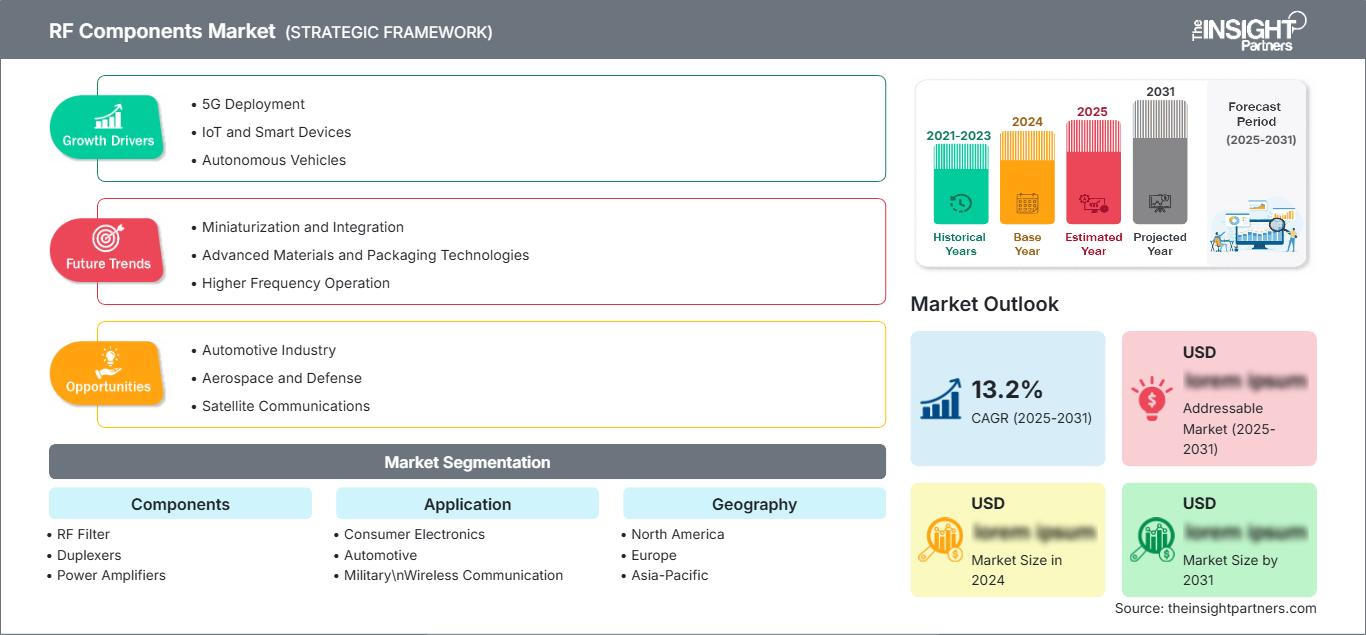
RF Components Market: Strategic Insights
Regional Insights
North America rf components market
North America represents 28–32% of 2025 global rf components market demand and is modeled to grow at 7.6–8.4% CAGR through 2034. US leads the region in terms of consumption due to the need for a performance RF signal chain owing to defense electronics, wireless infrastructure, satellite communication, and semiconductor design operations. Canadian participation comes from aerospace, telecommunications, and electronics manufacturing.
Regional procurement trends now take into account more resilient supply and technology requirements within the domestic jurisdiction. The defense industry demands quality components with extended life cycles, while the commercial players focus on architecture efficiency for dense wireless deployments. There is an automotive connectivity sector that continues to grow and includes telematics, radar, and vehicle networking.
U.S. rf components Market
The US represents approximately 72–76% of North America's 2025 rf components market share and is expected to expand at a 7.7–8.5% CAGR through 2034. The demand exists in the areas of defense radars, satellites, telecommunication, automotive electronic products, and industrial wireless products. Domestic providers of technologies for commercial and governmental radio frequency development exist.
The demands that are posed on the applications require high linearity, low noise characteristics, thermal stability, and multi-band operation. Some of the companies that provide solutions for radio frequencies are Analog Devices, Inc., Qorvo, Inc., and API Technologies Limited. The defense industry favors high qualification in the products, while in the automotive industry compactness and low energy consumption are important.
Europe rf components Market
Europe is modeled at a 20–24% share of the rf components market in 2025 with a projected 7.3–8.1% CAGR through 2034. Germany leads regional demand, supported by automotive electronics and industrial manufacturing. The UK contributes through aerospace, defense, telecommunications, and research-intensive RF applications. France maintains its importance through defense and aerospace programs.
Germany has a broad automotive electronics base, creating demand for RF components used in connected vehicles, radar, navigation, and wireless diagnostics. France benefits from aerospace and defense electronics, while Italy and Spain contribute through automotive, industrial automation, telecommunications, and infrastructure modernization. European suppliers also emphasize electromagnetic compatibility, energy efficiency, and component reliability.
APAC rf components Market
APAC holds an estimated 36–40% share of the rf components market in 2025 and is forecast to expand at a 9.0–9.8% CAGR, with China leading. Japan and South Korea contribute through electronics manufacturing, while India and Australia are expanding telecommunications, defense, and industrial applications. Regional electronics supply chains support cost-efficient production and rapid commercialization.
Industrial policies promoting semiconductor and electronics localization reinforce regional investment. Smartphone production remains important, but automotive connectivity, 5G infrastructure, satellite communications, and industrial wireless systems are broadening the demand base. China remains the principal regional market because of its manufacturing scale and extensive electronics consumption.
Middle East & Africa rf components Market
The Middle East and Africa rf components market demand is projected to expand at a 6.8–7.6% CAGR through 2034, with the UAE and Saudi Arabia leading regional adoption. Investments in telecommunications, smart infrastructure, satellite connectivity, and defense electronics create demand for reliable RF systems. South Africa remains important for industrial, communications, and specialized technology applications.
Saudi Arabia's digital infrastructure programs and the UAE's communications and aerospace investments support RF equipment deployment. South Africa contributes through telecommunications and industrial systems, while the rest of MEA remains tied to infrastructure modernization and energy-sector communications. Harsh operating environments increase requirements for thermal stability, reliability, and lifecycle support.
Segmentation Analysis
Components
Components represent the principal value concentration within the market because filters, duplexers, power amplifiers, antenna switches, and demodulators collectively determine signal quality and RF front-end efficiency. The RF components market report therefore, highlights the close relationship between component integration and frequency complexity. This segment is modeled to grow at a 7.8–8.6% CAGR during 2026–2034, supported by expanding wireless architectures.
- RF Filter: RF filters remain essential for frequency selectivity, interference suppression, and coexistence among multiple communication bands. Demand increases as equipment incorporates additional radios and wider bandwidths within constrained physical designs.
- Duplexers: Duplexers support simultaneous transmission and reception through shared antenna paths. Their strategic importance increases in compact wireless devices where isolation, insertion loss, and miniaturization directly influence system performance.
- Power Amplifiers: Power amplifiers determine transmit efficiency and coverage capability. Demand is supported by higher data rates, greater network density, automotive communications, and defense systems requiring reliable high-power transmission.
- Antenna Switches: Antenna switches manage multiple signal paths and frequency bands. Their value rises with multi-band smartphones, connected vehicles, Wi-Fi equipment, and increasingly complex RF front-end architectures.
- Demodulators: Demodulators convert modulated RF signals into usable information and remain important in communication receivers, test systems, radio equipment, and specialized industrial and defense applications.
Application
Application segmentation reflects differences in RF frequency, power, integration, reliability, and lifecycle requirements. The segment is expected to grow at a 8.1–9.0% CAGR during 2026–2034, with consumer electronics providing volume while automotive and military systems increasingly contribute higher-value demand. RF components market trends indicate that application-specific qualification remains a key determinant of supplier selection, particularly as end-use requirements become more complex and performance-driven.
- Consumer Electronics: Smartphones, tablets, routers, and connected devices require compact RF chains supporting multiple standards, bands, and antennas while maintaining low power consumption and high signal integrity.
- Automotive: Connected vehicles, radar, telematics, navigation, and V2X systems require qualified RF components capable of operating under demanding temperature, vibration, and electromagnetic conditions.
- Military: Military communications, radar, electronic warfare, and secure networking require specialized RF performance, ruggedization, long lifecycles, and controlled supply arrangements for mission-critical platforms.
Opportunity Snapshot
| Application | Revenue Contribution | Trend Tag | Adoption Stage |
| Consumer Electronics | High | Multi-band RF | Mature |
| Automotive | Medium | Vehicle Radar | Scaling |
| Military | Medium | Secure Radar | Scaling |
RF Components Market Growth Drivers and Impact Analysis
Expansion of Multi-Band Wireless Infrastructure
The proliferation of cellular, Wi-Fi, private wireless, satellite, and industrial communication networks increases the number of RF paths required within network equipment and connected devices. Operators are deploying architectures that must manage multiple frequencies while limiting interference and maintaining energy efficiency. This directly raises demand for filters, duplexers, switches, amplifiers, and signal-conditioning devices with tighter electrical specifications. As highlighted in the RF components market report, equipment manufacturers increasingly favor integrated RF solutions because they simplify board layouts and reduce component count. The impact extends across base stations, customer-premises equipment, routers, enterprise networks, and satellite terminals. Suppliers capable of supporting multiple frequency ranges and delivering consistent performance at scale are therefore positioned to secure broader design wins. This driver also encourages investment in advanced packaging and higher-frequency process technologies.
Increasing RF Complexity in Connected Vehicles
With advancements in modern automobiles where there is an integration of cellular connectivity, GNSS, Wi-Fi, Bluetooth, V2X, radar, keyless entry, and multiple ECUs, there is an emergence of a more challenging RF environment. With the evolving nature of vehicle architecture that is becoming more and more software-defined, there will be a need for wireless technology to be able to deliver better throughput and interoperability capabilities. This means that the RF products have to perform consistently over a wide range of operations while meeting the strict qualification demands of the automotive industry. There is a huge market effect since automotive designs usually entail long lead times and validation processes. The emergence of radar applications entails the requirement for products that can work at high frequencies with low losses.
Defense and Aerospace Modernization
Increased defense modernization is raising the demand for advanced RF technology applications in radar, electronic warfare, secure communication, satellite and surveillance systems. Such applications have requirements for agility, low noise, high power, durability, and long-term availability of the product. Unlike other mass market consumer products, defense applications prefer to have history, traceability, and sourcing of the components used in their program. Such an environment will make a supplier that offers unique manufacturing processes and has a strong defense contractor relationship be at an advantage. Investment in advanced radar and electronic warfare platforms will result in increased demand for advanced switches, amplifiers and filters. The effect is not limited only to selling the components, as defense programs provide opportunities for engineering and qualification revenue.
RF Components Market Future Trends
Integration of RF Functions Into Compact Modules
The rf components trends landscape is moving toward greater functional integration as designers seek smaller footprints, lower parasitic losses, simplified assembly, and improved thermal management. RF filters, switches, amplifiers, and other functions are increasingly combined into modules rather than deployed exclusively as individual components. Over time, module-level optimization should become more important in smartphones, automotive telematics, wireless infrastructure, and satellite equipment. Advanced packaging will support shorter signal paths and improved electrical performance while helping manufacturers manage increasingly dense circuit layouts. Suppliers are also likely to strengthen co-design capabilities with original equipment manufacturers, enabling RF architectures to be optimized earlier in the development cycle. This transition could shift competitive differentiation from individual component specifications toward complete front-end performance, lifecycle reliability, and application-specific integration.
Higher-Frequency Architectures and Advanced Materials
The future of wireless and sensor technologies will involve increasingly difficult frequency spectra, presenting possibilities for materials and manufacturing technologies that have low losses and consistent performance characteristics. Compound semiconductors, advanced silicon technologies, specialized substrates, and packaging advances will all help facilitate designs at higher RF frequencies. Applications will include automotive radar, satellite communication, military equipment, and wireless network infrastructure. Manufacturers will be required to utilize modeling, heat dissipation simulation, and electromagnetic simulation technologies in order to accelerate design cycles and optimize initial performance. This technological revolution will further make manufacturing accuracy more significant, as even minor differences can have a large impact on insertion loss, phase, gain, or isolation characteristics at higher frequencies.
RF Components Market Opportunities
Localized RF Supply Chains in Emerging Electronics Hubs
The rf components forecast outlook creates opportunities for manufacturers and investors to establish regional production, packaging, testing, and distribution capabilities closer to major electronics clusters. The Asia-Pacific region continues to be key to manufacturing, but India and other developing markets have been growing more capable of building their own semiconductor and electronics environments. Localization could help minimize logistics risks, cut qualification cycle times, and boost responsiveness for automotive, telecoms, and industrial customers. Investors can focus on specialized packaging, RF testing, substrate manufacturing, and component assembly as opposed to trying to duplicate full semiconductor environments. Partnering strategically with electronics producers in these regions could give investors a foothold in the market without the upfront risk. In the long run, regional diversity of capacity will become a critical factor for customers needing continuity of supply.
Application-Specific RF Platforms for Automotive and Defense
The rf components analysis indicates an opportunity to develop highly integrated RF platforms tailored to specific system architectures rather than selling isolated components. Filters, switches, amplifiers, and signal processors with controlled electrical properties are necessary for automotive radar, telematics, V2X, military communications, and electronic warfare. The suppliers may increase the value of their offerings by integrating hardware, reference designs, simulation software, qualification, and lifecycle services. This will decrease integration costs for customers and foster engineering collaboration. Investments should focus on platforms that are capable of being modified for successive generations of products while retaining their proven performance. Companies possessing complementary competencies in semiconductors, packaging, and RF can make use of collaborations or strategic acquisitions.
Frequently Asked Questions

- Comprehensive Market Sizing and Forecast Analysis
- Detailed Segmentation Analysis
- In-Depth Market Dynamics Assessment
- Regional and Country-Level Insights
- Competitive Landscape and Company Benchmarking
- Strategic Business Intelligence
Recent Reports
Testimonials

The Insight Partners' SCADA System Market report is comprehensive, with valuable insights on current trends and future forecasts. The team was highly professional, responsive, and supportive throughout. We are very satisfied and highly recommend their services.
RAN KEDEM Partner, Reali Technologies LTDs
I requested a report on a very specific software market and the team produced the report in a few days. The information was very relevant and well presented. I then requested some changes and additions to the report. The team was again very responsive and I got the final report in less than a week.
JEAN-HERVE JENN Chairman, Future Analytica
We worked with The Insight Partners for an important market study and forecast. They gave us clear insights into opportunities and risks, which helped shape our plans. Their research was easy to use and based on solid data. It helped us make smart, confident decisions. We highly recommend them.
PIYUSH NAGPAL Sr. Vice President, High Beam Global
The Insight Partners delivered insightful, well-structured market research with strong domain expertise. Their team was professional and responsive throughout. The user-friendly website made accessing industry reports seamless. We highly recommend them for reliable, high-quality research services
YUKIHIKO ADACHI CEO, Deep Blue, LLC.
This is the first time I have purchased a market report from The Insight Partners.While I was unsure at first, I visited their web site and felt more comfortable to take the risk and purchase a market report.I am completely satisfied with the quality of the report and customer service. I had several questions and comments with the initial report, but after a couple of dialogs over email with their analyst I believe I have a report that I can use as input to our strategic planning process.Thank you so much for taking the extra time and making this a positive experience.I will definitely recommend your service to others and you will be my first call when we need further market data.
JOHN SUZUKI President and Chief Executive Officer, Board Director, BK Technologies
I wish to appreciate your support and the professionalism you displayed in the course of attending to my request for information regarding to infectious disease IVD market in Nigeria. I appreciate your patience, your guidance, and the fact that you were willing to offer a discount, which eventually made it possible for us to close a deal. I look forward to engaging The Insight Partners in the future, all thanks to the impression you have created in me as a result of this first encounter.
DR CHIJIOKE ONYIA MANAGING DIRECTOR, PineCrest Healthcare Ltd.Reason to Buy
- Informed Decision-Making
- Understanding Market Dynamics
- Competitive Analysis
- Identifying Emerging Markets
- Customer Insights
- Market Forecasts
- Risk Mitigation
- Boosting Operational Efficiency
- Strategic Planning
- Investment Justification
- Tracking Industry Innovations
- Aligning with Regulatory Trends





 Get Free Sample for