
RF Semiconductor Market Size, Growth & Trends by 2034
Coverage: By Device (Power Amplifiers, Duplexers, Switches, Others); Material (Gallium Arsenide, Silicon, Silicon Germanium, Gallium Nitride, Others); Frequency (VHF and UHF, SHF, EHF); End-user (Consumer Devices, Telecom, Automotive, Aerospace and Defense, Manufacturing, Others), and Geography (North America, Europe, Asia Pacific, and South and Central America)
- Status : Data Released
- Report Code : TIPRE00011142
- Category : Electronics and Semiconductor
- No. of Pages : 150
- Available Report Formats :


- Last update date : September 10, 2026


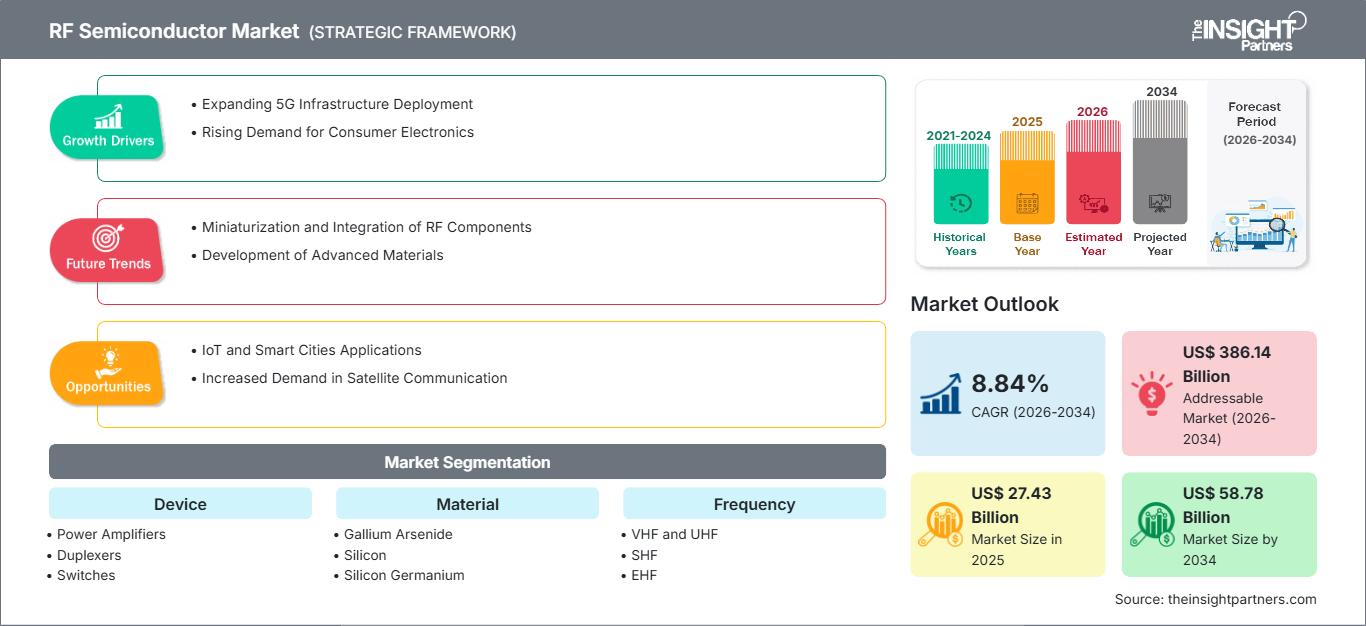
2025 Market Size
US$ 27.43 Bn
Base year value
2034 Forecast
US$ 58.78 Bn
Projected by 2034
CAGR 2026-2034
8.84 %
Growth rate
Addressable Market
US$ 386.14 Bn
(2026-2034)
The rf semiconductor market is positioned at the intersection of wireless connectivity, high-frequency electronics, and increasingly sophisticated radio architectures. The market was valued at US$ 27.43 Billion in 2025 and is projected to reach US$ 58.78 Billion by 2034, expanding at a CAGR of 8.84% during 2026–2034. Growth reflects increasing RF content in connected devices, telecom infrastructure, automotive electronics, aerospace systems, and industrial communication equipment requiring higher frequency performance and integration.
North America remains strategically important because of advanced defense electronics, 5G infrastructure, satellite communications, and semiconductor manufacturing investments. The rf semiconductor market size is expected to expand at an estimated 8.0–9.0% CAGR through 2034, supported by the modernization of radar and electronic warfare platforms and continued investment in domestic semiconductor production capacity.
RF Semiconductor Market Assessment and Insights
- North America: North America is expected to account for a 31–35% share in 2025 and expand at a CAGR of 8.0–9.0% between 2026–2034, supported by defense modernization, telecom infrastructure, satellite systems, and advanced semiconductor manufacturing.
- US: The US is estimated to represent 78–82% of North America's 2025 market and grow at a CAGR of 8.2–9.2% during 2026–2034, led by defense, wireless infrastructure, and aerospace applications.
- Europe: Europe is projected to hold a 20–24% share in 2025 and grow at a CAGR of 7.0–8.0%, with Germany, France, the UK, Italy, and Spain supporting automotive, industrial, aerospace, and telecommunications demand.
- Asia Pacific: Asia Pacific is estimated at a 30–34% share in 2025 and is expected to grow at a CAGR of 9.0–10.0%, with China, Japan, South Korea, India, and Taiwan anchoring electronics manufacturing and wireless infrastructure.
- Largest Segment: Power amplifiers are estimated to command a 34–38% market share in 2025 and expand at a CAGR of 8.0–9.0%, reflecting their central role in RF transmission architectures.
- High Growth Segment: Gallium nitride is estimated to represent a 14–18% market share in 2025 and grow at a CAGR of 12.0–14.0%, driven by high-power, high-frequency applications.
- Key companies analyzed in detail: Aethercomm, Analog Devices, Inc., MACOM Technology Solutions, Murata Manufacturing Co., Ltd., NXP Semiconductors N.V., Qorvo, Inc., Qualcomm Technologies, Inc., Skyworks Solutions, Inc., Texas Instruments Incorporated, Toshiba Corporation.
Source: The Insight Partners' analysis based on proprietary research, government publications, company annual reports, investor presentations, industry databases, and expert interviews.
The rf semiconductor market has evolved from discrete radio components toward highly integrated architectures combining amplification, switching, filtering, frequency conversion, and signal management. Silicon remains important for cost-sensitive applications, while GaAs and GaN increasingly address demanding frequency, power, and efficiency requirements. Production strategies are also shifting toward specialized process technologies, trusted domestic manufacturing, and application-specific RF front-end integration for telecom, defense, automotive, and consumer systems.
Over the forecast period, demand is expected to broaden beyond smartphones toward private networks, connected vehicles, satellite communications, radar, industrial automation, and advanced aerospace platforms. As highlighted in the RF semiconductor market report, investment in domestic semiconductor ecosystems, defense electronics, and 5G infrastructure should support regional diversification. Regulatory initiatives promoting resilient semiconductor supply chains may further encourage local fabrication, packaging, and specialized RF manufacturing capacity across North America, Europe, and Asia Pacific.
RF Semiconductor Market Report Scope
| Report Attribute | Details |
|---|---|
| Market size in 2025 | US$ 27.43 Billion |
| Market Size by 2034 | US$ 58.78 Billion |
| Global CAGR (2026 - 2034) | 8.84% |
| Historical Data | 2021-2024 |
| Forecast period | 2026-2034 |
RF Semiconductor Market Analysis
The rf semiconductor market growth is being supported by increasing radio complexity, higher antenna counts, wider bandwidth requirements, and rising transmission efficiency expectations. Ecosystem participants include semiconductor designers, compound semiconductor producers, foundries, packagers, RF module vendors, equipment makers, and systems integrators. Consumer demands continue to favor those components that exhibit low insertion losses, linear performance, and multiband capabilities with small physical size.
There continues to be differentiation in the supply chain with respect to materials and technologies employed. While silicon-based RF components have the advantage of mature production facilities, GaAs and GaN require more specialized manufacturing processes and substrates. The planned 2025 takeover of operations at its North Carolina-based wafer production plant by MACOM Technology Solutions shows the importance of GaN on SiC capacity.
Positioning in competition has become increasingly reliant on technology diversity, production capabilities, customer qualifications, and the ability to meet application-specific performance needs. Analog Devices, Inc., Murata Manufacturing Co., Ltd., NXP Semiconductors N.V., Qualcomm Technologies, Inc., and Texas Instruments Incorporated have extensive semiconductor offerings, whereas Qorvo, Inc., Skyworks Solutions, Inc., and MACOM Technology Solutions offer their specialization in radio frequency and connectivity technologies.
Strategic investment is also encouraging consolidation and portfolio expansion. In October 2025, Skyworks Solutions, Inc. announced an agreement to combine with Qorvo, Inc., creating a proposed US-based RF, analog, and mixed-signal semiconductor company with a transaction value of approximately US$22 billion. The transaction is expected to close in early 2027, subject to approvals.
● REPORT CUSTOMIZATION
Tailor This Report To Align With Your Specific Business Requirements
This report can be customized to align precisely with your business objectives, scope, and target markets. Customization options include tailored segmentation, geography, competitive analysis, and strategic insights to support informed decision-making.
Customize This Report →WHAT YOU CAN ADJUST
- ● Segmentations
- ● Geography
- ● Competitive Analysis
- ● Language Preferences
RF Semiconductor Market: Strategic Insights
Regional Insights
North America rf semiconductor market
North America is estimated to represent 31–35% of global rf semiconductor market revenue in 2025, with a projected CAGR of 8.0–9.0% through 2034. The region benefits from defense procurement, satellite communications, advanced radar, electronic warfare, and expanding wireless infrastructure. The US remains the principal demand center because of its extensive semiconductor design ecosystem and concentration of aerospace and defense contractors.
Investment in resilient domestic semiconductor capacity is reinforcing regional supply capabilities. Specialized RF fabrication is particularly relevant for GaAs and GaN devices, where process qualification and substrate availability influence system performance. Defense modernization creates demand for high-power amplifiers, low-noise devices, switches, and frequency components, while telecom operators support additional requirements for high-linearity RF architectures. Canada contributes specialized research and telecommunications activity, although its market remains materially smaller than that of the US.
U.S. rf semiconductor Market
The US is estimated to represent 78–82% of North America's 2025 rf semiconductor market revenue and is projected to grow at a CAGR of 8.2–9.2%. Demand is concentrated in aerospace and defense, telecom infrastructure, satellite communications, automotive electronics, and advanced industrial systems. Such a robust ecosystem of design in-country contributes to developing products in RF integrated circuits, power amplifiers, switches, and customized microwave components.
Companies like Aethercomm, Analog Devices, Inc., MACOM Technology Solutions, Qorvo, Inc., Qualcomm Technologies, Inc., Skyworks Solutions, Inc., and Texas Instruments Incorporated hold relevant market positions in the US for diverse RF applications. The nation is also building manufacturing resilience in the form of trusted fab programs and semiconductor investments. Defense applications tend to focus on higher power and higher frequencies, whereas commercial applications seek integration and multi-band performance.
Europe rf semiconductor Market
Europe is estimated to account for 20–24% of 2025 rf semiconductor market revenue and expand at a CAGR of 7.0–8.0%. The key regional market is Germany, driven by automotive electronics, industrial automation, and semiconductor fabrication. In addition, the United Kingdom and France play an important role in terms of aerospace, defense, telecommunications, and research, while Italy and Spain add industrial and automotive applications. The strategy of the European semiconductor industry focuses on reliability and technology independence.
The importance of Germany is due to the automotive and industrial electronics that need reliable RF sensing and communications. France and the United Kingdom have strong aerospace and defense applications, where radar systems, electronic warfare, and communications require advanced RF semiconductor technologies. Italy and Spain contribute to the industrial, automotive, telecom, and infrastructure sectors. Infineon Technologies AG and other European semiconductor manufacturers boost regional development, but the Asia Pacific region still has an important manufacturing base.
APAC rf semiconductor Market
APAC is estimated to hold 30–34% of the 2025 rf semiconductor market revenue and grow at a CAGR of 9.0–10.0%, making it the leading regional growth engine. China leads regional demand, followed by Japan, South Korea, India, and Australia. Large electronics manufacturing ecosystems, telecom investment, automotive electrification, and expanding semiconductor capacity support consumption.
China's communications and electronics industries provide substantial volume, while Japan and South Korea contribute advanced semiconductor and consumer electronics capabilities. India is increasing its telecom and electronics manufacturing capacity, and Australia contributes to specialized defense and communications demand. Regional policy support for semiconductor localization, 5G deployment, and electronics manufacturing should reinforce the supply ecosystem.
Middle East & Africa rf semiconductor Market
The Middle East and Africa rf semiconductor market demand remains smaller but strategically relevant for telecom infrastructure, satellite connectivity, defense electronics, and energy systems. Saudi Arabia and the UAE lead regional investment, while South Africa supports industrial and telecommunications applications. The region is estimated to expand at a CAGR of 6.5–7.5% through 2034.
Saudi Arabia's digital infrastructure and aerospace ambitions, together with UAE investments in communications and space technologies, create specialized RF opportunities. South Africa contributes through telecommunications and defense-related applications, while the rest of MEA is influenced by network expansion and infrastructure modernization. Energy infrastructure also creates demand for reliable industrial communications and monitoring systems.

Segmentation Analysis
Device
The Device segment is expected to expand at a CAGR of 8.0–9.0% during 2026–2034. Increasing RF chain complexity, higher transmission efficiency requirements, and integration of multiple functions into compact modules support demand. Power amplifiers remain particularly important because they directly influence transmission range, energy consumption, and system performance across wireless infrastructure, consumer electronics, automotive radar, and aerospace platforms. The RF semiconductor market continues to benefit from growing demand for high-performance wireless connectivity solutions and the increasing deployment of advanced communication technologies across multiple end-use industries.
- Power Amplifiers: Power amplifiers maintain the leading device position because transmit architectures require efficient signal amplification across mobile, telecom, radar, satellite, and industrial systems.
- Duplexers: Duplexers remain essential in frequency-division architectures, enabling simultaneous transmission and reception while limiting interference between closely spaced transmit and receive paths.
- Switches: RF switches support antenna selection, band switching, signal routing, and increasingly complex multi-band architectures in connected devices and infrastructure equipment.
- Others: Other devices address specialized signal-chain requirements, including frequency conversion, filtering, detection, and supporting functions used across application-specific RF architectures.
Material
The Material segment is projected to grow at a CAGR of 9.0–10.0% during 2026–2034. Material selection increasingly depends on frequency, power density, thermal management, efficiency, cost, and integration requirements. Silicon retains broad volume relevance, while GaAs and GaN benefit from higher-frequency and higher-power applications requiring performance beyond conventional silicon architectures. RF semiconductor market trends indicate that manufacturers are increasingly optimizing material platforms to balance performance, scalability, and cost across diverse wireless and high-frequency applications.
- Gallium Arsenide: Gallium arsenide remains important for high-frequency amplification and low-noise applications where electron mobility and established RF manufacturing processes support demanding performance requirements.
- Silicon: Silicon provides cost, availability, and manufacturing-scale advantages, supporting high-volume consumer, automotive, industrial, and communications applications where integration and economics are critical.
- Silicon Germanium: Silicon germanium serves high-frequency integrated applications requiring strong RF performance with compatibility with silicon manufacturing, particularly in communications, sensing, and automotive electronics.
- Gallium Nitride: Gallium nitride is increasingly selected for high-power and high-frequency systems because of strong power density, efficiency, and thermal performance across defense, telecom, and satellite applications.
Frequency
The Frequency segment is forecast to grow at a CAGR of 8.5–9.5% through 2034. Demand is shifting toward higher frequencies as wireless networks, radar, satellite communications, and sensing systems require greater bandwidth and resolution. Device architecture increasingly depends on minimizing losses while maintaining linearity and stable operation across wider frequency ranges. The RF semiconductor market share is increasingly influenced by suppliers capable of delivering high-performance solutions for advanced frequency bands and next-generation wireless applications.
- VHF and UHF: VHF and UHF remain established across communications, broadcasting, defense, industrial telemetry, and public-safety systems where coverage and penetration remain important.
- SHF: SHF supports microwave communications, radar, wireless infrastructure, satellite links, and industrial applications requiring greater bandwidth and directional transmission capabilities.
- EHF: EHF addresses emerging high-capacity communications, advanced radar, sensing, and experimental systems where very high bandwidth and compact antenna architectures justify higher component complexity.
End-user
The End-user segment is expected to register a CAGR of 8.0–9.0% during 2026–2034. Adoption is broadening from mobile devices toward automotive radar, aerospace systems, industrial connectivity, and advanced telecom infrastructure. The resulting demand profile favors reliable, application-specific RF solutions with greater integration, thermal stability, frequency flexibility, and lifecycle support.
- Consumer Devices: Consumer devices generate substantial RF volumes through smartphones, wearables, connected home products, tablets, and other wireless electronics requiring compact multi-band front ends.
- Telecom: Telecom remains strategically important because network densification, advanced cellular standards, massive MIMO, and fixed wireless access require increasingly capable RF chains.
- Automotive: Automotive adoption is increasing through radar, vehicle connectivity, telematics, and software-defined vehicle architectures requiring dependable high-frequency signal processing and communications.
- Aerospace and Defense: Aerospace and defense applications prioritize high power, reliability, frequency agility, and radiation tolerance across radar, electronic warfare, satellite, and secure communications systems.
- Manufacturing: Manufacturing applications increasingly use RF-enabled connectivity, sensing, automation, and industrial wireless networks requiring robust operation in demanding environments.
- Others: Other users include healthcare, infrastructure, research, energy, and specialized communications systems with application-specific requirements for RF performance and reliability.
Opportunity Snapshot
| End-user | Revenue Contribution (High/Medium/Low) | Trend Tag (MAX 2 words) | Adoption Stage (Emerging/Scaling/Mature) |
| Consumer Devices | High | Multi-band RF | Mature |
| Telecom | High | Massive MIMO | Scaling |
| Automotive | Medium | Radar Fusion | Scaling |
| Aerospace and Defense | Medium | EW Modernization | Scaling |
| Manufacturing | Medium | Industrial Wireless | Scaling |
| Others | Low | Specialized RF | Emerging |
RF Semiconductor Market Growth Drivers and Impact Analysis
5G Network Densification and Radio Complexity
Wireless infrastructure is increasingly turning into a more powerful force as carriers begin rolling out denser infrastructures, higher bandwidths, massive MIMO infrastructure, and multiband radios. Every new frequency band increases the need for amplification, switching, filtering, and routing of signals, hence, more RF components per node. The economic implications are not limited to macro cell sites as small cells, fixed wireless access gear, private networks, and enterprise connectivity infrastructure all require specialized RF architecture. Suppliers of semiconductor products that are able to offer high linearity with low power consumption will be able to cater to the needs of operators to make efficient networks. The development of sophisticated cellular infrastructure also pushes companies to invest in packaging and RF module integration.
Defense Modernization and Electronic Warfare Requirements
Defense electronics procurement is creating growing technical demands on RF components, especially radar, electronic warfare, secure communications, missiles, and UAVs. There is an increased need for modern systems to be agile with frequency, have wide instantaneous bandwidths, and be of high power density and small form factors. Compound semiconductor technology and advanced RF architectures that work effectively in difficult environments are preferred. This creates a significant market effect since the qualification process takes a long time, and wins result in a long lifecycle for products. This makes the relationships that companies have regarding manufacturing and application engineering become strategically valuable beyond the price of components. Increased spending on defense electronics in North America, Europe, and Asia Pacific encourages local supply chains for special RF technologies.
Automotive Connectivity and High-Frequency Sensing
Automotive electronics will create additional applications for RF technology in addition to standard connections. RF components must be highly accurate in terms of frequency for radar sensing and measurements. Additionally, connected cars will require cellular, Wi-Fi, GNSS, Bluetooth and many other types of wireless technologies. Electrification of automotive architecture, together with software-defined vehicles, will lead to additional electronics content and communication interfaces. This will drive the need for compact RF modules with consistent thermal behavior and good EMC characteristics. For semiconductor providers, this will be particularly important due to the long life cycle and stability of the design that results from the automotive qualification process. With the trend toward consolidation of electronic control architectures, RF providers could benefit from integration of RF front ends to minimize board complexity.
RF Semiconductor Market Future Trends
AI-Assisted RF Design and Adaptive Radio Architectures
The advent of AI in electronic design could have an impact on RF semiconductor designs through fast modeling of devices, optimization of circuits, layout exploration, and overall tuning. Investigations have been done to see how machine learning approaches can be applied to analog and RF electronic design automation processes in terms of topology generation, device sizing, placement, routing, and optimization of constraints. As time goes by, these approaches could result in reducing development times of sophisticated RF front-end designs while allowing more design space to be explored. Adaptive radios could become capable of combining digitally controlled tuning and intelligent calibration processes, which allow devices to be compensated in relation to temperature, aging, process, and operation conditions variations. As a result, competitive advantage might be based not only on transistors but also on software-based architecture, RF platform, and calibration algorithms.
Higher-Frequency Architectures and Advanced Compound Materials
Further advancement in the development of RF technology will be marked by increased adoption of compound semiconductors, as well as increased frequency systems. High power applications will make use of GaN materials, while high frequency applications will require GaAs. Investigations on ultra-wide bandgap materials, including diamond, AlN, and GaO, will look into future possibilities for higher frequency and higher power electronics. Thermal management will continue to be critical since high power density requires higher dissipation of heat. As a result, packaging, substrate development, and interconnections will assume as much importance as the transistors themselves. Adoption of new materials in commercial production will continue to be selective until better wafer availability, defect control, and economic manufacturing are achieved.
RF Semiconductor Market Opportunities
Localized RF Manufacturing and Trusted Supply Chains
The rf semiconductor market Forecasts indicate an expanding strategic opportunity for localized RF manufacturing as governments and system integrators seek greater control over semiconductor supply chains. Specialized GaAs and GaN fabrication remains concentrated among a limited number of suppliers, creating opportunities for domestic capacity, trusted foundries, advanced packaging, and qualified substrate production. Investors can target facilities serving defense, satellite, telecom, and industrial customers where qualification requirements create meaningful barriers to entry. The strongest opportunities are likely to involve specialized process technologies rather than commodity manufacturing, because application-specific RF products can justify higher engineering intensity. Companies developing secure manufacturing, process transfer, packaging integration, and long-term supply agreements may therefore capture value as customers diversify sourcing and seek greater resilience against geopolitical and logistics disruptions.
Integrated RF Platforms for Satellite and Private Networks
Both satellite communications and wireless private networks represent promising growth opportunities since they are characterized by custom RF implementations that consider trade-offs between range, throughput, power efficiency, and form factor. Satellite Internet necessitates the development of high-frequency amplifiers, converters, switches, and beam-forming components, whereas wireless private networks will require reliable radio communications for industrial sites, ports, utility companies, and transport infrastructure. Companies can leverage these trends by offering their products and technologies in the form of application-specific modules or reference designs that facilitate the integration process of their customers. Such commercial opportunities include not only selling the devices but also providing various engineering services, qualification, and lifecycle management due to the nature of operation of such systems under strict reliability requirements.
Frequently Asked Questions

- Comprehensive Market Sizing and Forecast Analysis
- Detailed Segmentation Analysis
- In-Depth Market Dynamics Assessment
- Regional and Country-Level Insights
- Competitive Landscape and Company Benchmarking
- Strategic Business Intelligence
Recent Reports
Testimonials

The Insight Partners provided valuable market intelligence that supported our global go-to-market strategy. Their team was professional, responsive, and attentive to our feedback, providing thoughtful analysis and helpful methodological clarifications throughout the project.
Junmo Kim Chief Financial Officer (CFO), Enertech Co., Ltd.
The Insight Partners' SCADA System Market report is comprehensive, with valuable insights on current trends and future forecasts. The team was highly professional, responsive, and supportive throughout. We are very satisfied and highly recommend their services.
RAN KEDEM Partner, Reali Technologies LTDs
I requested a report on a very specific software market and the team produced the report in a few days. The information was very relevant and well presented. I then requested some changes and additions to the report. The team was again very responsive and I got the final report in less than a week.
JEAN-HERVE JENN Chairman, Future Analytica
We worked with The Insight Partners for an important market study and forecast. They gave us clear insights into opportunities and risks, which helped shape our plans. Their research was easy to use and based on solid data. It helped us make smart, confident decisions. We highly recommend them.
PIYUSH NAGPAL Sr. Vice President, High Beam Global
The Insight Partners delivered insightful, well-structured market research with strong domain expertise. Their team was professional and responsive throughout. The user-friendly website made accessing industry reports seamless. We highly recommend them for reliable, high-quality research services
YUKIHIKO ADACHI CEO, Deep Blue, LLC.
This is the first time I have purchased a market report from The Insight Partners.While I was unsure at first, I visited their web site and felt more comfortable to take the risk and purchase a market report.I am completely satisfied with the quality of the report and customer service. I had several questions and comments with the initial report, but after a couple of dialogs over email with their analyst I believe I have a report that I can use as input to our strategic planning process.Thank you so much for taking the extra time and making this a positive experience.I will definitely recommend your service to others and you will be my first call when we need further market data.
JOHN SUZUKI President and Chief Executive Officer, Board Director, BK Technologies
I wish to appreciate your support and the professionalism you displayed in the course of attending to my request for information regarding to infectious disease IVD market in Nigeria. I appreciate your patience, your guidance, and the fact that you were willing to offer a discount, which eventually made it possible for us to close a deal. I look forward to engaging The Insight Partners in the future, all thanks to the impression you have created in me as a result of this first encounter.
DR CHIJIOKE ONYIA MANAGING DIRECTOR, PineCrest Healthcare Ltd.Reason to Buy
- Informed Decision-Making
- Understanding Market Dynamics
- Competitive Analysis
- Identifying Emerging Markets
- Customer Insights
- Market Forecasts
- Risk Mitigation
- Boosting Operational Efficiency
- Strategic Planning
- Investment Justification
- Tracking Industry Innovations
- Aligning with Regulatory Trends





 Get Free Sample for