
Robotic Lawn Mower Market Trends, Size & Growth by 2034
Coverage: by Battery Capacity (Up To 20V, 20V To 30V); Sales Channel (Retail Stores/Offline, Online); End-Use (Residential, Commercial); and Geography (North America, Europe, Asia Pacific, and South and Central America)
- Status : Data Released
- Report Code : TIPRE00004147
- Category : Electronics and Semiconductor
- No. of Pages : 150
- Available Report Formats :


- Last update date : September 10, 2026


2025 Market Size
US$ 1.95 Bn
Base year value
2034 Forecast
US$ 3.98 Bn
Projected by 2034
CAGR 2026-2034
9.32 %
Growth rate
Addressable Market
US$ 28.13 Bn
(2026-2034)
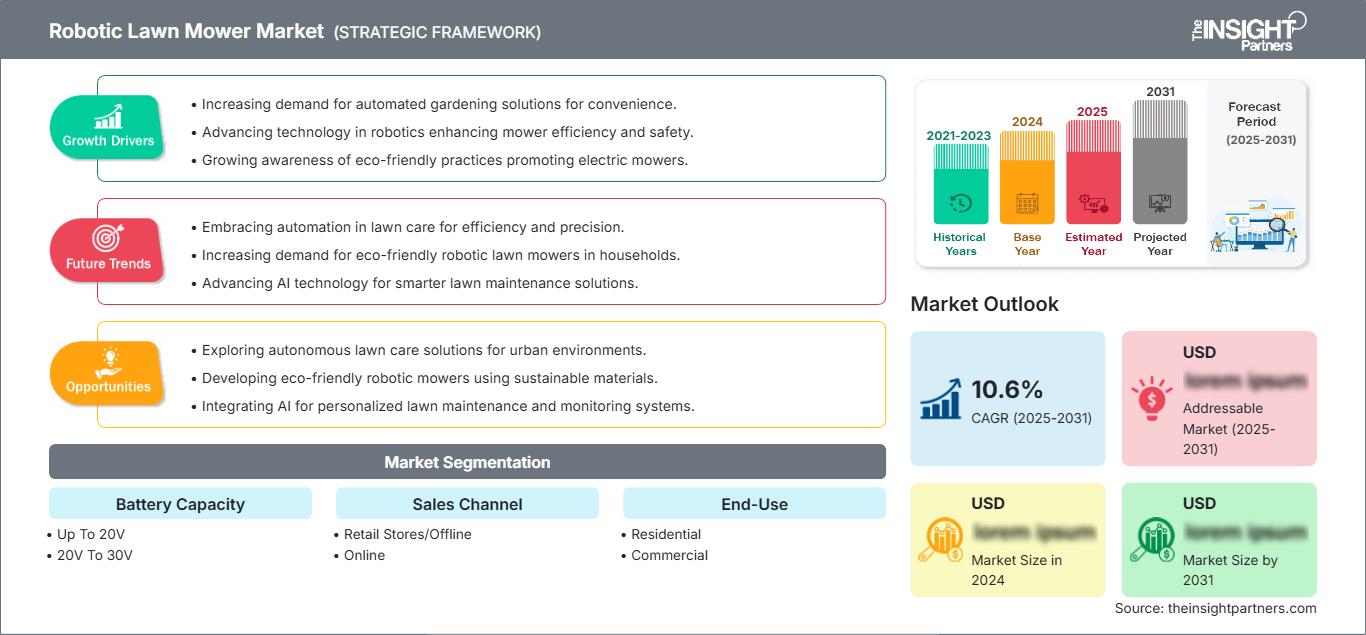
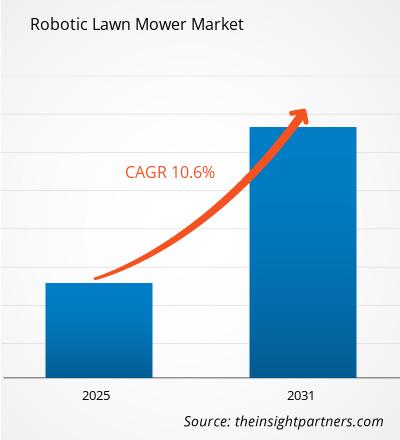
The robotic lawn mower market is projected to grow from US$ 1.95 Billion in 2025 to US$ 3.98 Billion by 2034, registering a CAGR of 9.32% during 2026–2034. Adoption is rising as homeowners, facility managers, and landscapers shift toward automated, battery-powered lawn care that reduces manual labor, improves schedule consistency, and supports quieter operation across residential and commercial green spaces.
The North America robotic lawn mower market size is expanding as suburban households, golf facilities, campuses, and commercial landscapers seek labor-saving equipment. The region is expected to grow at a CAGR of 8.7–9.4% during 2026–2034, supported by outdoor living investments, smart home adoption, and demand for low-noise, emission-free lawn maintenance systems.
Robotic Lawn Mower Market Assessment and Insights
- North America held an estimated 31–34% share in 2025 and is expected to grow at a CAGR of 8.7–9.4% between 2026–2034, supported by residential landscaping demand and commercial labor shortages.
- US accounted for around 78–81% of North America in 2025 and is projected to grow at 8.9–9.6% CAGR as connected lawn care products gain household acceptance.
- Europe represented 36–39% share in 2025 and is forecast to grow at 8.4–9.1% CAGR, led by Germany, the UK, France, Italy, and Spain.
- Asia Pacific held 18–21% share in 2025 and is expected to grow at 10.2–11.0% CAGR, with China, Japan, South Korea, India, and Australia supporting rising adoption.
- Largest Segment: Residential end-use accounted for 68–71% market share in 2025 and is expected to grow at 9.0–9.8% CAGR because households remain the primary buyer base.
- High Growth Segment: Online sales channel held 25–28% share in 2025 and is forecast to grow at 11.0–11.8% CAGR as connected product discovery and direct-to-consumer sales expand.
- Key companies analyzed in detail: ANDREAS STIHL AG & Co. KG, Bosch Limited, Deere & Company, Honda Motor Co., Ltd., Husqvarna Group, LG Electronics Inc., STIGA S.p.A., The WORX Company, YAMABIKO Corporation, and Zucchetti Centro Sistemi S.p.A.
Source: The Insight Partners' analysis based on proprietary research, government publications, company annual reports, investor presentations, industry databases, and expert interviews.
Robotic mowing has moved from premium novelty to practical outdoor automation as battery reliability, app-based scheduling, obstacle detection, and boundary management improve. The robotic lawn mower market growth is supported by mowers that now handle steeper slopes, narrow passages, weather interruptions, and multi-zone layouts. Manufacturers are also reducing installation friction through virtual boundaries and improved navigation.
Future demand will depend on affordability, dealer support, and confidence in autonomous operation. Europe will remain a strong early-adoption base, while North America and APAC add incremental volume through landscaping labor constraints and smart home penetration. Product investment is shifting toward wireless navigation, theft protection, fleet management, and commercial-duty models for larger, maintained areas.
Robotic Lawn Mower Market Report Scope
| Report Attribute | Details |
|---|---|
| Market size in 2025 | US$ 1.95 Billion |
| Market Size by 2034 | US$ 3.98 Billion |
| Global CAGR (2026 - 2034) | 9.32% |
| Historical Data | 2021-2024 |
| Forecast period | 2026-2034 |
Robotic Lawn Mower Market Analysis
Labor availability is a central demand factor, especially for commercial landscaping firms and facilities managing large grounds. Robotic lawn mower market growth is also driven by consumer preference for quieter equipment and reduced direct maintenance effort. Battery packs, brushless motors, cutting systems, sensors, connectivity modules, docking stations, and dealer installation services form the core value chain.
The robotic lawn mower market analysis shows clear movement toward navigation quality as the main differentiator. Consumers compare lawn coverage, slope rating, runtime, charging behavior, app usability, and service coverage before purchase. Suppliers with integrated software, parts availability, and installation guidance can capture higher loyalty because mower performance depends strongly on the lawn environment.
The Husqvarna Group continues to be one of the technology leaders in the industry thanks to its Automower range, while ANDREAS STIHL AG & Co. KG, STIGA S.p.A., Bosch Limited, The WORX Company, and Zucchetti Centro Sistemi S.p.A. leverage their broad residential coverage and enhanced navigation features. Deere & Company and Honda Motor Co., Ltd. bolster consumer confidence in outdoor power equipment.
The trends in investments focus on wireless mowing, better obstacle avoidance features, and service connectivity. Consumer electronics experience is provided by LG Electronics Inc., while YAMABIKO Corporation contributes expertise in professional outdoor equipment. Software and dealer networks become more important in the competition than just innovative hardware.
● REPORT CUSTOMIZATION
Tailor This Report To Align With Your Specific Business Requirements
This report can be customized to align precisely with your business objectives, scope, and target markets. Customization options include tailored segmentation, geography, competitive analysis, and strategic insights to support informed decision-making.
Customize This Report →WHAT YOU CAN ADJUST
- ● Segmentations
- ● Geography
- ● Competitive Analysis
- ● Language Preferences
Robotic Lawn Mower Market: Strategic Insights
Regional Insights
North America robotic lawn mower market
North America held around 31–34% robotic lawn mower market share in 2025. The region benefits from large suburban lawns, high spending on outdoor living, and rising use of smart connected appliances. Commercial landscaping labor pressure also supports demand from property managers, campuses, resorts, and sports facilities requiring predictable mowing schedules.
Regional CAGR is expected to reach 8.7–9.4% during 2026–2034. Adoption is strongest where dealers can provide installation, mapping, and after-sales support. Wire-free navigation is important because many homeowners dislike perimeter wire installation, while commercial buyers prioritize uptime, theft alerts, service contracts, and mowing consistency across multiple properties.
U.S. robotic lawn mower Market
The US represented about 78–81% of North America in 2025 and is expected to grow at 8.9–9.6% CAGR through 2034. Demand arises among suburban homeowners, golf courses, municipalities, and commercial landscaping companies. Robotic mowing is more feasible due to the use of battery-operated outdoor tools.
High visibility among consumers has been achieved by Husqvarna Group, Deere & Company, The WORX Company, Bosch Limited, and STIHL. Mowing technologies such as connected mowing, geofencing, and remote monitoring have become relevant since consumers consider factors such as safety, security, lawn quality, and reducing weekends spent on lawn maintenance.
Europe robotic lawn mower Market
Europe accounted for an estimated 36–39% share in 2025 and is expected to grow at 8.4–9.1% CAGR during 2026–2034. Germany is one of the key countries because of the gardening culture, the use of appliances, and the dealer network. UK is another key country because of the landscaping in suburbia, whereas France, Italy, and Spain have key demand through residential gardens and hospitality landscaping.
The customers in Europe are quick to adapt to robotic mowing, and their willingness to pay for robust navigation, silence, and seasonal maintenance is quite high. Husqvarna Group, STIGA S.p.A., Bosch Limited, ANDREAS STIHL AG & Co. KG, and Zucchetti Centro Sistemi S.p.A. will gain from the brand presence.
APAC robotic lawn mower Market
APAC held around 18–21% share in 2025 and is projected to grow at 10.2–11.0% CAGR through 2034. China is becoming a major player in supply and demand, while Japan and South Korea back up adoption via technologically oriented consumers. Australia is providing demand due to larger yards and grounds.
India is small right now, but has future promise as better housing, hospitality, and institutional landscaping develop. The future opportunity in this region will be contingent upon low costs, battery durability, local services, and machines capable of operating in humid, rough, and fast-growing grasses. Innovations in sensors and navigation in Asia are being watched very carefully by manufacturers.
Middle East & Africa robotic lawn mower Market
The Middle East & Africa is expected to grow at 7.0–7.8% CAGR during 2026–2034. SAUDI ARABIA AND THE UAE drive regional demand with the use of hospitality services, high-end residences, golf facilities, and landscaping for smart cities. SOUTH AFRICA encourages adoption via residential estate and commercial site landscaping maintenance.
Market growth faces constraints due to heat, irrigation practices, and services, but high-end commercial sites present good opportunities. Durability of battery, heat resistance, and fleet management services are more important than consumer novelty. Landscape contractors and facility managers who act as distributors of the product present good partners.
Segmentation Analysis
Battery Capacity
Battery Capacity is expected to grow at 9.0–9.7% CAGR during 2026–2034. The robotic lawn mower market scope across battery categories is influenced by lawn size, slope, runtime needs, and price sensitivity. Higher-capacity systems support longer mowing sessions and commercial sites, while lower-voltage models remain relevant for compact home gardens.
- Up To 20V models serve small lawns and entry-level buyers seeking lower upfront cost, simple operation, and compact units suitable for limited mowing zones.
- 20V To 30V models dominate mainstream residential demand because they balance runtime, cutting performance, smart features, and affordability for mid-sized lawns.
Sales Channel
Sales Channel is projected to grow at 9.4–10.1% CAGR during 2026–2034. Retail stores and dealers remain important because robotic mowers often need installation advice, boundary setup, and service support. Online channels are growing faster as consumers research smart garden equipment and compare navigation features before purchase.
- Retail Stores/Offline remain critical for demonstrations, installation packages, replacement parts, and customer reassurance, especially for first-time robotic mower buyers.
- Online channels gain share through product reviews, direct brand stores, seasonal promotions, and connected-device buyers comfortable with app-led setup.
End-Use
End-Use is forecast to grow at 9.1–9.8% CAGR during 2026–2034 in the Robotic Lawn Mower Market Report. Residential buyers generate the largest installed base, while commercial users create higher-value demand for rugged platforms, fleet monitoring, and predictable site coverage. Contractors increasingly view robotic mowing as a way to stabilize labor planning.
- Residential users value convenience, quiet operation, app scheduling, and consistent turf appearance, making homes the core volume market for compact and mid-range units.
- Commercial users adopt robotic mowing for campuses, sports grounds, resorts, offices, and managed estates where labor efficiency and repeatable lawn quality are measurable benefits.
Opportunity Snapshot
| End Use | Revenue Contribution | Trend Tag | Adoption Stage |
| Residential | High | Smart Gardens | Mature |
| Commercial | Medium | Fleet Mowing | Scaling |
Robotic Lawn Mower Market Growth Drivers and Impact Analysis
Rising labor constraints in lawn maintenance
Landscape companies and facilities teams continue to be challenged by seasonality issues, rising wages, and the need to deliver services consistently to customers. Mower robots decrease repetitive mowing effort and allow workers to concentrate on more interesting tasks such as trimming, planting, pruning, watering, and engaging with clients. This factor becomes even more important for commercial landscapes, sports complexes, colleges, and managed communities. There is more to it than just cost savings since scheduling predictability will become easier due to the possibility of mowing in cycles.
Shift toward battery-powered outdoor equipment
People are increasingly turning away from gas-operated maintenance devices due to issues such as noise, emissions, and their tendency to prefer low-maintenance electric devices. In this regard, robotic lawnmowers can benefit from this trend due to the quietness of operation, automatic recharging, and lack of any emissions during operation. Such effects are especially pronounced in residential areas, hotels, colleges, and health care facilities, where noise pollution and air quality play an important role. Technological progress in battery technology has enabled manufacturers to develop units suitable for large gardens and some commercial areas.
Improving navigation and boundary-free technology
Earlier, robotic mowing involved perimeter wires, which were cumbersome to install and prevented some people from purchasing robotic mowers. Current models make use of GPS technology, zones set by apps, cameras, and better sensor technology to ease installation processes and work on complicated terrain. This innovation allows the market potential to grow since homeowners and landscapers will be able to set up robotic mowers without damaging the grass. It also allows for higher prices due to better reliability.
Robotic Lawn Mower Market Future Trends
AI-assisted mowing and obstacle recognition
Robotic lawn mower market trends indicate a shift toward AI-assisted systems that can classify obstacles, adapt route planning, and protect objects or wildlife more effectively. Camera, radar, ultrasonic, and satellite inputs will increasingly work together to improve operation in changing outdoor conditions. These systems will move beyond simple random mowing toward efficient patterned coverage and context-aware route adjustments. Better intelligence will also help commercial operators monitor fleets remotely, reduce manual inspections, and document site performance for customers.
Commercial fleet management for large grounds
Professional landscapers will increasingly see robotic lawn mowers as fleets to be used, as opposed to individual units. The fleet control dashboards, remote diagnostic services, theft protection, maintenance scheduling, and multi-unit coordination will all factor into the purchase decision going forward. Those providers able to sell robust hardware along with the necessary subscription services will benefit greatly. Professional landscapers need a measure of uptime on commercial properties like golf courses, parks, hotels, and corporate campuses, so the data will be as valuable as the cut.
Robotic Lawn Mower Market Opportunities
Wire-free residential upgrades across mature markets
Robotic lawn mower market forecasts point to a strong replacement and upgrade opportunity in Europe and North America as early robotic mower users move from boundary-wire systems to virtual-boundary platforms. Homeowners value easier seasonal changes, zone control, and reduced installation disruption. Suppliers can target this opportunity with trade-in programs, dealer-led upgrade packages, and app-based onboarding. The strategy is attractive because existing users already understand automated mowing benefits, making them more receptive to premium models with better navigation and connectivity.
Commercial service partnerships with landscapers
The strategy to increase sales is to work with landscaping contractors who have regular maintenance contracts. Rather than just supplying the hardware, suppliers can now offer their services in terms of fleet planning, financing, training, maintenance solutions, and performance monitoring tools. This way, the contractors can reduce their dependence on manpower and still deliver quality service. This will also result in regular income for the suppliers from parts, software, and service contracts.
Frequently Asked Questions

- Comprehensive Market Sizing and Forecast Analysis
- Detailed Segmentation Analysis
- In-Depth Market Dynamics Assessment
- Regional and Country-Level Insights
- Competitive Landscape and Company Benchmarking
- Strategic Business Intelligence
Recent Reports
Testimonials

The Insight Partners' SCADA System Market report is comprehensive, with valuable insights on current trends and future forecasts. The team was highly professional, responsive, and supportive throughout. We are very satisfied and highly recommend their services.
RAN KEDEM Partner, Reali Technologies LTDs
I requested a report on a very specific software market and the team produced the report in a few days. The information was very relevant and well presented. I then requested some changes and additions to the report. The team was again very responsive and I got the final report in less than a week.
JEAN-HERVE JENN Chairman, Future Analytica
We worked with The Insight Partners for an important market study and forecast. They gave us clear insights into opportunities and risks, which helped shape our plans. Their research was easy to use and based on solid data. It helped us make smart, confident decisions. We highly recommend them.
PIYUSH NAGPAL Sr. Vice President, High Beam Global
The Insight Partners delivered insightful, well-structured market research with strong domain expertise. Their team was professional and responsive throughout. The user-friendly website made accessing industry reports seamless. We highly recommend them for reliable, high-quality research services
YUKIHIKO ADACHI CEO, Deep Blue, LLC.
This is the first time I have purchased a market report from The Insight Partners.While I was unsure at first, I visited their web site and felt more comfortable to take the risk and purchase a market report.I am completely satisfied with the quality of the report and customer service. I had several questions and comments with the initial report, but after a couple of dialogs over email with their analyst I believe I have a report that I can use as input to our strategic planning process.Thank you so much for taking the extra time and making this a positive experience.I will definitely recommend your service to others and you will be my first call when we need further market data.
JOHN SUZUKI President and Chief Executive Officer, Board Director, BK Technologies
I wish to appreciate your support and the professionalism you displayed in the course of attending to my request for information regarding to infectious disease IVD market in Nigeria. I appreciate your patience, your guidance, and the fact that you were willing to offer a discount, which eventually made it possible for us to close a deal. I look forward to engaging The Insight Partners in the future, all thanks to the impression you have created in me as a result of this first encounter.
DR CHIJIOKE ONYIA MANAGING DIRECTOR, PineCrest Healthcare Ltd.Reason to Buy
- Informed Decision-Making
- Understanding Market Dynamics
- Competitive Analysis
- Identifying Emerging Markets
- Customer Insights
- Market Forecasts
- Risk Mitigation
- Boosting Operational Efficiency
- Strategic Planning
- Investment Justification
- Tracking Industry Innovations
- Aligning with Regulatory Trends





 Get Free Sample for