
Rod End Joint Bearing Market Trends, Demand & Growth by 2034
Coverage: By Type (Sliding Surface, Angular Contact, Others); Application (Forging Machine, Hydraulic Cylinder, Engineering Machinery, Other) , and Geography (North America, Europe, Asia Pacific, and South and Central America)
- Status : Data Released
- Report Code : TIPRE00015998
- Category : Manufacturing and Construction
- No. of Pages : 150
- Available Report Formats :


- Last update date : September 16, 2026


2025 Market Size
US$ 1,438.85 Mn
Base year value
2034 Forecast
US$ 2,399.67 Mn
Projected by 2034
CAGR 2026-2034
5.85 %
Growth rate
Addressable Market
US$ 17,393.27 Mn
(2026-2034)
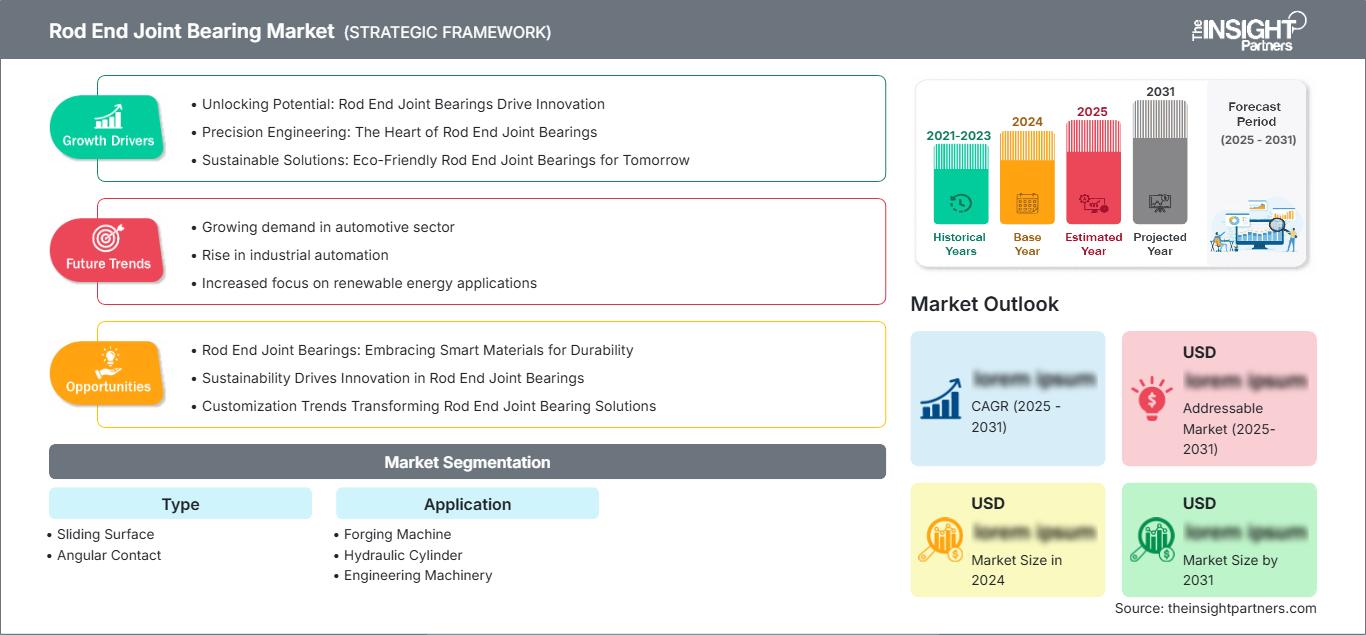
The rod end joint bearing market is valued at US$ 1438.85 Million in 2025 and is projected to reach US$ 2399.67 Million by 2034, registering a CAGR of 5.85% during 2026–2034. Demand is shaped by equipment reliability requirements, hydraulic motion systems, engineering machinery modernization, and replacement activity. Product selection increasingly balances load capacity, articulation, contamination resistance, installation simplicity, and lifecycle maintenance costs across industrial applications.
North American adoption in the Rod End Joint Bearing Market Size is supported by modernization of hydraulic equipment, construction fleets, and metal-forming machinery, with the market expected to expand at an estimated 4.8–5.4% CAGR during 2026–2034. Structural support comes from the reshoring of selected manufacturing activity and continued infrastructure investment, where durable articulation components can reduce maintenance interruptions.
Rod End Joint Bearing Market Assessment and Insights
- North America: The region is estimated to hold a 27–31% share in 2025, supported by hydraulic equipment, construction machinery, and industrial replacement demand, with growth projected at a 4.8–5.4% CAGR between 2026–2034.
- US: The US represents an estimated 82–86% share of North American demand in 2025 and is projected to expand at a 4.8–5.4% CAGR between 2026–2034, led by industrial machinery replacement.
- Europe: Europe is estimated to account for a 24–28% share in 2025 and grow at a 4.6–5.2% CAGR between 2026–2034, with Germany, Italy, France, the UK, and Spain providing established industrial equipment demand.
- Asia Pacific: Asia Pacific is estimated to command a 38–42% share in 2025 and register a 6.0–6.7% CAGR between 2026–2034, led by China, Japan, South Korea, and India through machinery production and infrastructure investment.
- Largest Segment: Sliding Surface is estimated to hold a 62–66% market share in 2025, with a 5.2–5.8% CAGR during 2026–2034, reflecting broad hydraulic and machinery applications.
- High Growth Segment: Angular Contact is expected to represent a 34–38% market share in 2025 and expand at a 6.3–7.0% CAGR during 2026–2034, supported by precision motion requirements.
- Key companies analyzed in detail: Schaeffler AG, Industrial Design Consultancy Ltd, New Hampshire Ball Bearings, JTEKT Corporation, NACHI-FUJIKOSHI CORP., NSK Ltd., NTN Corporation, SKF, The Timken Company, and ZKL Group.
Source: The Insight Partners' analysis based on proprietary research, government publications, company annual reports, investor presentations, industry databases, and expert interviews.
The trend for industrial machines is that they are now increasingly being designed with parts that can withstand greater loads, smaller tolerances, extended maintenance periods, and harsher operational conditions. This type of machine part benefits greatly from such changes since it has the characteristics of both articulation and compact design. The hydraulic cylinders, forging machines, and engineering machines are increasingly requiring misalignment-resistant bearing systems, which makes the selection of materials crucial.
Future demand is likely to broaden beyond established machinery centers as manufacturers localize equipment production and infrastructure investment increases across Asia, North America, and selected European economies in the Rod End Joint Bearing Market Report. Digital maintenance practices will also influence purchasing decisions, particularly where bearing failure can interrupt high-value machinery. Environmental requirements may favor longer-life components that reduce replacement frequency, while regional manufacturing strategies encourage suppliers to establish closer production and distribution networks.
Rod End Joint Bearing Market Report Scope
| Report Attribute | Details |
|---|---|
| Market size in 2025 | US$ 1,438.85 Million |
| Market Size by 2034 | US$ 2,399.67 Million |
| Global CAGR (2026 - 2034) | 5.85% |
| Historical Data | 2021-2024 |
| Forecast period | 2026-2034 |
Rod End Joint Bearing Market Analysis
The rod end joint bearing market growth is primarily connected with the installed base of hydraulic cylinders, forging machines, and engineering equipment. Its value chain includes bearing manufacturers, steel and alloy suppliers, machining specialists, heat-treatment providers, distributors, OEMs, maintenance contractors, and aftermarket channels. Demand is particularly sensitive to industrial capital expenditure and machinery utilization because rod end components are frequently selected according to load, oscillation, speed, and operating contamination.
Supply dynamics are influenced by precision machining capacity, alloy availability, heat-treatment consistency, and the ability to maintain dimensional tolerances in the Rod End Joint Bearing Market Forecast. Larger producers benefit from established manufacturing systems and application engineering, while specialists can compete through customized geometries and shorter delivery cycles. Customers increasingly evaluate total operating cost rather than acquisition price alone, particularly when component replacement requires equipment shutdown, skilled labor, or extensive disassembly.
Competitive positioning within the rod end joint bearing market analysis reflects a combination of scale, technical breadth, application expertise, and geographic coverage. Schaeffler AG, SKF, NSK Ltd., NTN Corporation, and The Timken Company all offer diversified bearing ranges, while JTEKT Corporation, NACHI-FUJIKOSHI CORP., and ZKL Group provide supplementary industrial capabilities. New Hampshire Ball Bearings caters to high-precision engineered requirements, and small engineering firms may handle custom demands as well.
In terms of investment focus, manufacturing efficiency, product engineering, quality assurance, and engineered solutions have become more important than mere expansion of production facilities. For example, Schaeffler's 2025 reporting shows industrial bearings, linear bearing systems, drive components, and sensor-based condition monitoring as some of the items in its industrial offering range, showcasing how the entire industry is moving towards engineering services.
● REPORT CUSTOMIZATION
Tailor This Report To Align With Your Specific Business Requirements
This report can be customized to align precisely with your business objectives, scope, and target markets. Customization options include tailored segmentation, geography, competitive analysis, and strategic insights to support informed decision-making.
Customize This Report →WHAT YOU CAN ADJUST
- ● Segmentations
- ● Geography
- ● Competitive Analysis
- ● Language Preferences
Rod End Joint Bearing Market: Strategic Insights
Regional Insights
North America rod end joint bearing market
North America is estimated to represent 27–31% of the global rod end joint bearing market demand in 2025 and is projected to grow at a 4.8–5.4% CAGR through 2034. United States consumption dominates the region, based on construction machinery, hydraulic machinery, metalworking, and industrial maintenance. Canadian contribution comes from mining activities, farming, and heavy machinery use, while Mexico derives its contribution from machinery production and industrial chain localization.
The demand in the region is structurally backed by equipment replacement, construction projects, and manufacturing investments. Buyers are interested in products that withstand misalignments and oscillations without requiring frequent maintenance. Distribution channels continue to play a critical role because buyers in the maintenance segment need quick access to replacement parts. The United States represents the largest country in the region, whereas Canada and Mexico represent the secondary countries.
U.S. rod end joint bearing Market
The US is estimated to account for 82–86% of North American rod end joint bearing market demand in 2025 and is expected to expand at a 4.8–5.4% CAGR through 2034. Machine refurbishment in the industry, hydraulic cylinder needs, and construction equipment usage facilitate repeat buying. Companies such as SKF, The Timken Company, Schaeffler AG, NSK Ltd., NTN Corporation, and New Hampshire Ball Bearings have already gained a foothold in the market with their industrial bearing products.
The trend in applications indicates a preference for rod ends in hydraulic cylinders, forging machinery, and engineering equipment that requires articulation under heavy mechanical load conditions. Replacement need is strategically important since there is a repeat need coming from existing equipment, irrespective of machine sales. Infrastructure investment in home manufacturing will help with machinery usage, while distributors will retain their influence in providing maintenance staff with the product.
Europe rod end joint bearing Market
Europe is estimated to hold a 24–28% share of the rod end joint bearing market in 2025 and is projected to grow at a 4.6–5.2% CAGR through 2034. Germany remains the leading country, followed by Italy, France, the UK, and Spain. Demand is concentrated in engineering machinery, industrial automation, hydraulic equipment, and metalworking applications, with replacement activity providing resilience during uneven capital expenditure cycles.
The UK maintains demand through industrial machinery maintenance, construction equipment, and specialized engineering. Germany benefits from its machinery and manufacturing base, supporting technically demanding bearing applications. France and Italy provide established industrial equipment ecosystems, while Spain contributes through construction, manufacturing, and infrastructure activity. European buyers increasingly emphasize service life, dimensional consistency, and maintenance efficiency, encouraging suppliers to differentiate through engineered solutions rather than standardized component pricing.
APAC rod end joint bearing Market
APAC is estimated to command a 38–42% share of the rod end joint bearing market in 2025 and is projected to expand at a 6.0–6.7% CAGR through 2034. China is the leading country, followed by Japan, South Korea, India, and Australia. Industrial machinery production, infrastructure programs, construction equipment, and expanding manufacturing capacity provide the principal demand base.
China combines extensive machinery production with large replacement requirements, while Japan emphasizes precision engineering and reliability. South Korea supports industrial equipment and advanced manufacturing, India benefits from infrastructure and industrialization, and Australia contributes through mining and heavy equipment. Regional policy support for domestic manufacturing and industrial modernization should sustain demand for durable articulation components.
Middle East & Africa rod end joint bearing Market
The Middle East and Africa rod end joint bearing market demand is estimated to expand at a 4.1–4.8% CAGR through 2034, with Saudi Arabia and the UAE leading regional activity. South Africa represents an important African market because of mining, construction, and industrial equipment requirements. The rest of MEA remains more project-driven and dependent on machinery imports.
Saudi Arabia benefits from infrastructure and industrial diversification, while the UAE supports construction, logistics, and equipment-intensive projects. South African mining generates recurring heavy-duty maintenance requirements. Energy infrastructure, construction programs, and industrial localization create opportunities for distributors and engineering suppliers able to provide application support and dependable replacement availability.
Segmentation Analysis
Type
The Type segment is expected to develop at differentiated rates, with Sliding Surface projected at a 5.2–5.8% CAGR and Angular Contact at a 6.3–7.0% CAGR during 2026–2034, reflecting key Rod End Joint Bearing Market Trends. The market scope increasingly reflects application-specific selection based on articulation, load direction, precision, lubrication, and operating environment.
- Sliding Surface: Sliding surface configurations retain broad industrial adoption because they accommodate oscillating movement and misalignment in hydraulic cylinders and engineering machinery. Their relatively simple construction supports established replacement and OEM channels.
- Angular Contact: Angular contact designs address applications requiring controlled contact geometry and higher precision. Their strategic importance is increasing, where equipment designers prioritize stiffness, directional load management, and smoother motion.
Application
Forging machines, hydraulic cylinders, and engineering machinery collectively create distinct demand patterns in the Rod End Joint Bearing Market. The Application segment is projected to advance at approximately a 4.9–6.4% CAGR during 2026–2034, reflecting differences in utilization intensity, equipment investment, and replacement frequency.
- Forging Machine: Forging equipment requires components capable of handling repetitive mechanical forces, vibration, and harsh production conditions. Bearing reliability directly affects machine availability and maintenance scheduling in high-utilization plants.
- Hydraulic Cylinder: Hydraulic cylinders represent a core application because rod ends must accommodate articulation and misalignment during repeated extension and retraction. Replacement demand is supported by large installed equipment populations.
- Engineering Machinery: Engineering machinery spans diverse equipment configurations, creating demand for adaptable bearing designs. OEM specifications and maintenance requirements influence selection, particularly where compact dimensions and dependable load handling are essential.
Technology
Hydraulic, Electric, and Diesel technologies represent different equipment architectures and operating requirements. The Technology segment is expected to progress within a 4.0–7.0% CAGR range through 2034, with electric systems benefiting from equipment modernization and increasing controls integration.
- Hydraulic: Hydraulic technology remains strategically significant because cylinders and actuators require articulated bearing interfaces. Demand is reinforced by construction, forging, material handling, and heavy engineering machinery.
- Electric: Electric technology is gaining relevance in equipment undergoing electrification and automation. Precision movement, compact actuator arrangements, and lower dependence on hydraulic infrastructure can create new bearing specification requirements.
- Diesel: Diesel-powered machinery remains important in mining, construction, agriculture, and remote operations. High-load operating conditions sustain demand, although equipment modernization gradually shifts procurement toward more efficient architectures.
Opportunity Snapshot
| Application | Revenue Contribution | Trend Tag | Adoption Stage |
| Forging Machine | Medium | Press Reliability | Mature |
| Hydraulic Cylinder | High | Cylinder Articulation | Mature |
| Engineering Machinery | High | Precision Motion | Scaling |
Rod End Joint Bearing Market Growth Drivers and Impact Analysis
Hydraulic Equipment Replacement and Reliability Requirements
Hydraulic cylinders are utilized in construction, mining, agriculture, materials handling, and industrial equipment; hence, there is a huge installed base of articulated bearings in these applications. Old equipment will lead to increased demand for replacement parts, whereas new machinery will need reliable performance due to the oscillating nature of loading conditions. The effect on the market would be greatest in areas where failure of these bearings could result in the whole production process coming to a halt. Manufacturers will find opportunity in designing products with greater longevity, better oil retention, contaminant protection, and application engineering. Maintenance contractors play a role in influencing purchases, since component choices are made during repair rather than during machine purchase.
Industrial Machinery Modernization and Precision Requirements
The trend towards industrial modernization is setting expectations about dimensional tolerance, consistency and service reliability for engineering machines. The development of automated assembly lines, the improvement of forging machinery and hydraulics with digital control, necessitates mechanical connections with predictable motion under controlled conditions. Rod end bearings could be important points of specification due to even the slightest misalignment or wear influencing the actuator operation and the position of the equipment. Thus, the consequences of the trend in question will not only involve the demand on components but also on engineering, testing and custom configurations. Vendors with application labs and precision manufacturing capabilities can influence the process of equipment design earlier.
Infrastructure and Heavy Equipment Investment
The construction and development of infrastructure facilities create the need for construction equipment, hydraulics, and other engineering equipment, which indirectly promotes the use of articulated bearings. Construction of roads, rail, energy generation, mining and industrial projects requires equipment that can work in variable load environments. The market demand will be compounded due to the use of the equipment, since heavily-used machinery will create a need for constant maintenance and repair. Manufacturers of equipment will have an advantage if there are demands for quick repairs and servicing when supplying equipment to distributors within the vicinity of project sites. There may be more chances for local bearing manufacturers within emerging markets since there may be an emphasis on the localization of infrastructure construction.
Rod End Joint Bearing Market Future Trends
Sensor-Enabled Condition Monitoring Around Bearing Assemblies
It seems that condition monitoring will play an increasingly important role with time as plant engineers try to be alerted sooner to signs of wear, contamination, lubrication degradation, and unusual loading. Even though rod end bearings are fairly small items, their condition can affect actuator performance and even the reliability of machines. In the future, maintenance needs may be determined by means of combining the bearing data with vibration, temperature, pressure, or actuator cycle statistics. The emergence of such technology may lead to changing the purchasing process from mere buying of components to maintenance solutions engineering. Companies that are able to offer appropriate interfaces for condition monitoring, digital documentation of services performed, and diagnostics of applications will be closer to OEMs and big industrial customers.
Advanced Materials and Surface Engineering
The evolution in material technology is likely to impact the effectiveness of bearings, considering that the machinery will have to run under heavier loads, contamination, variations in temperature, and extended maintenance intervals. Innovations in the form of better surface treatments, alloys, sliding materials, and coatings will enable reductions in friction and wear as well as increased longevity. This type of development will prove useful for hydraulic cylinders and engineering equipment that will be prone to dust, water, shock loads, or a lack of lubrication. Another benefit that will result from the development is product differentiation, where engineering materials will solve application-related issues that are not achievable by conventional designs.
Rod End Joint Bearing Market Opportunities
Localized Supply Networks for Emerging Machinery Markets
Manufacturers can pursue regional opportunities by establishing distribution, machining, or technical-support capabilities closer to machinery-producing economies. India, Southeast Asia, Mexico, and selected Middle Eastern markets offer potential because industrialization and infrastructure investment are increasing equipment requirements. Localization can shorten lead times, reduce inventory exposure, and improve response to customized bearing specifications. The strongest opportunity is likely to involve hybrid models combining centralized engineering with regional finishing, inventory, or service operations. Suppliers should prioritize applications with recurring aftermarket demand rather than relying exclusively on new equipment production. Partnerships with hydraulic cylinder manufacturers, machinery distributors, and maintenance providers can improve access to installed equipment while generating application data that supports subsequent product development and customer retention.
Engineered Bearing Packages for High-Downtime Applications
A second opportunity lies in packaging rod end bearings with application engineering, installation guidance, lubrication recommendations, and replacement planning. Customers operating forging, hydraulic, mining, and construction machinery often evaluate the cost of downtime more heavily than the component price. Suppliers can therefore develop application-specific kits that address alignment, sealing, lubrication, and replacement requirements together. Such offerings can simplify maintenance procurement and create differentiation against interchangeable standard products. Digital documentation and traceability can further support fleet operators managing multiple equipment types. The commercial opportunity is strongest where equipment failures carry high production or project costs, because customers have a clearer economic incentive to adopt engineered solutions that extend service intervals and make maintenance activities more predictable.
Frequently Asked Questions

- Comprehensive Market Sizing and Forecast Analysis
- Detailed Segmentation Analysis
- In-Depth Market Dynamics Assessment
- Regional and Country-Level Insights
- Competitive Landscape and Company Benchmarking
- Strategic Business Intelligence
Recent Reports
Testimonials

The Insight Partners' SCADA System Market report is comprehensive, with valuable insights on current trends and future forecasts. The team was highly professional, responsive, and supportive throughout. We are very satisfied and highly recommend their services.
RAN KEDEM Partner, Reali Technologies LTDs
I requested a report on a very specific software market and the team produced the report in a few days. The information was very relevant and well presented. I then requested some changes and additions to the report. The team was again very responsive and I got the final report in less than a week.
JEAN-HERVE JENN Chairman, Future Analytica
We worked with The Insight Partners for an important market study and forecast. They gave us clear insights into opportunities and risks, which helped shape our plans. Their research was easy to use and based on solid data. It helped us make smart, confident decisions. We highly recommend them.
PIYUSH NAGPAL Sr. Vice President, High Beam Global
The Insight Partners delivered insightful, well-structured market research with strong domain expertise. Their team was professional and responsive throughout. The user-friendly website made accessing industry reports seamless. We highly recommend them for reliable, high-quality research services
YUKIHIKO ADACHI CEO, Deep Blue, LLC.
This is the first time I have purchased a market report from The Insight Partners.While I was unsure at first, I visited their web site and felt more comfortable to take the risk and purchase a market report.I am completely satisfied with the quality of the report and customer service. I had several questions and comments with the initial report, but after a couple of dialogs over email with their analyst I believe I have a report that I can use as input to our strategic planning process.Thank you so much for taking the extra time and making this a positive experience.I will definitely recommend your service to others and you will be my first call when we need further market data.
JOHN SUZUKI President and Chief Executive Officer, Board Director, BK Technologies
I wish to appreciate your support and the professionalism you displayed in the course of attending to my request for information regarding to infectious disease IVD market in Nigeria. I appreciate your patience, your guidance, and the fact that you were willing to offer a discount, which eventually made it possible for us to close a deal. I look forward to engaging The Insight Partners in the future, all thanks to the impression you have created in me as a result of this first encounter.
DR CHIJIOKE ONYIA MANAGING DIRECTOR, PineCrest Healthcare Ltd.Reason to Buy
- Informed Decision-Making
- Understanding Market Dynamics
- Competitive Analysis
- Identifying Emerging Markets
- Customer Insights
- Market Forecasts
- Risk Mitigation
- Boosting Operational Efficiency
- Strategic Planning
- Investment Justification
- Tracking Industry Innovations
- Aligning with Regulatory Trends





 Get Free Sample for