
Server Market by Expert Industy Analysis 2034
Coverage: By Server Market Size and Forecast (2021–2034), Global and Regional Share, Trends, and Growth Opportunity Analysis: By Type (Blade, Rack, Tower, Multinode); Server Class (High-End Server, Mid-Range Server, Volume Server); Vertical (BFSI, IT & Telecom, Government, Healthcare, Manufacturing, Consumer Goods, Others), and Geography (North America, Europe, Asia Pacific, and South and Central America)
- Status : Data Released
- Report Code : TIPRE00010357
- Category : Electronics and Semiconductor
- No. of Pages : 150
- Available Report Formats :


- Last update date : July 20, 2026


2025 Market Size
US$ 121.83 Bn
Base year value
2034 Forecast
US$ 280.30 Bn
Projected by 2034
CAGR 2026-2034
9.7 %
Growth rate
Addressable Market
US$ 1,792.11 Bn
(2026-2034)
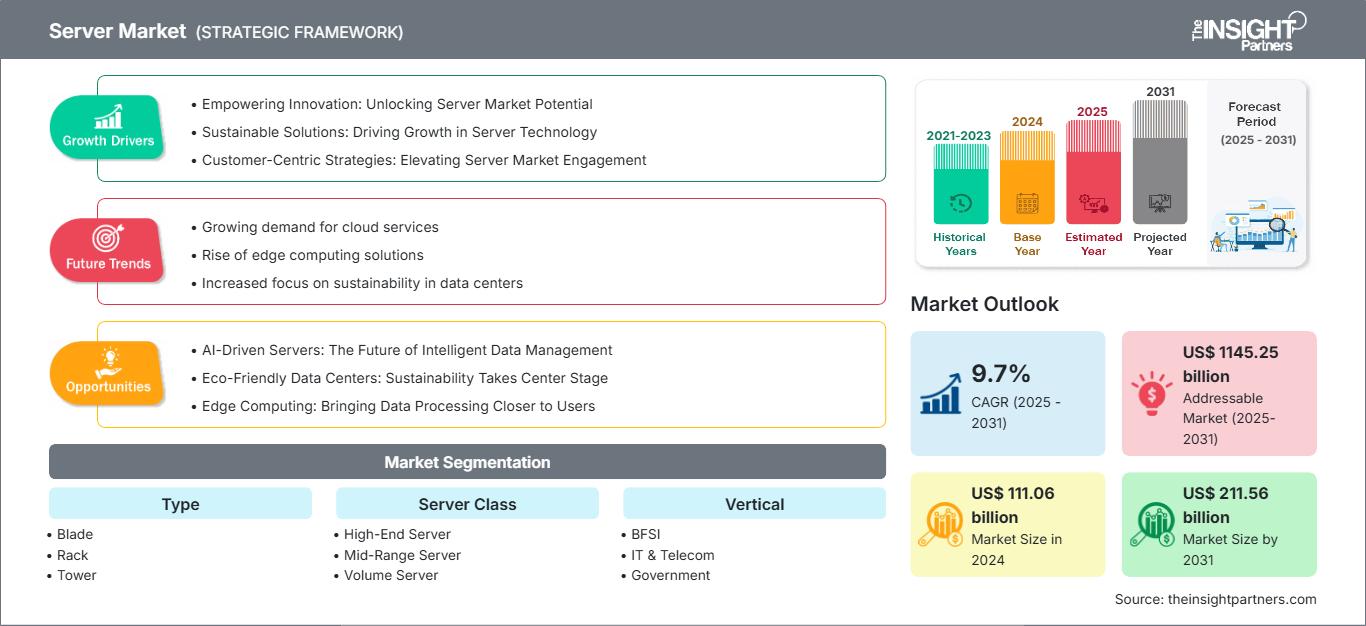
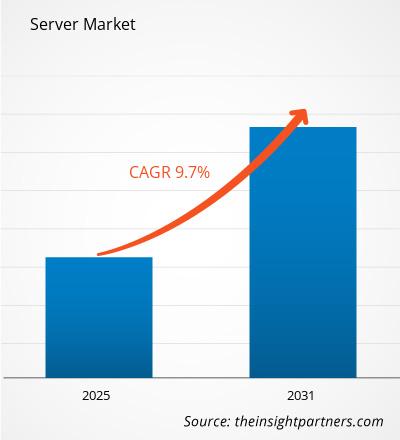
The Server market is projected to grow from US$ 121.83 Billion in 2025 to US$ 280.30 Billion by 2034, registering a CAGR of 9.7% from 2026 to 2034. Demand is being shaped by enterprise cloud migration, AI workload expansion, hybrid IT modernization, and higher compute density requirements across regulated and data-intensive industries.
North America remains the most advanced adoption base, with an estimated CAGR of 8.8–9.4% supported by hyperscale data center investment, accelerated server procurement, and enterprise refresh cycles. The Server size in the region is also influenced by AI infrastructure concentration in the US, strong colocation capacity additions, and regulated-sector demand for resilient private and hybrid cloud environments.
Server Market Assessment and Insights
- North America held 36–39% share in 2025 and is expected to grow at 8.8–9.4% CAGR between 2026–2034, supported by hyperscale AI clusters, cloud regions, and enterprise modernization.
- US accounted for 82–86% of North America in 2025 and is projected to grow at 8.9–9.5% CAGR between 2026–2034.
- Europe represented 22–25% share in 2025 and is forecast to grow at 7.8–8.6% CAGR between 2026–2034, led by Germany, the UK, and France.
- Asia Pacific captured 27–30% share in 2025 and is expected to expand at 10.5–11.4% CAGR between 2026–2034, led by China, Japan, South Korea, and India.
- Largest Segment Rack servers held 43–47% market share in 2025 and are expected to grow at 9.2–9.8% CAGR between 2026–2034.
- High Growth Segment Multinode servers held 12–15% market share in 2025 and are forecast to grow at 11.2–12.1% CAGR between 2026–2034.
- Key companies analyzed in detail: Cisco Systems, Inc.; Dell Technologies Inc.; Fujitsu Limited; Hewlett Packard Enterprise Company; Hitachi Vantara LLC; Huawei Technologies Co., Ltd.; International Business Machines Corporation; Inspur Group Co., Ltd.; Lenovo Group Limited; Oracle Corporation.
Source: The Insight Partners' analysis based on proprietary research, government publications, company annual reports, investor presentations, industry databases, and expert interviews.
Enterprise infrastructure has moved from fixed-purpose hardware toward software-defined, accelerator-ready platforms that support virtualization, containerized workloads, and AI inference. Production dynamics now favor rack-scale designs, standardized supply contracts, and thermal-aware configurations because dense processors, GPUs, memory, and networking fabric increasingly determine system value. These factors are significantly influencing the Server Market Size. Server suppliers are also aligning portfolios with liquid cooling, modular power delivery, and lifecycle management tools.
Through 2034, demand is expected to broaden beyond hyperscalers into sovereign cloud, healthcare data platforms, telecom edge nodes, and industrial digital twins. Government digitization, cybersecurity rules, and energy-efficiency standards are encouraging localized infrastructure investment. Emerging geographies are likely to prioritize scalable rack and multinode systems where cloud adoption, 5G backhaul, and AI-enabled public services require dependable compute capacity.
Server Market Report Scope
| Report Attribute | Details |
|---|---|
| Market size in 2025 | US$ 121.83 Billion |
| Market Size by 2034 | US$ 280.30 Billion |
| Global CAGR (2026 - 2034) | 9.7% |
| Historical Data | 2021-2024 |
| Forecast period | 2026-2034 |
Server Market Analysis
Server market growth is being driven by AI training, inference, cloud-native applications, and expanding enterprise data estates. Public information from infrastructure trackers indicates embedded GPU systems accounted for more than half of server revenue during 2025 quarters, demonstrating how accelerated compute is changing procurement priorities. Enterprises are also replacing aging systems to improve power efficiency, security posture, and workload consolidation.
The ecosystem includes processor vendors, memory suppliers, OEMs, ODMs, systems integrators, cloud providers, colocation operators, and enterprise IT teams. Supply dynamics remain sensitive to GPU, DRAM, SSD, and advanced networking availability. As a result, buyers are balancing lead times, energy budgets, and workload-critical performance when designing compute refresh plans.
Server market analysis shows a competitive field split between broad enterprise vendors and hyperscale-focused builders. Dell Technologies Inc., Hewlett Packard Enterprise Company, Lenovo Group Limited, and Inspur Group Co., Ltd. compete on rack-scale AI platforms, while Cisco Systems, Inc. and Huawei Technologies Co., Ltd. emphasize integrated networking and compute stacks.
Strategic positioning increasingly depends on accelerator partnerships, services depth, supply assurance, and hybrid cloud orchestration. International Business Machines Corporation, Oracle Corporation, Fujitsu Limited, and Hitachi Vantara LLC remain important where mission-critical workloads, regulated data, and enterprise modernization require stable architectures. Investment is shifting toward liquid-cooled designs, high-bandwidth interconnects, and AI-optimized reference systems.
● REPORT CUSTOMIZATION
Tailor This Report To Align With Your Specific Business Requirements
This report can be customized to align precisely with your business objectives, scope, and target markets. Customization options include tailored segmentation, geography, competitive analysis, and strategic insights to support informed decision-making.
Customize This Report →WHAT YOU CAN ADJUST
- ● Segmentations
- ● Geography
- ● Competitive Analysis
- ● Language Preferences
Server Market: Strategic Insights
Regional Insights
North America Server Market
North America held 36–39% share in 2025 and is expected to grow at 8.8–9.4% CAGR between 2026–2034. The server market share reflects hyperscale density, enterprise cloud maturity, and early adoption of accelerated computing for AI, analytics, cybersecurity, and digital customer platforms.
Regional growth is anchored by US cloud campuses, colocation expansions, semiconductor ecosystem proximity, and regulated industries requiring private compute capacity. Canada contributes through AI research clusters and public-sector modernization. Buyers are prioritizing systems with higher rack density, improved energy efficiency, secure firmware, and predictable service support.
U.S. Server Market
The US accounted for 82–86% of North America in 2025 and is projected to grow at 8.9–9.5% CAGR between 2026–2034. Demand is concentrated around hyperscale cloud, AI model infrastructure, financial services modernization, healthcare data platforms, and federal digital programs. These developments are examined in the Server Market Report.
Company presence is broad, with Dell Technologies Inc., Hewlett Packard Enterprise Company, Cisco Systems, Inc., International Business Machines Corporation, Oracle Corporation, and Lenovo Group Limited supporting enterprise and cloud deployments. Application trends include GPU clusters, database appliances, private cloud stacks, edge inference, and secure infrastructure for regulated workloads.
Europe Server Market
Europe represented 22–25% share in 2025 and is forecast to grow at 7.8–8.6% CAGR between 2026–2034. Germany leads on industrial automation, automotive engineering, and data sovereignty investments. The UK is supported by financial services, cloud adoption, public-sector digitalization, and AI research infrastructure, contributing significantly to the Server Market across the region.
France is strengthening sovereign cloud and defense-linked compute programs, while Italy and Spain show demand from manufacturing, telecom, and public services. Energy efficiency rules influence procurement decisions, favoring newer platforms with better performance per watt. European buyers also emphasize supply resilience, compliance support, and secure lifecycle management.
APAC Server Market
APAC captured 27–30% share in 2025 and is expected to expand at 10.5–11.4% CAGR between 2026–2034. China leads regional demand through cloud platforms, AI infrastructure, and domestic technology ecosystems, while Japan and South Korea emphasize enterprise modernization, semiconductor-linked compute, and advanced manufacturing. These factors continue to drive growth in the Server Market across the Asia-Pacific region.
India and Australia are scaling cloud regions, digital public infrastructure, and colocation capacity. Policy drivers include data localization, 5G rollout, smart manufacturing, and cybersecurity mandates. APAC buyers are increasingly adopting rack and multinode platforms that balance cost, density, and availability across distributed workloads.
Middle East & Africa Server Market
The Middle East & Africa is projected to grow at 8.6–9.3% CAGR between 2026–2034, led by Saudi Arabia and the UAE. National digital programs, sovereign cloud projects, energy-sector analytics, and smart city infrastructure are supporting larger compute deployments across Gulf markets, driving expansion of the Server Market across the region.
South Africa remains the main sub-Saharan hub, driven by banking, telecom, and colocation demand. The rest of MEA adoption is selective but rising where government services, oil and gas operations, and connectivity upgrades require localized processing. Buyers prioritize ruggedness, service coverage, and energy-aware configurations.
Segmentation Analysis
Type
Type is expected to grow at 9.5–10.2% CAGR between 2026–2034. The server market scope across blade, rack, tower, and multinode formats reflects divergent workload requirements, from compact enterprise rooms to large AI clusters. Procurement decisions increasingly consider rack density, cooling method, lifecycle cost, and compatibility with accelerators, storage, and software-defined infrastructure.
- Blade Servers still play an important role in the consolidated business environment, where the need for compact design, centralized management, and virtual workload performance is crucial, especially for banks, hospitals, and telecommunications facilities.
- Rack servers rule large-scale deployments due to their flexibility of configuration, compatibility of the ecosystem, and scalability of density for cloud computing, colocation, enterprise-level applications, and advanced computing workloads.
- Tower servers are used by branches, small businesses, clinics, and remote offices, where the quiet operation and ease of maintenance outweigh the benefits of dense design.
- Multinodes are gaining strategic relevance in the hyperscale and AI environments due to the combination of dense compute capabilities, shared infrastructure, and improved power efficiency of clustered workloads.
Server Class
The Server Class segment is forecast to grow at a 9.1–9.8% CAGR between 2026–2034. High-end systems support mission-critical and AI-intensive environments, mid-range systems serve core enterprise workloads, and volume systems address standardized cloud and business applications. Buyers are aligning server class choices with uptime needs, workload variability, compliance requirements, and total cost of ownership, contributing to growth in the Server Market.
- High-End Server platforms are chosen for critical database applications, financial operations, artificial intelligence processing, and the infrastructure of a nation, where reliability, memory requirements, security, and continuity of service are paramount.
- Mid-Range Server platforms are used for important enterprise applications, analysis, virtualization, and hybrid cloud computing needs, providing a balanced approach to performance, management, and cost management.
- Volume Server platforms are still crucial for standardized deployment, including cloud computing, web processing, enterprise applications, and compute processing.
Vertical
The Vertical segment is projected to grow at a 9.4–10.1% CAGR between 2026–2034. Demand varies by data intensity, latency sensitivity, regulatory exposure, and digital maturity. BFSI and IT & telecom remain heavy adopters. At the same time, healthcare, manufacturing, government, and consumer goods increasingly require scalable compute for analytics, security, automation, and customer engagement, supporting continued expansion of the Server Market.
- The BFSI industry requires strong infrastructure for its payment systems, fraud analytics, regulatory reporting, customer-facing platforms, and risk models, thereby making security and high availability an important consideration at all times.
- The IT & Telecom sector creates heavy demands due to cloud hosting, 5G core network infrastructure, edge computing, managed services, and AI-based infrastructure needs.
- The use of technology in the government sector is fueled by the need for digital identity management, public service portals, defense computing, and sovereignty clouds.
- Healthcare entities use systems for electronic health records, medical imaging, genomic studies, hospital management, and AI-based diagnostics, where buying decisions are driven by considerations like privacy, availability, and interoperability.
- Manufacturing relies on computing solutions for industrial Internet of Things, simulation technologies, robotics, quality analysis, and digital twin technologies, which require reliable processing near manufacturing and engineering facilities.
- Consumer Goods businesses invest in servers for logistics and supply chain visibility, demand forecasting, eCommerce, loyalty programs, and omnichannel analytics.
Opportunity Snapshot
| Vertical | Revenue Contribution | Trend Tag | Adoption Stage |
| BFSI | High | Fraud AI | Mature |
| IT & Telecom | High | Edge Core | Scaling |
| Government | Medium | Sovereign Cloud | Scaling |
| Healthcare | Medium | Clinical AI | Scaling |
| Manufacturing | Medium | Digital Twins | Scaling |
| Consumer Goods | Low | Retail Analytics | Emerging |
Server market forecasts indicate that vertical-specific demand will become more actionable as enterprises move from broad infrastructure refreshes to workload-mapped investments in AI, analytics, compliance, and edge processing.
Server Market Growth Drivers and Impact Analysis
AI Infrastructure Buildout Raises Compute Density
AI applications are driving changes to how businesses and cloud operators request compute resources. Higher processor density, greater memory requirements, better interconnect capabilities, and better thermal cooling are needed for training, inferencing, retrieval, augmented generation, and advanced analytics workloads. Industry tracking through public sources revealed that systems equipped with GPUs contributed to over half of the server revenues during 2025 quarters, suggesting that accelerated systems have ceased being specialty buys. What this means is that the paradigm changes from replacing equipment based on unit to planning capacity according to power budgets, rack readiness, and workload processing.
Hybrid Cloud Modernization Expands Enterprise Refresh Cycles
It is also common practice to see modernizations of traditional systems for use within the hybrid cloud environment, container technologies, and large data applications that cannot simply be moved to a public cloud platform. The users from BFSI, healthcare, government, and manufacturing sectors are still keeping their sensitive loads on private infrastructures and using cloud-native services. In this way, there is an increased need for servers with a security, virtualization-friendly nature, remote management capabilities, and a life cycle that can be predicted. The influence of such trends on the market is evident through the purchases of rack and mid-range servers.
Edge and Telecom Workloads Create Distributed Demand
With more applications getting distributed, there is an increase in the requirement for computing capacity beyond data centers. Service providers, manufacturers, retailers, hospitals, and government bodies have been setting up computing capability nearer to the user and data source to lower latency and improve operational resiliency. For such deployments, small, robust, and remotely manageable computing systems are needed to function in tough conditions while handling analytics, video, automation, and security workloads. Such drivers enlarge the target market beyond hyperscale and make demand stronger for tower, rack, and modular systems.
Server Market Future Trends
Liquid-Cooled Rack Architectures Move Mainstream
Server market trends are going to see increased deployment of liquid cooling and hybrid cooling racks due to the increasing power density of processors and accelerators. While air cooling is expected to be prevalent for regular enterprise servers, AI clusters and high-performance computing environments will have a need for direct chip cooling, rear door heat exchangers, and even complete facilities cooling infrastructure redesign. This will affect procurement practices, data center design, and service partnerships. Vendors that will be able to combine compute and cooling systems into a tested reference architecture should have an edge here.
Composable Infrastructure Supports Workload Fluidity
It is projected that future infrastructure will be more composable, enabling the dynamic allocation of compute, memory, storage, and acceleration capabilities among different workloads. This will come in handy considering that enterprises will operate in hybrid cloud environments that feature artificial intelligence inference, databases, analytics, virtualization, and containerized platforms. There will be improvements in terms of utilization with less stranded capacities through hardware abstraction, fast fabrics, and software automation. This is consistent with the move towards a gradual transition from the acquisition of stand-alone servers to architectures based on platforms.
Server Market Opportunities
Vertical AI Appliances for Regulated Industries
There is a chance for vendors to bundle their tested systems for use by regulated industries that would need the power of AI but do not want to compromise on control of their data. Banks, hospitals, government organizations, and telecommunications companies would need systems that have a safe firmware system, are audit-enabled, have encryption, have tools for governance and have predictable support programs. Appliance packages for tasks such as fraud detection, medical image processing, document processing, network optimization, and cybersecurity will help to speed up the deployment process.
Localized Compute for Sovereign Cloud Programs
The combination of data residency, national digital infrastructure, and public sector modernization makes it evident that there is an obvious investment case for localized compute solutions. There is a need from government organizations and regulated firms for infrastructure that offers support in terms of sovereign cloud, collaboration, citizen services, military workloads, and monitoring of critical infrastructure. Server manufacturers can leverage this situation through collaboration with local integrators, telecom providers, and colocation centers to provide serviceable, efficient, and certified implementations.
Recent Developments
- May 2026: Super Micro Computer, Inc (NASDAQ: SMCI), an AI, Enterprise, Storage, 5G/Edge total solution provider featuring Data Center Building Block Solutions (DCBBS), announced the launch of 12 new server platforms optimized for new Intel Xeon 6+ processors. Featuring up to 288 efficiency cores per socket and delivering improved performance-per-watt, the new systems are designed for high-density cloud, virtualization, 5G analytics, and other throughput-intensive workloads.
- March 2026: Altos Computing Ltd., an Acer Inc. group company, announced the launch of its Make-in-India AI server portfolio, marking a significant step toward strengthening India’s sovereign AI and data centre ecosystem.
- June 2026: Zoho has launched Nathu La, an in-house server designed as part of its effort to build more of its own technology stack. Developed with Intel, the system uses Intel Xeon 6 processors. Zoho said it delivers equivalent performance with 12-18% lower power consumption and 20-30% lower total cost of ownership, reducing inference costs for its artificial intelligence workloads.
Frequently Asked Questions

- Comprehensive Market Sizing and Forecast Analysis
- Detailed Segmentation Analysis
- In-Depth Market Dynamics Assessment
- Regional and Country-Level Insights
- Competitive Landscape and Company Benchmarking
- Strategic Business Intelligence
Recent Reports
Testimonials

The Insight Partners provided valuable market intelligence that supported our global go-to-market strategy. Their team was professional, responsive, and attentive to our feedback, providing thoughtful analysis and helpful methodological clarifications throughout the project.
Junmo Kim Chief Financial Officer (CFO), Enertech Co., Ltd.
The Insight Partners' SCADA System Market report is comprehensive, with valuable insights on current trends and future forecasts. The team was highly professional, responsive, and supportive throughout. We are very satisfied and highly recommend their services.
RAN KEDEM Partner, Reali Technologies LTDs
I requested a report on a very specific software market and the team produced the report in a few days. The information was very relevant and well presented. I then requested some changes and additions to the report. The team was again very responsive and I got the final report in less than a week.
JEAN-HERVE JENN Chairman, Future Analytica
We worked with The Insight Partners for an important market study and forecast. They gave us clear insights into opportunities and risks, which helped shape our plans. Their research was easy to use and based on solid data. It helped us make smart, confident decisions. We highly recommend them.
PIYUSH NAGPAL Sr. Vice President, High Beam Global
The Insight Partners delivered insightful, well-structured market research with strong domain expertise. Their team was professional and responsive throughout. The user-friendly website made accessing industry reports seamless. We highly recommend them for reliable, high-quality research services
YUKIHIKO ADACHI CEO, Deep Blue, LLC.
This is the first time I have purchased a market report from The Insight Partners.While I was unsure at first, I visited their web site and felt more comfortable to take the risk and purchase a market report.I am completely satisfied with the quality of the report and customer service. I had several questions and comments with the initial report, but after a couple of dialogs over email with their analyst I believe I have a report that I can use as input to our strategic planning process.Thank you so much for taking the extra time and making this a positive experience.I will definitely recommend your service to others and you will be my first call when we need further market data.
JOHN SUZUKI President and Chief Executive Officer, Board Director, BK Technologies
I wish to appreciate your support and the professionalism you displayed in the course of attending to my request for information regarding to infectious disease IVD market in Nigeria. I appreciate your patience, your guidance, and the fact that you were willing to offer a discount, which eventually made it possible for us to close a deal. I look forward to engaging The Insight Partners in the future, all thanks to the impression you have created in me as a result of this first encounter.
DR CHIJIOKE ONYIA MANAGING DIRECTOR, PineCrest Healthcare Ltd.Reason to Buy
- Informed Decision-Making
- Understanding Market Dynamics
- Competitive Analysis
- Identifying Emerging Markets
- Customer Insights
- Market Forecasts
- Risk Mitigation
- Boosting Operational Efficiency
- Strategic Planning
- Investment Justification
- Tracking Industry Innovations
- Aligning with Regulatory Trends





 Get Free Sample for