
Single Board Computer Market Size, Share & Demand by 2034
Coverage: By Component (Solution, Service); Processor (ARM, X86, Atom, PowerPC); End-user (Industrial Automation, Aerospace and Defense, Transportation, Medical, Entertainment); Application (Test and Measurement, Communication, Data Processing, Research) , and Geography (North America, Europe, Asia Pacific, and South and Central America)
- Status : Data Released
- Report Code : TIPRE00009531
- Category : Electronics and Semiconductor
- No. of Pages : 150
- Available Report Formats :


- Last update date : July 22, 2026


2025 Market Size
US$ 3.64 Bn
Base year value
2034 Forecast
US$ 5.15 Bn
Projected by 2034
CAGR 2026-2034
3.93 %
Growth rate
Addressable Market
US$ 39.92 Bn
(2026-2034)
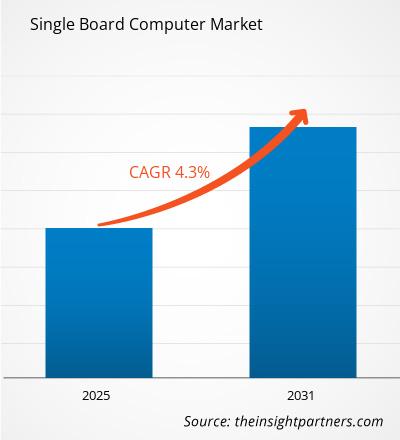
The Single Board Computer Market is projected to grow from US$ 3.64 Billion in 2025 to US$ 5.15 Billion by 2034, registering a CAGR of 3.93% during 2026–2034. Growth is supported by wider use of compact embedded computing platforms across industrial automation, aerospace and defense, consumer electronics, and healthcare applications, where reliability, board-level integration, and energy efficiency remain central purchase criteria.
North America remains a high-value adoption base, with the Single Board Computer Market size shaped by embedded AI, defense modernization, and industrial control upgrades. The region is estimated to grow at a CAGR of 3.6–4.1% through 2034, supported by the reshoring of electronics assembly, rising medical device digitization, and demand for ruggedized boards in factory equipment and secure communications.
Single Board Computer Market Assessment and Insights
- North America held 31–34% share in 2025 and is expected to grow at 3.6–4.1% CAGR during 2026–2034, led by aerospace electronics, medical devices, and industrial edge deployments.
- US accounted for 78–82% of North America in 2025 and is projected to expand at 3.7–4.2% CAGR, supported by defense electronics and automation upgrades.
- Europe represented 24–27% share in 2025 and is expected to grow at 3.2–3.8% CAGR, with Germany, the UK, and France leading embedded industrial adoption.
- Asia Pacific captured 29–32% share in 2025 and is forecast to grow at 4.4–5.0% CAGR, driven by China, Japan, South Korea, and India electronics ecosystems.
- Largest Segment ARM held 43–46% market share in 2025 and is expected to grow at 4.1–4.7% CAGR due to power efficiency and embedded Linux compatibility.
- High Growth Segment Healthcare held 12–15% market share in 2025 and is projected to grow at 4.8–5.4% CAGR, supported by portable diagnostics and connected monitoring.
- Key companies analyzed in detail: AAEON Technology Inc., Advantech Co., Ltd., Connect Tech Inc., Eurotech S.p.A., Hectronic GmbH, Intel Corporation, Kontron AG, Qualcomm Technologies, Inc., SECO S.p.A., WinSystems Inc.
Source: The Insight Partners' analysis based on proprietary research, government publications, company annual reports, investor presentations, industry databases, and expert interviews.
Technological advancements in the market have shifted from low cost development kits to advanced modules that include secure boot capability, long-life chip supply, thermal resistance, and hardware optimization. More industrial buyers are looking into factors such as lifecycle, operating temperature, I/O density, and certifications apart from processor speed when evaluating their options. Production trends in the market will be characterized by balancing ARM processing efficiency and x86 processors due to backward compatibility with legacy systems and AI workloads.
The demand for SBCs in the future will increase among other emerging industrial applications, including defense electronics, digital healthcare, and edge AI. Growth potential will be highest wherever compact processing capabilities offer reduced latency, lower dependence on cloud, and enhanced data sovereignty. Regulators' concern with medical device security, critical infrastructures resilience, and defense electronics will reward suppliers with traceability, cybersecurity support, and an extended roadmap.
Single Board Computer Market Report Scope
| Report Attribute | Details |
|---|---|
| Market size in 2025 | US$ 3.64 Billion |
| Market Size by 2034 | US$ 5.15 Billion |
| Global CAGR (2026 - 2034) | 3.93% |
| Historical Data | 2021-2024 |
| Forecast period | 2026-2034 |
Single Board Computer Market Analysis
The Single Board Computer Market growth is underpinned by rising automation intensity, distributed sensing, and edge analytics. Manufacturers use SBCs to shorten machine response times, reduce wiring complexity, and embed compute directly into controllers, robotics cells, and inspection systems. Demand also benefits from aerospace and defense programs requiring compact, rugged processors for mission systems, communications nodes, and unmanned platforms.
Supply dynamics reflect processor availability, board layout expertise, firmware support, and channel relationships with OEMs. The ecosystem spans silicon suppliers, board designers, operating system vendors, distributors, and system integrators. Buyers increasingly prefer suppliers that offer carrier-board customization, validation services, and software enablement, because integration risk can exceed component cost in regulated or long-life embedded programs.
Competitive positioning in the Single Board Computer Market analysis is shaped by processor roadmaps, thermal design capability, and vertical application knowledge. Advantech Co., Ltd., Kontron AG, AAEON Technology Inc., SECO S.p.A., and Eurotech S.p.A. represent strong competitors in the field of industrial and embedded computing. On the other hand, Intel Corporation and Qualcomm Technologies, Inc. set platform directions based on silicon ecosystems and artificial intelligence acceleration.
Current investment trends lean towards edge AI, rugged boards, and software-ready platforms rather than commodity hardware solutions. Connect Tech Inc. and WinSystems Inc. focus on challenging environments, utilizing NVIDIA and industrial I/O advantages. The exposure of Hectronic GmbH to embedded systems is more in line with mobility and infrastructure applications.
● REPORT CUSTOMIZATION
Tailor This Report To Align With Your Specific Business Requirements
This report can be customized to align precisely with your business objectives, scope, and target markets. Customization options include tailored segmentation, geography, competitive analysis, and strategic insights to support informed decision-making.
Customize This Report →WHAT YOU CAN ADJUST
- ● Segmentations
- ● Geography
- ● Competitive Analysis
- ● Language Preferences
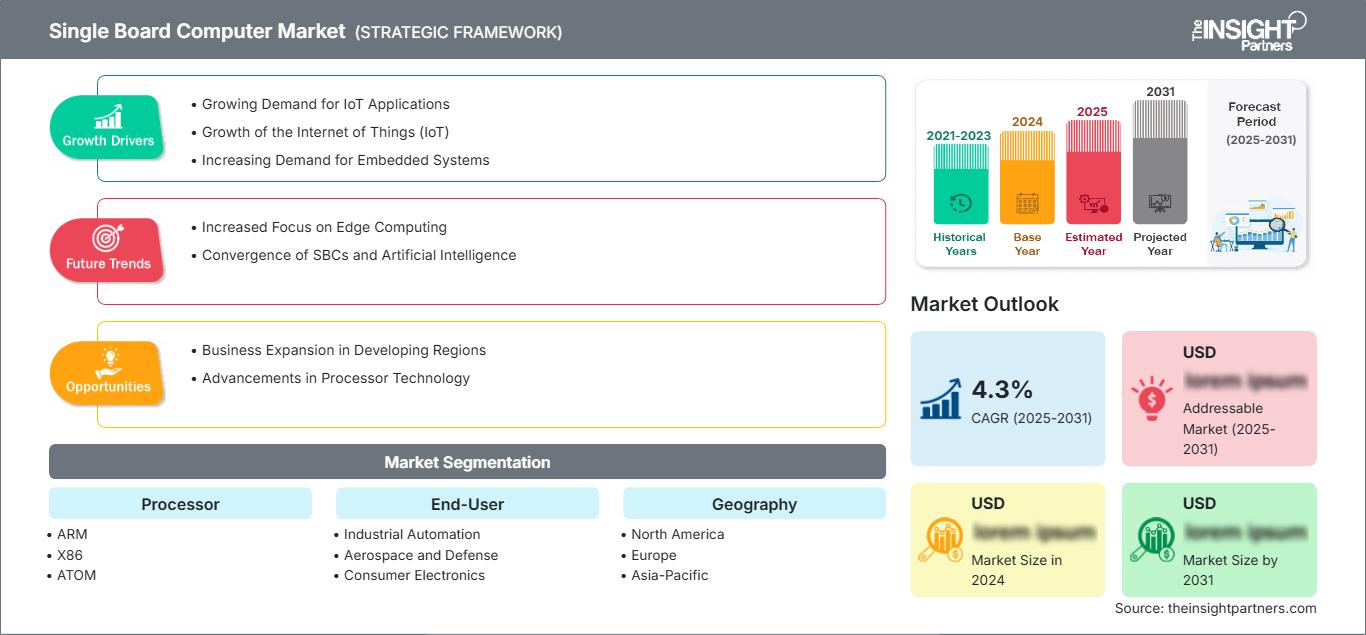
Single Board Computer Market: Strategic Insights
Regional Insights
North America Single Board Computer Market
North America accounted for 31–34% of global revenue in 2025 and is projected to advance at a 3.6–4.1% CAGR during 2026–2034. The region’s Single Board Computer Market share is supported by high-value aerospace electronics, medical device engineering, industrial automation, and cybersecurity-sensitive infrastructure. Demand is concentrated in designs requiring stable supply, certification support, and long operating lifecycles.
Industrial buyers in the US and Canada prioritize ruggedization, real-time networking, and secure firmware features. Defense modernization programs and factory automation refreshes create steady demand for x86 and ARM boards, while healthcare OEMs use SBCs in imaging, diagnostics, and connected monitoring. Supplier proximity, engineering collaboration, and compliance documentation remain key procurement advantages.
U.S. Single Board Computer Market
The US represented 78–82% of North America's revenue in 2025 and is forecast to grow at a 3.7–4.2% CAGR through 2034. The demand for single-board computers is bolstered by the need for defense electronics, certifications in aerospace, intelligent manufacturing, and innovations in the field of medical devices. The engineering groups within the country usually go for those that offer longevity, secure boot, and robust OS support.
Corporate presence is important for silicon, embedded boards, and system integration. Intel Corporation, Qualcomm Technologies, Inc., WinSystems Inc., and Connect Tech Inc. cater to applications including machine vision and avionics test systems. The US market prefers those used in rugged edge computing, industrial controllers, portable medical devices, and mission-critical communications.
Europe Single Board Computer Market
Europe held 24–27% share in 2025 and is projected to grow at a 3.2–3.8% CAGR during 2026–2034. Germany is leading the way in terms of adoption because of its strong background in industrial automation, machine building industry and use of embedded control systems in manufacturing processes. The UK is contributing by way of its presence in aerospace, defense electronics and edge computing based on research needs, along with the fact that compliance with CE certification, security laws and industrial safety norms remains a key purchase driver.
France, Italy and Spain contribute towards the demand through transport, medical, energy and manufacturing systems upgrades. European buyers have specific demands when it comes to product reliability, longevity, low power consumption and technical know-how. Technical know-how of regional vendors such as Kontron AG, Eurotech S.p.A. and SECO S.p.A. is important. At the same time, the global semiconductor industry will help in the adoption of AI-based embedded computing systems.
APAC Single Board Computer Market
APAC accounted for 29–32% share in 2025 and is expected to grow at a 4.4–5.0% CAGR through 2034, making it the fastest expanding regional base. China leads adoption through electronics manufacturing, factory automation, and smart infrastructure, while Japan and South Korea contribute precision robotics, medical technology, and semiconductor equipment demand.
India and Australia add momentum through industrial digitization, defense electronics, and healthcare access programs. Policy support for local electronics manufacturing strengthens regional board assembly and system integration. APAC customers often balance cost, thermal performance, and scalability, creating opportunities for ARM-based designs and modular platforms suited to volume production.
Middle East & Africa Single Board Computer Market
The Middle East & Africa is expected to grow at a 3.0–3.6% CAGR during 2026–2034, with Saudi Arabia and the UAE leading regional demand. Energy infrastructure, smart city programs, airport modernization, and industrial monitoring create use cases for rugged edge computing, remote sensing, and secure communications across harsh operating environments.
South Africa and the rest of MEA contribute through mining automation, telecom infrastructure, and healthcare equipment deployment. Adoption remains project-led rather than broad-based, but local system integrators increasingly specify SBCs where low power, compact form factor, and reliable connectivity reduce field maintenance in distributed assets.
Segmentation Analysis
Processor
The Processor segment is expected to grow at a 3.8–4.4% CAGR during 2026–2034. The Single Board Computer Market scope across processors is shaped by power budgets, software ecosystems, thermal limits, and legacy compatibility. ARM leads energy-sensitive deployments, while x86 and ATOM support Windows, industrial control, and existing software stacks.
- ARM boards dominate compact and low-power deployments, especially IoT gateways, portable devices, and edge sensing applications, where energy efficiency, Linux support, and broad developer ecosystems influence design decisions.
- X86 boards remain important for industrial PCs, legacy automation, and high-performance embedded systems where software continuity, virtualization, and Windows compatibility outweigh power and cost constraints.
- ATOM platforms serve fanless industrial designs, kiosks, transport equipment, and control panels that require moderate performance, low thermal output, and dependable long-life availability from established silicon roadmaps.
- PowerPC demand is concentrated in aerospace, defense, transport, and legacy industrial systems, where deterministic behavior, rugged certification history, and software continuity sustain specialized replacement and upgrade cycles.
End-User
The End-User segment is projected to grow at a 4.0–4.6% CAGR during 2026–2034. Industrial automation remains the revenue anchor, but healthcare and aerospace applications are becoming the Single Board Computer Market Forecast. Buyers select SBCs for embedded control, data acquisition, imaging, communication, and device intelligence where reliability is constrained.
- Industrial Automation is the largest end-user area, using SBCs in robotics, PLC-adjacent controllers, machine vision, and predictive maintenance systems that require rugged operation and real-time connectivity.
- Aerospace and Defense demand emphasizes secure firmware, ruggedization, lifecycle traceability, and compact computing for unmanned systems, avionics support equipment, mission communications, and harsh-environment monitoring.
- Consumer Electronics adoption is driven by smart appliances, entertainment devices, maker platforms, and connected home products that need affordable processing, multimedia capability, and compact board integration.
- Healthcare applications include portable diagnostics, patient monitoring, imaging peripherals, and laboratory instruments, where low power, reliability, cybersecurity readiness, and regulatory documentation are increasingly important.
Opportunity Snapshot
| End-User | Revenue Contribution | Trend Tag | Adoption Stage |
| Industrial Automation | High | Edge Control | Mature |
| Aerospace and Defense | Medium | Rugged Compute | Scaling |
| Consumer Electronics | Medium | Smart Devices | Mature |
| Healthcare | Medium | Portable Diagnostics | Scaling |
Single Board Computer Market Growth Drivers and Impact Analysis
Industrial Edge Computing Moves Closer to Machines
The movement by factories towards analytics, control logic, and vision close to production assets in order to decrease latency and dependence on cloud connectivity favors SBCs since they integrate processor, memory, input/output functions, and networking capabilities in a small form factor that can be integrated directly within machines. This effect is more pronounced when it comes to robotics, inspection, packaging, and condition monitoring, where even one millisecond can make a huge difference in terms of yield or safety.
Medical Device Digitization Requires Compact Compute
Healthcare OEMs are now incorporating more intelligent features into diagnostic equipment, imaging peripherals, patient monitors, and laboratory instruments. In essence, this means a higher demand for circuit boards that will run on secure operating systems, perform calculations based on sensor readings, and offer connectivity while maintaining small sizes. Practically, this results in a longer qualification cycle but greater retention of suppliers after qualification. Component traceability and the ability to provide cybersecurity updates and a consistent lifecycle roadmap become critical for such suppliers.
Defense and Aerospace Demand Rugged Embedded Platforms
Compact computing has become an important aspect in aerospace and defense programs in terms of uncrewed aircraft, communication systems, cockpit systems, and test equipment. SBCs help overcome the limitations of space and power and allow upgrades of mission systems through modularity. The procurement process is affected by considerations such as ruggedness, security capabilities, and availability over long periods of time throughout the program lifecycle. This is a driver that helps generate high revenue as there is always a need for conformal coating, a wide temperature range, and qualification.
Single Board Computer Market Future Trends
AI Acceleration Becomes Board-Level Standard
Single Board Computer Market trends point toward integrated neural processing, GPU acceleration, and optimized software toolchains becoming standard selection criteria. The future boards are going to support local inference for inspection, anomaly detection, NLI, and adaptive control. What is implied is the move from processor-level only comparisons to a full stack assessment, which includes model deployment tools, power efficiency per inference, and thermal stability. The vendors who bundle AI ready boards with software libraries can help their customers reduce the time-to-market significantly.
Lifecycle Assurance Gains Procurement Weight
Procurement in the future would require increased attention to continuity of components, firmware updates, cybersecurity patches, and resilience of supply chains. The industrial and medical customers are looking at board replacements as expensive operations since they are forced to validate software, change enclosures, and conduct compliance evaluations. It means that those suppliers who provide lifetime guarantees, revision control, and proactive EOL policies would be more popular. Such an approach would lead to lower turnover in qualified programs and stable recurring income for professional suppliers rather than for amateur ones.
Single Board Computer Market Opportunities
Application-Specific Reference Designs
Vendors can expand margins by selling reference designs specific to machine vision, portability testing, robotics, and secure gateway applications. As customers look for quick integration, in addition to hardware options, providing board support packages, pre-qualified sensors, and encasable boards can simplify design work. This trend is especially appealing to mid-volume original equipment manufacturers that lack embedded expertise. Vendors with specifications on thermal performance, power requirements, and certifications can turn an evaluation kit into a production platform.
Regional Manufacturing and Design-In Support
Regional manufacturing projects and continuous supply chain diversification have created considerable business opportunities for vendors who can provide regional engineering, assembly, and product customization services. As companies become more interested in building more resilient supply chains and less dependent on single-sourcing production facilities, there is an increasing need for vendors who can provide a regional presence and local technical support networks. There is also a growing need for a fast product development cycle, quick feedback on prototypes, and more visibility regarding the availability of components. Suppliers are now creating regional design centers, developing distribution channels, and providing application engineering and rapid product customization services in order to meet the needs of industrial, health care, transportation, and communication customers. The greatest business opportunities will be provided by solutions that provide standard platforms with customizable I/O configuration, wireless connectivity, advanced security, and extended lifecycle management.
Recent Developments
- November 2025: Quectel Wireless Solutions, an end-to-end global IoT solutions provider, has launched three new smart single board computers (SBCs). The QSM368Z, QSM560DR, and QSM668SR are designed to give developers more choice and speed up product development of intelligent solutions and digital transformation. Each board is cost-effective, fully certified, and offers a wide range of options for connectivity, operating system and memory options to suit different application needs.
- June 2025: ADLINK Technology Inc., a global leader in edge computing solutions, announces the launch of two new 3.5” single board computers: SBC35-MTL, powered by Intel Core Ultra processors with integrated NPU, and SBC35-ASL, based on the energy-efficient Intel Atom x7000RE Series. These new additions to ADLINK’s SBC35 Series address a wide spectrum of edge computing demands—from compact AI workloads to industrial-grade embedded control systems.
- October 2024: Power Device Corporation (PDC) proudly announces the successful deployment of SCS3740 Single Board Computers (SBCs) onboard the Space Development Agency (SDA) Tracking satellites, built by L3Harris Technologies and launched into Low Earth Orbit (LEO) in February by the SpaceX Falcon 9 rocket. The four wide-field-of-view satellites complete the SDA network of Tranche 0 satellites on orbit, consisting of both Transport and Tracking Layer satellites, as part of the prototype demonstration phase of the Proliferated Warfighter Space Architecture (PWSA), serving as a testbed for advanced hypersonic and ballistic missile warning, tracking and defense.
Frequently Asked Questions

- Comprehensive Market Sizing and Forecast Analysis
- Detailed Segmentation Analysis
- In-Depth Market Dynamics Assessment
- Regional and Country-Level Insights
- Competitive Landscape and Company Benchmarking
- Strategic Business Intelligence
Recent Reports
Testimonials

The Insight Partners provided valuable market intelligence that supported our global go-to-market strategy. Their team was professional, responsive, and attentive to our feedback, providing thoughtful analysis and helpful methodological clarifications throughout the project.
Junmo Kim Chief Financial Officer (CFO), Enertech Co., Ltd.
The Insight Partners' SCADA System Market report is comprehensive, with valuable insights on current trends and future forecasts. The team was highly professional, responsive, and supportive throughout. We are very satisfied and highly recommend their services.
RAN KEDEM Partner, Reali Technologies LTDs
I requested a report on a very specific software market and the team produced the report in a few days. The information was very relevant and well presented. I then requested some changes and additions to the report. The team was again very responsive and I got the final report in less than a week.
JEAN-HERVE JENN Chairman, Future Analytica
We worked with The Insight Partners for an important market study and forecast. They gave us clear insights into opportunities and risks, which helped shape our plans. Their research was easy to use and based on solid data. It helped us make smart, confident decisions. We highly recommend them.
PIYUSH NAGPAL Sr. Vice President, High Beam Global
The Insight Partners delivered insightful, well-structured market research with strong domain expertise. Their team was professional and responsive throughout. The user-friendly website made accessing industry reports seamless. We highly recommend them for reliable, high-quality research services
YUKIHIKO ADACHI CEO, Deep Blue, LLC.
This is the first time I have purchased a market report from The Insight Partners.While I was unsure at first, I visited their web site and felt more comfortable to take the risk and purchase a market report.I am completely satisfied with the quality of the report and customer service. I had several questions and comments with the initial report, but after a couple of dialogs over email with their analyst I believe I have a report that I can use as input to our strategic planning process.Thank you so much for taking the extra time and making this a positive experience.I will definitely recommend your service to others and you will be my first call when we need further market data.
JOHN SUZUKI President and Chief Executive Officer, Board Director, BK Technologies
I wish to appreciate your support and the professionalism you displayed in the course of attending to my request for information regarding to infectious disease IVD market in Nigeria. I appreciate your patience, your guidance, and the fact that you were willing to offer a discount, which eventually made it possible for us to close a deal. I look forward to engaging The Insight Partners in the future, all thanks to the impression you have created in me as a result of this first encounter.
DR CHIJIOKE ONYIA MANAGING DIRECTOR, PineCrest Healthcare Ltd.Reason to Buy
- Informed Decision-Making
- Understanding Market Dynamics
- Competitive Analysis
- Identifying Emerging Markets
- Customer Insights
- Market Forecasts
- Risk Mitigation
- Boosting Operational Efficiency
- Strategic Planning
- Investment Justification
- Tracking Industry Innovations
- Aligning with Regulatory Trends





 Get Free Sample for