
Smart Air Purifier Market Share, Size & Demand by 2034
Coverage: by Technology (HEPA, Plasma Wave, Electrostatic Precipitator, Activated Carbon, Ion & Ozone, and Others); and Application (Commercial and Residential), and Geography (North America, Europe, Asia Pacific, and South and Central America)
- Status : Data Released
- Report Code : TIPTE100001296
- Category : Electronics and Semiconductor
- No. of Pages : 150
- Available Report Formats :


- Last update date : July 28, 2026


2025 Market Size
US$ 3.02 Bn
Base year value
2034 Forecast
US$ 9.29 Bn
Projected by 2034
CAGR 2026-2034
13.30 %
Growth rate
Addressable Market
US$ 53.42 Bn
(2026-2034)
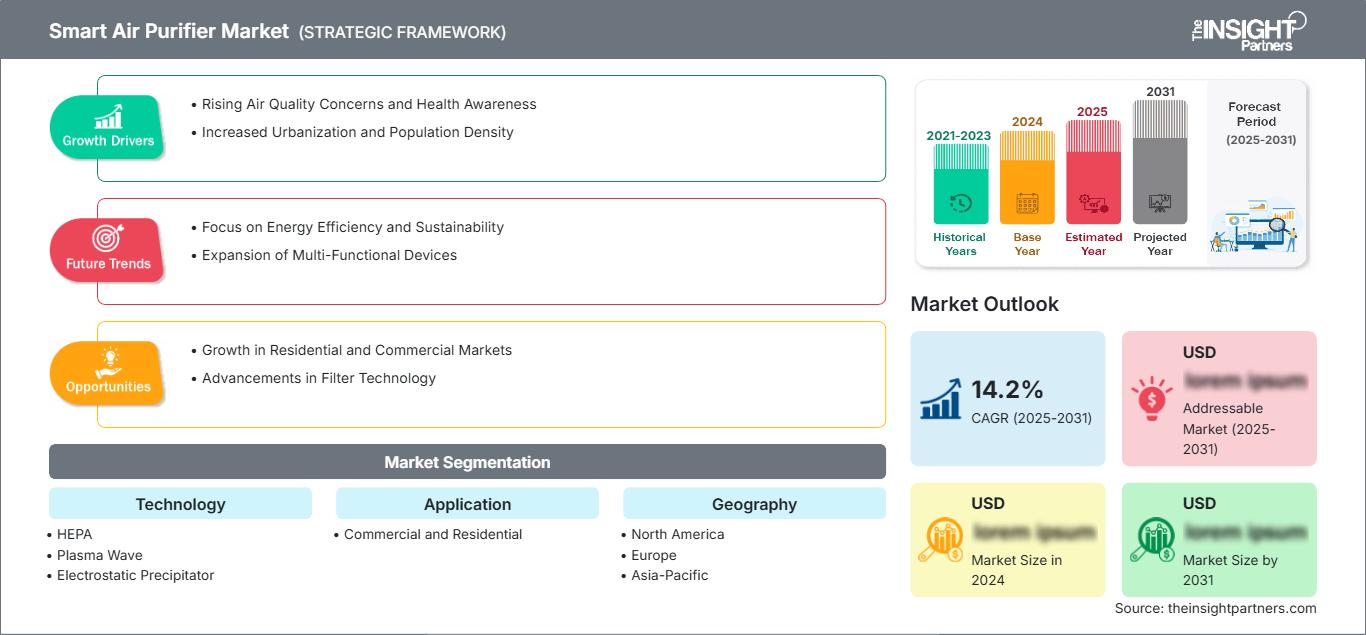
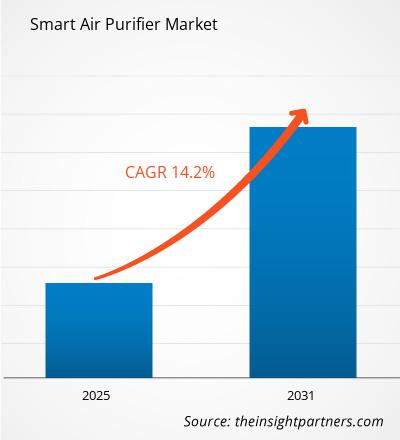
The Smart Air Purifier Market size is expected to grow from US$ 3.02 Billion in 2025 to US$ 9.29 Billion in 2034, with a CAGR of 13.30% in 2026-2034. Factors influencing market growth include connected filtration systems, sensor-based monitoring of indoor air quality, and increased demand for healthy and smart homes/commercial spaces. HEPA filter, activated carbon filter, plasma wave, electrostatic precipitator, ion & ozone, and hybrid are some of the existing competition technology types in the market.
North America continues to be a lucrative adoption region with the Smart Air Purifier Market growing at 12.0–13.0% CAGR in 2026-2034. This is attributed to wildfire smoke readiness, connected homes and buildings, and strict building air-quality requirements.
Smart Air Purifier Market Assessment and Insights
- North America accounted for 31–34% Smart Air Purifier Market share in 2025 and is growing at a CAGR between 2026–2034 of 12.0–13.0%, led by wildfire exposure, smart-home penetration, and institutional indoor-air programs.
- US represented 78–82% of North America in 2025 and is growing at a CAGR between 2026–2034 of 12.1–13.1%, supported by premium residential upgrades.
- Europe held 22–25% share in 2025 and is growing at a CAGR between 2026–2034 of 11.5–12.5%, with Germany, the UK, France, Italy, and Spain leading demand.
- Asia Pacific captured 33–36% share in 2025 and is growing at a CAGR between 2026–2034 of 14.0–15.0%, driven by China, Japan, South Korea, India, and Australia.
- Largest Segment HEPA technology held 48–52% market share in 2025 and is growing at a CAGR range 2026–2034 of 12.8–13.8%, reflecting proven particle-removal performance.
- High Growth Segment Residential application held 60–64% market share in 2025 and is growing at a CAGR range 2026–2034 of 13.8–14.8%, supported by app-based control and urban households.
- Key companies analyzed in detail: Honeywell International Inc., Panasonic Holdings Corporation, LG Electronics Inc., Koninklijke Philips N.V., Blueair AB, Xiaomi Corporation, Coway Co., Ltd., Sunbeam Products, Inc., Winix Inc., Whirlpool Corporation.
Source: The Insight Partners' analysis based on proprietary research, government publications, company annual reports, investor presentations, industry databases, and expert interviews.
Product evolution has shifted from basic filtration to advanced systems that integrate sensors, automated fan functionality, smartphone apps and multi-filters. Manufacturing is becoming more modular, as companies rely on other manufacturers for motors, sensors and filtration materials while competing on software, design and certification of their performance. HEPA is the key technology, but activated carbon and plasma functions are being included more and more in order to deal with odors, gases, and customer desire for quantifiable indoor air quality.
Future demand will move beyond premium homes to cover commercial buildings, schools, clinics and hotels that choose portable and embedded purification systems. New markets will benefit from urbanization, higher disposable incomes and regulatory concern about pollution exposure. Guidelines for smoke-ready buildings, energy efficiency and public health readiness will be a positive factor for replacement cycles, while investors will favor quiet motors and connectivity diagnostics.
Smart Air Purifier Market Report Scope
| Report Attribute | Details |
|---|---|
| Market size in 2025 | US$ 3.02 Billion |
| Market Size by 2034 | US$ 9.29 Billion |
| Global CAGR (2026 - 2034) | 13.30% |
| Historical Data | 2021-2024 |
| Forecast period | 2026-2034 |
Smart Air Purifier Market Analysis
Market demand depends on health consciousness, climate-induced smoke incidents, and consumer demand for metrics related to indoor air quality. WHO estimates that 99% of the world’s population inhales air that does not meet guideline requirements, while EPA guidance also suggests that smoke generated by wildfires enters houses and commercial structures. These facts contribute to the market development within residential and commercial spaces, particularly those expecting PM2.5, VOC, humidity, and filter lifetime monitoring.
Ecosystem players include filter media providers, sensor producers, motor suppliers, appliance manufacturers, distributors, online sellers, and facility managers. Supply forces work in favor of companies that will be able to reconcile CADR, low noise levels, filter replacement costs, and app performance. The market also receives additional boost from combined comfort solutions for homes that offer air purification with ventilation, humidity control, and energy management.
Competitiveness is escalating due to various companies offering products in diverse price ranges and geographical areas such as Honeywell International Inc., Panasonic Holdings Corporation, LG Electronics Inc., Koninklijke Philips N.V., Blueair AB, Xiaomi Corporation, Coway Co., Ltd., Sunbeam Products, Inc., Winix Inc., and Whirlpool Corporation. Premium products focus on filter certification and noise-free design, while consumer brands compete on connectivity, small designs, and affordability. In essence, Smart Air Purifiers Market Analysis reveals that positioning requires compatibility with the ecosystem and not just filter technology.
The focus for investment is shifting towards the development of intelligent operating modes, self-cleaning filters, long-lasting activated carbon filters, and integration within buildings. The companies with HVAC connections can easily access commercial customers, while those in consumer electronics will utilize application ecosystem and online retailers. Strategic positioning will require reduction of total cost of ownership and validating pollutants removal using standardized testing methods.
● REPORT CUSTOMIZATION
Tailor This Report To Align With Your Specific Business Requirements
This report can be customized to align precisely with your business objectives, scope, and target markets. Customization options include tailored segmentation, geography, competitive analysis, and strategic insights to support informed decision-making.
Customize This Report →WHAT YOU CAN ADJUST
- ● Segmentations
- ● Geography
- ● Competitive Analysis
- ● Language Preferences
Smart Air Purifier Market: Strategic Insights
Regional Insights
North America Smart Air Purifier Market
The market share in North America was estimated to be at 31% - 34% for the Smart Air Purifier Market in 2025 and the market is expected to grow at 12.0% - 13.0% CAGR between 2026 and 2034. This is driven by incidents of wildfires, allergies, and instructions from authorities to have clean rooms.
There is increasing commercial demand in office spaces, schools, health institutions, and public places due to planning to be smoke ready. There is continued residential demand due to the capability of connected houses to remotely monitor and control speeds and filters. The demand for premium replacement is growing due to comparisons of claims made by third parties.
U.S. Smart Air Purifier Market
The U.S. represented 78–82% of the North American region in 2025 and would register a growth rate of 12.1–13.1% CAGR from 2026 to 2034. The market is driven by wide retail availability, high penetration of smart homes and air quality due to smoke from the western, midwestern, and northeastern states of America.
Some of the key players that have visibility include Honeywell International Inc., Whirlpool Corporation, Blueair AB, and Winix Inc. Commercial purchasers will be targeting products to improve their conference rooms, classroom areas, waiting rooms, and hotel facilities. These applications require an enhancement to HVAC systems. There are also opportunities for small bedroom units and large open floor plan units.
Europe Smart Air Purifier Market
Share of Europe was 22-25% in 2025 and is expected to increase with CAGR of 11.5-12.5% during 2026-2034. Germany holds dominance due to strong appliances retailing, eco-friendly consumers and office and healthcare segments. Adoption rate in the United Kingdom is steady because of households dealing with allergy seasons, pollution and small homes.
France, Italy and Spain are catching up through hospitality, education and premium residential channels. Energy efficiency, noise levels and filter certification are top features for Europeans, who favor transparency in tests. Competitors like Koninklijke Philips N.V., Blueair AB, Panasonic Holdings Corporation and Xiaomi Corporation are operating in premium and mid-range connected categories.
APAC Smart Air Purifier Market
The APAC region accounted for 33-36% market share in 2025 and is anticipated to grow at a CAGR of 14.0-15.0% till 2034. This makes it the fastest growing regional driver. China has the largest market within the region, owing to factors such as increasing pollution awareness, smart appliance ecosystem, and production capability.
The regions of India and Australia contribute to market growth due to seasonally induced pollution and wildfires along with health-conscious middle class. Government regulations on urban air quality and energy-efficient buildings drive institutional purchases. Xiaomi Corporation, Coway Co., Ltd., Panasonic Holdings Corporation, and LG Electronics Inc. have strong positions in their respective segments.
Middle East & Africa Smart Air Purifier Market
The Middle East & Africa market is projected to grow at 10.5–11.5% CAGR during 2026–2034. Saudi Arabia leads demand through hospitality, healthcare, and premium residential projects, while the UAE benefits from high indoor comfort spending and smart-building investments. Dust exposure and air-conditioned indoor lifestyles support filtration demand.
South Africa and the Rest of MEA remain smaller but expanding markets, especially in commercial facilities and affluent households. Energy-efficient operation is important because cooling loads are high. Distribution partnerships and durable filters will be critical for wider penetration beyond premium urban buyers.
Segmentation Analysis
Technology
Technology is projected to grow at 13.0–14.0% CAGR during 2026–2034 as buyers increasingly compare filtration performance, by-product risk, sensor integration, and maintenance cost. The Smart Air Purifier Market scope across technology is broadening from particle capture toward combined particulate, odor, VOC, and microbial control. Manufacturers are bundling HEPA, carbon, and smart diagnostics to justify premium pricing.
- HEPA remains the dominant filtration choice because buyers associate it with fine-particle removal, allergy management, and credible performance testing across bedrooms, offices, clinics, and classrooms.
- Plasma Wave supports differentiation in premium devices where consumers seek additional odor and pollutant treatment, although brands must clearly manage concerns about unwanted by-products.
- Electrostatic Precipitator retains relevance in reusable or lower-maintenance designs, particularly where operators want reduced filter waste and acceptable particle capture in commercial settings.
- Activated Carbon is strategically important for odor, smoke, and VOC reduction, often paired with HEPA media to address broader indoor air-quality concerns.
- Ion & Ozone technologies occupy a cautious niche, with demand dependent on transparent safety claims, compliance positioning, and controlled use cases in select environments.
Application
Application is projected to grow at 13.2–14.2% CAGR from 2026 to 2034 as purchases shift from discretionary wellness devices to routine indoor-environment investments. Commercial users focus on occupant comfort, risk mitigation, and visible air-quality actions, while residential buyers prioritize sleep quality, allergen control, and app-enabled automation. The market benefits from both replacement cycles and first-time adoption.
- Commercial demand is concentrated in offices, schools, healthcare, hospitality, and retail spaces where visible purification supports occupant confidence and complements HVAC filtration strategies.
- Residential adoption is scaling through compact units, connected controls, child-room use, pet ownership, and seasonal pollution events that encourage households to buy multiple devices.
Opportunity Snapshot
| Application | Revenue Contribution | Trend Tag | Adoption Stage |
| Commercial | Medium | Clean Rooms | Scaling |
| Residential | High | Connected Homes | Mature |
Smart Air Purifier Market Growth Drivers and Impact Analysis
Rising Health Awareness Around Indoor Exposure
Indoor exposure has become a board-level issue for households, employers, and public facilities because people spend long periods inside sealed buildings. WHO air-pollution data show broad global exposure to unsafe air, and indoor smoke, dust, allergens, and VOCs intensify the concern. This creates direct willingness to pay for PM2.5 sensors, filter-status alerts, and verified capture performance. The impact is visible in larger basket sizes, more frequent filter replacements, and multi-room purchases. Commercial buyers also use purification as an operational signal, demonstrating practical steps to improve occupant comfort and reduce complaint-driven facility interventions.
Wildfire Smoke and Climate-Linked Air Events
Wildfire smoke is changing purchase behavior because it creates acute, visible air-quality disruptions across regions far from fire zones. EPA guidance explains that fine particles can enter homes through ventilation systems, openings, and infiltration, making indoor mitigation necessary even when windows remain closed. This driver benefits portable devices with high CADR, HEPA filters, and activated carbon layers. The Smart Air Purifier Market gains recurring seasonal demand as households and building managers prepare before smoke events rather than reacting afterward. Retailers also benefit from pre-season stocking, while manufacturers can differentiate through smoke-specific modes and clear room-size guidance.
Smart-Home Integration and Data-Led Operation
Connected functionality is shifting purifiers from passive appliances into monitored indoor-air platforms. Consumers increasingly expect phone-based control, voice-assistant compatibility, pollutant dashboards, and automatic fan changes based on sensor readings. For commercial spaces, data logs help facility teams understand usage patterns and maintenance timing. This driver supports premium pricing in the market because software, alerts, and automation improve perceived value beyond the filter. It also strengthens brand retention, since replacement filters, app ecosystems, and device families keep customers within one platform. Over time, data-led operation should support predictive maintenance and better energy optimization.
Smart Air Purifier Market Future Trends
AI-Based Predictive Purification
AI-based control is expected to become one of the most important Smart Air Purifier Market trends as devices learn from indoor pollutant cycles, occupancy, outdoor air-quality feeds, and user routines. Instead of reacting only after pollution spikes, future systems will adjust airflow before cooking, commuting-related infiltration, or expected smoke events. This shift can reduce energy use, noise, and filter wear while maintaining consistent air quality. Brands that combine reliable sensors with explainable app recommendations will be better positioned to win consumer trust and commercial procurement approval.
Low-Maintenance and Self-Cleaning Filter Platforms
Filter maintenance is a key friction point, so manufacturers are developing washable prefilters, longer-life carbon media, and self-cleaning concepts. CES recognition for Coway Co., Ltd.’s smart self-cleaning purifier signals growing attention to maintenance automation and user notifications. Over the forecast period, lower service effort could expand adoption among commercial operators, elderly consumers, and rental-property managers. The trend also supports sustainability positioning by reducing disposable filter waste. However, brands must prove that extended-life systems maintain capture efficiency and do not compromise hygiene or airflow performance over time.
Smart Air Purifier Market Opportunities
Commercial Smoke-Ready Building Programs
Commercial smoke-readiness offers a practical investment pathway as offices, schools, hotels, and public buildings update emergency indoor-air plans. EPA resources for commercial and public buildings encourage actions before, during, and after smoke events, creating demand for portable purifiers, sensors, and maintenance protocols. Smart Air Purifier Market Forecasts indicate that suppliers can capture value by packaging devices with room-sizing support, filter subscription programs, and facility reporting dashboards. The opportunity is strongest for brands that can serve multi-site buyers and align purifier deployment with existing HVAC and occupational health processes.
Affordable Connected Devices for Urban Households
Urban households in Asia Pacific, Latin America, and parts of the Middle East represent a significant expansion opportunity because pollution awareness is high but premium-device affordability remains uneven. Manufacturers can grow by offering compact connected models with essential PM2.5 sensing, quiet sleep modes, and lower-cost filter replacements. Retailers and e-commerce platforms can accelerate adoption through bundled filters and seasonal campaigns. The opportunity favors companies with scalable manufacturing, localized apps, and trusted after-sales support. Price-sensitive consumers will still require credible performance claims, making transparent specifications essential for conversion.
Recent Developments
- November 2025: Alen, a leading innovator in the air purification industry, announced the release of its BreatheSmart 25i, its latest edition to the BreatheSmart series, designed for small spaces like bedrooms, apartments and home offices. The 25i is a whisper-quiet, high-performance purifier and brings smart features at an accessible price point with its smallest footprint. The BreatheSmart 25i with airID technology delivers deeper, more personalized air quality insights to give users a full picture of the specific pollutants in their air.
- November 2024: The Hero Group owned smart devices maker Qubo launched two new models of smart air purifiers; the Q600 and Q1000, for larger living spaces (up to 1000 sq. ft). These air purifiers can be monitored and controlled via Qubo app, and through voice controls like Alexa and Google Assistant.
- August 2022: Xiaomi launched its latest air purifier model, Xiaomi smart air purifier 4 compact. It received TÜV Rheinland allergy care certification as Xiaomi smart air purifier 4 pro, 4, and 4 lite launched last year. TÜV Rheinland is a testing service provider with a history of more than 150 years. As an authoritative testing service provider in Germany, TÜV Rheinland has set stringent standards for products that apply for allergy care certification, including the efficiency of the filter elements, purification rate of indoor allergens, and indoor environment assessment. Only the product that effectively reduces or filters out indoor allergens can be issued the allergy care certification. According to the test results of TÜV Rheinland, Xiaomi smart air purifier 4 series (Xiaomi smart air purifier 4 pro, 4, 4 lite, and 4 compact) are highly effective in purifying common indoor allergens, including pollen, dust mites, and pet dander, thus effectively removing potential health threats from indoors.
Frequently Asked Questions

- Comprehensive Market Sizing and Forecast Analysis
- Detailed Segmentation Analysis
- In-Depth Market Dynamics Assessment
- Regional and Country-Level Insights
- Competitive Landscape and Company Benchmarking
- Strategic Business Intelligence
Recent Reports
Testimonials

The Insight Partners' SCADA System Market report is comprehensive, with valuable insights on current trends and future forecasts. The team was highly professional, responsive, and supportive throughout. We are very satisfied and highly recommend their services.
RAN KEDEM Partner, Reali Technologies LTDs
I requested a report on a very specific software market and the team produced the report in a few days. The information was very relevant and well presented. I then requested some changes and additions to the report. The team was again very responsive and I got the final report in less than a week.
JEAN-HERVE JENN Chairman, Future Analytica
We worked with The Insight Partners for an important market study and forecast. They gave us clear insights into opportunities and risks, which helped shape our plans. Their research was easy to use and based on solid data. It helped us make smart, confident decisions. We highly recommend them.
PIYUSH NAGPAL Sr. Vice President, High Beam Global
The Insight Partners delivered insightful, well-structured market research with strong domain expertise. Their team was professional and responsive throughout. The user-friendly website made accessing industry reports seamless. We highly recommend them for reliable, high-quality research services
YUKIHIKO ADACHI CEO, Deep Blue, LLC.
This is the first time I have purchased a market report from The Insight Partners.While I was unsure at first, I visited their web site and felt more comfortable to take the risk and purchase a market report.I am completely satisfied with the quality of the report and customer service. I had several questions and comments with the initial report, but after a couple of dialogs over email with their analyst I believe I have a report that I can use as input to our strategic planning process.Thank you so much for taking the extra time and making this a positive experience.I will definitely recommend your service to others and you will be my first call when we need further market data.
JOHN SUZUKI President and Chief Executive Officer, Board Director, BK Technologies
I wish to appreciate your support and the professionalism you displayed in the course of attending to my request for information regarding to infectious disease IVD market in Nigeria. I appreciate your patience, your guidance, and the fact that you were willing to offer a discount, which eventually made it possible for us to close a deal. I look forward to engaging The Insight Partners in the future, all thanks to the impression you have created in me as a result of this first encounter.
DR CHIJIOKE ONYIA MANAGING DIRECTOR, PineCrest Healthcare Ltd.Reason to Buy
- Informed Decision-Making
- Understanding Market Dynamics
- Competitive Analysis
- Identifying Emerging Markets
- Customer Insights
- Market Forecasts
- Risk Mitigation
- Boosting Operational Efficiency
- Strategic Planning
- Investment Justification
- Tracking Industry Innovations
- Aligning with Regulatory Trends





 Get Free Sample for