
Smart Air Quality Monitor Market Strategies, Top Players, Growth Opportunities, Analysis and Forecast by 2034
Coverage: By Type (Portable Monitor, Stationary Monitor, Others); Application (Indoor, Outdoor, Others); End User (Government, Commercial, Residential, Industrial, Others) , and Geography (North America, Europe, Asia Pacific, and South and Central America)
- Status : Data Released
- Report Code : TIPRE00006631
- Category : Electronics and Semiconductor
- No. of Pages : 150
- Available Report Formats :


- Last update date : July 28, 2026


2025 Market Size
US$ 5.74 Bn
Base year value
2034 Forecast
US$ 16.27 Bn
Projected by 2034
CAGR 2026-2034
11.80 %
Growth rate
Addressable Market
US$ 94.02 Bn
(2026-2034)
The Smart Air Quality Monitor market size was US$ 5.74 Billion in 2025 and will grow to reach US$ 16.27 Billion by 2034 with an 11.80% CAGR over 2026-2034 period. Increasing demand from public bodies, corporations, and consumers due to connected devices capable of measuring the level of particulate matter, carbon dioxide, volatile organic compounds, ozone, humidity, and temperature.
North America continues to be a valuable market region, where CAGR will be in the 10.6-11.4% range due to modernization of building automation and implementation of monitoring programs at community level. The Smart Air Quality Monitor Market size in this region depends on sensor guide from the EPA, awareness about indoor air quality, and retrofits of buildings to link monitoring and HVAC control, facility and health management.
Smart Air Quality Monitor Market Assessment and Insights
- North America accounted for 32–35% Smart Air Quality Monitor market share in 2025 and is expected to grow at a CAGR of 10.6–11.4% during 2026–2034, supported by sensor quality programs, wildfire exposure tracking, and smart building adoption.
- US represented 79–82% of North America in 2025 and is projected to grow at a CAGR of 10.8–11.6%, led by commercial buildings, schools, and municipal deployments.
- Europe held 24–27% share in 2025 and is forecast to grow at a CAGR of 10.2–11.0% during 2026–2034, with the UK, Germany, and France leading compliance-linked installations.
- Asia Pacific captured 28–31% share in 2025 and is expected to grow at a CAGR of 12.8–13.6%, driven by China, Japan, South Korea, India, and Australia.
- Largest Segment Stationary Monitor held 61–64% market share in 2025, with CAGR of 10.9–11.7%, reflecting demand for continuous compliance, facility, and municipal monitoring.
- High Growth Segment Residential end user held 20–23% market share in 2025 and is expected to grow at 13.2–14.0% CAGR as consumers adopt app-enabled indoor monitoring.
- Key companies analyzed in detail: 3M Company, Ecotech Pty Ltd, Emerson Electric Co., General Electric Company, Honeywell International Inc., HORIBA, Ltd., Merck KGaA, PerkinElmer Inc., Teledyne Technologies Incorporated, Thermo Fisher Scientific Inc.
Source: The Insight Partners' analysis based on proprietary research, government publications, company annual reports, investor presentations, industry databases, and expert interviews.
The progress of technology has brought the market of Smart Air Quality Monitors from independent detectors towards connected sensor systems that integrate electrochemical sensors, particle counters based on optics, cloud-based dashboards, and calibration. The production is now oriented towards modular design, sensor cartridges replacement, low power connectivity, and interoperability with building management systems. At the same time, producers face the challenge of meeting the expectations regarding accuracy at affordable prices in comparison with various types of measurement tools: consumer, industrial, and reference-proximity instruments.
According to the Smart Air Quality Monitor market forecast, future demand will be more pronounced in Asia-Pacific urban centers, Gulf infrastructure corridors, and North American community monitoring initiatives. Positive regulatory environment includes increased transparency of pollution exposure reporting, requirements of workplace safety, and criteria of green building certification.
Smart Air Quality Monitor Market Report Scope
| Report Attribute | Details |
|---|---|
| Market size in 2025 | US$ 5.74 Billion |
| Market Size by 2034 | US$ 16.27 Billion |
| Global CAGR (2026 - 2034) | 11.80% |
| Historical Data | 2021-2024 |
| Forecast period | 2026-2034 |
Smart Air Quality Monitor Market Analysis
Health risk perception, greater emission awareness, and the move of air information on to digital building platforms are some of the factors influencing the Smart Air Quality Monitor Market growth. WHO predicts 99% of the world population to be at the risk of exposure to levels of air pollution higher than WHO guidelines, and its 2026 database includes 8,024 human settlements in 127 member states/territories.
There are a number of participants in the value chain, which include, sensor providers, enclosure providers, wireless modules providers, analytics platforms, calibration laboratories, HVAC integration, and environmental agencies. Improvements have been seen in the supply chain due to increased standardization of optical and electrochemical sensors. Accuracies, drift correction, and multi-pollutants calibration remain the unique selling propositions.
The degree of competitiveness has increased, with companies like Thermo Fisher Scientific Inc., Teledyne Technologies Incorporated, HORIBA, Ltd., and Ecotech Pty Ltd defending their regulatory and industrial stance, while companies such as Honeywell International Inc., Emerson Electric Co., and General Electric Company link air data to their automation ecosystem. According to the analysis of the Smart Air Quality Monitor Market, strategic positioning revolves around accuracy credentials, software user experience, channel reach, and integration depth.
Capital expenditure will focus on anomaly detection assisted by artificial intelligence, subscription dashboards, and networked deployment across campuses, hospitals, manufacturing facilities, and urban zones. Companies such as 3M Company, Merck KGaA, and PerkinElmer Inc. will fortify the ecosystem by way of filtration, materials for analysis, and lab support which helps in validation and indoor exposure management.
● REPORT CUSTOMIZATION
Tailor This Report To Align With Your Specific Business Requirements
This report can be customized to align precisely with your business objectives, scope, and target markets. Customization options include tailored segmentation, geography, competitive analysis, and strategic insights to support informed decision-making.
Customize This Report →WHAT YOU CAN ADJUST
- ● Segmentations
- ● Geography
- ● Competitive Analysis
- ● Language Preferences
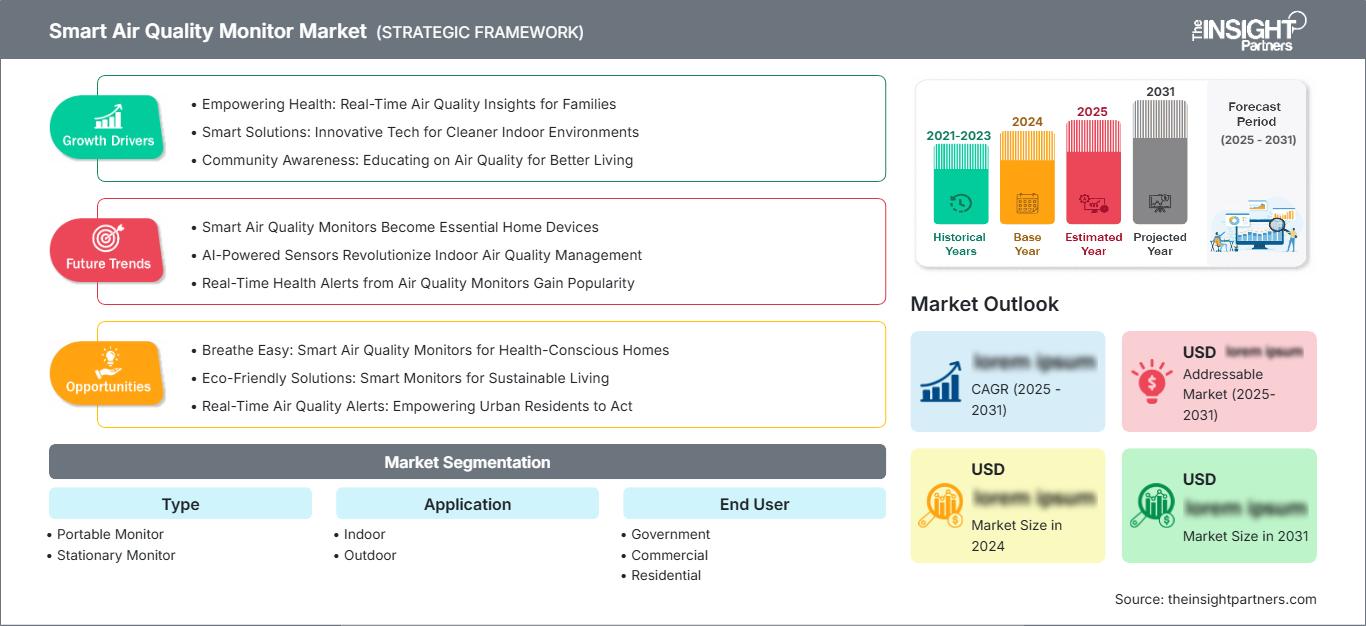
Smart Air Quality Monitor Market: Strategic Insights
Regional Insights
North America Smart Air Quality Monitor Market
North America accounted for 32-35% of worldwide revenue in 2025 and is forecast to grow at a CAGR of 10.6-11.4% during the period 2026-2034. Regional presence is driven by high concentration of commercial structures, smoke exposure due to wildfires, classroom ventilation systems upgrades, and EPA guidelines for sensor performance, colocating, and data analysis.
Factors driving the market share for Smart Air Quality Monitor in North America consist of the regular requirements from the healthcare campuses, office management, universities, and city authorities. Structural factors include HVAC systems enhancement, public warnings, environmental justice projects, and reduction of risks for insurance purposes. Instrument selection is gradually moving towards the tools combining particulates, gas measurements, and environmental metrics with proper dashboards.
U.S. Smart Air Quality Monitor Market
The US was responsible for 79%-82% of North America in 2025 and is expected to increase at a CAGR of 10.8%-11.6% up to 2034. The demand comes from government facilities, commercial properties, industry fence-line monitoring and home equipment reporting on the level of PM2.5, CO2, VOC and humidity via mobile apps.
The vendor base is extensive with companies such as Honeywell International Inc., Thermo Fisher Scientific Inc., Teledyne Technologies Incorporated, Emerson Electric Co., and 3M Company supplying hardware, automation and filtration related applications. Current application trends include wildfire networks, air quality management in schools, health tracking in offices, and supplementary monitoring that complements, rather than replaces, regulatory stations.
Europe Smart Air Quality Monitor Market
Europe accounted for 24% to 27% market share in 2025 and will see a compound annual growth rate (CAGR) of 10.2% to 11.0% between 2026 and 2034. Early commercial uptake is being driven by the UK via workplace wellness initiatives, better ventilation in schools, and smart buildings. Awareness regarding nitrogen dioxide and particulates drives further demand.
Germany is currently the top country in terms of industrial and municipal expenditure, backed by its manufacturing facilities, transportation routes, and building automation partners. France, Italy, and Spain contribute to growth via low-emission policies for urban areas, requirements due to tourism, and renovations. Buyers seek calibrated monitors, data storage, and energy management integration, not simple standalone displays.
APAC Smart Air Quality Monitor Market
The APAC market accounted for a 28–31% share in 2025 and is expected to expand with a CAGR of 12.8-13.6%. China drives demand, whereas Japan and South Korea focus on precision sensors for structures, laboratories, and transport hubs.
India and Australia are building adoption via air quality programs, awareness among residences, and safety regulations for industries. In the Smart Air Quality Monitor Market, high density of urban population, growth of industries, and increasing pressure to increase the visibility of PM2.5 plays an important role.
Middle East & Africa Smart Air Quality Monitor Market
MEA is projected to record a CAGR of 9.4%-10.2% between 2026 and 2034 driven by the growth of UAE, Saudi Arabia, and South Africa. Energy applications, urban developments, and indoor comfort needs in harsh environments boost the demand for sensors.
The UAE sets the pace in terms of adoption thanks to its smart cities, airports, hospitality industry assets, and high specification commercial buildings. The contribution of giga projects and industrial monitoring comes in handy for Saudi Arabia, whereas the rest of MEA depends on mining, utilities, and air quality programs in the municipalities.
Segmentation Analysis
Type
Type is expected to grow at a CAGR of 11.1–11.9% during 2026–2034 as users choose between fixed infrastructure and mobile inspection needs. The Smart Air Quality Monitor Market scope across type is shaped by deployment duration, calibration needs, connectivity, and whether data is used for continuous building control, community mapping, or short-term exposure assessment.
- Portable Monitor supports inspections, personal exposure checks, emergency response, and facility audits where mobility and quick readings matter. Demand rises when users need flexible sampling across rooms, sites, or temporary events.
- Stationary Monitor remains the largest segment because governments, factories, schools, hospitals, and offices require continuous measurements. Its strategic value comes from automated alerts, historical data, and integration with ventilation systems.
Application
Application is projected to grow at a CAGR of 11.3–12.1% during 2026–2034 as monitoring shifts from passive awareness to operational decision-making. Indoor use is tied to ventilation, productivity, and occupant reassurance, while outdoor use supports community exposure mapping, industrial perimeter visibility, transport corridor analysis, and local environmental planning.
- Indoor applications dominate building-level procurement because CO2, PM2.5, humidity, and VOC readings help improve ventilation decisions, reduce complaints, and support wellness certifications in offices, schools, and residences.
- Outdoor applications are strategically important for cities, ports, industrial zones, and transport corridors. Buyers use networked devices to identify hotspots, assess wildfire smoke, and support public information systems.
End User
End User is expected to grow at a CAGR of 11.6–12.4% during 2026–2034 as adoption broadens from environmental agencies into private buildings and homes. Government users require credible networks, commercial buyers need actionable dashboards, residential users seek simple alerts, and industrial facilities prioritize safety, compliance, and process-area risk monitoring.
- Government buyers deploy monitors for community visibility, public alerts, and supplemental networks. Strategic value is strongest where agencies need local data beyond sparse reference stations.
- Commercial adoption is driven by offices, malls, schools, hospitals, and hotels seeking occupant reassurance, ventilation optimization, and documented indoor environmental performance.
- Residential demand is scaling as connected-home users track PM2.5, CO2, allergens, smoke, and VOCs through mobile apps and automated filtration responses.
- Industrial users apply monitoring near production lines, warehouses, utilities, mines, and fence lines to detect exposure risks, manage incidents, and support environmental reporting.
Opportunity Snapshot
| End User | Revenue Contribution | Trend Tag | Adoption Stage |
| Government | High | Public Alerts | Scaling |
| Commercial | High | HVAC Data | Mature |
| Residential | Medium | Connected Home | Scaling |
| Industrial | Medium | Fence Monitoring | Scaling |
Smart Air Quality Monitor Market Growth Drivers and Impact Analysis
Rising health exposure awareness in buildings
Indoor exposure has emerged as an operational concern for boards at school campuses, corporate offices, hospitals, and housing societies since people spend the majority of their time in closed spaces. With smart sensors in place, facility managers can track CO2 emissions, particulate pollution, VOCs, humidity imbalance, and filter failure issues even before any complaint arises. As a result of this trend, the market will see increased investment in devices with continuous monitoring, service contracts, and dashboards that take action based on the results of sensing. This will also increase the need for replacements, as consumers will shift from simple monitoring to more complex multi-sensor solutions.
Expansion of sensor networks for communities
The use of distributed sensing networks is helping municipalities and environmental authorities to supplement scarce reference sites and provide better local visibility. This is especially important for wildfire smoke, traffic routes, industry areas, ports, and environmental justice communities, where pollution may be significantly different over short distances. Impact on the Smart Air Quality Monitor market includes trends towards ruggedized and outdoor sensors, calibration services, open feed data, and management systems for large number of nodes. The companies offering validation services and data correction tools will have an edge since public organizations need to make compromises between price and decision making support.
Integration with automation and sustainability systems
Air quality data is increasingly linked with HVAC control, energy management, occupational safety, and sustainability reporting. This integration changes monitors from passive display products into operational infrastructure that can trigger ventilation, filtration, alerts, and maintenance workflows. Market impact is visible in higher demand for connected stationary systems, API-ready software, and devices that support multiple building protocols. Commercial buyers also see a financial case because better ventilation control can reduce unnecessary energy use while maintaining occupant comfort. Suppliers that partner with automation vendors and facility service providers can capture larger projects than hardware-only competitors.
Smart Air Quality Monitor Market Future Trends
AI-calibrated multi-pollutant intelligence
The next phase of Smart Air Quality Monitor Market trends will center on AI-calibrated devices that correct sensor drift, identify pollutant patterns, and distinguish episodic events from persistent exposure risks. Future platforms will combine PM2.5, PM10, CO2, NO2, ozone, VOCs, temperature, and humidity with weather and occupancy data. This will make readings more actionable for building managers and city planners. Vendors able to explain model confidence, calibration frequency, and data lineage will gain trust as customers demand transparency before automating ventilation or public alerts.
Air quality data as a managed service
Monitoring hardware is expected to become the entry point for managed air intelligence services that include installation, calibration, analytics, alerts, reporting, and equipment recommendations. This transition will be important for customers lacking in-house environmental expertise, particularly schools, hospitality groups, warehouses, and small municipalities. Recurring service models can improve vendor margins while reducing buyer uncertainty around data quality. Over time, procurement may shift from buying individual devices to contracting performance-based monitoring coverage across buildings, campuses, or neighborhoods.
Smart Air Quality Monitor Market Opportunities
Campus-scale indoor air intelligence
Large campuses create a strong investment opportunity because they combine multiple buildings, diverse occupancy patterns, and centralized facility management. Universities, hospitals, corporate parks, and government complexes can deploy standardized monitors across rooms, laboratories, corridors, and mechanical zones, then compare performance across assets. This supports targeted filtration upgrades, maintenance planning, and occupant communication. Vendors should package hardware, analytics, calibration, and training as a multi-year program rather than a one-time device sale. The strongest opportunity lies in linking air quality with energy optimization, infection-control readiness, and sustainability reporting.
Localized manufacturing and service partnerships
Regional manufacturing and service partnerships can reduce lead times, improve after-sales support, and align devices with local pollutant profiles. This opportunity is especially relevant in APAC and Middle East markets where public infrastructure projects require quick deployment, training, and calibration continuity. Suppliers can strengthen competitiveness by partnering with HVAC contractors, environmental laboratories, telecom providers, and smart city integrators. Localized assembly also supports public procurement preferences and lowers import-related delays. Companies that combine global sensor quality with regional service depth can win tenders against lower-cost hardware suppliers.
Recent Developments
- June 2026: IQAir, a global leader in air quality technology, announced the launch of the Atem Eco, its most affordable room air purifier to date. Designed to bring medical-grade air purification to more homes and businesses, Atem Eco combines advanced filtration, intelligent air quality monitoring, and connected technology for $799.99 USD ($1,139.99 CAD).
- September 2025: Finnish smart sensor technology company Ruuvi has launched Ruuvi Air to address the unseen dangers of poor indoor air quality, which affects daily health and well-being in our homes, workspaces, and indoor environments where we spend 90% of our time. The new device is Ruuvi’s latest all-in-one smart sensor and an addition to the Ruuvi sensor portfolio. Users are empowered with the knowledge to optimise their indoor environments using the same continuous monitoring philosophy that millions apply to measure their steps, heart rate, and sleep patterns, making adjustments and improvements based on data and actionable insights.
- June 2024: Secretary, Electronics and IT Ministry, S. Krishnan on inaugurated Indigenous Air Quality Monitoring System (AQ-AIMS) and launched Air-Pravah App on the occasion of World Environment Day. These are developed under MeitY supported technologies.
Frequently Asked Questions

- Comprehensive Market Sizing and Forecast Analysis
- Detailed Segmentation Analysis
- In-Depth Market Dynamics Assessment
- Regional and Country-Level Insights
- Competitive Landscape and Company Benchmarking
- Strategic Business Intelligence
Recent Reports
Testimonials

The Insight Partners' SCADA System Market report is comprehensive, with valuable insights on current trends and future forecasts. The team was highly professional, responsive, and supportive throughout. We are very satisfied and highly recommend their services.
RAN KEDEM Partner, Reali Technologies LTDs
I requested a report on a very specific software market and the team produced the report in a few days. The information was very relevant and well presented. I then requested some changes and additions to the report. The team was again very responsive and I got the final report in less than a week.
JEAN-HERVE JENN Chairman, Future Analytica
We worked with The Insight Partners for an important market study and forecast. They gave us clear insights into opportunities and risks, which helped shape our plans. Their research was easy to use and based on solid data. It helped us make smart, confident decisions. We highly recommend them.
PIYUSH NAGPAL Sr. Vice President, High Beam Global
The Insight Partners delivered insightful, well-structured market research with strong domain expertise. Their team was professional and responsive throughout. The user-friendly website made accessing industry reports seamless. We highly recommend them for reliable, high-quality research services
YUKIHIKO ADACHI CEO, Deep Blue, LLC.
This is the first time I have purchased a market report from The Insight Partners.While I was unsure at first, I visited their web site and felt more comfortable to take the risk and purchase a market report.I am completely satisfied with the quality of the report and customer service. I had several questions and comments with the initial report, but after a couple of dialogs over email with their analyst I believe I have a report that I can use as input to our strategic planning process.Thank you so much for taking the extra time and making this a positive experience.I will definitely recommend your service to others and you will be my first call when we need further market data.
JOHN SUZUKI President and Chief Executive Officer, Board Director, BK Technologies
I wish to appreciate your support and the professionalism you displayed in the course of attending to my request for information regarding to infectious disease IVD market in Nigeria. I appreciate your patience, your guidance, and the fact that you were willing to offer a discount, which eventually made it possible for us to close a deal. I look forward to engaging The Insight Partners in the future, all thanks to the impression you have created in me as a result of this first encounter.
DR CHIJIOKE ONYIA MANAGING DIRECTOR, PineCrest Healthcare Ltd.Reason to Buy
- Informed Decision-Making
- Understanding Market Dynamics
- Competitive Analysis
- Identifying Emerging Markets
- Customer Insights
- Market Forecasts
- Risk Mitigation
- Boosting Operational Efficiency
- Strategic Planning
- Investment Justification
- Tracking Industry Innovations
- Aligning with Regulatory Trends





 Get Free Sample for