
Smart Bathroom Market Size, Growth & Trends by 2034
Coverage: by Product (Smart Windows, Hand Dryers, Touch-less Cisterns, Touch-less Soap Dispensers, Smart Toilets, Touch-less Faucets and Others); and End User (Residential and Commercial), and Geography (North America, Europe, Asia Pacific, and South and Central America)
- Status : Data Released
- Report Code : TIPTE100000638
- Category : Electronics and Semiconductor
- No. of Pages : 150
- Available Report Formats :


- Last update date : July 31, 2026


2025 Market Size
US$ 1,943.22 Mn
Base year value
2034 Forecast
US$ 3,550.44 Mn
Projected by 2034
CAGR 2026-2034
6.93 %
Growth rate
Addressable Market
US$ 24,816.57 Mn
(2026-2034)
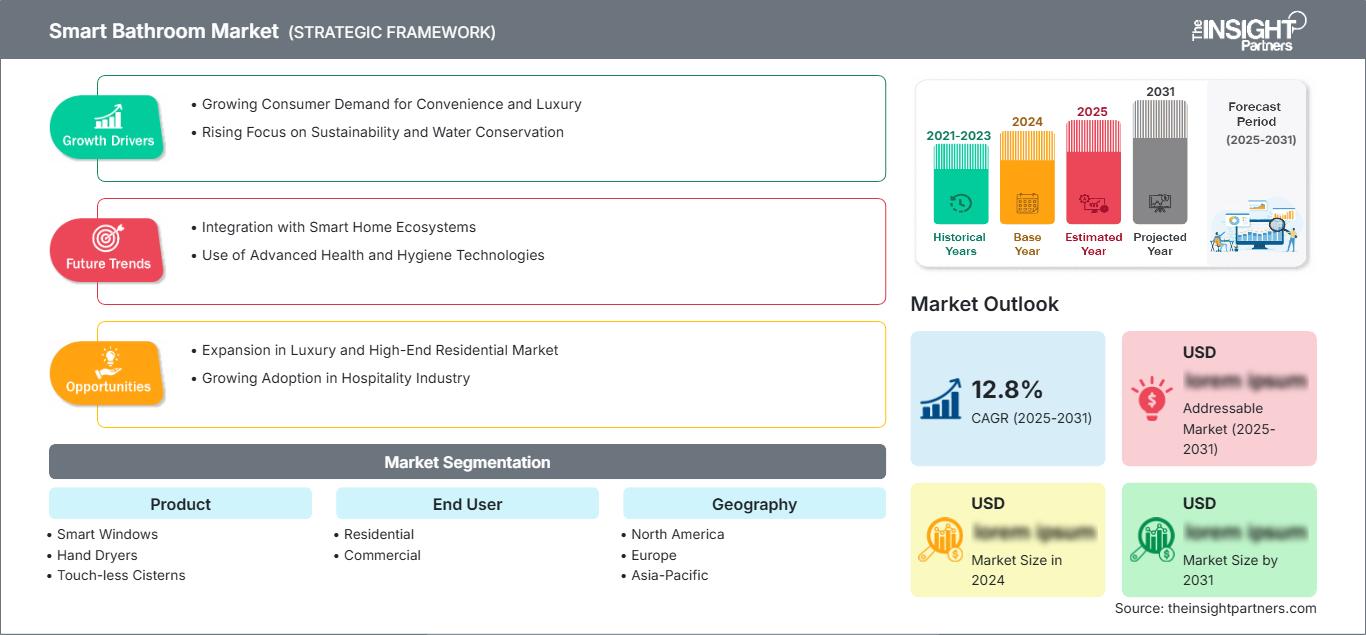
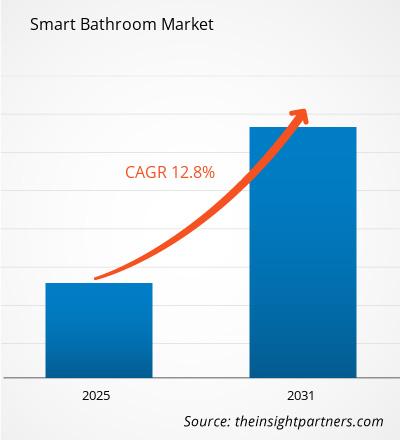
The Smart Bathroom Market is anticipated to grow from US$ 1,943.22 Million in 2025 to US$ 3,550.44 Million by 2034, growing at a CAGR of 6.93% from 2026 to 2034. This is driven by connected plumbing, touchless sanitization features, smart water usage and premium home renovation.
The North America region is a lucrative regional market with a projected CAGR ranging from 6.4 to 7.0 percent due to renovations, building codes on water efficiency and touchless installations in commercial establishments. The growth of the Smart Bathroom Market size in the North America region is boosted by adoption of smart homes, strong specification from hospitality and healthcare, and established distribution network for smart faucets, toilets, soap dispensers, and hand dryers.
Smart Bathroom Market Assessment and Insights
- North America accounted for 34–36% share in 2025 and is growing at a CAGR range of 6.4–7.0% during 2026–2034, led by water-saving upgrades, premium renovations, and commercial hygiene automation.
- US represented 78–82% of North America in 2025 and is growing at a CAGR range of 6.3–6.9% during 2026–2034, supported by brand presence and retrofit demand.
- Europe held 25–27% share in 2025 and is growing at a CAGR range of 5.8–6.4% during 2026–2034, with Germany, the UK, France, Italy, and Spain leading adoption.
- Asia Pacific captured 28–30% share in 2025 and is growing at a CAGR range of 7.8–8.5% during 2026–2034, driven by China, Japan, South Korea, India, and Australia.
- Largest Segment Smart Toilets held 30–33% market share in 2025 and is growing at a CAGR range of 6.8–7.4% during 2026–2034, reflecting premium hygiene and comfort demand.
- High Growth Segment Commercial held 38–41% market share in 2025 and is growing at a CAGR range of 7.4–8.1% during 2026–2034, supported by facility retrofits and hygiene-led procurement.
- Key companies analyzed in detail: Bradley Corporation, Grohe AG, Little Giant, Kohler Co., Moen Incorporated, Delta Faucet Company, TOTO Ltd., Gerber Plumbing Fixtures LLC, American Standard Brands, Sterling Plumbing Group.
Source: The Insight Partners' analysis based on proprietary research, government publications, company annual reports, investor presentations, industry databases, and expert interviews.
The development of product has evolved from individual sensor fitting to full bathroom ecosystems that integrate occupancy detection, automated flush, flow control, application-based customization and predictive maintenance. The manufacturers are changing their supply chain of ceramics, brassware, electronics, and software based on modular platform to keep control over cost and reliability. Thus, the Smart Bathroom Market moves away from exclusive product and becomes specified infrastructure in such settings as hotels, offices, healthcare facilities and luxury residences where hygiene, water saving and unique user experience become purchasing considerations.
The future market demand will depend on new urban residential buildings, hotel renovation, wellness-driven design and policies to promote efficient use of water resources. Manufacturers should plan investments in less noisy valves, more durable sensors, reliable connection and simple installation kit. Another growth point is mixed-used projects and assisted living facilities where automated bathroom functionality provides greater accessibility and efficiency in maintenance.
Smart Bathroom Market Report Scope
| Report Attribute | Details |
|---|---|
| Market size in 2025 | US$ 1,943.22 Million |
| Market Size by 2034 | US$ 3,550.44 Million |
| Global CAGR (2026 - 2034) | 6.93% |
| Historical Data | 2021-2024 |
| Forecast period | 2026-2034 |
Smart Bathroom Market Analysis
Market growth for Smart Bathrooms has been fostered by the interplay of cleanliness requirements, water-cost saving, and the general trend towards connected homes. Contactless faucets, cisterns, soap dispensers, and hand dryers have become popular due to lower shared surface contact while promoting water savings and energy efficiency in highly frequented restrooms. In households, intelligent toilets and devices are considered to be additions that will improve comfort, wellness, and support aging in place.
Value chain players include ceramic manufacturers, manufacturers of plumbing hardware, sensor makers, electronics integration companies, software firms, distributors, installers, architects, and facility managers. The supply market environment prefers those brands that offer quality plumbing hardware and efficient electronic control systems. Standardization is increasing serviceability, while businesses tend to demand devices meeting certain accessibility, water-saving, and certification standards.
According to Smart Bathroom Market report, competition is dominated by plumbing companies that can leverage their specification relationships into connected product offerings. Competition is being waged amongst Kohler Co., TOTO Ltd., Grohe AG, Moen Incorporated, and Delta Faucet Company via smart toilets, digital showers, sensor faucets, and sustainability-focused product lines. Bradley Corporation and American Standard Brands continue to play a role in commercial restroom applications based on their product durability and maintenance costs.
The areas of focus for investments include the development of sensors that are reliable, speech-enabled, low power electronics, and analysis of water consumption. The positioning of the products varies from one channel to another. While premium residential players adopt the strategy of experience and design positioning, institutional players position themselves in terms of uptime, retrofit kits, and cost savings in terms of lifetime usage.
● REPORT CUSTOMIZATION
Tailor This Report To Align With Your Specific Business Requirements
This report can be customized to align precisely with your business objectives, scope, and target markets. Customization options include tailored segmentation, geography, competitive analysis, and strategic insights to support informed decision-making.
Customize This Report →WHAT YOU CAN ADJUST
- ● Segmentations
- ● Geography
- ● Competitive Analysis
- ● Language Preferences
Smart Bathroom Market: Strategic Insights
Regional Insights
North America Smart Bathroom Market
In North America, the Smart Bathroom Market share was 34-36% in 2025 and is predicted to increase at a CAGR of 6.4-7.0% through 2034. This demand will be fueled by luxurious residential remodeling projects, efficiency-related initiatives regarding water usage and restroom modernization in commercial areas. The area has excellent availability of smart toilets, sensor faucets, soap dispensers and shower controls through retail sales and professional channels.
Facilities will be installing sensor products to minimize wastage of water and enhance perceptions of hygiene in offices, airports, hotels, universities and hospitals. EPA WaterSense procurement, LEED design and post pandemic hygiene practices will ensure continued investment in this area. There is also brand focus which includes Kohler Co., Moen Incorporated, Delta Faucet Company, Bradley Corporation and American Standard Brands for the region.
U.S. Smart Bathroom Market
The U.S. was responsible for 78-82% of the continent in 2025 and is expected to have a CAGR range of 6.3-6.9% from 2026-2034. Applications of smart plumbing systems involve luxury residential remodeling projects, multifamily units, hotel renovations, and health care facility restroom remodels. Smart toilet systems, hands-free faucet fixtures, and touch-less soap dispensers are becoming increasingly popular in applications involving hygiene, water saving, and maintenance monitoring considerations.
Corporate presence will aid in enhancing domestic demand as well. Among the leading companies which operate within the industry are Kohler Co., Moen Incorporated, Delta Faucet Company, Bradley Corporation, Sterling Plumbing Group, Gerber Plumbing Fixtures LLC, and American Standard Brands. Areas where the technology can be applied include luxury home smart bidets, office facility sensors, public restroom flushing mechanism, and intelligent showering systems for bathroom remodels based on experience.
Europe Smart Bathroom Market
Europe held 25–27% share in 2025 and is growing at a CAGR range of 5.8–6.4% during 2026–2034. Germany leads due to strong sanitaryware engineering, energy-conscious building standards, and specification of thermostatic, sensor, and digital fittings in premium projects. The UK market is driven by hotel refurbishment, assisted-living bathrooms, and water-efficient commercial restrooms.
Examples of the steady adaptation of France, Italy, and Spain include design-based renovation, boutique hotels, and apartment renovations in urban areas. Grohe AG achieves competitive advantage in the market due to the provision of efficient and smart product ranges. International companies are able to achieve competitive advantage because of their high-end distribution channels. Consequently, efficiency requirements, small spaces, and designs define the European Smart Bathroom Market.
APAC Smart Bathroom Market
APAC recorded 28–30% market share in 2025 and expected to grow at a CAGR between 7.8% and 8.5% from 2026–2034. China dominates owing to investments in urban housing, smart cities, and hotels. Japan and South Korea are mature markets for demand from smart toilet and bidet technology.
India and Australia contribute to growth from premium apartments, hospitality, and water-efficient building upgrades. Government initiatives in urban infrastructure development, renovation by the growing middle class population, and production of electronics locally ensure affordability. TOTO Ltd. continues to be a major player in high-end hygiene solutions, while faucet and sanitary ware brands fight for commercial specifications in the Smart Bathroom Market.
Middle East & Africa Smart Bathroom Market
Middle East and Africa is growing at a CAGR range of 6.6–7.2% during 2026–2034, led by Saudi Arabia, the UAE, South Africa, and the Rest of MEA. Saudi Arabia is the leading country, supported by tourism, healthcare, and mixed-use infrastructure programs that specify automated bathrooms.
Energy and water conservation are some of the most vital issues in the context of purchasing decisions made for hot climate conditions. High-end hotels, airports, shopping malls, and office buildings are incorporating sensor taps, touchless toilet cisterns, and hand dryers to maintain hygiene and operational expenses. The requirement in South Africa is more on the retrofit side.
Segmentation Analysis
Product
Product is expected to grow at a CAGR range of 6.7–7.3% during 2026–2034, reflecting wider adoption of automated water delivery, touch-free activation, and connected comfort systems. Smart Bathroom Market scope across products remains broad because buyers combine hygiene, resource efficiency, design, and accessibility requirements. Smart toilets and touch-less faucets dominate value perception, while hand dryers and dispensers strengthen commercial restroom automation.
- Smart Windows support premium bathroom design by improving privacy, daylight control, and energy performance, especially in luxury homes, hotels, and wellness-oriented properties seeking integrated ambience management.
- Hand Dryers remain strategically important in commercial restrooms because they reduce paper waste, simplify maintenance, and align with sustainability objectives in offices, airports, malls, and healthcare facilities.
- Touch-less Cisterns are specified in high-traffic washrooms where automatic flushing improves hygiene consistency, reduces manual contact, and supports facility-wide restroom modernization programs.
- Touch-less Soap Dispensers benefit from institutional hygiene protocols and pair naturally with sensor faucets, making them essential in healthcare, hospitality, education, and corporate restroom upgrades.
- Smart Toilets represent the leading value category, supported by bidet functions, heated seats, self-cleaning features, water efficiency, and premium positioning in residential and hospitality environments.
- Touch-less Faucets are widely adopted because automatic shutoff reduces waste, improves perceived cleanliness, and fits commercial specifications where water control and user throughput matter.
End User
End User is projected to grow at a CAGR range of 6.9–7.6% during 2026–2034 as residential and commercial buyers adopt smart fixtures for different reasons. Residential demand is linked to renovation, wellness, and convenience, while commercial demand is shaped by hygiene, traffic intensity, and operating-cost control. The Smart Bathroom Market therefore requires differentiated pricing, specification, and service strategies by customer group.
- Residential adoption is strongest in premium remodeling and new-build homes, where smart toilets, faucets, shower controls, and privacy solutions enhance comfort, accessibility, and perceived property value.
- Commercial demand is scaling across offices, hotels, airports, hospitals, universities, and retail sites where touch-free fixtures improve hygiene control, reduce water waste, and simplify maintenance planning.
Opportunity Snapshot
| End User | Revenue Contribution | Trend Tag | Adoption Stage |
| Residential | High | Wellness Retrofit | Scaling |
| Commercial | Medium | Touchless Upgrade | Scaling |
Smart Bathroom Market Growth Drivers and Impact Analysis
Water-Efficiency Pressure in Buildings
Water efficiency can now be quantified in the purchase criteria for toilet fixtures in areas with more expensive utility rates and higher standards of building codes. Smart faucet sensors, sensor-operated water closet cisterns, and remote monitoring systems can reduce wastage, detect inefficiencies, and enable sustainable reporting. The influence is most pronounced in hotels, office buildings, airports, and educational institutions, where there is significant usage of restrooms on a day-to-day basis. In terms of the manufacturer, this trend changes the focus of competition from design to certification and durability of valves and electronics.
Hygiene Automation in Shared Restrooms
Touchless operation continues to be an important driver owing to the fact that there are several common surfaces in public and semi-public bathrooms. Building managers are increasingly focusing on installing automatic faucets, soap dispensers, flushing systems, and hand dryers, in order to decrease contact and increase confidence among users. As a result of this driver, procurement officers are concerned about the accuracy, battery performance, vandalism resistance, cleanability, and maintenance alerts of sensors. The Smart Bathroom Market gains from automation being implemented in an entire bathroom, and not in individual components.
Premium Residential Renovation and Aging-in-Place Needs
Demand from homes is increasing due to the fact that bathrooms are increasingly being seen as wellness spaces, comfort zones, and accessibility rooms rather than mere functional rooms. Products like smart toilets, digital controls for showers, touch-free faucets, and privacy glass contribute to customization, temperature control, and user-friendliness for the elderly population. Consumers prefer renovation products that offer both functional benefits as well as aesthetic value in the form of reduced cleaning, safer use, and water control.
Smart Bathroom Market Future Trends
Predictive Maintenance and Water Analytics
Smart Bathroom Market trends will increasingly center on analytics that move beyond touchless activation. Commercial users will expect fixtures to report usage intensity, battery status, flow anomalies, and service needs through building platforms. This will help facility teams schedule maintenance before failures occur, reduce restroom downtime, and document water-saving outcomes. Suppliers that combine plumbing reliability with secure data integration can capture higher-value projects. Over time, predictive maintenance will become a differentiator in airports, campuses, hospitals, and large office portfolios where restroom availability directly affects user experience.
Personalized Wellness Bathrooms
Personalization will define the next phase of premium residential adoption. Smart toilets, showers, lighting, privacy windows, and mirrors are expected to coordinate user profiles, preferred temperatures, cleansing settings, and ambience. The trend will be reinforced by aging-in-place design, wellness real estate, and consumer familiarity with app-controlled home systems. Vendors will need intuitive interfaces and strong privacy safeguards to avoid complexity. Successful products will feel effortless, not technical, turning the bathroom into a responsive environment that supports comfort, routine, and independent living.
Smart Bathroom Market Opportunities
Commercial Retrofit Bundles
Commercial retrofits offer a practical route to scale because many facilities need hygiene and efficiency upgrades without full restroom reconstruction. Suppliers can create bundled kits combining touch-less faucets, cistern controls, soap dispensers, hand dryers, installation instructions, spare parts, and maintenance dashboards. This approach reduces project friction for offices, universities, healthcare sites, malls, and airports. It also supports phased capital spending, allowing buyers to upgrade restrooms floor by floor. Vendors that prove lower water use, easier cleaning, and fewer service calls can strengthen recurring relationships with facility management teams.
Mid-Premium Residential Packages
Mid-premium residential packages can unlock broader adoption by reducing the price gap between luxury smart bathrooms and conventional fixtures. Manufacturers can combine smart toilets or bidet seats, touch-less faucets, app-enabled shower controls, and simple privacy solutions into coordinated design collections. Retailers and installers can position these packages around wellness, water efficiency, and future-ready home value. The opportunity is strongest in urban apartments, remodeling projects, and developer-led premium housing. Clear warranties, easy servicing, and compatibility with common smart-home platforms will be essential to conversion.
Recent Developments
- March 2026: Bathroom specialist VitrA is introducing its new V-Care 3 smart toilet collection, which it says features 'top-tier hygiene, smart functionality and human-centred design'. Depending on the model, features include personalised wash and dry settings, microbubble washing, UV-C cleaning, automatic seat and lid opening, an air purifier, intuitive side-panel controls, a remote control and next-generation mobile app, offering tailored user control for ultimate everyday comfort.
- May 2025: hansgrohe, the premium German brand in bathroom and kitchen solutions, officially announced the launch of its latest innovation — the LavaPura Element S series of e-toilets for the Indian Market. Blending effortless hygiene, design-led luxury, and modern-day convenience, the LavaPura Element S reaffirms Hansgrohe’s commitment to transforming everyday bathroom rituals through smart technology, sustainable design, and understated elegance.
- February 2025: TOTO, the world's leading plumbing manufacturer with over $5.34 billion in annual sales, announced that it will captivate KBIS 2025 with an immersive experience in Booth #N738. The TOTO showcase will highlight next-generation smart technology, environmentally conscious solutions, and state-of-the-art luxury designs for the modern bathroom.
Frequently Asked Questions

- Comprehensive Market Sizing and Forecast Analysis
- Detailed Segmentation Analysis
- In-Depth Market Dynamics Assessment
- Regional and Country-Level Insights
- Competitive Landscape and Company Benchmarking
- Strategic Business Intelligence
Recent Reports
Testimonials

The Insight Partners' SCADA System Market report is comprehensive, with valuable insights on current trends and future forecasts. The team was highly professional, responsive, and supportive throughout. We are very satisfied and highly recommend their services.
RAN KEDEM Partner, Reali Technologies LTDs
I requested a report on a very specific software market and the team produced the report in a few days. The information was very relevant and well presented. I then requested some changes and additions to the report. The team was again very responsive and I got the final report in less than a week.
JEAN-HERVE JENN Chairman, Future Analytica
We worked with The Insight Partners for an important market study and forecast. They gave us clear insights into opportunities and risks, which helped shape our plans. Their research was easy to use and based on solid data. It helped us make smart, confident decisions. We highly recommend them.
PIYUSH NAGPAL Sr. Vice President, High Beam Global
The Insight Partners delivered insightful, well-structured market research with strong domain expertise. Their team was professional and responsive throughout. The user-friendly website made accessing industry reports seamless. We highly recommend them for reliable, high-quality research services
YUKIHIKO ADACHI CEO, Deep Blue, LLC.
This is the first time I have purchased a market report from The Insight Partners.While I was unsure at first, I visited their web site and felt more comfortable to take the risk and purchase a market report.I am completely satisfied with the quality of the report and customer service. I had several questions and comments with the initial report, but after a couple of dialogs over email with their analyst I believe I have a report that I can use as input to our strategic planning process.Thank you so much for taking the extra time and making this a positive experience.I will definitely recommend your service to others and you will be my first call when we need further market data.
JOHN SUZUKI President and Chief Executive Officer, Board Director, BK Technologies
I wish to appreciate your support and the professionalism you displayed in the course of attending to my request for information regarding to infectious disease IVD market in Nigeria. I appreciate your patience, your guidance, and the fact that you were willing to offer a discount, which eventually made it possible for us to close a deal. I look forward to engaging The Insight Partners in the future, all thanks to the impression you have created in me as a result of this first encounter.
DR CHIJIOKE ONYIA MANAGING DIRECTOR, PineCrest Healthcare Ltd.Reason to Buy
- Informed Decision-Making
- Understanding Market Dynamics
- Competitive Analysis
- Identifying Emerging Markets
- Customer Insights
- Market Forecasts
- Risk Mitigation
- Boosting Operational Efficiency
- Strategic Planning
- Investment Justification
- Tracking Industry Innovations
- Aligning with Regulatory Trends





 Get Free Sample for