
Smart-Connected Power Plug Socket Market Trends, Size & Growth by 2034
Coverage: By Type (Wi-Fi, Bluetooth); Application (Household, Commercial) , and Geography (North America, Europe, Asia Pacific, and South and Central America)
- Status : Data Released
- Report Code : TIPRE00019108
- Category : Electronics and Semiconductor
- No. of Pages : 150
- Available Report Formats :


- Last update date : September 28, 2026


2025 Market Size
US$ 696.62 Mn
Base year value
2034 Forecast
US$ 8,082.24 Mn
Projected by 2034
CAGR 2026-2034
31.31 %
Growth rate
Addressable Market
US$ 30,985.59 Mn
(2026-2034)
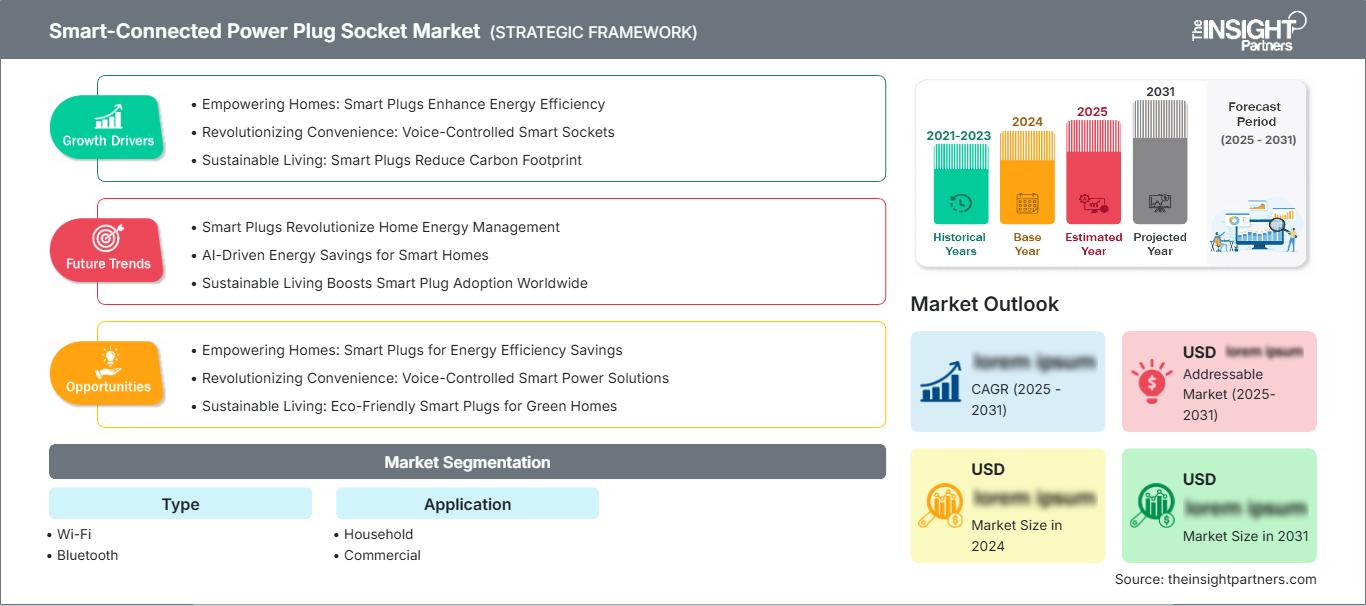
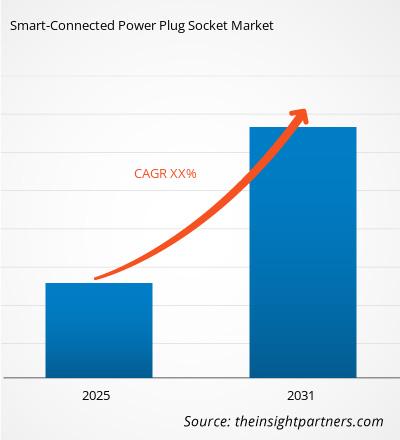
The Smart Connected Power Plug Socket Market was valued at US$ 696.62 Million in 2025 and is projected to reach US$ 8,082.24 Million by 2034, expanding at a CAGR of 31.31% during 2026–2034. There is an increasing trend of convergence among connected electrical accessories, home automation, energy monitoring and digital power management. The use of Wi-Fi and Bluetooth connectivity in appliances enables increasing levels of control of electrical loads at homes and commercial establishments.
In North America, the Smart Connected Power Plug Socket Market Size is projected to have a structural importance due to the presence of smart home ecosystems, broadband infrastructure and consumer experience with connected electric gadgets. The growth prospects for North America are a CAGR of 28-32% between 2026-2034. Growth will be driven by energy management applications and utility efficiency programs.
Smart-Connected Power Plug Socket Market Assessment and Insights
- North America is projected to retain a leading position, representing a 2025 share of 30–34% and growing at a CAGR of 29–32% between 2026–2034, supported by mature connected-home infrastructure.
- US represents the dominant North American market, with a 2025 share of 23–27% of global revenue and a CAGR of 29–33% between 2026–2034, led by household automation and energy control.
- Europe is estimated at a 2025 share of 24–28%, with a CAGR of 27–30% between 2026–2034. Germany, the UK, France, Italy, and Spain provide the principal demand centers through efficiency-oriented connected-device adoption.
- Asia Pacific is estimated at a 2025 share of 27–31% and a CAGR of 32–35% between 2026–2034. China, Japan, South Korea, and India underpin growth through electronics manufacturing, smart-home deployment, and digital infrastructure.
- Largest Segment is Wi-Fi, estimated at a 2025 market share of 67–72% and a CAGR of 30–33% during 2026–2034, reflecting direct router connectivity and broad ecosystem compatibility.
- High Growth Segment is Commercial, estimated at a 2025 market share of 36–40% and a CAGR of 32–35% during 2026–2034, supported by centralized energy management and operational automation.
- Key companies analyzed in detail: Aeotec GmbH; Azpen Innovation, Inc.; Belkin International, Inc.; D-Link Systems, Inc.; Honeywell International Inc.; adesso Inc.; BroadLink; ITEAD Intelligent Systems Co., Ltd.; Leviton Manufacturing Co., Inc.; SAFEMORE; TP-Link Systems Inc.
Source: The Insight Partners' analysis based on proprietary research, government publications, company annual reports, investor presentations, industry databases, and expert interviews.
Modern connected power-control devices have progressed from basic remote switch accessories to smart endpoints that can schedule, monitor, automate and integrate into a wider ecosystem, powered by digital management capabilities. The integration of semiconductor technology has allowed for simpler construction of such a device, while improvements in wireless technology have improved reliability and decreased entry barriers. Manufacturing has focused on miniaturization, energy monitoring, heat protection, interoperability and firmware support, thereby making the product a useful interface between the traditional electric system and connected devices ecosystem.
In the coming years, the technology will spread from digitally savvy homes to small businesses, rented spaces, hotels, and dispersed sites. Investments will be made on the issue of platform interoperability, cybersecurity, energy analytics, and certification in the local market. Energy efficiency and building electrification will help adoption in those areas where the installation of the connected plug sockets is rather easy.
Smart-Connected Power Plug Socket Market Report Scope
| Report Attribute | Details |
|---|---|
| Market size in 2025 | US$ 696.62 Million |
| Market Size by 2034 | US$ 8,082.24 Million |
| Global CAGR (2026 - 2034) | 31.31% |
| Historical Data | 2021-2024 |
| Forecast period | 2026-2034 |
Smart-Connected Power Plug Socket Market Analysis
Demand is influenced by the desire to regulate appliances without replacing existing electrical installations. Wireless socket represents a relatively simple entry route to automation which allows for load scheduling, remote switching of appliances, and selection of smart devices compatible with digital assistants. The ecosystem covers all stakeholders from chip providers and modules suppliers to electrical equipment producers, software platform owners, distributors, installers, resellers, and facility managers. Such an ecosystem permits differentiation of business models depending on hardware, software, energy, and channel solutions.
Supply is growing more and more dependent on chipsets, microcontrollers, relays, sensors, housings, and the certification process. Meanwhile, producers have to balance between the low cost of the bill of materials and electrical safety, thermal efficiency, reliable connection, and firmware development. With the electronics industry supply chain being susceptible to logistics problems and parts shortages, geographical diversification of supply sources starts playing an increasing role. This is why producers with certification and contract manufacturing expertise will be able to adapt faster to the demand changes in both channels.
Competition continues to be fragmented among electrical equipment providers, networking firms, smart-home specialists, and discount consumer electronics providers. According to the Smart Connected Power Plug Socket Market Report, Belkin International Inc. has taken a connected home approach whereas Leviton Manufacturing Co. Inc. integrates smart controls along with electrical distribution. Connected device ecosystems as well as software integration have been followed by D-Link Systems Inc., BroadLink, and ITEAD Intelligent Systems Co. Ltd. Honeywell International Inc. and Azpen Innovation Inc. are further incorporating automation capabilities. Specialized and value-based needs have been served by Aeotec GmbH, adesso Inc. and SAFEMORE.
Strategic positioning continues to rely more on interoperability, scope of application, cybersecurity, and channel distribution than on switch functionalities alone. For instance, the Tapo platform offered by TP-Link Systems Inc. has been expanded around the connected home products, thus showcasing the benefit of incorporating power control devices within wider platforms. Key investment areas include Matter, energy monitoring, mobile applications, cloud services, and local control features. The need for developing electrical distribution channels is also critical owing to higher value being achieved through professional installation and retrofit projects.
● REPORT CUSTOMIZATION
Tailor This Report To Align With Your Specific Business Requirements
This report can be customized to align precisely with your business objectives, scope, and target markets. Customization options include tailored segmentation, geography, competitive analysis, and strategic insights to support informed decision-making.
Customize This Report →WHAT YOU CAN ADJUST
- ● Segmentations
- ● Geography
- ● Competitive Analysis
- ● Language Preferences
Smart-Connected Power Plug Socket Market: Strategic Insights
Regional Insights
North America Smart Connected Power Plug Socket Market
North America has an estimated share of 30–34% for 2025, with a CAGR of 29–32% up to 2034. The region boasts well-developed broadband connectivity infrastructure, existing smart home solutions, and high user awareness of app-controlled appliances. Installation in residential buildings prevails, whereas small commercial buildings more often deploy connected sockets to regulate the work of lighting and devices and monitor operations.
The US dominates regional demand, whereas Canada is an emerging, although relatively small, market due to efficiency measures and connected building applications. Product choices increasingly emphasize ease of installation, compatibility with voice assistants, scheduling features, and energy monitoring. Utility and building efficiency projects can boost adoption through providing users and building owners with an effective means to control plug-level energy consumption without costly rewiring.
U.S. Smart Connected Power Plug Socket Market
The US accounts for about 23-27% of the Smart Connected Power Plug Socket Market share in 2025 and 76-82% of the North American market, showing a CAGR of 29-33% from 2026 to 2034. The US benefits from high adoption rates of smart homes, wide availability of e-commerce, and platforms with ecosystems, which drive repeated needs among consumers and SMBs.
Trends in applications involve the usage of the technology in lighting, entertainment devices, kitchen appliances, office devices, and seasonal load management. Connected sockets are being deployed among commercial users for the equipment scheduling to work with larger building control. Some of the vendors that will benefit are Belkin International Inc., Honeywell International Inc., and Leviton Manufacturing Co., Inc., due to their presence in the US electrical market.
Europe Smart Connected Power Plug Socket Market
The region will be responsible for a share of 24-28% for 2025, growing at a CAGR of 27-30% till 2034. Germany is the top national market, with an awareness of energy efficiency, connected building technology, and electrical distribution. The United Kingdom is close behind, while France, Italy, and Spain contribute through renovation and upgrading of the home to smart homes.
The United Kingdom has high smart meter awareness with consumer interest in energy visibility and appliance control. Germany has the benefit of industrial automation and efficiency concerns. France, Italy, and Spain are working on developing demand through renovation, connected homes, and availability of interoperable devices. European consumers are now also looking at privacy, cybersecurity, electrical safety, and interoperability along with price.
APAC Smart Connected Power Plug Socket Market
The Asia Pacific market is expected to capture a market share of 27-31% with CAGR of 32-35%, making it the highest growth region. China is the most prominent country market due to electronic manufacturing and smart homes' popularity. The connectivity advantage of the connected infrastructure drives Japan and South Korea markets, while India and Australia provide adoption opportunities.
The technical know-how in industrial electronics, smartphone penetration, and smart city initiatives boost regional demand. The China leads the regional market while India shows volume potential in the long run due to cheapness of the connected devices. Interoperability and automation are the key drivers in Japan and South Korea, whereas Australia possesses both of them.
Middle East & Africa Smart Connected Power Plug Socket Market
CAGR for Middle East and Africa region is projected at 28–32%, fueled by smart city initiatives, building renovations, and energy management applications. Leading countries within the region include Saudi Arabia and UAE, whereas the South African sub-region is a vital one. Rest of MEA is relatively fragmented but presents incremental opportunities.
The UAE enjoys smart buildings driven by digital technologies, whereas Saudi Arabia enjoys development of infrastructure projects. South Africa will offer demand owing to automation of homes and offices. Within MEA, connected sockets can help in managing loads locally where infrastructure upgrades and cost controls on energy as well as equipment supervision are key.
Segmentation Analysis
Type
Type segmentation in the Smart Connected Power Plug Socket Market is expected to expand at a CAGR of 30–33% during 2026–2034. The segment reflects a balance between direct Wi-Fi connectivity and shorter-range Bluetooth control. Buyers increasingly prioritize setup simplicity, interoperability, remote access, and energy-monitoring functionality, while manufacturers seek to reduce hardware costs and improve reliability across diverse network environments.
- Wi-Fi: Wi-Fi products maintain the dominant market position because they provide direct network access without dedicated hubs. Demand is concentrated where remote control, voice integration, scheduling, and cloud-connected energy monitoring are important.
- Bluetooth: Bluetooth products remain strategically relevant for simple local control, low-power connectivity, and compact installations. Their role is strengthened where users prioritize straightforward setup, device-to-phone communication, and lower networking complexity.
Application
Application is projected to grow at a CAGR of 31–34% during 2026–2034. Household demand benefits from accessible automation, while commercial adoption increasingly reflects operational efficiency, equipment scheduling, and distributed control. The Smart Connected Power Plug Socket Market scope therefore extends from individual appliance management toward coordinated energy and facility-management applications.
- Household: Household demand is supported by convenience, remote switching, automation routines, and compatibility with connected-home ecosystems. Consumers increasingly use smart sockets for lighting, entertainment, small appliances, seasonal equipment, and energy-aware scheduling.
- Commercial: Commercial adoption is strategically important for offices, hospitality sites, retail locations, and small facilities. Users can manage distributed loads, automate operating schedules, and complement broader building-management systems without extensive electrical reconstruction.
Opportunity Snapshot
| Application | Revenue Contribution (High/Medium/Low) | Trend Tag (MAX 2 words) | Adoption Stage (Emerging/Scaling/Mature) |
|---|---|---|---|
| Household | High | Home Automation | Mature |
| Commercial | Medium | Load Management | Scaling |
Smart-Connected Power Plug Socket Market Growth Drivers and Impact Analysis
Expansion of Retrofit-Based Home Automation
The advantage of retrofit convenience has helped expand the potential market for customers since the connected socket can control the existing appliance without replacing it. It provides more affordability when compared to a full-scale smart home transformation. This factor becomes especially relevant in well-developed housing markets where users have traditional appliances and need app control, scheduling, and voice commands. In addition, the retailer can offer connected sockets along with routers, smart lighting, security devices, and other products that can be attached to the home hub. Manufacturers can focus on the needs of the customers by developing small devices with easy pairing and wide compatibility. Repeated purchases may emerge when consumers will start buying connected sockets not for individual appliances but for rooms.
Growing Demand for Plug-Level Energy Management
Visibility of the use of energy has increasingly become a practical consideration in purchase decisions as households and organizations desire to take control of their electricity usage. Smart plugs are able to detect the behavior patterns of usage, schedule the use of certain loads, and cut off the power supply to equipment within a specified period of time. The influence of such devices on the market has been most pronounced in places where consumers experience variable charges, sustainability goals, or need to minimize unnecessary usage of energy at standby mode. Business consumers may utilize the same concept by controlling distributed equipment such as office equipment, lighting, hospitality devices, and small appliances. Manufacturers now have a chance to develop products that will go beyond being connected and incorporate metering and analysis features. Such devices will be more strategically relevant as energy management becomes part of the process of building renovation.
Interoperability and Secure Connected-Device Ecosystems
Influence on purchase decision is growing due to the need of customers and companies in products that work within ecosystems. Matter and other interoperability solutions will help decrease the dependency on proprietary platforms, while better security procedures can enhance trust in interconnected electrical products. Business benefits are obvious, as fragmentation leads to higher integration costs and discourages large-scale implementations. For companies that use standardized communication, regular firmware updates, proper authentication, and local control, this becomes easier. It will change the approach to competition as hardware specifications matter less when devices provide reliable operation in cross-platform environments. Installers and distributors will have a possibility to recommend devices according to the project needs without limitations of the particular environment for application. During the forecast period, interoperability will help with broader implementation within mixed installations and will provide business opportunities for those who can provide electrical security along with software lifecycle management.
Smart-Connected Power Plug Socket Market Future Trends
Energy-Aware Automation Becomes a Core Product Differentiator
The next phase of product development is likely to shift from remote switching toward automated energy decisions. Devices will increasingly combine consumption measurements with schedules, occupancy information, appliance behavior, and tariff signals to determine when connected loads should operate. This evolution can make plug-level controls more valuable in households with multiple connected appliances and in small commercial facilities without sophisticated building-management systems. Artificial intelligence may support anomaly detection, identifying unusual consumption patterns or equipment behavior and prompting users to investigate. Manufacturers are likely to compete on the quality of these insights rather than connectivity alone. Integration with smart meters, solar generation, batteries, and electric-vehicle charging systems could further increase usefulness. As the ecosystem matures, energy-aware automation should strengthen the role of connected sockets as distributed control points within broader digital energy environments.
Localized Intelligence Reduces Dependence on Cloud Services
Future architectures in the Smart Connected Power Plug Socket Market trends are expected to place greater emphasis on local processing, secure device-to-device communication, and resilient operation during internet outages. Consumers increasingly expect connected electrical products to continue executing essential schedules even when cloud services are unavailable. Local control can also reduce latency, improve privacy, and limit dependence on recurring software infrastructure. Manufacturers may therefore integrate more capable microcontrollers and memory while preserving low-cost hardware designs. This shift should encourage stronger interoperability with local smart-home hubs and standardized platforms. For commercial users, local execution can be particularly valuable where network interruptions could affect operating schedules or equipment control. Product road maps are consequently likely to balance cloud analytics with edge functionality, giving customers greater control over data, reliability, and system behavior.
Smart-Connected Power Plug Socket Market Opportunities
Commercial Retrofit Programs for Distributed Loads
Commercial retrofit programs represent an attractive investment area because many small facilities operate large numbers of conventional plug-in devices without granular control. Connected sockets can address selected loads without requiring extensive rewiring, allowing businesses to phase deployments according to operating priorities. Initial opportunities are likely to emerge in offices, hospitality properties, retail outlets, clinics, educational facilities, and small warehouses. Vendors can create higher-value offerings by combining hardware with installation, dashboards, reporting, and maintenance services. Channel partnerships with electrical contractors and building-management integrators can accelerate adoption while reducing customer acquisition costs. Investors should favor platforms capable of managing multiple sites and device groups because recurring software and service revenue can improve economics. Standardized installation procedures and energy-performance reporting can further strengthen the business case for larger retrofit portfolios.
Energy-Service Partnerships and Utility Integration
Partnerships between connected-device manufacturers, energy providers, utilities, and energy-service companies could create new routes to market. Instead of selling a socket solely as a consumer accessory, suppliers can position it as an enabling device for load scheduling, energy-saving programs, and flexible-demand initiatives. Such models can reduce upfront acquisition barriers through rebates, bundled services, or managed deployments. Commercial opportunities may extend to property managers seeking standardized control across multiple locations, while residential programs can target customers already participating in digital energy services. The most attractive platforms in the Smart Connected Power Plug Socket Market Forecast will likely combine secure device management with reliable consumption data and automated control rules. Market participants should therefore prioritize interoperability with utility systems, transparent data governance, and scalable device provisioning. These capabilities can turn individual sockets into distributed assets within broader energy-management programs.
Recent Developments
- February 2026: Leviton announced an integration between the My Leviton app and Sonos systems, enabling its Decora Smart Wi-Fi Scene Controller Switch to combine lighting scenes with audio control. The development demonstrates a broader strategy of integrating electrical controls with connected-home ecosystems and expanding the functionality of wall-mounted smart controls. Leviton announcement
- January 2026: Belkin confirmed the discontinuation of Wemo cloud services and app support for selected Wemo products effective January 31, 2026. Existing compatible devices configured through Apple HomeKit can continue operating locally, while Thread-based products remain functional through HomeKit, highlighting the growing importance of platform-independent connectivity. Belkin Wemo support update
- January 2025: TP-Link presented an expanded Tapo smart-home ecosystem at CES 2025, emphasizing integrated connected-home products, in-house component capabilities, and broader ecosystem management through the Tapo application. The announcement reinforced the strategic importance of platform breadth and interoperability for suppliers competing across connected residential applications. TP-Link CES 2025 announcement
Frequently Asked Questions

- Comprehensive Market Sizing and Forecast Analysis
- Detailed Segmentation Analysis
- In-Depth Market Dynamics Assessment
- Regional and Country-Level Insights
- Competitive Landscape and Company Benchmarking
- Strategic Business Intelligence
Recent Reports
Testimonials

The Insight Partners provided valuable market intelligence that supported our global go-to-market strategy. Their team was professional, responsive, and attentive to our feedback, providing thoughtful analysis and helpful methodological clarifications throughout the project.
Junmo Kim Chief Financial Officer (CFO), Enertech Co., Ltd.
The Insight Partners' SCADA System Market report is comprehensive, with valuable insights on current trends and future forecasts. The team was highly professional, responsive, and supportive throughout. We are very satisfied and highly recommend their services.
RAN KEDEM Partner, Reali Technologies LTDs
I requested a report on a very specific software market and the team produced the report in a few days. The information was very relevant and well presented. I then requested some changes and additions to the report. The team was again very responsive and I got the final report in less than a week.
JEAN-HERVE JENN Chairman, Future Analytica
We worked with The Insight Partners for an important market study and forecast. They gave us clear insights into opportunities and risks, which helped shape our plans. Their research was easy to use and based on solid data. It helped us make smart, confident decisions. We highly recommend them.
PIYUSH NAGPAL Sr. Vice President, High Beam Global
The Insight Partners delivered insightful, well-structured market research with strong domain expertise. Their team was professional and responsive throughout. The user-friendly website made accessing industry reports seamless. We highly recommend them for reliable, high-quality research services
YUKIHIKO ADACHI CEO, Deep Blue, LLC.
This is the first time I have purchased a market report from The Insight Partners.While I was unsure at first, I visited their web site and felt more comfortable to take the risk and purchase a market report.I am completely satisfied with the quality of the report and customer service. I had several questions and comments with the initial report, but after a couple of dialogs over email with their analyst I believe I have a report that I can use as input to our strategic planning process.Thank you so much for taking the extra time and making this a positive experience.I will definitely recommend your service to others and you will be my first call when we need further market data.
JOHN SUZUKI President and Chief Executive Officer, Board Director, BK Technologies
I wish to appreciate your support and the professionalism you displayed in the course of attending to my request for information regarding to infectious disease IVD market in Nigeria. I appreciate your patience, your guidance, and the fact that you were willing to offer a discount, which eventually made it possible for us to close a deal. I look forward to engaging The Insight Partners in the future, all thanks to the impression you have created in me as a result of this first encounter.
DR CHIJIOKE ONYIA MANAGING DIRECTOR, PineCrest Healthcare Ltd.Reason to Buy
- Informed Decision-Making
- Understanding Market Dynamics
- Competitive Analysis
- Identifying Emerging Markets
- Customer Insights
- Market Forecasts
- Risk Mitigation
- Boosting Operational Efficiency
- Strategic Planning
- Investment Justification
- Tracking Industry Innovations
- Aligning with Regulatory Trends





 Get Free Sample for