
Smart Cooling System Market Growth, Size & Forecast by 2034
Coverage: By Type (Smart Chillers, Smart Air Handling Unit (AHU), Smart Air-Conditioners (ACs), Smart Refrigerators, Others); End-user (Residential, Commercial, Industrial) , and Geography (North America, Europe, Asia Pacific, and South and Central America)
- Status : Data Released
- Report Code : TIPRE00007868
- Category : Electronics and Semiconductor
- No. of Pages : 150
- Available Report Formats :


- Last update date : August 04, 2026


2025 Market Size
US$ 7.38 Bn
Base year value
2034 Forecast
US$ 377.72 Bn
Projected by 2034
CAGR 2026-2034
54.84 %
Growth rate
Addressable Market
US$ 1,045.24 Bn
(2026-2034)
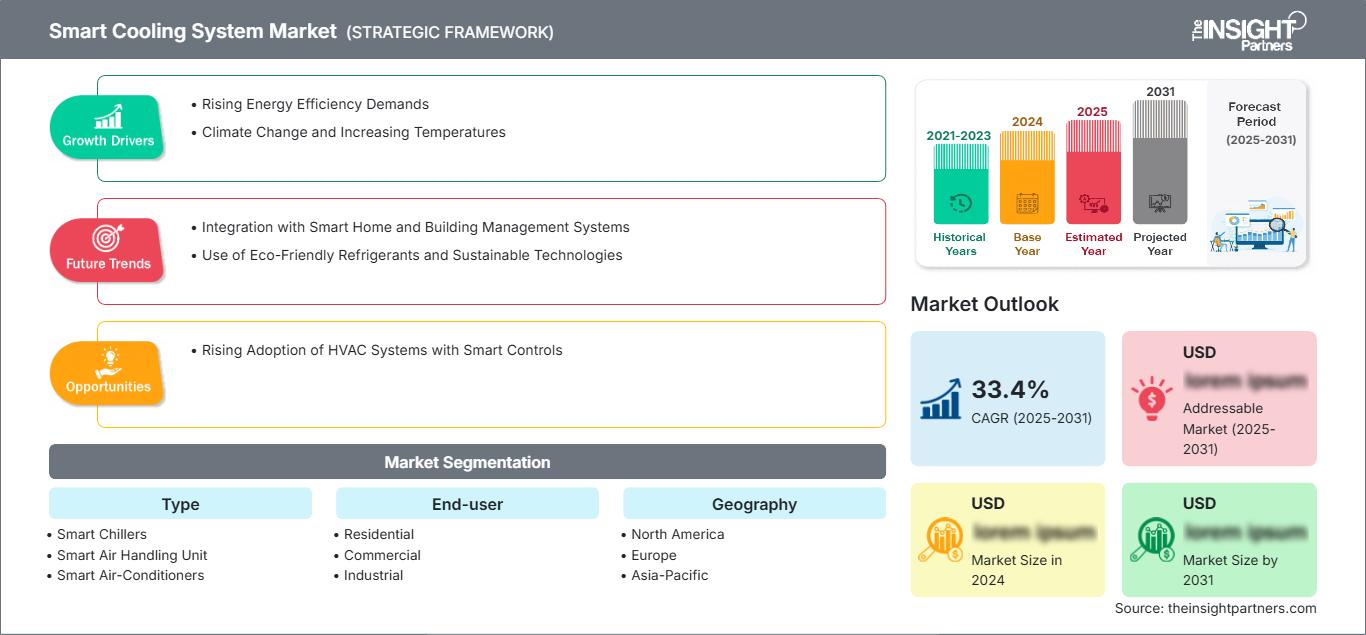
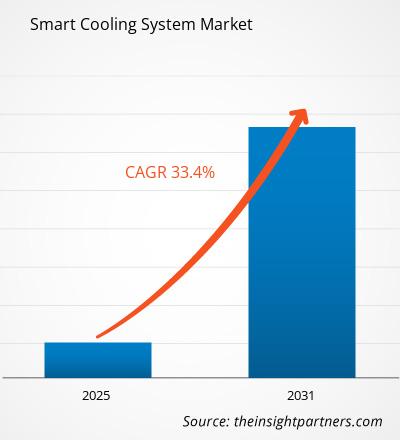
The Smart Cooling System Market reached a value of US$ 7.38 billion in 2025 and is expected to witness a market size valuation of US$ 377.72 billion by 2034; it is estimated to exhibit a CAGR of 54.84% from 2026 to 2034. Increasing integration of AI-based controls, smart compressors, sensors-based chillers, and predictive maintenance software is changing the paradigm of cooling from an equipment replacement cycle to digital thermal management.
Adoption in the North American region is anticipated to experience growth at a CAGR of 52% to 56% due to utilities, building owners, and commercial organizations giving importance to connected load management. Growth in the Smart Cooling System Market size is driven by building electrification initiatives, demand response initiatives, and higher cooling intensity in data centers, healthcare facilities, refrigeration, and multifamily buildings.
Smart Cooling System Market Assessment and Insights
- North America held 31–34% share in 2025 and is expected to grow at a 52–56% CAGR between 2026–2034, led by grid-interactive buildings, connected homes, and data center cooling upgrades.
- US accounted for 78–82% of North America in 2025 and is likely to grow at a 52–55% CAGR between 2026–2034, supported by smart thermostat penetration and commercial retrofits.
- Europe represented 22–25% share in 2025 and is projected to grow at a 49–53% CAGR between 2026–2034, led by Germany, the UK, France, Italy, and Spain.
- Asia Pacific captured 28–31% share in 2025 and is forecast to grow at a 57–61% CAGR between 2026–2034, with China, Japan, South Korea, India, and Australia driving demand.
- Largest Segment Smart Air-Conditioners held 39–43% market share in 2025 and are expected to grow at a 53–57% CAGR between 2026–2034.
- High Growth Segment Industrial end users held 18–22% market share in 2025 and are projected to grow at a 58–62% CAGR between 2026–2034.
- Key companies analyzed in detail: Blue Star Limited, Daikin Industries, Ltd., AB Electrolux, Friedrich Air Conditioning LLC, Fujitsu General Limited, LG Electronics Inc., Mitsubishi Electric Corporation, Samsung Electronics Co., Ltd., Whirlpool Corporation, Voltas Limited
Source: The Insight Partners' analysis based on proprietary research, government publications, company annual reports, investor presentations, industry databases, and expert interviews.
Technological innovations of coolants have shifted from mechanical efficiencies that work in isolation to software optimization systems in which variable frequency compressors, Internet of Things (IoT) gateways, occupancy sensors, and cloud computing analysis are becoming an important part of chillers, air handling units, air conditioning units, and refrigerators. This shift has been triggered by the manufacturers' application of electronic modularity, low GWP refrigerants, and BMS compatibility.
The future demand for the services of Smart Cooling System Market will increase with the development of emerging cities through the creation of new commercial spaces while also upgrading inefficient existing installations in developed economies. Peak electricity demand reduction, refrigerant transition, and performance disclosure regulations will make connected coolants more popular. The focus of investments will be on artificial intelligence (AI) enabled control systems, service platforms, and industrial thermal management systems.
Smart Cooling System Market Report Scope
| Report Attribute | Details |
|---|---|
| Market size in 2025 | US$ 7.38 Billion |
| Market Size by 2034 | US$ 377.72 Billion |
| Global CAGR (2026 - 2034) | 54.84% |
| Historical Data | 2021-2024 |
| Forecast period | 2026-2034 |
Smart Cooling System Market Analysis
The development of the market for Smart Cooling System is determined by increased requirements to cooling performance, efficiency standards, and the need to convert data from equipment into savings on operations. As IEA states, more than 40 countries faced the record peak demand of electricity caused by heat waves in 2024.
The smart cooling system value chain comprises compressor manufacturers, refrigerant experts, sensor producers, HVAC OEMs, software platforms, installation companies, and facilities managers. Dynamics of supply are moving from intelligence to maintenance. Lifespan costs, cybersecurity measures, and interoperability with automation are considered at procurement stage, instead of equipment capacity.
The Smart Cooling System Market Report shows a competitive environment in which the world's leaders in appliances and HVAC business use artificial intelligence, inverter technology, and service ecosystems connected together in order to protect their margins. Daikin Industries, Ltd. increases its capabilities of offering commercial cooling and service solutions, whereas LG Electronics Inc. and Samsung Electronics Co., Ltd. add artificial intelligence features into their residential cooling and refrigeration solutions.
Companies such as Blue Star Limited, Voltas Limited, Mitsubishi Electric Corporation, Fujitsu General Limited, Whirlpool Corporation, AB Electrolux, and Friedrich Air Conditioning LLC operate through localized sales and products/retrofits. Strategic positioning is increasingly moving towards connected fleets and monitoring subscription-based as well as energy efficiency guaranteed.
● REPORT CUSTOMIZATION
Tailor This Report To Align With Your Specific Business Requirements
This report can be customized to align precisely with your business objectives, scope, and target markets. Customization options include tailored segmentation, geography, competitive analysis, and strategic insights to support informed decision-making.
Customize This Report →WHAT YOU CAN ADJUST
- ● Segmentations
- ● Geography
- ● Competitive Analysis
- ● Language Preferences
Smart Cooling System Market: Strategic Insights
Regional Insights
North America Smart Cooling System Market
North America held a market share of 31–34% in 2025 and will have a CAGR of 52–56% till 2034. Share in the Smart Cooling System Market is attributed to a high level of air conditioning in homes, existence of many commercial buildings, and utilities that reward flexibility in managing their cooling load during peak heat periods.
Demand is seen in connected HVAC, water chilling system management, supermarket cooling needs, and thermal management in data centers. Maturity of installation channels and cloud-based buildings is another factor helping North America. Smart Cooling Systems are adopted in areas where one can measure reduced downtime and costs of maintaining equipment using sensors.
U.S. Smart Cooling System Market
The share of the U.S. in North America ranged between 78% and 82% in 2025, and the country is likely to experience 52% to 55% CAGR for 2026 to 2034. The smart thermostats, connected room air conditioners, energy dashboards, and building analytics applications are gaining prominence in residential, commercial, hospitals and retail settings.
There are numerous players active in the industry, including Daikin Industries, Ltd., LG Electronics Inc., Samsung Electronics Co., Ltd., Mitsubishi Electric Corporation, Whirlpool Corporation, and Friedrich Air Conditioning LLC. The areas of application include demand response, refrigerant changeover, smart kitchen and data centers requiring premium control systems.
Europe Smart Cooling System Market
The share of the U.S. in North America ranged between 78% and 82% in 2025, and the country is likely to experience 52% to 55% CAGR for 2026 to 2034. The smart thermostats, connected room air conditioners, energy dashboards, and building analytics applications are gaining prominence in residential, commercial, hospitals and retail settings.
There are numerous players active in the industry, including Daikin Industries, Ltd., LG Electronics Inc., Samsung Electronics Co., Ltd., Mitsubishi Electric Corporation, Whirlpool Corporation, and Friedrich Air Conditioning LLC. The areas of application include demand response, refrigerant changeover, smart kitchen and data centers requiring premium control systems.
APAC Smart Cooling System Market
In APAC, the share was estimated to be 28–31%, and the region is forecasted to witness a CAGR of 57–61%. China dominates manufacturing and usage of smart appliances, and Japan and South Korea develop their premium products rich with sensors.
Australia and India contribute to demand through the need for cooling in urban residential buildings, commercial cooling, and grid stability. The market benefits from industrial policy, increasing incomes, and high temperatures. Factories, logistics centers, hospitals, and shopping malls need less energy intensity and monitoring of services.
Middle East & Africa Smart Cooling System Market
MEA & Africa will have a forecasted CAGR growth of 50-54%, with Saudi Arabia leading the way on district cooling projects, hospitality, airports, and giga-project infrastructure. This is followed by the UAE in terms of premium commercial facilities, data centers, and smart city platforms.
South Africa and the Rest of MEA are still emerging regions, but grid unreliability and high intensity of cooling make for a good use case for energy efficiency through smart monitoring and fault detection, while optimizing chillers to lower peak power usage.
Segmentation Analysis
Type
Type is expected to grow at a 53–57% CAGR between 2026–2034 as equipment intelligence becomes embedded across chillers, air handling units, air-conditioners, and refrigerators. Smart Cooling System Market scope is broadening from premium products to mainstream equipment because connectivity, adaptive control, and service diagnostics are becoming standard procurement requirements.
- Smart Chillers serve commercial campuses, hospitals, factories, and data centers where predictive maintenance, compressor sequencing, and chilled-water optimization can materially reduce operating cost and downtime exposure.
- Smart Air Handling Unit demand is rising in buildings that need ventilation efficiency, filtration control, occupancy-linked airflow, and integration with centralized automation platforms.
- Smart Air-Conditioners remain the largest product group, supported by room-level sensing, app-based control, AI airflow, inverter efficiency, and strong residential replacement cycles.
- Smart Refrigerators are strategically important in connected kitchens and food retail because temperature stability, energy monitoring, inventory functions, and remote alerts improve convenience and preservation.
End-user
End-user demand is projected to grow at a 55–59% CAGR between 2026–2034, led by users that face high energy bills, reliability needs, and decarbonization targets. Residential adoption is volume-led, commercial deployment is ROI-led, and industrial uptake is increasingly tied to process stability, cold-chain compliance, and site-level energy management.
- Residential users adopt smart cooling through app-enabled air conditioners, refrigerators, and thermostats that improve comfort, lower energy use, and support connected home routines.
- Commercial users prioritize measurable savings in offices, malls, hotels, hospitals, and supermarkets, where centralized monitoring can reduce maintenance calls and improve occupant comfort.
- Industrial users represent the highest growth segment as factories, warehouses, laboratories, and logistics hubs require stable cooling, predictive alerts, and energy optimization at scale.
Opportunity Snapshot
| End-user | Revenue Contribution | Trend Tag | Adoption Stage |
| Residential | High | AI Comfort | Scaling |
| Commercial | High | Load Control | Scaling |
| Industrial | Medium | Process Cooling | Emerging |
Smart Cooling System Market Growth Drivers and Impact Analysis
Grid Pressure from Rising Cooling Loads
Extreme heat is converting cooling from a comfort issue into a power-system planning priority. IEA analysis shows that heatwaves pushed electricity demand to new records in more than 40 countries in 2024, including major markets such as China, India, Mexico, Brazil, and the US. Smart controls can pre-cool buildings, shift compressor operation, and coordinate with utility demand-response programs. This creates measurable value for the market because users can reduce peak charges while utilities gain flexible load without building new generation capacity.
Lifecycle Cost Reduction Through Predictive Maintenance
Predictive maintenance is becoming a decisive purchasing factor because cooling failures create high costs in commercial and industrial settings. Sensor data on vibration, refrigerant pressure, coil condition, runtime, and temperature drift helps service teams detect faults before capacity loss becomes visible. For retailers, hospitals, hotels, and factories, avoided downtime can be more valuable than energy savings alone. The market benefits as OEMs convert equipment sales into longer-term service relationships supported by analytics, remote diagnostics, and performance reporting.
Cold-Chain Visibility and Temperature Compliance
Temperature-sensitive logistics is expanding across pharmaceuticals, fresh food, biologics, and prepared meals, making connected refrigeration increasingly important. IATA temperature-control guidance highlights the need for compliant handling, labeling, documentation, and monitoring of healthcare cargo. Smart refrigeration and cooling analytics support traceability, excursion alerts, and audit-ready records across storage and transport nodes. This driver strengthens industrial and commercial adoption because temperature failures can trigger product loss, regulatory exposure, and brand damage, especially in healthcare and food distribution.
Smart Cooling System Market Future Trends
AI-Orchestrated Thermal Autonomy
Smart Cooling System Market trends will increasingly center on autonomous thermal optimization rather than remote control alone. Future systems will combine weather forecasts, occupancy prediction, energy tariffs, humidity data, and equipment health signals to adjust cooling before users intervene. AI models will learn building behavior and select operating modes that balance comfort, food safety, process stability, and electricity cost. As interoperability improves, chillers, air handling units, air-conditioners, and refrigerators will coordinate as distributed thermal assets inside buildings and campuses.
Refrigerant Transition with Digital Verification
Low-GWP refrigerants will reshape equipment design, safety controls, and service practices. Smart systems will help verify charge levels, leakage patterns, operating pressure, and maintenance events, giving owners stronger evidence for compliance and environmental reporting. Digital verification will matter most in commercial and industrial sites with large refrigerant inventories. OEMs that integrate refrigerant intelligence with predictive analytics can reduce service risk, support regulatory documentation, and differentiate equipment beyond efficiency ratings alone.
Smart Cooling System Market Opportunities
Retrofit Controls for Existing Building Stock
The installed base of conventional cooling equipment creates a large near-term opportunity because replacement cycles are slower than digital upgrade cycles. Retrofit controllers, sensor kits, cloud gateways, and analytics subscriptions can improve performance without requiring full equipment replacement. Facility owners with limited capital budgets can start with high-load zones, refrigeration racks, or central plants and expand after savings are proven. Vendors that offer open integration, cybersecurity assurance, and installer-friendly commissioning will be well positioned in the market.
Industrial Cooling-as-a-Service Models
Industrial customers increasingly prefer performance outcomes over equipment ownership when cooling reliability is mission-critical. Cooling-as-a-service models can bundle connected chillers, monitoring, maintenance, and energy optimization under contracts tied to uptime or efficiency. This approach reduces upfront capital barriers and aligns vendor incentives with operational performance. Pharmaceutical, food processing, electronics, and logistics facilities are suitable early adopters because temperature stability directly affects product quality, compliance, and throughput. Financing partnerships will help scale this opportunity across emerging markets.
Recent Developments
- June 2026: Valeo, a world leader in automotive technology, and Calyos, a pioneer in passive advanced two-phase Loop Heat Pipe (LHP) cooling solutions, announce the signing of a Memorandum of Understanding (MoU). It aims to develop and industrialize high-performance, standalone chip cooling solutions for the mobility and computing sectors, addressing the increasing thermal challenges posed by electrification and Artificial Intelligence (AI).
- October 2025: OVHcloud, a global cloud player and the European Cloud leader, unveils a new cooling architecture for its datacenters. The OVHcloud Smart Datacenter combines new industrial designs with AI features, reducing both power and water consumption and enabling datacenters to intelligently react to their surrounding environments. Through this new technology, OVHcloud is able to reduce water consumption by up to 30% and cooling electricity consumption by up to 50%.
- March 2025: LG Electronics (LG) is unveiling the ARTCOOL AI Air, an advanced cooling and heating solution designed to deliver optimal indoor comfort, sophisticated style and convenient usability. Adopting LG’s advanced AI Core-Tech, this impressive residential air conditioner learns from users’ preferences to provide personalized climate control and improved energy efficiency.
Frequently Asked Questions

- Comprehensive Market Sizing and Forecast Analysis
- Detailed Segmentation Analysis
- In-Depth Market Dynamics Assessment
- Regional and Country-Level Insights
- Competitive Landscape and Company Benchmarking
- Strategic Business Intelligence
Recent Reports
Testimonials

The Insight Partners provided valuable market intelligence that supported our global go-to-market strategy. Their team was professional, responsive, and attentive to our feedback, providing thoughtful analysis and helpful methodological clarifications throughout the project.
Junmo Kim Chief Financial Officer (CFO), Enertech Co., Ltd.
The Insight Partners' SCADA System Market report is comprehensive, with valuable insights on current trends and future forecasts. The team was highly professional, responsive, and supportive throughout. We are very satisfied and highly recommend their services.
RAN KEDEM Partner, Reali Technologies LTDs
I requested a report on a very specific software market and the team produced the report in a few days. The information was very relevant and well presented. I then requested some changes and additions to the report. The team was again very responsive and I got the final report in less than a week.
JEAN-HERVE JENN Chairman, Future Analytica
We worked with The Insight Partners for an important market study and forecast. They gave us clear insights into opportunities and risks, which helped shape our plans. Their research was easy to use and based on solid data. It helped us make smart, confident decisions. We highly recommend them.
PIYUSH NAGPAL Sr. Vice President, High Beam Global
The Insight Partners delivered insightful, well-structured market research with strong domain expertise. Their team was professional and responsive throughout. The user-friendly website made accessing industry reports seamless. We highly recommend them for reliable, high-quality research services
YUKIHIKO ADACHI CEO, Deep Blue, LLC.
This is the first time I have purchased a market report from The Insight Partners.While I was unsure at first, I visited their web site and felt more comfortable to take the risk and purchase a market report.I am completely satisfied with the quality of the report and customer service. I had several questions and comments with the initial report, but after a couple of dialogs over email with their analyst I believe I have a report that I can use as input to our strategic planning process.Thank you so much for taking the extra time and making this a positive experience.I will definitely recommend your service to others and you will be my first call when we need further market data.
JOHN SUZUKI President and Chief Executive Officer, Board Director, BK Technologies
I wish to appreciate your support and the professionalism you displayed in the course of attending to my request for information regarding to infectious disease IVD market in Nigeria. I appreciate your patience, your guidance, and the fact that you were willing to offer a discount, which eventually made it possible for us to close a deal. I look forward to engaging The Insight Partners in the future, all thanks to the impression you have created in me as a result of this first encounter.
DR CHIJIOKE ONYIA MANAGING DIRECTOR, PineCrest Healthcare Ltd.Reason to Buy
- Informed Decision-Making
- Understanding Market Dynamics
- Competitive Analysis
- Identifying Emerging Markets
- Customer Insights
- Market Forecasts
- Risk Mitigation
- Boosting Operational Efficiency
- Strategic Planning
- Investment Justification
- Tracking Industry Innovations
- Aligning with Regulatory Trends





 Get Free Sample for