
Smart Dishwasher Market Size, Share & Forecast by 2034
Coverage: By Type (Free standing, Built-in); End user (Commercial , Residential) , and Geography (North America, Europe, Asia Pacific, and South and Central America)
- Status : Data Released
- Report Code : TIPRE00019793
- Category : Electronics and Semiconductor
- No. of Pages : 150
- Available Report Formats :


- Last update date : August 06, 2026


2025 Market Size
US$ 4.14 Bn
Base year value
2034 Forecast
US$ 7.75 Bn
Projected by 2034
CAGR 2026-2034
7.22 %
Growth rate
Addressable Market
US$ 53.66 Bn
(2026-2034)
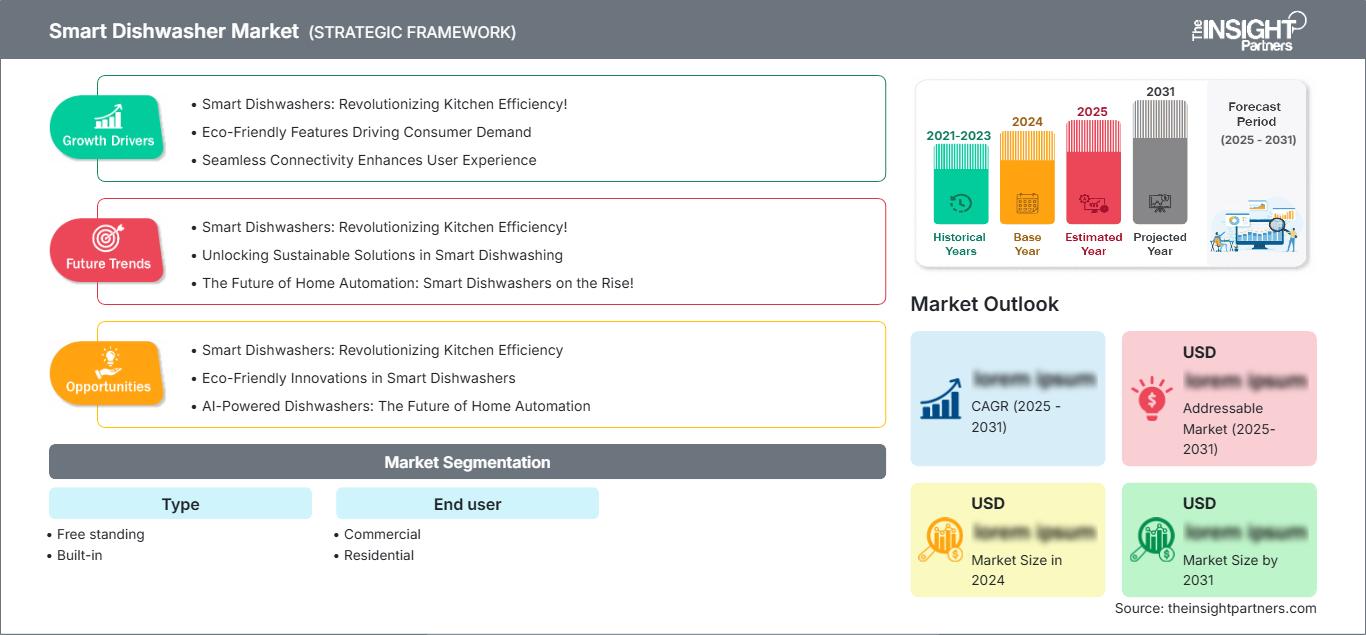
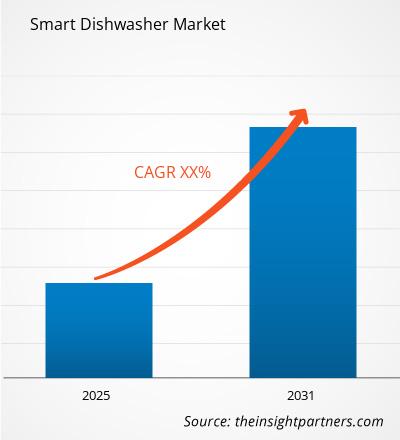
The Smart Dishwasher Market is projected to grow from US$ 4.14 Billion in 2025 to US$ 7.75 Billion by 2034, registering a CAGR of 7.22% during 2026–2034. Adoption is being shaped by connected home penetration, water-saving expectations, sensor-led cycle optimization, and premium kitchen modernization across residential and commercial settings. Demand is also supported by the wider availability of Wi-Fi-enabled, app-controlled, and voice-compatible dishwashing systems.
Across North America, demand is expected to advance at a CAGR range of 6.6–7.1% through 2034 as replacement purchases, kitchen remodeling, and smart-home interoperability strengthen appliance upgrades. The Smart Dishwasher Market size in the region benefits from high dishwasher penetration, utility focus on efficient appliances, and consumer preference for quiet, connected products that reduce household labor while meeting stricter energy and water-use expectations.
Smart Dishwasher Market Assessment and Insights
- North America held 29–32% share in 2025 and is projected to grow at a CAGR range of 6.6–7.1% during 2026–2034, supported by replacement demand, connected homes, and energy-efficient appliance standards.
- US accounted for 82–85% of North America in 2025 and is expected to grow at 6.7–7.2% CAGR, led by renovation-led built-in demand.
- Europe represented 38–41% share in 2025 and is projected to grow at 6.4–6.9% CAGR, with Germany, the UK, France, Italy, and Spain leading adoption.
- Asia Pacific held 19–22% share in 2025 and is forecast to grow at 8.5–9.2% CAGR, driven by China, Japan, South Korea, India, and Australia.
- Largest Segment Free-standing products held 54–57% market share in 2025 and are expected to grow at 6.8–7.3% CAGR due to flexible placement and replacement convenience.
- High Growth Segment Residential end users held 80–83% market share in 2025 and are projected to grow at 7.4–8.0% CAGR, supported by smart-home adoption.
- Key companies analyzed in detail: Arçelik A.Ş., General Electric Company, Haier Smart Home Co., Ltd., LG Electronics Inc., Miele and Cie. KG, Robert Bosch GmbH, Samsung Electronics Co., Ltd., Siemens AG, Smeg S.p.A., Whirlpool Corporation.
Source: The Insight Partners' analysis based on proprietary research, government publications, company annual reports, investor presentations, industry databases, and expert interviews.
Product evolution has moved the category from basic wash automation toward sensor-based cleaning, connected diagnostics, automatic detergent dosing, and adaptive drying. Manufacturers are balancing production between premium built-in models and accessible free-standing formats, while component suppliers focus on pumps, low-noise motors, soil sensors, and connectivity modules. The Smart Dishwasher Market is also influenced by modular kitchen design, where consumers increasingly treat dishwashers as integrated parts of efficient, data-enabled home environments.
Future demand will expand into new urban areas where suppliers, retail stores, and washing machine companies will market their products as efficient time-savers in the kitchen. Future regulations will favor improvements in water and power usage, while the recovery of the hotel and restaurant industries will drive more commercial demand. Companies must invest in production facilities, small sizes, and open platforms in order to deal with the issues of price, installation, and connectivity.
Smart Dishwasher Market Report Scope
| Report Attribute | Details |
|---|---|
| Market size in 2025 | US$ 4.14 Billion |
| Market Size by 2034 | US$ 7.75 Billion |
| Global CAGR (2026 - 2034) | 7.22% |
| Historical Data | 2021-2024 |
| Forecast period | 2026-2034 |
Smart Dishwasher Market Analysis
Demand is expanding as households seek appliances that reduce manual work, optimize water use, and integrate with connected home platforms. Smart Dishwasher Market growth is especially visible among dual-income families and urban consumers who value remote cycle monitoring, predictive maintenance alerts, and customized wash programs. Energy-efficient models also align with utility and regulatory priorities, making replacement cycles more technology-led than purely capacity-led.
The value chain includes stainless-steel tub suppliers, motor and pump makers, sensor manufacturers, connectivity chip providers, appliance assemblers, retailers, installers, and after-sales service networks. Supply dynamics favor brands that can secure electronics components while maintaining cost discipline, because consumers expect smart features without steep premium gaps.
Competition is shaped by portfolio breadth, energy performance, reliability, and ecosystem compatibility. Smart Dishwasher Market analysis indicates that Robert Bosch GmbH and Siemens AG emphasize integrated European kitchen systems, while LG Electronics Inc., Samsung Electronics Co., Ltd., and Haier Smart Home Co., Ltd. use connected platforms to extend loyalty across appliances.
Arçelik A.Ş., Whirlpool Corporation, Miele and Cie. KG, Smeg S.p.A., and General Electric Company compete through design, channel reach, and localized product positioning. Investment is moving toward lower-noise systems, app diagnostics, targeted spray zones, and manufacturing closer to growth markets to manage freight, tariffs, and service responsiveness.
● REPORT CUSTOMIZATION
Tailor This Report To Align With Your Specific Business Requirements
This report can be customized to align precisely with your business objectives, scope, and target markets. Customization options include tailored segmentation, geography, competitive analysis, and strategic insights to support informed decision-making.
Customize This Report →WHAT YOU CAN ADJUST
- ● Segmentations
- ● Geography
- ● Competitive Analysis
- ● Language Preferences
Smart Dishwasher Market: Strategic Insights
Regional Insights
North America Smart Dishwasher Market
North America held 29–32% share in 2025 and is expected to grow at a CAGR range of 6.6–7.1% during 2026–2034. The Smart Dishwasher Market share in the region is supported by mature dishwasher penetration, high replacement frequency, and strong retail visibility for connected kitchen appliances.
Structural demand comes from remodeling activity, larger suburban kitchens, and consumer interest in quiet, efficient, app-enabled appliances. ENERGY STAR-oriented purchasing, smart speaker adoption, and service diagnostics encourage upgrades. Commercial demand from restaurants and institutional kitchens adds resilience, although residential replacement remains the dominant revenue contributor across the US and Canada.
U.S. Smart Dishwasher Market
The U.S. Dishwasher Market accounted for 82–85% of North America in 2025 and is projected to grow at a CAGR range of 6.7–7.2% through 2034. The demand base is based on replacement sales, pre-installed kitchen designs, and customers' ability to pay for silent running, soil sensors, and Wi-Fi capability. An increased interest in smart kitchens and energy-efficient appliances is helping to drive demand among residential consumers as well.
Market participants are widespread, including Robert Bosch GmbH, Whirlpool Corporation, General Electric Company, LG Electronics Inc., and Samsung Electronics Co., Ltd., as leading competitors in both the premium and mass segments. Trending applications include residential upgrade, while commercial kitchens have started installing connectivity to monitor downtime, standardize cleaning cycles, and help maintain maintenance schedules that are oriented towards regulatory compliance.
Europe Smart Dishwasher Market
Europe held 38–41% of the Dishwasher Market share in 2025 and is projected to grow at a 6.4–6.9% CAGR, with Germany leading regional revenue. The UK benefits from compact urban kitchens and replacement-led demand, while premium connected dishwashers gain traction through retailers emphasizing energy labels, quiet operation, and integrated smart-home control.
Germany remains the manufacturing and innovation anchor, supported by Robert Bosch GmbH, Siemens AG, and Miele & Cie. KG. France, Italy, and Spain show steady adoption as modular kitchens, apartment renovations, and water-efficiency priorities encourage built-in formats. Smeg S.p.A. strengthens design-led demand, particularly in premium kitchen refurbishment projects. Growing consumer interest in energy-efficient appliances and smart connectivity features is further supporting market expansion across both mature and replacement-driven segments.
APAC Smart Dishwasher Market
APAC accounted for 19–22% of the Dishwasher Market share in 2025 and is forecast to grow at an 8.5–9.2% CAGR, making it the fastest-expanding region. China leads demand through urban household upgrades, while Japan and South Korea benefit from connected appliance ecosystems and compact premium designs.
India and Australia add growth through rising incomes, nuclear households, and retailer education on hygiene and water savings. Policy support for efficient appliances, local manufacturing programs, and smart city infrastructure are strengthening awareness and adoption. Haier Smart Home Co., Ltd., LG Electronics Inc., and Samsung Electronics Co., Ltd. are central to regional product localization, offering models tailored to regional preferences, space constraints, and evolving consumer expectations for smart and energy-efficient appliances.
Middle East & Africa Smart Dishwasher Market
The Middle East & Africa Dishwasher Market is projected to grow at a 5.8–6.4% CAGR during 2026–2034. The demand in Saudi Arabia and the UAE will be driven by premium housing, hospitality investments, and penetration of appliance imports, whereas South Africa is considered price sensitive but an established retail market.
Efficiency in energy and water consumption will be an important factor to be considered at the time of purchase, since many markets have pressure for costs and infrastructure. The demand in RoMEA will come from hotels, serviced apartments, and premium households. Commercial kitchens are increasingly utilizing intelligent dishwashers with alerts and monitoring facilities.
Segmentation Analysis
Type
Type is expected to grow at 7.0–7.6% CAGR during 2026–2034 as buyers choose between placement flexibility and seamless kitchen integration. The Smart Dishwasher Market scope across type reflects two distinct needs: free standing models support replacement and rental housing, while built-in products align with modular kitchens, premium renovations, and developer-installed appliance packages.
- Free-standing products remain the largest type because they are easier to install, relocate, and replace, making them attractive for renters, smaller households, and value-oriented buyers seeking connected functionality without cabinetry changes.
- Built-in products are strategically important in premium residential projects and commercial kitchens where space planning, noise reduction, visual integration, and higher-capacity configurations support long-term appliance specification decisions.
End user
End user is projected to grow at 7.2–7.8% CAGR during 2026–2034 as both homes and businesses prioritize efficient dishwashing. Residential buyers dominate revenue due to connected kitchen upgrades, while commercial buyers evaluate smart dishwashers for uptime, hygiene consistency, labor optimization, and predictable operating costs.
- Commercial users are primarily those like restaurants, hotels, cafes, health-care kitchens, and institutions food service areas where automated cycle logs, quicker turnover, and maintenance notifications help eliminate interruptions in operation.
- Demand from home users determines usage as more homes remodel their kitchens to improve convenience, hygiene, save water, and integrate with their smart homes.
Opportunity Snapshot
| End user | Revenue Contribution | Trend Tag | Adoption Stage |
| Commercial | Medium | Hygiene Automation | Scaling |
| Residential | High | Connected Kitchens | Mature |
Smart Dishwasher Market Growth Drivers and Impact Analysis
Connected Home Integration Becomes a Purchase Filter
Dishwasher Market trends are being shaped by smart speakers, mobile apps, and unified home platforms that are changing how consumers evaluate kitchen appliances. Buyers increasingly expect remote start, cycle notifications, diagnostics, and compatibility with broader appliance ecosystems. This driver improves replacement conversion because connectivity creates a clear reason to upgrade even when existing dishwashers still function. For manufacturers, integration also supports recurring engagement through apps, service alerts, consumable prompts, and software-enabled feature improvements. The impact is strongest in developed markets, but APAC adoption is accelerating as connected appliance bundles become common in new urban households.
Efficiency Standards Push Technology-Led Replacement
Energy and water efficiency requirements are raising the performance baseline for dishwashing appliances. Sensor-led soil detection, load recognition, optimized spray pressure, and adaptive drying help reduce resource consumption while preserving cleaning performance. This shift benefits premium and midrange smart models because connected diagnostics can demonstrate efficient operation and support maintenance. Retailers also use efficiency labels to simplify comparisons, turning sustainability into a measurable purchase factor. The Smart Dishwasher Market benefits as replacement buyers choose models that lower utility exposure and meet stricter regulatory expectations without sacrificing convenience.
Urban Kitchen Modernization Expands Addressable Demand
Dishwasher Market growth is being supported by urbanization, smaller family units, and higher participation in formal employment, all of which are increasing demand for time-saving household appliances. Modular kitchen designs are making dishwasher installation easier, while compact and free-standing formats reduce adoption barriers in apartments and smaller residences where cabinetry modifications are limited. Developers, homebuilders, and kitchen studios are increasingly positioning dishwashers as a standard component of modern kitchen packages, helping drive first-time purchases among a broader consumer base.
On the other hand, growing consciousness regarding efficiency, convenience, and hygienic advantages is making the technology more appealing than it was before to people outside traditional upper-class families. Food service companies can also benefit greatly from dishwashers which are capable of being connected, as it is easy to ensure that proper cleaning is performed when there is a lack of available labor force. Thus, the demand for such devices is growing not only among the rich customers but also among average city families.
Smart Dishwasher Market Future Trends
AI-Assisted Wash Optimization
Smart Dishwasher Market trends are moving toward AI-assisted cycle selection that interprets soil levels, load arrangement, detergent type, and water hardness before adjusting wash intensity. Over time, appliances will learn household usage patterns and recommend lower-resource cycles when cleaning risk is limited. This trend can reduce customer dissatisfaction caused by poor cycle selection while strengthening brand differentiation through software. Manufacturers that combine reliable sensors with transparent app feedback will be better positioned to convert connected features into practical value rather than novelty.
Open Connectivity Standards Gain Relevance
According to the Dishwasher Market outlook, interoperability is anticipated to be a more pronounced differentiation factor in the future, as consumers strive to create a cohesive smart home experience. Interoperable connections based on standards could make dishwashers compatible with voice assistants and other energy management systems, among other things. This is important, considering that appliances have a lengthy lifespan, and consumers want to ensure that their connected capabilities will serve them well throughout this period.
Smart Dishwasher Market Opportunities
Localized Products for Emerging Urban Households
Manufacturers can expand adoption by designing models for local cooking habits, apartment sizes, and price expectations. In India, Southeast Asia, and parts of the Middle East, buyers need machines that handle oily utensils, mixed loads, and limited installation space. Smart Dishwasher Market Forecasts indicate stronger conversion where brands combine compact formats, financing, retailer demonstrations, and water-saving messaging. Local assembly can further reduce cost exposure and improve service availability. The opportunity is not only a product launch, but education that reframes dishwashers as practical hygiene and time-management appliances.
Commercial Lifecycle Services and Predictive Maintenance
Market opportunity for dishwashers is growing in commercial kitchens. Connected dishwashers can be used to offer a range of services. Businesses like hotels, restaurants, hospitals, and other institutions will appreciate the reliability and maintenance of these dishwashers rather than the features of each machine. Companies can bundle dishwashers along with maintenance services like remote monitoring, planned maintenance, detergents management, usage reporting, and others.
This model facilitates recurring revenue generation, along with lessening downtime for customers and better utilization of assets. The systems can alert about maintenance needs, monitor the efficiency of the wash cycle, and help facility managers meet their operational and regulatory demands. Furthermore, it enables the companies to stand out in a category where purchases are made based on the cost of ownership, hygiene guarantee, labor efficiencies, and continuous operation capabilities rather than merely through the consumer-oriented intelligence of the machines.
Recent Developments
- May 2026: LG Electronics Canada (LG) today released new national survey findings exploring how Canadians load their dishwashers, as part of the introduction of its LG FlushFit Dishwasher. According to the research commissioned by LG, Canadians bring strong and often differing preferences to how the dishwasher is loaded. Nearly half (47 per cent) believe there is a definitive right and wrong way to do it, while more than one-third (37 per cent) admit to re-loading dishes after someone else has already done it.
- May 2026: Xiaomi introduced in China the Mijia Smart Dishwasher Pro 18-Set, a new smart dishwasher from the Mijia line, highlighting a capacity for up to 18 place settings and approximately 130 pieces per cycle, reinforcing its strategy to expand the portfolio of connected appliances.
- June 2022: Samsung Electronics Singapore has unveiled a new category of home appliances – dishwasher – adding on to Samsung’s existing range of home appliances for cleaner homes. The launch of the Samsung Dishwashers seeks to elevate the lifestyles of Singaporean households and cultivate the mindset of having an effective dishwasher to help consumers keep their kitchenware hygienic. The Dishwashers also come with a slew of features that make cleaning a breeze, with smart features that help users monitor, control and personalize their dishwashing experiences
Frequently Asked Questions

- Comprehensive Market Sizing and Forecast Analysis
- Detailed Segmentation Analysis
- In-Depth Market Dynamics Assessment
- Regional and Country-Level Insights
- Competitive Landscape and Company Benchmarking
- Strategic Business Intelligence
Recent Reports
Testimonials

The Insight Partners' SCADA System Market report is comprehensive, with valuable insights on current trends and future forecasts. The team was highly professional, responsive, and supportive throughout. We are very satisfied and highly recommend their services.
RAN KEDEM Partner, Reali Technologies LTDs
I requested a report on a very specific software market and the team produced the report in a few days. The information was very relevant and well presented. I then requested some changes and additions to the report. The team was again very responsive and I got the final report in less than a week.
JEAN-HERVE JENN Chairman, Future Analytica
We worked with The Insight Partners for an important market study and forecast. They gave us clear insights into opportunities and risks, which helped shape our plans. Their research was easy to use and based on solid data. It helped us make smart, confident decisions. We highly recommend them.
PIYUSH NAGPAL Sr. Vice President, High Beam Global
The Insight Partners delivered insightful, well-structured market research with strong domain expertise. Their team was professional and responsive throughout. The user-friendly website made accessing industry reports seamless. We highly recommend them for reliable, high-quality research services
YUKIHIKO ADACHI CEO, Deep Blue, LLC.
This is the first time I have purchased a market report from The Insight Partners.While I was unsure at first, I visited their web site and felt more comfortable to take the risk and purchase a market report.I am completely satisfied with the quality of the report and customer service. I had several questions and comments with the initial report, but after a couple of dialogs over email with their analyst I believe I have a report that I can use as input to our strategic planning process.Thank you so much for taking the extra time and making this a positive experience.I will definitely recommend your service to others and you will be my first call when we need further market data.
JOHN SUZUKI President and Chief Executive Officer, Board Director, BK Technologies
I wish to appreciate your support and the professionalism you displayed in the course of attending to my request for information regarding to infectious disease IVD market in Nigeria. I appreciate your patience, your guidance, and the fact that you were willing to offer a discount, which eventually made it possible for us to close a deal. I look forward to engaging The Insight Partners in the future, all thanks to the impression you have created in me as a result of this first encounter.
DR CHIJIOKE ONYIA MANAGING DIRECTOR, PineCrest Healthcare Ltd.Reason to Buy
- Informed Decision-Making
- Understanding Market Dynamics
- Competitive Analysis
- Identifying Emerging Markets
- Customer Insights
- Market Forecasts
- Risk Mitigation
- Boosting Operational Efficiency
- Strategic Planning
- Investment Justification
- Tracking Industry Innovations
- Aligning with Regulatory Trends





 Get Free Sample for