
Smart Electric Meter Market Demand, Size & Forecast by 2034
Coverage: By Type (AMI and AMR), End Users (Residential, Commercial, and Industrial), and Geography (North America, Europe, Asia Pacific, Middle East and Africa, and South and Central America)
- Status : Data Released
- Report Code : TIPRE00009078
- Category : Electronics and Semiconductor
- No. of Pages : 275
- Available Report Formats :


- Last update date : August 06, 2026


2025 Market Size
US$ 8.03 Bn
Base year value
2034 Forecast
US$ 21.62 Bn
Projected by 2034
CAGR 2026-2034
11.63 %
Growth rate
Addressable Market
US$ 130.39 Bn
(2026-2034)
The Smart Electric Meter Market is projected to grow from US$ 8.03 Billion in 2025 to US$ 21.62 Billion by 2034, expanding at a CAGR of 11.63% during 2026–2034. Adoption is moving beyond automated billing toward two-way metering, outage analytics, load profiling, and grid-edge visibility. Utilities are prioritizing smart electric meters as electricity demand, distributed generation, and regulatory expectations reshape distribution networks.
North America remains a mature but investable base for the Smart Electric Meter Market size, with an estimated CAGR range of 8.6–9.8% through 2034. Replacement cycles, time-of-use tariff expansion, and second-wave AMI deployments support steady procurement. Utilities are also upgrading communications modules, cybersecurity layers, and analytics platforms to convert installed meters into operational intelligence assets.
Smart Electric Meter Market Assessment and Insights
- North America accounted for 28–31% share in 2025 and is expected to grow at a CAGR between 2026–2034 of 8.6–9.8%, supported by AMI replacements and grid resilience programs.
- US represented 82–86% of North America in 2025 and should grow at a CAGR between 2026–2034 of 8.8–10.0%, led by investor-owned utility upgrades.
- Europe held 24–27% share in 2025 and is forecast to grow at 9.4–10.6% CAGR between 2026–2034, with the UK, Italy, France, Germany, and Spain leading deployments.
- Asia Pacific captured 32–35% share in 2025 and is projected to grow at 13.0–14.5% CAGR between 2026–2034, driven by China, India, Japan, South Korea, and Australia.
- Largest Segment AMI held 70–74% market share in 2025 and is estimated to grow at 12.0–13.4% CAGR between 2026–2034 due to two-way communications demand.
- High Growth Segment Industrial end users held 14–17% market share in 2025 and are expected to grow at 12.8–14.2% CAGR between 2026–2034.
- Key companies analyzed in detail: Siemens AG, Schneider Electric SE, Honeywell International Inc., Hubbell Incorporated, Landis+Gyr Group AG, Itron Inc., BOVE Technology, ZENNER International GmbH & Co. KG, Xylem Inc., Sagemcom Broadband SAS.
Source: The Insight Partners' analysis based on proprietary research, government publications, company annual reports, investor presentations, industry databases, and expert interviews.
Metering technology has moved from basic pulse capture and monthly manual reads to connected devices that support remote connect-disconnect, tamper detection, firmware updates, and interval-level consumption data. The Smart Electric Meter Market reflects this shift through growing AMI penetration and a gradual decline in standalone AMR procurement. Production dynamics are also changing as vendors redesign meters around modular communications, secure elements, longer device life, and interoperability with head-end systems.
During the forecasted period, new demand for meters is expected to arise from countries in Asia, the Middle East, and Africa that have policies aimed at reducing losses, using prepaid electricity, and integrating renewable energy into the grid. Investment will also be made into cloud management of meter data, communications via cell or LPWA networks, and cybersecurity for utilities.
Smart Electric Meter Market Report Scope
| Report Attribute | Details |
|---|---|
| Market size in 2025 | US$ 8.03 Billion |
| Market Size by 2034 | US$ 21.62 Billion |
| Global CAGR (2026 - 2034) | 11.63% |
| Historical Data | 2021-2024 |
| Forecast period | 2026-2034 |
Smart Electric Meter Market Analysis
Demand is being shaped by distribution automation, renewable power variability, electric vehicle charging, and pressure to reduce non-technical losses. Smart Electric Meter Market growth is strongest where utilities can link meter data to outage restoration, voltage optimization, and customer billing accuracy. Public data from the U.S. Energy Information Administration and European Commission show continued movement from AMR toward AMI, validating the role of two-way meters in modern grids.
In this ecosystem, there are metering hardware providers, communication module providers, head-end software providers, system integrators, utilities, regulatory bodies, and installation providers. The availability of semiconductors, the certification process, and communication standards affect the delivery period. Utilities combine the devices with meter data management, analysis, and managed services, which decrease the significance of one-time hardware purchase and increase the importance of strategic contracts.
The competitive advantage of the market analysis is based on the number of installed meters, interoperability, security compliance, and utility referrals. Itron Inc. and Landis+Gyr Group AG are influential players in large AMI projects, while Siemens AG, Schneider Electric SE, and Honeywell International Inc. enjoy broader grid automation portfolios. Hubbell Incorporated, Sagemcom Broadband SAS, ZENNER International GmbH & Co. KG, BOVE Technology, and Xylem Inc. improve specific coverage.
Investment trends point towards software-based metering, cellular technology, and analytics services that provide additional value for devices after their installation. Vendors are stressing utility-level cybersecurity, update capability of the product in the field, and reduction in total cost of ownership. The strategic alliance of vendors with telecom companies, cloud providers, and software distributors is gaining precedence over device pricing alone.
● REPORT CUSTOMIZATION
Tailor This Report To Align With Your Specific Business Requirements
This report can be customized to align precisely with your business objectives, scope, and target markets. Customization options include tailored segmentation, geography, competitive analysis, and strategic insights to support informed decision-making.
Customize This Report →WHAT YOU CAN ADJUST
- ● Segmentations
- ● Geography
- ● Competitive Analysis
- ● Language Preferences
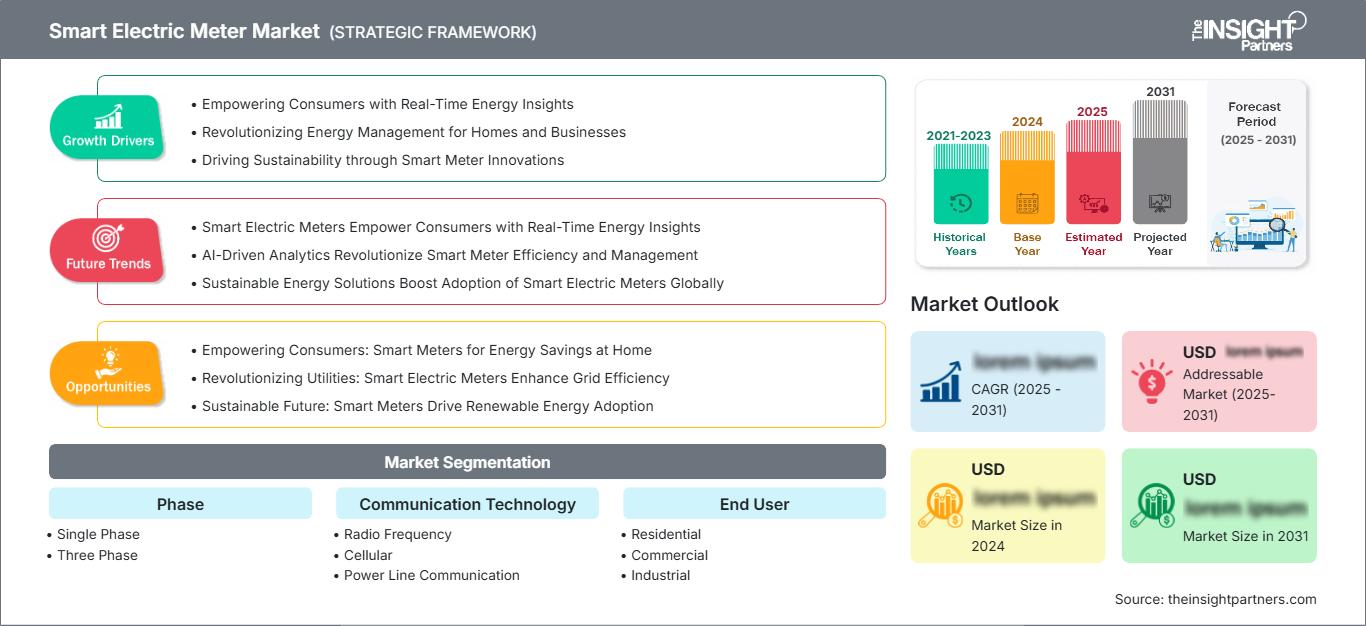
Smart Electric Meter Market: Strategic Insights
Regional Insights
North America Smart Electric Meter Market
North America accounted for 28–31% of global revenue in 2025 and is projected to expand at an 8.6–9.8% CAGR. The Smart Electric Meter Market share in the region is supported by high AMI penetration, second-wave replacement programs, and utility investments in grid resilience following weather-related outages. Smart metering system infrastructure that already exists, along with digitalization of utilities, keeps presenting possibilities for hardware replacement, software incorporation, and data analytics solutions.
Purchasing is becoming more and more associated with rates varying in time, distributed energy resources management, demand response, and outage management. Smart meters can also be used to optimize grid operation, billing systems, and customer relationships through real-time consumption monitoring. Canada is highly penetrated, while the USA utilities keep improving their old-generation AMI systems for better communication and cybersecurity needs. The public information shows that North America is approaching 91% smart electricity meter penetration by 2030, which further confirms the replacement opportunities and focuses the market on analytics and automation.
U.S. Smart Electric Meter Market
The U.S. represented 82–86% of North America in 2025 and is expected to grow at an 8.8–10.0% CAGR. The country’s installed AMI base is large, but early deployments require communications upgrades, cybersecurity refreshes, and integration with outage, billing, and customer engagement platforms. Utilities are increasingly modernizing first-generation smart meter networks to improve data quality, network reliability, and support evolving grid management requirements.
In the efforts by investor-owned utilities as well as municipal utilities to integrate solar power distribution, enable electric vehicle load management, and facilitate demand response programs, smart meters are being utilized. Smart meters have also been employed by utilities to enhance their ability to detect outages, cut costs of operation, and allow their customers to get information on their energy consumption patterns. Companies such as Itron Inc., Landis+Gyr Group AG, Siemens AG, and Hubbell Incorporated enjoy a strong market share as a result of contracts with utilities and collaboration with software partners.
Europe Smart Electric Meter Market
Europe held 24–27% of the Smart Electric Meter Market share in 2025 and is projected to grow at a 9.4–10.6% CAGR. The UK is still an important market for deployment because suppliers need to complete the current installation processes and replace existing equipment. Second-generation projects are implemented in Italy, while France gains from successful large-scale deployments and ongoing grid digitalization projects, which help in implementing advanced metering and energy management features.
Germany advances from the slower starting point and its developing regulatory framework creates the need for secure metering gateways and increased data protection capabilities. In addition, Spain, Sweden, Poland, Austria, and Greece are increasing activity in terms of either replacements or first-generation implementations of smart meters. Smart metering policies, interoperability standards, and transparency of consumer energy consumption information are still driving technological, security, data protection, and access requirements to real-time energy consumption information in the region through the efforts of the European Commission.
APAC Smart Electric Meter Market
APAC accounted for 32–35% share in 2025 and is expected to grow at a 13.0–14.5% CAGR, making it the fastest regional contributor. China remains the leading country by deployment scale, while India’s loss-reduction and prepaid metering programs expand addressable demand.
Japan, South Korea, and Australia are shifting toward next-generation devices that support distributed energy resources, virtual power plants, and consumer data services. Industrial growth, urban electrification, and policy-backed grid modernization reinforce the market across both mature and emerging Asian power systems.
Middle East & Africa Smart Electric Meter Market
The Middle East & Africa is expected to grow at a 10.8–12.2% CAGR, led by Saudi Arabia and the UAE as utilities digitize distribution networks and improve consumption visibility. Smart city programs and large infrastructure investments are supporting metering upgrades in urban areas.
South Africa and the Rest of MEA are adopting smart electric meters for revenue assurance, prepaid electricity, and outage reduction. Renewable energy integration and network loss management are central drivers, though procurement cycles remain influenced by utility finances, regulatory capacity, and local installation capabilities.
Segmentation Analysis
Type
Type is expected to grow at an 11.8–13.0% CAGR during 2026–2034 as utilities move from meter reading automation toward real-time grid intelligence. The market scope is increasingly defined by communication depth, data granularity, and integration with billing, outage, and demand response systems rather than by hardware alone.
- AMI dominates deployments because it enables two-way communication, remote operations, firmware upgrades, and granular interval data. Utilities prefer AMI where grid flexibility, distributed energy visibility, and customer analytics are strategic priorities.
- AMR remains relevant for cost-sensitive or lower-density networks that require automated readings without full two-way capability. Its role is narrowing as utilities standardize long-term digital grid architectures.
End User
End User is projected to grow at a 10.9–12.4% CAGR during 2026–2034, supported by residential tariff reform, commercial energy management, and industrial reliability needs. Adoption differs by customer class, but all users benefit from improved billing accuracy, consumption transparency, and faster service restoration.
- Residential demand is anchored in automated billing, time-of-use tariffs, prepaid programs, and household energy visibility. High connection volumes make this sub-segment central to utility-wide AMI economics.
- Commercial users adopt smart meters to manage peak demand, tenant billing, equipment loads, and sustainability reporting. Retail, offices, campuses, and data-heavy facilities require more granular usage intelligence.
- Industrial customers need metering for power quality, load forecasting, outage diagnostics, and energy cost control. Strategic importance rises as factories electrify processes and integrate onsite generation.
Opportunity Snapshot
| End User | Revenue Contribution | Trend Tag | Adoption Stage |
| Residential | High | Tariff Shift | Mature |
| Commercial | Medium | Load Analytics | Scaling |
| Industrial | Medium | Power Quality | Scaling |
Smart Electric Meter Market Growth Drivers and Impact Analysis
Grid Modernization and Reliability Mandates
Smart electric meters are being used as the key endpoints for modernizing the distribution system in cases where the restoration of outages, feeder visibility, and asset planning call for near-real-time information. It is felt most keenly in those areas with aging infrastructure and disruptions caused by weather because AMI allows for automatic outage reporting and quicker crew dispatch. Since regulators use reliability performance as part of determining whether a utility can receive approval for capital projects, this driver provides value through initiatives that use meters, communications, and operations software.
Renewable Integration and Demand Flexibility
With increasing penetration of solar, wind, storage, and electric vehicles, there is an increase in the variability of loads at the edge of the distribution network. Smart meters assist utilities in measuring bidirectional flows, detecting voltage problems, and developing tariffs to motivate flexible usage. From the customer’s point of view, interval data provides more information to make decisions on solar power, storage, and peak-hour demand. The effect in the market would be a change from the acquisition of devices to grid orchestration based on data.
Revenue Assurance and Loss Reduction
Revenue protection is an immediate impetus in situations where there are significant levels of loss in distribution, errors in manual billing, and risk of theft. Advanced meters provide the capability to give alerting on tampering, disconnect services remotely, allow for prepaid services, and better settlement. The business implication is critical in countries where line losses are limiting their investment capabilities. With advanced metering infrastructure, revenue protection will be greatly improved and will enhance the bottom line of the utility companies.
Smart Electric Meter Market Future Trends
Edge Intelligence in Metering Networks
Smart Electric Meter Market trends are moving toward edge intelligence, where meters process selected events locally before sending data to utility systems. This can reduce communication traffic, improve outage detection, and support localized voltage monitoring. Future devices are expected to include stronger processors, secure boot capabilities, and configurable event logic. Utilities will value meters that can support evolving applications without full hardware replacement. As grid complexity increases, edge-capable metering networks may become critical for balancing cost, latency, and operational visibility across dense service territories.
Cybersecure Interoperable Utility Data Platforms
The future focus for procurement is going to be more on secure, interoperable platforms instead of meter fleets in isolation. There needs to be devices, head-end systems, and meter data management systems that share data securely without compromising customer data and utility data. The security regulations applicable to critical infrastructure cybersecurity will compel vendors to provide documentation regarding encryption, access control, vulnerability management, and updates. The open interfaces may help minimize vendor lock-in and allow integration of the metering data with outage management systems and distributed energy resource systems.
Smart Electric Meter Market Opportunities
Second-Wave AMI Replacement Programs
Utilities that deployed early AMI systems now face replacement needs tied to communication obsolescence, cybersecurity requirements, and new customer service models. This creates an opportunity for vendors to position upgrades as broader digital grid programs rather than meter swaps. Smart Electric Meter Market Forecasts point to attractive replacement demand in North America and Western Europe, where installed bases are mature but application expectations are rising. Suppliers offering migration planning, backward compatibility, data conversion, and managed network services can capture higher-value contracts and reduce utility implementation risk.
Emerging Market Revenue Protection Programs
Emerging markets offer substantial opportunities where utilities need to reduce losses, improve billing discipline, and expand prepaid electricity. Investors and suppliers can target projects that combine meters with communications networks, installation services, financing, and analytics. Success depends on aligning product cost with local grid conditions and regulatory objectives. Partnerships with local system integrators and utilities can improve deployment speed. Programs that demonstrate measurable cash-flow improvement are likely to receive stronger policy and lender support than hardware-only proposals.
Recent Developments
- December 2025: Under Revamped Distribution Sector Scheme (RDSS), 20.33 crore smart meters have been sanctioned based on the proposal submitted by the States. In addition, many States have installed smart meters under the State schemes or externally aided projects. Till date 4.76 crore smart meters have been installed in the country under various schemes. Under RDSS, smart metering is being carried out through Public Private Partnership (PPP) in TOTEX (i.e total expenditure which is sum of capital expenditure and operational expenditure) mode. The Advanced Metering Infrastructure Service Provider (AMISP) is responsible for supplying, maintaining and operating the metering infrastructure post installation.
- February 2025: EDF India announced a strategic joint venture (JV) with Actis, a leading global investor in sustainable infrastructure, to deploy smart metering infrastructure. This collaboration aims to operate a dedicated platform company for Advanced Metering Infrastructure Service Provider (AMISP) concessions, reinforcing EDF India's and Actis' commitment to investing in the Indian power sector.
- February 2025: Tata Power Delhi Distribution said it has collaborated with Probus Smart Things to revolutionize smart metering technology through the adoption of a universal Network Interface Card (NIC) with Bluetooth enabled communication. As part of this collaboration, Tata Power-DDL and Probus will jointly create innovative use cases to advance smart metering technology and will file joint patents to protect the intellectual property arising from these efforts.
Frequently Asked Questions

- Comprehensive Market Sizing and Forecast Analysis
- Detailed Segmentation Analysis
- In-Depth Market Dynamics Assessment
- Regional and Country-Level Insights
- Competitive Landscape and Company Benchmarking
- Strategic Business Intelligence
Recent Reports
Testimonials

The Insight Partners' SCADA System Market report is comprehensive, with valuable insights on current trends and future forecasts. The team was highly professional, responsive, and supportive throughout. We are very satisfied and highly recommend their services.
RAN KEDEM Partner, Reali Technologies LTDs
I requested a report on a very specific software market and the team produced the report in a few days. The information was very relevant and well presented. I then requested some changes and additions to the report. The team was again very responsive and I got the final report in less than a week.
JEAN-HERVE JENN Chairman, Future Analytica
We worked with The Insight Partners for an important market study and forecast. They gave us clear insights into opportunities and risks, which helped shape our plans. Their research was easy to use and based on solid data. It helped us make smart, confident decisions. We highly recommend them.
PIYUSH NAGPAL Sr. Vice President, High Beam Global
The Insight Partners delivered insightful, well-structured market research with strong domain expertise. Their team was professional and responsive throughout. The user-friendly website made accessing industry reports seamless. We highly recommend them for reliable, high-quality research services
YUKIHIKO ADACHI CEO, Deep Blue, LLC.
This is the first time I have purchased a market report from The Insight Partners.While I was unsure at first, I visited their web site and felt more comfortable to take the risk and purchase a market report.I am completely satisfied with the quality of the report and customer service. I had several questions and comments with the initial report, but after a couple of dialogs over email with their analyst I believe I have a report that I can use as input to our strategic planning process.Thank you so much for taking the extra time and making this a positive experience.I will definitely recommend your service to others and you will be my first call when we need further market data.
JOHN SUZUKI President and Chief Executive Officer, Board Director, BK Technologies
I wish to appreciate your support and the professionalism you displayed in the course of attending to my request for information regarding to infectious disease IVD market in Nigeria. I appreciate your patience, your guidance, and the fact that you were willing to offer a discount, which eventually made it possible for us to close a deal. I look forward to engaging The Insight Partners in the future, all thanks to the impression you have created in me as a result of this first encounter.
DR CHIJIOKE ONYIA MANAGING DIRECTOR, PineCrest Healthcare Ltd.Reason to Buy
- Informed Decision-Making
- Understanding Market Dynamics
- Competitive Analysis
- Identifying Emerging Markets
- Customer Insights
- Market Forecasts
- Risk Mitigation
- Boosting Operational Efficiency
- Strategic Planning
- Investment Justification
- Tracking Industry Innovations
- Aligning with Regulatory Trends





 Get Free Sample for