
Smart Farming Machine Market Size, Growth & Trends by 2034
Coverage: By Type (Manned, Unmanned); Applocation (Soil and Crop Management, Storage and Irrigation Management, Indoor Farming, Other) , and Geography (North America, Europe, Asia Pacific, and South and Central America)
- Status : Data Released
- Report Code : TIPRE00017058
- Category : Electronics and Semiconductor
- No. of Pages : 150
- Available Report Formats :


- Last update date : August 12, 2026


2025 Market Size
US$ 276.02 Mn
Base year value
2034 Forecast
US$ 695.47 Mn
Projected by 2034
CAGR 2026-2034
10.81 %
Growth rate
Addressable Market
US$ 4,297.56 Mn
(2026-2034)
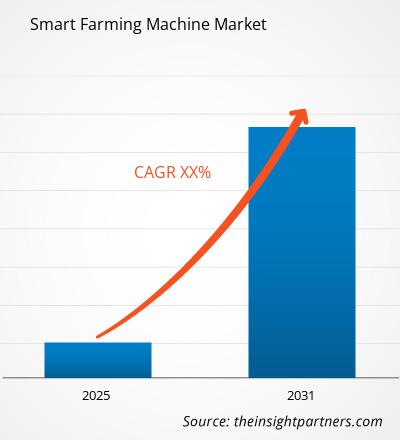
The global Smart Farming Machine Market was valued at US$ 276.02 million in 2025 and is projected to reach US$ 695.47 million by 2034, registering a CAGR of 10.81% from 2026 to 2034. This can be attributed to the increasing use of advanced technologies within the sector of agriculture. With the application of automation, artificial intelligence, and decision making through data, the process of farming is being revolutionized and allowing the farmers to increase their productivity and also ensure that there is no wastage of resources.
North America is a prominent region for the Smart Farming Machine Market Size. The region is projected to grow at a CAGR of 9-11% over the forecast period. The drivers responsible for structural growth include the adoption of precision agriculture, government support for sustainable farming, and the presence of major players within the market. The rising labor shortage and increased costs have led to an increased adoption of smart farming systems.
Smart Farming Machine Market Assessment and Insights
- North America: North America holds a substantial share of 30-34% in the global Market in 2025. The region is growing at a CAGR of 9-11% from 2026 to 2034, driven by strong technology adoption and government support for precision agriculture.
- US: The US dominates North America, accounting for approximately 80-85% of the regional market in 2025. Growth is supported by widespread adoption of autonomous tractors and drones, with a CAGR range of 9-11% from 2026 to 2034.
- Europe: Europe accounts for 24-28% of the global Smart Farming Machine Market in 2025, with Germany, the UK, and France as leading countries. The region is growing at a CAGR of 10-12% from 2026 to 2034, supported by EU sustainability policies and strong agricultural technology adoption.
- Asia Pacific: APAC is the fastest-growing regional market, holding 26-30% share in 2025, led by China, Japan, and Australia. Growing at a CAGR of 12-14% from 2026 to 2034, the region benefits from government modernization programs and rising food security concerns.
- Largest Segment: The Soil and Crop Management application segment holds the largest share, estimated at 45-50% in 2025. Growing at a CAGR of 10-12% from 2026 to 2034, this segment is driven by demand for precision agriculture solutions.
- High Growth Segment: The Indoor Farming application segment is projected as the high-growth segment, with a CAGR of 12-14% from 2026 to 2034. This growth is fueled by investments in controlled-environment agriculture and urban food production.
- Key companies analyzed in detail: AGCO Corporation, cultYvate, Claas Group, DICKEY-john, Farmers Edge, John Deere, Iteris, Inc., PrecisionHawk, Raven Industries, Trimble Inc.
Source: The Insight Partners' analysis based on proprietary research, government publications, company annual reports, investor presentations, industry databases, and expert interviews.
The Smart Farming Machine Market has come a long way from being merely mechanical to advanced technology-based systems, which are used in precision farming. With the transition from manned to unmanned machines, the scope of operations has widened through constant monitoring and real-time adjustment. Modern production techniques are based on AI technology and IoT connectivity, thereby making the best use of resources and increasing crop yield. As such, the advent of technology has increased the accessibility of smart farming machines across agriculture.
In the coming future, the growth of Market is expected to see a rise in the number of opportunities created due to the investment by emerging economies in the development of their agriculture sector. Due to government incentives to promote sustainability in agriculture, it is possible that the market will continue to grow. This will be driven by the use of 5G and edge computing technologies.
Smart Farming Machine Market Report Scope
| Report Attribute | Details |
|---|---|
| Market size in 2025 | US$ 276.02 Million |
| Market Size by 2034 | US$ 695.47 Million |
| Global CAGR (2026 - 2034) | 10.81% |
| Historical Data | 2021-2024 |
| Forecast period | 2026-2034 |
Smart Farming Machine Market Analysis
The need for intelligent farming machines is fueled by the necessity of increased efficiency and productivity within the agricultural sector. Farmers have to produce more food using less inputs. The value chain includes component manufacturers, equipment producers, software producers, and service providers, all being crucial to deliver holistic solutions. The supply situation has improved thanks to the development of standard platforms and service-oriented architectures making the process of integration easier and faster.
The competitors within the Smart Farming Machine Market report include both large agricultural equipment manufacturers and technology companies. John Deere, AGCO Corporation, and Claas Group take leading positions due to their comprehensive portfolios. Trimble Inc. and Raven Industries specialize in precision agriculture, whereas Farmers Edge and Iteris, Inc. focus on data analysis and farm management software. Current investment trends include more focus on AI analytics, autonomous vehicles, and subscription-based business model. The strategic positioning is based on partnership ecosystems with vendors developing joint solutions tailored specifically to the farmers' needs.
● REPORT CUSTOMIZATION
Tailor This Report To Align With Your Specific Business Requirements
This report can be customized to align precisely with your business objectives, scope, and target markets. Customization options include tailored segmentation, geography, competitive analysis, and strategic insights to support informed decision-making.
Customize This Report →WHAT YOU CAN ADJUST
- ● Segmentations
- ● Geography
- ● Competitive Analysis
- ● Language Preferences
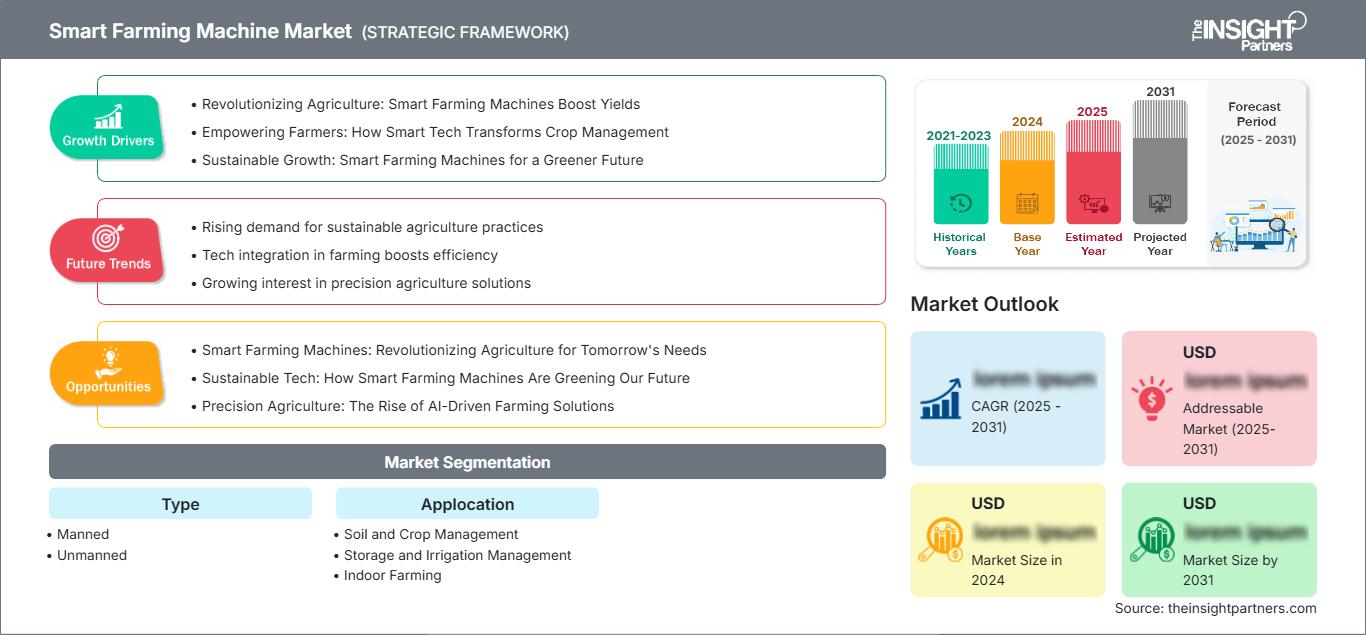
Smart Farming Machine Market: Strategic Insights
Regional Insights
North America Smart Farming Machine Market
North America is a prime market for smart farming equipment, holding a 30-34% market share in 2025. The agricultural industry of the region is facing rapid digitalization due to the requirement to cope with labor issues and enhance efficiency. The USA takes the lead through technology implementation and government support for precision agriculture. Canada shows steady growth, thanks to sustainable agriculture initiatives. The CAGR of the region's growth will be 9-11% between 2026 and 2034.
U.S. Smart Farming Machine Market
The US holds about 80-85% of the North American Smart Farming Machine Market share in 2025. The growth is fueled by the use of autonomous tractors, drones, and artificial intelligence for analysis. Commercial farms in large numbers have started using precision farming technologies for better utilization of inputs and improved yield. Some of the key vendors that contribute to the market include John Deere, Trimble Inc., and Raven Industries. The US market is expected to grow at a CAGR of 9-11% between 2026 and 2034.
Europe Smart Farming Machine Market
Europe represents a market share of 24-28% in the Smart Farming Machine Market globally in 2025. Europe comprises Germany, the United Kingdom, and France as primary market players. Germany is one of the leaders in the European market, due to the country's high level of development in the agricultural technology industry and sustainability policy. The United Kingdom is currently expanding the application of smart farming solutions in crop surveillance and livestock management. In France, emphasis is placed on sustainable intensification and precision agriculture.
APAC Smart Farming Machine Market
APAC is the fastest-growing regional market, representing 26-30% of global share in 2025. China leads with government initiatives promoting agricultural modernization and food security. Japan and Australia are leaders in precision agriculture and autonomous machinery adoption. India is accelerating through production-linked incentives for agricultural technology. South Korea is applying smart technologies in controlled-environment agriculture. APAC is projected to grow at a CAGR of 12-14% from 2026 to 2034.
Middle East & Africa Smart Farming Machine Market
Despite the fact that the Middle East & Africa region is currently offering a relatively smaller market share, there is an evident future prospect for growth. The Vision 2030 of Saudi Arabia and the UAE food security programs have been fueling investments in precision agriculture. Commercial farms in South Africa have also been adopting the technology. The expected CAGR of the region from 2026-2034 is 10-12%.
Segmentation Analysis
Type
The Type segment of the Smart Farming Machine Market encompasses Manned and Unmanned machines. Unmanned machines are gaining significant traction, driven by advancements in automation and the need for continuous monitoring. Manned machines continue to dominate in traditional farming operations, offering reliability and operator control. Unmanned machines are increasingly deployed for precision spraying, crop monitoring, and autonomous harvesting. The Type segment is projected to grow at a CAGR of 10-12% from 2026 to 2034.
- Manned: Manned machines remain dominant in traditional farming operations, offering operator control and flexibility. They are widely used for tasks requiring human judgment and adaptability.
- Unmanned: Unmanned machines are rapidly gaining adoption, driven by automation and continuous operation capabilities. They are deployed for precision spraying, monitoring, and harvesting in large-scale farms.
Application
The Application segment covers Soil and Crop Management, Storage and Irrigation Management, and Indoor Farming. Soil and Crop Management is the largest application segment, driven by demand for precision agriculture solutions and yield optimization. Storage and Irrigation Management is gaining importance as farmers seek to reduce water waste and improve post-harvest operations. Indoor Farming is the fastest-growing segment, driven by investments in controlled-environment agriculture and urban food production. The Application segment is projected to grow at a CAGR of 10-12% from 2026 to 2034.
- Soil and Crop Management: Soil and Crop Management applications focus on precision agriculture, including soil analysis, crop monitoring, and variable-rate application. Demand for yield optimization and input efficiency drives this segment.
- Storage and Irrigation Management: Storage and Irrigation Management solutions help farmers reduce water waste, monitor storage conditions, and optimize irrigation scheduling. Growing focus on resource efficiency is driving adoption.
- Indoor Farming: Indoor Farming applications are rapidly expanding, driven by investments in controlled-environment agriculture and urban food production. Climate resilience and year-round production are key drivers.
Opportunity Snapshot
| Application | Revenue Contribution | Trend Tag | Adoption Stage |
|---|---|---|---|
| Soil and Crop Management | High | Precision Ag | Scaling |
| Storage and Irrigation Management | Medium | Water Optimization | Emerging |
| Indoor Farming | Medium | Urban Ag | Emerging |
Smart Farming Machine Market Growth Drivers and Impact Analysis
Precision Agriculture and Yield Optimization Demands
The growing global population and food security concerns are driving demand for precision agriculture solutions that optimize crop yields and reduce resource waste. Smart farming machines enable farmers to monitor soil conditions, crop health, and weather patterns in real-time, facilitating data-driven decisions. According to the Food and Agriculture Organization, global food production must increase by 60% by 2050 to meet rising demand, creating substantial opportunities for smart farming technologies. Precision agriculture solutions help farmers optimize input usage, improve crop health monitoring, and enhance harvesting accuracy. The integration of AI and IoT is enabling predictive crop management, shifting the industry from reactive to proactive strategies.
Labor Shortages and Rising Operational Costs
Persistent labor shortages and increasing wage costs across major agricultural economies are accelerating investment in smart farming machines. Farmers are turning to automation and robotics to offset labor shortages, reduce operational costs, and improve productivity. Autonomous tractors, drones, and robotic harvesters are expanding from niche solutions to core operational assets. Smart farming machines offer a solution that enables continuous, efficient operations with minimal human intervention. The shift toward automation is further accelerated by post-pandemic recovery efforts, with farmers prioritizing resilience and productivity to mitigate future disruptions.
Technological Advancements in AI and Robotics
Continuous innovations in artificial intelligence, machine learning, and robotics are expanding smart farming machine capabilities and accessibility. AI-powered analytics enable granular evaluation of soil moisture, pest presence, nutrient deficiencies, and crop stress levels. Machine learning models help farmers predict yield variability, identify disease risks early, and simulate input strategies to maximize output with minimal resource waste. Connectivity infrastructure, including 5G, satellite, and LoRaWAN, is enabling seamless, real-time farm management even in remote rural environments. These technological breakthroughs have made smart farming machines practical for real-world applications.
Smart Farming Machine Market Future Trends
AI-Driven Predictive Analytics and Autonomous Operations
Artificial intelligence is becoming the central intelligence layer for smart farming machine market trends. Predictive analytics models analyze multi-sensor data to identify crop stress patterns, optimize irrigation schedules, and predict yield outcomes. Computer vision systems improve weed detection and pest identification, while AI-based harvesting systems enable autonomous picking. Generative AI and agricultural copilots are emerging to assist farmers with crop management decisions, maintenance procedures, and process optimization. The integration of AI with robotics enables fully autonomous farming operations, reducing the need for manual intervention and improving operational efficiency.
Expansion of Connectivity and IoT-Enabled Smart Farming
The expansion of 5G, satellite, and LoRaWAN connectivity is transforming smart farming capabilities, enabling real-time data collection and remote monitoring across vast agricultural areas. Connected devices enable comprehensive monitoring of equipment, inventory, and crop conditions. Real-time connectivity supports uninterrupted machine-to-cloud syncing, even in remote regions, enabling live supervision, maintenance alerts, and automated planning. The shift toward fully networked, machine-supported agricultural environments marks a significant move toward semi- or fully autonomous farming systems, redefining how farms are monitored and operated globally.
Smart Farming Machine Market Opportunities
Autonomous Machinery and Robotics Solutions
The growing demand for autonomous tractors, harvesters, and drones presents significant opportunities for Smart Farming Machine Market Forecast. Farmers are increasingly adopting autonomous solutions to offset labor shortages, reduce operational costs, and improve productivity. Opportunities exist in developing task-specific autonomous machines for applications such as precision spraying, crop monitoring, and harvesting. Companies that develop cost-effective, reliable autonomous solutions with rapid payback periods will capture significant market share. The integration of AI and computer vision will further enhance the capabilities of autonomous farming machines.
Indoor Farming and Controlled-Environment Agriculture
The expansion of indoor farming and controlled-environment agriculture creates substantial opportunities for smart farming machines. Investments in vertical farms, greenhouses, and urban agriculture are driving demand for specialized equipment for climate control, lighting, irrigation, and crop monitoring. Companies that develop affordable, scalable indoor farming solutions with robust automation capabilities are well-positioned to capture market share. The increasing focus on food security, climate resilience, and local food production is accelerating investment in indoor farming technologies.
Recent Developments
- November 2025: AGCO (NYSE: AGCO), a global leader in the design, manufacture and distribution of agricultural machinery and precision ag technology, attended AGRITECHNICA 2025 to showcase its iconic machine and technology brands – Fendt, Massey Ferguson, PTx and Valtra – at the world's largest indoor agricultural trade fair. Hundreds of thousands of farmers and dealers will experience the latest product launches and innovative technologies from AGCO's leading brands alongside offerings from AGCO Power and AGCO Finance.
- September 2025: AGCO Corporation (NYSE: AGCO), a global leader in agricultural machinery and precision ag technology, showcased some of the most innovative precision agriculture technology in the industry during its annual Tech Day at the more than century-old Götz Agrardienst farm in Markt Indersdorf, Germany. The program on September 30 – October 1 spotlighted Farmer-First innovations that work throughout the crop cycle and across almost any fleet a farmer owns to help increase yields and boost profitability.
- August 2023: Bosch BASF Smart Farming, the joint venture between Bosch and BASF Digital Farming to globally market and sell smart farming technology, announced its new brand name: ONE SMART SPRAY. The distinctive new brand name also applies to its product, previously known as the Smart Spraying Solution. With the name change a new logo, visual identity, and messaging will be introduced in all markets globally.
Frequently Asked Questions

- Comprehensive Market Sizing and Forecast Analysis
- Detailed Segmentation Analysis
- In-Depth Market Dynamics Assessment
- Regional and Country-Level Insights
- Competitive Landscape and Company Benchmarking
- Strategic Business Intelligence
Recent Reports
Testimonials

The Insight Partners' SCADA System Market report is comprehensive, with valuable insights on current trends and future forecasts. The team was highly professional, responsive, and supportive throughout. We are very satisfied and highly recommend their services.
RAN KEDEM Partner, Reali Technologies LTDs
I requested a report on a very specific software market and the team produced the report in a few days. The information was very relevant and well presented. I then requested some changes and additions to the report. The team was again very responsive and I got the final report in less than a week.
JEAN-HERVE JENN Chairman, Future Analytica
We worked with The Insight Partners for an important market study and forecast. They gave us clear insights into opportunities and risks, which helped shape our plans. Their research was easy to use and based on solid data. It helped us make smart, confident decisions. We highly recommend them.
PIYUSH NAGPAL Sr. Vice President, High Beam Global
The Insight Partners delivered insightful, well-structured market research with strong domain expertise. Their team was professional and responsive throughout. The user-friendly website made accessing industry reports seamless. We highly recommend them for reliable, high-quality research services
YUKIHIKO ADACHI CEO, Deep Blue, LLC.
This is the first time I have purchased a market report from The Insight Partners.While I was unsure at first, I visited their web site and felt more comfortable to take the risk and purchase a market report.I am completely satisfied with the quality of the report and customer service. I had several questions and comments with the initial report, but after a couple of dialogs over email with their analyst I believe I have a report that I can use as input to our strategic planning process.Thank you so much for taking the extra time and making this a positive experience.I will definitely recommend your service to others and you will be my first call when we need further market data.
JOHN SUZUKI President and Chief Executive Officer, Board Director, BK Technologies
I wish to appreciate your support and the professionalism you displayed in the course of attending to my request for information regarding to infectious disease IVD market in Nigeria. I appreciate your patience, your guidance, and the fact that you were willing to offer a discount, which eventually made it possible for us to close a deal. I look forward to engaging The Insight Partners in the future, all thanks to the impression you have created in me as a result of this first encounter.
DR CHIJIOKE ONYIA MANAGING DIRECTOR, PineCrest Healthcare Ltd.Reason to Buy
- Informed Decision-Making
- Understanding Market Dynamics
- Competitive Analysis
- Identifying Emerging Markets
- Customer Insights
- Market Forecasts
- Risk Mitigation
- Boosting Operational Efficiency
- Strategic Planning
- Investment Justification
- Tracking Industry Innovations
- Aligning with Regulatory Trends





 Get Free Sample for