
Smart Glass and Smart Window Market Size, Share & Growth by 2034
Coverage: by Technology (Active Glasses, Passive Glasses); Application (Automotive, Aircraft, Marine, Construction), and Geography (North America, Europe, Asia Pacific, and South and Central America)
- Status : Data Released
- Report Code : TIPRE00013066
- Category : Electronics and Semiconductor
- No. of Pages : 150
- Available Report Formats :


- Last update date : August 11, 2026


2025 Market Size
US$ 7.9 Bn
Base year value
2034 Forecast
US$ 30.44 Bn
Projected by 2034
CAGR 2026-2034
16.17 %
Growth rate
Addressable Market
US$ 161.95 Bn
(2026-2034)
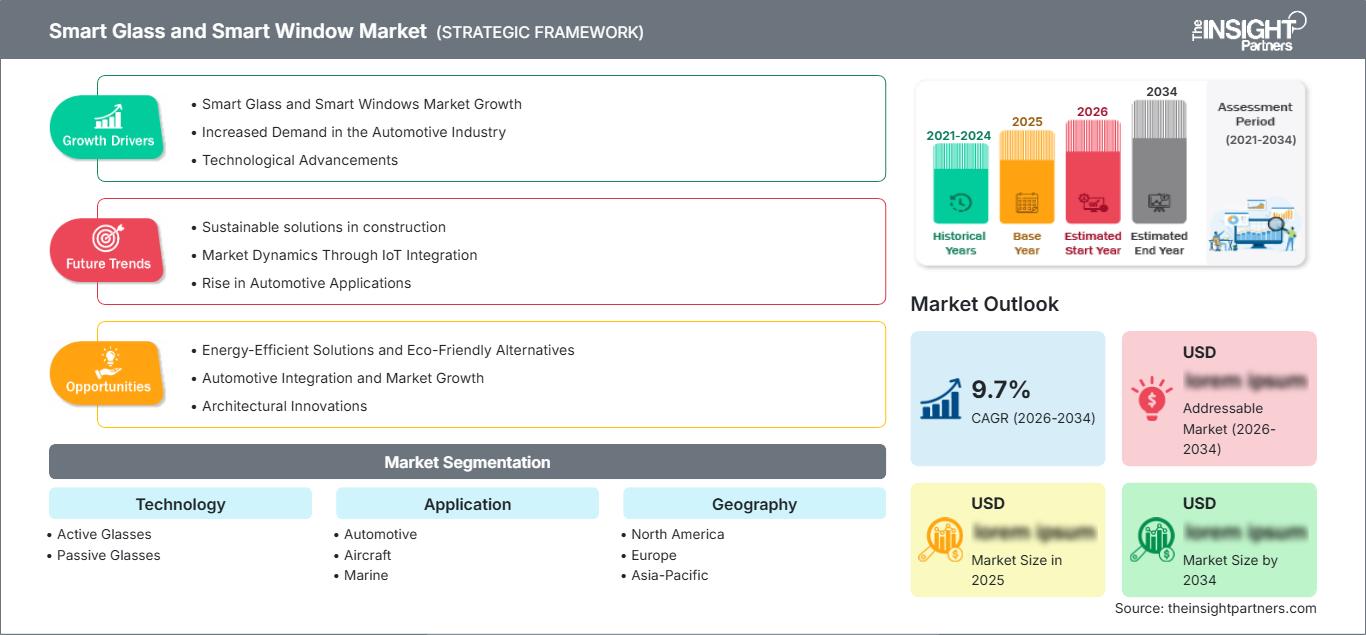
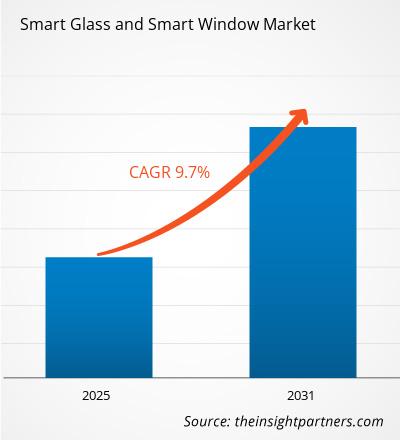
The Smart Glass and Smart Window Market had a valuation of US$ 7.9 billion in 2025, and is estimated to attain a valuation of US$ 30.44 billion by 2034, marking a CAGR of 16.17% during the forecasted period 2026-2034. Growth in the market has been fueled by rising demand for energy-saving building products, innovations in electrochromic and suspended particle device technology, and growing adoption in the construction, automotive, and aerospace industries. The move towards sustainable infrastructure and the rise in smart city initiatives is driving the adoption of dynamic glazing systems, which provide optimized light transmission and thermal comfort.
The Smart Glass and Smart Window Market size in North America occupied a significant market share owing to strict regulations related to energy efficiency along with huge infrastructure investment. The market in North America has experienced a steady growth rate of 14%–16% CAGR during 2026-2034, due to the presence of major players and increasing adoption of green building certification.
Smart Glass and Smart Window Market Assessment and Insights
- North America – North America held a 32%–36% share in 2025 and is projected to grow at a CAGR of 14%–16% during 2026–2034, driven by energy regulations and green building mandates .
- US – The US market represented 78%–82% of North America's share in 2025, with a CAGR of 13%–15%, supported by strong construction activity and smart building technology adoption.
- Europe – Europe captured 26%–30% of the global market in 2025, growing at 13%–15% CAGR, with Germany, UK, and France leading the adoption of energy-efficient glazing .
- Asia Pacific – Asia Pacific dominated with 34%–38% market share in 2025, growing at 17%–19% CAGR, led by China, Japan, and India due to rapid urbanization and smart city projects .
- Largest Segment – The construction segment held the largest share of 52%–56% in 2025, growing at 15%–17% CAGR, driven by green building initiatives and energy efficiency mandates .
- High Growth Segment – The active glass segment is the high-growth segment with 62%–66% market share in 2025, growing at 16%–18% CAGR, due to superior energy control capabilities .
- Key companies analyzed in detail: Gentex Corporation, Heliotrope Technologies, Inc., Kinestral Technologies, Inc., Pleotint LLC, Ravenbrick LLC, SAGE Electrochromics, Inc., Saint-Gobain S.A., SmartGlass International Ltd., Tokai Rika Co. Ltd., VG Smartglass LLC.
Source: The Insight Partners' analysis based on proprietary research, government publications, company annual reports, investor presentations, industry databases, and expert interviews.
The Smart Glass and Smart Window Market is witnessing a significant technological evolution, transitioning from passive glazing solutions to active, responsive systems that dynamically adjust optical properties. Advanced electrochromic and SPD technologies enable precise control over light transmission, heat gain, and privacy, reducing building energy consumption by up to 30% . Manufacturers are increasingly integrating IoT connectivity and AI-driven control systems, allowing smart windows to respond automatically to environmental conditions and user preferences. The market is also seeing innovation in nanostructured coatings and thin-film technologies that enhance durability and optical performance while lowering production costs.
The Market is poised for substantial expansion across emerging economies, with Asia Pacific leading the growth trajectory driven by urbanization and infrastructure development. Investments in smart building technologies and the rising adoption of electric vehicles with smart glass sunroofs are creating new revenue streams . Regulatory tailwinds, including mandatory energy performance standards and green building certifications, are expected to accelerate adoption globally. The integration of energy-harvesting capabilities and self-cleaning functionalities will further enhance the value proposition of smart glass solutions.
Smart Glass and Smart Window Market Report Scope
| Report Attribute | Details |
|---|---|
| Market size in 2025 | US$ 7.9 Billion |
| Market Size by 2034 | US$ 30.44 Billion |
| Global CAGR (2026 - 2034) | 16.17% |
| Historical Data | 2021-2024 |
| Forecast period | 2026-2034 |
Smart Glass and Smart Window Market Analysis
The Smart Glass and Smart Window Market is driven by growing demand for energy efficiency in buildings, which account for approximately 40% of global energy consumption . Smart windows reduce HVAC loads by dynamically managing solar heat gain, leading to significant operational cost savings. The value chain encompasses raw material suppliers, glass manufacturers, technology developers, system integrators, and installation service providers, all collaborating to deliver integrated solutions. Supply dynamics are influenced by the availability of specialized materials such as transparent conductive oxides and electrochromic polymers, with manufacturers investing in capacity expansion to meet growing demand. The adoption of smart glass is further accelerated by the increasing focus on occupant comfort and wellness in commercial buildings.
The competitive landscape of the Smart Glass and Smart Window Market Report is moderately fragmented, with key players such as Saint-Gobain S.A., Gentex Corporation, and AGC Inc. holding significant market shares. These companies are focusing on strategic partnerships, product innovation, and geographic expansion to strengthen their market positions . Significant investments are directed toward R&D to develop next-generation technologies with improved switching speeds, optical clarity, and durability. Saint-Gobain's acquisition strategy and Gentex's focus on automotive applications exemplify the diverse approaches to market penetration. The market also features specialized players like View Inc. and Kinestral Technologies that are pioneering integrated smart glass solutions for architectural applications.
● REPORT CUSTOMIZATION
Tailor This Report To Align With Your Specific Business Requirements
This report can be customized to align precisely with your business objectives, scope, and target markets. Customization options include tailored segmentation, geography, competitive analysis, and strategic insights to support informed decision-making.
Customize This Report →WHAT YOU CAN ADJUST
- ● Segmentations
- ● Geography
- ● Competitive Analysis
- ● Language Preferences
Smart Glass and Smart Window Market: Strategic Insights
Regional Insights
North America Smart Glass and Smart Window Market
North America accounted for 32%–36% of the global Smart Glass and Smart Window Market Share in 2025 and is projected to grow at a CAGR of 14%–16% during the forecast period. The region's growth is driven by stringent energy efficiency regulations, including ENERGY STAR and LEED certification requirements, which mandate the adoption of energy-saving building materials. The United States is the leading country in North America, with a high concentration of technology providers and architectural firms embracing sustainable design practices. The commercial sector, particularly office buildings and retail spaces, represents a significant growth driver for smart glass adoption. The region is also witnessing increasing demand for smart windows in residential applications, driven by consumer awareness of energy savings and home automation integration. Market players in North America are investing in local manufacturing capacity to reduce supply chain dependencies and enhance product availability.
U.S. Smart Glass and Smart Window Market
The U.S. Market represented approximately 78%–82% of the North American market in 2025 and is anticipated to register a CAGR of 13%–15% from 2026 to 2034. The U.S. market is characterized by rapid technological adoption and a strong regulatory environment promoting energy efficiency. Major companies like Saint-Gobain, Gentex, and View Inc. have a strong presence in the U.S., offering advanced electrochromic and SPD-based solutions across architectural and automotive applications. The commercial sector remains the primary end-user, with smart glass being increasingly specified in new office developments and building retrofits. The automotive segment is also gaining traction with the integration of smart glass sunroofs and windows in luxury and electric vehicles. Government incentives and tax credits for energy-efficient building improvements are further supporting market expansion across the country.
Europe Smart Glass and Smart Window Market
Europe captured 26%–30% of the global market in 2025 and is projected to grow at a CAGR of 13%–15% from 2026 to 2034. The United Kingdom, Germany, and France are the leading countries in the region, driven by stringent energy performance regulations and ambitious carbon reduction targets. The UK market is supported by government initiatives promoting energy-efficient building retrofits and sustainable construction practices. Germany leads in industrial innovation, with a strong focus on integrating smart glass into modern architectural designs and automotive applications. France is witnessing growing adoption driven by mandatory environmental regulations and the renovation of public buildings. Italy and Spain are emerging as significant markets, with increasing investments in smart building technologies and sustainable urban development projects. The European market benefits from a robust regulatory framework that mandates energy efficiency improvements across residential and commercial sectors.
APAC Smart Glass and Smart Window Market
Asia Pacific dominated the global Market with a 34%–38% share in 2025 and is projected to register the highest CAGR of 17%–19% during the forecast period. China, Japan, India, and South Korea are the leading countries in the region, driven by rapid urbanization, government-led smart city initiatives, and massive infrastructure investments. China is the largest market in APAC, with its extensive construction sector and government policies promoting green buildings. India is emerging as a significant market, with large-scale smart city projects and rising demand for energy-efficient building solutions. Japan and South Korea are at the forefront of technological innovation, with companies developing advanced electrochromic and PDLC smart glass solutions. Australia is also contributing to market growth with its focus on sustainable building practices and energy-efficient architecture.
Middle East & Africa Smart Glass and Smart Window Market
The Middle East & Africa region is experiencing steady growth in the Smart Glass and Smart Window Market, with a projected CAGR of 11%–13% from 2026 to 2034. Saudi Arabia, UAE, and South Africa are the leading countries, driven by infrastructure development and the need for efficient energy management in extreme climates. The UAE, particularly Dubai and Abu Dhabi, is at the forefront of smart glass adoption, with numerous iconic buildings incorporating dynamic glazing technologies. Saudi Arabia's Vision 2030 initiatives and massive giga-projects like NEOM are creating substantial opportunities for smart window applications. South Africa is witnessing growing adoption driven by energy efficiency regulations and the need to reduce cooling costs in commercial buildings. The Rest of MEA shows promising potential, with increasing awareness about the benefits of smart glass in reducing energy consumption and improving occupant comfort.
Segmentation Analysis
Technology
By technology the Smart Glass and Smart Window Market is segmented into Active Glasses and Passive Glasses. Active Glasses dominated the market in 2025 and are projected to continue their leadership with a CAGR of 16%–18% from 2026 to 2034 . Active glasses, which include electrochromic, SPD, and PDLC technologies, offer superior control over light transmission and can be dynamically adjusted based on user preferences or environmental conditions . The demand for active glasses is driven by their versatility, energy efficiency benefits, and increasing adoption in high-end commercial and automotive applications. Passive glasses, which include thermochromic and photochromic technologies, respond passively to environmental stimuli and offer a simpler, lower-cost alternative. Passive glasses are particularly suitable for applications where low maintenance and cost-effectiveness are prioritized.
- Active Glasses – Active glasses enable dynamic control over tint and privacy through electrical stimulation, making them the preferred choice for architectural and automotive applications requiring responsive functionality .
- Passive Glasses – Passive glasses react to environmental changes such as temperature or light without electricity, offering a low-maintenance, cost-effective option for applications with simpler requirements.
Application
By application the Smart Glass and Smart Window Market is segmented into Automotive, Aircraft, Marine, and Construction. The construction segment captured the largest share of approximately 54% in 2025 and is projected to grow at a CAGR of 15%–17% during the forecast period . The construction sector's dominance is driven by the increasing adoption of smart glass in commercial buildings, residential complexes, and architectural projects focused on energy efficiency and aesthetic appeal. The automotive segment is the second-largest, with smart glass being integrated into sunroofs, side windows, and rear windows to enhance user experience and improve energy efficiency. The aircraft and marine segments are also growing, driven by the need for glare reduction, thermal control, and passenger comfort.
- Automotive – The automotive sector is adopting smart glass for sunroofs, side, and rear windows to enhance passenger comfort, reduce glare, and contribute to energy efficiency in vehicles .
- Aircraft – In aerospace, smart windows offer glare reduction and thermal control, improving passenger experience while contributing to cabin energy efficiency and comfort.
- Marine – The marine sector benefits from smart glass solutions that enhance visibility, reduce heat gain, and improve energy efficiency in ships and yachts.
- Construction – The construction segment leads the market, driven by the demand for energy-efficient building envelopes, privacy control, and aesthetic versatility in modern architecture .
Opportunity Snapshot
| Application | Revenue Contribution | Trend Tag | Adoption Stage |
|---|---|---|---|
| Construction | High | Green Building | Scaling |
| Automotive | High | EV Integration | Scaling |
| Aircraft | Medium | Cabin Comfort | Emerging |
| Marine | Low | Marine Glazing | Emerging |
Smart Glass and Smart Window Market Growth Drivers and Impact Analysis
Rising Demand for Energy-Efficient Building Solutions
The increasing focus on energy conservation and sustainable construction practices is a primary driver for the Market. Buildings account for a significant portion of global energy consumption, and smart windows help reduce HVAC loads by dynamically managing solar heat gain and daylight penetration . With governments worldwide implementing stricter building energy codes and green certification programs such as LEED and BREEAM, the adoption of smart glass technologies is accelerating across commercial, residential, and institutional sectors. The long-term operational cost savings associated with smart windows, coupled with occupant comfort benefits, are making them an increasingly attractive investment for building owners and developers. The market is expected to grow as awareness of these benefits expands and technology costs continue to decline.
Regulatory Mandates Promoting Energy Efficiency
Government policies and regulations targeting carbon emission reduction and energy efficiency are significantly propelling the Market. Many countries have implemented building codes that require the use of energy-saving materials, including dynamic glazing, in new construction and major renovations . Incentives such as tax credits, rebates, and grants for energy-efficient building improvements are further encouraging adoption. In Europe, the Energy Performance of Buildings Directive mandates stringent efficiency standards that support smart glass integration. These regulatory frameworks are creating a favorable environment for market growth and driving investment in advanced glazing technologies.
Technological Advancements in Electrochromic and SPD Materials
Continuous innovation in electrochromic and suspended particle device (SPD) technologies is expanding the Smart Glass and Smart Window Market by improving performance, durability, and cost-effectiveness. Recent advancements include faster switching speeds, enhanced optical clarity, and integration with IoT-enabled control systems . These technologies now offer better energy performance, longer lifespans, and more competitive pricing compared to earlier generations. Manufacturers are also developing next-generation solutions with energy-harvesting capabilities and smart automation features that respond to real-time environmental data. These technological improvements are making smart glass solutions more accessible to broader market segments and enabling new applications across diverse industries.
Smart Glass and Smart Window Market Future Trends
Integration of IoT and AI in Smart Window Automation
A key trend in the Smart Glass and Smart Window Market Trends is the integration of Internet of Things (IoT) and artificial intelligence (AI) technologies for automated control and optimization. Smart windows are increasingly being connected to building management systems and can now respond to environmental conditions, occupancy patterns, and user preferences in real time . AI algorithms analyze data from sensors to optimize tint levels for maximum energy efficiency and occupant comfort. This trend is particularly pronounced in commercial buildings, where smart glass systems are being integrated into comprehensive building automation platforms. The convergence of smart glass with smart building technologies represents a significant step toward creating truly intelligent and responsive built environments.
Adoption of Smart Glass in Electric Vehicles
The growing electric vehicle (EV) market is driving the adoption of smart glass and smart window technologies in the automotive sector . Smart glass sunroofs and windows are being integrated into EV designs to improve cabin comfort, reduce air conditioning loads, and enhance energy efficiency. EVs are increasingly incorporating dynamic glazing solutions that can adjust tint levels to manage heat and glare while providing privacy. The use of smart glass in EVs aligns with the overall sustainability focus of electric mobility and enhances the premium user experience. As EV adoption continues to grow globally, the automotive application of smart glass is expected to expand significantly, creating new opportunities for technology providers and glass manufacturers.
Smart Glass and Smart Window Market Opportunities
Expansion in Emerging Markets with Smart City Development
The Smart Glass and Smart Window Market presents significant opportunities in emerging economies, particularly in Asia Pacific and Latin America, where rapid urbanization and infrastructure development are creating strong demand for energy-efficient building solutions . Countries like India, China, and Brazil are investing heavily in smart city initiatives and sustainable construction, creating substantial market potential for smart glass technologies. These regions are experiencing a construction boom, with new commercial and residential projects increasingly incorporating green building features. Companies can capitalize on these opportunities by forming partnerships with local distributors, adapting products to regional climate conditions, and aligning with local building codes and regulations. The growth of the middle class and rising awareness of energy efficiency benefits are further supporting market expansion in these regions.
Development of Self-Powered and Energy-Harvesting Smart Glass
There is a growing opportunity for smart glass manufacturers to develop self-powered and energy-harvesting solutions that reduce dependence on external power sources. The integration of photovoltaic cells and transparent energy-harvesting technologies into smart windows enables buildings to generate clean energy while maintaining dynamic light and heat control . These integrated solutions offer enhanced sustainability benefits and reduce operational costs, making them particularly attractive for off-grid and remote applications. Companies investing in R&D to develop next-generation self-powered smart glass solutions are well-positioned to capture early mover advantages in this emerging market segment.
Recent Developments
- March 2025: Leading smart window technology creator Miru Smart Technologies (“Miru”) has introduced one of the world’s largest electrochromic sunroof window devices for the automotive industry. Made possible with Argotec advanced thermoplastic polyurethane (TPU) interlayer films, this achievement demonstrates the scalability and commercial value of their cutting-edge, sustainable window solution in next generation vehicle design. As a major leap forward for both the smart glass and automotive industries, Miru’s dynamic electrochromic technology (“eWindows”) is combined with Argotec optically clear polymer film into a compound-curved electrochromic window prototype measuring 1.5 m x 1.6 m. The increased size makes it an ideal solution for automotive applications such as panoramic sunroofs, expansive glazing, and other window components..
- January 2025: Gauzy in Israel has developed an energy harvesting smart glass with black suspended particles for the first time. The black SPD technology is a dimmable glass with a distinguishable black appearance for the automotive, aeronautics, and architecture industries. The glass turns opaque within seconds under electronic control and blocks more than 99% of visible light to reduce energy consumption, regulate temperature control, increase headroom in vehicles by at least two inches, extend driving ranges in electric vehicles. It can be retrofitted to existing structures, vehicles and aircraft.
- January 2023: NSG Group announces that the energy-saving electrochromic (dynamic light control) window "View Smart Glass" was adopted for the first case in the new "Kudan Kaikan Terrace" (Chiyoda-ku, Tokyo) in Japan. This new office building opened on 1 October 2022.
Frequently Asked Questions

- Comprehensive Market Sizing and Forecast Analysis
- Detailed Segmentation Analysis
- In-Depth Market Dynamics Assessment
- Regional and Country-Level Insights
- Competitive Landscape and Company Benchmarking
- Strategic Business Intelligence
Recent Reports
Testimonials

The Insight Partners' SCADA System Market report is comprehensive, with valuable insights on current trends and future forecasts. The team was highly professional, responsive, and supportive throughout. We are very satisfied and highly recommend their services.
RAN KEDEM Partner, Reali Technologies LTDs
I requested a report on a very specific software market and the team produced the report in a few days. The information was very relevant and well presented. I then requested some changes and additions to the report. The team was again very responsive and I got the final report in less than a week.
JEAN-HERVE JENN Chairman, Future Analytica
We worked with The Insight Partners for an important market study and forecast. They gave us clear insights into opportunities and risks, which helped shape our plans. Their research was easy to use and based on solid data. It helped us make smart, confident decisions. We highly recommend them.
PIYUSH NAGPAL Sr. Vice President, High Beam Global
The Insight Partners delivered insightful, well-structured market research with strong domain expertise. Their team was professional and responsive throughout. The user-friendly website made accessing industry reports seamless. We highly recommend them for reliable, high-quality research services
YUKIHIKO ADACHI CEO, Deep Blue, LLC.
This is the first time I have purchased a market report from The Insight Partners.While I was unsure at first, I visited their web site and felt more comfortable to take the risk and purchase a market report.I am completely satisfied with the quality of the report and customer service. I had several questions and comments with the initial report, but after a couple of dialogs over email with their analyst I believe I have a report that I can use as input to our strategic planning process.Thank you so much for taking the extra time and making this a positive experience.I will definitely recommend your service to others and you will be my first call when we need further market data.
JOHN SUZUKI President and Chief Executive Officer, Board Director, BK Technologies
I wish to appreciate your support and the professionalism you displayed in the course of attending to my request for information regarding to infectious disease IVD market in Nigeria. I appreciate your patience, your guidance, and the fact that you were willing to offer a discount, which eventually made it possible for us to close a deal. I look forward to engaging The Insight Partners in the future, all thanks to the impression you have created in me as a result of this first encounter.
DR CHIJIOKE ONYIA MANAGING DIRECTOR, PineCrest Healthcare Ltd.Reason to Buy
- Informed Decision-Making
- Understanding Market Dynamics
- Competitive Analysis
- Identifying Emerging Markets
- Customer Insights
- Market Forecasts
- Risk Mitigation
- Boosting Operational Efficiency
- Strategic Planning
- Investment Justification
- Tracking Industry Innovations
- Aligning with Regulatory Trends





 Get Free Sample for