
Smart Greenhouse Market Size, Share & Trends by 2034
Coverage: By Type (Hydroponic, Non-hydroponic); Covering Material Type (Polyethylene, Polycarbonate, Others); Component (HVAC System, LED Grow Lights, Control Systems and Sensors); End Users (Research and Educational Institutes, Commercial Growers, Retail Gardens, Others) , and Geography (North America, Europe, Asia Pacific, and South and Central America)
- Status : Data Released
- Report Code : TIPRE00008409
- Category : Electronics and Semiconductor
- No. of Pages : 150
- Available Report Formats :


- Last update date : August 11, 2026


2025 Market Size
US$ 2.32 Bn
Base year value
2034 Forecast
US$ 6.83 Bn
Projected by 2034
CAGR 2026-2034
12.74 %
Growth rate
Addressable Market
US$ 39.88 Bn
(2026-2034)
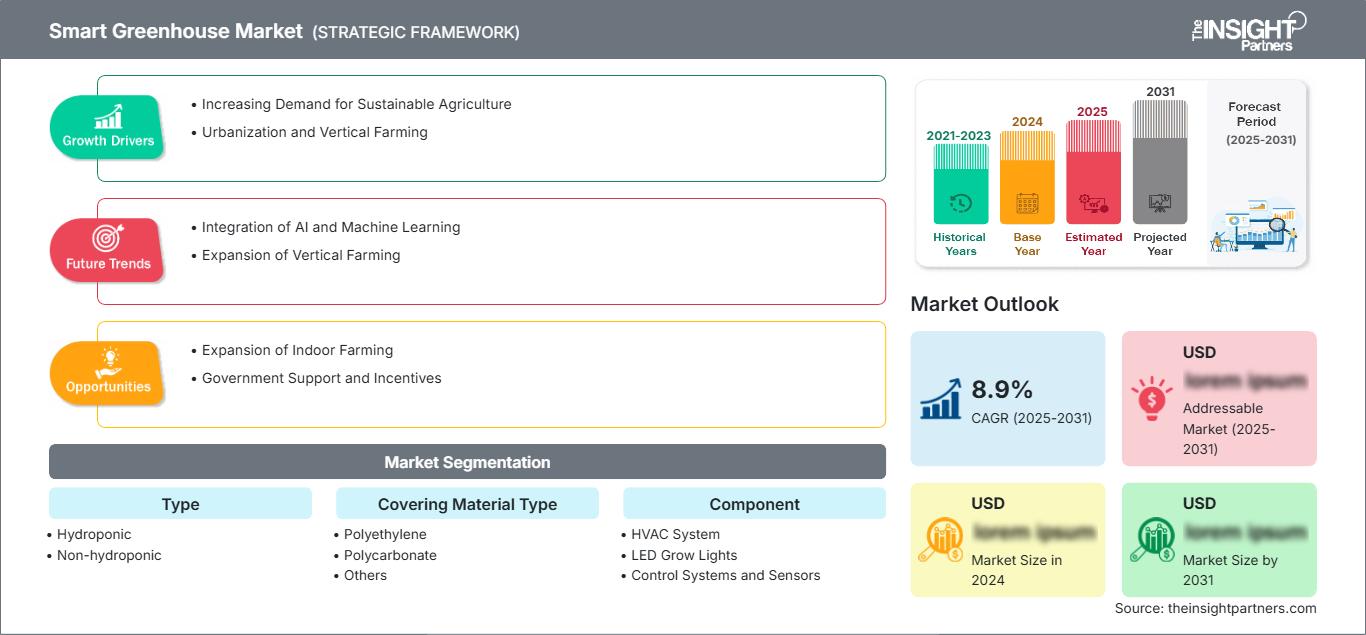
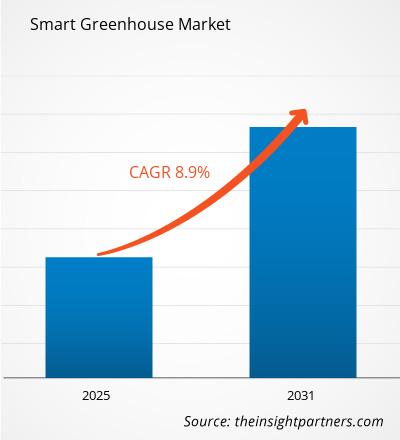
The Smart Greenhouse Market was valued at US$ 2.32 billion in 2025 and is projected to reach US$ 6.83 billion by 2034, registering a CAGR of 12.74% during the forecast period from 2026 to 2034. The market growth is driven by increasing demand for food security, diminishing arable land, and the need for sustainable agricultural practices that optimize resource utilization while maximizing crop yields. Smart greenhouses integrate advanced technologies such as IoT sensors, AI-driven analytics, and automated climate control systems to create controlled environments that enhance productivity and reduce dependency on external climatic conditions.
The Smart Greenhouse Market size in North America accounted for a substantial share, driven by early adoption of precision agriculture technologies, strong government support for smart farming initiatives, and the presence of key market players. The region is experiencing steady growth with a projected CAGR of 11.5%–12.5% from 2026 to 2034, supported by advancements in agricultural technology and the increasing use of automation in controlled-environment agriculture. Government initiatives promoting water conservation and precision farming are further propelling market expansion.
Smart Greenhouse Market Assessment and Insights
- North America – North America held a 27%–31% share in 2025 and is projected to grow at a CAGR of 11.5%–12.5% during 2026–2034, driven by early adoption of precision agriculture, government support, and the presence of key technology providers.
- US – The US market represented 85%–90% of North America's share in 2025, with a CAGR of 11%–13%, supported by strong government initiatives promoting precision farming, water conservation, and the adoption of automation in agriculture.
- Europe – Europe captured 26%–30% of the global market in 2025, growing at 10%–11% CAGR, with the Netherlands, Germany, UK, France, and Spain leading due to advanced horticultural practices and sustainability goals.
- Asia Pacific – Asia Pacific held 30%–34% market share in 2025, growing at 13%–14% CAGR, led by China, India, and Japan due to rapid urbanization, government policies promoting smart agriculture, and increasing population pressure.
- Largest Segment – The hydroponic segment held the largest market share of 38%–42% in 2025, growing at 12%–13% CAGR, driven by water efficiency, year-round cultivation, and suitability for urban and vertical farming applications.
- High Growth Segment – The commercial growers segment is the high-growth segment with a 52%–56% market share in 2025, growing at 12%–13% CAGR, driven by the need for high-efficiency production systems that maximize yield and minimize resource use.
- Key companies analyzed in detail: Argus Control Systems Limited, Certhon Build B.V., Greentech Agro LLC, Heliospectra AB, Greenhouse Megastore, LOGIQS B.V., LumiGrow, Inc., Netafim Limited, Nexus Corporation, Rough Brothers, Inc.
Source: The Insight Partners' analysis based on proprietary research, government publications, company annual reports, investor presentations, industry databases, and expert interviews.
There is a notable advancement in technology with a shift from simple automated systems to more sophisticated systems that incorporate AI and IoT and are capable of offering real-time monitoring and predictive analytics. With the incorporation of machine learning algorithms, it becomes possible to manage different environmental factors such as temperature, humidity, light intensity, and nutrient levels with precision to optimize plant growing conditions. There is increasing production of modular and scalable greenhouse systems by manufacturers to satisfy the needs of different kinds of greenhouses ranging from research-oriented ones to big commercial ones.
Looking forward, there will be significant growth in the Market due to expansion into developing countries, whereby the Asia Pacific region will be at the forefront of such growth, fueled by urbanization, increased population and concerns about food security. Investments made in smart agriculture technology and government policies that encourage modern farming will bring forth numerous growth opportunities. Favorable regulations such as the European Green Deal and Farm to Fork Strategy will fuel uptake of smart greenhouses in the developed nations. Blockchain technology for traceability, 5G for improved connectivity and AI for autonomous decisions will all contribute to the future of the smart greenhouse industry.
Smart Greenhouse Market Report Scope
| Report Attribute | Details |
|---|---|
| Market size in 2025 | US$ 2.32 Billion |
| Market Size by 2034 | US$ 6.83 Billion |
| Global CAGR (2026 - 2034) | 12.74% |
| Historical Data | 2021-2024 |
| Forecast period | 2026-2034 |
Smart Greenhouse Market Analysis
The Smart Greenhouse Market is fueled by rising need for food security and sustainable agriculture. As per the report by the Food and Agriculture Organization (FAO), there will be an estimated need for about 60% rise in food production until 2050 to cater to the increasing population demands, which makes use of technology-based farming methods very important. In smart greenhouses, IoT devices, artificial intelligence, and automation are used to maximize crop production and minimize wastages. The supply chain consists of producers of sensors, automation technology companies, greenhouse constructors, software developers, and integrators. The dynamics of the supply chain include advanced technologies like climate management, LED lighting, and irrigation control.
Competitive environment in the Smart Greenhouse Market report is fragmented in nature; with some of the major market participants being Argus Control Systems Limited, Certhon Build B.V., Heliospectra AB and Netafim Limited. These firms are making concerted efforts to innovate new products, develop partnerships and expand geographically. A lot of effort and money is going into research and development of new technologies in the form of lighting, control systems based on Artificial Intelligence and greenhouse management software. Firms like Heliospectra are developing smart lighting systems for greenhouses and other controlled plant growth facilities, whereas, Certhon and Netafim are concentrating on greenhouse solutions and precise irrigation systems respectively.
● REPORT CUSTOMIZATION
Tailor This Report To Align With Your Specific Business Requirements
This report can be customized to align precisely with your business objectives, scope, and target markets. Customization options include tailored segmentation, geography, competitive analysis, and strategic insights to support informed decision-making.
Customize This Report →WHAT YOU CAN ADJUST
- ● Segmentations
- ● Geography
- ● Competitive Analysis
- ● Language Preferences
Smart Greenhouse Market: Strategic Insights
Regional Insights
North America Smart Greenhouse Market
The share of North America in the Global Smart Greenhouse Market was 27%–31% in 2025 and is expected to grow at a CAGR of 11.5%–12.5% through the forecast period. Advancements in agricultural technologies, rising need for sustainable agriculture practices, and automation in agriculture within controlled environment are the major factors driving the growth of the region. The United States holds the highest market position within North America with various initiatives taken by the government to promote precision agriculture and water conservation practices which help accelerate the growth of the region. Commercial entities, especially the greenhouse industry, are one of the key growth drivers for the smart greenhouse market. There is an increasing demand for hydroponic and vertical farm technologies.
U.S. Smart Greenhouse Market
The U.S. Smart Greenhouse Market held around 85%–90% of the North American market share in 2025 and is estimated to record a CAGR of 11%–13% during 2026 to 2034. Some of the most advanced technological developments include AI-assisted climate control, IoT-enabled monitoring, and hydroponics that ensure higher efficiency and productivity. There are various established players in the U.S., such as Rough Brothers, Inc., Nexus Corporation, and Argus Control Systems, which provide high-end greenhouse solutions and control systems. Government programs related to precision farming and water conservation are driving the growth of the U.S. smart greenhouse market. In addition, there are various leading players and institutes present in the region, which facilitate innovation. The rising costs of energy and climatic conditions are also compelling farmers to adopt advanced technology.
Europe Smart Greenhouse Market
Europe captured 26%–30% of the global market in 2025 and is projected to grow at a CAGR of 10%–11% from 2026 to 2034. The Netherlands, Germany, the United Kingdom, France, and Spain are the leading countries in the region, driven by advanced horticultural practices, environmental sustainability goals, and strict regulatory frameworks promoting energy-efficient farming solutions. The Netherlands, recognized for its expertise in greenhouse horticulture, leads the region with its export-oriented production and innovative cultivation techniques. Germany benefits from its robust manufacturing sector and automation solutions. The UK market is supported by government initiatives promoting sustainable agriculture and the adoption of smart farming technologies. France and Spain are witnessing growing demand for smart greenhouse solutions driven by the need for year-round production and climate resilience.
APAC Smart Greenhouse Market
Asia Pacific held 30%–34% of the global Smart Greenhouse Market in 2025 and is projected to register the highest CAGR of 13%–14% during the forecast period. China, India, Japan, South Korea, and Australia are the leading countries in the region, driven by rapid urbanization, population growth, and favorable government policies promoting smart agriculture. China is the largest market in APAC, with its extensive agricultural sector and government initiatives to modernize farming practices. India is emerging as a significant market with large-scale smart city projects and increasing demand for high-quality food products. Japan is increasingly utilizing smart agriculture to address severe labor shortages, with AI-equipped robots being deployed in large-scale smart greenhouses. South Korea and Australia are contributing to market growth with their focus on sustainable farming practices and advanced agricultural technologies.
Middle East & Africa Smart Greenhouse Market
The Middle East & Africa region is experiencing steady growth in the Smart Greenhouse Market, with a projected CAGR of 10%–11.5% from 2026 to 2034. Saudi Arabia, UAE, and South Africa are the leading countries, driven by the need for food security, water scarcity challenges, and extreme climatic conditions. The UAE is at the forefront of smart greenhouse adoption, with significant investments in controlled-environment agriculture to ensure food security. Saudi Arabia's Vision 2030 initiatives are creating substantial opportunities for smart greenhouse applications. South Africa is witnessing growing adoption driven by the need for sustainable agriculture and water-efficient farming solutions. The Rest of MEA shows promising potential with increasing awareness of smart greenhouse benefits in ensuring food security and resource efficiency.
Segmentation Analysis
Type
The Smart Greenhouse Market is segmented by type into Hydroponic and Non-hydroponic. The hydroponic segment dominated the market in 2025 with a share of 38%–42% and is projected to continue its leadership with a CAGR of 12%–13% from 2026 to 2034. Hydroponic systems, which grow plants without soil using mineral nutrient solutions in water, have gained immense traction owing to their efficiency, speed, and sustainability. These systems allow year-round cultivation, drastically reduce water consumption by up to 90% compared to conventional methods, and optimize space utilization, making them particularly attractive for urban and vertical farming applications. The non-hydroponic segment maintains a strong presence, especially in regions with fertile land and established agricultural practices where traditional soil-based cultivation is preferred.
- Hydroponic – Hydroponic smart greenhouses offer efficient water usage, higher yields, and year-round cultivation, making them ideal for urban farming and regions with soil degradation and water scarcity.
- Non-hydroponic – Non-hydroponic smart greenhouses maintain a strong presence in regions with fertile land and established agricultural practices, integrating smart technologies into traditional soil-based cultivation.
Covering Material Type
The Smart Greenhouse Market is segmented by covering material type into Polyethylene, Polycarbonate, and Others. Polycarbonate is the most widely adopted covering material, offering superior durability, light transmission, thermal insulation, and impact resistance compared to traditional materials. Smart greenhouses increasingly utilize polycarbonate for its structural strength and ability to accommodate advanced automation components. Polyethylene remains a cost-effective option, particularly in regions where affordability is a primary consideration. The selection of covering material significantly impacts greenhouse performance, influencing energy efficiency, light diffusion, and overall cultivation conditions.
- Polyethylene – Polyethylene is a cost-effective covering material widely adopted in regions where affordability is a primary consideration, offering adequate light transmission and durability for basic greenhouse applications.
- Polycarbonate – Polycarbonate offers superior durability, light transmission, thermal insulation, and impact resistance, making it the preferred choice for advanced smart greenhouse installations.
Component
The Smart Greenhouse Market is segmented by component into HVAC System, LED Grow Lights, Control Systems and Sensors. The HVAC system segment holds a significant market share as it plays an essential role in maintaining optimal temperature needed for plant growth, minimizing the adverse impact of external temperature changes, and facilitating cultivation throughout the year. The integration of AI in HVAC systems has been revolutionizing the concept of regularly measuring and adjusting temperature, humidity, and CO2 levels as needed through sensors and monitoring systems. LED grow lights are increasingly adopted for their energy efficiency and ability to provide specific light spectra optimized for different crop growth stages. Control systems and sensors form the backbone of smart greenhouse automation, enabling precise monitoring and management of environmental conditions.
- HVAC System – HVAC systems maintain optimal temperature and humidity conditions for plant growth, with AI integration enabling precise control and energy efficiency in smart greenhouse operations.
- LED Grow Lights – LED grow lights provide energy-efficient, spectrally optimized lighting solutions that enhance photosynthesis and enable year-round cultivation in smart greenhouses.
- Control Systems and Sensors – Control systems and sensors form the foundation of smart greenhouse automation, enabling real-time monitoring of environmental parameters and data-driven decision-making.
End Users
The Smart Greenhouse Market is segmented by end user into Research and Educational Institutes, Commercial Growers, Retail Gardens, and Others. The commercial growers segment dominated the market with a share of 52%–56% in 2025 and is projected to grow at a CAGR of 12%–13% during the forecast period. Commercial growers dominate this segment due to their need for high-efficiency production systems that maximize yield and minimize resource use. The trend toward sustainable farming practices, automation, and increasing demand for fresh produce are propelling commercial growers to adopt smart greenhouse technologies. Research and educational institutions are also significant adopters, focusing on crop science innovation and sustainable agriculture research. Retail gardens are adopting smart greenhouse solutions for localized production of high-value crops.
- Research and Educational Institutes – Research and educational institutions are significant adopters of smart greenhouse technologies, focusing on crop science innovation, sustainable agriculture research, and training the next generation of agricultural professionals.
- Commercial Growers – Commercial growers dominate this segment due to their need for high-efficiency production systems that maximize yield, minimize resource use, and ensure consistent quality for retail and foodservice markets.
- Retail Gardens – Retail gardens are adopting smart greenhouse solutions for localized production of high-value crops, enabling year-round cultivation and direct-to-consumer sales.
Opportunity Snapshot
| End User | Revenue Contribution | Trend Tag | Adoption Stage |
|---|---|---|---|
| Commercial Growers | High | Yield Optimization | Scaling |
| Research and Educational Institutes | Medium | Crop Innovation | Scaling |
| Retail Gardens | Medium | Local Production | Emerging |
| Others | Low | Specialty Cultivation | Emerging |
Smart Greenhouse Market Growth Drivers and Impact Analysis
Rising Global Food Demand and Food Security Concerns
The increasing global population and the need to ensure food security are primary drivers for the Smart Greenhouse Market. The global population is projected to reach nearly 10 billion by 2050, requiring a substantial increase in food production while facing diminishing arable land and water resources. Smart greenhouses offer a solution by enabling year-round cultivation, increasing crop yields per square meter, and reducing dependence on external climatic conditions. These controlled environments allow for the cultivation of high-value crops regardless of weather patterns, improving crop reliability and quality while reducing food waste and supply chain disruptions.
Technological Advancements in AI and IoT for Agriculture
The integration of Artificial Intelligence and Internet of Things technologies in agriculture is significantly propelling the Smart Greenhouse Market. IoT sensors collect real-time data on environmental conditions, which AI algorithms analyze to optimize water usage, nutrient delivery, and lighting conditions. Automated climate control systems further improve efficiency by adjusting conditions based on predictive analytics, enabling farmers to transition to data-driven precision farming methods. The continuous development of advanced sensor technologies, machine learning algorithms, and cloud-based management platforms is expanding the capabilities of smart greenhouses and making them more accessible to a broader range of agricultural operations.
Government Initiatives Promoting Sustainable Agriculture
Government policies and regulations targeting sustainable agriculture and food security are significantly driving the Smart Greenhouse Market. Governments worldwide are implementing policies that promote the adoption of smart greenhouse technologies through subsidies, grants, and tax incentives. The European Union's Green Deal and Farm to Fork Strategy mandate sustainable agricultural practices and provide financial support for digital innovation and emissions reduction in agriculture. In North America, initiatives promoting precision farming and water conservation are accelerating the adoption of smart greenhouse technologies. In Asia Pacific, governments are promoting smart agriculture to ensure food security amid climate variability and growing populations.
Smart Greenhouse Market Future Trends
AI-Driven Autonomous Greenhouse Management
A key trend in the Smart Greenhouse Market is the emergence of AI-driven autonomous greenhouse management systems that can make calculated decisions independently. These systems analyze environmental data, crop health metrics, and market conditions to optimize growing strategies without human intervention. AI enables farmers to improve workflows, boost productivity, optimize supply chains, and increase profit margins while reducing waste and conserving resources. The development of digital twins and predictive maintenance capabilities allows growers to simulate and optimize growing conditions before implementation. As AI technology advances, smart greenhouses are expected to become fully autonomous cultivation systems capable of managing complex agricultural operations with minimal human oversight.
Integration of Blockchain for Traceability and Transparency
The adoption of blockchain technology in smart greenhouses is emerging as a significant trend, enabling enhanced traceability and transparency throughout the agricultural supply chain. Blockchain-enabled food traceability allows consumers and retailers to verify the provenance, growing conditions, and sustainability credentials of produce grown in smart greenhouses. This technology supports the growing consumer demand for safe, high-quality, and traceable food products while enabling growers to demonstrate compliance with sustainability standards. The integration of blockchain with IoT sensors and data analytics creates comprehensive records of cultivation practices, improving supply chain transparency and building consumer trust.
Smart Greenhouse Market Opportunities
Expansion in Emerging Markets with Smart City Development
The Smart Greenhouse Market presents significant opportunities in emerging economies, particularly in Asia Pacific and Latin America, where rapid urbanization, population growth, and smart city initiatives are creating strong demand for sustainable food production solutions. Countries like India, China, and Southeast Asian nations are investing heavily in smart agriculture infrastructure and modern farming practices to ensure food security amid climate variability. The growth of the middle class and rising awareness of food safety and quality are further supporting market expansion. Companies can capitalize on these opportunities by forming partnerships with local distributors, adapting products to regional crop requirements, and aligning with local government initiatives promoting smart agriculture.
Development of Modular and Scalable Greenhouse Solutions
There is a growing opportunity for smart greenhouse manufacturers to develop modular and scalable solutions that cater to diverse cultivation needs, from small-scale research facilities and retail gardens to large commercial operations. Modular greenhouse designs offer flexibility, cost-effectiveness, and ease of expansion, making smart greenhouse technology accessible to a broader range of agricultural operators. Companies investing in the development of standardized, plug-and-play greenhouse systems with integrated automation and control technologies are well-positioned to capture market share in both developed and emerging markets. The growing trend toward urban farming and vertical farming applications further supports the demand for scalable smart greenhouse solutions.
Recent Developments
- March 2024: Heliospectra AB, a world leader in intelligent lighting technology for greenhouse and controlled plant growth environments, announces a new order from a leading greenhouse grower in Ontario, Canada. The new order includes Heliospectra´s fully modular MITRA X LED light and helioCORE system solution and is spread out over 4 deliveries in 2024 and 2025. The total order value is 8,3 million SEK.
- December 2024: Breaking new ground with a domestic solution for the remote monitoring and automated cultivation of crops, the government of Costa Rica with support from South Korea and the Central American Bank for Economic Integration (CABEI) has launched a new greenhouse project with sensors that measure light, heat, movement, humidity and pressure and remotely controlled control cooling, heating, lighting, and irrigation systems. The large-scale facility which consists of two greenhouses for tomatoes and sweet peppers, a control room, a nursery, and a storage space for agricultural inputs, is just one of many that are now being built around the world, which has to meet the challenge of producing more food. In order to feed a projected global population of nine billion people by 2050, the FAO (Food and Agriculture Organisation of the United Nations) estimates that food production will need to be increased by 60%. The hope is that advanced technology for the optimization of agricultural yields and smart greenhouses in particular will contribute to achieving this goal. At the same time, the new production facilities are particularly popular in developing countries like Cameroon, which are eager to stabilise volatile food prices.
- December 2022: The Indonesia Agriculture Ministry’s ground-breaking SGH initiative aims to advance modern agriculture. Farmers in Mojokerto, East Java, have started to benefit from the program’s digital agriculture. SGH participates in initiatives to promote digitization in agriculture, with the ultimate objective of enhancing agricultural output. Agriculture with SGH maximizes digital technology for the advancement of agriculture in its deployment. Greenhouse-branded buildings and a digitalized system make up SGH. SGH encourages environmentally beneficial agricultural cultivation, thus farmers use SGH to produce organic veggies. Since SGH was established, farmer income has increased. SGH is anticipated to be combined with or perhaps transformed into a type of edu-tourism in the future for students and the general public.
Frequently Asked Questions

- Comprehensive Market Sizing and Forecast Analysis
- Detailed Segmentation Analysis
- In-Depth Market Dynamics Assessment
- Regional and Country-Level Insights
- Competitive Landscape and Company Benchmarking
- Strategic Business Intelligence
Recent Reports
Testimonials

The Insight Partners' SCADA System Market report is comprehensive, with valuable insights on current trends and future forecasts. The team was highly professional, responsive, and supportive throughout. We are very satisfied and highly recommend their services.
RAN KEDEM Partner, Reali Technologies LTDs
I requested a report on a very specific software market and the team produced the report in a few days. The information was very relevant and well presented. I then requested some changes and additions to the report. The team was again very responsive and I got the final report in less than a week.
JEAN-HERVE JENN Chairman, Future Analytica
We worked with The Insight Partners for an important market study and forecast. They gave us clear insights into opportunities and risks, which helped shape our plans. Their research was easy to use and based on solid data. It helped us make smart, confident decisions. We highly recommend them.
PIYUSH NAGPAL Sr. Vice President, High Beam Global
The Insight Partners delivered insightful, well-structured market research with strong domain expertise. Their team was professional and responsive throughout. The user-friendly website made accessing industry reports seamless. We highly recommend them for reliable, high-quality research services
YUKIHIKO ADACHI CEO, Deep Blue, LLC.
This is the first time I have purchased a market report from The Insight Partners.While I was unsure at first, I visited their web site and felt more comfortable to take the risk and purchase a market report.I am completely satisfied with the quality of the report and customer service. I had several questions and comments with the initial report, but after a couple of dialogs over email with their analyst I believe I have a report that I can use as input to our strategic planning process.Thank you so much for taking the extra time and making this a positive experience.I will definitely recommend your service to others and you will be my first call when we need further market data.
JOHN SUZUKI President and Chief Executive Officer, Board Director, BK Technologies
I wish to appreciate your support and the professionalism you displayed in the course of attending to my request for information regarding to infectious disease IVD market in Nigeria. I appreciate your patience, your guidance, and the fact that you were willing to offer a discount, which eventually made it possible for us to close a deal. I look forward to engaging The Insight Partners in the future, all thanks to the impression you have created in me as a result of this first encounter.
DR CHIJIOKE ONYIA MANAGING DIRECTOR, PineCrest Healthcare Ltd.Reason to Buy
- Informed Decision-Making
- Understanding Market Dynamics
- Competitive Analysis
- Identifying Emerging Markets
- Customer Insights
- Market Forecasts
- Risk Mitigation
- Boosting Operational Efficiency
- Strategic Planning
- Investment Justification
- Tracking Industry Innovations
- Aligning with Regulatory Trends





 Get Free Sample for