
Smart Indoor Gardening Market Demand, Size & Forecast by 2034
Coverage: By Type (Small Garden, Wall Garden, Others); Solution (Self-Watering, Smart Sensing, Smart Pest Management, Smart Lighting, Others); End-user (Residential, Commercial) , and Geography (North America, Europe, Asia Pacific, and South and Central America)
- Status : Data Released
- Report Code : TIPRE00009196
- Category : Electronics and Semiconductor
- No. of Pages : 150
- Available Report Formats :


- Last update date : August 21, 2026


2025 Market Size
US$ 2.44 Bn
Base year value
2034 Forecast
US$ 8.49 Bn
Projected by 2034
CAGR 2026-2034
14.88 %
Growth rate
Addressable Market
US$ 46.81 Bn
(2026-2034)
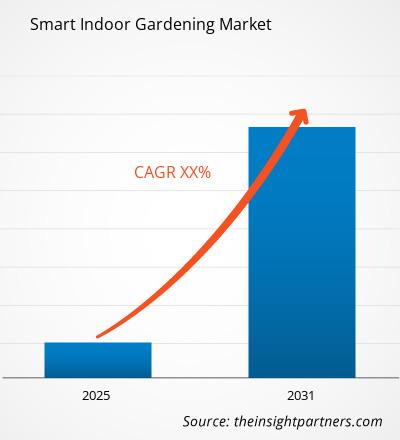
The global Smart Indoor Gardening Market was valued at US$ 2.44 billion in 2025 and is projected to reach US$ 8.49 billion by 2034. The market is anticipated to register a compound annual growth rate (CAGR) of 14.88% during the forecast period from 2026 to 2034, driven by increasing urbanization, shrinking residential spaces, and rising consumer interest in sustainable home-based food production.
The Smart Indoor Gardening Market size in North America is estimated to account for a dominant share, with the region growing at a CAGR of approximately 12–14% through 2034. Growth is underpinned by high consumer spending on smart home technologies, a strong culture of home gardening, and the presence of key industry players offering innovative automated solutions for urban dwellers.
Smart Indoor Gardening Market Assessment and Insights
- North America: The region held a significant market share of approximately 34–38% in 2025. It is projected to grow at a robust CAGR of 12–14% from 2026 to 2034, driven by high disposable incomes, rapid smart home adoption, and strong consumer interest in sustainable living and home-grown produce .
- US: The United States is the largest contributor in North America, accounting for over 85–90% of the region's market share in 2025. The US market is anticipated to grow at a CAGR of 12–14% during 2026–2034, propelled by advanced smart home infrastructure, widespread availability of automated gardening systems, and increasing health-conscious consumer behavior .
- Europe: Europe captured approximately 28–32% share in 2025, with a projected CAGR of 11–13% through 2034. Leading countries include Germany, the UK, and France, where stringent sustainability regulations, growing awareness of organic food, and strong retail distribution channels are accelerating demand.
- Asia Pacific: The APAC region held a 20–24% share in 2025 and is expected to grow at the fastest CAGR of 16–18%. China, Japan, and South Korea are leading the charge, driven by rapid urbanization, rising middle-class income, and government-backed smart agriculture and urban farming initiatives .
- Largest Segment: Smart Lighting emerged as the largest solution segment, holding approximately 30–34% market share in 2025. It is projected to grow at a CAGR of 13–15% through 2034, driven by advancements in energy-efficient LED technology and its critical role in enabling year-round indoor cultivation .
- High Growth Segment: Smart Pest Management is the high-growth segment, with a market share of 12–16% in 2025 and an anticipated CAGR of 16–18%. The segment's expansion is fueled by AI-powered pest detection systems and growing consumer demand for chemical-free, automated plant care solutions .
- Key companies analyzed in detail: Agrilution Systems GmbH; AVA Technologies Inc.; BOSCH GmbH; Click and Grow LLC; EDN, Inc.; AeroFarms; Grow Smart Greens; Plantui; Rise Gardens LLC; Sprouts IO.
Source: The Insight Partners' analysis based on proprietary research, government publications, company annual reports, investor presentations, industry databases, and expert interviews.
The Smart Indoor Gardening Market is transitioning from simple automated planters to sophisticated AI-driven ecosystems that combine IoT sensors, machine learning, and data analytics . Technological convergence is enabling real-time environmental monitoring, automated nutrient delivery, and adaptive plant care based on growth patterns . Production dynamics are shifting towards modular, compact designs with seamless mobile app integration, making indoor gardening accessible to consumers with limited gardening experience .
The forward-looking outlook for the Smart Indoor Gardening Market points to significant growth in emerging economies across Asia Pacific and Latin America, spurred by urbanization trends and increasing internet penetration. Strategic investments in AI-powered plant care algorithms and subscription-based consumable models are reshaping the competitive landscape, positioning the market for sustained expansion.
Smart Indoor Gardening Market Report Scope
| Report Attribute | Details |
|---|---|
| Market size in 2025 | US$ 2.44 Billion |
| Market Size by 2034 | US$ 8.49 Billion |
| Global CAGR (2026 - 2034) | 14.88% |
| Historical Data | 2021-2024 |
| Forecast period | 2026-2034 |
Smart Indoor Gardening Market Analysis
The Smart Indoor Gardening Market is experiencing robust demand driven by evolving consumer preferences and changing urban lifestyles. As the number of people in urban areas increases, and living quarters continue to get smaller, there is an increasing demand for space-saving options in order to grow food at home. Smart gardening systems cater to this demand by providing users with a way of growing different types of herbs, vegetables, and ornamental plants all year round in small spaces without relying on natural elements.
The value chain for this market is also changing through collaboration among technology suppliers and smart homes ecosystems providers, retail organizations, and logistics companies that will supply consumers with ready-to-use gardening systems with minimal input from the user. Also, advancements in the production of sensors, automation, and LED lighting have decreased the cost of hardware.
The competition within the industry entails both mature players like Bosch GmbH and niche players like Click and Grow LLC, AeroFarms, and AVA Technologies Inc. These players differentiate themselves by developing innovative products with integrated technology that will boost the growth performance of plants while increasing ease of use and efficiency of the system. Research and development is an ongoing processes among the players.
Companies are increasingly pursuing vertical integration and strategic partnerships to offer comprehensive indoor gardening ecosystems, as highlighted in the Smart Indoor Gardening Market report. The main areas of investment are the development of plant care algorithms, monitoring systems and management platforms powered by artificial intelligence. Instead of selling only hardware, many players in the market are embracing a business model of recurrent revenue by refilling seed pods and providing personalized plant care recommendations. This is gaining in importance for the purposes of gaining market share in the digital and sustainable indoor gardening industry.
● REPORT CUSTOMIZATION
Tailor This Report To Align With Your Specific Business Requirements
This report can be customized to align precisely with your business objectives, scope, and target markets. Customization options include tailored segmentation, geography, competitive analysis, and strategic insights to support informed decision-making.
Customize This Report →WHAT YOU CAN ADJUST
- ● Segmentations
- ● Geography
- ● Competitive Analysis
- ● Language Preferences
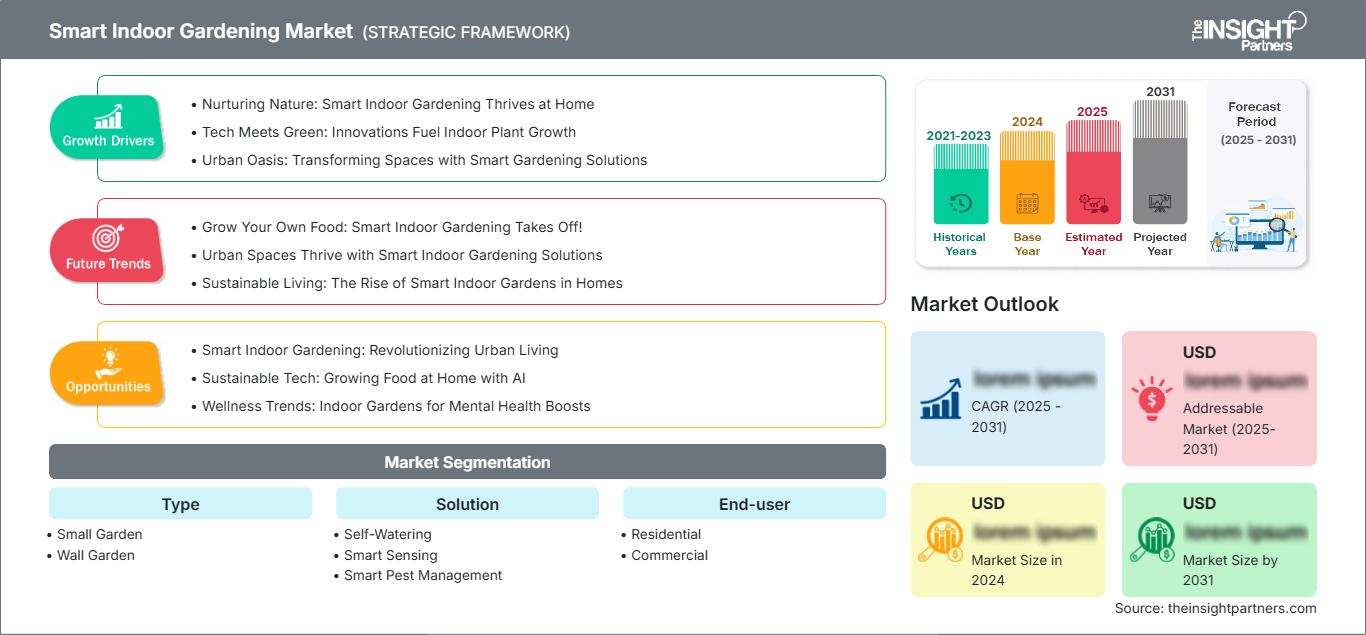
Smart Indoor Gardening Market: Strategic Insights
Regional Insights
North America Smart Indoor Gardening Market
North America dominated the global Smart Indoor Gardening Market share with a substantial share of 34–38% in 2025. The market in the area is an established one and is advantageous owing to the adoption of smart home technology, high expenditure on home automation products by consumers, and a culture of home gardening and sustainable living. The United States is still at the forefront because of the high level of adoption of smart gardening technologies, social media influencers' promotion of "technology meets nature" concepts, and good distribution through both e-commerce and home improvement portals. Canada ranks second because of the urban center adoption of smart gardening technologies because of cold weather growing conditions. Growth is further supported by rising health consciousness and wellness trends, positioning North America for a steady CAGR of 12–14% through 2034.
U.S. Smart Indoor Gardening Market
As the leading market globally, the Smart Indoor Gardening Market forecast indicates that the U.S. accounted for a commanding 85–92% share of the North American region in 2025. The market's growth, projected at a CAGR of 12–14%, is underpinned by strong consumer spending on connected lifestyle products and the presence of key technology players. Application trends are shifting towards compact countertop systems that integrate seamlessly with voice assistants and smart home networks, offering users remote monitoring and control capabilities. Companies like Click and Grow, AeroFarms, and Rise Gardens are aggressively expanding their product portfolios to cater to the growing urban consumer base seeking convenient, aesthetically pleasing gardening solutions for small apartments and modern homes, supporting a positive market forecast through 2034.
Europe Smart Indoor Gardening Market
Europe held a significant 28–32% share of the global market in 2025, with a projected CAGR of 11–13%. Sustainability laws, consumer awareness about organic food production, and a thriving retail environment characterize the region. Germany tops the list in Europe, followed by the United Kingdom and France. In the case of the United Kingdom, the demand is being propelled by growing consumer interest in home gardening and wellness. The strategy for Germany involves creating smart garden systems that fit into the sustainability and renewable energy environment of the country. Italy and Spain are also experiencing good growth rates due to their rich gardening traditions and eco-friendly home solutions. The regulatory and cultural landscape in Europe, emphasizing organic, pesticide-free food, is a primary catalyst, pushing manufacturers to innovate sustainable, resource-efficient gardening solutions and shaping key Smart Indoor Gardening Market trends across the region.
APAC Smart Indoor Gardening Market
The Asia Pacific region, accounting for 20–24% of the global share in 2025, is projected to be the fastest-growing market with a CAGR of 16–18%. China emerges as the dominant country owing to huge investments in urban agriculture programs and favorable government policies regarding vertical farming and indoor farming practices. Japan and South Korea follow close behind owing to the presence of a sophisticated electronics industry, high rates of smartphone ownership and consumer interest in smart homes. India emerges as the new hub owing to the growth of the middle-class population, urbanization trends and various initiatives such as 'Digital India' that spur the need for efficient gardening methods. Australia is no stranger to the growth trend owing to climate change issues.
Middle East & Africa Smart Indoor Gardening Market
The MEA region is poised for significant growth at a CAGR of 13–15% during 2026–2034. The reason why Saudi Arabia is leading the market is because of the mega-projects and the difficulty of growing in extreme climate conditions, which make controlled environment agriculture mandatory for food security. Following Saudi Arabia is the United Arab Emirates, whose biggest city, Dubai, is marketing itself as the place of choice for Smart cities and promoting urban farming projects. The growth market in Africa is South Africa, because of its need for water-efficient food production and the need for indoor cultivation solutions.
Segmentation Analysis
Type
The Type segment forms the core of the Smart Indoor Gardening Market, encompassing physical configurations designed to fit diverse living spaces. This segment is projected to grow at a CAGR of 13–15% during 2026–2034. The market is witnessing a shift towards modular, space-saving designs that cater to urban consumers with limited floor space. Key drivers include the rising demand for aesthetically pleasing indoor greenery, the need for efficient use of residential spaces, and the increasing popularity of biophilic interior design trends that incorporate natural elements for mental well-being.
- Small Garden: This is the dominant product category, widely adopted for its compact footprint, countertop installation, and suitability for growing herbs, leafy greens, and microgreens in kitchens and apartments.
- Wall Garden: An emerging type that enables vertical cultivation, maximizing space utilization while serving as a decorative interior element, appealing to consumers with limited countertop space.
Solution
The Solution segment distinguishes the market based on the specific technology or automation feature offered, with each solution addressing unique consumer pain points. This segment is projected to register a CAGR of 14–16% during the forecast period. While self-watering systems have historically led the market, there is a notable surge in AI-driven smart sensing and smart pest management solutions, driven by the imperative to reduce manual intervention and ensure optimal plant health. The convergence of these solutions into integrated platforms is enhancing user convenience and expanding the addressable market.
- Self-Watering: This is the foundational solution, widely adopted for its ability to automate irrigation and ensure plants receive consistent moisture without user intervention, reducing the risk of over- or under-watering .
- Smart Sensing: An advanced solution that enables real-time monitoring of environmental parameters such as light intensity, temperature, humidity, and nutrient levels, allowing users to optimize plant growth conditions .
- Smart Pest Management: An emerging and high-growth solution, integrating sensors and AI-powered systems to detect and manage pest issues automatically, reducing the need for chemical interventions .
- Smart Lighting: This solution is critical for enabling year-round cultivation, utilizing energy-efficient LED technology to provide optimal light spectra for photosynthesis independent of natural sunlight .
End-user
The End-user segmentation categorizes the Smart Indoor Gardening Market based on the application environment, with each sector exhibiting distinct requirements and adoption drivers. This segment is projected to grow at a CAGR of 13–15% during the forecast period. While residential applications have historically led the market, there is a notable surge in commercial and institutional adoption, driven by the imperative to enhance indoor environments and promote wellness in workplaces, educational institutions, and hospitality settings.
- Residential: This segment is the primary driver of the market, dominated by a focus on home-grown fresh produce, aesthetic greenery, and the wellness benefits of indoor plants for urban consumers .
- Commercial: Offices, restaurants, hotels, and educational institutions are increasingly adopting smart gardening systems to improve indoor air quality, provide fresh produce for culinary use, and support employee and student wellness programs .
Opportunity Snapshot
| End-user Segment | Revenue Contribution | Trend Tag | Adoption Stage |
| Residential | High | Urban Farming | Scaling |
| Commercial | Medium | Wellness Enhancement | Emerging |
Smart Indoor Gardening Market Growth Drivers and Impact Analysis
Rapid Urbanization and Space Limitations
The accelerating global shift toward urban living is a primary driver for the Smart Indoor Gardening Market. With increasing urbanization and a decrease in living spaces, consumers are experiencing the problem of a lack of space for gardens. Smart indoor gardening provides the perfect remedy, allowing individuals to cultivate their vegetables, herbs, and flowers indoors without much hassle. Such solutions are especially relevant for urban millennials and Gen Z who are focused on sustainability and customization of activities through technology. With more than 55% of the world’s population currently residing in urban regions and further increase expected, the need for such solutions will only increase.
Increasing Consumer Focus on Health, Wellness, and Sustainability
With increasing concern about the safety of the food that we consume, its health benefits, and the environment, there is an increasing need for smart indoor garden technology. More and more people are aware of the source of their food and the chemicals that go into it, and hence the trend towards growing organic herbs, vegetables, and microgreens at home without using any chemical substances is on the rise. Indoor gardens are in line with the well-being trend since studies have shown that having plants indoors helps in improving air quality and reducing stress.
Technological Advancements in AI, IoT, and Energy Efficiency
Continuous progress in artificial intelligence, IoT connectivity, and energy-efficient LED technologies is reshaping the Smart Indoor Gardening Market. AI and machine learning are being integrated into smart gardening systems to create intelligent solutions that adapt to plant growth patterns, analyzing sensor data on moisture levels, light exposure, and nutrients to automatically adjust watering schedules, lighting, and nutrient delivery. IoT-enabled connectivity and mobile app integration allow users to monitor and control their gardens remotely, providing insights into plant health and growth patterns. Additionally, advancements in energy-efficient LED lighting and water-saving technologies are making these systems more sustainable and cost-effective, appealing to eco-conscious consumers and expanding the addressable market.
Smart Indoor Gardening Market Future Trends
AI-Powered Personalization and Predictive Plant Care
The next generation of smart indoor gardening systems will leverage advanced artificial intelligence and machine learning to offer personalized, predictive plant care. These intelligent systems will analyze vast datasets from integrated sensors to learn individual plant species requirements, anticipate growth patterns, and proactively adjust environmental conditions. AI algorithms will be capable of detecting early signs of stress, disease, or nutrient deficiencies through computer vision and automated pest detection systems, alerting users and suggesting corrective actions before issues escalate. This predictive capability will transform gardening from a reactive to a proactive activity, ensuring optimal plant health and yields while minimizing manual intervention. The cumulative impact is a more autonomous indoor gardening ecosystem that supports remote diagnostics, adaptive care, and continuous learning, making the technology accessible to consumers with no gardening experience.
Subscription-Based Models and Ecosystem Expansion
The Smart Indoor Gardening Market is witnessing a shift from one-time hardware sales to recurring revenue models centered on consumable subscriptions and data-driven services. Key players are developing subscription-based platforms that offer seed pods, nutrients, and professional plant care recommendations on a regular basis. This trend enhances customer lifetime value, fosters brand loyalty, and ensures users remain engaged within proprietary ecosystems. Additionally, smart indoor gardening systems are increasingly being integrated into broader smart home networks, enabling voice-controlled operation and seamless connectivity with platforms like Amazon Alexa and Google Assistant. This ecosystem expansion positions indoor gardening as a core component of the connected, intelligent home, driving sustained engagement and opening new opportunities for cross-industry partnerships with technology and retail players.
Smart Indoor Gardening Market Opportunities
Expansion into Commercial and Institutional Applications
A significant opportunity lies in expanding Smart Indoor Gardening solutions beyond residential settings into commercial and institutional environments. Offices, restaurants, hotels, schools, and healthcare facilities are increasingly adopting smart gardening systems to improve indoor environments, support wellness programs, and provide fresh produce. Studies suggest indoor planting can reduce cortisol levels in patients, while corporate wellness initiatives are leveraging smart gardens to enhance employee well-being and productivity. Companies that offer scalable, modular solutions tailored to commercial applications, including vertical gardens for restaurants, educational planting pods for schools, and therapeutic gardens for healthcare settings, will be well-positioned to capture significant market share. Strategic partnerships with commercial real estate developers, hospitality groups, and educational institutions represent a key growth avenue for market players seeking to diversify beyond residential markets.
Integration of Sustainable and Circular Economy Practices
There is a growing opportunity for market players to differentiate through sustainability and circular economy principles. Consumers are increasingly seeking eco-friendly solutions that minimize environmental impact, including energy-efficient LED lighting, water-saving hydroponic and aeroponic systems, biodegradable growth mediums, and recyclable packaging. Companies that integrate sustainable manufacturing practices, offer reusable nutrient solutions, and implement take-back programs for consumable pods will appeal to environmentally conscious consumers. Additionally, the development of solar-powered or low-power smart gardening systems aligns with the growing demand for off-grid, sustainable living solutions. This sustainability focus not only meets regulatory and consumer expectations but also provides a competitive advantage in an increasingly crowded market.
Recent Developments
- August 2026: LetPot, a smart gardening brand dedicated to making home growing simpler through technology, announced that it will exhibit at IFA Berlin 2026, taking place September 4-8 at Messe Berlin, Germany. Located at IFA Next, Hall 25, Booth H25_155, LetPot will present its portfolio of intelligent growing solutions and unveil an all-new product for the first time. The launch represents the next step in LetPot's mission to make fresh, homegrown herbs, vegetables and greenery easier to enjoy in everyday life.
- January 2025: At CES, Plantaform, a pioneer in sustainable indoor gardening, proudly announces the launch of its Smart Indoor Garden in the United States. Named CES Innovation Awards Best of Innovation in the Food and AgTech category for 2025, Plantaform is the world's first smart indoor garden that uses fog to grow plants.
- December 2025: As interest in "plant butlers" and "plant tech" continues to grow among people who care for houseplants, IoT-based smart garden specialist ALLUONE Co., Ltd. has announced the launch of its 2025 home smart garden, "Watering Garden," offering a new lifestyle that brings nature closer to urban living. The product is equipped with IoT-based environmental control technology that enables real-time monitoring of plant growth conditions, while automatically managing watering, lighting, and ventilation to create an optimal growth environment.
Frequently Asked Questions

- Comprehensive Market Sizing and Forecast Analysis
- Detailed Segmentation Analysis
- In-Depth Market Dynamics Assessment
- Regional and Country-Level Insights
- Competitive Landscape and Company Benchmarking
- Strategic Business Intelligence
Recent Reports
Testimonials

The Insight Partners' SCADA System Market report is comprehensive, with valuable insights on current trends and future forecasts. The team was highly professional, responsive, and supportive throughout. We are very satisfied and highly recommend their services.
RAN KEDEM Partner, Reali Technologies LTDs
I requested a report on a very specific software market and the team produced the report in a few days. The information was very relevant and well presented. I then requested some changes and additions to the report. The team was again very responsive and I got the final report in less than a week.
JEAN-HERVE JENN Chairman, Future Analytica
We worked with The Insight Partners for an important market study and forecast. They gave us clear insights into opportunities and risks, which helped shape our plans. Their research was easy to use and based on solid data. It helped us make smart, confident decisions. We highly recommend them.
PIYUSH NAGPAL Sr. Vice President, High Beam Global
The Insight Partners delivered insightful, well-structured market research with strong domain expertise. Their team was professional and responsive throughout. The user-friendly website made accessing industry reports seamless. We highly recommend them for reliable, high-quality research services
YUKIHIKO ADACHI CEO, Deep Blue, LLC.
This is the first time I have purchased a market report from The Insight Partners.While I was unsure at first, I visited their web site and felt more comfortable to take the risk and purchase a market report.I am completely satisfied with the quality of the report and customer service. I had several questions and comments with the initial report, but after a couple of dialogs over email with their analyst I believe I have a report that I can use as input to our strategic planning process.Thank you so much for taking the extra time and making this a positive experience.I will definitely recommend your service to others and you will be my first call when we need further market data.
JOHN SUZUKI President and Chief Executive Officer, Board Director, BK Technologies
I wish to appreciate your support and the professionalism you displayed in the course of attending to my request for information regarding to infectious disease IVD market in Nigeria. I appreciate your patience, your guidance, and the fact that you were willing to offer a discount, which eventually made it possible for us to close a deal. I look forward to engaging The Insight Partners in the future, all thanks to the impression you have created in me as a result of this first encounter.
DR CHIJIOKE ONYIA MANAGING DIRECTOR, PineCrest Healthcare Ltd.Reason to Buy
- Informed Decision-Making
- Understanding Market Dynamics
- Competitive Analysis
- Identifying Emerging Markets
- Customer Insights
- Market Forecasts
- Risk Mitigation
- Boosting Operational Efficiency
- Strategic Planning
- Investment Justification
- Tracking Industry Innovations
- Aligning with Regulatory Trends





 Get Free Sample for