
Smart Locker Market Growth, Demand & Size by 2034
Smart Locker Market Size and Forecasts (2021–2034), Global and Regional Share, Trends, and Growth Opportunity Analysis Report Coverage : By Offering (Hardware, Software, Services), Technology (RFID, Electronic, Mobile, Biometric, Cloud), Deployment (Indoor, Outdoor), Application (Day Lockers/Generic Lockers, Parcel Lockers, Staff/Employee Lockers, Asset Management Lockers), End-Use Industry (Commercial, Office, Logistics, Residential, Education, Other)
- Status : Data Released
- Report Code : TIPRE00039632
- Category : Electronics and Semiconductor
- No. of Pages : 150
- Available Report Formats :


- Last update date : August 17, 2026


2025 Market Size
US$ 2.64 Bn
Base year value
2034 Forecast
US$ 6.29 Bn
Projected by 2034
CAGR 2026-2034
10.13 %
Growth rate
Addressable Market
US$ 39.70 Bn
(2026-2034)
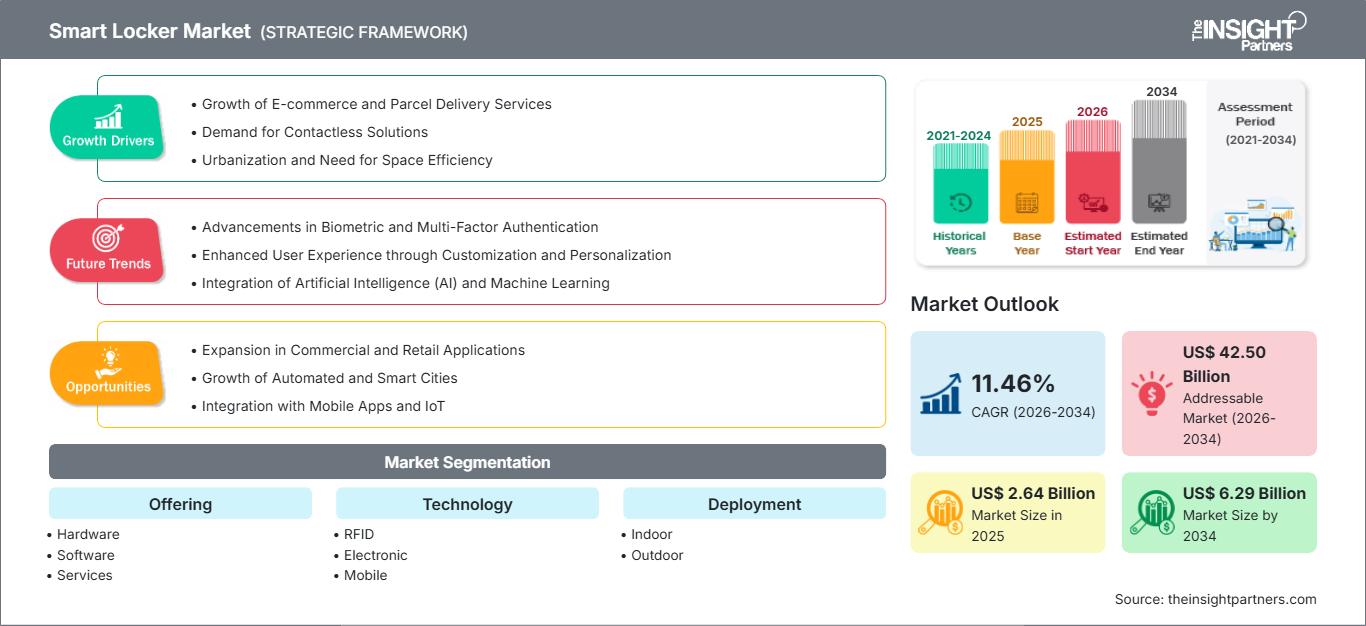
The Smart Locker market was valued at US$ 2.64 billion in 2025 and is expected to reach US$ 6.29 billion by 2034; it is estimated to record a CAGR of 10.13% during 2026-2034.
Smart Locker Market Assessment and Insights
- North America – Estimated to hold 34-38% of the global market in 2025, growing at a CAGR of 10-12% from 2026 to 2034. This is driven by corporate workplace locker adoption, USPS public kiosk expansion, and a high density of multifamily housing units requiring parcel management solutions .
- US – Represents approximately 85-90% of the North American market in 2025, with a CAGR of 10-12% projected through 2034. The US market is reinforced by over 15,000 installed locker banks and a 39% year-over-year increase in corporate take-up as employers seek to reduce mailroom labor costs .
- Europe – Accounts for 24-28% of the global market in 2025, growing at an estimated CAGR of 11-13% during the forecast period. The UK and Germany are leading countries, anchored by InPost's 61,196 machines and the company's GBP 600 million investment to expand UK density to 20,000 units by 2029 .
- Asia Pacific – Captures 28-32% of global market share in 2025 and is projected to grow at the fastest CAGR of 13-15% through 2034. China leads the region with the world's largest parcel volumes and manufacturers like Zhilai Tech .
- Largest Segment – The hardware offering segment represented the largest share with 65-70% of the market in 2025, growing at a CAGR of 10-12% through 2034, driven by essential physical components like cabinets, electronic locks, and sensors .
- High Growth Segment – The software offering segment is projected as the fastest-growing with a CAGR of 13-15% from 2026 to 2034, due to the shift toward platform fees, cloud dashboards, and recurring revenue models for remote monitoring and API integration .
- Key companies analyzed in detail – Ricoh Group, Quadient SA, TZ Limited, Pitney Bowes Inc., KEBA Group AG, Cleveron, LUXER Corporation, ParcelPort Solutions, Inc., Hollman, Inc., and Shenzhen Zhilai Sci-Tech Co.
Source: The Insight Partners' analysis based on proprietary research, government publications, company annual reports, investor presentations, industry databases, and expert interviews.
The Smart Locker Market has evolved from simple, manually operated metal cabinets to intelligent, networked IoT systems that offer secure, data-driven asset management and fulfillment capabilities . Modern smart lockers integrate modular hardware, edge and cloud software stacks, cameras, sensors, and analytics to support diverse use cases ranging from automated returns to asset tracking . The market is witnessing a shift from capital-expenditure purchasing toward locker-as-a-service subscriptions, with vendors such as KEBA charging USD 15-40 per unit per month for cloud dashboards . Software platforms are becoming critical differentiators, enabling remote diagnostics, analytics, and integration with WMS/TMS systems .
Emerging geographies, particularly in Southeast Asia and India, present significant growth opportunities as e-commerce volumes continue to rise and smart city mandates encourage locker density targets, supporting expansion in Smart Locker Market share. Municipal curb-use regulations in cities like New York, San Francisco, and London are creating dedicated micro-fulfillment zones for locker banks, accelerating outdoor locker adoption. Investment in temperature-controlled lockers for pharmacy and grocery applications is also creating new revenue streams across the market.
Smart Locker Market Report Scope
| Report Attribute | Details |
|---|---|
| Market size in 2025 | US$ 2.64 Billion |
| Market Size by 2034 | US$ 6.29 Billion |
| Global CAGR (2026 - 2034) | 10.13% |
| Historical Data | 2021-2024 |
| Forecast period | 2026-2034 |
Smart Locker Market Analysis
The Smart Locker Market is fundamentally driven by the rapid growth in e-commerce parcel volumes and the rising costs associated with last-mile delivery operations. As parcel shipments continue to increase globally, logistics providers and retailers are seeking efficient alternatives to traditional home delivery models. Smart lockers help reduce failed delivery attempts, improve operational efficiency, and provide consumers with flexible pickup options. These benefits have made unattended locker networks an attractive solution for carriers, retailers, and property operators seeking to optimize delivery economics.
The market value chain encompasses metal cabinet manufacturers, electronic lock and sensor suppliers, software developers, connectivity providers, and system integrators. These participants work together to deliver scalable and secure locker solutions for residential, commercial, retail, and public-sector applications. Urbanization and changing delivery patterns are also influencing market development, with municipalities increasingly allocating space for micro-fulfillment infrastructure to support growing e-commerce activity and reduce congestion associated with delivery vehicles.
The competitive landscape includes established players such as Quadient SA, Pitney Bowes Inc., and KEBA Group AG, alongside specialized companies including Cleveron and LUXER Corporation. Market participants are focusing on product innovation, geographic expansion, and strategic partnerships to strengthen their competitive positions. Increasing demand for connected locker networks is encouraging providers to enhance software capabilities, user experience, security features, and operational flexibility.
Investment trends are increasingly centered on software and service offerings, with vendors developing cloud-native management platforms, mobile access credentials, and open APIs that transform traditional hardware sales into recurring revenue opportunities. Strategic positioning now depends heavily on ecosystem integration, enabling seamless connectivity with identity management systems, e-commerce platforms, property management software, and workplace tools. The market is also witnessing innovation in ruggedized outdoor locker systems capable of operating in harsh environmental conditions, expanding deployment opportunities across transportation hubs, public spaces, and outdoor delivery networks.
● REPORT CUSTOMIZATION
Tailor This Report To Align With Your Specific Business Requirements
This report can be customized to align precisely with your business objectives, scope, and target markets. Customization options include tailored segmentation, geography, competitive analysis, and strategic insights to support informed decision-making.
Customize This Report →WHAT YOU CAN ADJUST
- ● Segmentations
- ● Geography
- ● Competitive Analysis
- ● Language Preferences
Smart Locker Market: Strategic Insights
Regional Insights
North America Smart Locker Market
North America is estimated to hold 34–38% of the global Smart Locker Market in 2025, with a projected CAGR of 10–12% through 2034. The United States serves as the primary engine, with over 15,000 installed locker banks clustered in coastal and Sun Belt metros with dense multifamily stock. Corporate take-up climbed 39% year-over-year as employers sought to cut mailroom labor costs, while the USPS layered 3,200 public outdoor units onto rural post offices to maintain service levels where staffed counters were scaled back. Major players, including Ricoh Group and Pitney Bowes, are strengthening their positions through cloud-based platforms and partnerships with property developers. The region benefits from high feature bundles and average selling prices, reinforcing its dominant market position, according to the Smart Locker Market report.
U.S. Smart Locker Market
The Smart Locker Market forecast indicates that the U.S. market accounts for approximately 85–90% of North American revenue, with a CAGR of 10–12% projected through 2034. The widespread adoption of multifamily package lockers and growing corporate interest are key drivers. The United States Postal Service placed 3,200 public kiosks across 45 states by late 2025 to extend rural service windows. Security audits have also enhanced vendor value, with SOC 2 Type II-certified vendors achieving 15–20% pricing uplifts in enterprise bids. Investments in refrigerated variants for pharmacy and grocery applications are capturing premium niches in the U.S. market, supporting a positive market forecast through the assessment period.
Europe Smart Locker Market
Europe is estimated to capture 24–28% of the global market in 2025, growing at a CAGR of 11–13% through 2034, reflecting key Smart Locker Market trends. The UK and Germany are leading countries, anchored by InPost's 61,196 machines. The company processed 1.36 billion parcels in 2025 and has earmarked GBP 600 million (USD 723 million) to raise UK density to 20,000 units by 2029. France counts more than 10,000 kiosks, with 68% of urban shoppers expressing a preference for parcel machines. Europe's active base of workplace locker SaaS vendors and open-network parcel station platforms is supporting the region's robust growth trajectory.
APAC Smart Locker Market
The Smart Locker Market in Asia Pacific accounted for 28–32% of global market share in 2025 and is projected to grow at the fastest CAGR of 13–15% through 2034. China leads the region with the world's largest parcel volumes, taking up about 30% of the global revenue market, with manufacturers like Zhilai Tech and operators like Hive Box holding a roughly 19% regional share with more than 200,000 installations. India's market crossed 43.2 million parcels in 2025, driven by 36% annual e-commerce growth. Japan and South Korea prioritize transit-hub locker banks that authenticate with national ID cards, pushing usage rates well above global norms.
Middle East & Africa Smart Locker Market
The Smart Locker Market in the MEA region exhibits emerging adoption of smart locker technologies, with a projected CAGR of 10–12% through 2034. Saudi Arabia takes the lead in regional investment due to the country’s Vision 2030, which will see the establishment of smart cities, leading to demand for parcel locker systems. The use of smart city lockers in the UAE is enhanced through the country’s Smart City Program, with 1,200 systems being in operation and registering an annual growth rate of 22%. South Africa has emerged as the biggest market in Africa, with increasing adoption and availability in retail stores.
Segmentation Analysis
Offering
The offering segment comprises Hardware, Software, and Services. Hardware dominates the segment, accounting for 65-70% of the market in 2025, driven by essential components like cabinets, electronic locks, sensors, display modules, and communication modules. The segment is growing at a CAGR of 10-12%. Software, however, represents the fastest-growing sub-segment with a CAGR of 13-15%, reflecting the shift toward platform fees, cloud dashboards, and recurring revenue models for remote diagnostics and API integration.
- Hardware – Forms the physical backbone of the system, including cabinets, electronic locks, sensors, and display modules. Constant innovation in rugged outdoor-rated components is driving durability and performance.
- Software – Enables centralized management, remote monitoring, and integration with e-commerce platforms. Rapidly growing due to demand for analytics, APIs, and mobile applications that support workflow orchestration.
- Services – Includes consulting, installation, and maintenance services. The market is seeing a transition toward service-based offerings, including locker-as-a-service subscriptions.
Technology
The technology segment includes RFID, Electronic, Mobile, Biometric, and Cloud technologies. Cloud-based deployment is gaining prominence, driven by demand for scalable, remote management capabilities. Mobile credentialing and biometric authentication are emerging as high-growth areas as organizations seek secure, convenient access methods. The adoption of open API frameworks and RESTful interfaces is accelerating integration with enterprise systems.
- RFID – Enables automated identification and tracking of parcels and assets. Widely used in logistics and supply chain applications.
- Electronic – Includes PIN-based and keypad access systems. Mature technology with a strong presence in workplace and institutional environments.
- Mobile – Fastest-growing authentication method, enabling smartphone-based access via QR codes and mobile apps. Driven by consumer preference for contactless convenience.
- Biometric – Emerging authentication method using fingerprints or facial recognition. Growing in enterprise and government applications requiring high security.
- Cloud – Enables remote management, analytics, and software updates. Cloud-native platforms are becoming the industry standard for locker management.
Deployment
The deployment segment includes Indoor and Outdoor lockers. Indoor lockers dominate, accounting for 58-62% of the market in 2025, with a CAGR of 10-12%, driven by installations in climate-controlled lobbies and back-of-house retail corridors. Outdoor lockers represent the fastest-growing segment with a CAGR of 12-14%, propelled by municipal curb-space policies and the USPS rollout of public kiosks across rural locations.
- Indoor – Installed in climate-controlled environments such as lobbies, mailrooms, and retail corridors. Offers lower hardware costs and longer equipment lifespan.
- Outdoor – Fastest-growing segment, driven by municipal policies encouraging curbside locker placement. Must survive -40°C to +60°C swings and meet IP-65 electronics standards .
Application
The application category comprises Day Lockers/Generic Lockers, Parcel Lockers, Staff/Employee Lockers, and Asset Management Lockers. The Parcel Lockers constitute the biggest application category, being spurred by the rise in e-commerce and the improvement in last-mile deliveries. The Staff/Employee Lockers constitute the fastest-growing application category, owing to hybrid workplaces and hot desking.
- Day Lockers/Generic Lockers – Used for temporary storage in gyms, entertainment venues, and public spaces. Demand is stable, with innovation focused on mobile access and contactless operation.
- Parcel Lockers – Largest application segment, driven by e-commerce parcel growth and last-mile delivery optimization. Enables secure, contactless pickup and returns.
- Staff/Employee Lockers – Fastest-growing application, reshaped by hybrid work and hot-desking. Enables flexible storage and asset management in corporate environments .
- Asset Management Lockers – Expanding in IT, healthcare, warehousing, and public safety. Provides accountability and auditability for valuable equipment and supplies .
Opportunity Snapshot
| Application | Revenue Contribution | Trend Tag | Adoption Stage |
| Day Lockers/Generic Lockers | Low | General Storage | Mature |
| Parcel Lockers | High | Last-Mile Optimization | Scaling |
| Staff/Employee Lockers | High | Hybrid Work | Scaling |
| Asset Management Lockers | Medium | Asset Accountability | Emerging |
Smart Locker Market Growth Drivers and Impact Analysis
E-Commerce Parcel Volume Growth and Failed Delivery Reduction
The sustained growth of global e-commerce is a primary driver for the smart locker market. Parcel volume grew to 121 billion parcels per year in 2025, registering a 10% increase and straining the warehouse system, with failed delivery costs soaring up to USD 7 per attempt. Locker banks streamline hundreds of delivery points into one, reducing fuel and labor expenses and decreasing congestion in cities. The network effect in action is exemplified by China, where the adoption rate of lockers is around 15-20% in tier-1 cities, meaning distribution of the fixed costs over a huge volume, allowing lower transaction costs than the attended delivery system.
Urban Congestion and Municipal Curb-Use Regulations
Increasing municipal regulations on curb access by delivery trucks is also promoting the adoption of outdoor lockers. New York, San Francisco, and London are some of the cities that have micro-fulfillment sites in order to avoid double-parking infractions, which accounted for 23% of urban traffic delays in 2024. Truck carriers without locker access are being penalized over $115 per violation in New York City, whereas companies that provide outdoor banks are guaranteed priority curb space. Public-private partnerships are also speeding up the adoption of outdoor lockers, as in Portland's microhubs initiative of 2025 and the Urban Freight Lab from the U.S. Department of Transportation.
Workplace Transformation and Hybrid Work Models
The trend towards hybrid work and flexible office spaces is increasing the demand for staff or employee lockers. Corporate adoption of locker systems in workplaces increased by 39% year-over-year as companies were looking to reduce labor costs in the mailrooms as well as implement hot desking strategies. Software solutions help create dynamic assignments, assign roles, and integrate lockers with workplace solutions, making the use of lockers an integral part of the employee experience. Companies that provide cloud-based solutions for lockers that can be monitored remotely have an opportunity to capture this demand.
Smart Locker Market Future Trends
Cloud-Native Platforms and Locker-as-a-Service Models
The market is moving toward cloud-native platforms and locker-as-a-service (LaaS) subscriptions that lower upfront capital barriers. Software attach rates climbed from 38% in 2023 to 52% in 2025, with vendors charging USD 15-40 per unit per month for cloud dashboards that monitor door strikes, predict maintenance, and expose RESTful APIs for warehouse system integration . LaaS models are reshaping procurement, allowing organizations to deploy lockers as an operating expense rather than a capital investment. This trend is expected to accelerate as vendors emphasize integration, scalability, and measurable KPIs over proof-of-concept novelty.
Temperature-Controlled and Refrigerated Locker Expansion
Temperature-controlled smart lockers are emerging as a key growth area, driven by demand for secure storage of pharmaceuticals, fresh food, and perishable items. The global temperature-controlled smart locker market was valued at USD 837.6 million in 2026 and is expected to reach USD 1706.1 million by 2034, growing at a CAGR of 9.3% . Refrigerated variants are capturing premium niches in pharmacy and grocery, where controlled temperature ranges of 2-8°C are mandatory for vaccine or fresh-food chains of custody . Integration with cold-chain logistics and the growth of grocery e-commerce are driving innovation in climate-controlled locker designs.
Smart Locker Market Opportunities
Smart City Infrastructure and Public Locker Networks
There is tremendous potential in the use of smart lockers within smart city infrastructures. There is increasing governmental support for locker systems that help save miles traveled and enhance the efficiency of last-mile deliveries. The examples of public investment partnerships, such as Urban Freight Lab from the U.S. Department of Transportation and microhub from Portland, provide good opportunities for long-term deployment. Vendors who can overcome permitting issues, design outdoor lockers, and connect with the the government transportation system would be best suited to capture these government contracts. 3,200 public kiosks were deployed by the United States Postal Service within 45 states by late 2025.
Healthcare and Pharmaceutical Cold-Chain Logistics
Smart lockers can be considered an important opportunity within the healthcare industry, especially in cold-chain logistics that relate to pharmaceutical products, biologics and vaccines. Temperature-controlled lockers are currently used in pharmacies, hospitals, and community distribution centers to make sure temperature-sensitive medications remain intact. IATCL stresses the importance of these smart lockers to maintain the integrity of the product when stored and transported. With the increasing demand for biologics and specialty medicines, there will be more healthcare-related locker deployments, providing an important opportunity for certified vendors.
Recent Developments
- July 2026: The U.S. Postal Service launches smart locker service for local transactions. USPS has launched an offering that enables sellers to drop off packages at parcel lockers for customer pickup. The service allows buyers and sellers who are local to each other to deliver and retrieve items purchased through an online marketplace without having to meet in person.
- November 2025: Autope Payment Solutions Ltd, a fintech company enabling seamless digital payments and services for India's mass transit ecosystems, announced the successful launch of its innovative Smart Locker system across 12 Mumbai Metro One stations. The first of its kind initiative, in collaboration with Mumbai Metro One, introduces over 996 state-of-the-art digital lockers to the city's transit network.
- April 2023: Winsoft announces the new addition in their suite of financial products. They have successfully launched SmartLocker product. It is a Comprehensive Cloud-Enabled locker management solution for banks. It simplifies end-to-end lockers operations for banks and its customers. It streamlines processes around managing locker requests, allocations, access, key issuance, blocking and unblocking, rent payments, and more.
Frequently Asked Questions

- Comprehensive Market Sizing and Forecast Analysis
- Detailed Segmentation Analysis
- In-Depth Market Dynamics Assessment
- Regional and Country-Level Insights
- Competitive Landscape and Company Benchmarking
- Strategic Business Intelligence
Recent Reports
Testimonials

The Insight Partners provided valuable market intelligence that supported our global go-to-market strategy. Their team was professional, responsive, and attentive to our feedback, providing thoughtful analysis and helpful methodological clarifications throughout the project.
Junmo Kim Chief Financial Officer (CFO), Enertech Co., Ltd.
The Insight Partners' SCADA System Market report is comprehensive, with valuable insights on current trends and future forecasts. The team was highly professional, responsive, and supportive throughout. We are very satisfied and highly recommend their services.
RAN KEDEM Partner, Reali Technologies LTDs
I requested a report on a very specific software market and the team produced the report in a few days. The information was very relevant and well presented. I then requested some changes and additions to the report. The team was again very responsive and I got the final report in less than a week.
JEAN-HERVE JENN Chairman, Future Analytica
We worked with The Insight Partners for an important market study and forecast. They gave us clear insights into opportunities and risks, which helped shape our plans. Their research was easy to use and based on solid data. It helped us make smart, confident decisions. We highly recommend them.
PIYUSH NAGPAL Sr. Vice President, High Beam Global
The Insight Partners delivered insightful, well-structured market research with strong domain expertise. Their team was professional and responsive throughout. The user-friendly website made accessing industry reports seamless. We highly recommend them for reliable, high-quality research services
YUKIHIKO ADACHI CEO, Deep Blue, LLC.
This is the first time I have purchased a market report from The Insight Partners.While I was unsure at first, I visited their web site and felt more comfortable to take the risk and purchase a market report.I am completely satisfied with the quality of the report and customer service. I had several questions and comments with the initial report, but after a couple of dialogs over email with their analyst I believe I have a report that I can use as input to our strategic planning process.Thank you so much for taking the extra time and making this a positive experience.I will definitely recommend your service to others and you will be my first call when we need further market data.
JOHN SUZUKI President and Chief Executive Officer, Board Director, BK Technologies
I wish to appreciate your support and the professionalism you displayed in the course of attending to my request for information regarding to infectious disease IVD market in Nigeria. I appreciate your patience, your guidance, and the fact that you were willing to offer a discount, which eventually made it possible for us to close a deal. I look forward to engaging The Insight Partners in the future, all thanks to the impression you have created in me as a result of this first encounter.
DR CHIJIOKE ONYIA MANAGING DIRECTOR, PineCrest Healthcare Ltd.Reason to Buy
- Informed Decision-Making
- Understanding Market Dynamics
- Competitive Analysis
- Identifying Emerging Markets
- Customer Insights
- Market Forecasts
- Risk Mitigation
- Boosting Operational Efficiency
- Strategic Planning
- Investment Justification
- Tracking Industry Innovations
- Aligning with Regulatory Trends





 Get Free Sample for